steering wheel Peugeot 308 2016 Owner's Manual
[x] Cancel search | Manufacturer: PEUGEOT, Model Year: 2016, Model line: 308, Model: Peugeot 308 2016Pages: 398, PDF Size: 9.38 MB
Page 7 of 398
5
308_en_Chap00b_vue-ensemble_ed02-2015
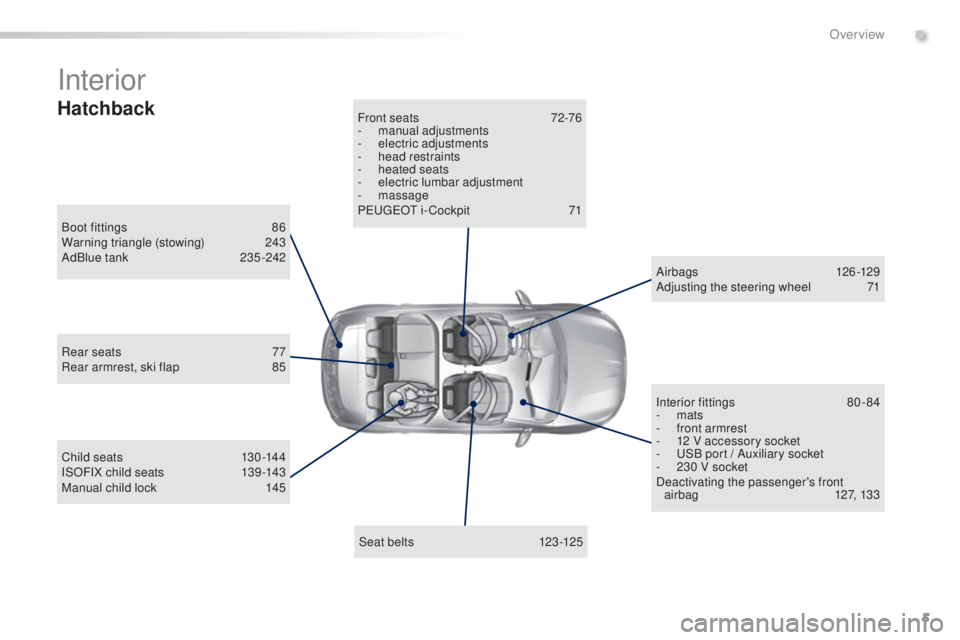
Interior
Boot fittings 86
W arning triangle (stowing) 24 3
AdBlue tank
23
5 -242
Seat belts
123
-125
Front seats
72
-76
-
man
ual adjustments
-
ele
ctric adjustments
-
he
ad restraints
-
heat
ed seats
-
el
ectric lumbar adjustment
-
m
assage
P
eu
ge
Ot i
- Cockpit
71
C
hild seats
13
0 -144
ISOFIX child seats
13
9 -143
Manual child lock
145 A
ir bags
12
6 -129
Adjusting the steering wheel
71
I
nterior fittings
80
-84
-
m
ats
-
fr
ont armrest
-
12 V a
ccessory socket
-
u
SB p
ort / Auxiliary socket
-
23
0 V socket
Deactivating the passenger's front airbag
12
7, 133
Rear seats
77
R
ear armrest, ski flap
85
Hatchback
.
Over view
Page 8 of 398
6
308_en_Chap00b_vue-ensemble_ed02-2015
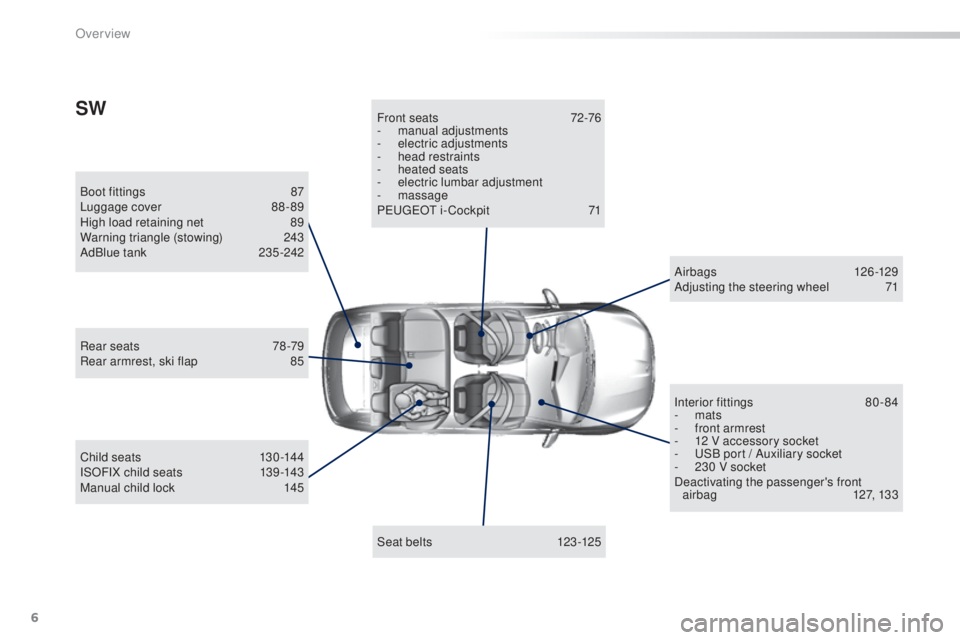
Boot fittings 87
Lu ggage cover 88 - 89
High load retaining net
89
W
arning triangle (stowing)
24
3
AdBlue tank
23
5 -242
Seat belts
123
-125
Front seats
72
-76
-
man
ual adjustments
-
ele
ctric adjustments
-
he
ad restraints
-
heat
ed seats
- el ectric lumbar adjustment
- m assage
P
eu
ge
Ot i
- Cockpit
71
C
hild seats
13
0 -144
ISOFIX child seats
13
9 -143
Manual child lock
145 A
ir bags
12
6 -129
Adjusting the steering wheel
71
I
nterior fittings
80
-84
-
m
ats
-
fr
ont armrest
-
12 V a
ccessory socket
-
u
SB p
ort / Auxiliary socket
-
23
0 V socket
Deactivating the passenger's front airbag
12
7, 133
Rear seats
78
-79
Rear armrest, ski flap
85
SW
Over view
Page 36 of 398
34
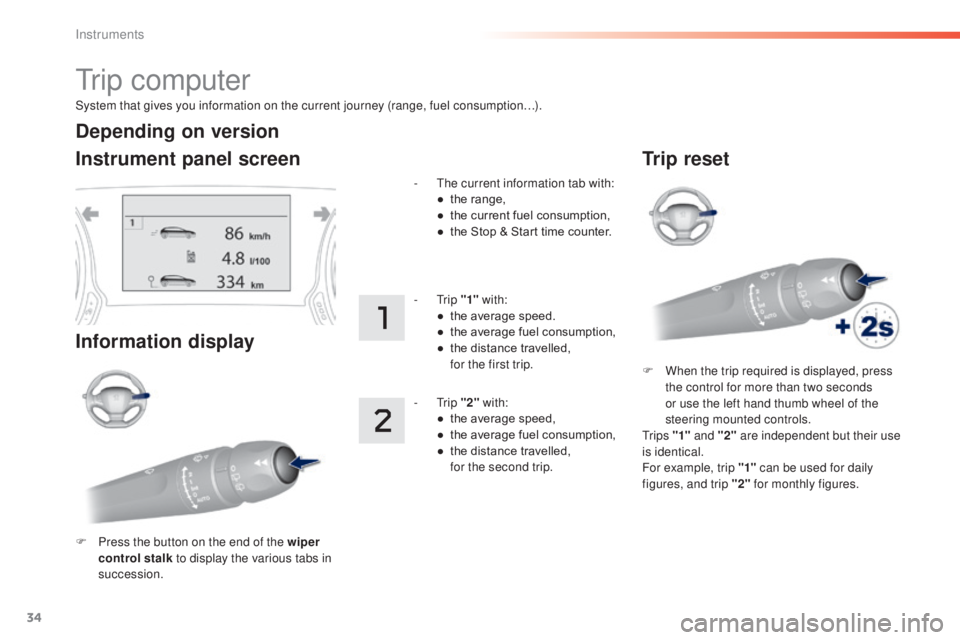
System that gives you information on the current journey (range, fuel consumption…).
tr i p c o m p u t e r
Instrument panel screen
Information display
F Press the button on the end of the wiper
control stalk to display the various tabs in
succession. -
t
he c
urrent information tab with:
●
th
e range,
●
th
e current fuel consumption,
●
th
e Stop & Start time counter.
-
tri
p
"1" with:
●
th
e average speed.
●
th
e average fuel consumption,
●
th
e distance travelled,
fo
r the first trip.
-
tri
p
"2" with:
●
th
e average speed,
●
th
e average fuel consumption,
●
th
e distance travelled,
fo
r the second trip.
Depending on version
Trip reset
F When the trip required is displayed, press
the control for more than two seconds
or use the left hand thumb wheel of the
steering mounted controls.
tr
i p s "1" and "2" are independent but their use
is identical.
For example, trip "1" can be used for daily
figures, and trip "2" for monthly figures.
Instruments
Page 42 of 398
40
ButtonCorresponding function Comments
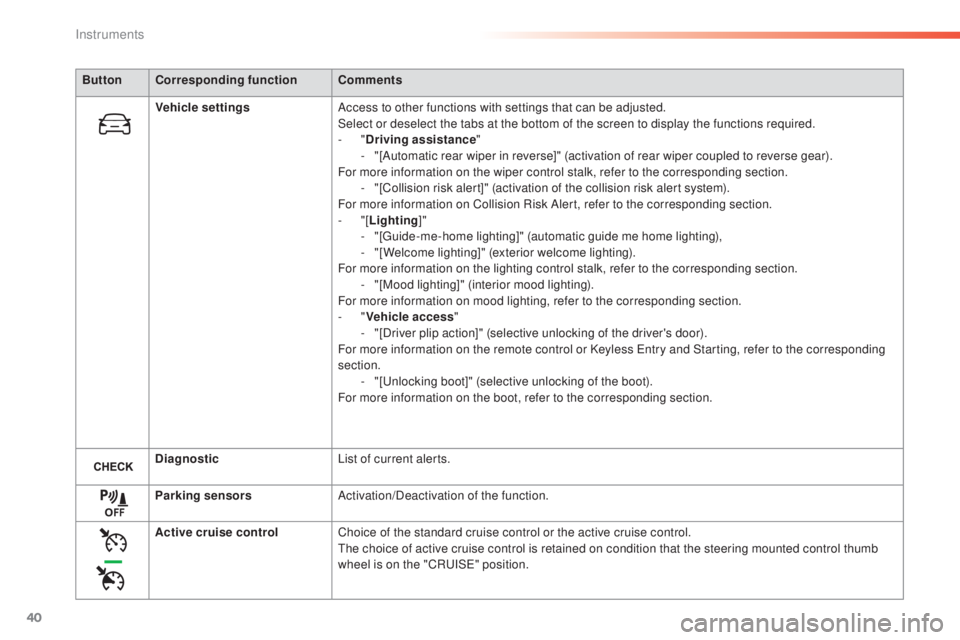
Vehicle settings Access to other functions with settings that can be adjusted.
Select or deselect the tabs at the bottom of the screen to display the functions required.
-
"D
riving assistance"
-
"[
Automatic rear wiper in reverse]" (activation of rear wiper coupled to reverse gear).
For more information on the wiper control stalk, refer to the corresponding section. -
"[
Collision risk alert]" (activation of the collision risk alert system).
For more information on Collision Risk Alert, refer to the corresponding section.
-
"
[Lighting ]"
-
"[gui
de-me-home lighting]" (automatic guide me home lighting),
-
"[
Welcome lighting]" (exterior welcome lighting).
For more information on the lighting control stalk, refer to the corresponding section. -
"[
Mood lighting]" (interior mood lighting).
For more information on mood lighting, refer to the corresponding section.
-
" V
ehicle access"
-
"[
Driver plip action]" (selective unlocking of the driver's door).
For more information on the remote control or Keyless
ent
ry and Starting, refer to the corresponding
section. -
"[unl
ocking boot]" (selective unlocking of the boot).
For more information on the boot, refer to the corresponding section.
Diagnostic List of current alerts.
Parking sensors Activation/Deactivation of the function.
Active cruise control Choice of the standard cruise control or the active cruise control.
the c
hoice of active cruise control is retained on condition that the steering mounted control thumb
wheel is on the "CR
uISe" p
osition.
Instruments
Page 73 of 398
71
308_en_Chap03_ergonomie-et-confort_ed02-2015
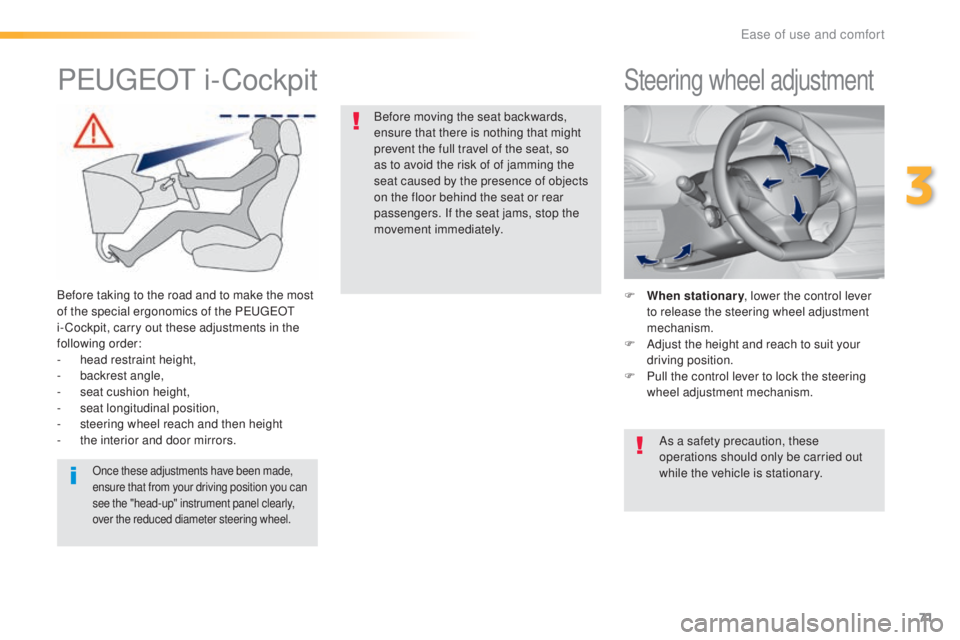
Steering wheel adjustment
F When stationary, l ower the control lever
to release the steering wheel adjustment
mechanism.
F
Ad
just the height and reach to suit your
driving position.
F
Pu
ll the control lever to lock the steering
wheel adjustment mechanism.
As a safety precaution, these
operations should only be carried out
while the vehicle is stationary.
PeugeOt i- Cockpit
Before taking to the road and to make the most
of the special ergonomics of the Peu
geOt
i
- Cockpit, carry out these adjustments in the
following order:
-
head
restraint height,
-
ba
ckrest angle,
-
seat
cushion height,
-
se
at longitudinal position,
-
st
eering wheel reach and then height
-
th
e interior and door mirrors.
Once these adjustments have been made,
ensure that from your driving position you can
see the "head-up" instrument panel clearly,
over the reduced diameter steering wheel.
Before moving the seat backwards,
ensure that there is nothing that might
prevent the full travel of the seat, so
as to avoid the risk of of jamming the
seat caused by the presence of objects
on the floor behind the seat or rear
passengers. If the seat jams, stop the
movement immediately.
3
ease of use and comfort
Page 122 of 398
120
308_en_Chap05_securite_ed02-2015
electronic Stability Control (eSC) incorporating
the following systems:
-
an
ti-lock braking system (ABS) and the
electronic brake force distribution (
eBF
D),
-
emer
gency braking assistance (
eBA)
,
-
wh
eel anti-slip regulation (ASR) or traction
control,
-
dy
namic stability control (DSC).
electronic stability control (eSC )
Definitions
Anti-lock braking system (ABS)
and electronic brake force
distribution (EBFD)
this system improves the stability and
m anoeuvrability of your vehicle when braking
and contributes towards improved control in
corners, in particular on poor or slippery road
surfaces.
the A
BS prevents wheel lock in the event of
emergency braking.
the e
lectronic brake force distribution system
manages the braking pressure wheel by wheel.
Emergency braking assistance
(EBA)
In an emergency, this system enables you to
reach the optimum braking pressure more
quickly and therefore reduce the stopping
distance.
It is triggered according to the speed at which
the brake pedal is pressed.
thi
s is felt by a
reduction in the resistance of the pedal and an
increase in the effectiveness of the braking.
Anti-slip regulation (ASR)
the ASR system (also known as tra ction
Control) optimises traction in order to limit
wheel slip by acting on the brakes of the driving
wheels and on the engine. It also improves
the directional stability of the vehicle on
acceleration.
Dynamic stability control (DSC)
If there is a difference between the path
followed by the vehicle and that required by
the driver, the DSC monitors each wheel and
automatically acts on the brake of one or more
wheels and on the engine to return the vehicle
to the required path, within the limits of the laws
of physics.
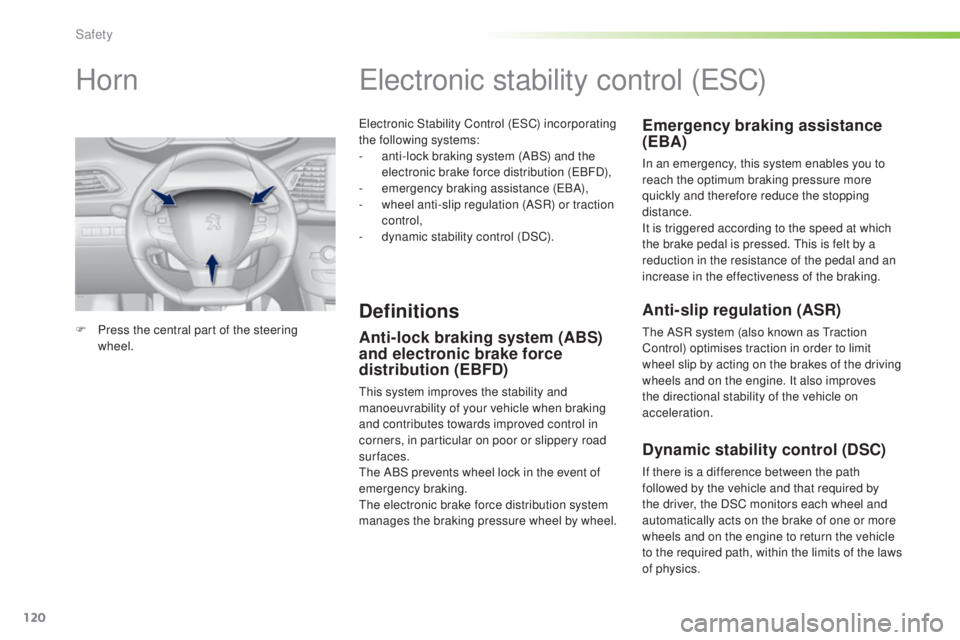
Horn
F Press the central part of the steering
w heel.
Safety
Page 128 of 398
126
308_en_Chap05_securite_ed02-2015
Airbags
System designed to contribute towards
improving the safety of the occupants (with
the exception of the rear centre passenger)
in the event of violent collisions.
the a
irbags
supplement the action of the force-limiting
seat belts (with the exception of the centre rear
passenger).
If a collision occurs, the electronic detectors
record and analyse the front and side impacts
sustained in the impact detection zones:
-
in t
he case of a serious impact, the airbags
are deployed instantly and contribute
towards better protection of the occupants
of the vehicle (with the exception of the
rear centre passenger); immediately after
the impact, the airbags deflate rapidly so
that they do not hinder visibility or the exit
of the occupants,
-
in t
he case of a minor or rear impact or in
certain roll-over conditions, the airbags
may not be deployed; the seat belt
alone contributes towards ensuring your
protection in these situations.
The airbags do not operate when the
ignition is switched off.
thi
s equipment will only deploy once.
If a second impact occurs (during the
same or a subsequent accident), the
airbag will not be deployed again. Deployment of one or more of the
airbags is accompanied by a slight
emission of smoke and a noise, due
to the activation of the pyrotechnic
cartridge incorporated in the system.
thi
s smoke is not harmful, but sensitive
individuals may experience slight
irritation.
the n
oise of detonation related to the
deployment of one or more airbags may
result in a slight loss of hearing for a
short time.
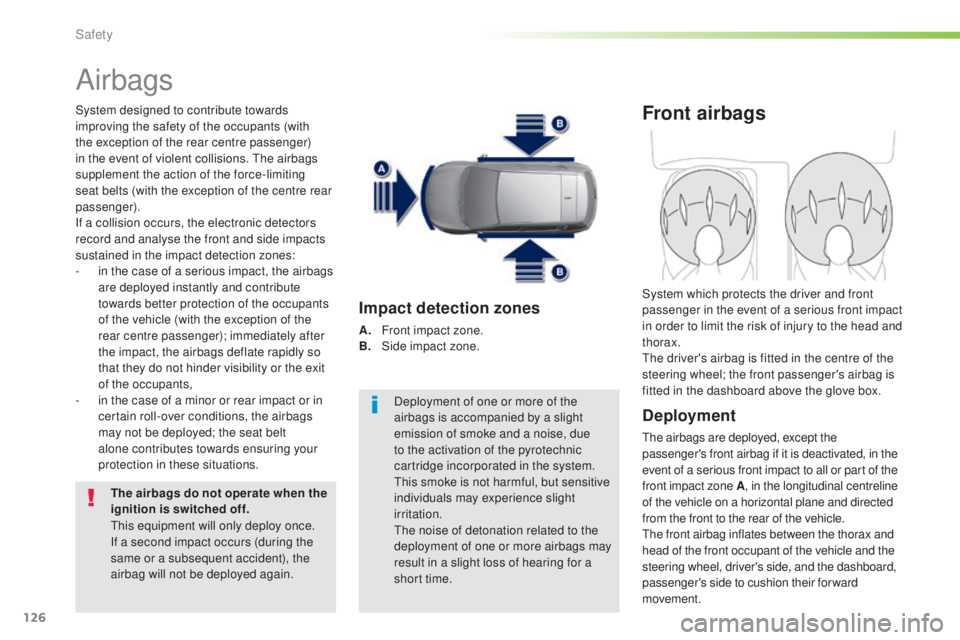
Impact detection zones
A. Front impact zone.
B. Si de impact zone.
Front airbags
Deployment
the airbags are deployed, except the
p assenger's front airbag if it is deactivated, in the
event of a serious front impact to all or part of the
front impact zone A , in the longitudinal centreline
of the vehicle on a horizontal plane and directed
from the front to the rear of the vehicle.
the f
ront airbag inflates between the thorax and
head of the front occupant of the vehicle and the
steering wheel, driver's side, and the dashboard,
passenger's side to cushion their forward
movement. System which protects the driver and front
passenger in the event of a serious front impact
in order to limit the risk of injury to the head and
thorax.
the d
river's airbag is fitted in the centre of the
steering wheel; the front passenger's airbag is
fitted in the dashboard above the glove box.
Safety
Page 131 of 398
129
308_en_Chap05_securite_ed02-2015
Sit in a normal upright position.
Wear a correctly adjusted seat belt.
Do not leave anything between the
occupants and the airbags (a child, pet,
object...), nor fix or attach anything close to
the inflation trajectory of the airbags; this
could cause injuries during their deployment.
Never modify the original definition of your
vehicle, particularly in the area directly
around the airbags.
After an accident or if the vehicle has been
stolen or broken into, have the airbag
systems checked.
All work on the airbag system must be
carried out by a P
eu
ge
Ot d
ealer or a
qualified workshop.
eve
n if all of the precautions mentioned
are observed, a risk of injury or of minor
burns to the head, chest or arms when an
airbag is deployed cannot be ruled out.
the
b
ag inflates almost instantly (within a few
milliseconds) then deflates within the same
time discharging the hot gas via openings
provided for this purpose.Lateral airbags
use only approved covers on the seats,
c ompatible with the deployment the lateral
airbags. For information on the range of seat
covers suitable for your vehicle, you can
contact a P
eu
ge
Ot d
ealer.
Refer to the "Accessories" section.
Do not fix or attach anything to the seat
backs (clothing...).
thi
s could cause injury
to the chest or arms if the lateral airbag is
deployed.
Do not sit with the upper part of the body any
nearer to the door than necessary.
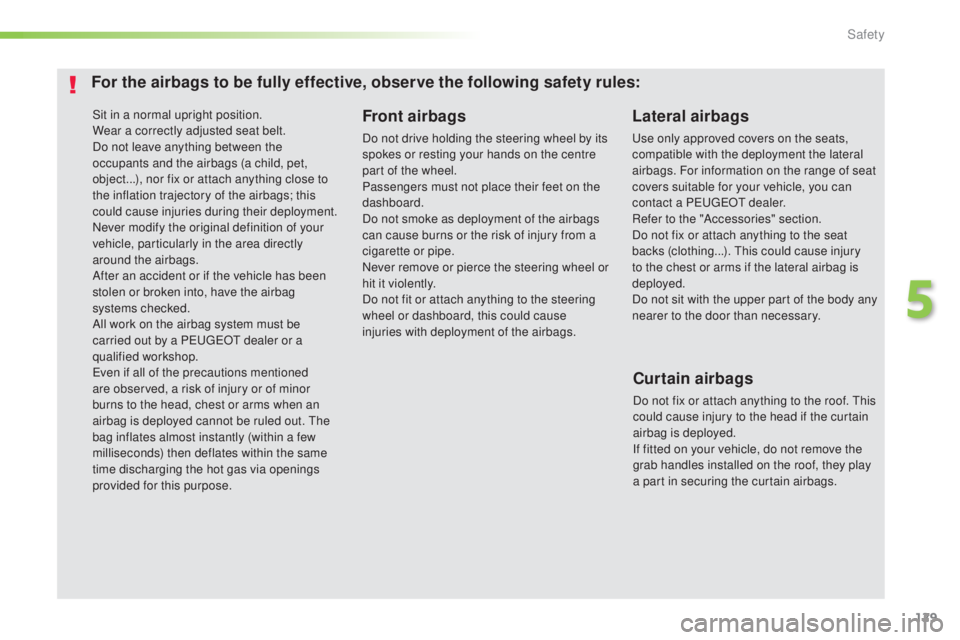
Front airbags
Do not drive holding the steering wheel by its
spokes or resting your hands on the centre
part of the wheel.
Passengers must not place their feet on the
dashboard.
Do not smoke as deployment of the airbags
can cause burns or the risk of injury from a
cigarette or pipe.
Never remove or pierce the steering wheel or
hit it violently.
Do not fit or attach anything to the steering
wheel or dashboard, this could cause
injuries with deployment of the airbags.
For the airbags to be fully effective, observe the following safety rules:
Curtain airbags
Do not fix or attach anything to the roof. this
could cause injury to the head if the curtain
airbag is deployed.
If fitted on your vehicle, do not remove the
grab handles installed on the roof, they play
a part in securing the curtain airbags.
5
Safety
Page 150 of 398
148
308_en_Chap06_conduite_ed02-2015
Starting-switching off the engine, remote control
Put the gear lever into neutral.
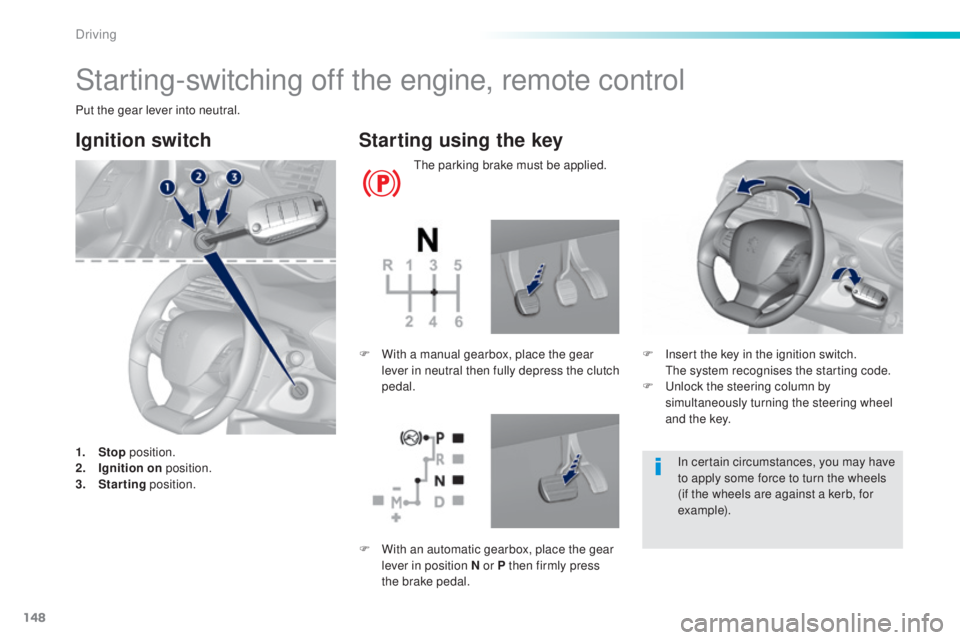
Ignition switch
1. Stop p osition.
2. Ig nition on position.
3.
Sta
rting position.
Starting using the key
the parking brake must be applied.
F
In
sert the key in the ignition switch.
the s
ystem recognises the starting code.
F
u
nl
ock the steering column by
simultaneously turning the steering wheel
and the key.
F
Wi
th a manual gearbox, place the gear
lever in neutral then fully depress the clutch
pedal.
In certain circumstances, you may have
to apply some force to turn the wheels
(if the wheels are against a kerb, for
example).
F
Wi
th an automatic gearbox, place the gear
lever in position N or P then firmly press
the brake pedal.
Driving
Page 152 of 398
150
308_en_Chap06_conduite_ed02-2015
Avoid attaching heavy objects to the
key, which would weigh down on its
blade in the ignition switch and could
cause a malfunction.
Switching off the engine leads to a loss
of braking assistance.
Key left in the "Ignition on"
position
If the key has been left in the ignition switch
at position 2 (Ignition on)
, the ignition will
be switched off automatically after one hour.
to sw
itch the ignition back on, turn the
key to position 1 (Stop) , then back to
position
2 (
Ignition on) .
Never leave the engine running in
an enclosed area without adequate
ventilation: internal combustion
engines emit toxic exhaust gases,
such as carbon monoxide. Danger of
intoxication and death.
In very severe wintry conditions
(temperatures below -23°C), to ensure
the correct operation and the durability
of the mechanical components of your
vehicle, the engine and gearbox, it is
necessary to leave the engine running
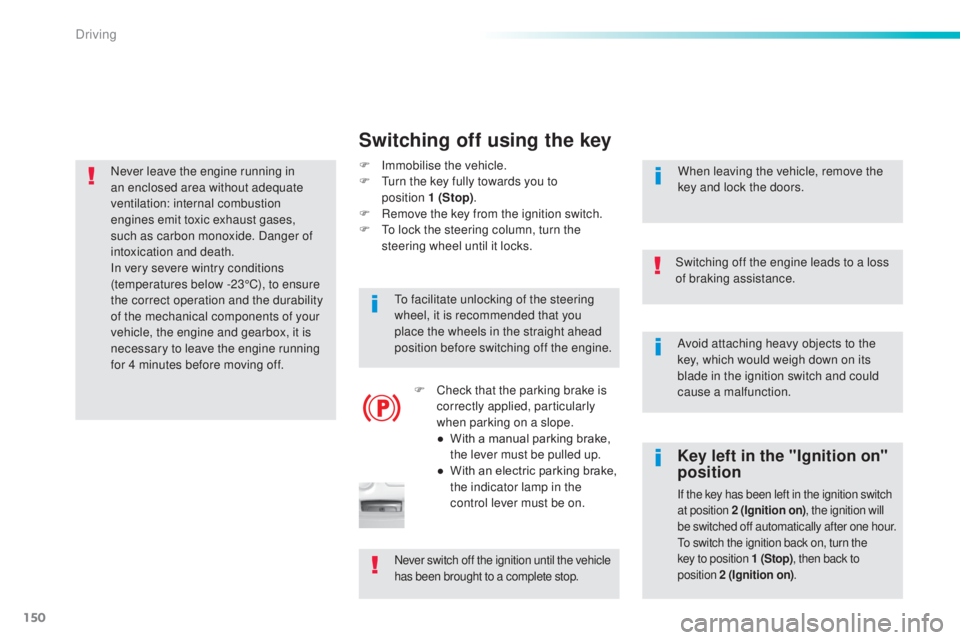
for 4 minutes before moving off. F Immo
bilise the vehicle.
F tur n the key fully towards you to
position
1 (
Stop).
F
Re
move the key from the ignition switch.
F
t
o lo
ck the steering column, turn the
steering wheel until it locks.
Switching off using the key
to facilitate unlocking of the steering
w heel, it is recommended that you
place the wheels in the straight ahead
position before switching off the engine.
F
Ch
eck that the parking brake is
correctly applied, particularly
when parking on a slope.
●
Wi
th a manual parking brake,
the lever must be pulled up.
●
Wi
th an electric parking brake,
the indicator lamp in the
control lever must be on. When leaving the vehicle, remove the
key and lock the doors.
Never switch off the ignition until the vehicle
has been brought to a complete stop.
Driving