ECO mode PEUGEOT 308 2016 Owner's Guide
[x] Cancel search | Manufacturer: PEUGEOT, Model Year: 2016, Model line: 308, Model: Peugeot 308 2016Pages: 344, PDF Size: 12.23 MB
Page 171 of 344
169
3008_en_Chap08_conduite_ed01-2015
The Stop & Start system puts the engine
t emporarily into standby - STOP mode - during
stops in the traffic (red lights, traffic jams, or
other...). The engine restarts automatically -
START mode - as soon as you want to move
off. The restart takes place instantly, quickly
and silently.
Per fect for urban use, the Stop & Start system
reduces fuel consumption and exhaust
emissions as well as the noise level when
stationary.
Operation
Going into engine STOP mode
The "ECO" indicator lamp comes
on in the instrument panel and the
engine goes into standby:
-
w
ith a manual gearbox , at speeds below
12 mph (20 km/h), or vehicle stationary
with PureTech 130 and BlueHDi 115 and
120 versions, when you put the gear lever
into neutral and release the clutch pedal,
-
w
ith an electronic gearbox , at speeds
below 5 mph (8 km/h), when you press the
brake pedal or you put the gear selector in
position N ,
Special cases: STOP mode not
available
STOP mode is not invoked when:
- t
he driver's door is open,
-
t
he driver's seat belt is not fastened,
-
t
he vehicle has not exceeded 6 mph
(10
km/h) since the last engine start using
t h e key,
-
t
he vehicle is stopped on a steep slope
(up
or down),
-
t
he electric parking brake is applied or
being applied,
-
t
he engine is needed to maintain a
comfortable temperature in the passenger
compartment,
-
d
emisting is active,
-
s
ome special conditions (battery charge,
engine temperature, braking assistance,
ambient temperature...) where the engine is
needed to assure control of a system.
In this case, the "ECO" indicator
lamp flashes for a few seconds then
goes off.
This operation is perfectly normal.
Never refuel with the engine in STOP
mode; you must switch off the ignition
with the key. For your comfort, during parking
maoeuvres, STOP mode is not
available for a few seconds after
coming out of reverse gear.
STOP mode does not affect the
functionality of the vehicle, such as for
example, braking, power steering...
Stop & Start
- with an automatic gearbox, vehicle
stationary, when you press the brake pedal
or you put the gear selector in position N .
If your vehicle is fitted with the system,
a time counter calculates the sum of the
periods in STOP mode during a journey.
It rests itself to zero every time the
ignition is switched on with the key.
8
Driving
Page 172 of 344
170
3008_en_Chap08_conduite_ed01-2015
Going into engine START mode
The "ECO" indicator lamp goes off
and the engine starts automatically:
-
w
ith a manual gearbox , when you fully
depress the clutch pedal,
-
w
ith an electronic gearbox:
●
g
ear selector in position A or M , when
you release the brake pedal,
●
o
r gear selector in position N and brake
pedal released, when you put the gear
selector in position A or M ,
●
o
r when you engage reverse gear.
-
w
ith an automatic gearbox:
●
g
ear selector in position D or M , when
you release the brake pedal,
●
o
r gear selector in position N and brake
pedal released, when you put the gear
selector in position D or M ,
●
o
r when you engage reverse gear. In this case the "ECO" indicator lamp
flashes for a few seconds, then goes
of f.
Special cases: START invoked
automatically
START mode is invoked automatically when:
- t he driver's door is open,
-
t
he driver's seat belt is not fastened,
-
t
he speed of the vehicle exceeds 18 mph
(25 km/h) with a manual gearbox, 2
mph
(3
km/h) with the PureTech 130 and
BlueHDi 115 and 120 versions, 7 mph
(11
km/h) with an electronic gearbox or
2
mph (3 km/h) with an automatic gearbox,
-
t
he electric parking brake is being applied,
-
s
ome special conditions (battery charge,
engine temperature, braking assistance,
ambient temperature...) where the engine is
needed for control of a system.
This operation is perfectly normal.
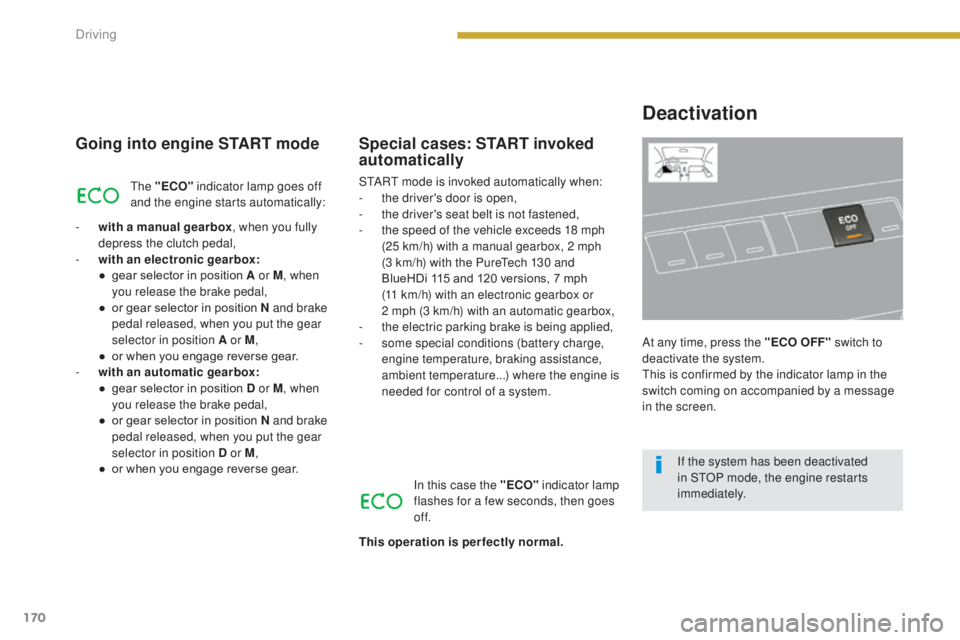
Deactivation
At any time, press the "ECO OFF" switch to
d eactivate the system.
This is confirmed by the indicator lamp in the
switch coming on accompanied by a message
in the screen.
If the system has been deactivated
in STOP mode, the engine restarts
immediately.
Driving
Page 173 of 344
171
3008_en_Chap08_conduite_ed01-2015
Reactivation
Press the "ECO OFF" switch again.
The system is active again; this is confirmed by
the indicator lamp in the switch going off and a
message in the screen.
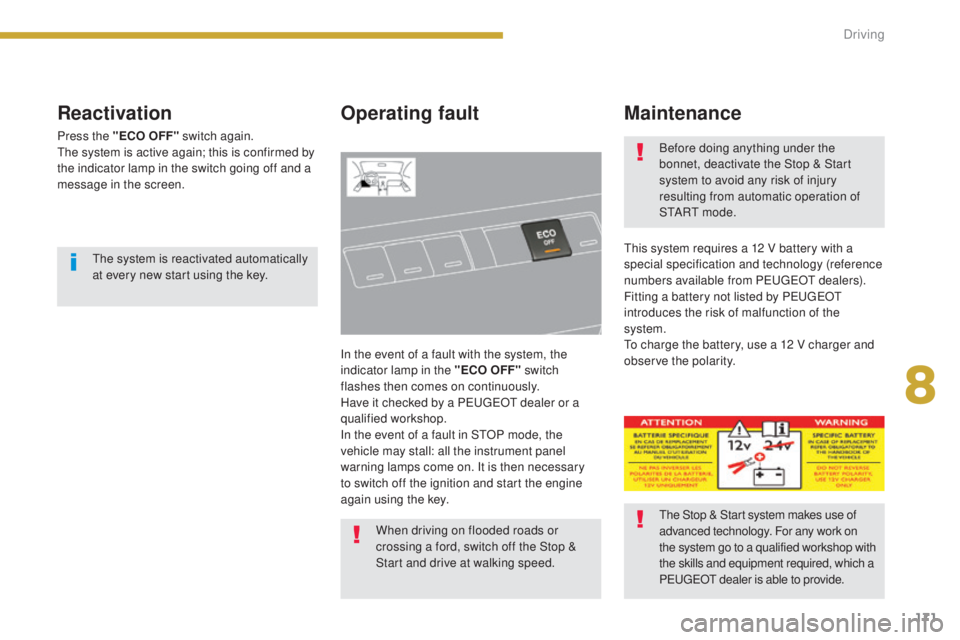
Operating fault
In the event of a fault with the system, the
indicator lamp in the "ECO OFF" switch
flashes then comes on continuously.
Have it checked by a PEUGEOT dealer or a
qualified workshop.
In the event of a fault in STOP mode, the
vehicle may stall: all the instrument panel
warning lamps come on. It is then necessary
to switch off the ignition and start the engine
again using the key.
Maintenance
This system requires a 12 V battery with a
special specification and technology (reference
numbers available from PEUGEOT dealers).
Fitting a battery not listed by PEUGEOT
introduces the risk of malfunction of the
system.
To charge the battery, use a 12 V charger and
observe the polarity.
The system is reactivated automatically
at every new start using the key.
The Stop & Start system makes use of
advanced technology. For any work on
the system go to a qualified workshop with
the skills and equipment required, which a
PEUGEOT dealer is able to provide. Before doing anything under the
bonnet, deactivate the Stop & Start
system to avoid any risk of injury
resulting from automatic operation of
S TA R T m o d e .
When driving on flooded roads or
crossing a ford, switch off the Stop &
Start and drive at walking speed.
8
Driving
Page 219 of 344
217
3008_en_Chap10_infos-pratiques_ed01-2015
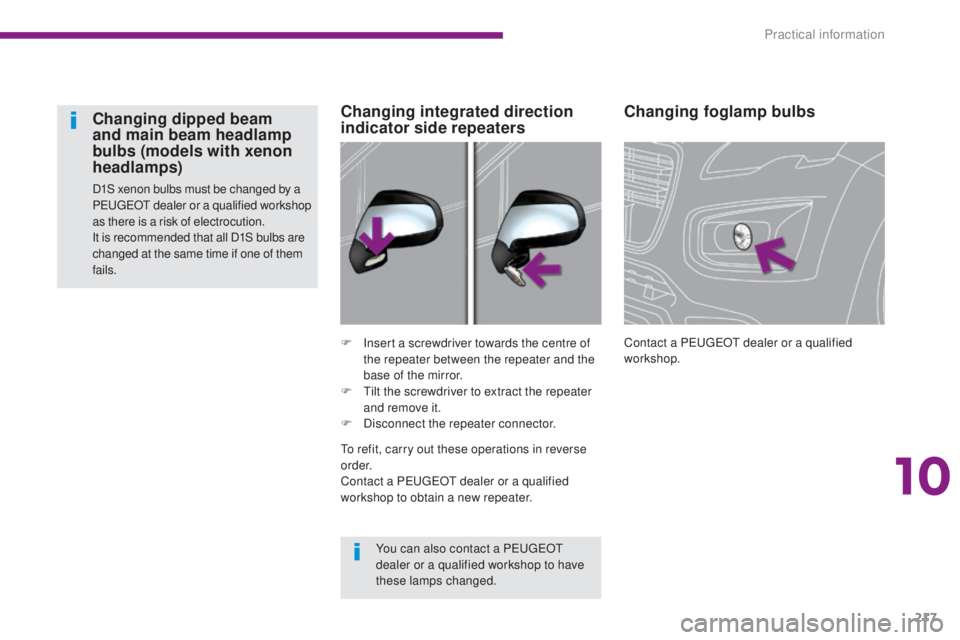
Changing foglamp bulbs
Contact a PEUGEOT dealer or a qualified
workshop.
F
I
nsert a screwdriver towards the centre of
the repeater between the repeater and the
base of the mirror.
F
T
ilt the screwdriver to extract the repeater
and remove it.
F
D
isconnect the repeater connector.
Changing integrated direction
indicator side repeaters
Changing dipped beam
and main beam headlamp
bulbs (models with xenon
headlamps)
D1S xenon bulbs must be changed by a
PEUGEOT dealer or a qualified workshop
as there is a risk of electrocution.
It is recommended that all D1S bulbs are
changed at the same time if one of them
fails.
You can also contact a PEUGEOT
dealer or a qualified workshop to have
these lamps changed.
To refit, carry out these operations in reverse
o r d e r.
Contact a PEUGEOT dealer or a qualified
workshop to obtain a new repeater.
10
Practical information
Page 233 of 344
231
3008_en_Chap10_infos-pratiques_ed01-2015
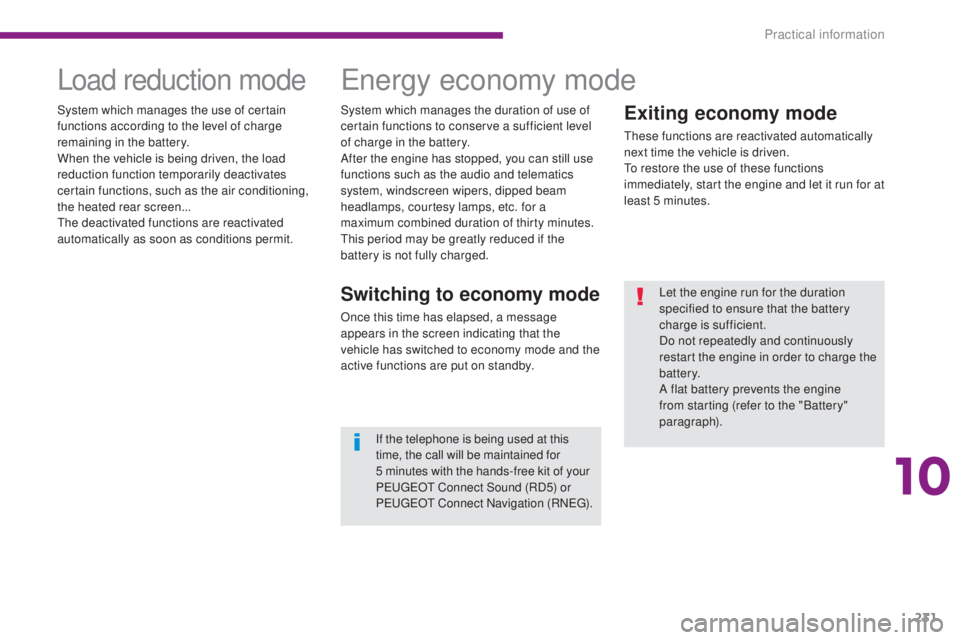
Exiting economy mode
These functions are reactivated automatically
next time the vehicle is driven.
To restore the use of these functions
immediately, start the engine and let it run for at
least 5 minutes.
Load reduction modeEnergy economy mode
Switching to economy mode
Once this time has elapsed, a message
appears in the screen indicating that the
vehicle has switched to economy mode and the
active functions are put on standby.Let the engine run for the duration
specified to ensure that the battery
charge is sufficient.
Do not repeatedly and continuously
restart the engine in order to charge the
battery.
A flat battery prevents the engine
from starting (refer to the "Battery"
paragraph).
If the telephone is being used at this
time, the call will be maintained for
5
minutes with the hands-free kit of your
P
E
UGEOT
C
onnect Sound (RD5) or
P
E
UGEOT
C
onnect Navigation (RNEG).
System which manages the duration of use of
certain functions to conserve a sufficient level
of charge in the battery.
After the engine has stopped, you can still use
functions such as the audio and telematics
system,
windscreen wipers, dipped beam
headlamps, courtesy lamps, etc. for a
maximum combined duration of thirty minutes.
This period may be greatly reduced if the
battery is not fully charged.
System which manages the use of certain
functions according to the level of charge
remaining in the battery.
When the vehicle is being driven, the load
reduction function temporarily deactivates
certain functions, such as the air conditioning,
the heated rear screen...
The deactivated functions are reactivated
automatically as soon as conditions permit.
10
Practical information
Page 245 of 344
243
3008_en_Chap11_caracteristiques_ed01-2015
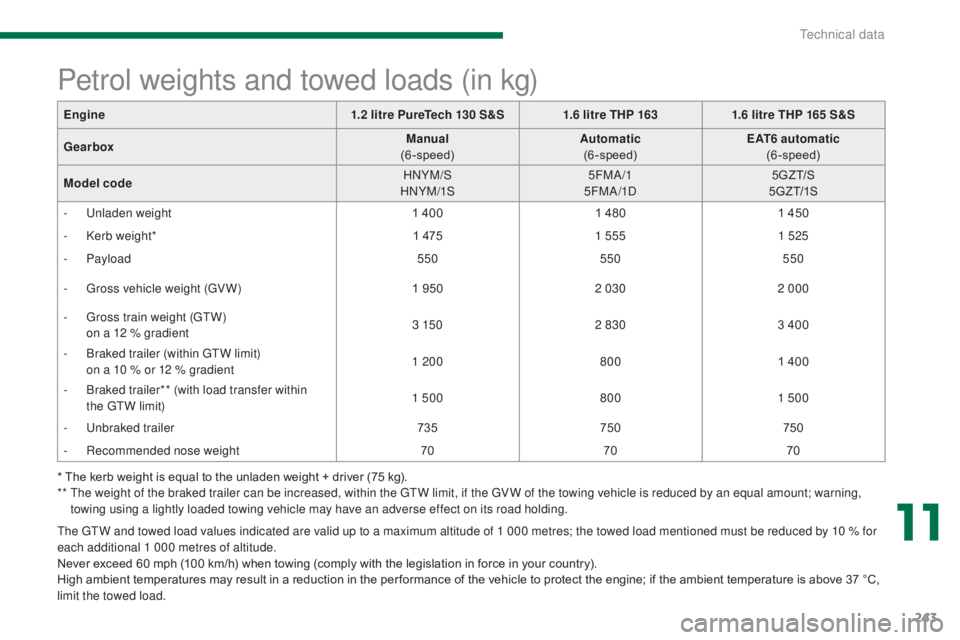
* The kerb weight is equal to the unladen weight + driver (75 kg).
** T he weight of the braked trailer can be increased, within the GTW limit, if the GV W of the towing vehicle is reduced by an equal amount; warning,
towing using a lightly loaded towing vehicle may have an adverse effect on its road holding.
Petrol weights and towed loads (in kg)
The GTW and towed load values indicated are valid up to a maximum altitude of 1 000 metres; the towed load mentioned must be reduced by 10 % for
each additional 1 000 metres of altitude.
Never exceed 60 mph (100 km/h) when towing (comply with the legislation in force in your country).
High ambient temperatures may result in a reduction in the per formance of the vehicle to protect the engine; if the ambient temperature is above 37 °C,
limit the towed load. Engine
1.2 litre PureTech 130 S&S 1.6 litre THP 163 1.6 litre THP 165 S&S
Gearbox Manual
(6-speed) Automatic
(6-speed) EAT6 automatic
(6-speed)
Model code HNYM/S
HNYM/1S 5FMA /1
5FM A /1D 5G Z T/S
5G Z T/1S
-
U
nladen weight
1 4001 4801 450
-
K
erb weight*
1 4751 555 1 525
-
Payload
550550550
-
G
ross vehicle weight (GV W)
1 9502 0302 000
-
G
ross train weight (GTW)
o
n a 12 % gradient
3 150
2 830 3 400
-
B
raked trailer (within GTW limit)
o
n a 10 % or 12 % gradient
1 200
8001 400
-
B
raked trailer** (with load transfer within
the GTW limit)
1 500
8001 500
-
U
nbraked trailer
735750750
-
R
ecommended nose weight
707070
11
Technical data
Page 246 of 344
244
3008_en_Chap11_caracteristiques_ed01-2015
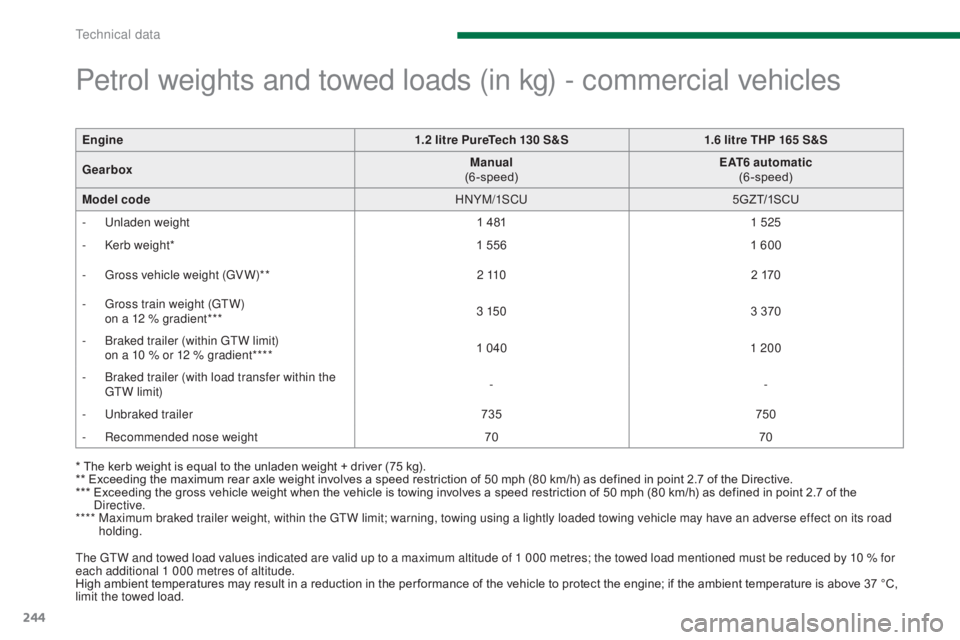
Petrol weights and towed loads (in kg) - commercial vehicles
* The kerb weight is equal to the unladen weight + driver (75 kg).
** Exceeding the maximum rear axle weight involves a speed restriction of 50 mph (80 km/h) as defined in point 2.7 of the Directive.
***
E
xceeding the gross vehicle weight when the vehicle is towing involves a speed restriction of 50 mph (80 km/h) as defined in point 2.7 of the
Directive.
****
M
aximum braked trailer weight, within the GTW limit; warning, towing using a lightly loaded towing vehicle may have an adverse effect on its road
holding.
The GTW and towed load values indicated are valid up to a maximum altitude of 1 000 metres; the towed load mentioned must be reduced by 10 % for
each additional 1 000 metres of altitude.
High ambient temperatures may result in a reduction in the per formance of the vehicle to protect the engine; if the ambient temperature is above 37 °C,
limit the towed load. Engine
1.2 litre PureTech 130 S&S1.6 litre THP 165 S&S
Gearbox Manual
(6-speed) EAT6 automatic
(6-speed)
Model code HNYM/1SCU5G Z T/1SCU
-
U
nladen weight
1 4811 525
-
K
erb weight*
1 5561 600
-
G
ross vehicle weight (GV W)**
2 11 02 170
-
G
ross train weight (GTW)
o
n a 12 % gradient***
3 150
3 370
-
B
raked trailer (within GTW limit)
o
n a 10 % or 12 % gradient****
1 040
1 200
-
B
raked trailer (with load transfer within the
GTW limit) -
-
-
U
nbraked trailer
735750
-
R
ecommended nose weight
7070
Technical data
Page 249 of 344
247
3008_en_Chap11_caracteristiques_ed01-2015
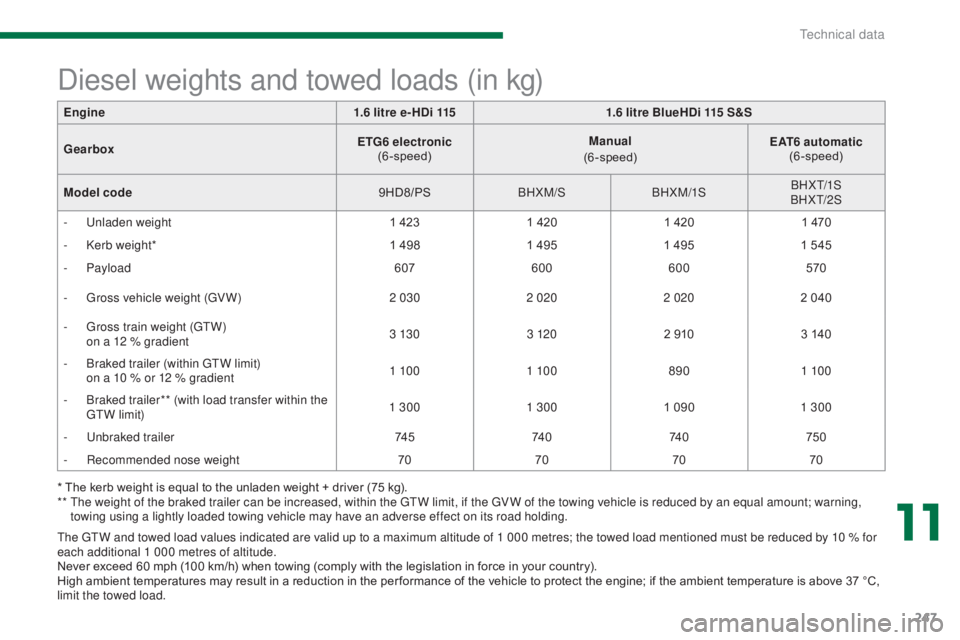
* The kerb weight is equal to the unladen weight + driver (75 kg).
** T he weight of the braked trailer can be increased, within the GTW limit, if the GV W of the towing vehicle is reduced by an equal amount; warning,
towing using a lightly loaded towing vehicle may have an adverse effect on its road holding.
Diesel weights and towed loads (in kg)
The GTW and towed load values indicated are valid up to a maximum altitude of 1 000 metres; the towed load mentioned must be reduced by 10 % for
each additional 1 000 metres of altitude.
Never exceed 60 mph (100 km/h) when towing (comply with the legislation in force in your country).
High ambient temperatures may result in a reduction in the per formance of the vehicle to protect the engine; if the ambient temperature is above 37 °C,
limit the towed load. Engine
1.6 litre e- HDi 1151.6 litre BlueHDi 115 S&S
Gearbox ETG6 electronic
(6-speed) Manual
(6-speed) EAT6 automatic
(6-speed)
Model code 9HD8/PSBHXM/SBHXM/1S BH X T/1S
BH X T/2S
-
U
nladen weight
1 4231 4201 420 1 470
-
K
erb weight*
1 4981 4951 4951 545
-
Payload
607600 600 570
-
G
ross vehicle weight (GV W)
2 0302 0202 0202 040
-
G
ross train weight (GTW)
o
n a 12 % gradient
3 13 0
3 1202 9103 140
-
B
raked trailer (within GTW limit)
o
n a 10 % or 12 % gradient
1 10 0
1 10 0 8901 10 0
-
B
raked trailer** (with load transfer within the
GTW limit) 1 300
1 3001 090 1 300
-
U
nbraked trailer
74 574 074 0750
-
R
ecommended nose weight
70707070
11
Technical data
Page 250 of 344
248
3008_en_Chap11_caracteristiques_ed01-2015
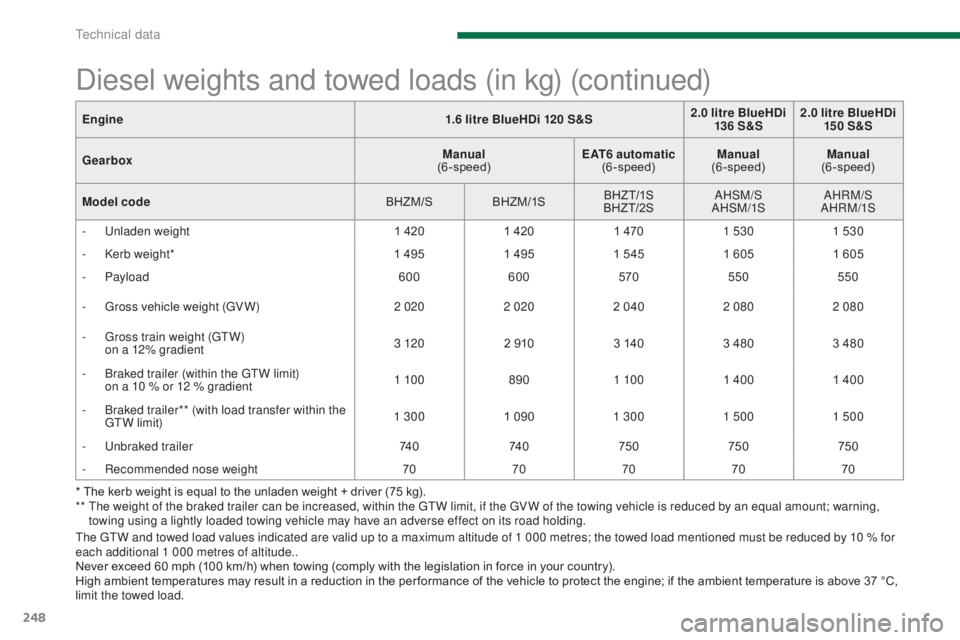
Diesel weights and towed loads (in kg) (continued)
* The kerb weight is equal to the unladen weight + driver (75 kg).
** T he weight of the braked trailer can be increased, within the GTW limit, if the GV W of the towing vehicle is reduced by an equal amount; warning,
towing using a lightly loaded towing vehicle may have an adverse effect on its road holding.
The GTW and towed load values indicated are valid up to a maximum altitude of 1 000 metres; the towed load mentioned must be reduced by 10 % for
each additional 1 000 metres of altitude..
Never exceed 60 mph (100 km/h) when towing (comply with the legislation in force in your country).
High ambient temperatures may result in a reduction in the per formance of the vehicle to protect the engine; if the ambient temperature is above 37 °C,
limit the towed load. Engine
1.6 litre BlueHDi 120 S&S2.0 litre BlueHDi
136 S&S 2.0 litre BlueHDi
15 0 S&S
Gearbox Manual
(6-speed) EAT6 automatic
(6-speed) Manual
(6-speed) Manual
(6-speed)
Model code BHZM/SBHZM /1S BHZ T/1S
BHZ T/2S AHSM/S
AHSM/1S AHRM/S
AHRM/1S
-
U
nladen weight
1 4201 420 1 4701 530 1 530
-
K
erb weight*
1 4951 4951 545 1 6051 605
-
Payload
600600 570550 550
-
G
ross vehicle weight (GV W)
2 0202 0202 040 2 080 2 080
-
G
ross train weight (GTW)
o
n a 12% gradient
3 120
2 9103 1403 480 3 480
-
B
raked trailer (within the GTW limit)
o
n a 10 % or 12 % gradient
1 10 0
8901 10 0 1 400 1 400
-
B
raked trailer** (with load transfer within the
GTW limit) 1 300
1 090 1 300 1 5001 500
-
U
nbraked trailer
74 074 0750 750750
-
R
ecommended nose weight
7070707070
Technical data
Page 251 of 344
249
3008_en_Chap11_caracteristiques_ed01-2015
The GTW and towed load values indicated are valid up to a maximum altitude of 1 000 metres; the towed load mentioned must be reduced by 10 % for
each additional 1 000 metres of altitude.
High ambient temperatures may result in a reduction in the per formance of the vehicle to protect the engine; if the ambient temperature is above 37 °C,
limit the towed load.
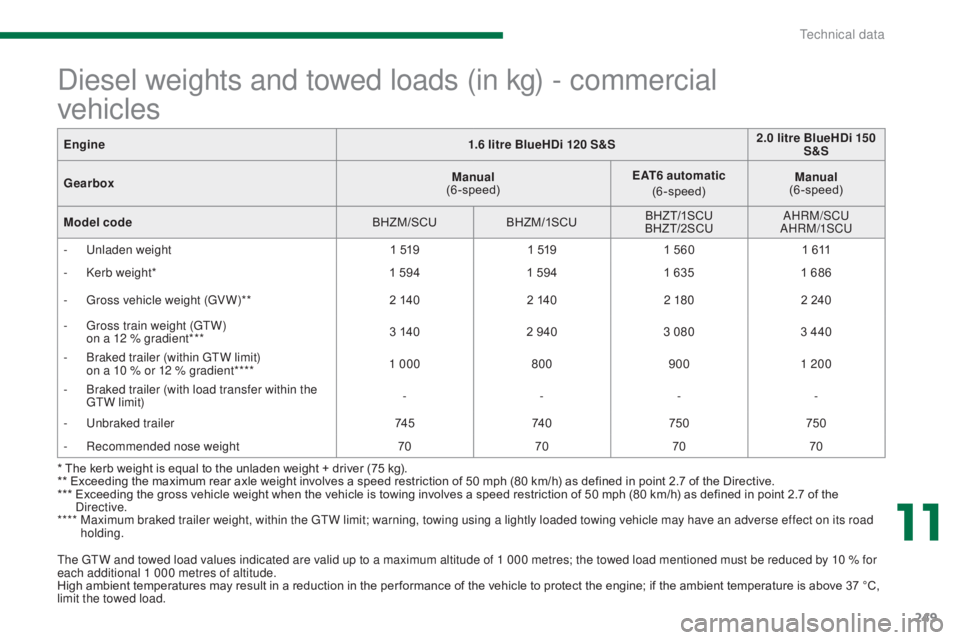
Diesel weights and towed loads (in kg) - commercial
vehicles
* The kerb weight is equal to the unladen weight + driver (75 kg).
** Exceeding the maximum rear axle weight involves a speed restriction of 50 mph (80 km/h) as defined in point 2.7 of the Directive.
***
E
xceeding the gross vehicle weight when the vehicle is towing involves a speed restriction of 50 mph (80 km/h) as defined in point 2.7 of the
Directive.
****
M
aximum braked trailer weight, within the GTW limit; warning, towing using a lightly loaded towing vehicle may have an adverse effect on its road
holding.
Engine
1.6 litre BlueHDi 120 S&S 2.0 litre BlueHDi 150
S&S
Gearbox Manual
(6-speed) E AT 6
automatic
(6-speed) Manual
(6-speed)
Model code BHZM/SCUBHZM/1SCU BHZ T/1SCU
BHZT/2SCU AHRM/SCU
AHRM/1SCU
-
U
nladen weight
1 5191 5191 560 1 611
-
K
erb weight*
1 5941 594 1 6351 686
-
G
ross vehicle weight (GV W)**
2 1402 1402 180 2 240
-
G
ross train weight (GTW)
o
n a 12 % gradient***
3 140
2 940 3 080 3 440
-
B
raked trailer (within GTW limit)
o
n a 10 % or 12 % gradient****
1 000
8009001 200
-
B
raked trailer (with load transfer within the
GTW limit) -
---
-
U
nbraked trailer
74 574 0750 750
-
R
ecommended nose weight
70707070
11
Technical data