towing PEUGEOT 308 2016 Owners Manual
[x] Cancel search | Manufacturer: PEUGEOT, Model Year: 2016, Model line: 308, Model: Peugeot 308 2016Pages: 344, PDF Size: 12.23 MB
Page 5 of 344
.
3008_en_Chap00a_sommaire_ed01-2015
Direction indicators 123
Hazard warning lamps 1 23
H or n
12
3
ESC system
1
24
Grip control
1
27
Front seat belts
1
29
Airbags
1
32
Safety
Driving recommendations 136
Starting-switching off the engine 1 37
Electric parking brake
1
40
Hill start assist
1
44
Head-up display
1
47
Distance alert
1
49
Speed limiter
1
52
Cruise control
1
55
Manual gearbox
1
58
Electronic gearbox
1
59
Automatic gearbox
1
64
Gear ef ficiency indicator
1
68
Stop & Start
1
69
Tyre under-inflation detection
1
72
Parking sensors
1
74
Reversing camera
1
76
Parking space sensors
1
77
Driving
Emergency or assistance 2 52
PE UGEOT C onnect Navigation (RT6) 2 55
P
E
UGEOT
C
onnect Sound (RD5)
3
11
Audio equipment and telematics
Alphabetical index
Fuel tank 1 80
Misfuel prevention (Diesel) 1 83
Running out of fuel (Diesel)
1
84
Opening the bonnet
1
85
Underbonnet - petrol engines
1
86
Underbonnet - Diesel engines
1
87
Checking levels
1
88
Checks
19
1
AdBlue
® additive and SCR system
(BlueHDi Diesel) 1 93
Checks
Tool kit 2 01
Temporary puncture repair kit
2
03
Changing a wheel
2
09
Snow chains
2
14
Changing a bulb
2
15
Changing a fuse
2
21
12 V battery
2
28
Energy economy mode
23
1
Changing a wiper blade
2
32
Towing the vehicle
2
32
Towbar with quickly detachable
towball
2
34
Towing a trailer
2
36
Fitting roof bars
2
38
Very cold climate screen
2
39
Accessories
2
40
Practical information
Petrol engines 2 42
Petrol weights 2 43
Diesel engines
2
45
Diesel weights
2
47
Dimensions
250
Identification markings
2
51
Technical data
Contents
Page 6 of 344
4
3008_en_Chap00b_vue-ensemble_ed01-2015
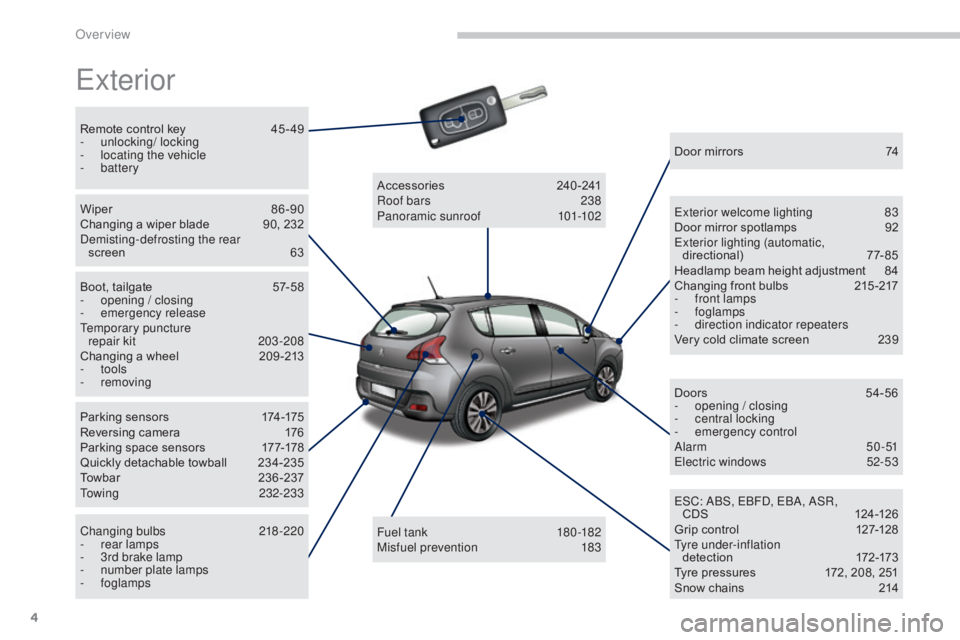
Exterior
Remote control key 45 - 49
- u nlocking/ locking
-
l
ocating the vehicle
-
battery
Wiper
8
6 -90
Changing a wiper blade
9
0, 232
Demisting-defrosting the rear screen
6
3
Boot, tailgate
5
7-58
-
ope
ning / closing
-
em
ergency release
Temporary puncture repair kit
2
03-208
Changing a wheel
2
09 -213
-
tools
-
removing
Parking sensors
1
74-175
Reversing camera
1
76
Parking space sensors
1
77-178
Quickly detachable towball
2
34-235
Towbar
23
6-237
Towing
232-233
Changing bulbs
2
18-220
-
r
ear lamps
-
3
rd brake lamp
-
n
umber plate lamps
-
foglamps Fuel tank
18
0 -182
Misfuel prevention
1
83
Accessories
2
40-241
Roof bars
2
38
Panoramic sunroof
1
01-102Door mirrors
7
4
Exterior welcome lighting
8
3
Door mirror spotlamps
9
2
Exterior lighting (automatic, directional)
7
7-85
Headlamp beam height adjustment
8
4
Changing front bulbs
2
15 -217
-
f
ront lamps
-
foglamps
-
d
irection indicator repeaters
Very cold climate screen
2
39
Doors
5
4-56
-
ope
ning / closing
-
c
entral locking
-
em
ergency control
Alarm
50-51
Electric windows
5
2-53
ESC: ABS, EBFD, EBA, ASR, CDS
12
4 -126
Grip control
1
27-128
Tyre under-inflation d ete c t i o n
17
2-173
Tyre pressures
1
72, 208, 251
Snow chains
2
14
Over view
Page 62 of 344
60
3008_en_Chap03_confort_ed01-2015
Recommendations for ventilation and air conditioning
In order for these systems to be fully effective, follow the operation and maintenance
guidelines below:
F
I
f the interior temperature remains very high after the vehicle has been parked in the sun for
a considerable time, first ventilate the passenger compartment for a few minutes.
P
lace the air flow control at a sufficient level to provide an adequate renewal of air in the
passenger compartment.
F
T
o obtain an even air distribution, take care not to obstruct the exterior air intake grilles
located at the base of the windscreen, the nozzles, the vents and the air outlets, as well
as the air extractor located in the boot.
F
U
se in preference the intake of exterior air as prolonged use of the air recirculation may
cause misting of the windows and side windows.
F
D
o not cover the sunshine sensor, located on the dashboard; this is used for regulation
of the automatic air conditioning system.
F
O
perate the air conditioning system for 5 to 10 minutes, once or twice a month to keep it
in good working order.
F
E
nsure that the passenger compartment filter is in good condition and have the filter
elements replaced regularly (refer to the "Checks" section).
W
e recommend the use of a combined passenger compartment filter. Thanks to its
second special active filter, it contributes to the purification of the air breathed by the
occupants and the cleanliness of the passenger compartment (reduction of allergic
symptoms, bad odours and greasy deposits).
F
T
he air conditioning uses power from the engine while operating. This results in an
increase in the vehicle's fuel consumption.
W
hen towing at or near maximum capacity or on steep slopes in high ambient
temperatures, switching off the air conditioning saves engine power and so improves
towing capacity.
C
ondensation created by the air conditioning results in a discharge of water under the
vehicle when stationary, which is per fectly normal.
F
T
o ensure correct operation of the air conditioning system, you are also advised to have
it checked regularly.
F
I
f the system does not produce cold air, do not use it and contact a PEUGEOT dealer or
a qualified workshop. The air conditioning system does not
contain chlorine and does not present
any danger to the ozone layer.
Comfort
Page 105 of 344
103
3008_en_Chap05_amenagements_ed01-2015
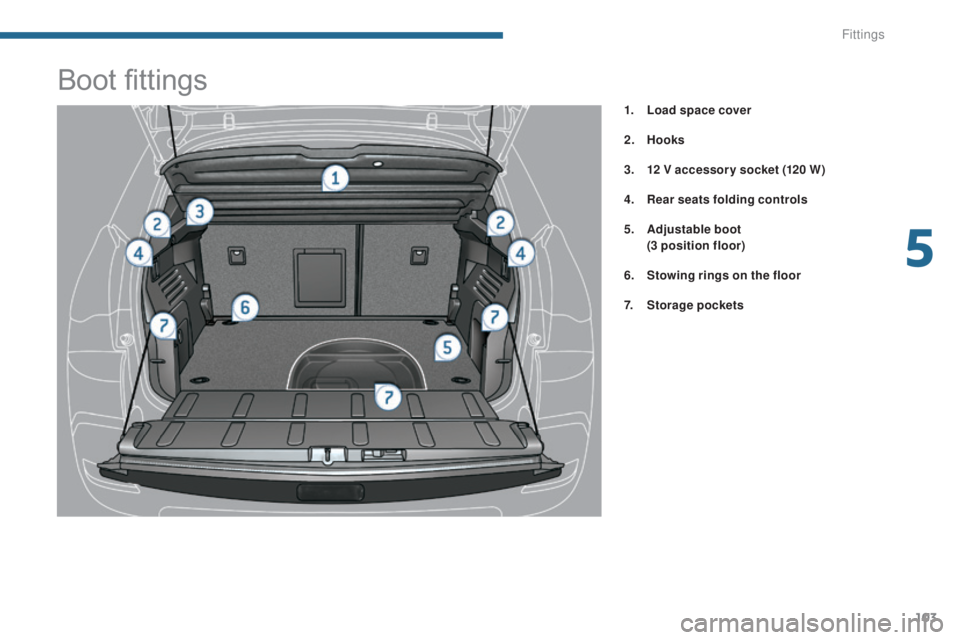
Boot fittings
1. Load space cover
2.
Hoo
ks
3.
1
2 V accessor y socket (120 W)
4.
R
ear seats folding controls
5.
A
djustable boot
(
3 position floor )
6.
S
towing rings on the floor
7.
Sto
rage pockets
5
Fittings
Page 108 of 344
106
3008_en_Chap05_amenagements_ed01-2015
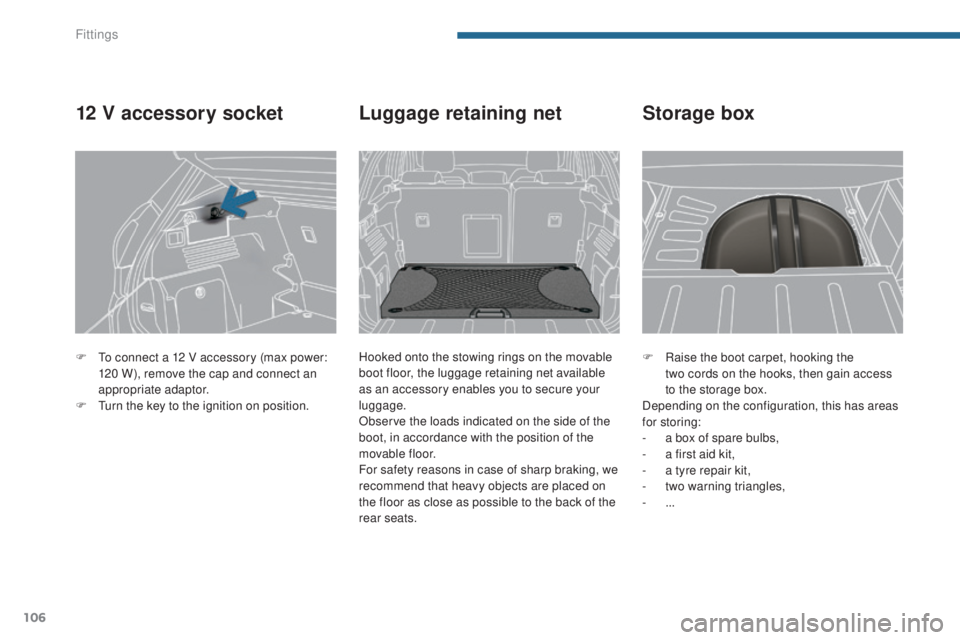
F Raise the boot carpet, hooking the two cords on the hooks, then gain access
to the storage box.
Depending on the configuration, this has areas
for storing:
-
a b
ox of spare bulbs,
-
a f
irst aid kit,
-
a t
yre repair kit,
-
t
wo warning triangles,
-
...
Storage box
F To connect a 12 V accessory (max power: 120 W), remove the cap and connect an
appropriate adaptor.
F
T
urn the key to the ignition on position.
12 V accessory socket Luggage retaining net
Hooked onto the stowing rings on the movable
boot floor, the luggage retaining net available
as an accessory enables you to secure your
luggage.
Observe the loads indicated on the side of the
boot, in accordance with the position of the
movable floor.
For safety reasons in case of sharp braking, we
recommend that heavy objects are placed on
the floor as close as possible to the back of the
rear seats.
Fittings
Page 109 of 344
107
3008_en_Chap05_amenagements_ed01-2015
Adjustable boot floor
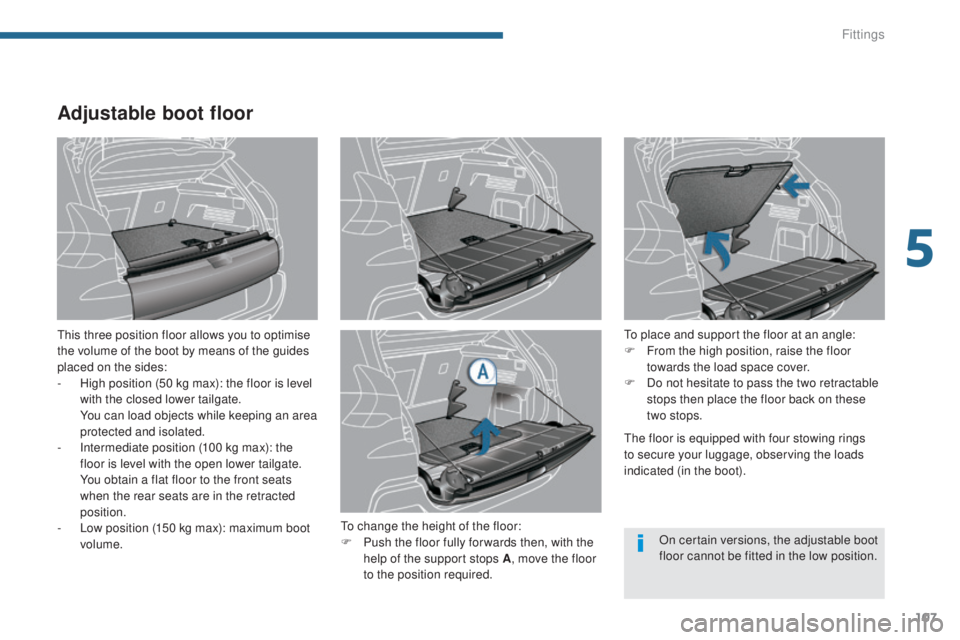
This three position floor allows you to optimise
the volume of the boot by means of the guides
placed on the sides:
-
H
igh position (50 kg max): the floor is level
with the closed lower tailgate.
Y
ou can load objects while keeping an area
protected and isolated.
-
I
ntermediate position (100 kg max): the
floor is level with the open lower tailgate.
Y
ou obtain a flat floor to the front seats
when the rear seats are in the retracted
position.
-
L
ow position (150 kg max): maximum boot
volume. To place and support the floor at an angle:
F
F rom the high position, raise the floor
towards the load space cover.
F
D
o not hesitate to pass the two retractable
stops then place the floor back on these
two stops.
To change the height of the floor:
F
P
ush the floor fully for wards then, with the
help of the support stops A , move the floor
to the position required. The floor is equipped with four stowing rings
to secure your luggage, observing the loads
indicated (in the boot).
On certain versions, the adjustable boot
floor cannot be fitted in the low position.
5
Fittings
Page 125 of 344
123
3008_en_Chap07_securite_ed01-2015
Direction indicators
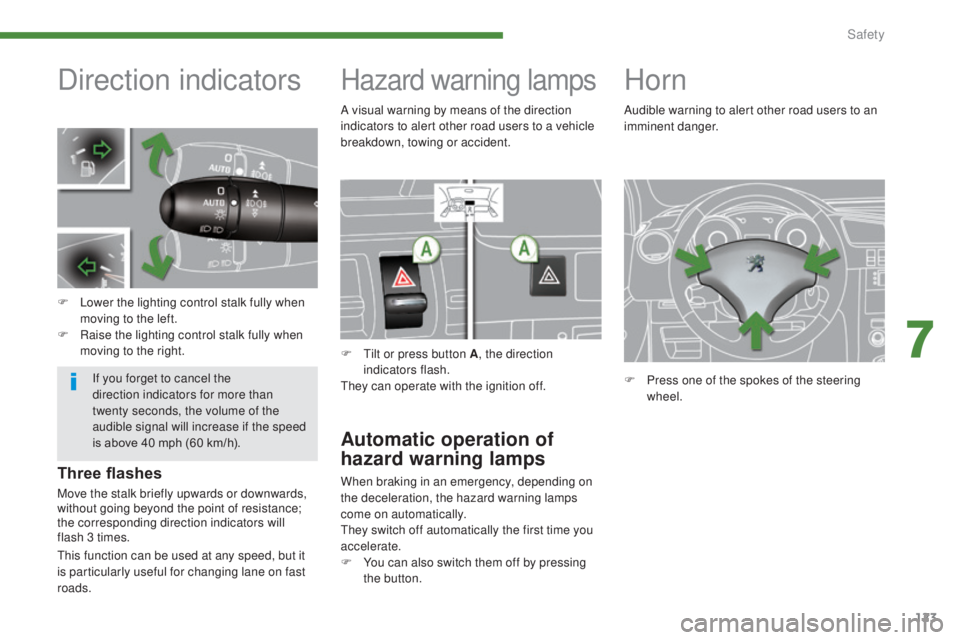
F Lower the lighting control stalk fully when moving to the left.
F
R
aise the lighting control stalk fully when
moving to the right.
Hazard warning lamps
F Tilt or press button A , the direction
indicators flash.
They can operate with the ignition off.
Automatic operation of
hazard warning lamps
When braking in an emergency, depending on
the deceleration, the hazard warning lamps
come on automatically.
They switch off automatically the first time you
accelerate.
F
Y
ou can also switch them off by pressing
the button.
Horn
F Press one of the spokes of the steering wheel.
Audible warning to alert other road users to an
imminent danger.
Three flashes
Move the stalk briefly upwards or downwards,
without going beyond the point of resistance;
the corresponding direction indicators will
flash
3 times.If you forget to cancel the
direction indicators for more than
twenty
seconds, the volume of the
audible signal will increase if the speed
is above 40 mph (60 km/h). A visual warning by means of the direction
indicators to alert other road users to a vehicle
breakdown, towing or accident.
This function can be used at any speed, but it
is particularly useful for changing lane on fast
roads.
7
Safety
Page 142 of 344
140
3008_en_Chap08_conduite_ed01-2015
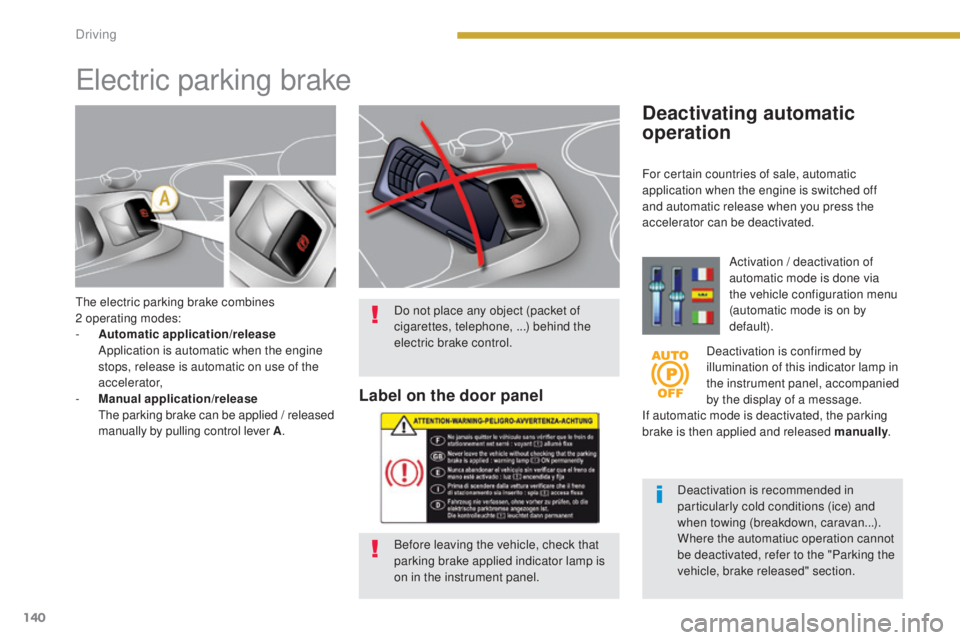
The electric parking brake combines
2 operating modes:
-
A
utomatic application/release
A
pplication is automatic when the engine
stops, release is automatic on use of the
accelerator,
-
M
anual application/release
T
he parking brake can be applied / released
manually by pulling control lever A .
Electric parking brake
Deactivating automatic
operation
Activation / deactivation of
automatic mode is done via
the vehicle configuration menu
(automatic mode is on by
default).
Deactivation is confirmed by
illumination of this indicator lamp in
the instrument panel, accompanied
by the display of a message.
If automatic mode is deactivated, the parking
brake is then applied and released manually .
Deactivation is recommended in
particularly cold conditions (ice) and
when towing (breakdown, caravan...).
Where the automatiuc operation cannot
be deactivated, refer to the "Parking the
vehicle, brake released" section.
Do not place any object (packet of
cigarettes, telephone, ...) behind the
electric brake control.
Label on the door panel
Before leaving the vehicle, check that
parking brake applied indicator lamp is
on in the instrument panel. For certain countries of sale, automatic
application when the engine is switched off
and automatic release when you press the
accelerator can be deactivated.
Driving
Page 144 of 344
142
3008_en_Chap08_conduite_ed01-2015
Automatic application,
engine off
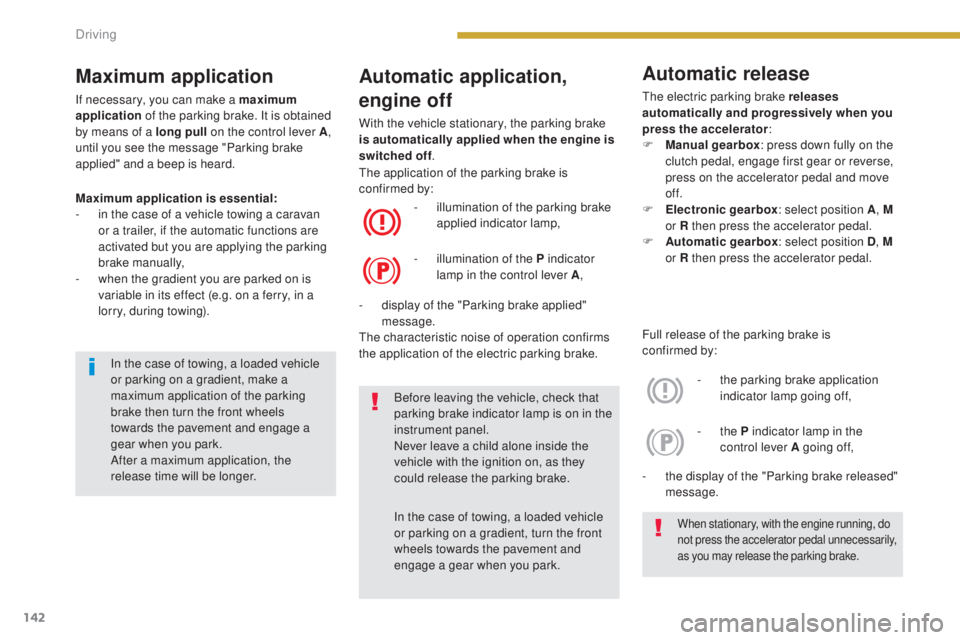
With the vehicle stationary, the parking brake
is automatically applied when the engine is
switched off.
Maximum application is essential:
-
i
n the case of a vehicle towing a caravan
or a trailer, if the automatic functions are
activated but you are applying the parking
brake manually,
-
w
hen the gradient you are parked on is
variable in its effect (e.g. on a ferry, in a
lorry, during towing). -
i
llumination of the parking brake
applied indicator lamp,
-
d
isplay of the "Parking brake applied"
message.
The characteristic noise of operation confirms
the application of the electric parking brake. The application of the parking brake is
confirmed by:
-
i
llumination of the P indicator
lamp in the control lever A ,
Before leaving the vehicle, check that
parking brake indicator lamp is on in the
instrument panel.
Never leave a child alone inside the
vehicle with the ignition on, as they
could release the parking brake.
In the case of towing, a loaded vehicle
or parking on a gradient, turn the front
wheels towards the pavement and
engage a gear when you park.
When stationary, with the engine running, do
not press the accelerator pedal unnecessarily,
as you may release the parking brake.
In the case of towing, a loaded vehicle
or parking on a gradient, make a
maximum application of the parking
brake then turn the front wheels
towards the pavement and engage a
gear when you park.
After a maximum application, the
release time will be longer.
Maximum application
If necessary, you can make a maximum
application of the parking brake. It is obtained
by means of a long pull on the control lever
A,
until you see the message "Parking brake
applied" and a beep is heard.
Full release of the parking brake is
confirmed
by:
-
t
he parking brake application
indicator lamp going off,
-
t
he display of the "Parking brake released"
message. -
the P indicator lamp in the
control lever A going of f,
Automatic release
The electric parking brake releases
automatically and progressively when you
press the accelerator :
F
M
anual gearbox : press down fully on the
clutch pedal, engage first gear or reverse,
press on the accelerator pedal and move
of f.
F
E
lectronic gearbox : select position A, M
or R then press the accelerator pedal.
F
A
utomatic gearbox : select position D, M
or R then press the accelerator pedal.
Driving
Page 204 of 344
202
3008_en_Chap10_infos-pratiques_ed01-2015
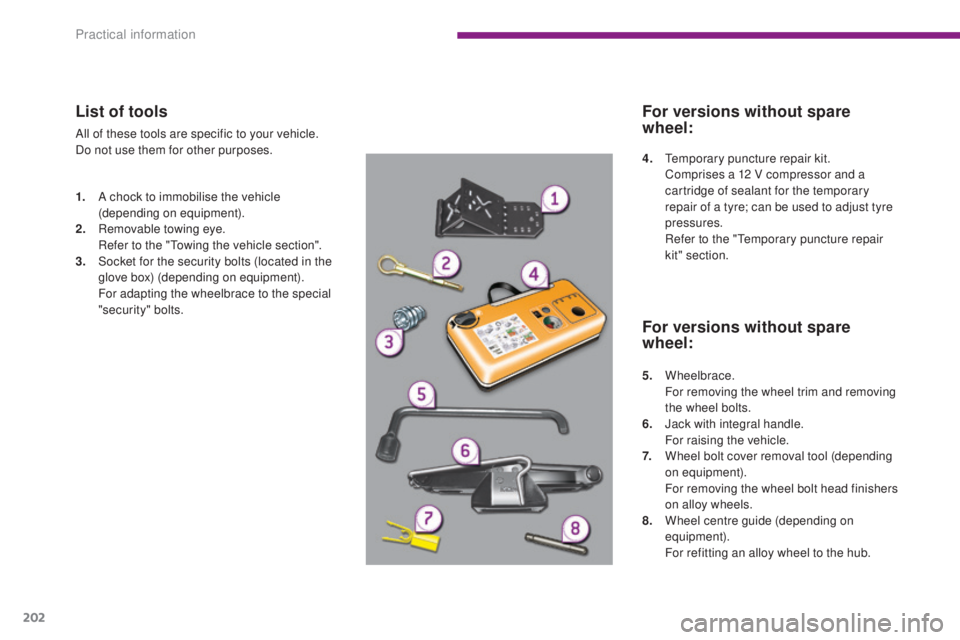
List of tools
All of these tools are specific to your vehicle.
Do not use them for other purposes.
1.
A c
hock to immobilise the vehicle
(depending on equipment).
2.
R
emovable towing eye.
R
efer to the "Towing the vehicle section".
3.
S
ocket for the security bolts (located in the
glove box) (depending on equipment).
F
or adapting the wheelbrace to the special
"security" bolts. 4.
T
emporary puncture repair kit.
C
omprises a 12 V compressor and a
cartridge of sealant for the temporary
repair of a tyre; can be used to adjust tyre
pressures.
R
efer to the "Temporary puncture repair
kit" section.
5.
Wheelbrace.
F
or removing the wheel trim and removing
the wheel bolts.
6.
J
ack with integral handle.
F
or raising the vehicle.
7.
W
heel bolt cover removal tool (depending
on equipment).
F
or removing the wheel bolt head finishers
on alloy wheels.
8.
W
heel centre guide (depending on
equipment).
F
or refitting an alloy wheel to the hub.
For versions without spare
wheel:
For versions without spare
wheel:
Practical information