belt Peugeot 308 2017 Owner's Guide
[x] Cancel search | Manufacturer: PEUGEOT, Model Year: 2017, Model line: 308, Model: Peugeot 308 2017Pages: 392, PDF Size: 10.16 MB
Page 141 of 392
139
308_en_Chap05_securite_ed01-2016
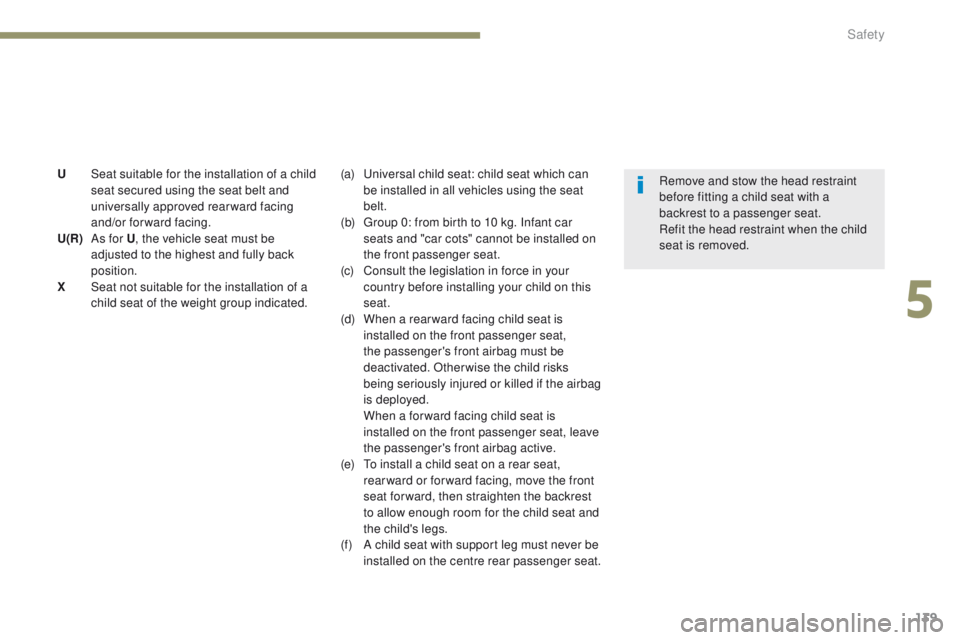
U Seat suitable for the installation of a child seat secured using the seat belt and
universally approved rear ward facing
and/or forward facing.
U(R)
A
s for U, the vehicle seat must be
adjusted to the highest and fully back
position.
X
S
eat not suitable for the installation of a
child seat of the weight group indicated. Remove and stow the head restraint
before fitting a child seat with a
backrest to a passenger seat.
Refit the head restraint when the child
seat is removed.
(a)
un iversal child seat: child seat which can
be installed in all vehicles using the seat
belt.
(b)
g
r
oup 0: from birth to 10 kg. Infant car
seats and "car cots" cannot be installed on
the front passenger seat.
(c)
C
onsult the legislation in force in your
country before installing your child on this
seat.
(d)
W
hen a rear ward facing child seat is
installed on the front passenger seat,
the passenger's front airbag must be
deactivated. Otherwise the child risks
being seriously injured or killed if the airbag
is deployed.
W
hen a for ward facing child seat is
installed on the front passenger seat, leave
the passenger's front airbag active.
(e)
t
o i
nstall a child seat on a rear seat,
rear ward or for ward facing, move the front
seat for ward, then straighten the backrest
to allow enough room for the child seat and
the child's legs.
(f)
A c
hild seat with support leg must never be
installed on the centre rear passenger seat.
5
Safety
Page 144 of 392
142
308_en_Chap05_securite_ed01-2016
ISOFIX child seats recommended by PeugeOt
PeugeOt offers a range of ISOFIX child seats listed and type approved for your vehicle.
Refer also to the child seat manufacturer's fitting instructions for information on installing and removing the seat.
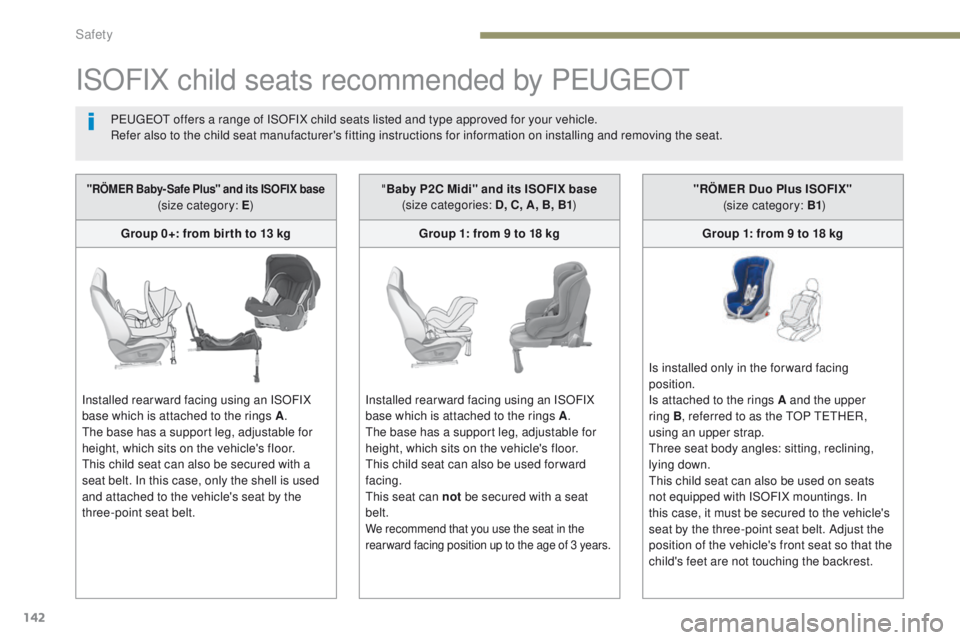
"RÖMER Baby- Safe Plus" and its ISOFIX base (size category: E)
Group 0+: from bir th to 13 kg
Installed rearward facing using an ISOFIX
base which is attached to the rings A .
th
e base has a support leg, adjustable for
height, which sits on the vehicle's floor.
th
is child seat can also be secured with a
seat belt. In this case, only the shell is used
and attached to the vehicle's seat by the
three-point seat belt. "
Baby P2C Midi" and its ISOFIX base
(size categories: D, C, A, B, B1
)
Group 1: from 9 to 18 kg
Installed rearward facing using an ISOFIX
base which is attached to the rings A .
th
e base has a support leg, adjustable for
height, which sits on the vehicle's floor.
th
is child seat can also be used for ward
facing.
th
is seat can not be secured with a seat
belt.
We recommend that you use the seat in the
rear ward facing position up to the age of 3 years.
"RÖMER Duo Plus ISOFIX" (size category: B1 )
Group 1: from 9 to 18 kg
Is installed only in the for ward facing
position.
Is attached to the rings A and the upper
ring
B , referred to as the
t
O
P tet
HeR
,
using an upper strap.
th
ree seat body angles: sitting, reclining,
lying down.
th
is child seat can also be used on seats
not equipped with ISOFIX mountings. In
this case, it must be secured to the vehicle's
seat by the three-point seat belt. Adjust the
position of the vehicle's front seat so that the
child's feet are not touching the backrest.
Safety
Page 147 of 392
145
308_en_Chap05_securite_ed01-2016
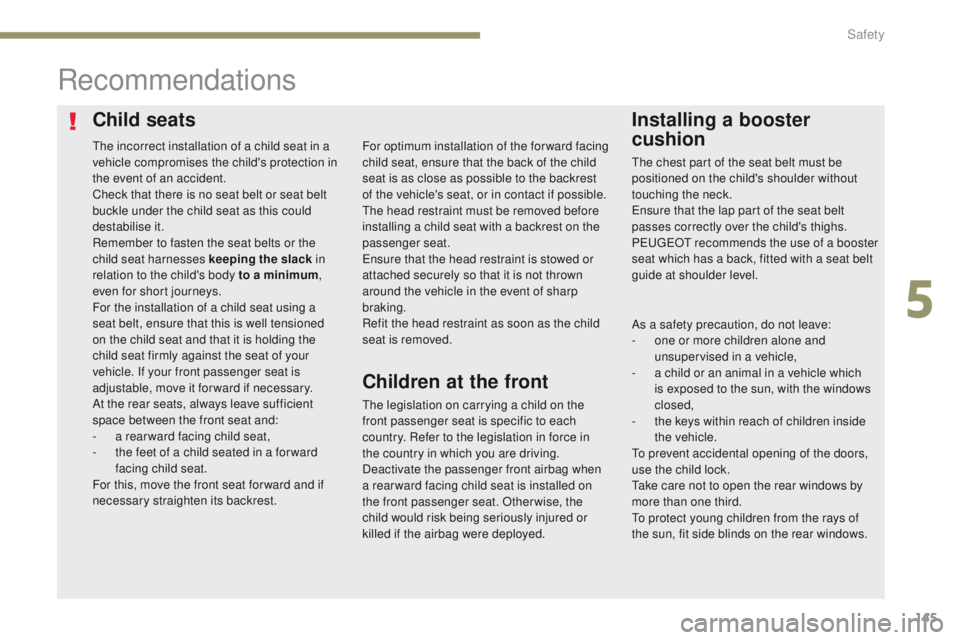
Child seatsInstalling a booster
cushion
Recommendations
the legislation on carrying a child on the
front passenger seat is specific to each
country. Refer to the legislation in force in
the country in which you are driving.
Deactivate the passenger front airbag when
a rear ward facing child seat is installed on
the front passenger seat. Otherwise, the
child would risk being seriously injured or
killed if the airbag were deployed. For optimum installation of the forward facing
child seat, ensure that the back of the child
seat is as close as possible to the backrest
of the vehicle's seat, or in contact if possible.
th
e head restraint must be removed before
installing a child seat with a backrest on the
passenger seat.
en
sure that the head restraint is stowed or
attached securely so that it is not thrown
around the vehicle in the event of sharp
braking.
Refit the head restraint as soon as the child
seat is removed.
th
e incorrect installation of a child seat in a
vehicle compromises the child's protection in
the event of an accident.
Check that there is no seat belt or seat belt
buckle under the child seat as this could
destabilise it.
Remember to fasten the seat belts or the
child seat harnesses keeping the slack in
relation to the child's body to a minimum ,
even for short journeys.
For the installation of a child seat using a
seat belt, ensure that this is well tensioned
on the child seat and that it is holding the
child seat firmly against the seat of your
vehicle. If your front passenger seat is
adjustable, move it forward if necessary.
At the rear seats, always leave sufficient
space between the front seat and:
-
a r
ear ward facing child seat,
-
t
he feet of a child seated in a for ward
facing child seat.
For this, move the front seat for ward and if
necessary straighten its backrest.
Children at the front
the chest part of the seat belt must be
positioned on the child's shoulder without
touching the neck.
en
sure that the lap part of the seat belt
passes correctly over the child's thighs.
P
e
uge
Ot
recommends the use of a booster
seat which has a back, fitted with a seat belt
guide at shoulder level.
As a safety precaution, do not leave:
-
o
ne or more children alone and
unsupervised in a vehicle,
-
a c
hild or an animal in a vehicle which
is exposed to the sun, with the windows
closed,
-
t
he keys within reach of children inside
the vehicle.
to p
revent accidental opening of the doors,
use the child lock.
ta
ke care not to open the rear windows by
more than one third.
to p
rotect young children from the rays of
the sun, fit side blinds on the rear windows.
5
Safety
Page 173 of 392
171
308_en_Chap06_conduite_ed01-2016
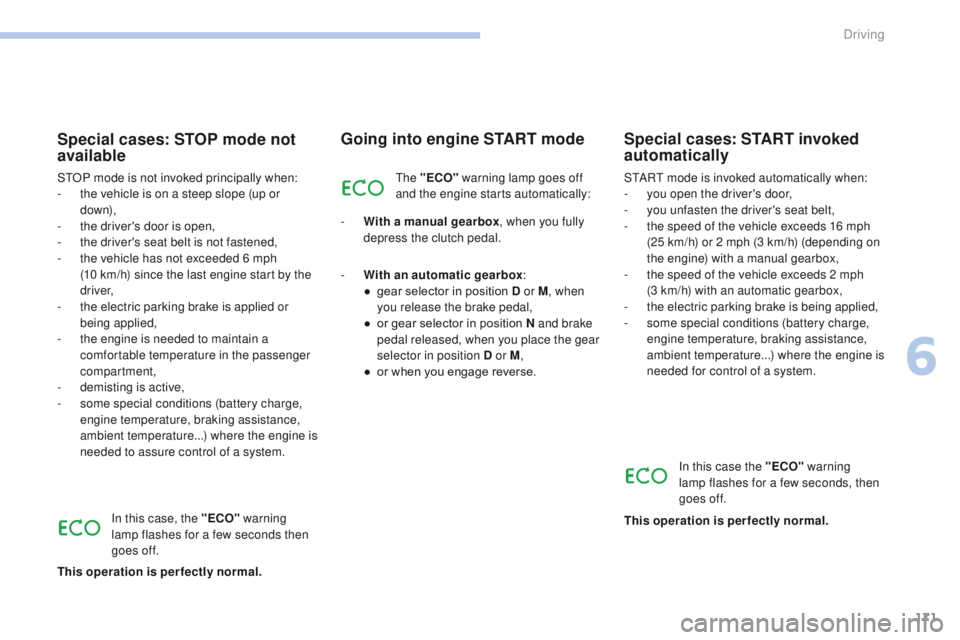
Special cases: STOP mode not
available
StOP mode is not invoked principally when:
- t he vehicle is on a steep slope (up or
d ow n),
-
t
he driver's door is open,
-
t
he driver's seat belt is not fastened,
-
t
he vehicle has not exceeded 6 mph
(10
km/h) since the last engine start by the
driver,
-
t
he electric parking brake is applied or
being applied,
-
t
he engine is needed to maintain a
comfortable temperature in the passenger
compartment,
-
d
emisting is active,
-
s
ome special conditions (battery charge,
engine temperature, braking assistance,
ambient temperature...) where the engine is
needed to assure control of a system.
In this case, the "ECO" warning
lamp flashes for a few seconds then
goes
off.
This operation is perfectly normal.
Going into engine START mode
- With a manual gearbox , when you fully
depress the clutch pedal.
-
W
ith an automatic gearbox :
●
g
ear selector in position D or M , when
you release the brake pedal,
●
o
r gear selector in position N and brake
pedal released, when you place the gear
selector in position D or M ,
●
o
r when you engage reverse. S
tA
R
t
mode is invoked automatically when:
-
y
ou open the driver's door,
- y ou unfasten the driver's seat belt,
- t he speed of the vehicle exceeds 16 mph
(25 km/h) or 2 mph (3 km/h) (depending on
the engine) with a manual gearbox,
-
t
he speed of the vehicle exceeds 2 mph
(3
km/h) with an automatic gearbox,
-
t
he electric parking brake is being applied,
-
s
ome special conditions (battery charge,
engine temperature, braking assistance,
ambient temperature...) where the engine is
needed for control of a system.
Special cases: START invoked
automatically
In this case the "ECO" warning
lamp flashes for a few seconds, then
goes
off.
This operation is perfectly normal.
th
e "ECO"
warning lamp goes off
and the engine starts automatically:
6
Driving
Page 266 of 392
264
308_en_Chap08_en-cas-de-panne_ed01-2016
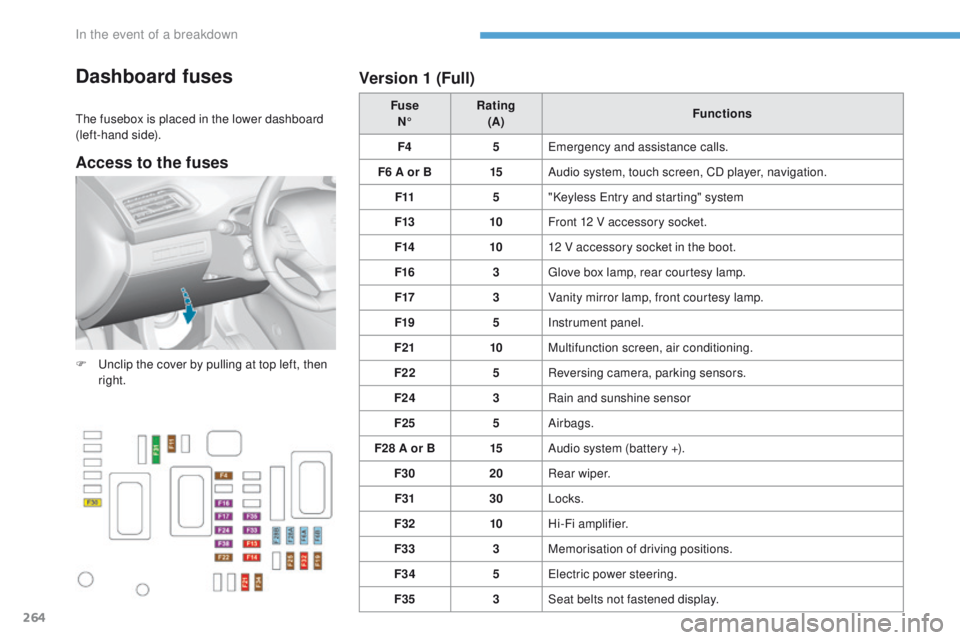
Dashboard fuses
the fusebox is placed in the lower dashboard
(left-hand side). Fuse
N° Rating
(A) Functions
F4 5
em
ergency and assistance calls.
F6 A or B 15Audio system, touch screen, CD player, navigation.
F11 5"Keyless
e
n
try and starting" system
F13 10Front 12 V accessory socket.
F14 1012 V accessory socket in the boot.
F16 3
gl
ove box lamp, rear courtesy lamp.
F17 3Vanity mirror lamp, front courtesy lamp.
F19 5Instrument panel.
F21 10Multifunction screen, air conditioning.
F22 5Reversing camera, parking sensors.
F24 3Rain and sunshine sensor
F25 5Airbags.
F28 A or B 15Audio system (battery +).
F30 20Rear wiper.
F31 30Locks.
F32 10Hi-Fi amplifier.
F33 3Memorisation of driving positions.
F34 5
el
ectric power steering.
F35 3Seat belts not fastened display.
F
u
n
clip the cover by pulling at top left, then
right.
Version 1 (Full)
Access to the fuses
In the event of a breakdown
Page 271 of 392
269
308_en_Chap08_en-cas-de-panne_ed01-2016
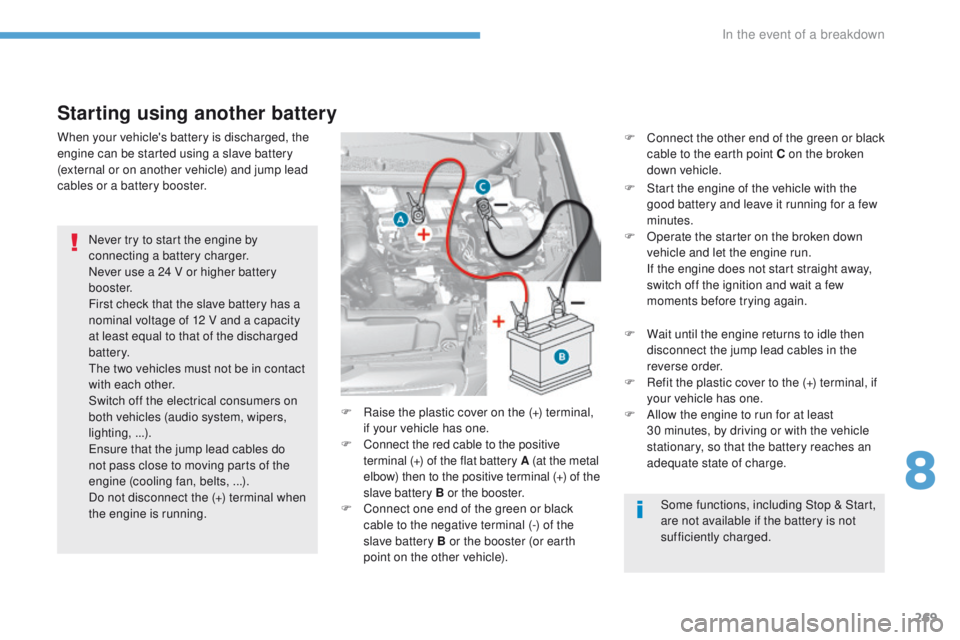
Starting using another battery
Never try to start the engine by
connecting a battery charger.
Never use a 24 V or higher battery
b o o s t e r.
First check that the slave battery has a
nominal voltage of 12 V and a capacity
at least equal to that of the discharged
battery.
th
e two vehicles must not be in contact
with each other.
Switch off the electrical consumers on
both vehicles (audio system, wipers,
lighting, ...).
en
sure that the jump lead cables do
not pass close to moving parts of the
engine (cooling fan, belts, ...).
Do not disconnect the (+) terminal when
the engine is running. F
R
aise the plastic cover on the (+) terminal,
if your vehicle has one.
F
C
onnect the red cable to the positive
terminal (+) of the flat battery A (at the metal
elbow) then to the positive terminal
(+) of the
slave battery B or the booster.
F
C
onnect one end of the green or black
cable to the negative terminal (-) of the
slave battery B or the booster (or earth
point on the other vehicle).
When your vehicle's battery is discharged, the
engine can be started using a slave battery
(external or on another vehicle) and jump lead
cables or a battery booster.
Some functions, including Stop & Start,
are not available if the battery is not
sufficiently charged.
F
C
onnect the other end of the green or black
cable to the earth point C on the broken
down vehicle.
F
S
tart the engine of the vehicle with the
good battery and leave it running for a few
minutes.
F O perate the starter on the broken down
vehicle and let the engine run.
I
f the engine does not start straight away,
switch off the ignition and wait a few
moments before trying again.
F
W
ait until the engine returns to idle then
disconnect the jump lead cables in the
reverse order.
F
R
efit the plastic cover to the (+) terminal, if
your vehicle has one.
F
A
llow the engine to run for at least
30
minutes, by driving or with the vehicle
stationary, so that the battery reaches an
adequate state of charge.
8
In the event of a breakdown
Page 384 of 392
382
308_en_Chap11_index-alpha_ed01-2016
Recirculation, air .......................................95, 99
Reduction of electrical load ..........................219
Regeneration of the particle filter
.................2
31
Reinitialisation of the under-inflation detection system
......................................... 210
Reinitialising the remote control
............... 5
4, 64
Reminder, key in ignition
...............................150
Remote control
.................. 5
0, 51, 56, 58 - 60, 65
Removing a wheel
........................................ 248
Removing the mat
........................................... 83
Replacing bulbs
............................ 252, 257, 259
Replacing fuses
..............................
.....262, 264
Replacing the air filter
...................................231
Replacing the oil filter
................................... 2
31
Replacing the passenger compartment filter
...................................... 231
Reservoir, headlamp wash
...........................230
Reservoir, screenwash
................................. 23
0
Resetting the service indicator
.......................30
Resetting the trip recorder
..............................35
Reversing camera
......................................... 200
Reversing lamp
..................................... 25
7, 259
Risk areas (update)
....................................... 327
Roof bars
....................................................... 2
23
Running out of fuel (Diesel)
..........................2
74
Navigation
..................................................... 322
Net, high load retaining
................................... 90
Number plate lamps
...................................... 2
61
Oil change
..................................................... 228
Oil consumption
............................................ 228
OIl, engine
..................................................... 228
Opening the bonnet
...................................... 2
25
Opening the boot
......................... 5
0, 56, 58, 61
Opening the doors
............................. 5
0, 56, 58
Pads, brake
................................................... 232
Paint colour code
.......................................... 292
Panoramic glass sunroof
.............................. 102
Parcel shelf, rear
............................................. 87
P
ark Assist
.................................... 201, 203, 206
Parking brake
.................................. 15, 15 4, 232Radio
.................................... 308, 309, 312, 362
Radio, digital (Digital Audio Broadcasting - DAB)
........................... 310, 311
Range, AdBlue
® ............................... ...............32
RDS
............................................................... 309
Rear screen, demisting
................................. 101
Recharging the battery
................................. 2
70Safety, children ..............................
1
27, 131-13 3,
13 8, 142, 143, 145
Saturation of the particle filter (Diesel)
.........2
31
N
O
PR
S
Parking brake, electric ....................20, 155, 160
Parking sensors, front ...................................198
Parking sensors, rear .................................... 198
P
e
uge
Ot
Connect Apps .............................3 41
Peuge
O
t Connect Assistance
...................11 9
Peuge
O
t Connect Packs
...........................11 9
Peuge
O
t Connect SOS
............................. 11
9
Peuge
O
t Connect Sound (RD5)
................3
59
Plates, identification ...................................... 292
Player, Apple
® .............................. .........314, 3 6 9
Player, MP3 CD ............................. 312, 367, 368
Player,
u
S
B
........................................... 312, 3 6 6
Port,
u
S
B
.................................. 8
2, 85, 312, 366
Pressures, tyres
.................... 239, 245, 251, 292
Pre-tensioning seat belts
.............................. 126
Priming pump
................................................ 2 74
Priming the fuel system
................................ 2 74
Protecting children
................. 127, 131-13 3, 13 8,
140, 142, 143, 145
Puncture
........................................................ 239
Alphabetical index
Page 385 of 392
383
308_en_Chap11_index-alpha_ed01-2016
Stay, bonnet .................................................. 225
Steering mounted controls, audio ........299, 361
Steering wheel, adjustment
............................72
Stop
................................................................. 18
Stopping the vehicle
.....................151, 152, 165
Stop & Start
..................16, 25, 39, 92, 100, 170,
172, 213, 225, 231, 268, 271
Stop (warning lamp)
........................................ 18
St
orage
.......................................... 82, 84, 86 - 88
Storage wells
............................................ 87, 88
Storing driving positions
.................................75
Stowing rings
............................................ 87, 88
Switching off the engine
............................... 14
8
Synchronising the remote control
..................................................... 5
4, 64
T
tables of weights .................................. 278, 285tab
les of engines ..........................275, 281, 285
ta
bles of fuses ............................. 262, 264, 266
t
a n k , f u e l
....................................................... 213
te
chnical data
.......................275, 278, 281, 285
te
lephone
..................................... 346-348, 370
te
mperature, coolant
...................................... 28
thr
ee flashes (direction indicators)
..............112
tim
e (setting)
..............................
...............47- 4 9
tM
C (
tr
affic info)
.......................................... 32
8
to
o l s
...................................................... 239, 246
to
pping-up the AdBlue
® additive ................. 23 5to
p
te
ther
..................................................... 140
to
tal distance recorder
................................... 35
to
uch screen ..... 38, 40, 42, 44, 45, 47, 173, 211
Screen, cold climate
.....................................
217
Screen, colour
......................................
300, 301
Screen, instrument panel
................................
37
Screen menu map
........
302, 304, 306, 316, 318,
322, 330, 342, 344, 372-374
Screen, monochrome
...................................
372
Screen, monochrome A
................................
372
Screen, multifunction (with audio system)
...............................
49, 362
Screen, multifunction (without audio system)
..................................
49
Screenwash
..................................................
115
SCR (Selective Catalytic Reduction)
............
233
Seat belts
....................................... 12
4 -126, 137
Seat, rear bench
.......................................
79, 80
Seats, electric
.................................................
74
Seats, front
...............................
.................
73 -75
Seats, heated
..................................................
76
Serial number, vehicle
.................................. 2
92
Service indicator
.............................................
28
Service (warning lamp)
................................... 19
S
ettings, equipment
........................................
44
Settings (Menus)
...........................................
330
Settings, system
............................................
338
Sidelamps
..............
107, 252, 253, 255-257, 259
Side repeater
..............................
..................
256
Ski flap
..............................
..............................
86
Snow chains
.......................................... 2
09, 216
Socket, 12 V accessory
.....................
8
2, 84, 88
Socket, 230 V
...............................
.............
82, 85
Socket, auxiliary
....................................
312, 3 67
Socket, JACK
............................
82, 85, 312, 367
Sockets, audio
................................................
85
Speed limiter
.........................................
173 , 174
Spotlamps, side
....................................
113 , 2 5 6
Stability control (e
SC)............................. 17, 1 2 1
Starting the vehicle
....................... 148, 151, 152
Starting using another battery
...................... 15
2
Station, radio
................................ 3
08, 309, 362
tou
ch screen (Menus)
.................
295, 300, 301
to
w b a r
...................................................
1 4 7, 2 1 8
to
wed loads
..........................................
278, 285
to
wing another vehicle
.................................
2
72
to
wing eye ......................................................
87
tra
ction control (ASR)
.......................17, 21, 121
tr
affic information (
tA
)
.........................
329, 363
tr
affic information (
tM
C)
..............................
32
8
t
r a i l e r
....................................................
1 4 7, 2 1 8
tr
iangle, warning
........................................... 238
tr
ip computer
.............................................37- 3 9
tr
ip distance recorder
.....................................
35
ty
r e s
................................................................
10
ty
re under-inflation
detection
...............................
24, 209, 211, 245
U
V
under-inflation (detection) ............................20 9unl
ocking .............................. .............50, 56, 58
up
dating risk areas
....................................... 3
27
up
dating the date
............................................ 47
upd
ating the time
............................................ 47
u
SB
................................................. 85, 312, 368
Ventilation
..............................
.......10, 91-94, 99
.
Alphabetical index