tow Peugeot 308 2017 Service Manual
[x] Cancel search | Manufacturer: PEUGEOT, Model Year: 2017, Model line: 308, Model: Peugeot 308 2017Pages: 392, PDF Size: 10.16 MB
Page 240 of 392
238
308_en_Chap08_en-cas-de-panne_ed01-2016
Warning triangle (stowing)
Before leaving your vehicle to set up
and install the triangle, switch on the
hazard warning lamps and put on your
high visibility vest.
th
is safety equipment should be used in
addition to the hazard warning lamps.
Its presence in the vehicle is mandatory.
Placing the triangle in the
road
Refer to the manufacturer's instructions on
unfolding and installing supplied with the
triangle. F
P
lace the triangle behind the vehicle, as
required by the legislation in force in your
c o unt r y.
th
e triangle is available as an
accessory; contact a P
e
uge
Ot
dealer
or a qualified workshop.
th
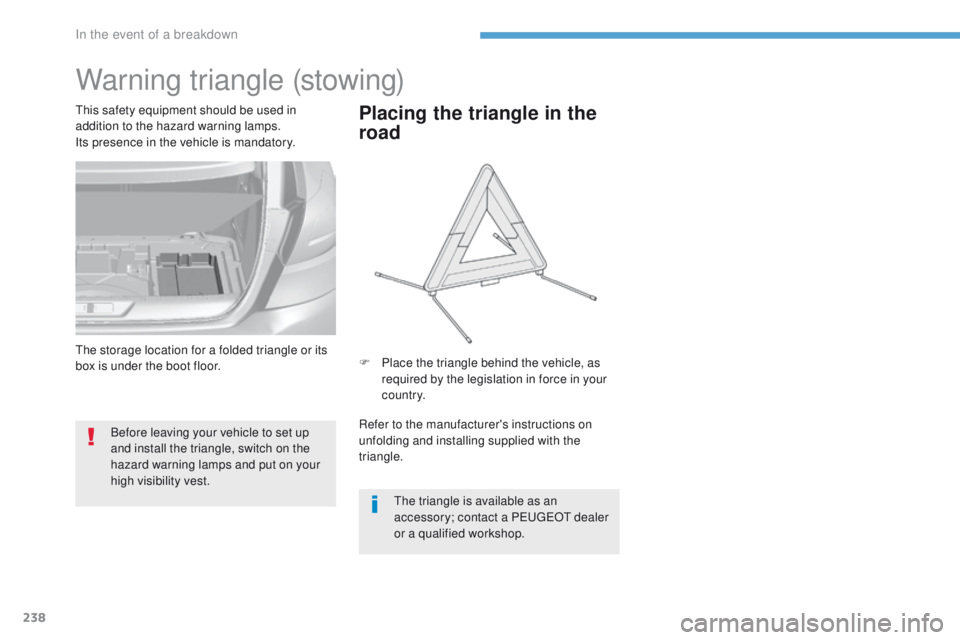
e storage location for a folded triangle or its
box is under the boot floor.
In the event of a breakdown
Page 245 of 392
243
308_en_Chap08_en-cas-de-panne_ed01-2016
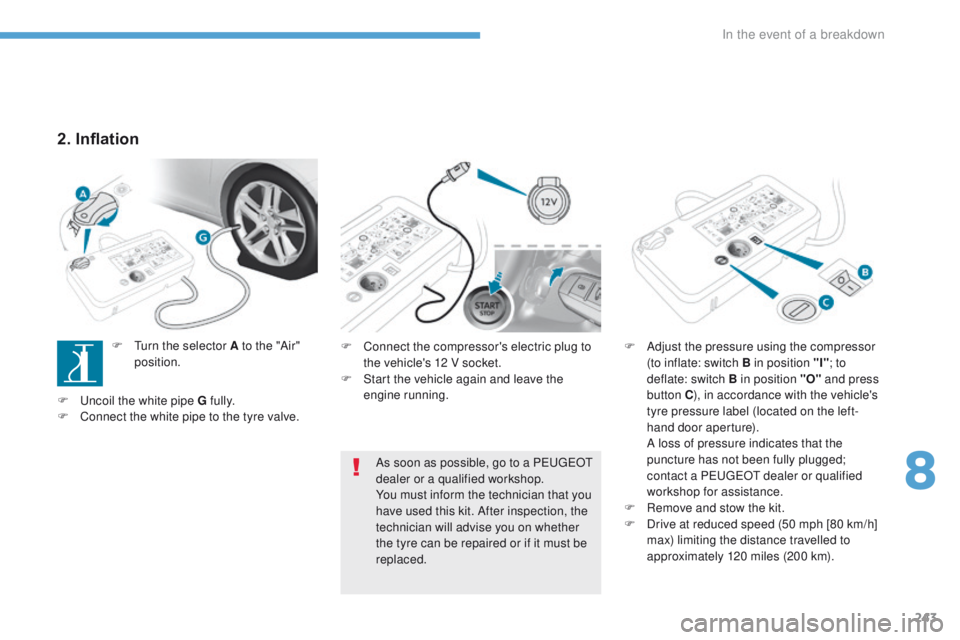
F Connect the compressor's electric plug to
the vehicle's 12 V socket.
F
S
tart the vehicle again and leave the
engine running. F
A djust the pressure using the compressor
(to inflate: switch B in position "I" ; to
deflate: switch B in position "O" and press
button C ), in accordance with the vehicle's
tyre pressure label (located on the left-
hand door aperture).
A l
oss of pressure indicates that the
puncture has not been fully plugged;
contact a P
e
uge
Ot
dealer or qualified
workshop for assistance.
F
R
emove and stow the kit.
F
D
rive at reduced speed (50 mph [80 km/h]
max) limiting the distance travelled to
approximately 120 miles (200 km).
As soon as possible, go to a P
e
uge
Ot
dealer or a qualified workshop.
You must inform the technician that you
have used this kit. After inspection, the
technician will advise you on whether
the tyre can be repaired or if it must be
replaced.
2. Inflation
F turn the selector A to the "Air" position.
F
u
n
coil the white pipe G fully.
F
C
onnect the white pipe to the tyre valve.
8
In the event of a breakdown
Page 247 of 392
245
308_en_Chap08_en-cas-de-panne_ed01-2016
Checking / adjusting tyre pressures
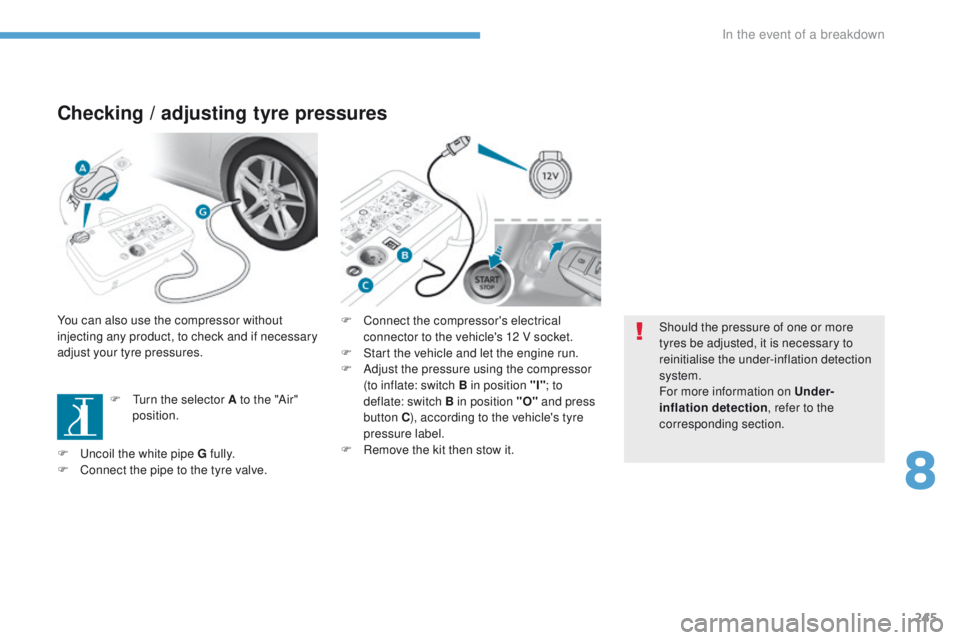
You can also use the compressor without
injecting any product, to check and if necessary
adjust your tyre pressures.
F
t
u
rn the selector A to the "Air"
position. F
C onnect the compressor's electrical
connector to the vehicle's 12 V socket.
F
S
tart the vehicle and let the engine run.
F
A
djust the pressure using the compressor
(to inflate: switch B in position "I" ; to
deflate: switch B in position "O" and press
button C ), according to the vehicle's tyre
pressure label.
F
R
emove the kit then stow it.Should the pressure of one or more
tyres be adjusted, it is necessary to
reinitialise the under-inflation detection
system.
For more information on Under-
inflation detection
, refer to the
corresponding section.
F
u
n
coil the white pipe G fully.
F
C
onnect the pipe to the tyre valve.
8
In the event of a breakdown
Page 249 of 392
247
308_en_Chap08_en-cas-de-panne_ed01-2016
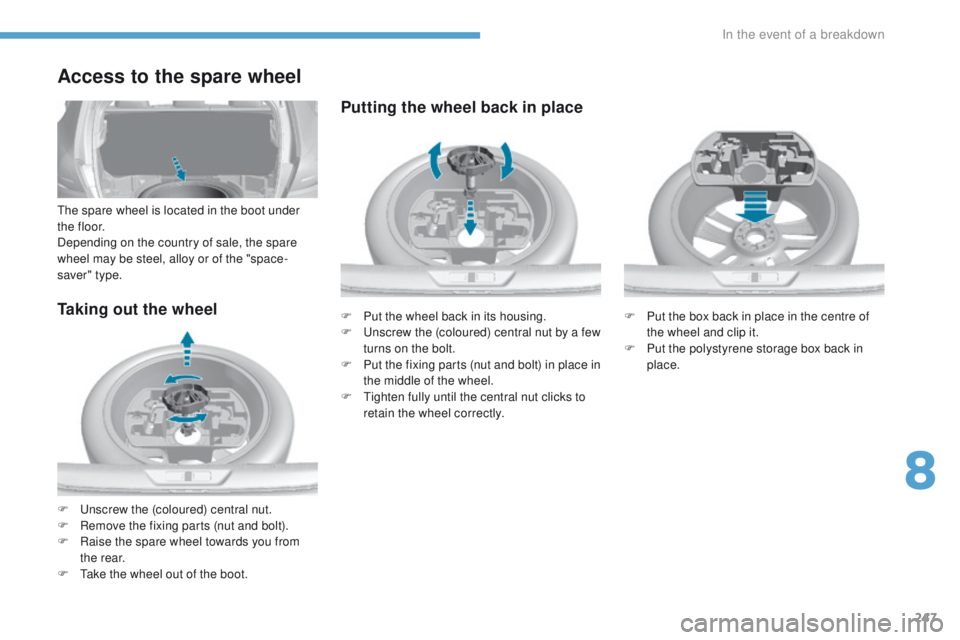
Taking out the wheel
F unscrew the (coloured) central nut.
F
R emove the fixing parts (nut and bolt).
F
R
aise the spare wheel towards you from
the rear.
F
t
a
ke the wheel out of the boot.
Access to the spare wheel
the spare wheel is located in the boot under
t h e f l o o r.
Depending on the country of sale, the spare
wheel may be steel, alloy or of the "space-
saver" type.
Putting the wheel back in place
F Put the box back in place in the centre of the wheel and clip it.
F
P
ut the polystyrene storage box back in
place.
F
P
ut the wheel back in its housing.
F
un
screw the (coloured) central nut by a few
turns on the bolt.
F
P
ut the fixing parts (nut and bolt) in place in
the middle of the wheel.
F
t
i
ghten fully until the central nut clicks to
retain the wheel correctly.
8
In the event of a breakdown
Page 255 of 392
253
308_en_Chap08_en-cas-de-panne_ed01-2016
In some weather conditions (e.g. low
temperature or humidity), the presence
of misting on the internal sur face of the
glass of the headlamps and rear lamps
is normal; it disappears after the lamps
have been on for a few minutes.th
e headlamps have polycarbonate
lenses with a protective coating:
F
d
o not clean them using a dr y
or abrasive cloth, nor with a
detergent or solvent product,
F
u
se a sponge and soapy water or a
pH neutral product,
F
w
hen using a high pressure washer
on persistent marks, do not keep
the lance directed towards the
lamps or their edges for too long,
so as not to damage their protective
coating and seals.
Changing a bulb should only be done
after the headlamp has been switched
off for several minutes (risk of serious
burns).
F
D
o not touch the bulb directly with
your fingers, use a lint-free cloth.
It is imperative to use only anti-
ultraviolet (
uV
) type bulbs to avoid
damaging the headlamp.
Always replace a failed bulb with a
new bulb with the same type and
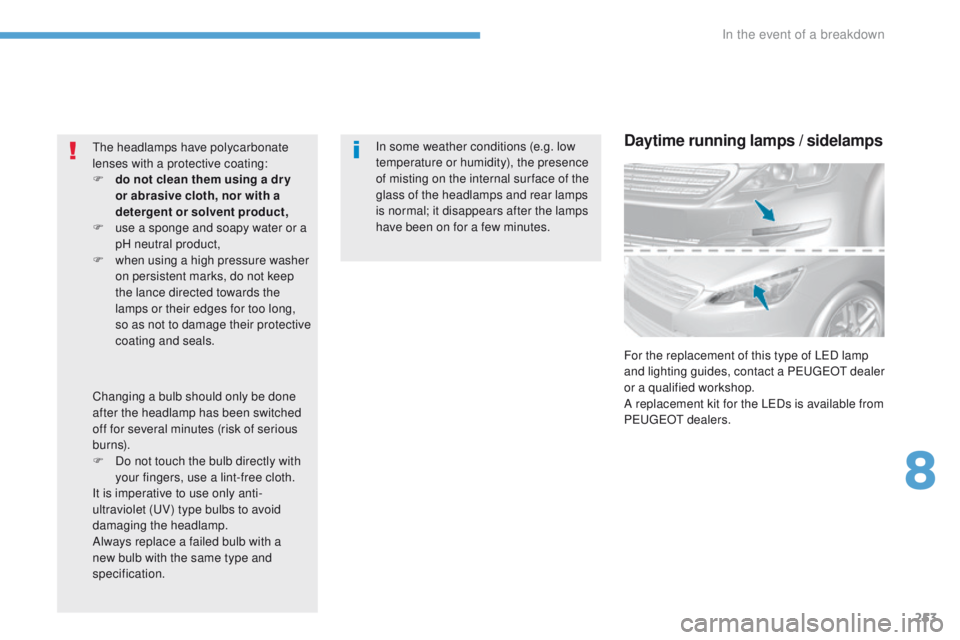
specification.Daytime running lamps / sidelamps
For the replacement of this type of LeD l amp
and lighting guides, contact a Pe ugeOt dealer
or a qualified workshop.
A replacement kit for the L
eD
s is available from
P
e
uge
Ot d
ealers.
8
In the event of a breakdown
Page 256 of 392
254
308_en_Chap08_en-cas-de-panne_ed01-2016
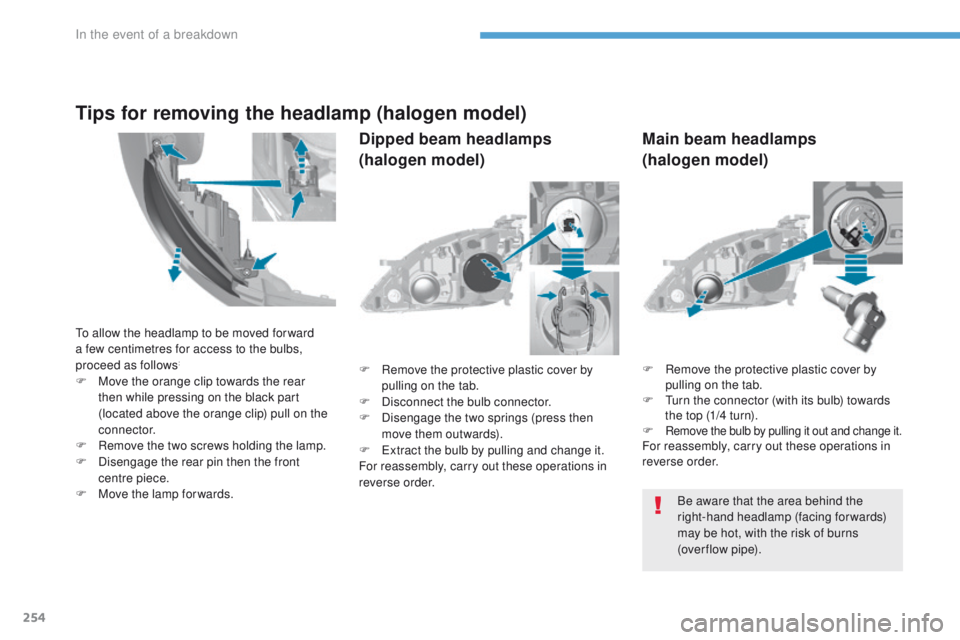
F Remove the protective plastic cover by
pulling on the tab.
F
t
u
rn the connector (with its bulb) towards
the top (1/4 turn).
F
Remove the bulb by pulling it out and change it.For reassembly, carry out these operations in
reverse order.
F
R
emove the protective plastic cover by
pulling on the tab.
F
D
isconnect the bulb connector.
F
D
isengage the two springs (press then
move them outwards).
F
ex
tract the bulb by pulling and change it.
For reassembly, carry out these operations in
reverse order.
Be aware that the area behind the
right-hand headlamp (facing forwards)
may be hot, with the risk of burns
(over flow
pipe).
to a
llow the headlamp to be moved for ward
a few centimetres for access to the bulbs,
proceed as follows
:
F Move the orange clip towards the rear then while pressing on the black part
(located above the orange clip) pull on the
connector.
F
R
emove the two screws holding the lamp.
F
D
isengage the rear pin then the front
centre piece.
F
M
ove the lamp for wards.
Tips for removing the headlamp (halogen model)
Dipped beam headlamps
(halogen model) Main beam headlamps
(halogen model)
In the event of a breakdown
Page 274 of 392
272
308_en_Chap08_en-cas-de-panne_ed01-2016
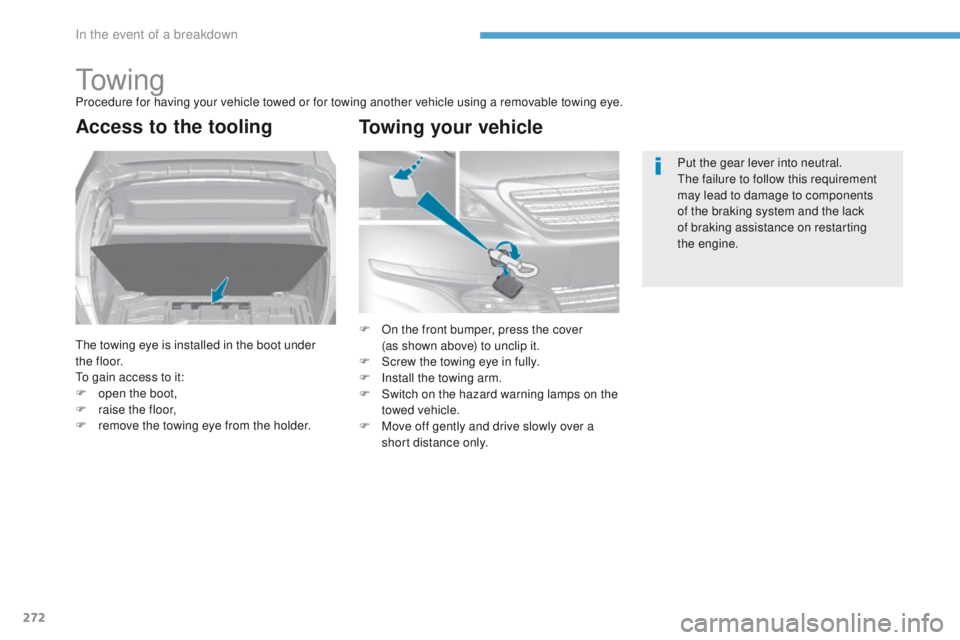
to w i n gProcedure for having your vehicle towed or for towing another vehicle using a removable towing eye.
Access to the tooling
the towing eye is installed in the boot under
t h e f l o o r.
to g
ain access to it:
F
o
pen the boot,
F
r
aise the floor,
F
r
emove the towing eye from the holder. Put the gear lever into neutral.
th
e failure to follow this requirement
may lead to damage to components
of the braking system and the lack
of braking assistance on restarting
the
engine.
F O n the front bumper, press the cover
(as shown above) to unclip it.
F
S
crew the towing eye in fully.
F
I
nstall the towing arm.
F
S
witch on the hazard warning lamps on the
towed vehicle.
F
M
ove off gently and drive slowly over a
short distance only.
Towing your vehicle
In the event of a breakdown
Page 275 of 392
273
308_en_Chap08_en-cas-de-panne_ed01-2016
General recommendations
Observe the legislation in force in your country.en
sure that the weight of the towing vehicle is higher than that of the towed vehicle.
th
e driver must remain at the wheel of the towed vehicle and must have a valid driving licence.
When towing a vehicle with all four wheels on the ground, always use an approved towing
arm; rope and straps are prohibited.
th
e towing vehicle must move off gently.
When towing a vehicle with the engine off, there is no longer any power assistance for
braking or steering.
In the following cases, you must always call on a professional recovery service:
-
v
ehicle broken down on a motor way or fast road,
-
f
our-wheel drive vehicle,
-
w
hen it is not possible to put the gearbox into neutral, unlock the steering, or release
the parking brake,
-
t
owing with only two wheels on the ground,
-
w
here there is no approved towing arm available...
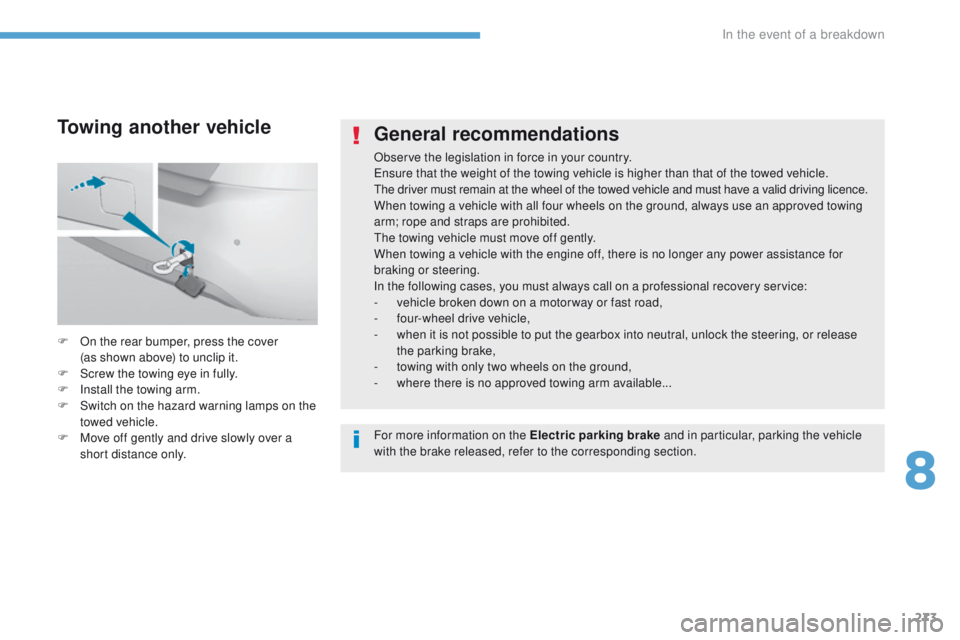
F
O
n the rear bumper, press the cover
(as
shown above) to unclip it.
F
S
crew the towing eye in fully.
F
I
nstall the towing arm.
F
S
witch on the hazard warning lamps on the
towed vehicle.
F
M
ove off gently and drive slowly over a
short distance only.
Towing another vehicle
For more information on the Electric parking brake and in particular, parking the vehicle
with the brake released, refer to the corresponding section.
8
In the event of a breakdown
Page 280 of 392
278
308_en_Chap09_caracteristiques-techniques_ed01-2016
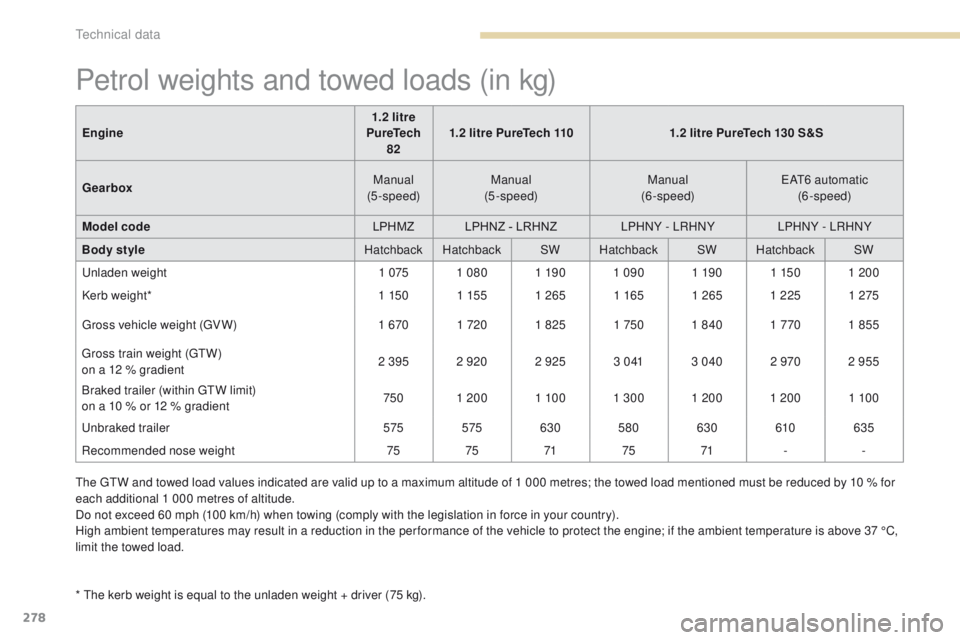
Petrol weights and towed loads (in kg)
* the kerb weight is equal to the unladen weight + driver (75 kg).Engine
1.2 litre
PureTech 82 1.2 litre PureTech 110
1.2 litre PureTech 130 S&S
Gearbox Manual
(5-speed) Manual
(5-speed) Manual
(6-speed)
eAt6
automatic
(6-speed)
Model code LPHMZLPHNZ - LRHNZ LPHNY - LRHNY LPHNY - LRHNY
Body style Hatchback HatchbackSWHatchback SWHatchback SW
un
laden weight
1 0751 080 1 19 01 090 1 19 01 1501 200
Kerb weight* 1 150 1 1551 2651 1651 265 1 225 1 275
gr
oss vehicle weight (
gV
W)
1 6701 720 1 825 1 7501 840 1 7701 855
gr
oss train weight (
g
t
W
)
on a 12 % gradient 2 395 2 920 2 925
3 0 413 040 2 9702 955
Braked trailer (within gt
W l
imit)
on a 10 % or 12 % gradient 750
1 200 1 10 01 300 1 200 1 200 1 10 0
unb
raked trailer
575 575630580 630 610635
Recommended nose weight 7575 7175 71 --
th
e gt
W a
nd towed load values indicated are valid up to a maximum altitude of 1 000 metres; the towed load mentioned must be reduced by 10 % for
each additional 1 000 metres of altitude.
Do not exceed 60 mph (100 km/h) when towing (comply with the legislation in force in your country).
High ambient temperatures may result in a reduction in the per formance of the vehicle to protect the engine; if the ambient temperature is above 37 °C,
limit the towed load.
technical data
Page 281 of 392
279
308_en_Chap09_caracteristiques-techniques_ed01-2016
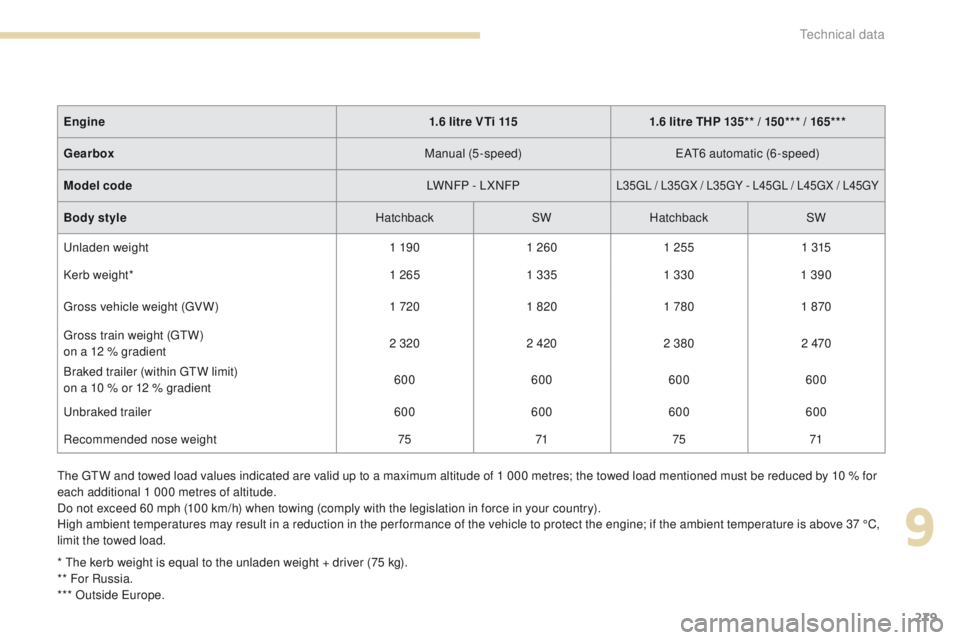
the gtW a nd towed load values indicated are valid up to a maximum altitude of 1 000 metres; the towed load mentioned must be reduced by 10 % for
each additional 1 000 metres of altitude.
Do not exceed 60 mph (100 km/h) when towing (comply with the legislation in force in your country).
High ambient temperatures may result in a reduction in the per formance of the vehicle to protect the engine; if the ambient temperature is above 37 °C,
limit the towed load.
*
t
h
e kerb weight is equal to the unladen weight + driver (75 kg).
** For Russia.
*** Outside
e
u
rope.
Engine
1.6 litre VTi 1151.6 litre THP 135** / 150*** / 165***
Gearbox Manual (5-speed)
eAt6
automatic (6-speed)
Model code LWNFP - LXNFP
L35gL / L35gX / L35gY - L 45gL / L 45gX / L 45gY
Body style HatchbackSWHatchback SW
un
laden weight 1 19 01 260 1 255 1 315
Kerb weight* 1 2651 335 1 3301 390
gr
oss vehicle weight (
gV
W) 1 7201 820 1 780 1 870
gr
oss train weight (
g
t
W
)
on a 12 % gradient 2 320
2 4202 380 2 470
Braked trailer (within
gt
W l
imit)
on a 10 % or 12 % gradient 600
600600600
unb
raked trailer 600600600600
Recommended nose weight 757175 71
9
technical data