fuel PEUGEOT 308 2017 User Guide
[x] Cancel search | Manufacturer: PEUGEOT, Model Year: 2017, Model line: 308, Model: Peugeot 308 2017Pages: 566, PDF Size: 16.05 MB
Page 55 of 566

53
3008-2_en_Chap01_instruments-de-bord_ed01-2016
ButtonCorresponding function Comments
Screen configuration Adjustment of the display settings (scrolling of text, animations...) and brightness.
Instrument panel perso Select the type of information displayed in the digital instrument panel.
System configuration Choice of units:
-
t
emperature (°Celsius or °Fahrenheit)
-
d
istance and fuel consumption (l/100 km, mpg or km/l).
Languages Choice of language used for the touch screen and the digital instrument panel.
Time / Date Setting the time, date and format.
Option of synchronisation with GPS.
Settings
The settings possible for the touch screen and the digital instrument panel are presented in the table below.
1
Instruments
Page 59 of 566
57
3008-2_en_Chap02_ouvertures_ed01-2016
If selective unlocking of the boot is
deactivated, pressing the unlocking
button unlocks the whole vehicle.
Remote operation of
exterior lighting
Availability of this function depends on version.F
M
ake a short press on this
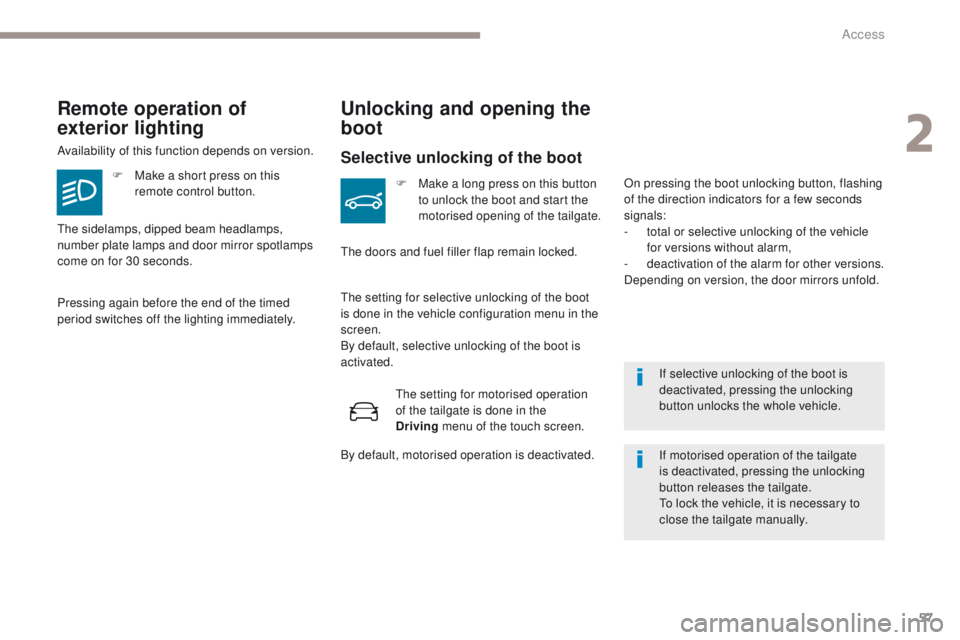
remote control button.
Pressing again before the end of the timed
period switches off the lighting immediately.
Unlocking and opening the
boot
Selective unlocking of the boot
F Make a long press on this button to unlock the boot and start the
motorised opening of the tailgate.
The doors and fuel filler flap remain locked.
The sidelamps, dipped beam headlamps,
number plate lamps and door mirror spotlamps
come on for 30 seconds.
The setting for selective unlocking of the boot
is done in the vehicle configuration menu in the
screen.
By default, selective unlocking of the boot is
activated.
If motorised operation of the tailgate
is deactivated, pressing the unlocking
button releases the tailgate.
To lock the vehicle, it is necessary to
close the tailgate manually.
On pressing the boot unlocking button, flashing
of the direction indicators for a few seconds
signals:
-
t
otal or selective unlocking of the vehicle
for versions without alarm,
-
d
eactivation of the alarm for other versions.
Depending on version, the door mirrors unfold.
The setting for motorised operation
of the tailgate is done in the
Driving
menu of the touch screen.
By default, motorised operation is deactivated.
2
Access
Page 99 of 566
97
3008-2_en_Chap03_ergonomie-et-confort_ed01-2016
Heated seats
The function is active only with the engine
running.
Switching on
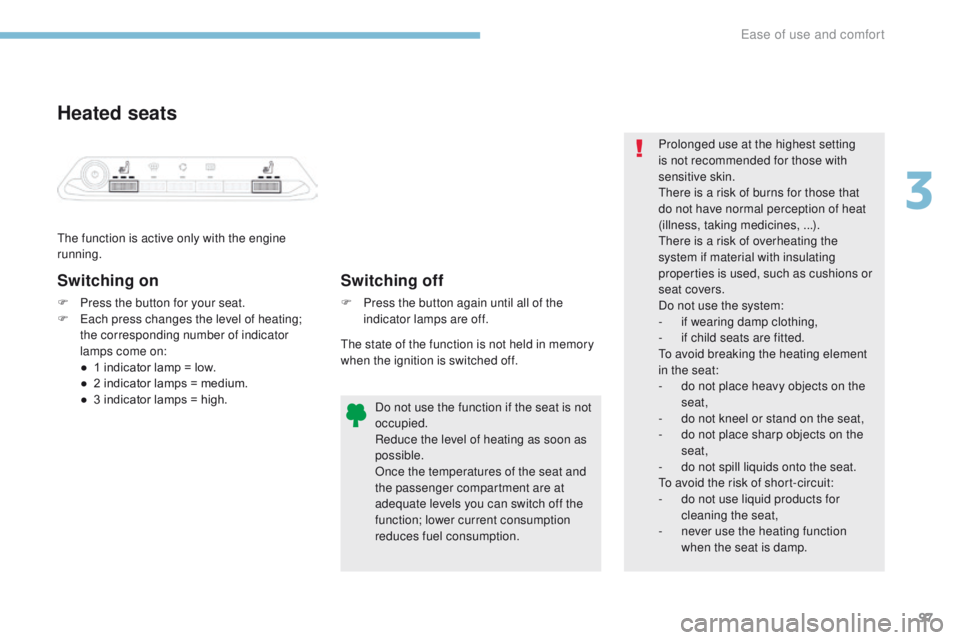
F Press the button for your seat.
F E ach press changes the level of heating;
the corresponding number of indicator
lamps come on:
●
1 i
ndicator lamp = low.
●
2 i
ndicator lamps = medium.
●
3 i
ndicator lamps = high. Do not use the function if the seat is not
occupied.
Reduce the level of heating as soon as
possible.
Once the temperatures of the seat and
the passenger compartment are at
adequate levels you can switch off the
function; lower current consumption
reduces fuel consumption.
Switching off
F Press the button again until all of the
indicator lamps are off.
The state of the function is not held in memory
when the ignition is switched off. Prolonged use at the highest setting
is not recommended for those with
sensitive skin.
There is a risk of burns for those that
do not have normal perception of heat
(illness, taking medicines, ...).
There is a risk of overheating the
system if material with insulating
properties is used, such as cushions or
seat covers.
Do not use the system:
-
i
f wearing damp clothing,
-
i
f child seats are fitted.
To avoid breaking the heating element
in the seat:
-
d
o not place heavy objects on the
seat,
-
d
o not kneel or stand on the seat,
-
d
o not place sharp objects on the
seat,
-
d
o not spill liquids onto the seat.
To avoid the risk of short-circuit:
-
d
o not use liquid products for
cleaning the seat,
-
n
ever use the heating function
when the seat is damp.
3
Ease of use and comfort
Page 120 of 566
118
3008-2_en_Chap03_ergonomie-et-confort_ed01-2016
Rear screen demist - defrost
Switching on
Switching off
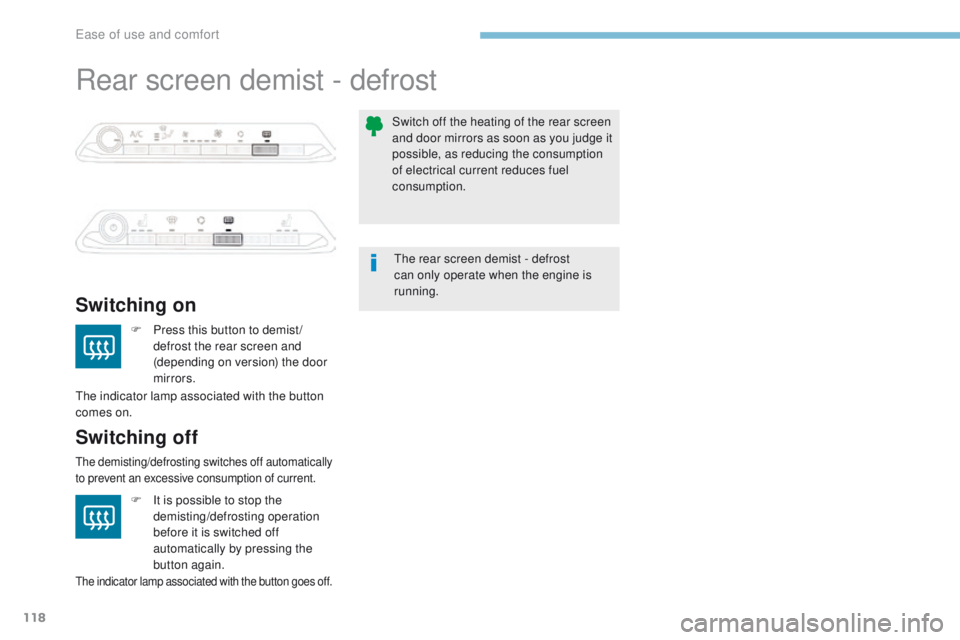
F Press this button to demist /defrost the rear screen and
(depending on version) the door
mirrors.
The demisting/defrosting switches off automatically
to prevent an excessive consumption of current.
The rear screen demist - defrost
can only operate when the engine is
running.
Switch off the heating of the rear screen
and door mirrors as soon as you judge it
possible, as reducing the consumption
of electrical current reduces fuel
consumption.
F
I
t is possible to stop the
demisting/defrosting operation
before it is switched off
automatically by pressing the
button again.
The indicator lamp associated with the button goes off.
The indicator lamp associated with the button
comes on.
Ease of use and comfort
Page 167 of 566
165
3008-2_en_Chap05_securite_ed01-2016
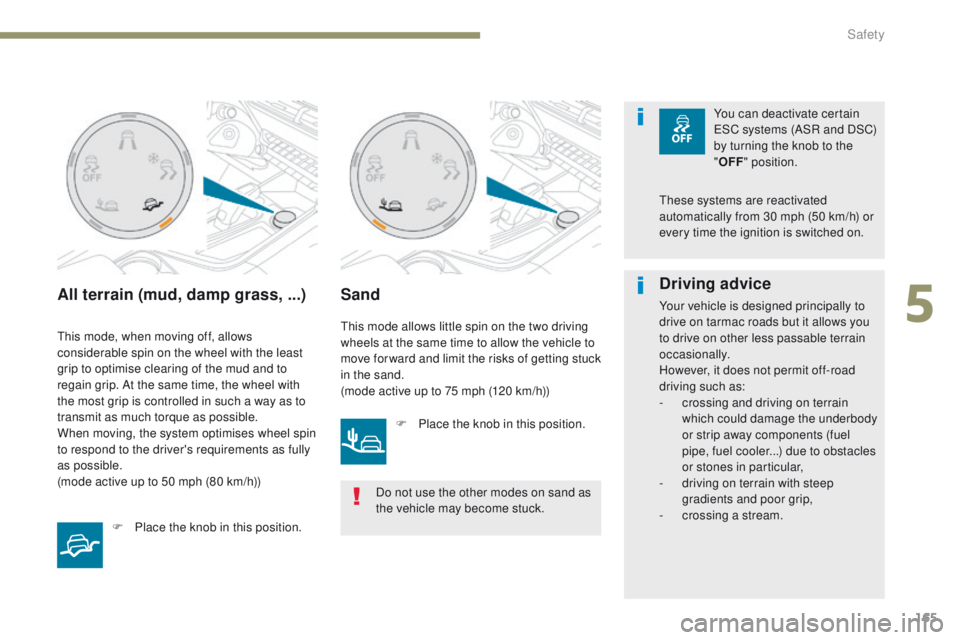
All terrain (mud, damp grass, ...)
This mode, when moving off, allows
considerable spin on the wheel with the least
grip to optimise clearing of the mud and to
regain grip. At the same time, the wheel with
the most grip is controlled in such a way as to
transmit as much torque as possible.
When moving, the system optimises wheel spin
to respond to the driver's requirements as fully
as possible.
(mode active up to 50 mph (80 km/h))F
P
lace the knob in this position.
Sand
This mode allows little spin on the two driving
wheels at the same time to allow the vehicle to
move for ward and limit the risks of getting stuck
in the sand.
(mode active up to 75 mph (120 km/h))F
P
lace the knob in this position. You can deactivate certain
ESC systems (ASR and DSC)
by turning the knob to the
"
OFF " position.
Driving advice
Your vehicle is designed principally to
drive on tarmac roads but it allows you
to drive on other less passable terrain
occasionally.
However, it does not permit off-road
driving such as:
-
c
rossing and driving on terrain
which could damage the underbody
or strip away components (fuel
pipe, fuel cooler...) due to obstacles
or stones in particular,
-
d
riving on terrain with steep
gradients and poor grip,
-
c
rossing a stream.
Do not use the other modes on sand as
the vehicle may become stuck. These systems are reactivated
automatically from 30 mph (50 km/h) or
every time the ignition is switched on.
5
Safety
Page 214 of 566
SPORT
SPORT
212
3008-2_en_Chap06_conduite_ed01-2016
Steering mounted control paddles
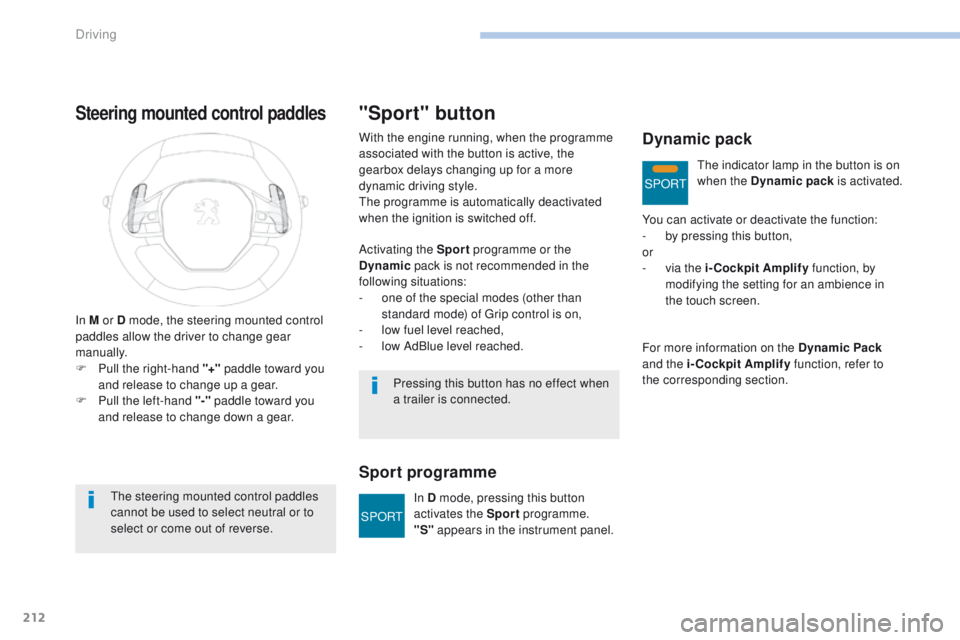
In M or D mode, the steering mounted control
paddles allow the driver to change gear
manually.
F
P
ull the right-hand "+" paddle toward you
and release to change up a gear.
F
P
ull the left-hand "-"
paddle toward you
and release to change down a gear.
The steering mounted control paddles
cannot be used to select neutral or to
select or come out of reverse.
"Sport" button
Activating the Sport programme or the
Dynamic pack is not recommended in the
following situations:
-
o
ne of the special modes (other than
standard mode) of Grip control is on,
-
l
ow fuel level reached,
-
l
ow AdBlue level reached.
Sport programme
With the engine running, when the programme
associated with the button is active, the
gearbox delays changing up for a more
dynamic driving style.
The programme is automatically deactivated
when the ignition is switched off.
Pressing this button has no effect when
a trailer is connected.In D mode, pressing this button
activates the Sport programme.
"S" appears in the instrument panel.Dynamic pack
You can activate or deactivate the function:
-
b y pressing this button,
or
-
v
ia the i-Cockpit Amplify function, by
modifying the setting for an ambience in
the touch screen.
For more information on the Dynamic Pack
and the i-Cockpit Amplify function, refer to
the corresponding section. The indicator lamp in the button is on
when the Dynamic pack
is activated.
Driving
Page 220 of 566
218
3008-2_en_Chap06_conduite_ed01-2016
Gear shift indicator*
Depending on the driving situation and your
vehicle's equipment, the system may advise
you to skip one (or more) gear(s). You can
follow this instruction without engaging the
intermediate gears.
The gear engagement recommendations must
not be considered compulsory. In fact, the
configuration of the road, the amount of traffic
and safety remain determining factors when
choosing the best gear. Therefore, the driver
remains responsible for deciding whether or not
to follow the advice given by the system.
This function cannot be deactivated.-
Y
ou press the accelerator pedal.
Example:
-
Y
ou are in third gear.
-
T
he system may suggest that you engage
a higher gear.
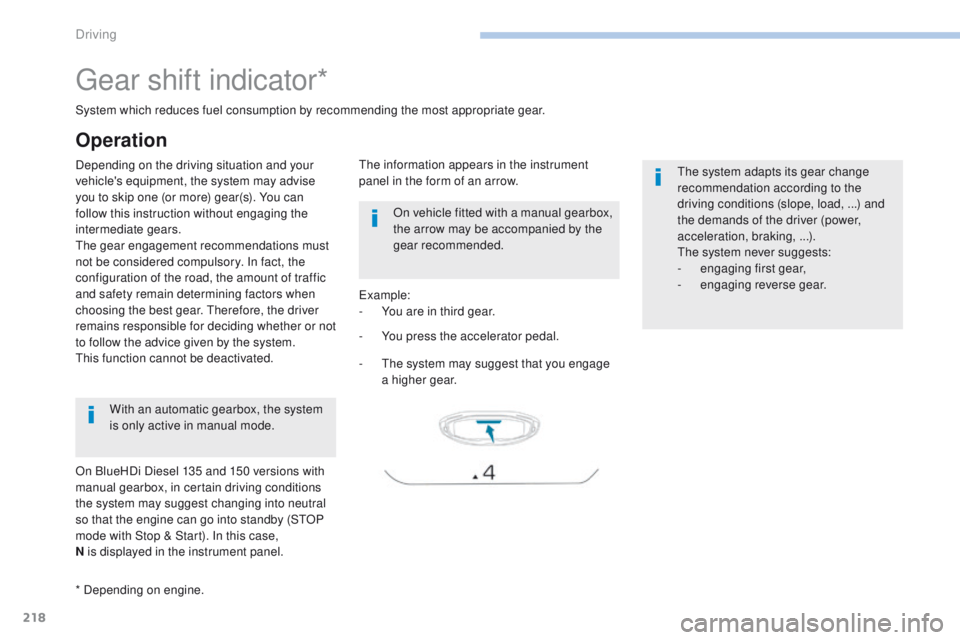
The information appears in the instrument
panel in the form of an arrow.
System which reduces fuel consumption by recommending the most appropriate gear.
With an automatic gearbox, the system
is only active in manual mode.
* Depending on engine. On vehicle fitted with a manual gearbox,
the arrow may be accompanied by the
gear recommended.
The system adapts its gear change
recommendation according to the
driving conditions (slope, load,
...) and
the demands of the driver (power,
acceleration, braking,
...).
The system never suggests:
-
e
ngaging first gear,
-
enga
ging reverse gear.
Operation
On BlueHDi Diesel 135 and 150 versions with
manual gearbox, in certain driving conditions
the system may suggest changing into neutral
so that the engine can go into standby (STOP
mode with Stop & Start). In this case,
N is displayed in the instrument panel.
Driving
Page 221 of 566
219
3008-2_en_Chap06_conduite_ed01-2016
Stop & Start
Operation
Going into engine STOP mode
This indicator lamp comes on in the
instrument panel and the engine
goes into standby automatically:
-
w
ith a manual gearbox , at speeds below
12 mph (20 km/h) or vehicle stationary with
the PureTech 130 petrol and BlueHDi 115
and 120 Diesel versions, when you place
the gear lever in neutral and you release
the clutch pedal,
A time counter calculates the sum of the
periods in STOP mode during a journey. It
resets itself to zero every time the ignition is
switched on with the key or the START/STOP
button. -
w
ith an automatic gearbox , vehicle
stationary, when you press the brake pedal
or put the gear selector in N mode.
The Stop & Start
system puts the engine
temporarily into standby - STOP mode
-
during stops in the traffic (red lights,
traffic jams,
...). The engine restarts
automatically
-
START
mode - as soon as
you want to move off. The restart takes place
instantly, quickly and silently.
Per fect for urban use, the Stop & Start system
reduces fuel consumption and exhaust
emissions as well as the noise level when
stationary.
Never refuel with the engine in
STOP
mode; you must switch off the
ignition with the key or the S TA R T/
STOP button.
For your comfort, during parking
manoeuvres, STOP mode is not
available for a few seconds after
coming out of reverse gear.
Stop & Start does not affect the
operation of vehicle systems such as
braking, power steering...
6
Driving
Page 225 of 566
223
3008-2_en_Chap06_conduite_ed01-2016
Under-inflation detection
System which automatically checks the pressures of the tyres while driving.The under-inflation detection system
does not replace the need for vigilance
on the part of the driver.
This system does not avoid the need to
check the tyre pressures (including the
spare wheel) every month as well as
before a long journey.
Driving with under-inflated tyres impairs
road holding, extends braking distances
and causes premature tyre wear,
particularly under arduous conditions
(high loading, high speed, long journey).The inflation pressures defined for
your vehicle can be found on the tyre
pressure label.
For more information on the
Identification markings
, refer to the
corresponding section.
Driving with under-inflated tyres
increases fuel consumption.
The system monitors the pressures in the four
tyres, once the vehicle is moving.
It compares the information given by the four
wheel speed sensors with reference values,
which must be reinitialised ever y time the
tyre pressures are adjusted or a wheel
changed
.
The system triggers an alert as soon as it
detects a drop in the inflation pressure of one
or more tyres.
Snow chains
The system does not have to be
reinitialised after fitting or removing
snow chains.Checking tyre pressures
This check should be done when the
tyres are "cold" (vehicle stopped for
1
hour or after a journey of less than
6
miles (10 km) at moderate speeds).
Other wise, add 0.3 bar to the pressures
shown on the label.
6
Driving
Page 283 of 566
281
3008-2_en_Chap07_infos-pratiques_ed01-2016
Fuel tank
Fuel tank capacity: approximately 53 litres.
When the low fuel level is reached in the
fuel tank, this warning lamp comes on on
the instrument panel, accompanied by
the display of a message and an audible
signal. When it first comes on there remains
approximately 6 litres of fuel in the tank.
Low fuel level
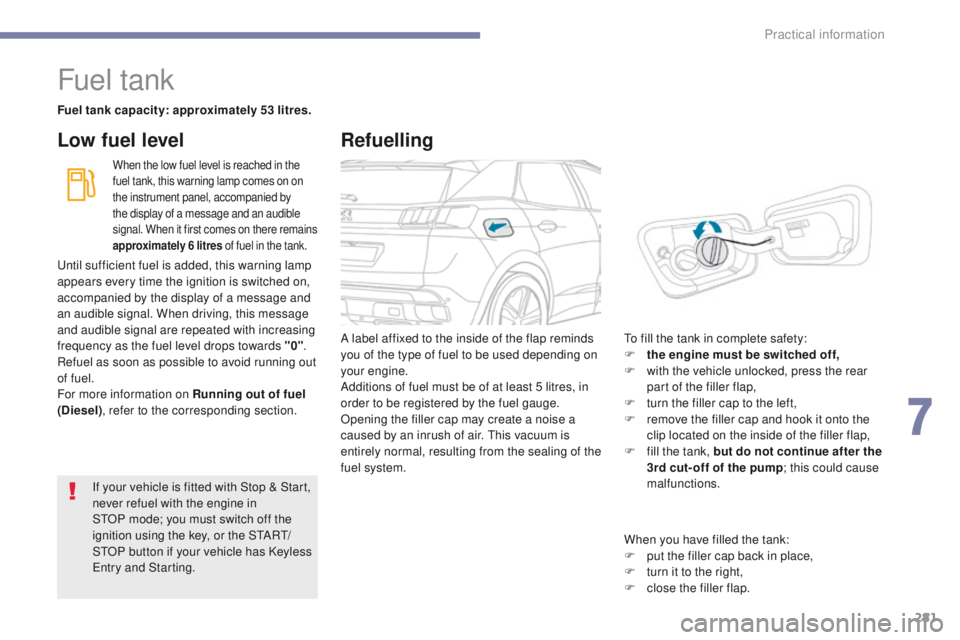
A label affixed to the inside of the flap reminds
you of the type of fuel to be used depending on
your engine.
Additions of fuel must be of at least 5 litres, in
order to be registered by the fuel gauge.
Opening the filler cap may create a noise a
caused by an inrush of air. This vacuum is
entirely normal, resulting from the sealing of the
fuel system. To fill the tank in complete safety:
F
t he engine must be switched off,
F
w
ith the vehicle unlocked, press the rear
part of the filler flap,
F
t
urn the filler cap to the left,
F
r
emove the filler cap and hook it onto the
clip located on the inside of the filler flap,
F
f
ill the tank, but do not continue after the
3rd cut- off of the pump ; this could cause
malfunctions.
If your vehicle is fitted with Stop
&
Start,
never refuel with the engine in
STOP
mode; you must switch off the
ignition using the key, or the START/
STOP button if your vehicle has Keyless
Entry and Starting.
Until sufficient fuel is added, this warning lamp
appears every time the ignition is switched on,
accompanied by the display of a message and
an audible signal. When driving, this message
and audible signal are repeated with increasing
frequency as the fuel level drops towards "0"
.
Refuel as soon as possible to avoid running out
of fuel.
For more information on Running out of fuel
(Diesel) , refer to the corresponding section.
Refuelling
When you have filled the tank:
F
p ut the filler cap back in place,
F
t
urn it to the right,
F
c
lose the filler flap.
7
Practical information