gearbox PEUGEOT 308 2017 User Guide
[x] Cancel search | Manufacturer: PEUGEOT, Model Year: 2017, Model line: 308, Model: Peugeot 308 2017Pages: 566, PDF Size: 16.05 MB
Page 197 of 566

195
3008-2_en_Chap06_conduite_ed01-2016
Driving recommendations
Observe the driving regulations and remain
vigilant whatever the traffic conditions.
Pay close attention to the traffic and keep your
hands on the wheel so that you are ready to
react at any time to any eventuality.
On a long journey, a break every two hours is
strongly recommended.
In difficult weather, drive smoothly, anticipate
the need to brake and increase the distance
from other vehicles.
Driving on flooded roads
We strongly advise against driving on flooded
roads, as this could cause serious damage
to the engine or gearbox, as well as to the
electrical systems of your vehicle.
Important!If you are obliged to drive through water:
-
c
heck that the depth of water does not
exceed 15 cm, taking account of waves
that might be generated by other users,
-
d
eactivate the Stop & Start system,
-
d
rive as slowly as possible without stalling.
In all cases, do not exceed 6 mph
(10 km/h),
-
d
o not stop and do not switch off the
engine. Never drive with the parking brake
applied - Risk of overheating and
damage to the braking system!
Risk of fire!
As the exhaust system of your vehicle
is very hot, even several minutes after
switching off the engine, do not park
or run the engine over areas where
inflammable substances and materials
are present: grass, leaves, etc.
Never leave a vehicle unsupervised
with the engine running. If you have
to leave your vehicle with the engine
running, apply the parking brake
and put the gearbox into neutral or
position
N or P, depending on the type
of gearbox.
On leaving the flooded road, as soon as
circumstances allow, make several light brake
applications to dry the brake discs and pads.
If in doubt on the state of your vehicle, contact
a PEUGEOT dealer or a qualified workshop.
6
Driving
Page 200 of 566

198
3008-2_en_Chap06_conduite_ed01-2016
Starting the engine
F With a petrol engine, operate the starter motor by turning the key to position 3
without pressing the accelerator pedal,
until the engine starts. Once the engine is
running, release the key. F
W
ith a Diesel engine, turn the key to
position 2 , ignition on, to operate the
engine pre-heating system.
Wait until this warning lamp goes off
in the instrument panel then operate
the starter motor by turning the key
to position 3 without pressing the
accelerator pedal, until the engine
starts. Once the engine is running,
release the key.
If the engine does not start straight
away, switch off the ignition. Wait a
few moments before operating the
starter motor again. If the engine does
not start after several attempts, do not
keep trying: you risk damaging the
starter motor or the engine. Contact
a PEUGEOT dealer or a qualified
workshop. Never leave the engine running in
an enclosed area without adequate
ventilation: internal combustion
engines emit toxic exhaust gases,
such as carbon monoxide. Danger of
intoxication and death!
In very severe wintry conditions
(temperatures below -23°C), to ensure
the correct operation and durability of
the mechanical components of your
vehicle, engine and gearbox, it is
necessary to leave the engine running
for 4 minutes before moving off.
In certain cases, you may have to apply
more force to the steering (wheels on
full lock, for example).
In wintry conditions, the warning lamp
can stay on for a longer period. When
the engine is hot, the warning lamp
does not come on.In temperate conditions, do not leave
the engine at idle to warm up but move
off straight away and drive at moderate
speed.
With the parking brake applied and the gearbox
in neutral or position N or P
:
F
d
epress the clutch pedal fully (manual
gearbox),
or
F
p
ress the brake pedal firmly (automatic
gearbox),
F
i
nsert the key into the ignition switch; the
system recognises the code,
F
u
nlock the steering column by simultaneously
turning the steering and the key.
Driving
Page 202 of 566
200
3008-2_en_Chap06_conduite_ed01-2016
Starting / Switching off the engine with
Keyless Entry and Starting
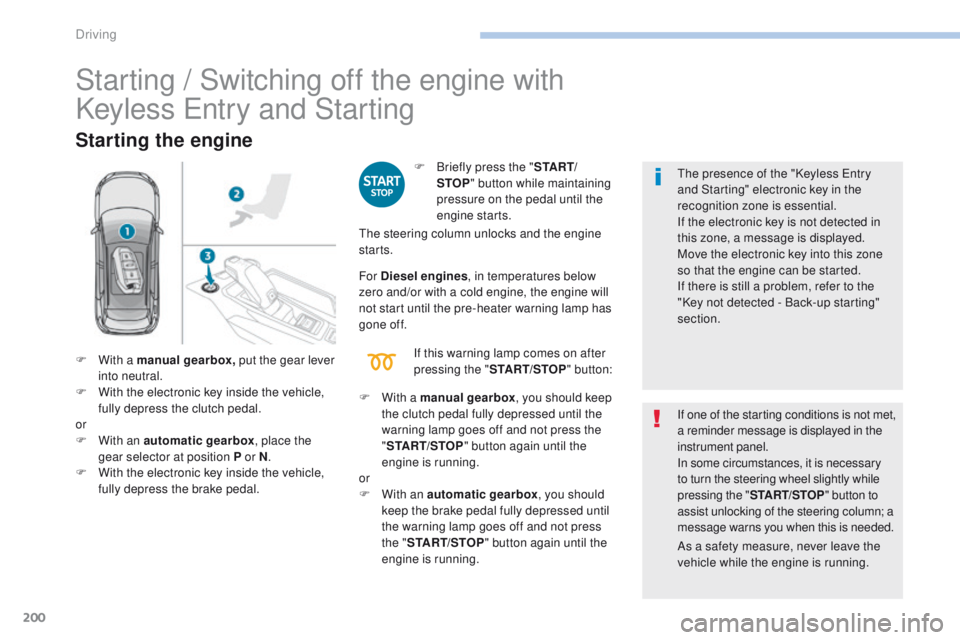
Starting the engine
F Briefly press the "S TA R T/
STOP " button while maintaining
pressure on the pedal until the
engine starts. The presence of the "Keyless Entry
and Starting" electronic key in the
recognition zone is essential.
If the electronic key is not detected in
this zone, a message is displayed.
Move the electronic key into this zone
so that the engine can be started.
If there is still a problem, refer to the
"Key not detected - Back-up starting"
section.
If one of the starting conditions is not met,
a reminder message is displayed in the
instrument panel.
In some circumstances, it is necessary
to turn the steering wheel slightly while
pressing the "
START/STOP " button to
assist unlocking of the steering column; a
message warns you when this is needed.
F
W
ith a manual gearbox , put the gear lever
into neutral.
F
W
ith the electronic key inside the vehicle,
fully depress the clutch pedal.
or
F
W
ith an automatic gearbox , place the
gear selector at position P or N .
F
W
ith the electronic key inside the vehicle,
fully depress the brake pedal. The steering column unlocks and the engine
starts.
F
W
ith a manual gearbox , you should keep
the clutch pedal fully depressed until the
warning lamp goes off and not press the
" START/STOP " button again until the
engine is running.
or
F
W
ith an automatic gearbox , you should
keep the brake pedal fully depressed until
the warning lamp goes off and not press
the " START/STOP " button again until the
engine is running.
For Diesel engines
, in temperatures below
zero and/or with a cold engine, the engine will
not start until the pre-heater warning lamp has
gone of f.
If this warning lamp comes on after
pressing the " START/STOP " button:
As a safety measure, never leave the
vehicle while the engine is running.
Driving
Page 203 of 566
201
3008-2_en_Chap06_conduite_ed01-2016
Switching off the engine
F Immobilise the vehicle, engine at idle.
F W ith a manual gearbox , put the gear lever
into neutral.
or
F
W
ith an automatic gearbox , place the
gear selector at position P or N .
Never leave your vehicle with the
electronic key still inside.
Switching off the engine leads to a loss
of braking assistance. If the vehicle is not immobilised, the
engine will not stop. F
W
ith the electronic key inside
the vehicle, press the " S TA R T/
STOP " button.
The engine stops and the steering
column locks.
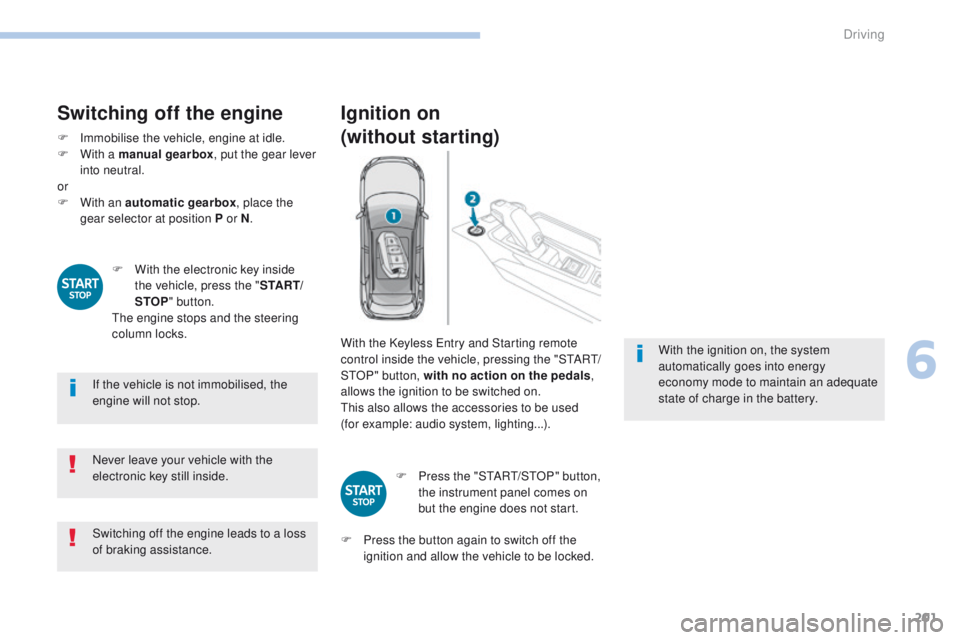
Ignition on
(without starting)
With the Keyless Entry and Starting remote
control inside the vehicle, pressing the "START/
STOP" button, with no action on the pedals ,
allows the ignition to be switched on.
This also allows the accessories to be used
(for example: audio system, lighting...).
F
P
ress the "START/STOP" button,
the instrument panel comes on
but the engine does not start.
F
P
ress the button again to switch off the
ignition and allow the vehicle to be locked. With the ignition on, the system
automatically goes into energy
economy mode to maintain an adequate
state of charge in the battery.
6
Driving
Page 204 of 566
202
3008-2_en_Chap06_conduite_ed01-2016
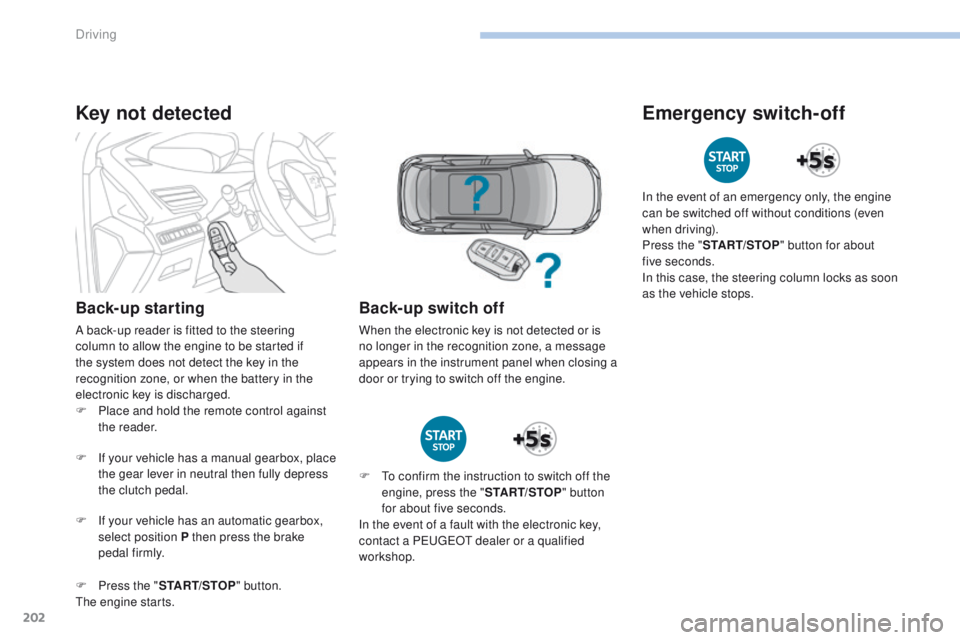
Key not detected
Back-up starting
A back-up reader is fitted to the steering
column to allow the engine to be started if
the system does not detect the key in the
recognition zone, or when the battery in the
electronic key is discharged.
F
P
lace and hold the remote control against
the reader.
F
I
f your vehicle has a manual gearbox, place
the gear lever in neutral then fully depress
the clutch pedal.
F
I
f your vehicle has an automatic gearbox,
select position P then press the brake
pedal firmly.
F
P
ress the " START/STOP " button.
The engine starts.
Emergency switch-off
In the event of an emergency only, the engine
can be switched off without conditions (even
when driving).
Press the " START/STOP " button for about
five
seconds.
In this case, the steering column locks as soon
as the vehicle stops.
F
T
o confirm the instruction to switch off the
engine, press the " START/STOP" button
for about five seconds.
In the event of a fault with the electronic key,
contact a PEUGEOT dealer or a qualified
workshop.
Back-up switch off
When the electronic key is not detected or is
no longer in the recognition zone, a message
appears in the instrument panel when closing a
door or trying to switch off the engine.
Driving
Page 205 of 566
203
3008-2_en_Chap06_conduite_ed01-2016
Electric parking brake
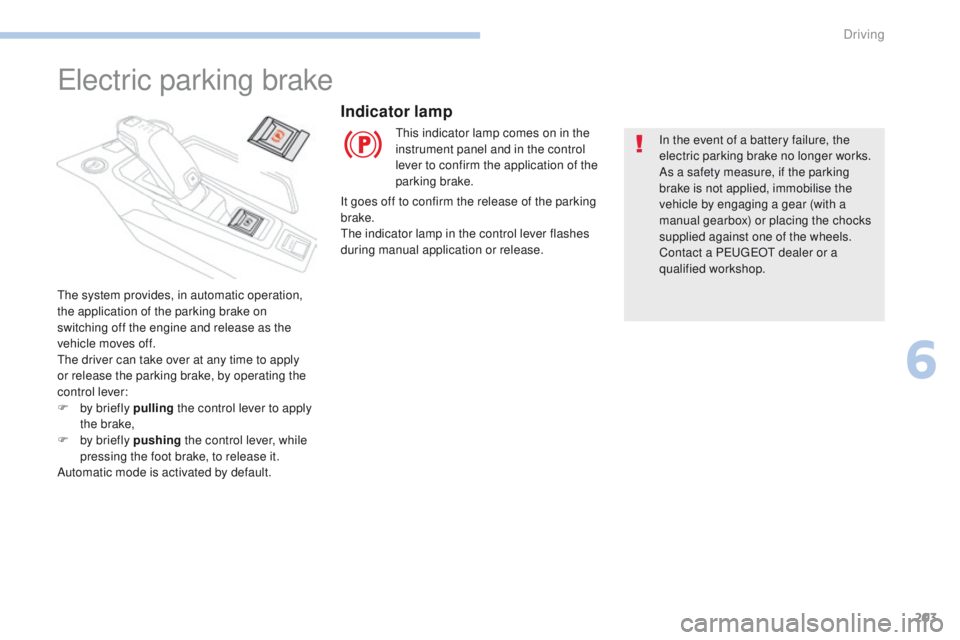
The system provides, in automatic operation,
the application of the parking brake on
switching off the engine and release as the
vehicle moves off.
The driver can take over at any time to apply
or release the parking brake, by operating the
control lever:
F
b
y briefly pulling the control lever to apply
the brake,
F
b
y briefly pushing the control lever, while
pressing the foot brake, to release it.
Automatic mode is activated by default.
Indicator lamp
This indicator lamp comes on in the
instrument panel and in the control
lever to confirm the application of the
parking brake.
It goes off to confirm the release of the parking
brake.
The indicator lamp in the control lever flashes
during manual application or release. In the event of a battery failure, the
electric parking brake no longer works.
As a safety measure, if the parking
brake is not applied, immobilise the
vehicle by engaging a gear (with a
manual gearbox) or placing the chocks
supplied against one of the wheels.
Contact a PEUGEOT dealer or a
qualified workshop.
6
Driving
Page 206 of 566
204
3008-2_en_Chap06_conduite_ed01-2016
When towing, parking on a steep slope,
or if your vehicle is heavily laden,
turn the wheels towards the kerb and
engage a gear (with a manual gearbox)
or place the gear selector at position P
with an automatic gearbox.
For towing, you vehicle is approved for
parking on slopes of up to 12%.
Manual operation
Manual application
With the vehicle stationary: briefly pull the control lever.
If you push the control lever without
pressing the brake pedal, the parking
brake will not be released and a
message is displayed.
Manual release
With the ignition on or the engine running, to
release the parking brake:
F
p
ress the brake pedal,
F
w
hile maintaining pressure on the brake
pedal, briefly push the control lever.
The complete release of the parking brake
is confirmed by the brake indicator lamp and
the
P indicator lamp in the control lever going
off, accompanied by the display of the message
"Parking brake released".
Never leave a child alone inside the
vehicle with the ignition on, as they
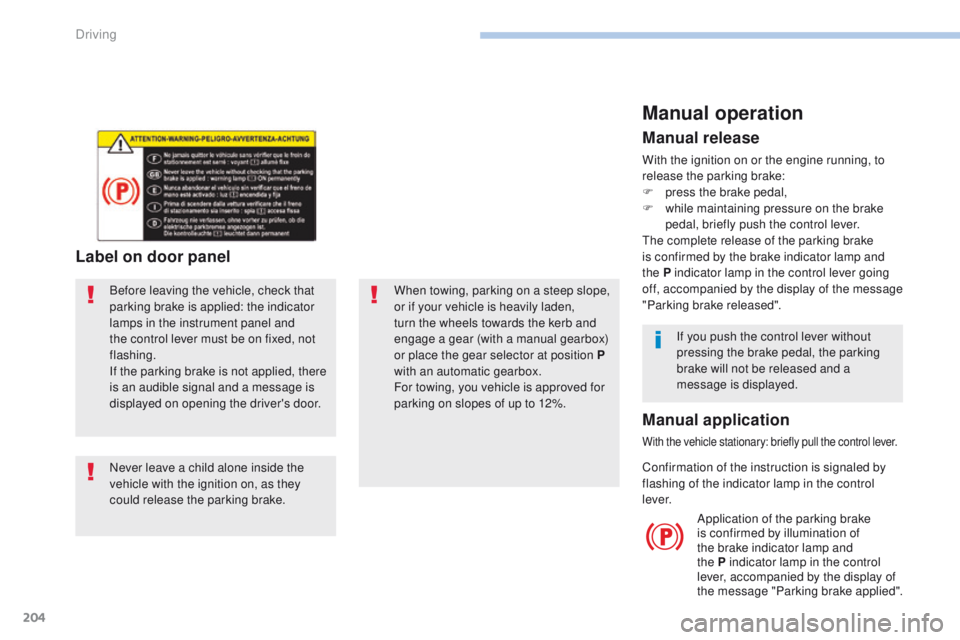
could release the parking brake. Before leaving the vehicle, check that
parking brake is applied: the indicator
lamps in the instrument panel and
the control lever must be on fixed, not
flashing.
If the parking brake is not applied, there
is an audible signal and a message is
displayed on opening the driver's door.
Label on door panel
Confirmation of the instruction is signaled by
flashing of the indicator lamp in the control
l eve r. Application of the parking brake
is confirmed by illumination of
the brake indicator lamp and
the
P indicator lamp in the control
lever, accompanied by the display of
the message "Parking brake applied".
Driving
Page 207 of 566
205
3008-2_en_Chap06_conduite_ed01-2016
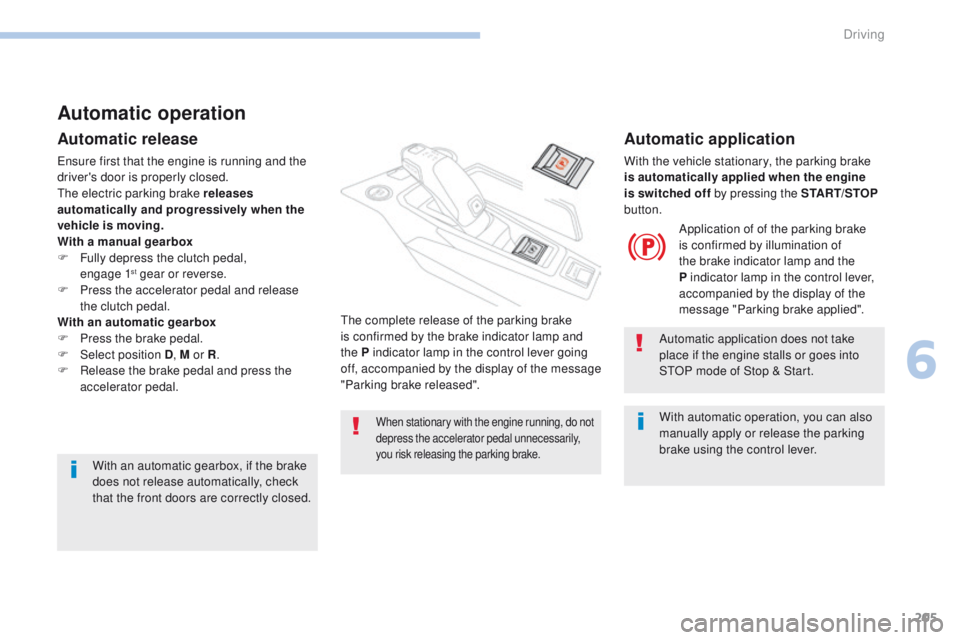
Automatic operation
Automatic release
Ensure first that the engine is running and the
driver's door is properly closed.
The electric parking brake releases
automatically and progressively when the
vehicle is moving.
With a manual gearbox
F
F
ully depress the clutch pedal,
engage 1
st gear or reverse.
F
P
ress the accelerator pedal and release
the clutch pedal.
With an automatic gearbox
F
P
ress the brake pedal.
F
Sel
ect position D , M or R.
F
R
elease the brake pedal and press the
accelerator pedal.
With an automatic gearbox, if the brake
does not release automatically, check
that the front doors are correctly closed.
When stationary with the engine running, do not
depress the accelerator pedal unnecessarily,
you risk releasing the parking brake.
The complete release of the parking brake
is confirmed by the brake indicator lamp and
the P indicator lamp in the control lever going
off, accompanied by the display of the message
"Parking brake released".
Automatic application
With the vehicle stationary, the parking brake
is automatically applied when the engine
is switched off by pressing the START/STOP
button.
Application of of the parking brake
is confirmed by illumination of
the brake indicator lamp and the
P
indicator lamp in the control lever,
accompanied by the display of the
message "Parking brake applied".
Automatic application does not take
place if the engine stalls or goes into
STOP mode of Stop & Start.
With automatic operation, you can also
manually apply or release the parking
brake using the control lever.
6
Driving
Page 208 of 566
206
3008-2_en_Chap06_conduite_ed01-2016
Special cases
In some situations, you may need to operate
the parking brake manually.
Immobilisation of the vehicle
with the engine running
To immobilise the vehicle with the engine
running, briefly pull the control lever.In very cold conditions (ice), it is
recommended that the parking brake
not be applied.
To immobilise your vehicle, engage a
gear or fit the chocks supplied against
one of the wheels.
Application of of the parking
brake is confirmed by illumination
of the brake indicator lamp and
the
P indicator lamp in the control
lever, accompanied by the display of
the message "Parking brake applied".
Parking the vehicle with the
brake released
Immobilisation of the vehicle with the
parking brake released
F
S
witch off the engine.
I
llumination of the warning lamps in the
instrument panel and control lever confirm
application of the parking brake.
F
S
witch on the ignition again, without
starting the engine.
F
R
elease the parking brake manually by
pushing the control lever while keeping
your foot on the brake. The complete release of the parking
brake is confirmed by the brake
indicator lamp and the P indicator
lamp in the control lever going off,
accompanied by the display of the
message "Parking brake released".
F
S
witch off the ignition.
With an automatic gearbox, P mode is
automatically selected when the ignition
is switched off. The wheels are blocked.
Driving
Page 211 of 566
209
3008-2_en_Chap06_conduite_ed01-2016
SituationsConsequences
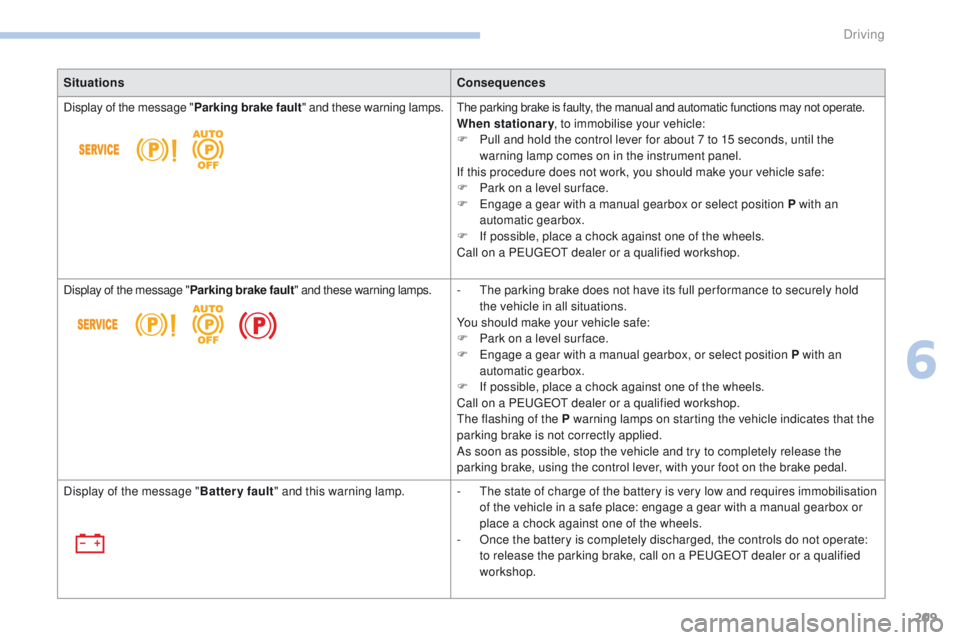
Display of the message " Parking brake fault" and these warning lamps. The parking brake is faulty, the manual and automatic functions may not operate.
When stationary, to immobilise your vehicle:
F
P
ull and hold the control lever for about 7 to 15 seconds, until the
warning lamp comes on in the instrument panel.
If this procedure does not work, you should make your vehicle safe:
F
P
ark on a level sur face.
F
E
ngage a gear with a manual gearbox or select position P with an
automatic gearbox.
F
I
f possible, place a chock against one of the wheels.
Call on a PEUGEOT dealer or a qualified workshop.
Display of the message " Parking brake fault" and these warning lamps. -
T
he parking brake does not have its full per formance to securely hold
the vehicle in all situations.
You should make your vehicle safe:
F
P
ark on a level sur face.
F
E
ngage a gear with a manual gearbox, or select position P with an
automatic gearbox.
F
I
f possible, place a chock against one of the wheels.
Call on a PEUGEOT dealer or a qualified workshop.
The flashing of the P warning lamps on starting the vehicle indicates that the
parking brake is not correctly applied.
As soon as possible, stop the vehicle and try to completely release the
parking brake, using the control lever, with your foot on the brake pedal.
Display of the message " Battery fault" and this warning lamp. -
T
he state of charge of the battery is very low and requires immobilisation
of the vehicle in a safe place: engage a gear with a manual gearbox or
place a chock against one of the wheels.
-
O
nce the battery is completely discharged, the controls do not operate:
to release the parking brake, call on a PEUGEOT dealer or a qualified
workshop.
6
Driving