height PEUGEOT 308 2017 User Guide
[x] Cancel search | Manufacturer: PEUGEOT, Model Year: 2017, Model line: 308, Model: Peugeot 308 2017Pages: 566, PDF Size: 16.05 MB
Page 147 of 566
145
3008-2_en_Chap04_eclairage-et-visibilite_ed01-2016
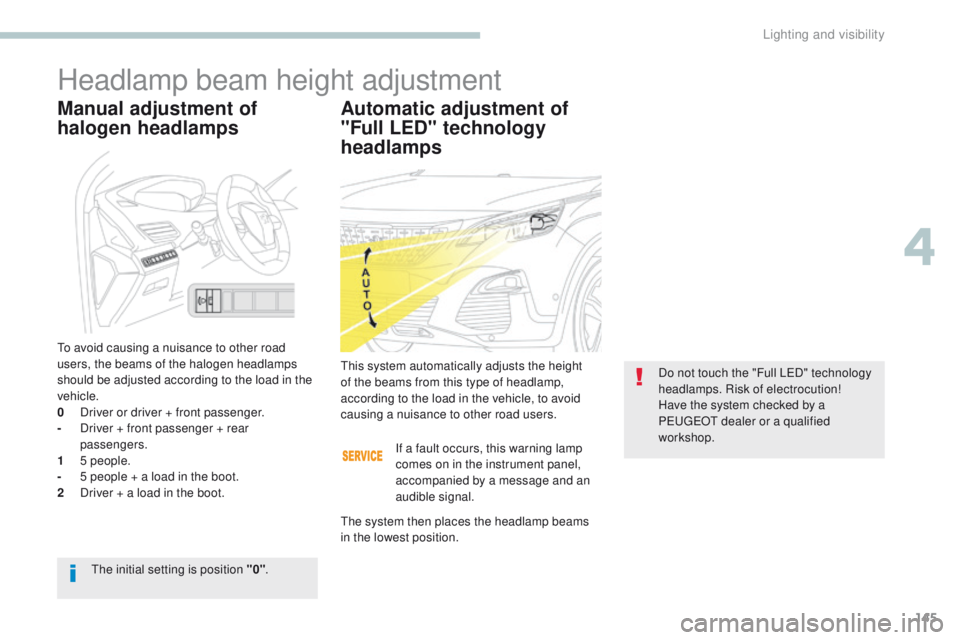
Headlamp beam height adjustment
Automatic adjustment of
"Full LED" technology
headlamps
This system automatically adjusts the height
of the beams from this type of headlamp,
according to the load in the vehicle, to avoid
causing a nuisance to other road users.Do not touch the "Full LED" technology
headlamps. Risk of electrocution!
Have the system checked by a
PEUGEOT dealer or a qualified
workshop.
The initial setting is position "0" .
Manual adjustment of
halogen headlamps
To avoid causing a nuisance to other road
users, the beams of the halogen headlamps
should be adjusted according to the load in the
vehicle.
0
D
river or driver + front passenger.
-
D
river + front passenger + rear
passengers.
1
5
people.
-
5 p
eople + a load in the boot.
2
D
river + a load in the boot. If a fault occurs, this warning lamp
comes on in the instrument panel,
accompanied by a message and an
audible signal.
The system then places the headlamp beams
in the lowest position.
4
Lighting and visibility
Page 170 of 566
168
3008-2_en_Chap05_securite_ed01-2016
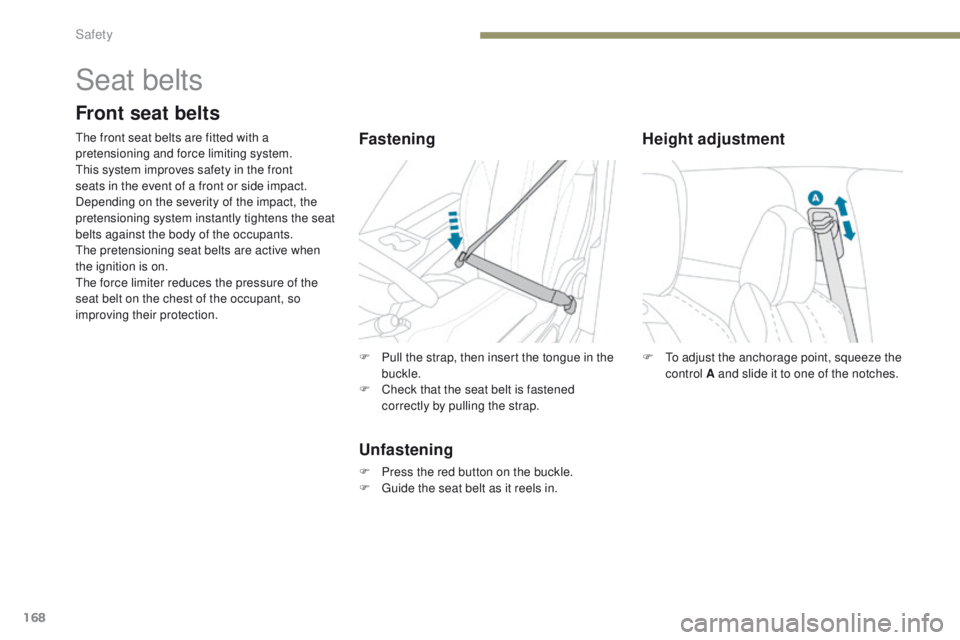
F To adjust the anchorage point, squeeze the control A and slide it to one of the notches.
Height adjustment
Seat belts
Front seat belts
The front seat belts are fitted with a
pretensioning and force limiting system.
This system improves safety in the front
seats in the event of a front or side impact.
Depending on the severity of the impact, the
pretensioning system instantly tightens the seat
belts against the body of the occupants.
The pretensioning seat belts are active when
the ignition is on.
The force limiter reduces the pressure of the
seat belt on the chest of the occupant, so
improving their protection.Fastening
Unfastening
F Press the red button on the buckle.
F G uide the seat belt as it reels in.
F
P
ull the strap, then insert the tongue in the
buckle.
F
C
heck that the seat belt is fastened
correctly by pulling the strap.
Safety
Page 186 of 566

184
3008-2_en_Chap05_securite_ed01-2016
Locations for child seats secured using the seat belt
Weight of the child / indicative age
Seat Passenger's
front airbag Under 13 kg
(groups 0 (b)
a n d 0 +)
Up to about 1
year From 9 to 18 kg
(g r o u p 1)
From 1 to about 3 years From 15 to
25 kg
(group 2)
From 3 to about 6 years From 22 to
36 kg
(group 3)
From 6 to about 10 years
Row 1 (c) Passenger seat
with height
adjustment*
Deactivated "OFF"U
UUU
Activated "ON" XUF UFUF
Passenger seat
without height
adjustment**
Deactivated "OFF"U UUU
Activated "ON" XUF UFUF
Row 2 (d) Seat behind the
driver's seat
U
UUU
Seat behind the
passenger's seat U
UUU
Centre rear seat (e) UUUU
In accordance with European regulations, this table indicates the options for installing child seats secured using the seat belt and universally
approved
(a)
in relation to the weight of the child and the seat in the vehicle.
* Fully high position.
** Backrest straightened.
Safety
Page 189 of 566

187
3008-2_en_Chap05_securite_ed01-2016
ISOFIX child seats recommended by PEUGEOT
PEUGEOT offers a range of ISOFIX child seats listed and type approved for your vehicle.Refer also to the child seat
manufacturer's fitting instructions for
information on installing and removing
the seat.
"RÖMER Baby- Safe Plus"
and its ISOFIX base (size category: E )
Group 0+: from bir th to 13 kg
Installed rearward facing using an ISOFIX
base which is attached to the rings A .
The base has a support leg, adjustable for
height, which sits on the vehicle's floor.
This child seat can also be secured with a
seat belt. In this case, only the shell is used
and attached to the vehicle's seat by the
three-point seat belt. "RÖMER Duo Plus ISOFIX"
(size category: B1 )
Group 1: from 9 to 18 kg
Is installed only in the for ward facing
position.
Is attached to the rings A and the upper
ring
B, referred to as the TOP TETHER,
using an upper strap.
Three seat body angles: sitting, reclining,
lying down.
This child seat can also be used on seats
not equipped with ISOFIX mountings. In
this case, it must be secured to the vehicle's
seat by the three-point seat belt. Adjust the
position of the vehicle's front seat so that the
child's feet are not touching the backrest.
5
Safety
Page 190 of 566

188
3008-2_en_Chap05_securite_ed01-2016
Locations for ISOFIX child seats
In line with European regulations, this table indicates the options for installing ISOFIX child seats on seats in the vehicle fitted with ISOFIX mountings.
In the case of universal and semi-universal ISOFIX child seats, the ISOFIX size category, determined by a letter from A to G, is indicated on the child
seat next to the ISOFIX logo.
Weight of the child / indicative age
Under 10 kg (group 0)
Up to about 6
monthsUnder 10 kg
(group 0)
Under 13 kg (group 0+)
Up to about 1 year From 9 to 18 kg
(g ro u p 1)
From about 1 to 3 years
Type of ISOFIX child seat CotRearward facing Rearward facing Forward facing
ISOFIX size categor y F G C D E C D A B B1
Seat
Passenger's front airbag
Row 1 (a) Passenger's seat
with height
adjustment
Deactivated
"OFF" X
IL ILIUF / ILActivated "ON"X XXIUF / IL
Passenger's seat
without height
adjustment Deactivated
"OFF" X
IL ILIUF / IL
Activated "ON"X XXIUF / IL
Row 2 Seat behind driver's
seat
IL (b)
ILILIUF / IL
Seat behind
passenger's seat IL (b)
ILILIUF / IL
Centre rear seat Not ISOFIX
Safety
Page 198 of 566
196
3008-2_en_Chap06_conduite_ed01-2016
When towing
Distribution of loads
F Distribute the load in the trailer so that the heaviest items are as close as possible to
the axle and the nose weight approaches
the maximum permitted without
exceeding
it.
Air density decreases with altitude, thus
reducing engine performance. Above
1
000 metres, the maximum towed load must
be reduced by 10
% for every 1 000 metres of
altitude.
Side wind
F Take into account the increased sensitivity to side wind.
For more information on Weights
, refer to the
corresponding section. F
I
f the warning lamp and the
STOP warning lamp come on,
stop the vehicle and switch off
the engine as soon as possible.
Braking
Towing a trailer increases the braking distance.
To avoid overheating of the brakes, the use of
engine braking is recommended.
Ty r e s
F Check the tyre pressures of the towing vehicle and of the trailer, observing the
recommended pressures.
Lighting
F Check the electrical lighting and signalling on the trailer and the headlamp beam
height of your vehicle.
For more information on Adjusting the
headlamp beam height , refer to the
corresponding section.
The rear parking sensors will be
deactivated automatically to avoid the
audible signal if a genuine PEUGEOT
towbar is used.
Cooling
Towing a trailer on a slope increases the
temperature of the coolant.
As the fan is electrically controlled, its cooling
capacity is not dependent on the engine speed.
F
T
o lower the engine speed, reduce your
speed.
The maximum towed load on a long incline
depends on the gradient and the ambient
temperature.
In all cases, keep a check on the coolant
temperature.
Driving
Page 288 of 566
286
3008-2_en_Chap07_infos-pratiques_ed01-2016
Before each use
Check that the towball is correctly fitted, verifying the follow points:
- t he towball is correctly engaged (position A ),
-
t
he safety lock is on and the key removed; the trigger can no longer be operated,
-
t
he towball must not be able to move in its carrier; test by shaking it with your hand.
If the towball is not locked, the trailer could separate - Risk of an accident!
During use
Never release the locking system with a trailer or load carrier on the towball.
Never exceed the maximum authorised weight for the vehicle plus trailer - the Gross Train
Weight or GTW.
You must not exceed the maximum nose weight on the towbar: if exceeded, this could result
in detachment from the vehicle - Risk of an accident!
Check that the trailer lighting and signalling work correctly.
Before setting off, check the adjustment of the headlamp beam height.
For more information on Adjusting the headlamp beam height , refer to the corresponding
section.
Following use
When travelling without a trailer or load on a towbar-mounted carrier, the towball must be
removed and the protective plug inserted in the carrier. This measure applies particularly
where the towball might obscure visibility of the number plate or its lighting.
Maintenance
Correct operation is only possible if the towball
and its carrier are kept clean.
Before cleaning the vehicle with a high-
pressure jet wash, the towball must be removed
and the protective plug fitted to the carrier.
Go to a PEUGEOT dealer or a qualified
workshop for any work on the towbar system.
Practical information
Page 295 of 566
293
3008-2_en_Chap07_infos-pratiques_ed01-2016
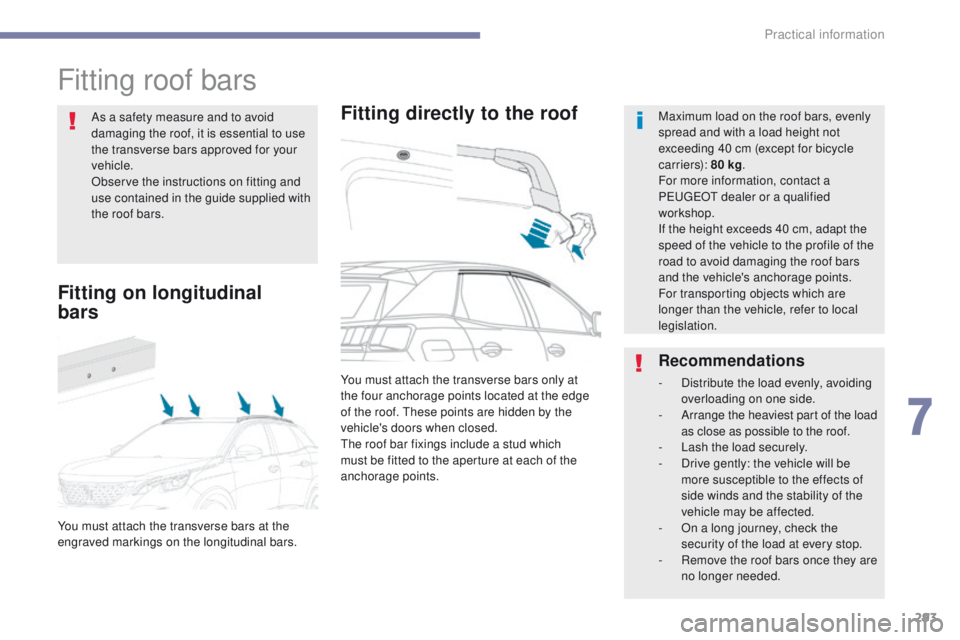
Fitting roof bars
Fitting directly to the roofMaximum load on the roof bars, evenly
spread and with a load height not
exceeding 40 cm (except for bicycle
c a r r i e r s): 80 kg.
For more information, contact a
PEUGEOT dealer or a qualified
workshop.
If the height exceeds 40 cm, adapt the
speed of the vehicle to the profile of the
road to avoid damaging the roof bars
and the vehicle's anchorage points.
For transporting objects which are
longer than the vehicle, refer to local
legislation.
Recommendations
- Distribute the load evenly, avoiding overloading on one side.
-
A
rrange the heaviest part of the load
as close as possible to the roof.
-
L
ash the load securely.
-
D
rive gently: the vehicle will be
more susceptible to the effects of
side winds and the stability of the
vehicle may be affected.
-
O
n a long journey, check the
security of the load at every stop.
-
R
emove the roof bars once they are
no longer needed.
As a safety measure and to avoid
damaging the roof, it is essential to use
the transverse bars approved for your
vehicle.
Observe the instructions on fitting and
use contained in the guide supplied with
the roof bars.
You must attach the transverse bars only at
the four anchorage points located at the edge
of the roof. These points are hidden by the
vehicle's doors when closed.
The roof bar fixings include a stud which
must be fitted to the aperture at each of the
anchorage points.
Fitting on longitudinal
bars
You must attach the transverse bars at the
engraved markings on the longitudinal bars.
7
Practical information
Page 348 of 566
346
3008-2_en_Chap11_index-alpha_ed01-2016
180° rear vision .............................................2 67Air intake .......................................................111
Air vents ........................................................104
Alarm
...............................................................70
Amplifier, audio
.............................................12 2
Anti-lock braking system (ABS)
......................................16
0, 161
Anti-theft
.......................................................197
Armrest, front
................................................124
Armrest, rear
................................................. 13
4
Assistance call
..............................................15 8
Assistance, emergency braking
...............
.................................160, 249
Audio system (r adi o)
............................................................45
C
Capacity, fuel tank .............................. ..........281
Cartridge, fragrance .............................125, 126
Central locking
.......................................... 60, 68
Changing a bulb
........................... 323, 328 , 330
Changing a fuse
............................................ 331
Changing a wheel
......................................... 309
Changing a wiper blade
................................15 4
Changing the remote control battery
........................................................... 66
C
harger, induction
......................................... 12 2
Charger, wireless
.......................................... 12 2
CHECK
................
............................................ 40
Checking the engine oil level
.......................................................... 36
Checking the levels
...............................2 97- 3 0 0
Checking tyre pressures (using the kit)
..............................
................312
Checks
...............
..................295, 296 , 301, 302
Checks, routine
..................................... 301, 302
Child lock
...............................
................193, 19 4
Children
...............................
..18 4 , 18 6 -188 , 19 0
Children (safety)
...............................
.....193 , 19 4
Backrest, folding
............................................. 92
Battery
................................... 290, 301 , 332-335
Battery, charging
........................................... 334
Battery, remote control
............................. 63,
66
Blanking screen
(snow shield)
...............................
................ 291
Blind
................................................................ 84
Blind spot monitoring system
......... 20, 260 , 262
Blind spot monitoring system, active ..................................................... 20, 262
Blind spot sensors
.................................. 20, 260
BlueHDi
..................................... 37, 40 , 303 , 308
Bonnet
........................................................... 294
Boot
..................................................... 75, 76 , 79
Brake discs
.................................................... 3
02
Brake lamps
.................................................. 328
B
Brakes ..................................................... 26, 302
Braking assistance system
......................................................... 160
Braking, automatic emergency
.............................. 21, 26 , 247 , 250
Braking, dynamic emergency
......................................... 203, 208
Bulbs (changing)
.......................... 32
3, 328 , 330
Accessories
.......................................... 15 6, 201
Active Safety Brake................... 21, 26 , 247 , 250
AdBlue
® ..................................... 3 0, 37 , 303 , 304
Additive, Diesel ............................................. 301
Adjusting headlamps
.................................... 145
Adjusting head restraints
................................ 93
Adjusting seat
..................................... 90, 91 , 94
Adjusting the air distribution
.........................111
Adjusting the air flow
..................................... 111
Adjusting the date
........................................... 45
Adjusting the height and reach of the steering wheel
.................................... 99
Adjusting the lumbar support
..............90, 91 , 94
Adjusting the seat belt height
.......................168
Adjusting the temperature
............................ 111
A
djusting the time
........................................... 45
Advanced Grip Control
................................. 16 4
Advice on driving
.................................. 195, 19 6
Airbags
.................................................... 28, 172
Airbags, curtain
..................................... 17
5, 176
Airbags, front ......................................... 173, 176
Airbags, lateral
...................................... 175, 176
Air conditioning
................................ 10, 107 , 11 0
Air conditioning, automatic
...........................105
Air conditioning, digital
.......................... 111, 11 6
Air conditioning, dual-zone automatic
............................................. 111,
11 6
Air conditioning, manual
...............105, 10 6 , 11 6
Air conditioning, mono-zone
.................108, 11 6
A
Alphabetical index