trailer PEUGEOT 308 2017 User Guide
[x] Cancel search | Manufacturer: PEUGEOT, Model Year: 2017, Model line: 308, Model: Peugeot 308 2017Pages: 566, PDF Size: 16.05 MB
Page 259 of 566
257
3008-2_en_Chap06_conduite_ed01-2016
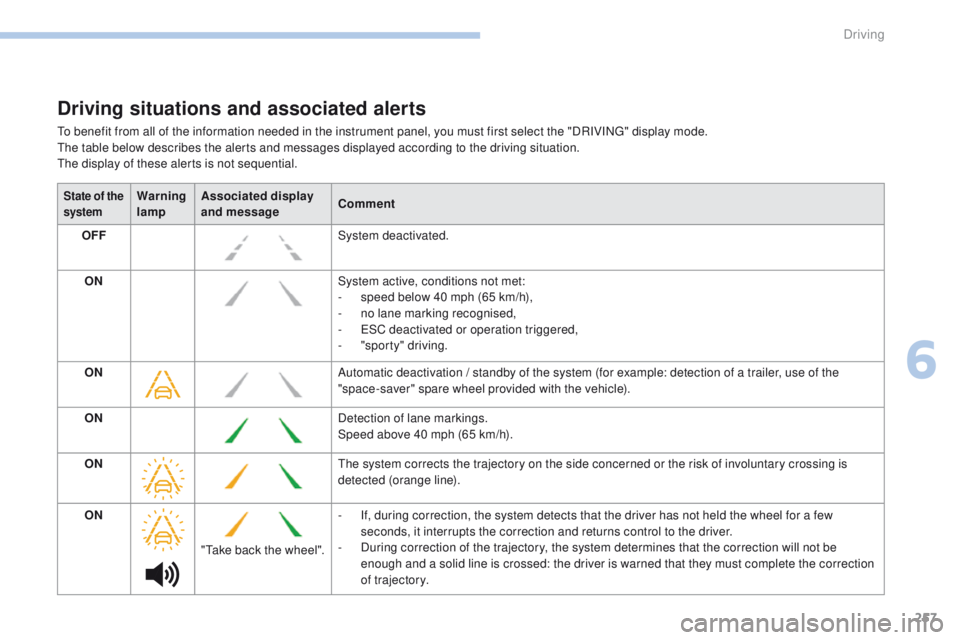
Driving situations and associated alerts
To benefit from all of the information needed in the instrument panel, you must first select the "DRIVING" display mode.
The table below describes the alerts and messages displayed according to the driving situation.
The display of these alerts is not sequential.
State of the
systemWarning
lampAssociated display
and message
Comment
OFF System deactivated.
ON System active, conditions not met:
-
s
peed below 40 mph (65 km/h),
-
n
o lane marking recognised,
-
E
SC deactivated or operation triggered,
-
"
sporty" driving.
ON Automatic deactivation / standby of the system (for example: detection of a trailer, use of the
"space-saver" spare wheel provided with the vehicle).
ON Detection of lane markings.
Speed above 40 mph (65 km/h).
ON The system corrects the trajectory on the side concerned or the risk of involuntary crossing is
detected (orange line).
ON "Take back the wheel". -
I
f, during correction, the system detects that the driver has not held the wheel for a few
seconds, it interrupts the correction and returns control to the driver.
-
D
uring correction of the trajectory, the system determines that the correction will not be
enough and a solid line is crossed: the driver is warned that they must complete the correction
of trajectory.
6
Driving
Page 260 of 566

258
3008-2_en_Chap06_conduite_ed01-2016
Limits of operation
The system goes into standby automatically in
the following cases:
-
E
SC deactivated or operation triggered,
-
s
peed below 40 mph (65 km/h) or above
112 mph (180 km/h),
-
c
onnected electrically to a trailer,
-
u
se of the "space-saver" spare
wheel detected (as detection is not
immediate, deactivation of the system is
recommended),
-
d
ynamic driving style detected, pressure
on the brake or accelerator pedal,
-
d
riving where there are no lane markings,
-
ope
ration of the direction indicators,
-
d
riving in a tight corner,
-
i
nactivity by the driver detected during
correction. The system may not operate correctly
or at all in the following situations:
-
c
onditions of poor visibility
(inadequate street lighting,
snowfall, rain, fog),
-
d
azzle (headlamps of on oncoming
vehicle, low sun, reflections on a
wet road sur face, leaving a tunnel,
alternating light and shade),
-
a
rea of the windscreen in front of
the camera dirty, misted, frosted,
snow-covered, damaged or
covered by a sticker,
-
r
oad markings absent, worn,
hidden (snow, mud) or multiple
(roadworks),
-
r
unning close to the vehicle in front
(the lane markings may not be
detected),
-
n
arrow, twisty roads.Risk of undesirable operation
Deactivation of the system is recommended in
the following situations:
-
d
riving on a road sur face in poor condition,
-
u
nfavorable weather conditions,
-
d
riving on slippery sur faces (black ice).
The system is not designed for the following
driving situations:
-
d
riving on a speed circuit,
-
d
riving with a trailer,
-
d
riving on a rolling road,
-
d
riving on unstable sur faces.
Driving
Page 263 of 566
261
3008-2_en_Chap06_conduite_ed01-2016
Operation
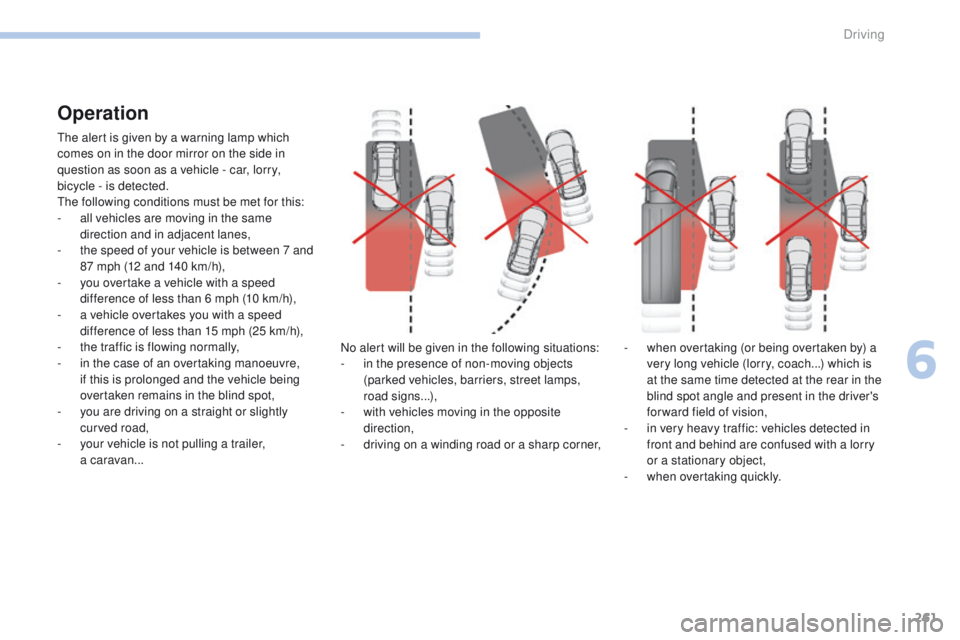
The alert is given by a warning lamp which
comes on in the door mirror on the side in
question as soon as a vehicle - car, lorry,
bicycle - is detected.
The following conditions must be met for this:
-
a
ll vehicles are moving in the same
direction and in adjacent lanes,
-
t
he speed of your vehicle is between 7 and
87 mph (12 and 140 km/h),
-
y
ou overtake a vehicle with a speed
difference of less than 6 mph (10 km/h),
-
a v
ehicle overtakes you with a speed
difference of less than 15 mph (25 km/h),
-
t
he traffic is flowing normally,
-
i
n the case of an overtaking manoeuvre,
if this is prolonged and the vehicle being
overtaken remains in the blind spot,
-
y
ou are driving on a straight or slightly
curved road,
-
y
our vehicle is not pulling a trailer,
a
caravan... No alert will be given in the following situations:
-
i
n the presence of non-moving objects
(parked vehicles, barriers, street lamps,
road signs...),
-
w
ith vehicles moving in the opposite
direction,
-
d
riving on a winding road or a sharp corner,-
w
hen overtaking (or being overtaken by) a
very long vehicle (lorry, coach...) which is
at the same time detected at the rear in the
blind spot angle and present in the driver's
forward field of vision,
-
i
n very heavy traffic: vehicles detected in
front and behind are confused with a lorry
or a stationary object,
-
w
hen overtaking quickly.
6
Driving
Page 266 of 566
264
3008-2_en_Chap06_conduite_ed01-2016
Front parking sensors
The system will be deactivated
automatically if a trailer is being
towed or a bicycle carrier is fitted on
a towbar (vehicle fitted with a towbar
installed in line with the manufacturer's
recommendations).In bad or wintry weather, ensure that
the sensors are not covered with mud,
ice or snow. When reverse gear is
engaged, an audible signal (long beep)
indicates that the sensors may be dirty.
Certain sound sources (motorcycle,
lorry, pneumatic drill, etc.) may trigger
the audible signals of the parking
sensor system.
The sound emitted by the speaker (front
or rear) indicates whether the obstacle
is in front or behind.
Deactivation / Activation
The deactivation or activation of the system
is done in the vehicle parameters menu in the
screen.
The state of the system is held in memory when
the ignition is switched off.
The parking sensors are deactivated while the
Park Assist system is measuring a space.
For more information on Park Assist
, refer to
the corresponding section.
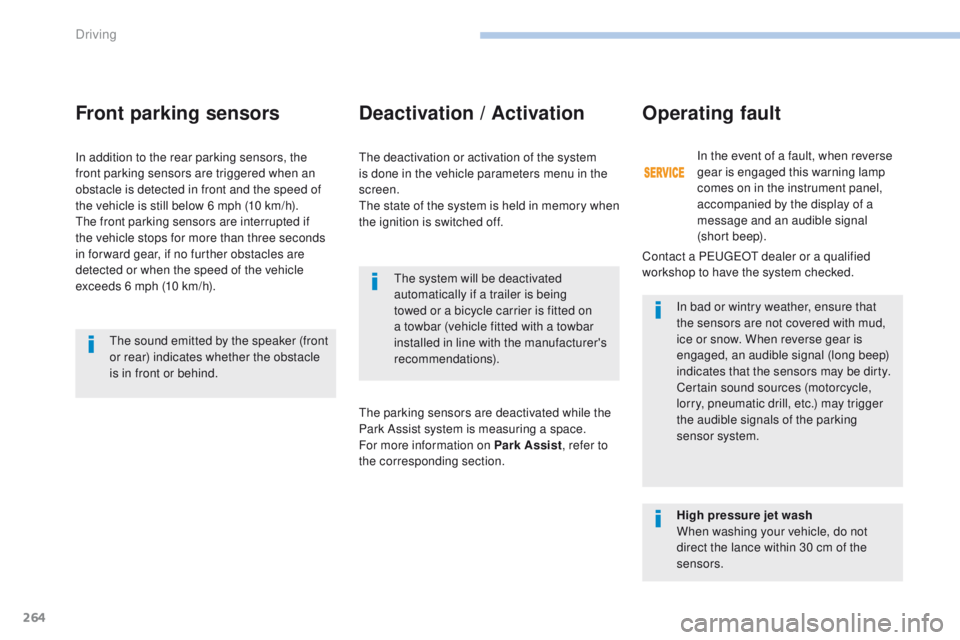
Operating fault
High pressure jet wash
When washing your vehicle, do not
direct the lance within 30 cm of the
sensors. In the event of a fault, when reverse
gear is engaged this warning lamp
comes on in the instrument panel,
accompanied by the display of a
message and an audible signal
(short beep).
Contact a PEUGEOT dealer or a qualified
workshop to have the system checked.
In addition to the rear parking sensors, the
front parking sensors are triggered when an
obstacle is detected in front and the speed of
the vehicle is still below 6 mph (10 km/h).
The front parking sensors are interrupted if
the vehicle stops for more than three seconds
in for ward gear, if no further obstacles are
detected or when the speed of the vehicle
exceeds 6 mph (10 km/h).
Driving
Page 271 of 566
269
3008-2_en_Chap06_conduite_ed01-2016
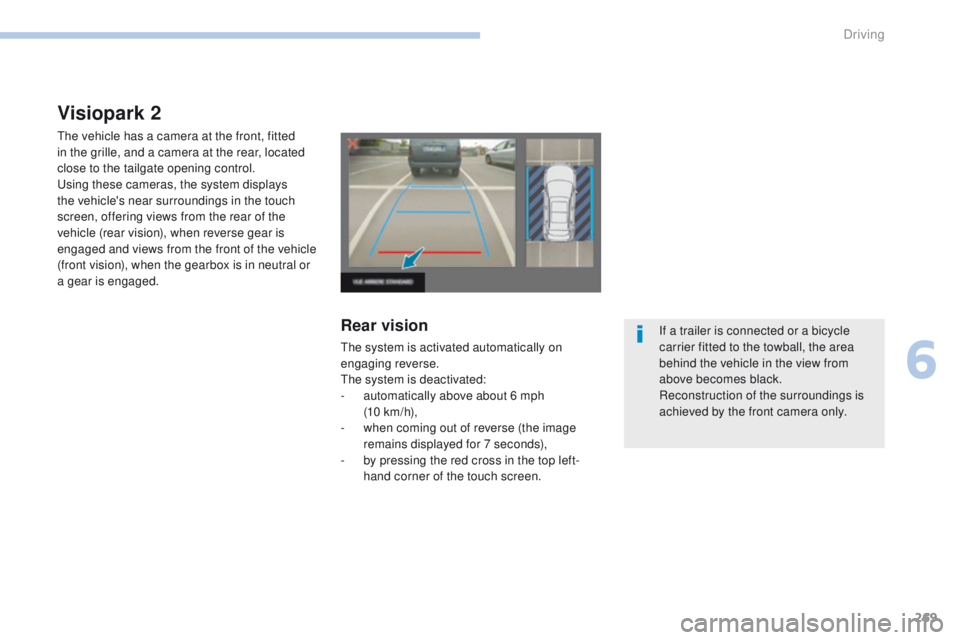
Visiopark 2
The vehicle has a camera at the front, fitted
in the grille, and a camera at the rear, located
close to the tailgate opening control.
Using these cameras, the system displays
the vehicle's near surroundings in the touch
screen, offering views from the rear of the
vehicle (rear vision), when reverse gear is
engaged and views from the front of the vehicle
(front vision), when the gearbox is in neutral or
a gear is engaged.
Rear vision
The system is activated automatically on
engaging reverse.
The system is deactivated:
-
a
utomatically above about 6 mph
(10 km/h),
-
w
hen coming out of reverse (the image
remains displayed for 7 seconds),
-
b
y pressing the red cross in the top left-
hand corner of the touch screen. If a trailer is connected or a bicycle
carrier fitted to the towball, the area
behind the vehicle in the view from
above becomes black.
Reconstruction of the surroundings is
achieved by the front camera only.
6
Driving
Page 281 of 566
279
3008-2_en_Chap06_conduite_ed01-2016
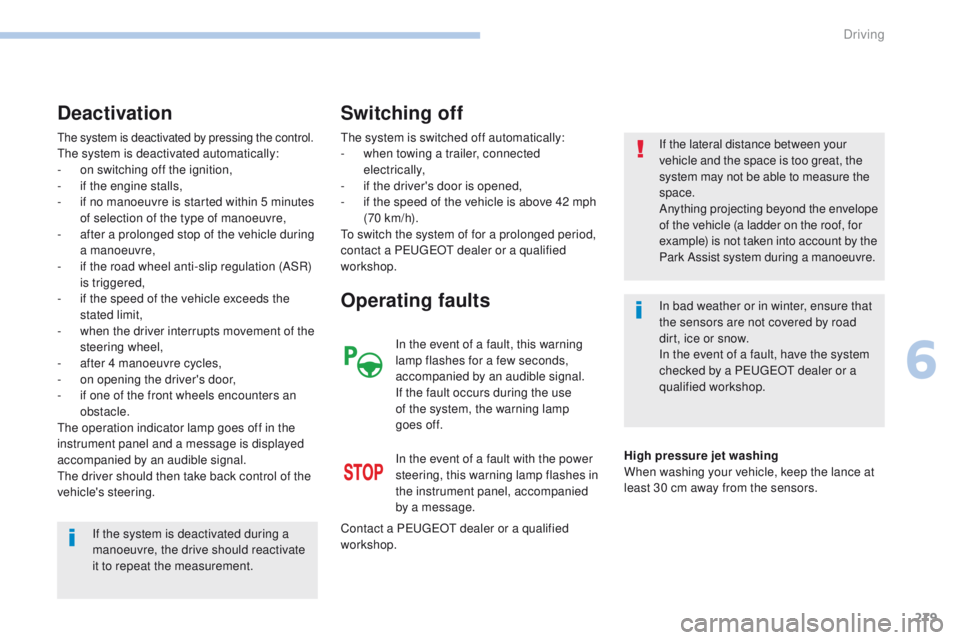
The system is deactivated by pressing the control.The system is deactivated automatically:
- o n switching off the ignition,
-
i
f the engine stalls,
-
i
f no manoeuvre is started within 5 minutes
of selection of the type of manoeuvre,
-
a
fter a prolonged stop of the vehicle during
a manoeuvre,
-
i
f the road wheel anti-slip regulation (ASR)
is triggered,
-
i
f the speed of the vehicle exceeds the
stated limit,
-
w
hen the driver interrupts movement of the
steering wheel,
-
a
fter 4 manoeuvre cycles,
-
o
n opening the driver's door,
-
i
f one of the front wheels encounters an
obstacle.
The operation indicator lamp goes off in the
instrument panel and a message is displayed
accompanied by an audible signal.
The driver should then take back control of the
vehicle's steering.
Deactivation
The system is switched off automatically:
- w hen towing a trailer, connected
electrically,
-
i
f the driver's door is opened,
-
i
f the speed of the vehicle is above 42 mph
(70 km/h).
To switch the system of for a prolonged period,
contact a PEUGEOT dealer or a qualified
workshop.
Operating faults
In the event of a fault with the power
steering, this warning lamp flashes in
the instrument panel, accompanied
by a message.
Contact a PEUGEOT dealer or a qualified
workshop.
Switching off
If the lateral distance between your
vehicle and the space is too great, the
system may not be able to measure the
space.
Anything projecting beyond the envelope
of the vehicle (a ladder on the roof, for
example) is not taken into account by the
Park Assist system during a manoeuvre.
In bad weather or in winter, ensure that
the sensors are not covered by road
dirt, ice or snow.
In the event of a fault, have the system
checked by a PEUGEOT dealer or a
qualified workshop.
If the system is deactivated during a
manoeuvre, the drive should reactivate
it to repeat the measurement. In the event of a fault, this warning
lamp flashes for a few seconds,
accompanied by an audible signal.
If the fault occurs during the use
of the system, the warning lamp
goes
off. High pressure jet washing
When washing your vehicle, keep the lance at
least 30 cm away from the sensors.
6
Driving
Page 286 of 566
284
3008-2_en_Chap07_infos-pratiques_ed01-2016
Towing a trailer
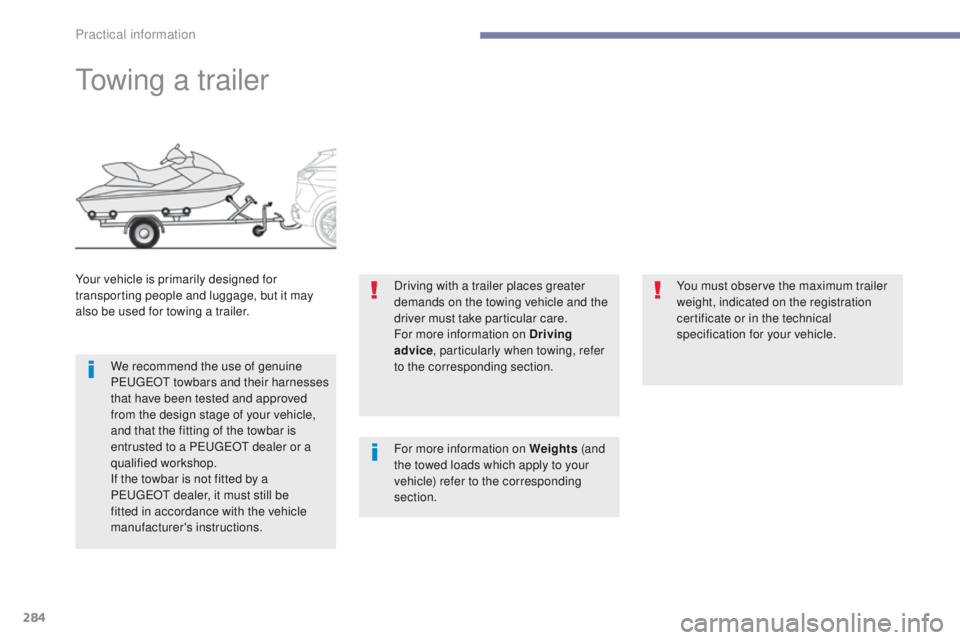
Your vehicle is primarily designed for
transporting people and luggage, but it may
also be used for towing a trailer.We recommend the use of genuine
PEUGEOT towbars and their harnesses
that have been tested and approved
from the design stage of your vehicle,
and that the fitting of the towbar is
entrusted to a PEUGEOT dealer or a
qualified workshop.
If the towbar is not fitted by a
PEUGEOT dealer, it must still be
fitted in accordance with the vehicle
manufacturer's instructions. Driving with a trailer places greater
demands on the towing vehicle and the
driver must take particular care.
For more information on Driving
advice
, particularly when towing, refer
to the corresponding section.
For more information on Weights (and
the towed loads which apply to your
vehicle) refer to the corresponding
section. You must observe the maximum trailer
weight, indicated on the registration
certificate or in the technical
specification for your vehicle.
Practical information
Page 287 of 566
285
3008-2_en_Chap07_infos-pratiques_ed01-2016
Towbar with quickly detachable towball
Presentation
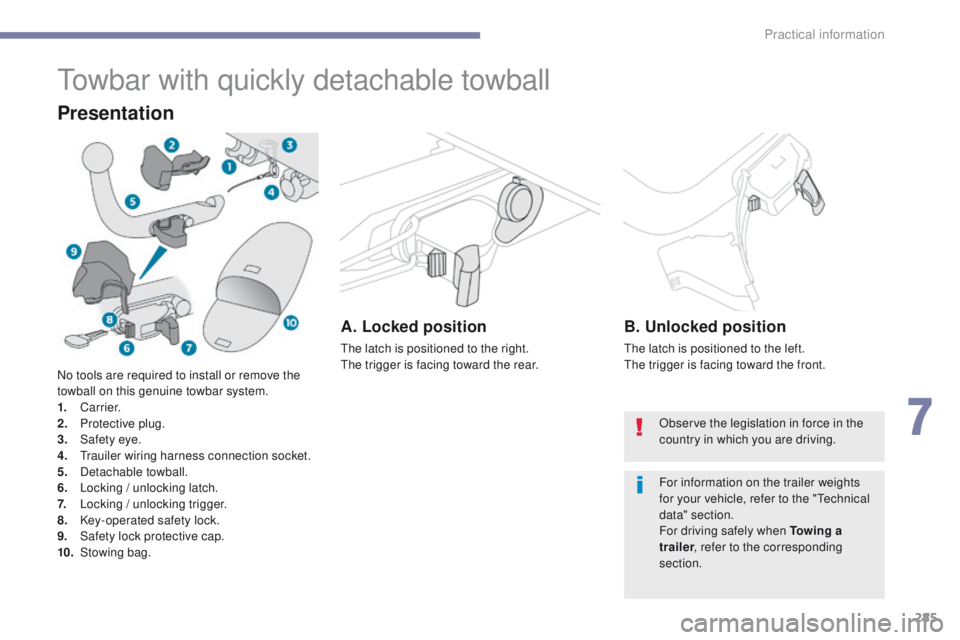
A. Locked position
The latch is positioned to the right.
The trigger is facing toward the rear.
B. Unlocked position
The latch is positioned to the left.
The trigger is facing toward the front.Observe the legislation in force in the
country in which you are driving.
For information on the trailer weights
for your vehicle, refer to the "Technical
data" section.
For driving safely when Towing a
trailer, refer to the corresponding
section.
No tools are required to install or remove the
towball on this genuine towbar system.
1.
Carrier.
2.
P
rotective plug.
3.
S
afety eye.
4.
T
rauiler wiring harness connection socket.
5.
D
etachable towball.
6.
L
ocking / unlocking latch.
7.
L
ocking / unlocking trigger.
8.
K
ey-operated safety lock.
9.
S
afety lock protective cap.
10.
S
towing bag.
7
Practical information
Page 288 of 566
286
3008-2_en_Chap07_infos-pratiques_ed01-2016
Before each use
Check that the towball is correctly fitted, verifying the follow points:
- t he towball is correctly engaged (position A ),
-
t
he safety lock is on and the key removed; the trigger can no longer be operated,
-
t
he towball must not be able to move in its carrier; test by shaking it with your hand.
If the towball is not locked, the trailer could separate - Risk of an accident!
During use
Never release the locking system with a trailer or load carrier on the towball.
Never exceed the maximum authorised weight for the vehicle plus trailer - the Gross Train
Weight or GTW.
You must not exceed the maximum nose weight on the towbar: if exceeded, this could result
in detachment from the vehicle - Risk of an accident!
Check that the trailer lighting and signalling work correctly.
Before setting off, check the adjustment of the headlamp beam height.
For more information on Adjusting the headlamp beam height , refer to the corresponding
section.
Following use
When travelling without a trailer or load on a towbar-mounted carrier, the towball must be
removed and the protective plug inserted in the carrier. This measure applies particularly
where the towball might obscure visibility of the number plate or its lighting.
Maintenance
Correct operation is only possible if the towball
and its carrier are kept clean.
Before cleaning the vehicle with a high-
pressure jet wash, the towball must be removed
and the protective plug fitted to the carrier.
Go to a PEUGEOT dealer or a qualified
workshop for any work on the towbar system.
Practical information
Page 290 of 566
288
3008-2_en_Chap07_infos-pratiques_ed01-2016
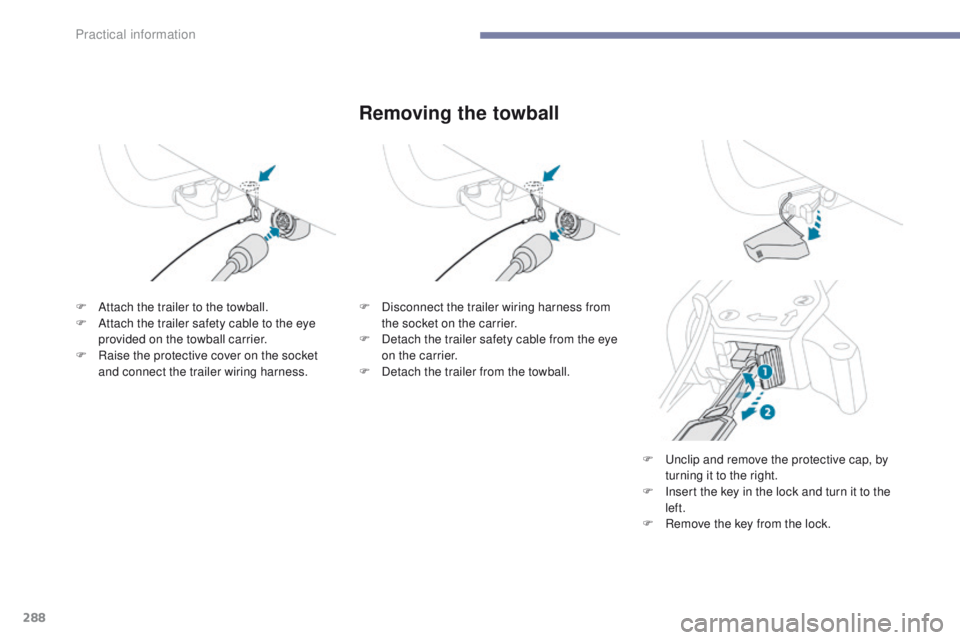
Removing the towball
F Attach the trailer to the towball.
F A ttach the trailer safety cable to the eye
provided on the towball carrier.
F
R
aise the protective cover on the socket
and connect the trailer wiring harness. F
D isconnect the trailer wiring harness from
the socket on the carrier.
F
D
etach the trailer safety cable from the eye
on the carrier.
F
D
etach the trailer from the towball.
F
U
nclip and remove the protective cap, by
turning it to the right.
F
I
nsert the key in the lock and turn it to the
left.
F
R
emove the key from the lock.
Practical information