weight PEUGEOT 308 2017 User Guide
[x] Cancel search | Manufacturer: PEUGEOT, Model Year: 2017, Model line: 308, Model: Peugeot 308 2017Pages: 566, PDF Size: 16.05 MB
Page 288 of 566
286
3008-2_en_Chap07_infos-pratiques_ed01-2016
Before each use
Check that the towball is correctly fitted, verifying the follow points:
- t he towball is correctly engaged (position A ),
-
t
he safety lock is on and the key removed; the trigger can no longer be operated,
-
t
he towball must not be able to move in its carrier; test by shaking it with your hand.
If the towball is not locked, the trailer could separate - Risk of an accident!
During use
Never release the locking system with a trailer or load carrier on the towball.
Never exceed the maximum authorised weight for the vehicle plus trailer - the Gross Train
Weight or GTW.
You must not exceed the maximum nose weight on the towbar: if exceeded, this could result
in detachment from the vehicle - Risk of an accident!
Check that the trailer lighting and signalling work correctly.
Before setting off, check the adjustment of the headlamp beam height.
For more information on Adjusting the headlamp beam height , refer to the corresponding
section.
Following use
When travelling without a trailer or load on a towbar-mounted carrier, the towball must be
removed and the protective plug inserted in the carrier. This measure applies particularly
where the towball might obscure visibility of the number plate or its lighting.
Maintenance
Correct operation is only possible if the towball
and its carrier are kept clean.
Before cleaning the vehicle with a high-
pressure jet wash, the towball must be removed
and the protective plug fitted to the carrier.
Go to a PEUGEOT dealer or a qualified
workshop for any work on the towbar system.
Practical information
Page 338 of 566
336
3008-2_en_Chap08_en cas-de-panne_ed01-2016
Towing the vehicle
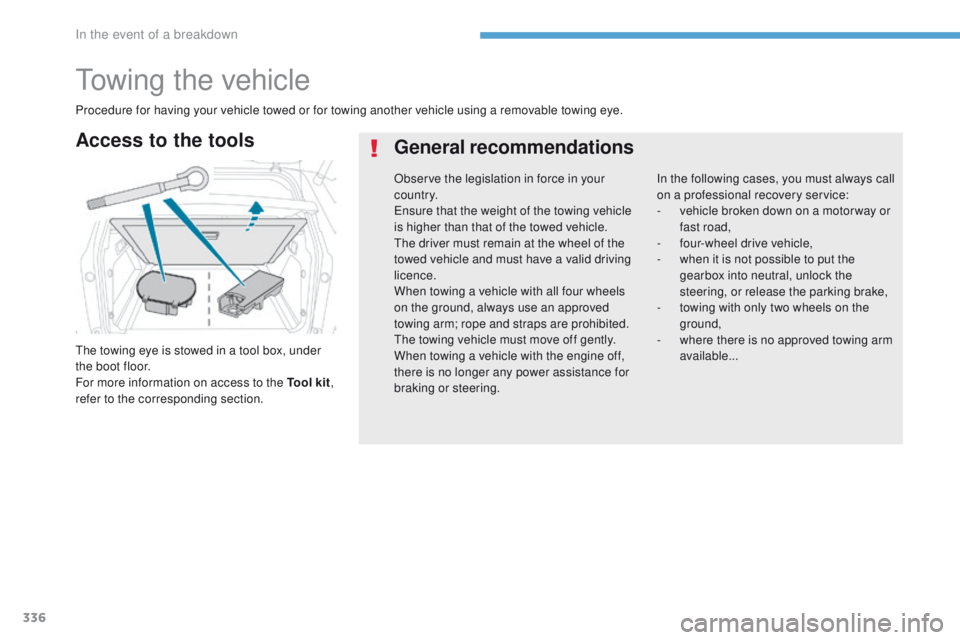
The towing eye is stowed in a tool box, under
the boot floor.
For more information on access to the Tool kit,
refer to the corresponding section.
Access to the tools General recommendations
In the following cases, you must always call
on a professional recovery service:
-
v
ehicle broken down on a motor way or
fast road,
-
f
our-wheel drive vehicle,
-
w
hen it is not possible to put the
gearbox into neutral, unlock the
steering, or release the parking brake,
-
t
owing with only two wheels on the
ground,
-
w
here there is no approved towing arm
available...
Procedure for having your vehicle towed or for towing another vehicle using a removable towing eye.
Observe the legislation in force in your
c o unt r y.
Ensure that the weight of the towing vehicle
is higher than that of the towed vehicle.
The driver must remain at the wheel of the
towed vehicle and must have a valid driving
licence.
When towing a vehicle with all four wheels
on the ground, always use an approved
towing arm; rope and straps are prohibited.
The towing vehicle must move off gently.
When towing a vehicle with the engine off,
there is no longer any power assistance for
braking or steering.
In the event of a breakdown
Page 341 of 566
339
3008-2_en_Chap09_caracteristiques_ed01-2016
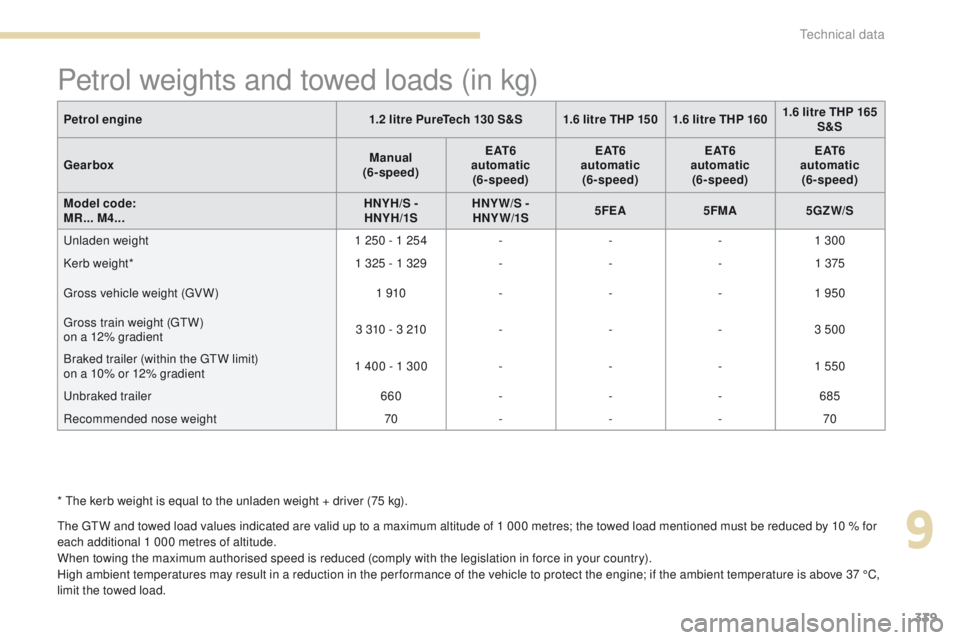
Petrol weights and towed loads (in kg)
The GTW and towed load values indicated are valid up to a maximum altitude of 1 000 metres; the towed load mentioned must be reduced by 10 % for
each additional 1 000 metres of altitude.
When towing the maximum authorised speed is reduced (comply with the legislation in force in your country).
High ambient temperatures may result in a reduction in the per formance of the vehicle to protect the engine; if the ambient temperature is above 37 °C,
limit the towed load.Petrol engine
1.2 litre PureTech 130 S&S 1.6 litre THP 150 1.6 litre THP 160 1.6 litre THP 165
S&S
Gearbox Manual
(6- speed) E AT 6
automatic (6- speed) E AT 6
automatic (6- speed) E AT 6
automatic (6- speed) E AT 6
automatic (6- speed)
Model code:
MR... M4... HNYH/S -
HNYH/1S HNY W/S -
HNY W/1S 5FEA
5FMA5GZW/S
Unladen weight 1 250 - 1 254---1 300
Kerb weight* 1 325 - 1 329---1 375
Gross vehicle weight (GV W) 1 910---1 950
Gross train weight (GTW)
on a 12% gradient 3 310 - 3 210
---3 500
Braked trailer (within the GTW limit)
on a 10% or 12% gradient 1 400 - 1 300
---1 550
Unbraked trailer 660---685
Recommended nose weight 70---70
* The kerb weight is equal to the unladen weight + driver (75 kg).
9
Technical data
Page 344 of 566
342
3008-2_en_Chap09_caracteristiques_ed01-2016
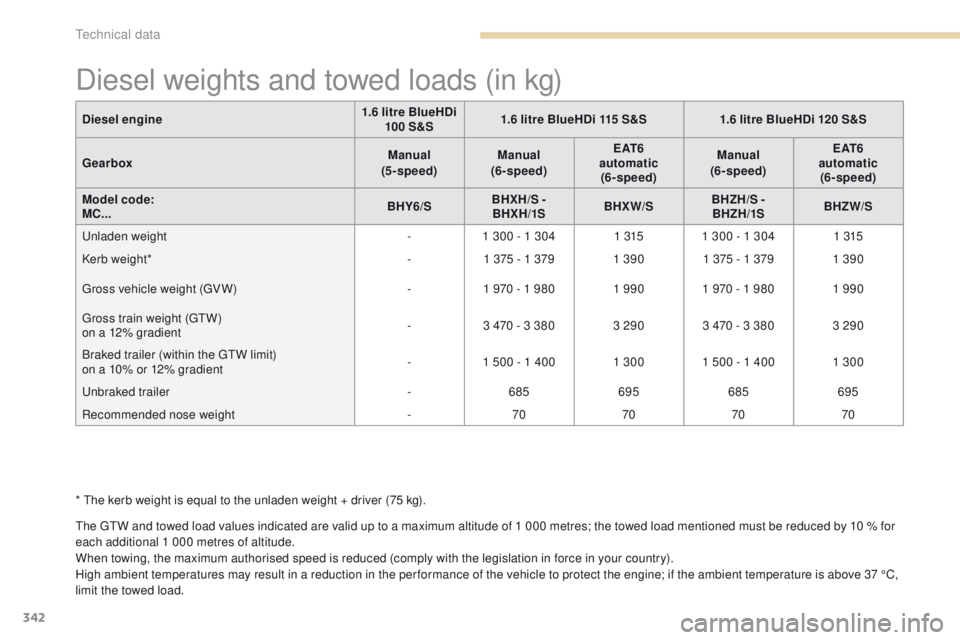
Diesel weights and towed loads (in kg)
The GTW and towed load values indicated are valid up to a maximum altitude of 1 000 metres; the towed load mentioned must be reduced by 10 % for
each additional 1 000 metres of altitude.
When towing, the maximum authorised speed is reduced (comply with the legislation in force in your country).
High ambient temperatures may result in a reduction in the per formance of the vehicle to protect the engine; if the ambient temperature is above 37 °C,
limit the towed load.Diesel engine
1.6 litre BlueHDi
100 S&S 1.6 litre BlueHDi 115 S&S
1.6 litre BlueHDi 120 S&S
Gearbox Manual
(5 -speed ) Manual
(6- speed) E AT 6
automatic (6- speed) Manual
(6- speed) E AT 6
automatic (6- speed)
Model code:
MC... BHY6/SBHXH/S -
BHXH/1S BHXW/SBHZH/S -
BHZH/1S BHZW/S
Unladen weight -1 300 - 1 304 1 3151 300 - 1 304 1 315
Kerb weight* -1 375 - 1 379 1 390 1 375 - 1 379 1 390
Gross vehicle weight (GV W) -1 970 - 1 980 1 990 1 970 - 1 980 1 990
Gross train weight (GTW)
on a 12% gradient -
3 470 - 3 380 3 290 3 470 - 3 380 3 290
Braked trailer (within the GTW limit)
on a 10% or 12% gradient -
1 500 - 1 400 1 300 1 500 - 1 400 1 300
Unbraked trailer -685 695685695
Recommended nose weight -70 707070
* The kerb weight is equal to the unladen weight + driver (75 kg).
Technical data
Page 345 of 566
343
3008-2_en_Chap09_caracteristiques_ed01-2016
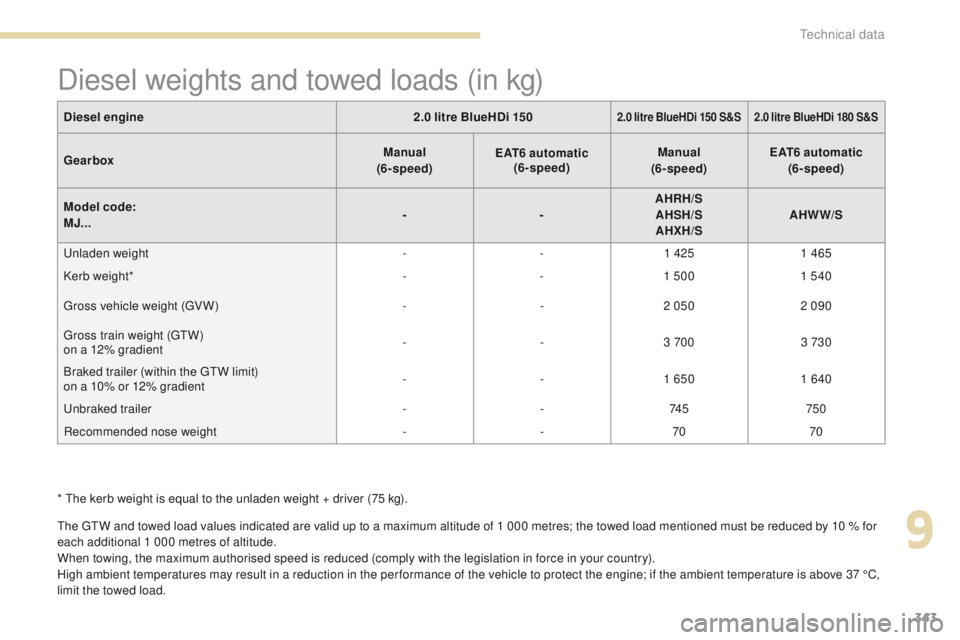
The GTW and towed load values indicated are valid up to a maximum altitude of 1 000 metres; the towed load mentioned must be reduced by 10 % for
each additional 1 000 metres of altitude.
When towing, the maximum authorised speed is reduced (comply with the legislation in force in your country).
High ambient temperatures may result in a reduction in the per formance of the vehicle to protect the engine; if the ambient temperature is above 37 °C,
limit the towed load.Diesel engine
2.0 litre BlueHDi 150
2.0 litre BlueHDi 150 S&S 2.0 litre BlueHDi 180 S&S
GearboxManual
(6- speed) EAT6 automatic
(6- speed) Manual
(6- speed) EAT6 automatic
(6- speed)
Model code:
MJ... -
-AHRH/S
AHSH/S
AHXH/S AHWW/S
Unladen weight --1 425 1 465
Kerb weight* --1 500 1 540
Gross vehicle weight (GV W) --2 050 2 090
Gross train weight (GTW)
on a 12% gradient -
-3 700 3 730
Braked trailer (within the GTW limit)
on a 10% or 12% gradient -
-1 650 1 640
Unbraked trailer --74 5 750
Recommended nose weight --70 70
* The kerb weight is equal to the unladen weight + driver (75 kg).
Diesel weights and towed loads (in kg)
9
Technical data
Page 347 of 566
345
3008-2_en_Chap09_caracteristiques_ed01-2016
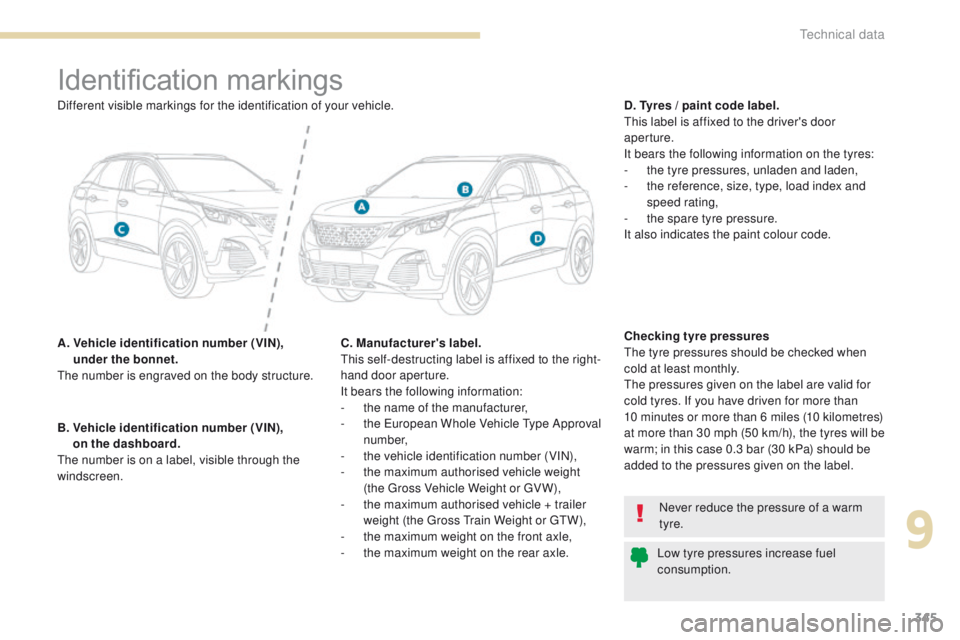
Identification markings
A. Vehicle identification number (VIN), under the bonnet.
The number is engraved on the body structure. D. Tyres / paint code label.
This label is affixed to the driver's door
aperture.
It bears the following information on the tyres:
-
t
he tyre pressures, unladen and laden,
-
t
he reference, size, type, load index and
speed rating,
-
t
he spare tyre pressure.
It also indicates the paint colour code.
B.
V
ehicle identification number (VIN),
on the dashboard.
The number is on a label, visible through the
windscreen.
Never reduce the pressure of a warm
tyre.
Low tyre pressures increase fuel
consumption.
Different visible markings for the identification of your vehicle.
Checking tyre pressures
The tyre pressures should be checked when
cold at least monthly.
The pressures given on the label are valid for
cold tyres. If you have driven for more than
10 minutes or more than 6 miles (10 kilometres)
at more than 30 mph (50 km/h), the tyres will be
warm; in this case 0.3 bar (30 kPa) should be
added to the pressures given on the label.
C. Manufacturer's label.
This self-destructing label is affixed to the right-
hand door aperture.
It bears the following information:
-
t
he name of the manufacturer,
-
t
he European Whole Vehicle Type Approval
number,
-
t
he vehicle identification number (VIN),
-
t
he maximum authorised vehicle weight
(the Gross Vehicle Weight or GV W),
-
t
he maximum authorised vehicle + trailer
weight (the Gross Train Weight or GTW),
-
t
he maximum weight on the front axle,
-
t
he maximum weight on the rear axle.
9
Technical data
Page 352 of 566
350
3008-2_en_Chap11_index-alpha_ed01-2016
Range, AdBlue .................................... 30, 37 , 38
Rear screen, demisting .................................118
Recharging the battery
................................. 33
4
Reduction of electrical load
..........................290
Regeneration of the particle filter
.......................................... 301
Reinitialisation of the under-inflation detection system
.................................224 , 225
Reinitialising the remote control
........................................................... 67
R
eminder, key in ignition ...............................19 9
Remote control
........................ 5
4-56, 60, 62, 63
Removing a wheel
........................................ 319
Removing the mat
......................................... 127
Replacing bulbs
........................... 323, 328 , 330
Replacing fuses
..............................
..............331
Replacing the air filter
...................................301
Replacing the oil filter
................................... 3
01
Replacing the passenger compartment filter
...................................... 301
Reservoir, screenwash
................................. 29
9
Resetting the service indicator
.......................35
Resetting the trip recorder
..............................41
Reset trip
......................................................... 43
R
ev counter
..................................................... 12
Reversing lamps
........................................... 328
Roof bars
....................................................... 2
93
Running out of fuel (Diesel)
..........................3
08 Table of weights
....................................339,
342
Table position
..................................................92
Tables of engines
.................................338, 340
Tailgate
................
............................................75
Ta n k , f u e l
...............................................281, 282
Technical data
...............................338-340, 342
Telephone
.....................................................12 2
Temperature, coolant
......................................32
Third brake lamp
...........................................330
Three flashes (direction indicators)
...................................14 4
T
Starting using another
battery ................................................ 2
02, 333
Stay, bonnet
.................................................. 294
Steering wheel, adjustment
.................................................... 99
S
topping the vehicle
.....................197, 200 , 2 11
Stop & Start
........................ 18, 21 , 44 , 105 , 11 6,
219 , 281 , 294 , 301, 335
Storage
.......................... 11 9, 120 , 124, 13 4 , 13 5
Storage box
................................................... 13
9
Storage compartments
................................. 11
9
Storage wells
........................................ 13 5, 13 9
Storing driving positions
.................................96
Stowing rings
................................................ 13 5
Sunroof, panoramic
........................................ 84
Sun visor
....................................................... 120
Switching off the engine
............................... 19
7
Synchronising the remote control
........................................................... 67
S
aturation of the particle
filter (Diesel)
............................................... 301
Scented air freshener
........................... 12
5 , 126
Screen, monochrome
..................................... 45
Screens, very cold conditions
.................................................. 291
Screenwash, front
......................................... 153
Screenwash, rear
.......................................... 153
SCR (Selective Catalytic Reduction)
............................................ 31,
303
SCR system
............................................ 31, 303
Seat belts
....................................... 1
6 8 -171 , 183
Seat belts, rear
...................................... 169, 170
Seats, electric
................................................. 96
Seats, front
...............................
................. 90, 96
Seats, heated
.................................................. 97
Seats, rear
..................................................... 13 0
Selector, gear
................................................ 2 11
Serial number, vehicle
.................................. 3
45
Service indicator
....................................... 33, 40
Servicing
...............................
.................... 10, 33
Settings, equipment
........................... 45, 48 , 50
Sidelamps
.................... 143, 14 4 , 323 , 324, 328
Side repeater
..............................
.................. 327
Ski flap
..............................
............................ 13 4
Snow chains
......................................... 2
23 , 292
Snow screen
................................................. 291
Socket, 12V
................................................... 314
Socket, 12 V accessory
........ 12
0 , 13 3 , 13 6 , 314
Socket, 230 V
...............................
................. 13 3
Speakers
....................................................... 12 2
Speed limiter
................................ 226, 229 , 231
Speed limit recognition
................................. 227
Speedometer
.................................................. 12
Spotlamps, side
.................................... 148, 327
Stability control (ESC)................... 160, 163 , 16 4
Starting the vehicle
....................... 197, 200 , 2 11
R
Safety, children ..................... 17 3, 17 7 , 178 , 182 ,
18 4 , 18 6 -188 , 19 0
S
Alphabetical index
Page 353 of 566
351
3008-2_en_Chap11_index-alpha_ed01-2016
U
Under-inflation (detection) ................................................... 223
Unlocking
..............................
....................55, 58
Unlocking from the inside
...............................68
U
nlocking the boot .................................... 57, 59
Unlocking the tailgate
...............................57, 59
Ticket holder
.................................................
11
9
Time (setting)
..............................
....................
45
Tool box
.........................................................
13 9
To o l s
..............................................................
309
Total distance recorder
...................................
41
Touch screen ....................... 42, 48 , 50, 102 , 121
Towball, quickly detachable
..................................................
285
To w b a r
..........................................
163, 19 6 , 284
Towbar with quickly detachable towball
...................................... 28
5
Towed loads
..........................................
339, 342
Towing another vehicle
................................. 33
6
Traction control (ASR)
...........
26, 160 , 162, 16 4
Tr a i l e r
...........................................
163, 19 6 , 284
Trailer stability assist (TSA)
..................
160, 163
Trajectory control systems ............................
160
Triangle, warning ........................................... 307
Trip computer
............................................
43, 44
Trip distance recorder
.....................................
41
Ty r e s
........................................................
10, 345
Tyre under-inflation detection
.............................................
223, 316
V
Ventilation .............................. .10 , 104 -10 6 , 108
Visibility ......................................................... 11 6
Vision, 180° for ward
..................................... 26
9
Vision, panoramic
......................................... 265
Visio Park
...................................... 265, 267 , 269
W
Warning and indicator
lamps .............................. ..................16, 21 , 22
Warning lamp, braking system
........................................................... 26
Warning lamp, Diesel engine pre-heater
...............................
..........18
Warning lamps
.............................. 19, 22 , 25, 40
Warning lamp, Service ....................................23
Weights
................................................. 339, 342
Welcome lighting ..................................... 57, 148
Wheel, spare
................................. 309, 317 , 345
Window controls
............................................. 82
Windscreen, heated
...................................... 117
Wiper blades (changing)
............................... 15
4
Wiper, rear ..................................................... 153
Wipers
............................................. 20, 152 , 155
Wipers, automatic rain sensitive
....................................... 15
2, 155
.
Alphabetical index
Page 553 of 566
13
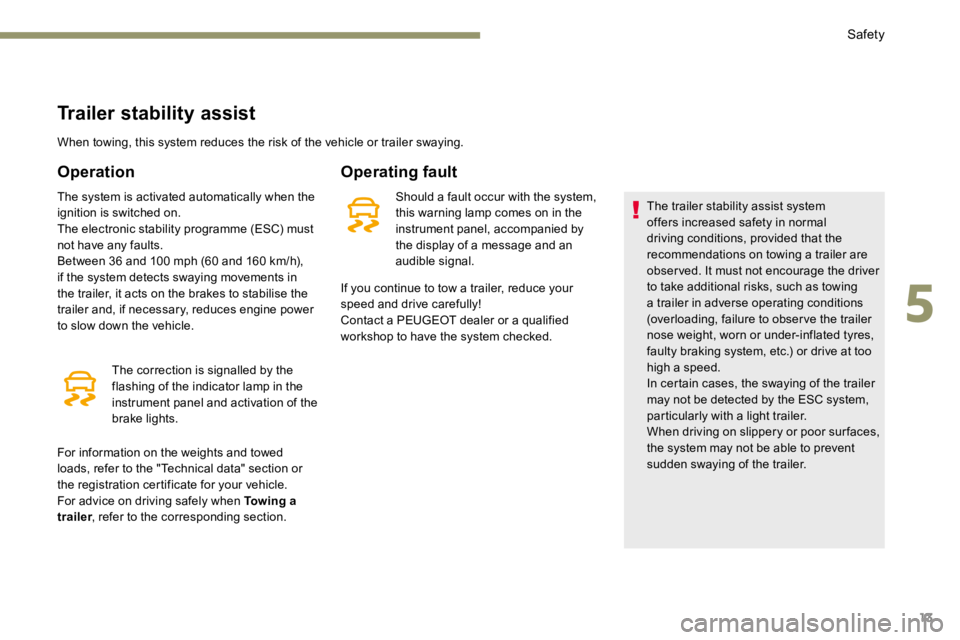
Trailer stability assist
When towing, this system reduces the risk of the vehicle or trailer swaying.
Operation
The system is activated automatically when the
ignition is switched on.
The electronic stability programme (ESC) must
not have any faults.
Between 36 and 100 mph (60 and 160 km/h),
if the system detects swaying movements in
the trailer, it acts on the brakes to stabilise the
trailer and, if necessary, reduces engine power
to slow down the vehicle.The correction is signalled by the
flashing of the indicator lamp in the
instrument panel and activation of the
brake lights.
Operating fault
Should a fault occur with the system,
this warning lamp comes on in the
instrument panel, accompanied by
the display of a message and an
audible signal. The trailer stability assist system
offers increased safety in normal
driving conditions, provided that the
recommendations on towing a trailer are
obser ved. It must not encourage the driver
to take additional risks, such as towing
a trailer in adverse operating conditions
(overloading, failure to obser ve the trailer
nose weight, worn or under-inflated tyres,
faulty braking system, etc.) or drive at too
high a speed.
In certain cases, the swaying of the trailer
may not be detected by the ESC system,
particularly with a light trailer.
When driving on slippery or poor sur faces,
the system may not be able to prevent
sudden swaying of the trailer.
If you continue to tow a trailer, reduce your
speed and drive carefully!
Contact a PEUGEOT dealer or a qualified
workshop to have the system checked.
For information on the weights and towed
loads, refer to the "Technical data" section or
the registration certificate for your vehicle.
For advice on driving safely when Towing a
trailer , refer to the corresponding section.
5
Safety
Page 559 of 566
19
Characteristics of engines and towed loads
Engines
The engine characteristics are detailed on the
vehicle's registration certificate, and in the
sales documentation.
Weights and towed loads
When the ambient temperature is high,
leaving the engine running for 1 to
2 minutes after stopping the vehicle to
allow it to cool is recommended.
The weights and towed loads relating to your
vehicle are stated in the registration certificate,
and in the sales documentation.
These values are also shown on the
manufacturer's nameplate or label.
For more information, contact a PEUGEOT
dealer or a qualified workshop.
The GTW and towed load values indicated are
valid up to a maximum altitude of 1,000 metres.
The towed load value must be reduced by 10%
for each additional 1,000 metres of altitude.
The recommended nose weight corresponds
to the weight permitted on the towbar
(dismantlable with or without a tool).
GT W:
Gross train weight High ambient temperatures may result
in a reduction in the per formance of
the vehicle to protect the engine. If the
ambient temperature is above 37°C, limit
the towed load.
Towing with a towing vehicle which is only
slightly laden may negatively affect its
handling.
Towing a trailer increases the braking
distance.
With a towing vehicle, never exceed the
speed of 62 mph (100 km/h) (obser ve the
local legislation in force).
The maximum power corresponds to
the value type-approved on a test bed,
according to the conditions defined in
European legislation (Directive 1999/99/
EC).
For more information, contact a PEUGEOT
dealer or a qualified workshop.
9
Technical data