lock PEUGEOT 308 2017 Workshop Manual
[x] Cancel search | Manufacturer: PEUGEOT, Model Year: 2017, Model line: 308, Model: Peugeot 308 2017Pages: 566, PDF Size: 16.05 MB
Page 201 of 566
199
3008-2_en_Chap06_conduite_ed01-2016
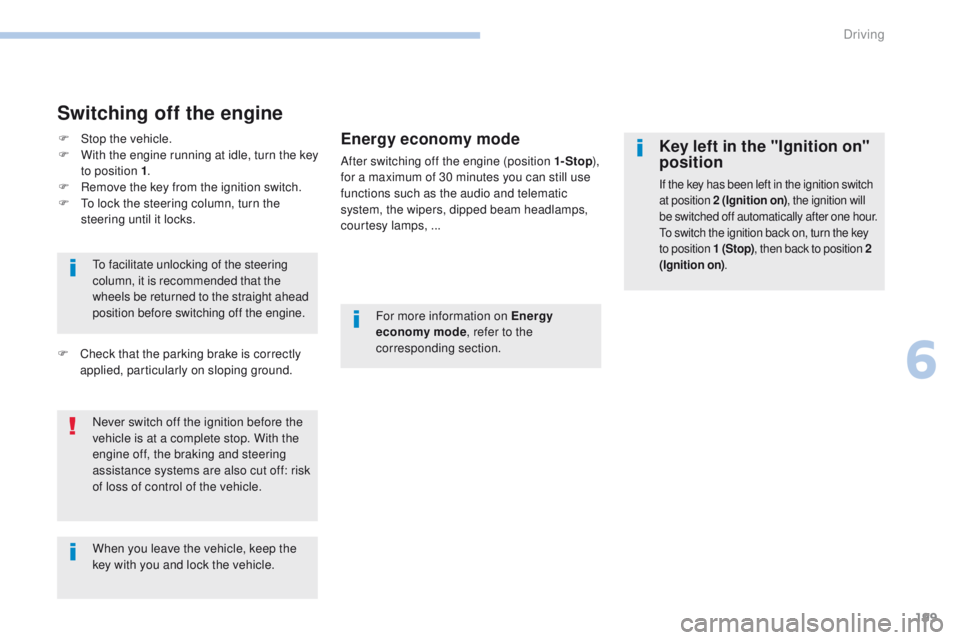
Switching off the engine
Energy economy mode
After switching off the engine (position 1- Stop),
for a maximum of 30 minutes you can still use
functions such as the audio and telematic
system, the wipers, dipped beam headlamps,
courtesy lamps, ...
F
C
heck that the parking brake is correctly
applied, particularly on sloping ground.
Never switch off the ignition before the
vehicle is at a complete stop. With the
engine off, the braking and steering
assistance systems are also cut off: risk
of loss of control of the vehicle. To facilitate unlocking of the steering
column, it is recommended that the
wheels be returned to the straight ahead
position before switching off the engine.
When you leave the vehicle, keep the
key with you and lock the vehicle. For more information on Energy
economy mode
, refer to the
corresponding section.Key left in the "Ignition on"
position
If the key has been left in the ignition switch
at position 2 (Ignition on) , the ignition will
be switched off automatically after one hour.
To switch the ignition back on, turn the key
to position 1 (Stop) , then back to position 2
(Ignition on) .
F Stop the vehicle.
F
W ith the engine running at idle, turn the key
to position 1 .
F
R
emove the key from the ignition switch.
F
T
o lock the steering column, turn the
steering until it locks.
6
Driving
Page 202 of 566
200
3008-2_en_Chap06_conduite_ed01-2016
Starting / Switching off the engine with
Keyless Entry and Starting
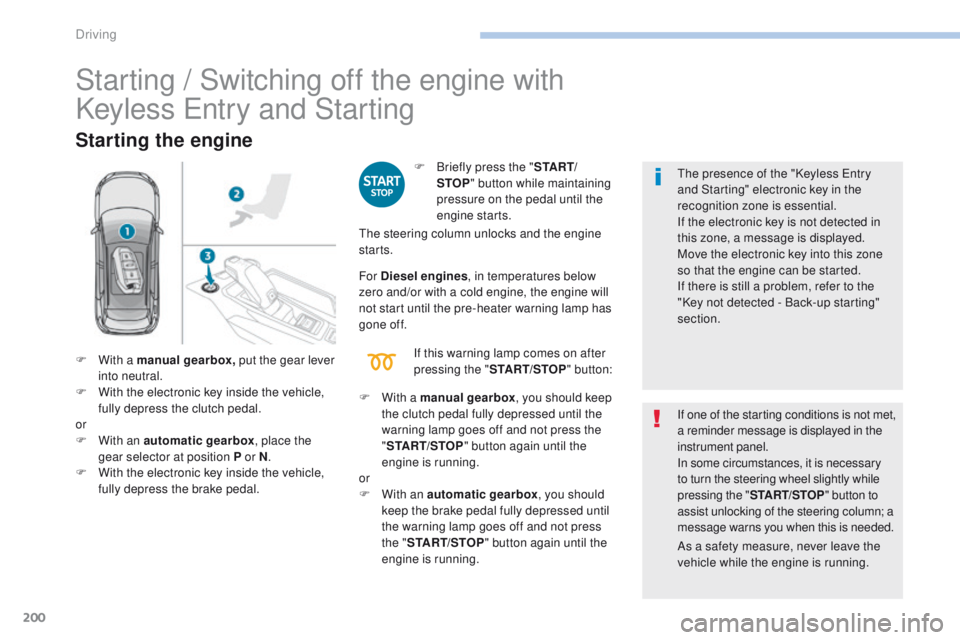
Starting the engine
F Briefly press the "S TA R T/
STOP " button while maintaining
pressure on the pedal until the
engine starts. The presence of the "Keyless Entry
and Starting" electronic key in the
recognition zone is essential.
If the electronic key is not detected in
this zone, a message is displayed.
Move the electronic key into this zone
so that the engine can be started.
If there is still a problem, refer to the
"Key not detected - Back-up starting"
section.
If one of the starting conditions is not met,
a reminder message is displayed in the
instrument panel.
In some circumstances, it is necessary
to turn the steering wheel slightly while
pressing the "
START/STOP " button to
assist unlocking of the steering column; a
message warns you when this is needed.
F
W
ith a manual gearbox , put the gear lever
into neutral.
F
W
ith the electronic key inside the vehicle,
fully depress the clutch pedal.
or
F
W
ith an automatic gearbox , place the
gear selector at position P or N .
F
W
ith the electronic key inside the vehicle,
fully depress the brake pedal. The steering column unlocks and the engine
starts.
F
W
ith a manual gearbox , you should keep
the clutch pedal fully depressed until the
warning lamp goes off and not press the
" START/STOP " button again until the
engine is running.
or
F
W
ith an automatic gearbox , you should
keep the brake pedal fully depressed until
the warning lamp goes off and not press
the " START/STOP " button again until the
engine is running.
For Diesel engines
, in temperatures below
zero and/or with a cold engine, the engine will
not start until the pre-heater warning lamp has
gone of f.
If this warning lamp comes on after
pressing the " START/STOP " button:
As a safety measure, never leave the
vehicle while the engine is running.
Driving
Page 203 of 566
201
3008-2_en_Chap06_conduite_ed01-2016
Switching off the engine
F Immobilise the vehicle, engine at idle.
F W ith a manual gearbox , put the gear lever
into neutral.
or
F
W
ith an automatic gearbox , place the
gear selector at position P or N .
Never leave your vehicle with the
electronic key still inside.
Switching off the engine leads to a loss
of braking assistance. If the vehicle is not immobilised, the
engine will not stop. F
W
ith the electronic key inside
the vehicle, press the " S TA R T/
STOP " button.
The engine stops and the steering
column locks.
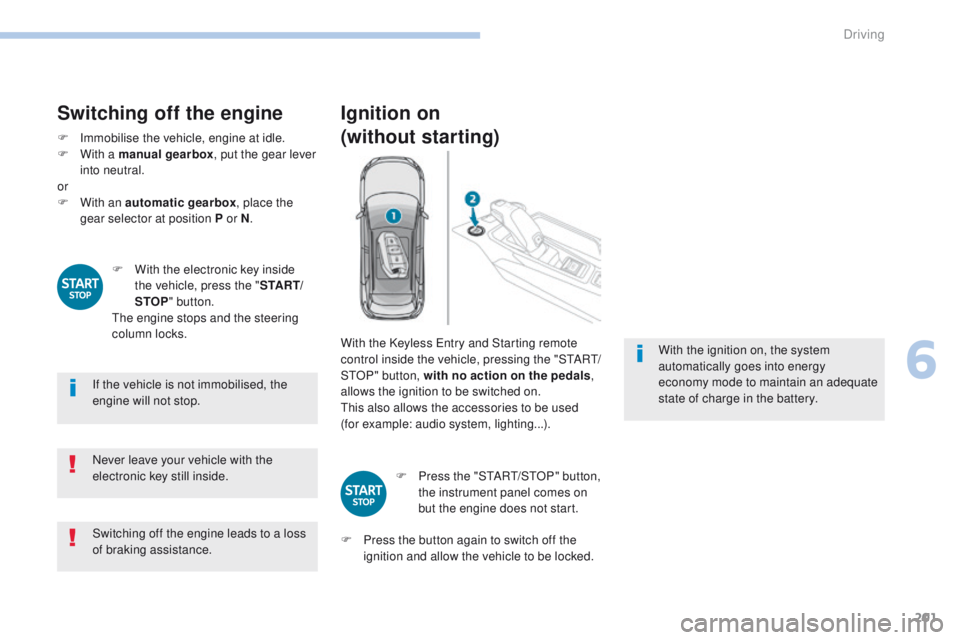
Ignition on
(without starting)
With the Keyless Entry and Starting remote
control inside the vehicle, pressing the "START/
STOP" button, with no action on the pedals ,
allows the ignition to be switched on.
This also allows the accessories to be used
(for example: audio system, lighting...).
F
P
ress the "START/STOP" button,
the instrument panel comes on
but the engine does not start.
F
P
ress the button again to switch off the
ignition and allow the vehicle to be locked. With the ignition on, the system
automatically goes into energy
economy mode to maintain an adequate
state of charge in the battery.
6
Driving
Page 204 of 566
202
3008-2_en_Chap06_conduite_ed01-2016
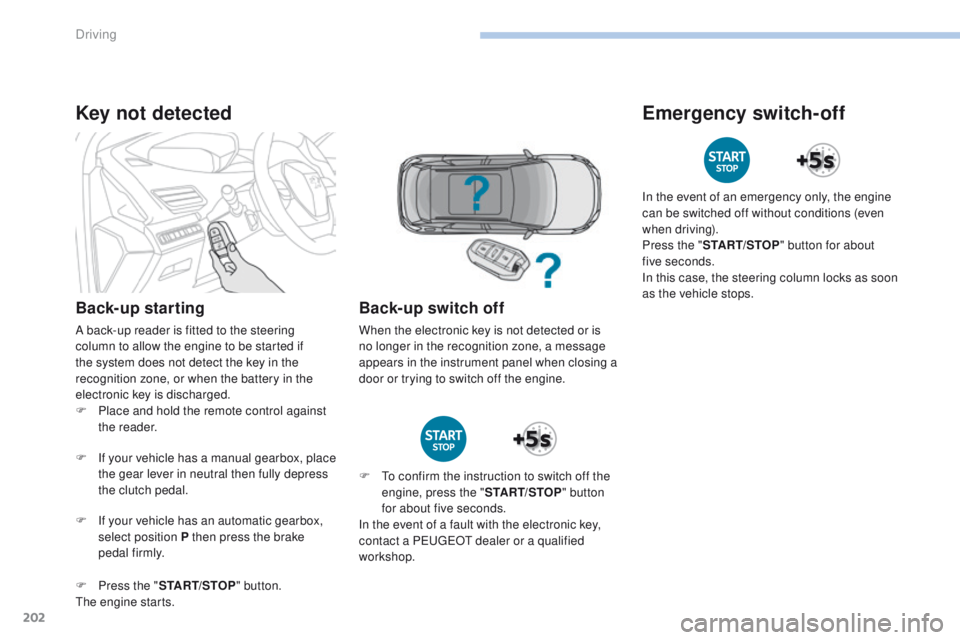
Key not detected
Back-up starting
A back-up reader is fitted to the steering
column to allow the engine to be started if
the system does not detect the key in the
recognition zone, or when the battery in the
electronic key is discharged.
F
P
lace and hold the remote control against
the reader.
F
I
f your vehicle has a manual gearbox, place
the gear lever in neutral then fully depress
the clutch pedal.
F
I
f your vehicle has an automatic gearbox,
select position P then press the brake
pedal firmly.
F
P
ress the " START/STOP " button.
The engine starts.
Emergency switch-off
In the event of an emergency only, the engine
can be switched off without conditions (even
when driving).
Press the " START/STOP " button for about
five
seconds.
In this case, the steering column locks as soon
as the vehicle stops.
F
T
o confirm the instruction to switch off the
engine, press the " START/STOP" button
for about five seconds.
In the event of a fault with the electronic key,
contact a PEUGEOT dealer or a qualified
workshop.
Back-up switch off
When the electronic key is not detected or is
no longer in the recognition zone, a message
appears in the instrument panel when closing a
door or trying to switch off the engine.
Driving
Page 208 of 566
206
3008-2_en_Chap06_conduite_ed01-2016
Special cases
In some situations, you may need to operate
the parking brake manually.
Immobilisation of the vehicle
with the engine running
To immobilise the vehicle with the engine
running, briefly pull the control lever.In very cold conditions (ice), it is
recommended that the parking brake
not be applied.
To immobilise your vehicle, engage a
gear or fit the chocks supplied against
one of the wheels.
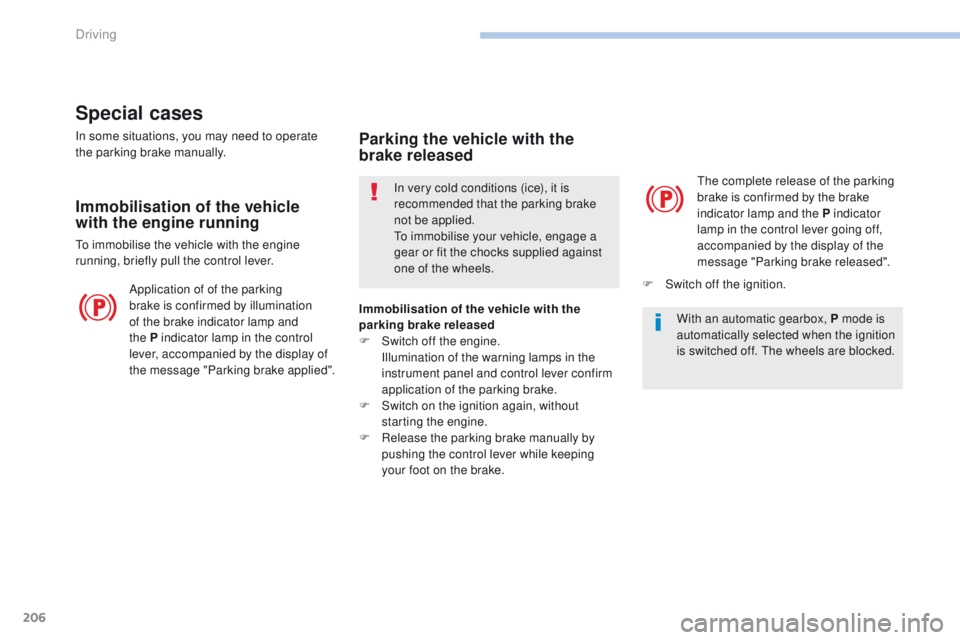
Application of of the parking
brake is confirmed by illumination
of the brake indicator lamp and
the
P indicator lamp in the control
lever, accompanied by the display of
the message "Parking brake applied".
Parking the vehicle with the
brake released
Immobilisation of the vehicle with the
parking brake released
F
S
witch off the engine.
I
llumination of the warning lamps in the
instrument panel and control lever confirm
application of the parking brake.
F
S
witch on the ignition again, without
starting the engine.
F
R
elease the parking brake manually by
pushing the control lever while keeping
your foot on the brake. The complete release of the parking
brake is confirmed by the brake
indicator lamp and the P indicator
lamp in the control lever going off,
accompanied by the display of the
message "Parking brake released".
F
S
witch off the ignition.
With an automatic gearbox, P mode is
automatically selected when the ignition
is switched off. The wheels are blocked.
Driving
Page 213 of 566
211
3008-2_en_Chap06_conduite_ed01-2016
Automatic gearbox (EAT6)
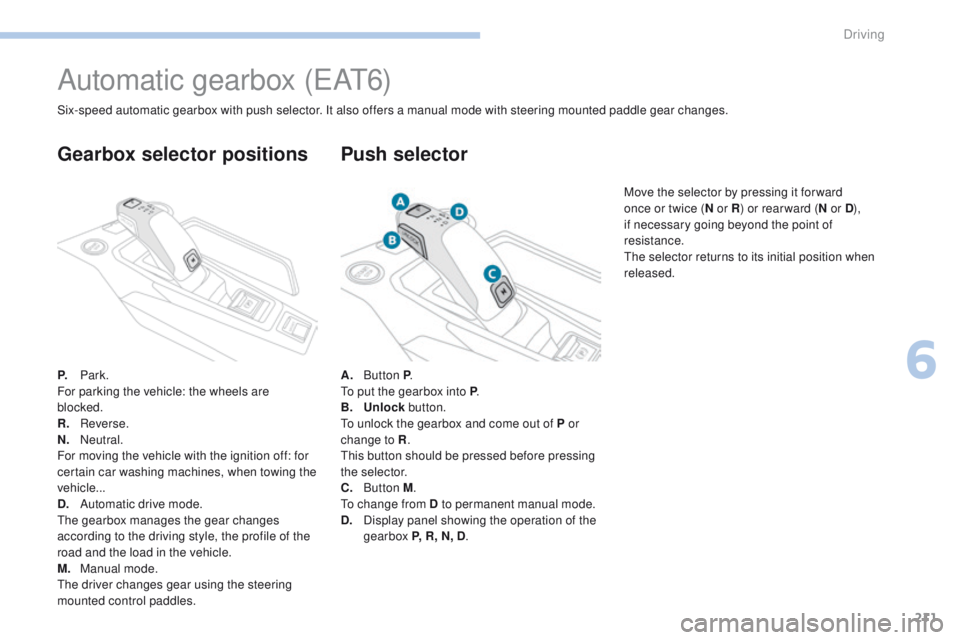
P. Park.
For parking the vehicle: the wheels are
blocked.
R.
R
everse.
N.
N
eutral.
For moving the vehicle with the ignition off: for
certain car washing machines, when towing the
vehicle...
D.
Aut
omatic drive mode.
The gearbox manages the gear changes
according to the driving style, the profile of the
road and the load in the vehicle.
M.
M
anual mode.
The driver changes gear using the steering
mounted control paddles.
Gearbox selector positions
A. Button P.
To put the gearbox into P .
B.
Un
lock button.
To unlock the gearbox and come out of P or
change to R .
This button should be pressed before pressing
the selector.
C.
Button M.
To change from D to permanent manual mode.
D.
D
isplay panel showing the operation of the
gearbox P, R, N, D .
Push selector
Six-speed automatic gearbox with push selector. It also offers a manual mode with steering mounted paddle gear changes.
Move the selector by pressing it for ward
once or twice (N or R) or rear ward ( N or
D),
if necessary going beyond the point of
resistance.
The selector returns to its initial position when
released.
6
Driving
Page 215 of 566
213
3008-2_en_Chap06_conduite_ed01-2016
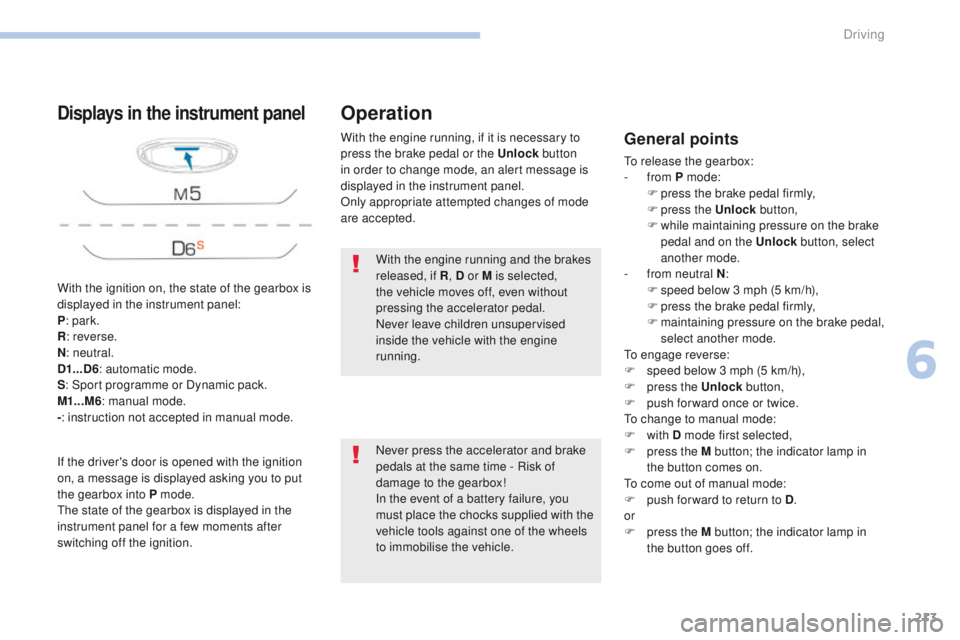
With the ignition on, the state of the gearbox is
displayed in the instrument panel:
P: park.
R : reverse.
N : neutral.
D1...D6 : automatic mode.
S : Sport programme or Dynamic pack.
M1...M6 : manual mode.
- : instruction not accepted in manual mode.
Displays in the instrument panel
If the driver's door is opened with the ignition
on, a message is displayed asking you to put
the gearbox into P mode.
The state of the gearbox is displayed in the
instrument panel for a few moments after
switching off the ignition. With the engine running, if it is necessary to
press the brake pedal or the Unlock
button
in order to change mode, an alert message is
displayed in the instrument panel.
Only appropriate attempted changes of mode
are accepted.
Operation
General points
To release the gearbox:
- from P mode:
F
p
ress the brake pedal firmly,
F
press the Unlock button,
F
w
hile maintaining pressure on the brake
pedal and on the Unlock button, select
another mode.
-
f
rom neutral N :
F
s
peed below 3 mph (5 km/h),
F
p
ress the brake pedal firmly,
F
m
aintaining pressure on the brake pedal,
select another mode.
To engage reverse:
F
s
peed below 3 mph (5 km/h),
F
p
ress the Unlock button,
F
p
ush forward once or twice.
To change to manual mode:
F
with D mode first selected,
F
p
ress the M button; the indicator lamp in
the button comes on.
To come out of manual mode:
F
p
ush for ward to return to D .
or
F
p
ress the M button; the indicator lamp in
the button goes off.
With the engine running and the brakes
released, if R
, D or M is selected,
the vehicle moves off, even without
pressing the accelerator pedal.
Never leave children unsupervised
inside the vehicle with the engine
running.
Never press the accelerator and brake
pedals at the same time - Risk of
damage to the gearbox!
In the event of a battery failure, you
must place the chocks supplied with the
vehicle tools against one of the wheels
to immobilise the vehicle.
6
Driving
Page 216 of 566
214
3008-2_en_Chap06_conduite_ed01-2016
The vehicle must be stationary to switch off the
ignition.
To put the vehicle into free-wheel with the
engine off:
F
v
ehicle stationary, engine running,
select
N,
F
s
witch off the engine,
F
s
witch the ignition on within five seconds,
F
w
ith your foot on the brake pedal, push the
selector for ward or rear ward and release to
confirm N and release the electric parking
brake manually,
F
s
witch off the ignition.
If you exceed the period of five seconds, the
gearbox goes into P mode; you must then start
the procedure again from the beginning.
Special aspects of automatic
mode
The gearbox selects the gear that offers
optimum per formance, taking account of the
ambient temperature, the profile of the road,
the load on the vehicle and the style of driving.
For maximum acceleration without touching
the selector, press the accelerator fully down
(kick-down). The gearbox changes down
automatically or holds the gear selected until
the maximum engine speed is reached.
When braking, the gearbox changes down
automatically to provide effective engine
braking.
The steering mounted controls allow the driver
to temporarily select a gear, if the road and
engine speed permit.
Special aspects of manual mode
The change from one gear to another takes
place only if the if the road speed and engine
speed permit.
If the engine speed is too high or too low, the
gear selected flashes for a few seconds, then
the gear actually engaged is displayed.
With N engaged, opening the driver's
door results in an audible signal.
Closing the driver's door stops the
signal.
Moving off
From P mode:
F
P ress the brake pedal firmly.
F
S
tart the engine.
F
M
aintaining pressure on the brake pedal,
press the Unlock button.
F
P
ush twice rear ward going beyond
the point of resistance to select the
automatic
D mode, or for ward to engage
reverse R .
From neutral N :
F
P
ress the brake pedal firmly.
F
S
tart the engine.
F
M
aintaining pressure on the brake
pedal, push rear ward to select the
automatic
D mode, or for ward, while
pressing the Unlock
button to engage
reverse R .
Then, from P or N :
F
R
elease the brake pedal.
F
A
ccelerate progressively to automatically
release the electric parking brake.
F
W
ith the parking brake released, the
vehicle then moves off.
Driving
Page 283 of 566
281
3008-2_en_Chap07_infos-pratiques_ed01-2016
Fuel tank
Fuel tank capacity: approximately 53 litres.
When the low fuel level is reached in the
fuel tank, this warning lamp comes on on
the instrument panel, accompanied by
the display of a message and an audible
signal. When it first comes on there remains
approximately 6 litres of fuel in the tank.
Low fuel level
A label affixed to the inside of the flap reminds
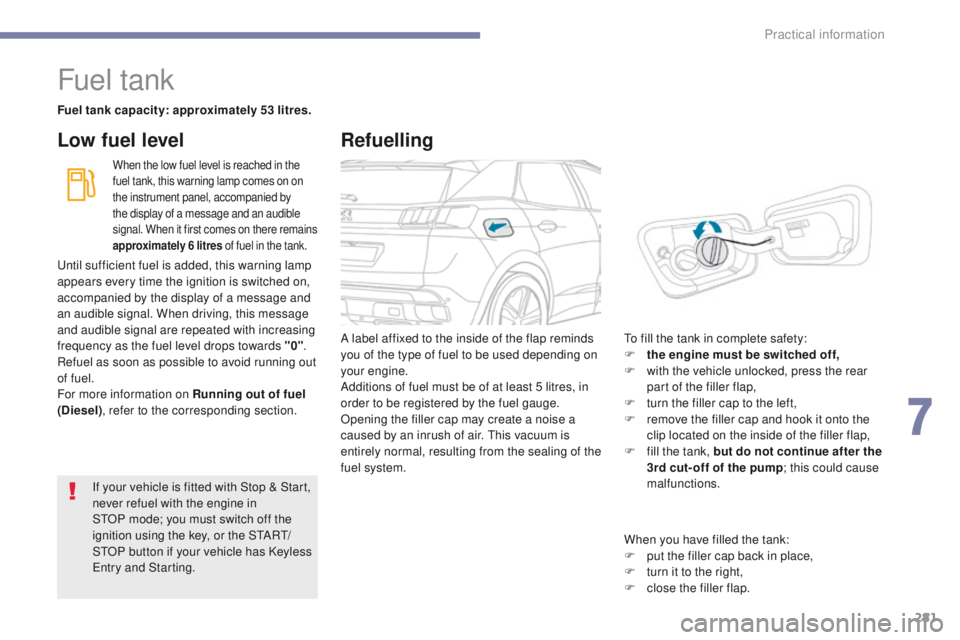
you of the type of fuel to be used depending on
your engine.
Additions of fuel must be of at least 5 litres, in
order to be registered by the fuel gauge.
Opening the filler cap may create a noise a
caused by an inrush of air. This vacuum is
entirely normal, resulting from the sealing of the
fuel system. To fill the tank in complete safety:
F
t he engine must be switched off,
F
w
ith the vehicle unlocked, press the rear
part of the filler flap,
F
t
urn the filler cap to the left,
F
r
emove the filler cap and hook it onto the
clip located on the inside of the filler flap,
F
f
ill the tank, but do not continue after the
3rd cut- off of the pump ; this could cause
malfunctions.
If your vehicle is fitted with Stop
&
Start,
never refuel with the engine in
STOP
mode; you must switch off the
ignition using the key, or the START/
STOP button if your vehicle has Keyless
Entry and Starting.
Until sufficient fuel is added, this warning lamp
appears every time the ignition is switched on,
accompanied by the display of a message and
an audible signal. When driving, this message
and audible signal are repeated with increasing
frequency as the fuel level drops towards "0"
.
Refuel as soon as possible to avoid running out
of fuel.
For more information on Running out of fuel
(Diesel) , refer to the corresponding section.
Refuelling
When you have filled the tank:
F
p ut the filler cap back in place,
F
t
urn it to the right,
F
c
lose the filler flap.
7
Practical information
Page 287 of 566
285
3008-2_en_Chap07_infos-pratiques_ed01-2016
Towbar with quickly detachable towball
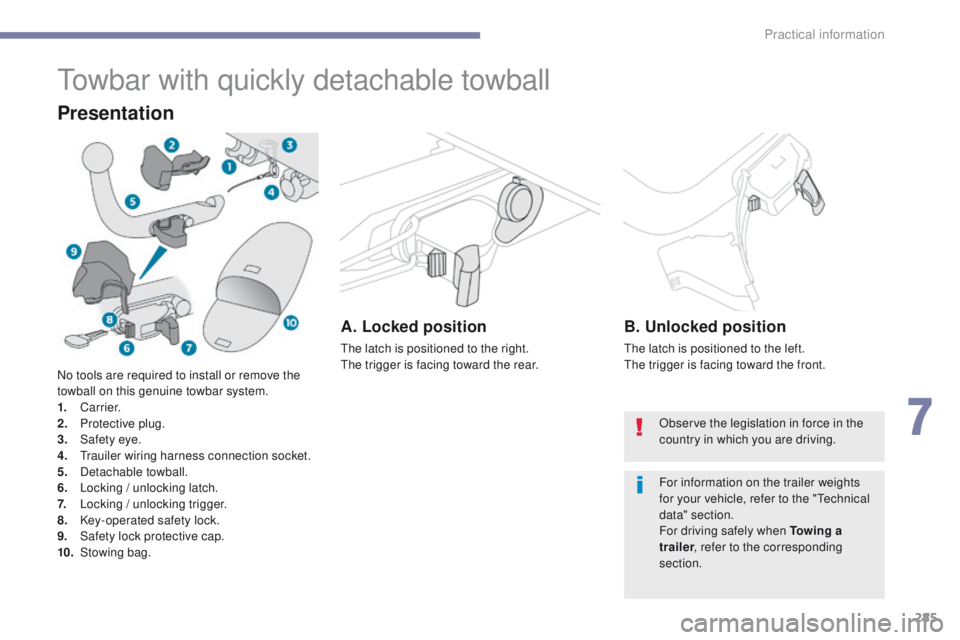
Presentation
A. Locked position
The latch is positioned to the right.
The trigger is facing toward the rear.
B. Unlocked position
The latch is positioned to the left.
The trigger is facing toward the front.Observe the legislation in force in the
country in which you are driving.
For information on the trailer weights
for your vehicle, refer to the "Technical
data" section.
For driving safely when Towing a
trailer, refer to the corresponding
section.
No tools are required to install or remove the
towball on this genuine towbar system.
1.
Carrier.
2.
P
rotective plug.
3.
S
afety eye.
4.
T
rauiler wiring harness connection socket.
5.
D
etachable towball.
6.
L
ocking / unlocking latch.
7.
L
ocking / unlocking trigger.
8.
K
ey-operated safety lock.
9.
S
afety lock protective cap.
10.
S
towing bag.
7
Practical information