light PEUGEOT 308 2017 Repair Manual
[x] Cancel search | Manufacturer: PEUGEOT, Model Year: 2017, Model line: 308, Model: Peugeot 308 2017Pages: 566, PDF Size: 16.05 MB
Page 260 of 566

258
3008-2_en_Chap06_conduite_ed01-2016
Limits of operation
The system goes into standby automatically in
the following cases:
-
E
SC deactivated or operation triggered,
-
s
peed below 40 mph (65 km/h) or above
112 mph (180 km/h),
-
c
onnected electrically to a trailer,
-
u
se of the "space-saver" spare
wheel detected (as detection is not
immediate, deactivation of the system is
recommended),
-
d
ynamic driving style detected, pressure
on the brake or accelerator pedal,
-
d
riving where there are no lane markings,
-
ope
ration of the direction indicators,
-
d
riving in a tight corner,
-
i
nactivity by the driver detected during
correction. The system may not operate correctly
or at all in the following situations:
-
c
onditions of poor visibility
(inadequate street lighting,
snowfall, rain, fog),
-
d
azzle (headlamps of on oncoming
vehicle, low sun, reflections on a
wet road sur face, leaving a tunnel,
alternating light and shade),
-
a
rea of the windscreen in front of
the camera dirty, misted, frosted,
snow-covered, damaged or
covered by a sticker,
-
r
oad markings absent, worn,
hidden (snow, mud) or multiple
(roadworks),
-
r
unning close to the vehicle in front
(the lane markings may not be
detected),
-
n
arrow, twisty roads.Risk of undesirable operation
Deactivation of the system is recommended in
the following situations:
-
d
riving on a road sur face in poor condition,
-
u
nfavorable weather conditions,
-
d
riving on slippery sur faces (black ice).
The system is not designed for the following
driving situations:
-
d
riving on a speed circuit,
-
d
riving with a trailer,
-
d
riving on a rolling road,
-
d
riving on unstable sur faces.
Driving
Page 263 of 566
261
3008-2_en_Chap06_conduite_ed01-2016
Operation
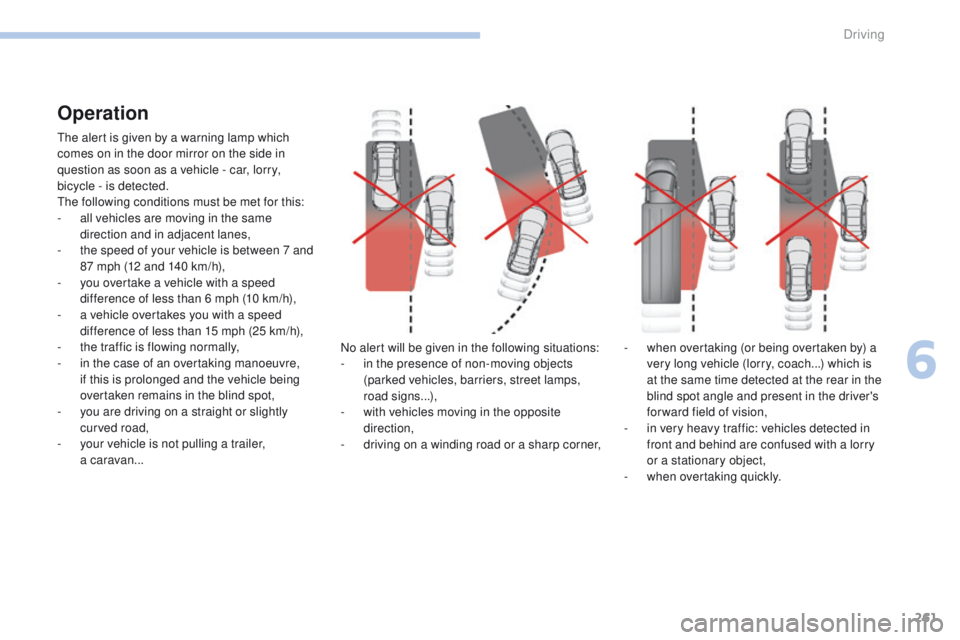
The alert is given by a warning lamp which
comes on in the door mirror on the side in
question as soon as a vehicle - car, lorry,
bicycle - is detected.
The following conditions must be met for this:
-
a
ll vehicles are moving in the same
direction and in adjacent lanes,
-
t
he speed of your vehicle is between 7 and
87 mph (12 and 140 km/h),
-
y
ou overtake a vehicle with a speed
difference of less than 6 mph (10 km/h),
-
a v
ehicle overtakes you with a speed
difference of less than 15 mph (25 km/h),
-
t
he traffic is flowing normally,
-
i
n the case of an overtaking manoeuvre,
if this is prolonged and the vehicle being
overtaken remains in the blind spot,
-
y
ou are driving on a straight or slightly
curved road,
-
y
our vehicle is not pulling a trailer,
a
caravan... No alert will be given in the following situations:
-
i
n the presence of non-moving objects
(parked vehicles, barriers, street lamps,
road signs...),
-
w
ith vehicles moving in the opposite
direction,
-
d
riving on a winding road or a sharp corner,-
w
hen overtaking (or being overtaken by) a
very long vehicle (lorry, coach...) which is
at the same time detected at the rear in the
blind spot angle and present in the driver's
forward field of vision,
-
i
n very heavy traffic: vehicles detected in
front and behind are confused with a lorry
or a stationary object,
-
w
hen overtaking quickly.
6
Driving
Page 268 of 566
266
3008-2_en_Chap06_conduite_ed01-2016
The images provided by the camera(s)
may be distorted by the relief.
In the presence of areas in shade,
or in conditions of bright sunlight or
inadequate lighting, the image may be
darkened and with lower contrast.
Maintenance
In bad or wintry weather, ensure that the
sensors and camera lenses are not covered
with mud, ice or snow.
Check the cleanliness of the camera lenses
regularly.
If necessary, clean the camera lenses with a
soft, dry cloth.
High pressure jet wash
When washing your vehicle, keep the tip of the
lance at least 30 cm from the cameras.
This system is a visual aid that cannot
in any circumstances replace the need
for vigilance on the part of the driver.
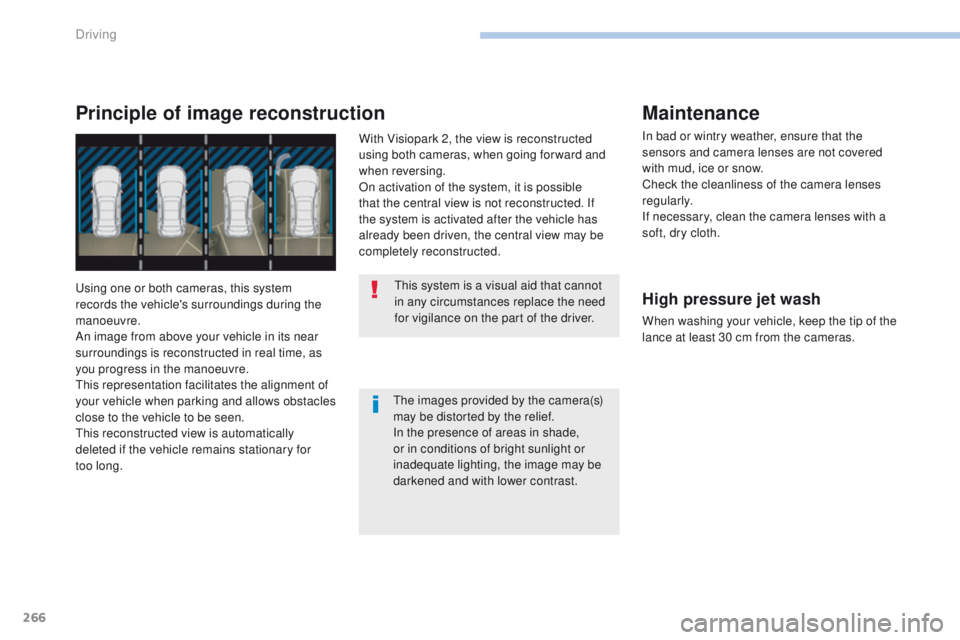
Principle of image reconstruction
Using one or both cameras, this system
records the vehicle's surroundings during the
manoeuvre.
An image from above your vehicle in its near
surroundings is reconstructed in real time, as
you progress in the manoeuvre.
This representation facilitates the alignment of
your vehicle when parking and allows obstacles
close to the vehicle to be seen.
This reconstructed view is automatically
deleted if the vehicle remains stationary for
too
long. With Visiopark 2, the view is reconstructed
using both cameras, when going for ward and
when reversing.
On activation of the system, it is possible
that the central view is not reconstructed. If
the system is activated after the vehicle has
already been driven, the central view may be
completely reconstructed.
Driving
Page 288 of 566
286
3008-2_en_Chap07_infos-pratiques_ed01-2016
Before each use
Check that the towball is correctly fitted, verifying the follow points:
- t he towball is correctly engaged (position A ),
-
t
he safety lock is on and the key removed; the trigger can no longer be operated,
-
t
he towball must not be able to move in its carrier; test by shaking it with your hand.
If the towball is not locked, the trailer could separate - Risk of an accident!
During use
Never release the locking system with a trailer or load carrier on the towball.
Never exceed the maximum authorised weight for the vehicle plus trailer - the Gross Train
Weight or GTW.
You must not exceed the maximum nose weight on the towbar: if exceeded, this could result
in detachment from the vehicle - Risk of an accident!
Check that the trailer lighting and signalling work correctly.
Before setting off, check the adjustment of the headlamp beam height.
For more information on Adjusting the headlamp beam height , refer to the corresponding
section.
Following use
When travelling without a trailer or load on a towbar-mounted carrier, the towball must be
removed and the protective plug inserted in the carrier. This measure applies particularly
where the towball might obscure visibility of the number plate or its lighting.
Maintenance
Correct operation is only possible if the towball
and its carrier are kept clean.
Before cleaning the vehicle with a high-
pressure jet wash, the towball must be removed
and the protective plug fitted to the carrier.
Go to a PEUGEOT dealer or a qualified
workshop for any work on the towbar system.
Practical information
Page 304 of 566
302
3008-2_en_Chap07_infos-pratiques_ed01-2016
Automatic gearbox
The gearbox does not require any
maintenance (no oil change).
Refer to the manufacturer's service
schedule for the checking interval
for this component.
Electric parking
brake
This system does not require any
routine servicing. However, in
the event of a problem, have the
system checked by a PEUGEOT
dealer or a qualified workshop.
Brake pads
Brake wear depends on the style
of driving, particularly in the case
of vehicles used in town, over short
distances. It may be necessary to
Brake disc wear
For information on checking brake
disc wear, contact a PEUGEOT
dealer or a qualified workshop.For more information on the Electric parking
brake
, refer to the corresponding section.
Manual gearbox
The gearbox does not require any
maintenance (no oil change).
Refer to the manufacturer's service
schedule for the checking interval
for this component.
Only use products recommended by
PEUGEOT or products of equivalent
quality and specification.
In order to optimise the operation of
units as important as those in the
braking system, PEUGEOT selects and
offers very specific products.
After washing the vehicle, dampness,
or in wintry conditions, ice can form
on the brake discs and pads: braking
efficiency may be reduced. Make light
brake applications to dry and defrost
the brakes.
have the condition of the brakes checked, even
between vehicle services.
Unless there is a leak in the circuit, a drop in
the brake fluid level indicates that the brake
pads are worn.
Practical information
Page 307 of 566
305
3008-2_en_Chap07_infos-pratiques_ed01-2016
Recommendations on storage ProcedurePark the vehicle
F Before topping-up, ensure that the vehicle is parked on a flat and level sur face.
F
S
witch off the ignition to stop the engine
and remove the key from the switch.
or
F
W
ith Keyless Entry and Starting, press
the
"START/STOP " button to stop the
engine.
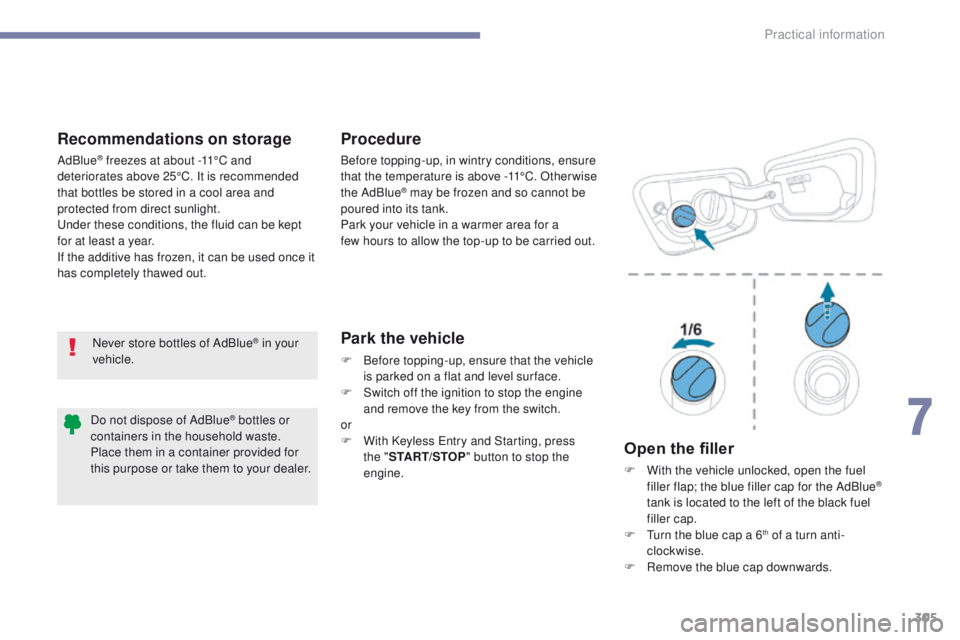
Open the filler
F With the vehicle unlocked, open the fuel filler flap; the blue filler cap for the AdBlue®
tank is located to the left of the black fuel
filler cap.
F
T
urn the blue cap a 6
th of a turn anti-
clockwise.
F
R
emove the blue cap downwards.
Never store bottles of AdBlue
® in your
vehicle. Before topping-up, in wintry conditions, ensure
that the temperature is above -11°C. Other wise
the AdBlue
® may be frozen and so cannot be
poured into its tank.
Park your vehicle in a warmer area for a
few
hours to allow the top-up to be carried out.
AdBlue
® freezes at about -11°C and
deteriorates above 25°C. It is recommended
that bottles be stored in a cool area and
protected from direct sunlight.
Under these conditions, the fluid can be kept
for at least a year.
If the additive has frozen, it can be used once it
has completely thawed out.
Do not dispose of AdBlue
® bottles or
containers in the household waste.
Place them in a container provided for
this purpose or take them to your dealer.
7
Practical information
Page 325 of 566
323
3008-2_en_Chap08_en cas-de-panne_ed01-2016
Changing a bulb
The headlamps have polycarbonate
lenses with a protective coating:
F
d
o not clean them using a dr y
or abrasive cloth, nor with a
detergent or solvent product,
F
u
se a sponge and soapy water or a
pH neutral product,
F
w
hen using a high pressure washer
on persistent marks, do not keep
the lance directed towards the
lamps or their edges for too long,
so as not to damage their protective
coating and seals.
Changing a bulb should only be done
after the headlamp has been switched
off for several minutes (risk of serious
burns).
F
D
o not touch the bulb directly with
your fingers, use a lint-free cloth.
It is imperative to use only anti-
ultraviolet (UV) type bulbs to avoid
damaging the headlamp.
Always replace a failed bulb with a
new bulb with the same type and
specification.Front lamps
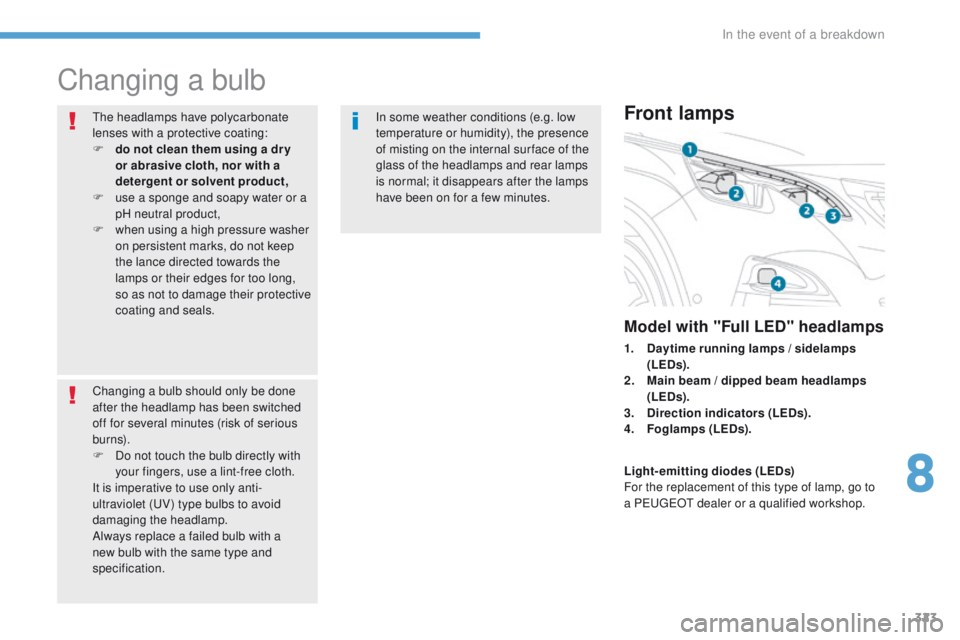
Model with "Full LED" headlamps
1. Daytime running lamps / sidelamps (LEDs).
2.
M
ain beam / dipped beam headlamps
(LEDs).
3.
D
irection indicators (LEDs).
4.
Fo
glamps (LEDs).
In some weather conditions (e.g. low
temperature or humidity), the presence
of misting on the internal sur face of the
glass of the headlamps and rear lamps
is normal; it disappears after the lamps
have been on for a few minutes.
Light-emitting diodes (LEDs)
For the replacement of this type of lamp, go to
a PEUGEOT dealer or a qualified workshop.
8
In the event of a breakdown
Page 326 of 566
324
3008-2_en_Chap08_en cas-de-panne_ed01-2016
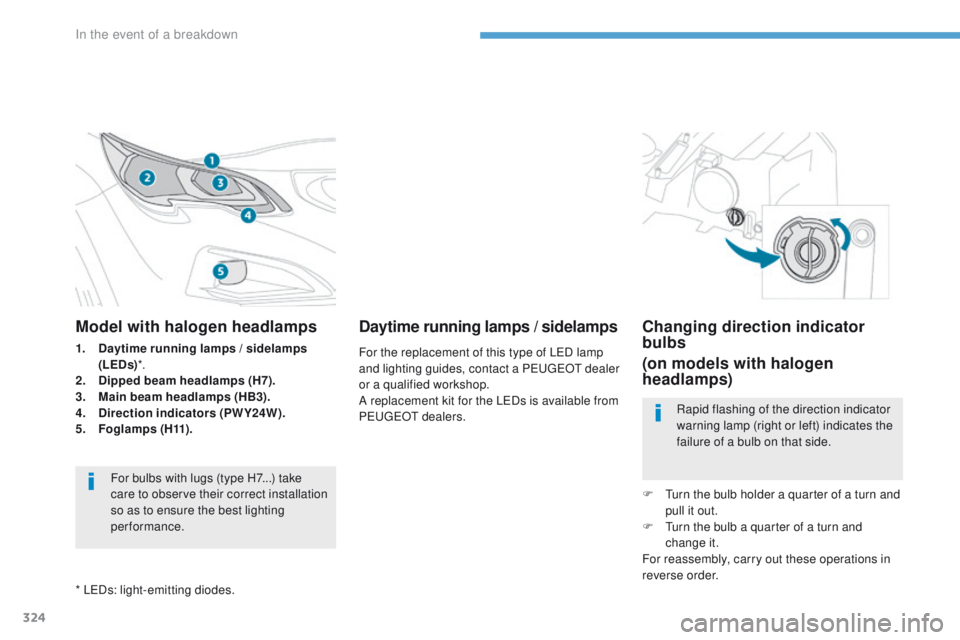
Model with halogen headlamps
1. Daytime running lamps / sidelamps (LEDs) *.
2.
D
ipped beam headlamps (H7).
3.
M
ain beam headlamps (HB3).
4.
D
irection indicators (PWY24W).
5.
Fo
glamps ( H11) .
For bulbs with lugs (type H7...) take
care to observe their correct installation
so as to ensure the best lighting
performance.
* LEDs: light-emitting diodes.
Daytime running lamps / sidelamps
For the replacement of this type of LED lamp
and lighting guides, contact a PEUGEOT dealer
or a qualified workshop.
A replacement kit for the LEDs is available from
PEUGEOT dealers.
Changing direction indicator
bulbs
(on models with halogen
headlamps)
Rapid flashing of the direction indicator
warning lamp (right or left) indicates the
failure of a bulb on that side.
F
T
urn the bulb holder a quarter of a turn and
pull it out.
F
T
urn the bulb a quarter of a turn and
change it.
For reassembly, carry out these operations in
reverse order.
In the event of a breakdown
Page 329 of 566
327
3008-2_en_Chap08_en cas-de-panne_ed01-2016
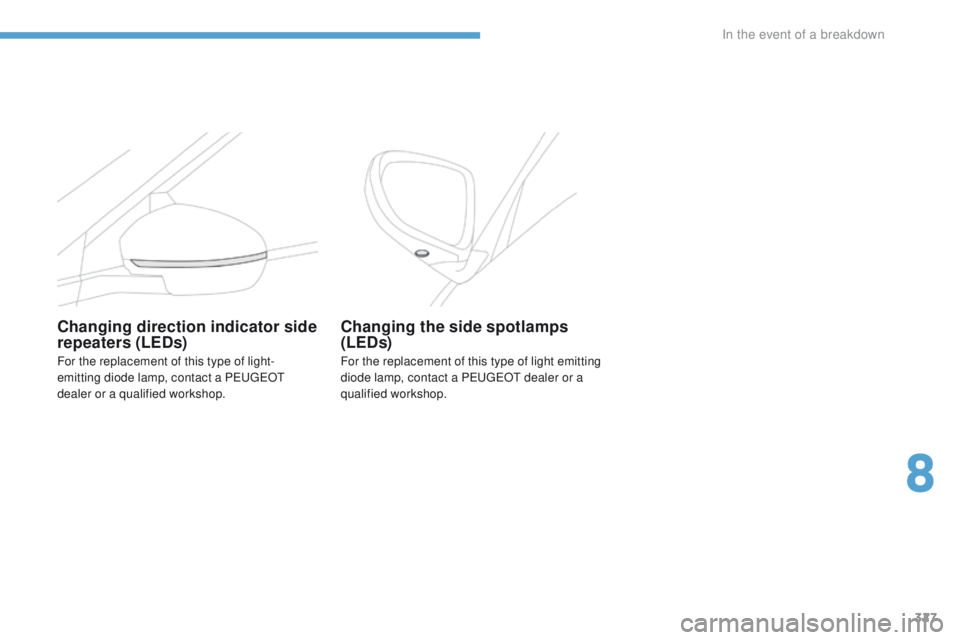
Changing the side spotlamps
(LEDs)
For the replacement of this type of light emitting
diode lamp, contact a PEUGEOT dealer or a
qualified workshop.
Changing direction indicator side
repeaters (LEDs)
For the replacement of this type of light-
emitting diode lamp, contact a PEUGEOT
dealer or a qualified workshop.
8
In the event of a breakdown
Page 330 of 566
328
3008-2_en_Chap08_en cas-de-panne_ed01-2016
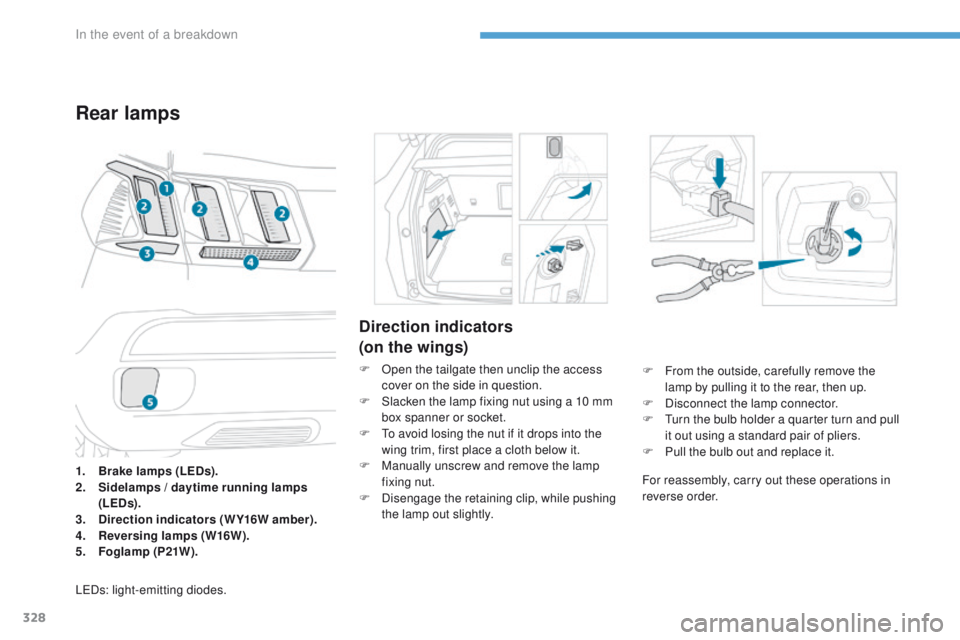
Direction indicators
(on the wings)
F Open the tailgate then unclip the access cover on the side in question.
F
S
lacken the lamp fixing nut using a 10 mm
box spanner or socket.
F
T
o avoid losing the nut if it drops into the
wing trim, first place a cloth below it.
F
M
anually unscrew and remove the lamp
fixing nut.
F
D
isengage the retaining clip, while pushing
the lamp out slightly.
Rear lamps
1. Brake lamps (LEDs).
2. Si delamps / daytime running lamps
(LEDs).
3.
D
irection indicators (WY16W amber).
4.
R
eversing lamps (W16W).
5.
F
oglamp (P21W).
LEDs: light-emitting diodes. F
F
rom the outside, carefully remove the
lamp by pulling it to the rear, then up.
F
D
isconnect the lamp connector.
F
T
urn the bulb holder a quarter turn and pull
it out using a standard pair of pliers.
F
P
ull the bulb out and replace it.
For reassembly, carry out these operations in
reverse order.
In the event of a breakdown