parking assist Peugeot 308 2018 User Guide
[x] Cancel search | Manufacturer: PEUGEOT, Model Year: 2018, Model line: 308, Model: Peugeot 308 2018Pages: 324, PDF Size: 10.72 MB
Page 163 of 324
161
Obstacles may appear further away than
they actually are in reality.
It is important to check the sides of the
vehicle during the manoeuvre, using the
mirrors.
The rear parking sensors also provide
information on the vehicle's surroundings.
180° viewRecommendations on care
In bad or wintry weather, ensure that the
sensors and camera are not covered with mud,
ice or snow.
Check the cleanliness of the camera lens
regularly.
If necessary, clean the camera with a soft, dry
cloth.
When washing your vehicle at high pressure,
direct the lance at least 30
cm away from the
camera and parking sensors.
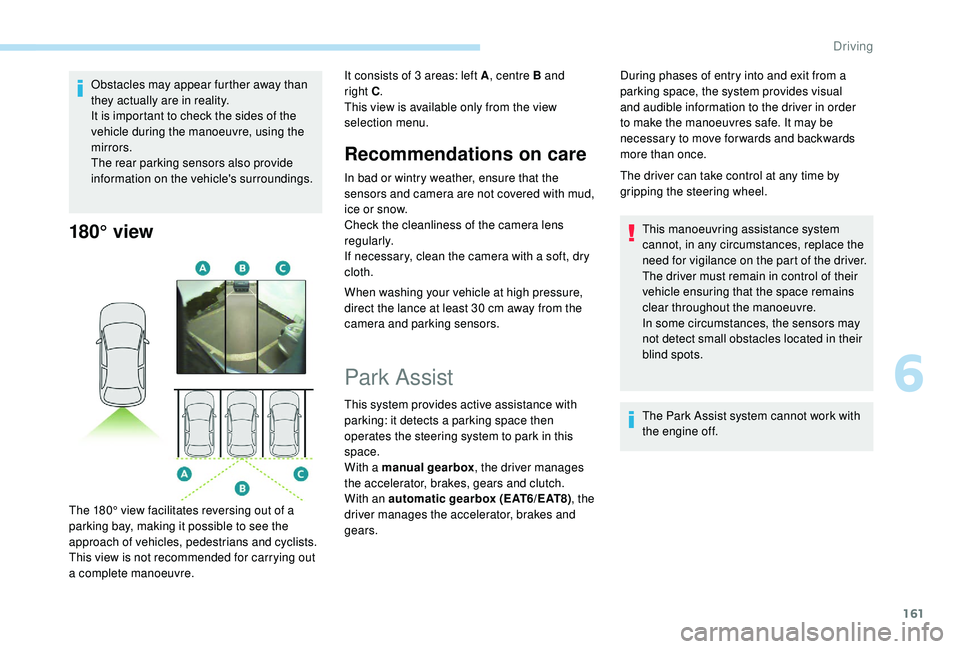
The 180° view facilitates reversing out of a
parking bay, making it possible to see the
approach of vehicles, pedestrians and cyclists.
This view is not recommended for carrying out
a complete manoeuvre. It consists of 3 areas: left A
, centre B and
right C .
This view is available only from the view
selection menu.
Park Assist
This system provides active assistance with
parking: it detects a parking space then
operates the steering system to park in this
space.
With a manual gearbox , the driver manages
the accelerator, brakes, gears and clutch.
With an automatic gearbox (EAT6/EAT8) , the
driver manages the accelerator, brakes and
gears. During phases of entry into and exit from a
parking space, the system provides visual
and audible information to the driver in order
to make the manoeuvres safe. It may be
necessary to move for wards and backwards
more than once.
The driver can take control at any time by
gripping the steering wheel.
This manoeuvring assistance system
cannot, in any circumstances, replace the
need for vigilance on the part of the driver.
The driver must remain in control of their
vehicle ensuring that the space remains
clear throughout the manoeuvre.
In some circumstances, the sensors may
not detect small obstacles located in their
blind spots.
The Park Assist system cannot work with
the engine off.
6
Driving
Page 164 of 324
162
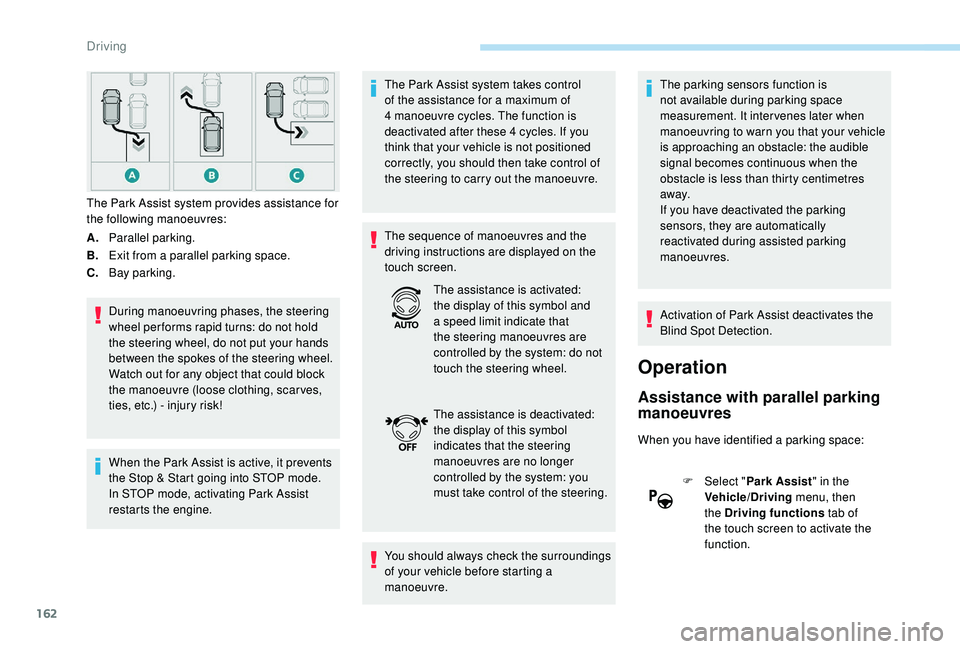
A.Parallel parking.
B. Exit from a parallel parking space.
C. Bay parking.
During manoeuvring phases, the steering
wheel per forms rapid turns: do not hold
the steering wheel, do not put your hands
between the spokes of the steering wheel.
Watch out for any object that could block
the manoeuvre (loose clothing, scar ves,
ties, etc.) - injury risk!
When the Park Assist is active, it prevents
the Stop & Start going into STOP mode.
In STOP mode, activating Park Assist
restarts the engine. The Park Assist system takes control
of the assistance for a maximum of
4
manoeuvre cycles. The function is
deactivated after these 4 cycles. If you
think that your vehicle is not positioned
correctly, you should then take control of
the steering to carry out the manoeuvre.
The sequence of manoeuvres and the
driving instructions are displayed on the
touch screen.
You should always check the surroundings
of your vehicle before starting a
manoeuvre. The parking sensors function is
not available during parking space
measurement. It intervenes later when
manoeuvring to warn you that your vehicle
is approaching an obstacle: the audible
signal becomes continuous when the
obstacle is less than thirty centimetres
away.
If you have deactivated the parking
sensors, they are automatically
reactivated during assisted parking
manoeuvres.
Activation of Park Assist deactivates the
Blind Spot Detection.
Operation
Assistance with parallel parking
manoeuvres
When you have identified a parking space:
F
Sel
ect "Park Assist " in the
Vehicle/Driving menu, then
the Driving functions tab of
the touch screen to activate the
function.
The Park Assist system provides assistance for
the following manoeuvres:
The assistance is activated:
the display of this symbol and
a speed limit indicate that
the steering manoeuvres are
controlled by the system: do not
touch the steering wheel.
The assistance is deactivated:
the display of this symbol
indicates that the steering
manoeuvres are no longer
controlled by the system: you
must take control of the steering.
Driving
Page 165 of 324
163
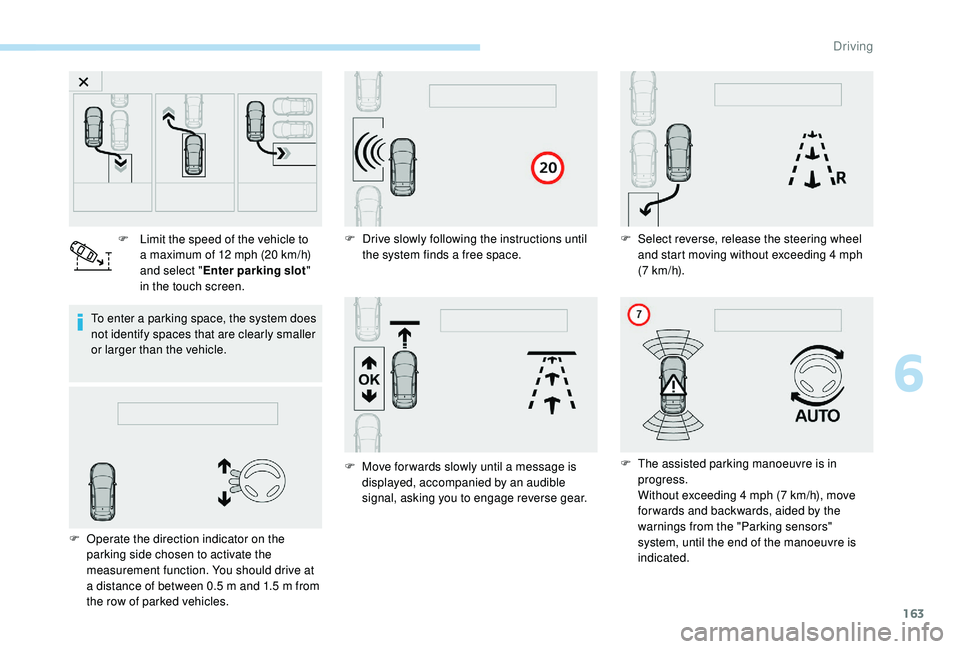
F Limit the speed of the vehicle to a maximum of 12 mph (20 km/h)
and select " Enter parking slot "
in the touch screen.
To enter a parking space, the system does
not identify spaces that are clearly smaller
or larger than the vehicle.
F
O
perate the direction indicator on the
parking side chosen to activate the
measurement function. You should drive at
a distance of between 0.5
m and 1.5 m from
the row of parked vehicles. F
D rive slowly following the instructions until
the system finds a free space.
F
M
ove for wards slowly until a message is
displayed, accompanied by an audible
signal, asking you to engage reverse gear. F
S elect reverse, release the steering wheel
and start moving without exceeding 4 mph
(7
km/h).
F
T
he assisted parking manoeuvre is in
progress.
Without exceeding 4
mph (7 km/h), move
for wards and backwards, aided by the
warnings from the "Parking sensors"
system, until the end of the manoeuvre is
indicated.
6
Driving
Page 166 of 324
164
Assistance in exiting from a
parallel parking space
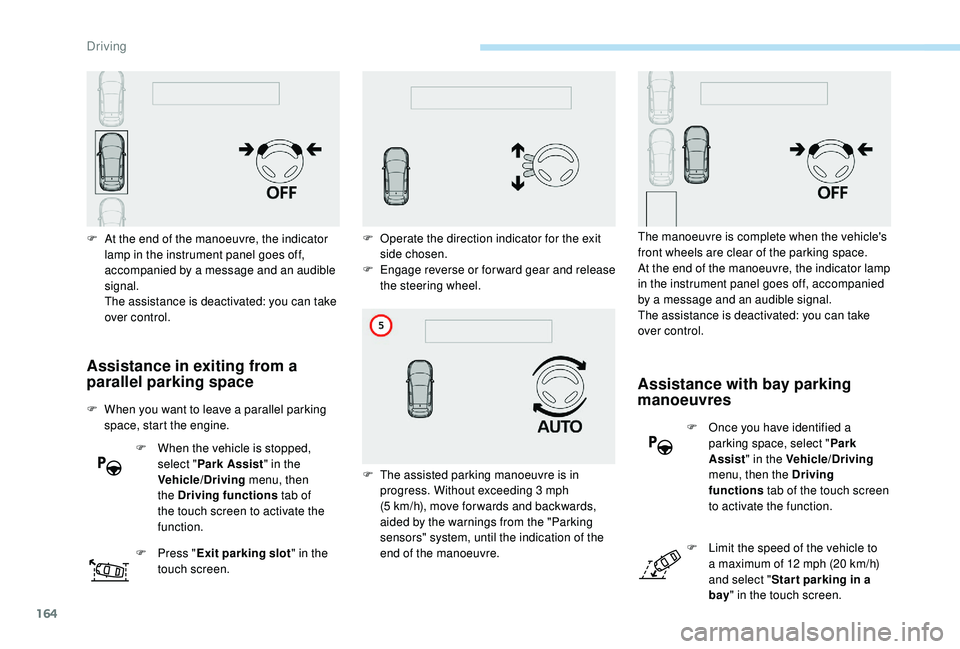
F When you want to leave a parallel parking space, start the engine.
F
W
hen the vehicle is stopped,
select " Park Assist " in the
Vehicle/Driving menu, then
the Driving functions tab of
the touch screen to activate the
function.
F
P
ress "Exit parking slot " in the
touch screen.
F
A
t the end of the manoeuvre, the indicator
lamp in the instrument panel goes off,
accompanied by a message and an audible
signal.
The assistance is deactivated: you can take
over control.
Assistance with bay parking
manoeuvres
F Once you have identified a parking space, select " Park
Assist " in the Vehicle/Driving
menu, then the Driving
functions tab of the touch screen
to activate the function.
F
L
imit the speed of the vehicle to
a maximum of 12
mph (20 km/h)
and select " Star t parking in a
bay " in the touch screen.
F
O
perate the direction indicator for the exit
side chosen.
F
E
ngage reverse or forward gear and release
the steering wheel.
F
T
he assisted parking manoeuvre is in
progress. Without exceeding 3
mph
(5
km/h), move for wards and backwards,
aided by the warnings from the "Parking
sensors" system, until the indication of the
end of the manoeuvre. The manoeuvre is complete when the vehicle's
front wheels are clear of the parking space.
At the end of the manoeuvre, the indicator lamp
in the instrument panel goes off, accompanied
by a message and an audible signal.
The assistance is deactivated: you can take
over control.
Driving
Page 167 of 324
165
When several successive bays are found,
the vehicle will be directed towards the
last one.
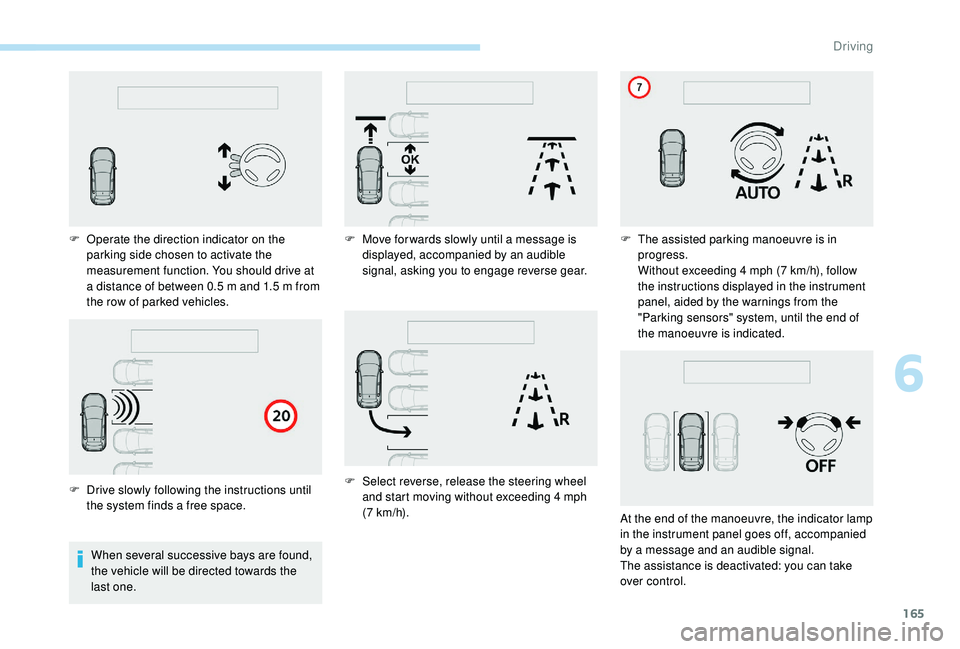
F
O
perate the direction indicator on the
parking side chosen to activate the
measurement function. You should drive at
a distance of between 0.5 m and 1.5 m from
the row of parked vehicles.
F
D
rive slowly following the instructions until
the system finds a free space. F
M
ove for wards slowly until a message is
displayed, accompanied by an audible
signal, asking you to engage reverse gear.
F
S
elect reverse, release the steering wheel
and start moving without exceeding 4 mph
(7
km/h).F
T
he assisted parking manoeuvre is in
progress.
Without exceeding 4 mph (7 km/h), follow
the instructions displayed in the instrument
panel, aided by the warnings from the
"Parking sensors" system, until the end of
the manoeuvre is indicated.
At the end of the manoeuvre, the indicator lamp
in the instrument panel goes off, accompanied
by a message and an audible signal.
The assistance is deactivated: you can take
over control.
6
Driving
Page 168 of 324
166
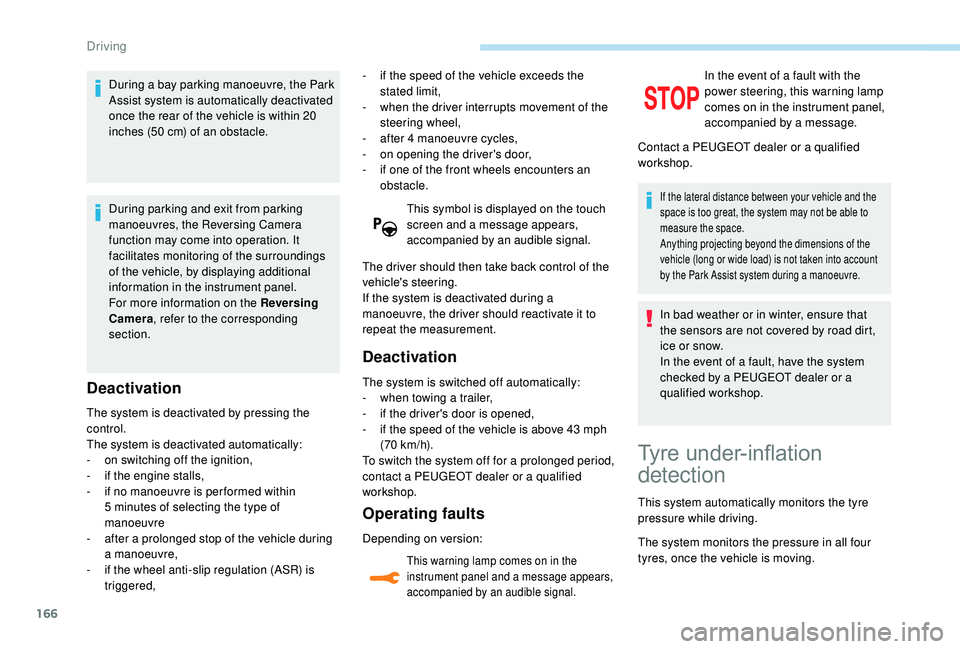
During a bay parking manoeuvre, the Park
Assist system is automatically deactivated
once the rear of the vehicle is within 20
inches (50 cm) of an obstacle.
During parking and exit from parking
manoeuvres, the Reversing Camera
function may come into operation. It
facilitates monitoring of the surroundings
of the vehicle, by displaying additional
information in the instrument panel.
For more information on the Reversing
Camera , refer to the corresponding
section.
Deactivation
The system is deactivated by pressing the
control.
The system is deactivated automatically:
-
o
n switching off the ignition,
-
i
f the engine stalls,
-
i
f no manoeuvre is per formed within
5
minutes of selecting the type of
manoeuvre
-
a
fter a prolonged stop of the vehicle during
a manoeuvre,
-
i
f the wheel anti-slip regulation (ASR) is
triggered, This symbol is displayed on the touch
screen and a message appears,
accompanied by an audible signal.
The driver should then take back control of the
vehicle's steering.
If the system is deactivated during a
manoeuvre, the driver should reactivate it to
repeat the measurement.
Deactivation
The system is switched off automatically:
- w hen towing a trailer,
-
i
f the driver's door is opened,
-
i
f the speed of the vehicle is above 43 mph
(70
km/h).
To switch the system off for a prolonged period,
contact a PEUGEOT dealer or a qualified
workshop.
Operating faults
Depending on version:
This warning lamp comes on in the
instrument panel and a message appears,
accompanied by an audible signal.
In the event of a fault with the
power steering, this warning lamp
comes on in the instrument panel,
accompanied by a message.
If the lateral distance between your vehicle and the
space is too great, the system may not be able to
measure the space.
Anything projecting beyond the dimensions of the
vehicle (long or wide load) is not taken into account
by the Park Assist system during a manoeuvre.
In bad weather or in winter, ensure that
the sensors are not covered by road dirt,
ice or snow.
In the event of a fault, have the system
checked by a PEUGEOT dealer or a
qualified workshop.
Contact a PEUGEOT dealer or a qualified
workshop.
Tyre under-inflation
detection
This system automatically monitors the tyre
pressure while driving.
The system monitors the pressure in all four
tyres, once the vehicle is moving.
-
i
f the speed of the vehicle exceeds the
stated limit,
-
w
hen the driver interrupts movement of the
steering wheel,
-
a
fter 4
manoeuvre cycles,
-
o
n opening the driver's door,
-
i
f one of the front wheels encounters an
obstacle.
Driving
Page 203 of 324
201
F Adjust the pressure using the compressor (to inflate: switch B in position " I"; to deflate:
switch B in position " O" and press button
C ), according to the vehicle's tyre pressure
label.
If after approximately seven minutes this
pressure is not reached, this indicates
that the tyre is not repairable; contact a
PEUGEOT dealer or a qualified workshop
for assistance.
F
R
emove the kit then stow it.
Do not drive more than 125
miles (200 km)
with the repaired tyre; see a PEUGEOT
dealer or a qualified workshop to change
the tyre.
Should the pressure of one or more tyres
be adjusted, it is necessary to reinitialise
the under-inflation detection system.
For more information on Tyre under-
inflation detection , refer to the
corresponding section.Spare wheel
Scan the QR code on page 3 to view
explanatory videos.
Procedure for changing a damaged wheel with
the spare wheel using the tools provided with
the vehicle. For more information on the Tool kit , refer
to the corresponding section.
The jack must only be used to change
a wheel with a damaged or punctured tyre.
The jack does not require any
maintenance.
The jack meets European standards,
as defined in the Machinery Directive
2006/42/EC.
Wheel with wheel trim
When refitting the wheel , refit the wheel
trim, starting by placing its aperture in
line with the valve and then pushing it into
place all round its edge with the palm of
your hand. F
P
ark the vehicle without obstructing any
traffic and apply the parking brake.
F F ollow the safety instructions (hazard
warning lamps, warning triangle, wearing
high visibility vest, etc.) according to the
legislation in force in the country where you
are driving.
F
S
witch off the ignition.
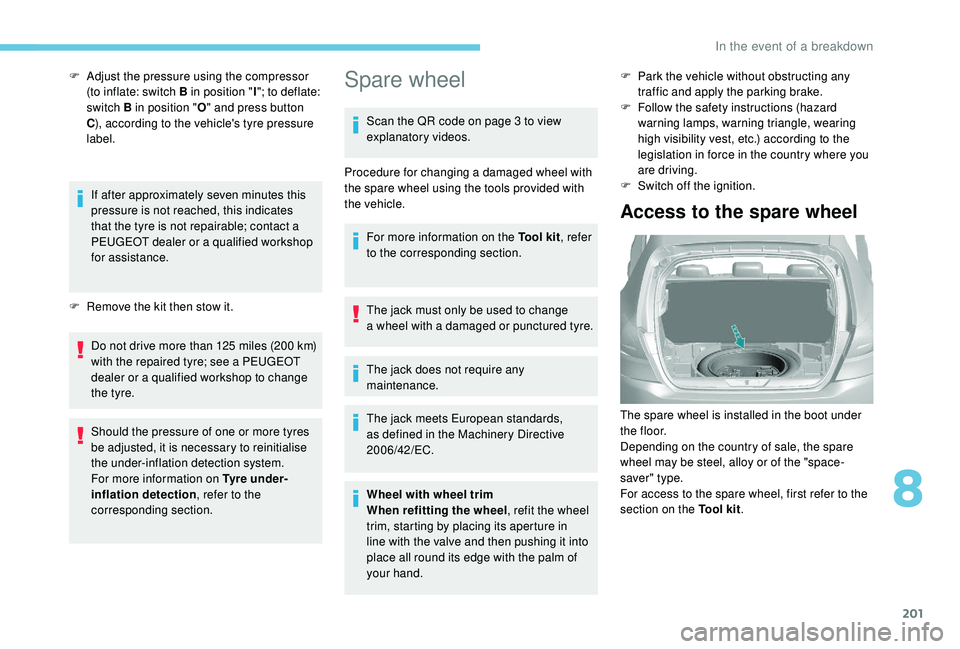
Access to the spare wheel
The spare wheel is installed in the boot under
t h e f l o o r.
Depending on the country of sale, the spare
wheel may be steel, alloy or of the "space-
saver" type.
For access to the spare wheel, first refer to the
section on the Tool kit.
8
In the event of a breakdown
Page 215 of 324
213
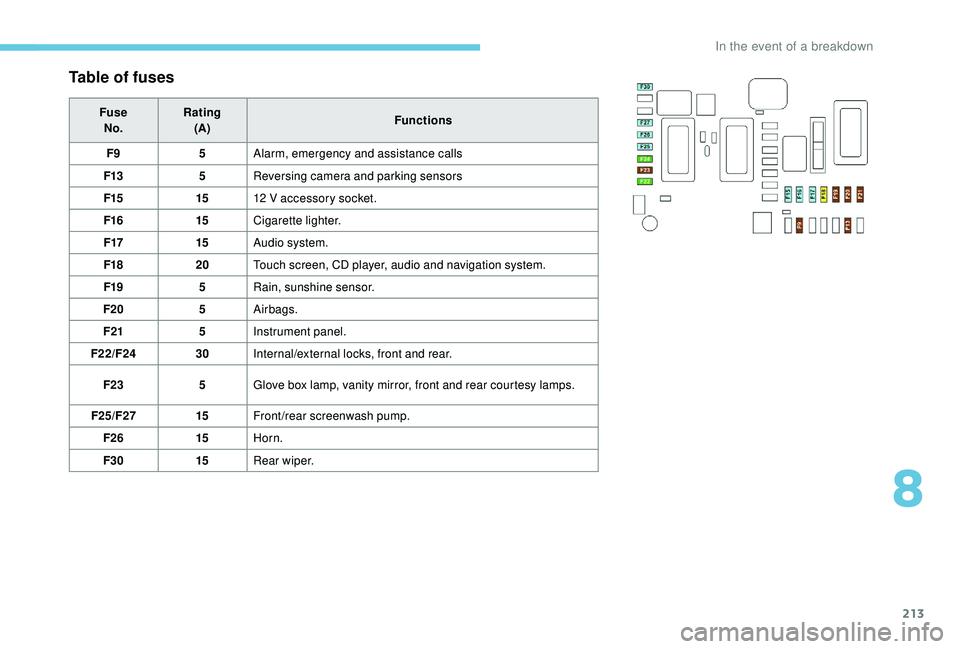
Table of fuses
FuseNo. Rating
(A) Functions
F9 5Alarm, emergency and assistance calls
F13 5Reversing camera and parking sensors
F15 1512
V accessory socket.
F16 15Cigarette lighter.
F17 15Audio system.
F18 20Touch screen, CD player, audio and navigation system.
F19 5Rain, sunshine sensor.
F20 5Airbags.
F21 5Instrument panel.
F22/F24 30Internal/external locks, front and rear.
F23 5Glove box lamp, vanity mirror, front and rear courtesy lamps.
F25/F27 15Front/rear screenwash pump.
F26 15Horn.
F30 15Rear wiper.
8
In the event of a breakdown
Page 221 of 324
219
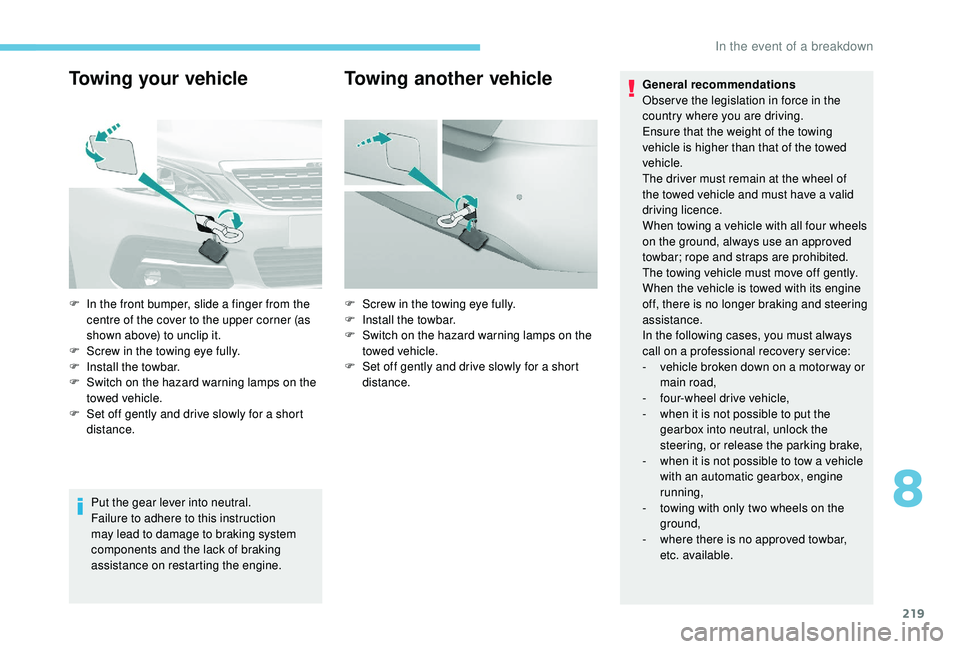
Towing your vehicle
Put the gear lever into neutral.
Failure to adhere to this instruction
may lead to damage to braking system
components and the lack of braking
assistance on restarting the engine.
Towing another vehicleGeneral recommendations
Obser ve the legislation in force in the
country where you are driving.
Ensure that the weight of the towing
vehicle is higher than that of the towed
vehicle.
The driver must remain at the wheel of
the towed vehicle and must have a valid
driving licence.
When towing a vehicle with all four wheels
on the ground, always use an approved
towbar; rope and straps are prohibited.
The towing vehicle must move off gently.
When the vehicle is towed with its engine
off, there is no longer braking and steering
assistance.
In the following cases, you must always
call on a professional recovery ser vice:
-
v
ehicle broken down on a motor way or
main road,
-
f
our-wheel drive vehicle,
-
w
hen it is not possible to put the
gearbox into neutral, unlock the
steering, or release the parking brake,
-
w
hen it is not possible to tow a vehicle
with an automatic gearbox, engine
running,
-
t
owing with only two wheels on the
ground,
-
w
here there is no approved towbar,
etc. available.
F
I
n the front bumper, slide a finger from the
centre of the cover to the upper corner (as
shown above) to unclip it.
F
S
crew in the towing eye fully.
F
I
nstall the towbar.
F
S
witch on the hazard warning lamps on the
towed vehicle.
F
S
et off gently and drive slowly for a short
distance. F
S
crew in the towing eye fully.
F
I
nstall the towbar.
F
S
witch on the hazard warning lamps on the
towed vehicle.
F
S
et off gently and drive slowly for a short
distance.
8
In the event of a breakdown
Page 315 of 324
237
Indicator, coolant temperature ..................23 -24
Indicator, engine oil level ..........................24-25
Indicator lamps, operation
.............................. 10
In
dicator lamps, status
.................................... 10
I
ndicators, direction
........................................ 79
Inflating tyres
................................................ 188
Inflating tyres (using the kit)
......... 19
4, 19 6, 20 0
Instrument panel
............................................... 8
Intelligent Traction Control
..............................87
Internet browser
.............................................. 16
I
SOFIX
.......................................................... 104
ISOFIX mountings .................................. 102,103
JJack ............................... .......193,194, 201, 9, 23
Jump starting ................................................ 215
KKey ................................................ 39-42, 44-46
Key, electronic ........................................... 41- 4 3
Keyless Entry and Starting
...4
1 - 4 2 , 4 4 , 112 ,113
Key not recognised
....................................... 11
3
Key with remote control
....................4
0, 42, 110
Kit, hands-free
...................... 9
-10, 13 -14, 25 -2 6
Kit, temporary puncture repair
.............................. 62, 193,19 4, 19 6, 20 0
LLabels, identification ..................................... 233
LEDs – Light-emitting diodes ......................... 76
L
evel, brake fluid ........................................... 185
Level, Diesel additive
.............................18 6,187
Level, engine coolant
.................23 -24, 185,18 6
Level, engine oil
..........................24 -25, 18 4,185
Level, headlamp wash
............................81, 18 6
Level, screenwash fluid
..........................8
1, 18 6
Levels and checks
..............................
...183,18 6
Light-emitting diodes – LEDs
......................... 76
L
ighting
............................................................ 73
Lighting, ambient ............................................. 73
Lighting, exterior
............................................. 74
Lighting, guide-me home
..........................40, 78
Lighting, interior
...............................
..........72-73
Lighting, welcome
..................................... 78 -79
Lighting dimmer
.............................................. 28
Loading
..................................................... 6, 182
Load reduction mode
.................................... 181
Locating your vehicle
...................................... 40
Locking
...............................
.............................44
Long objects, transporting
..............................61
Low fuel level
.......................................... 17
0,171
Luggage retaining strap
.................................. 62
Lu
mbar
...................................................... 52, 54
MMaintenance, routine ........................................ 6
Map reading lamps ......................................... 72
M
arkings, identification
.................................233
Massage function
............................................ 54
Mat
.................................................................. 59
Memorising a speed
..................................... 13
0
Menu
............................................................... 12
Menu, main
....................................................... 4
M
enus (audio)
........................................ 4-5, 3-5
Messages
........................................................ 28
Messages, quick .............................................28
M irror, rear view .............................................. 56
Mirrors, door ..................................... 5 5, 15 4,15 5
Misfuel prevention
......................................... 171
Mountings, ISOFIX
...............................102, 103
NNet, high load retaining ...................................64
Number plate lamps ...................................... 2 11
OOil, engine .............................................. 18 4,185
Oil change .............................................. 18
4,185
Oil consumption
..................................... 18 4,185
On-board tools
....................................... 193,19 4
Opening the bonnet
...................................... 183
Opening the boot
................................ 4 0 - 41, 47
Opening the doors
..............................4 0 - 41, 4 6
PPads, brake ............................................ 187,188
Paint colour code .......................................... 233
Panoramic glass roof
...................................... 71
Parcel shelf, rear
....................................... 61- 62
Park Assist
...............................
......161,162, 16 4
Parking brake
.................................. 114, 187,188
Parking brake, electric
...... 1
2 -14 , 1 8 -1 9 , 114 ,117
Parking sensors, front
............................15 6,157
Parking sensors, rear .............................15 6,157
PEUGEOT Connect Nav
...................................1
PEUGEOT Connect Radio
...............................1
P
lates, identification ...................................... 233
.
Alphabetical index