ECU PEUGEOT 308 2018 User Guide
[x] Cancel search | Manufacturer: PEUGEOT, Model Year: 2018, Model line: 308, Model: Peugeot 308 2018Pages: 360, PDF Size: 12.38 MB
Page 134 of 360
132
Advice
The driver must ensure that passengers
use the seat belts correctly and that they
are all fastened before setting off.
Wherever you are seated in the vehicle,
always fasten your seat belt, even for short
journeys.
Do not interchange the seat belt buckles as
they will not fulfil their role fully.
The seat belts are fitted with an inertia reel
permitting automatic adjustment of the
length of the strap to your size. The seat
belt is stowed automatically when not in
use.
Before and after use, ensure that the seat
belt is reeled in correctly.
The lower part of the strap must be
positioned as low as possible on the pelvis.
The upper part must be positioned in the
hollow of the shoulder.
The inertia reels have an automatic locking
device at the time of a collision, during
sudden braking or if the vehicle turns over.
You can release the device by pulling the
strap firmly and then releasing it so that it
reels in slightly.In order to be effective, a seat belt must:
-
b e tightened as close to the body as
possible,
-
b
e pulled in front of you with a smooth
movement, checking that it does not twist,
-
b
e used to restrain only one person,
-
n
ot show any signs of cuts or fraying,
-
n
ot be converted or modified to avoid
affecting its performance.
In accordance with current safety regulations,
for all repairs on your vehicle's seat belts, go
to a qualified workshop with the skills and
equipment needed, which a PEUGEOT dealer
is able to provide.
Have your seat belts checked regularly by a
PEUGEOT dealer or a qualified workshop,
particularly if the straps show signs of
damage.
Clean the seat belt straps with soapy water or
a textile cleaning product, sold by PEUGEOT
dealers.
After folding or moving a seat or rear bench
seat, ensure that the seat belt is positioned
and reeled in correctly. Recommendations for children
Use a suitable child seat if the passenger is
less than 12
years old or shorter than one and
a half metres.
Never use the same seat belt to secure more
than one person.
Never allow a child to travel on your lap.
For more information on Child seats , refer to
the corresponding section.
In the event of an impact
Depending on the nature and seriousness
of the impact , the pyrotechnic device may
be deployed before and independently of the
airbags. Deployment of the pretensioners is
accompanied by a slight discharge of harmless
smoke and a noise, due to the activation of
the pyrotechnic cartridge incorporated in the
system.
In all cases, the airbag warning lamp comes
on.
Following an impact, have the seat belts
system checked and, if necessary, replaced, by
a PEUGEOT dealer or a qualified workshop.
Safety
Page 138 of 360
136
Advice
For the airbags to be fully effective,
observe the safety recommendations
below.
Adopt a normal and upright sitting position.
Wear a correctly adjusted seat belt.
Do not leave anything between the occupants
and the airbags (a child, pet, object, etc.), nor
fix or attach anything close to or in the way of
the airbag release trajectory; this could cause
injuries during their deployment.
Never modify the original definition of your
vehicle, particularly in the area directly
around the airbags.
After an accident or if the vehicle has been
stolen, have the airbag systems checked.
All work on the airbag systems must be
per fomed by a PEUGEOT dealer or a
qualified workshop.
Even if all of the precautions mentioned
are obser ved, a risk of injury or of minor
burns to the head, chest or arms when an
airbag is deployed cannot be ruled out. The
bag inflates almost instantly (within a few
milliseconds) then deflates within the same
time discharging the hot gas via openings
provided for this purpose.Front airbags
Do not drive holding the steering wheel by its
spokes or resting your hands on the centre
part of the wheel.
Passengers must not place their feet on the
dashboard.
Do not smoke as deployment of the airbags
can cause burns or the risk of injury from a
cigarette or pipe.
Never remove or pierce the steering wheel or
hit it violently.
Do not fit or attach anything to the steering
wheel or dashboard, this could cause injuries
in case of airbag deployment.
Do not attach anything to or hang anything
from the seat backrests (clothes, etc.) as
this could cause injuries to the thorax or arm
when the lateral airbag is deployed.
Do not sit with the upper part of the body any
nearer to the door than necessary.
The vehicle's front door panels include side
impact sensors.
A damaged door or any unauthorised or
incorrectly executed work (modification or
repair) on the front doors or their interior trim
could compromise the operation of these
sensors
– risk of malfunction of the lateral
airbags!
Such work must only be done by a PEUGEOT
dealer or a qualified workshop.
Curtain airbags
Do not attach anything or hang anything to
the roof, as this could cause head injuries
when the curtain airbag is deployed.
If fitted to your vehicle, do not remove the
grab handles installed on the roof, they play a
part in securing the curtain airbags. Lateral airbags
Use only approved covers on the seats,
compatible with the deployment of the lateral
airbags. For information on the range of seat
covers suitable for your vehicle, you can
contact a PEUGEOT
dealer.
Safety
Page 143 of 360
141
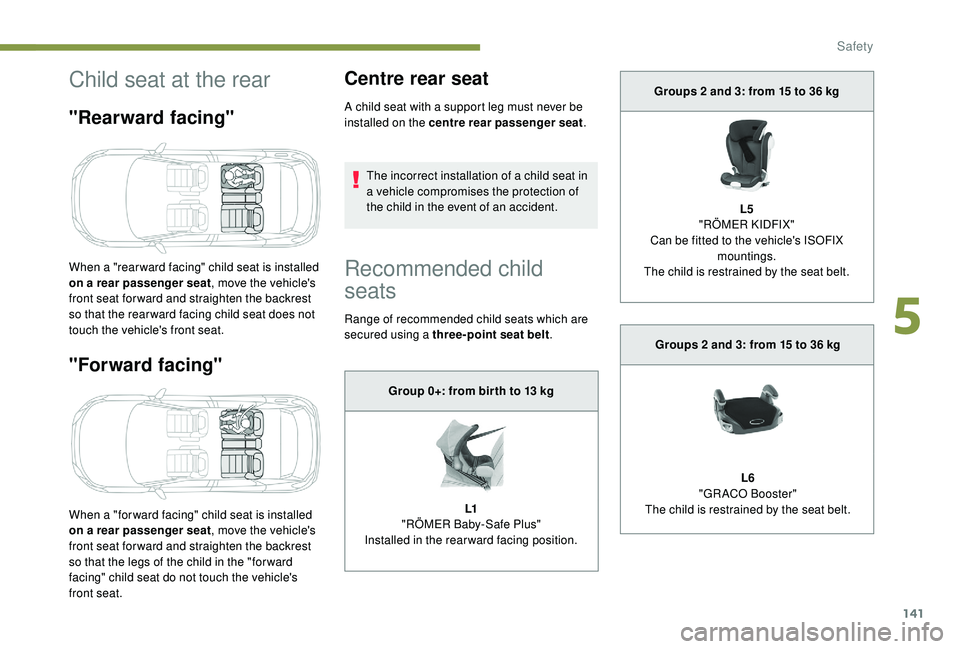
Child seat at the rear
"Rearward facing"
"Forward facing"
When a "for ward facing" child seat is installed
on a rear passenger seat, move the vehicle's
front seat for ward and straighten the backrest
so that the legs of the child in the "for ward
facing" child seat do not touch the vehicle's
front seat.
Centre rear seat
A child seat with a support leg must never be
installed on the centre rear passenger seat .
The incorrect installation of a child seat in
a vehicle compromises the protection of
the child in the event of an accident.
When a "rear ward facing" child seat is installed
on a rear passenger seat , move the vehicle's
front seat for ward and straighten the backrest
so that the rear ward facing child seat does not
touch the vehicle's front seat.
Recommended child
seats
Range of recommended child seats which are
secured using a three-point seat belt .
Group 0+: from bir th to 13
kg
L1
"RÖMER Baby-Safe Plus"
Installed in the rearward facing position. Groups 2
and 3: from 15 to 36 kg
L5
"RÖMER KIDFIX"
Can be fitted to the vehicle's ISOFIX mountings.
The child is restrained by the seat belt.
Groups 2 and 3: from 15 to 36 kg
L6
"GRACO Booster"
The child is restrained by the seat belt.
5
Safety
Page 144 of 360
142
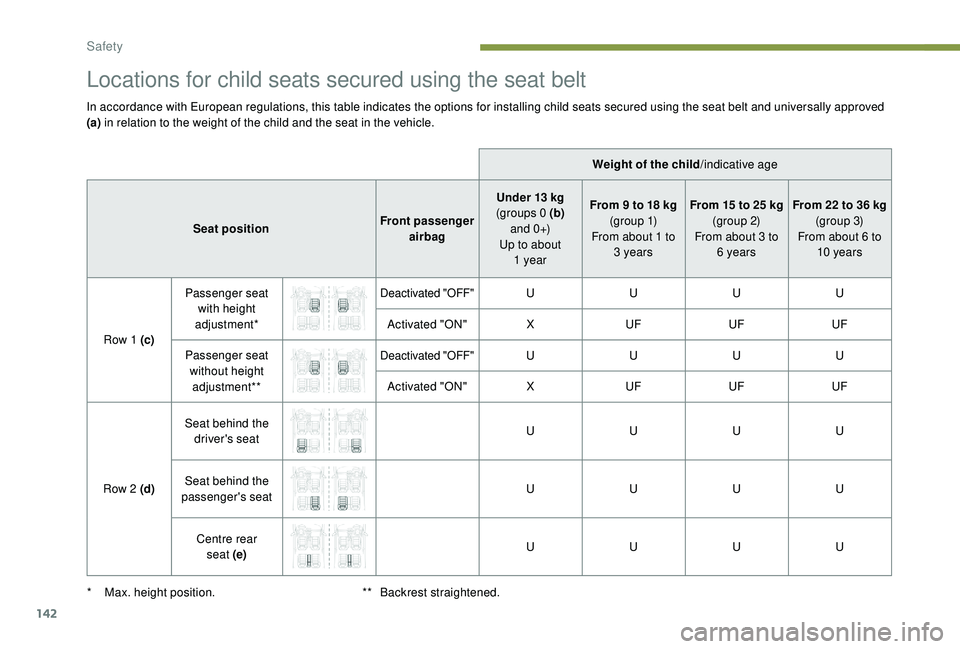
Locations for child seats secured using the seat belt
In accordance with European regulations, this table indicates the options for installing child seats secured using the seat belt and universally approved
(a) in relation to the weight of the child and the seat in the vehicle.
Weight of the child/indicative age
Seat position Front passenger
airbag Under 13
kg
(groups 0 (b)
a n d
0 +)
Up to about 1
yearFrom 9 to 18
kg
(g r o u p 1)
From about 1 to 3
yearsFrom 15 to 25
kg
(group 2)
From about 3 to 6
yearsFrom 22 to 36 kg
(group 3)
From about 6 to 10
years
Row 1 (c) Passenger seat
with height
adjustment*
Deactivated "OFF"U UUU
Activated "ON" XUF UFUF
Passenger seat without height adjustment**
Deactivated "OFF"U UUU
Activated "ON" XUF UFUF
Row 2 (d) Seat behind the
driver's seat U
UUU
Seat behind the
passenger's seat U
UUU
Centre rear seat
(e) U
UUU
*
M
ax. height position. **
B
ackrest straightened.
Safety
Page 145 of 360
143
U:seat suitable for installing a child
seat secured using the seat belt and
universally approved for "rearward
facing" and/or "forward facing" use.
UF: seat suitable for installing a child
seat secured using the seat belt and
universally approved for "forward
facing" use.
X: seat not suitable for installing a child
seat of the weight group indicated.
(a) Universal child seat: child seat that can
be installed in all vehicles using the
seat belt.
(b) Group 0: from birth to 10
kg. Infant car
seats and "car cots" cannot be installed
on the front passenger seat.
(c) Refer to the current legislation in your
country before installing your child in
this seat.
(d) When installing a child seat on a rear
seat in a "rear ward facing" or "for ward
facing" position, move the front seat
for ward then adjust the backrest to an
upright position to allow enough room
for the child seat and the child's legs.
(e) A child seat with a support leg must
never be installed on this seat.'ISOFIX' mountings
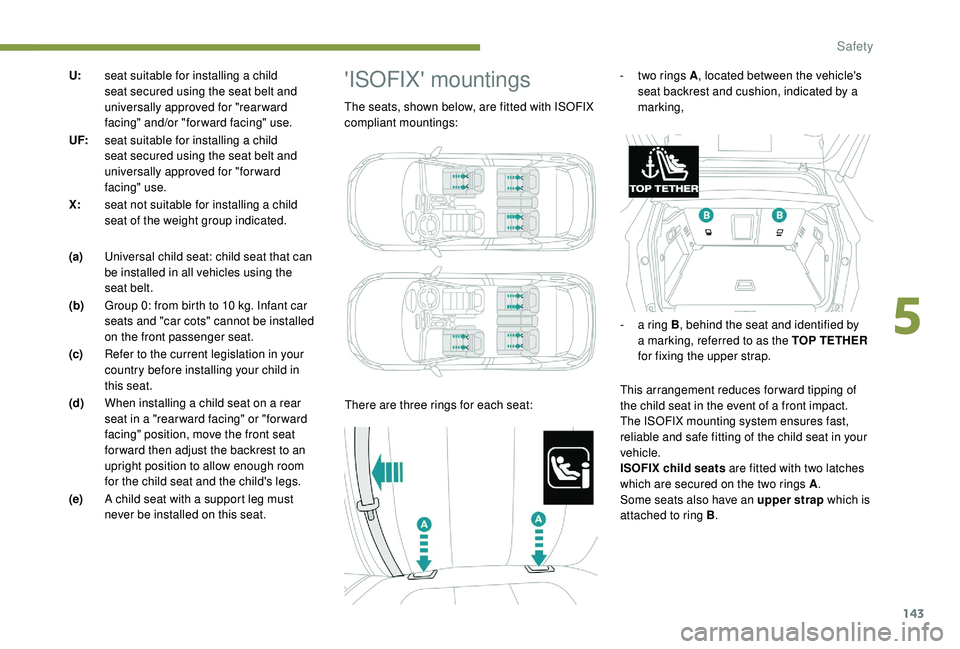
The seats, shown below, are fitted with ISOFIX
compliant mountings:
There are three rings for each seat: -
t
wo rings A
, located between the vehicle's
seat backrest and cushion, indicated by a
marking,
This arrangement reduces forward tipping of
the child seat in the event of a front impact.
The ISOFIX mounting system ensures fast,
reliable and safe fitting of the child seat in your
vehicle.
ISOFIX child seats are fitted with two latches
which are secured on the two rings A .
Some seats also have an upper strap which is
attached to ring B .
-
a r
ing B, behind the seat and identified by
a marking, referred to as the TOP TETHER
for fixing the upper strap.
5
Safety
Page 146 of 360
144
To secure the child seat to the TOP TETHER:
F r emove and stow the head restraint before
installing the child seat on the seat (refit it
once the child seat has been removed),
F
p
ass the upper strap of the child seat behind
the seat backrest, between the apertures
for the head restraint rods,
F
f
ix the hook of the upper strap to ring B ,
F
t
ighten the upper strap.When fitting an ISOFIX child seat to
the left-hand rear seat of the bench
seat, before fitting the seat, first move
the centre rear seat belt towards the
middle of the vehicle, so as to avoid
the seat interfering with the operation
of the seat belt.
The incorrect installation of a child seat
in a vehicle compromises the child's
protection in the event of an accident.
Strictly obser ve the fitting instructions
provided with the child seat.
For information on the possibilities for
installing ISOFIX child seats in your
vehicle, refer to the summary table.Recommended ISOFIX
child seats
Also consult the installation notes from the
child seat's manufacturer to find out how
to install and remove the seat.
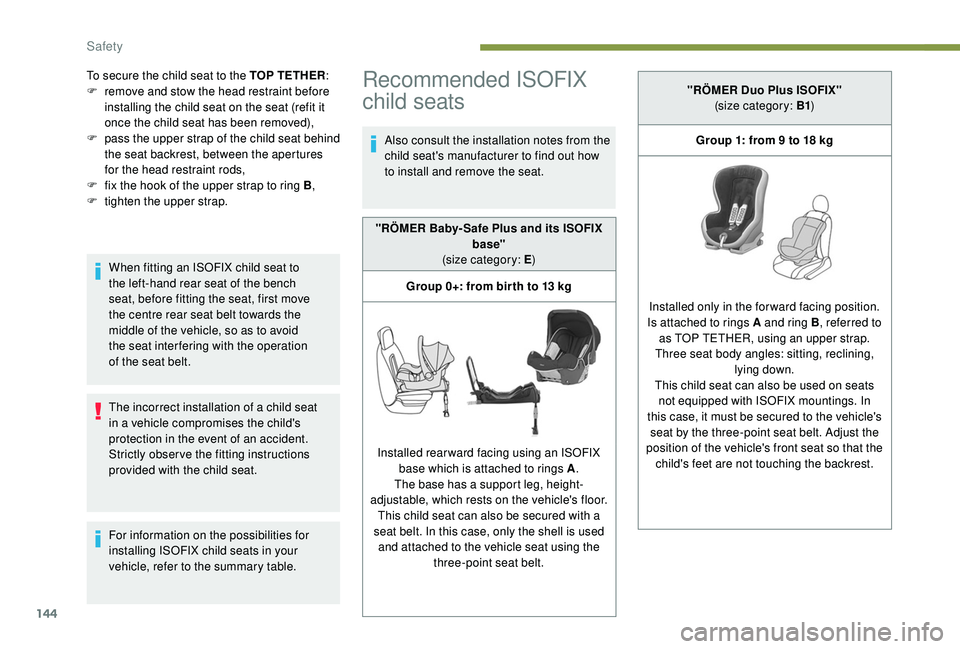
"RÖMER Baby- Safe Plus and its ISOFIX base"
(size category: E )
Group 0+: from bir th to 13
kg
Installed rearward facing using an ISOFIX base which is attached to rings A .
The base has a support leg, height-
adjustable, which rests on the vehicle's floor. This child seat can also be secured with a
seat belt. In this case, only the shell is used and attached to the vehicle seat using the three-point seat belt. "RÖMER Duo Plus ISOFIX"
(size category: B1 )
Group 1: from 9 to 18 kg
Installed only in the forward facing position.
Is attached to rings A and ring B , referred to
as TOP TETHER, using an upper strap.
Three seat body angles: sitting, reclining, lying down.
This child seat can also be used on seats not equipped with ISOFIX mountings. In
this case, it must be secured to the vehicle's seat by the three-point seat belt. Adjust the
position of the vehicle's front seat so that the child's feet are not touching the backrest.
Safety
Page 148 of 360
146
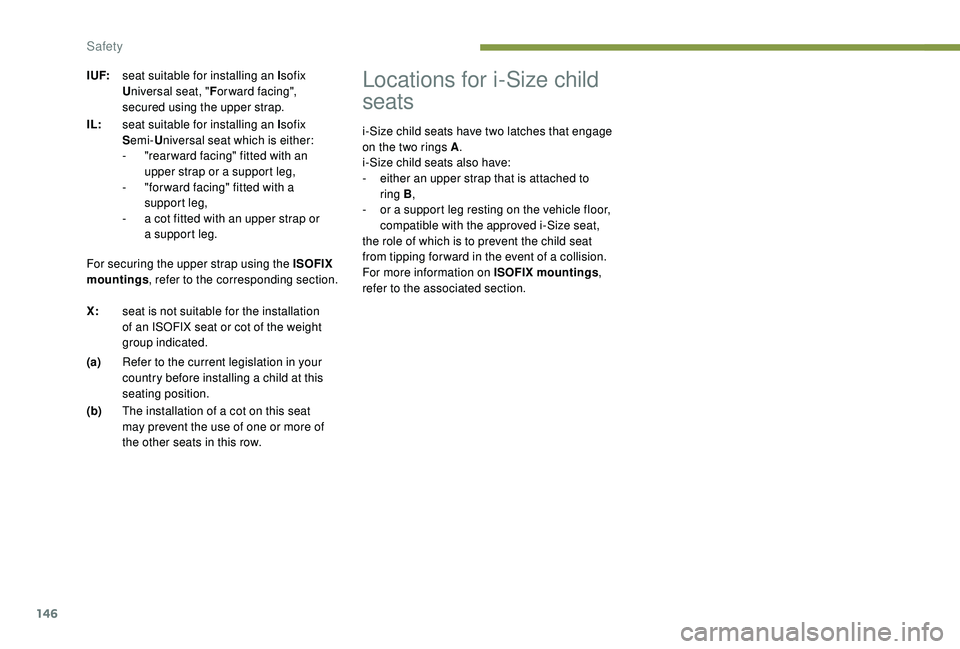
Locations for i-Size child
seats
i-Size child seats have two latches that engage
on the two rings A.
i-Size child seats also have:
-
e
ither an upper strap that is attached to
ring
B,
-
o
r a support leg resting on the vehicle floor,
compatible with the approved i-Size seat,
the role of which is to prevent the child seat
from tipping for ward in the event of a collision.
For more information on ISOFIX mountings ,
refer to the associated section.
I UF:
seat suitable for installing an I sofix
U niversal seat, " For ward facing",
secured using the upper strap.
IL: seat suitable for installing an I sofix
S emi- Universal seat which is either:
-
"
rear ward facing" fitted with an
upper strap or a support leg,
-
"
for ward facing" fitted with a
support leg,
-
a c
ot fitted with an upper strap or
a support leg.
(a) Refer to the current legislation in your
country before installing a child at this
seating position.
(b) The installation of a cot on this seat
may prevent the use of one or more of
the other seats in this row.
For securing the upper strap using the ISOFIX
mountings
, refer to the corresponding section.
X: seat is not suitable for the installation
of an ISOFIX seat or cot of the weight
group indicated.
Safety
Page 150 of 360
148
Advice
The incorrect installation of a child seat in a
vehicle compromises the child's protection
in the event of an accident.
Ensure that there is no seat belt or seat
belt buckle under the child seat, as this
could destabilise it.
Remember to fasten the seat belts or the
child seat harnesses keeping the slack
relative to the child's body to a minimum,
even for short journeys.
When installing a child seat using the seat
belt, ensure that the seat belt is tightened
correctly on the child seat and that it
secures the child seat firmly on the seat
of your vehicle. If your passenger seat is
adjustable, move it forwards if necessary.
At rear seating positions, always leave
sufficient space between the front seat
and:
-
a r
ear ward facing child seat,
-
t
he child's feet for a child seat fitted
forward facing.
To do this, move the front seat for wards
and, if necessary, move its backrest into
the upright position.
For optimal installation of the forward
facing child seat, verify that its backrest is
as close as possible to the backrest of the
vehicle seat, if possible in contact with it. The head restraint must be removed before
installing a child seat with a backrest on a
passenger seat.
Ensure that the head restraint is stored or
attached securely to prevent it from being
thrown around the vehicle in the event of
sharp braking. Refit the head restraint when
the child seat is removed.
Children in front
The legislation on carrying children on the
front passenger seat is specific to each
country. Refer to the legislation in force in
your country.
Deactivate the front passenger airbag when
a
rear ward facing child seat is installed on
the front passenger seat.
Otherwise, the child would risk being seriously
injured or killed if the airbag were deployed.
Installing a booster seat
The chest part of the seat belt must be
positioned on the child's shoulder without
touching the neck.
Ensure that the lap part of the seat belt
passes correctly over the child's thighs.
PEUGEOT recommends using a booster seat
with a backrest equipped with a belt guide at
shoulder level. As a safety precaution, do not leave:
-
a c hild or children alone and unattended in
a vehicle,
-
a c
hild or an animal in a vehicle which
is exposed to the sun, with the windows
closed,
-
t
he keys within reach of children inside the
vehicle.
To prevent accidental opening of the doors
and rear windows, use the child lock.
Take care not to open the rear windows by
more than one third.
To protect young children from the rays of the
sun, fit side blinds on the rear windows.
Safety
Page 190 of 360
188
The cruise control operates by day and
night, in fog or moderate rainfall.
However, it is strongly recommended
that you always keep a safe distance
from vehicles ahead, according to the
driving conditions, the weather and the
road surface.
Use the cruise control only where
the driving conditions allow running
at a constant speed and keeping an
adequate safety distance.
Do not activate the cruise control in an
urban area where pedestrians are likely
to cross the road, in heavy traffic, on
winding or steep roads, on slippery or
flooded roads, when there is snowfall,
if the front bumper or the windscreen
is damaged, or when the brake lamps
have failed.
In certain circumstances, it may not
be possible for the speed setting to be
maintained or even attained: loaded
vehicle, ascending a steep hill, etc.The system is not intended for the
following situations:
-
i
f the front end of the vehicle has
been modified (addition of long-range
headlamps, painting of the front
bumper),
-
d
riving on a racing circuit,
-
r
unning on a rolling road,
-
u
se of snow chains, non-slip covers or
studded tyres.
The use of mats not approved by
PEUGEOT may inter fere with the
operation of the cruise control.
To avoid any risk of jamming of the pedals:
-
e
nsure that the mat is secured
c o r r e c t l y,
-
d
o not fit one mat on top of another.The camera may be disrupted or not
work in the following situations:
-
p
oor visibility (inadequate street
lighting, falling snow, heavy rain,
dense fog, etc.),
-
d
azzle (headlamps of an oncoming
vehicle, low sun, reflections on
a damp road, leaving a tunnel,
alternating shade and light, etc.),
-
c
amera or radar obstructed (mud,
frost, snow, condensation, etc.).
In these situations, detection
performance may be reduced.
Operation of the radar, located in the
front bumper, may be impaired by the
accumulation of dirt (dust, mud, etc.)
or in certain weather conditions (snow,
f r o s t , e t c .) .
Clean the front bumper regularly.
Clean the windscreen regularly,
particularly the area in front of the
detection camera.
Do not allow snow to accumulate on
the bonnet or roof of the vehicle, as this
could obscure the camera.
Driving
Page 222 of 360
220
Towbar with quickly
detachable towball
No tools are required to install or remove the
towball on this genuine towbar system.
Presentation
Trailers with LED lamps are not
compatible with the wiring harness of this
device.To know the Technical data
, and, in
particular, the towable weights for your
vehicle, refer to the corresponding
section.
To ensure complete safety while driving
with a Towbar system , refer to the
corresponding section.
Before each use
Check that the towball is correctly fitted,
verifying the follow points:
-
t
he green mark on the locking wheel
is in line with the green mark on the
towball,
-
t
he locking wheel is in contact with the
towball (position A ),
-
t
he security key lock is on and the key
removed; the locking wheel can no
longer be operated,
- t he towball must not be able to move
in its carrier; test by shaking it with
your hand.
If the towball is not locked, the trailer can
detach
– accident risk!
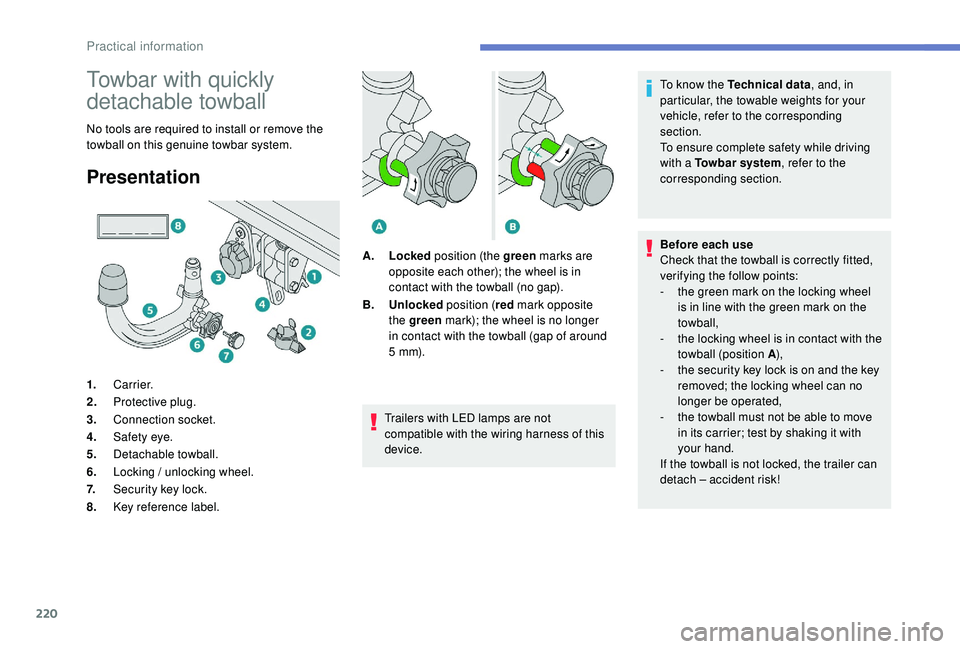
1.
Carrier.
2. Protective plug.
3. Connection socket.
4. Safety eye.
5. Detachable towball.
6. Locking / unlocking wheel.
7. Security key lock.
8. Key reference label. A.
Locked position (the green marks are
opposite each other); the wheel is in
contact with the towball (no gap).
B. Unlocked position (red mark opposite
the green mark); the wheel is no longer
in contact with the towball (gap of around
5
m m).
Practical information