brakes PEUGEOT 308 2018 User Guide
[x] Cancel search | Manufacturer: PEUGEOT, Model Year: 2018, Model line: 308, Model: Peugeot 308 2018Pages: 360, PDF Size: 12.38 MB
Page 193 of 360
191
If the camera and/or radar have
confirmed the presence of a vehicle
or a pedestrian, this warning lamp
flashes once the function is acting
on the vehicle's brakes.
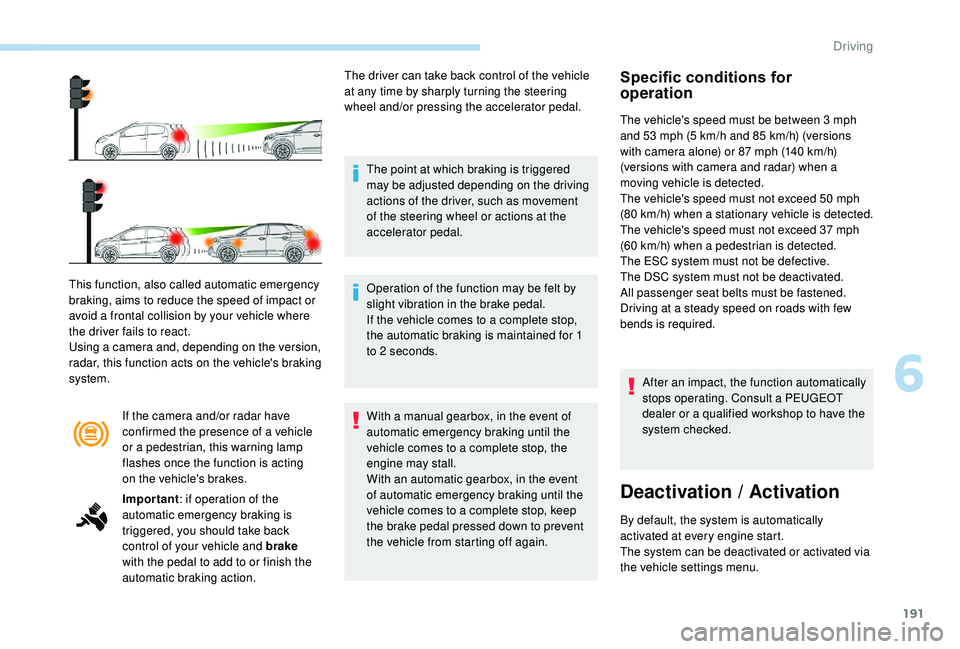
This function, also called automatic emergency
braking, aims to reduce the speed of impact or
avoid a frontal collision by your vehicle where
the driver fails to react.
Using a camera and, depending on the version,
radar, this function acts on the vehicle's braking
system.
Important : if operation of the
automatic emergency braking is
triggered, you should take back
control of your vehicle and brake
with the pedal to add to or finish the
automatic braking action. The driver can take back control of the vehicle
at any time by sharply turning the steering
wheel and/or pressing the accelerator pedal.
The point at which braking is triggered
may be adjusted depending on the driving
actions of the driver, such as movement
of the steering wheel or actions at the
accelerator pedal.
Operation of the function may be felt by
slight vibration in the brake pedal.
If the vehicle comes to a complete stop,
the automatic braking is maintained for 1
to 2 seconds.
With a manual gearbox, in the event of
automatic emergency braking until the
vehicle comes to a complete stop, the
engine may stall.
With an automatic gearbox, in the event
of automatic emergency braking until the
vehicle comes to a complete stop, keep
the brake pedal pressed down to prevent
the vehicle from starting off again.
Specific conditions for
operation
The vehicle's speed must be between 3 mph
a nd 53 mph (5 km/h and 85 km/h) (versions
with camera alone) or 87
mph (140 km/h)
(versions with camera and radar) when a
moving vehicle is detected.
The vehicle's speed must not exceed 50
mph
(80
k
m/h) when a stationary vehicle is detected.
The vehicle's speed must not exceed 37
mph
(60
km/h) when a pedestrian is detected.
The ESC system must not be defective.
The DSC system must not be deactivated.
All passenger seat belts must be fastened.
Driving at a steady speed on roads with few
bends is required.
After an impact, the function automatically
stops operating. Consult a PEUGEOT
dealer or a qualified workshop to have the
system checked.
Deactivation / Activation
By default, the system is automatically
activated at every engine start.
The system can be deactivated or activated via
the vehicle settings menu.
6
Driving
Page 197 of 360
195
The detection may be impeded:
- i f the markings on the road are worn,
-
i
f there is little contrast between the
markings on the road and the road
sur face,
-
i
f the windscreen is dirty,
-
i
n certain weather conditions: fog,
heavy rain, snow, shade, bright
sunlight or direct exposure to the sun
(low sun, leaving a tunnel, etc.).
Active Lane Departure
Warning System
Using a camera placed at the top of the
windscreen to identify lane markings on the
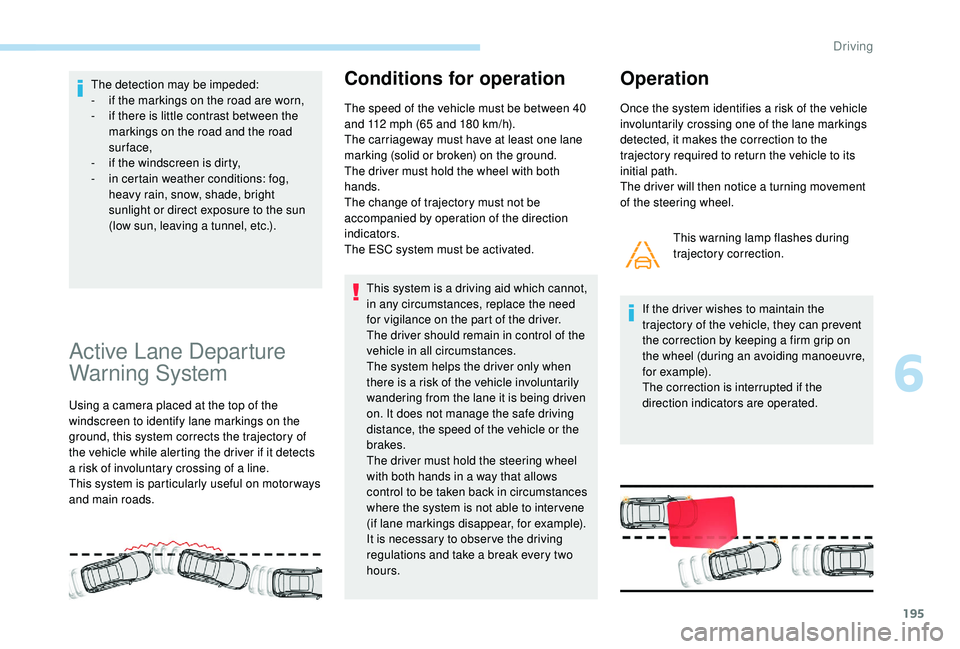
ground, this system corrects the trajectory of
the vehicle while alerting the driver if it detects
a risk of involuntary crossing of a line.
This system is particularly useful on motor ways
and main roads.
Conditions for operation
The speed of the vehicle must be between 40
and 112 mph (65 and 180 km/h).
The carriageway must have at least one lane
marking (solid or broken) on the ground.
The driver must hold the wheel with both
hands.
The change of trajectory must not be
accompanied by operation of the direction
indicators.
The ESC system must be activated.
This system is a driving aid which cannot,
in any circumstances, replace the need
for vigilance on the part of the driver.
The driver should remain in control of the
vehicle in all circumstances.
The system helps the driver only when
there is a risk of the vehicle involuntarily
wandering from the lane it is being driven
on. It does not manage the safe driving
distance, the speed of the vehicle or the
brakes.
The driver must hold the steering wheel
with both hands in a way that allows
control to be taken back in circumstances
where the system is not able to inter vene
(if lane markings disappear, for example).
It is necessary to obser ve the driving
regulations and take a break every two
hours. This warning lamp flashes during
trajectory correction.
If the driver wishes to maintain the
trajectory of the vehicle, they can prevent
the correction by keeping a firm grip on
the wheel (during an avoiding manoeuvre,
for example).
The correction is interrupted if the
direction indicators are operated.
Operation
Once the system identifies a risk of the vehicle
involuntarily crossing one of the lane markings
detected, it makes the correction to the
trajectory required to return the vehicle to its
initial path.
The driver will then notice a turning movement
of the steering wheel.
6
Driving
Page 211 of 360
209
180° view
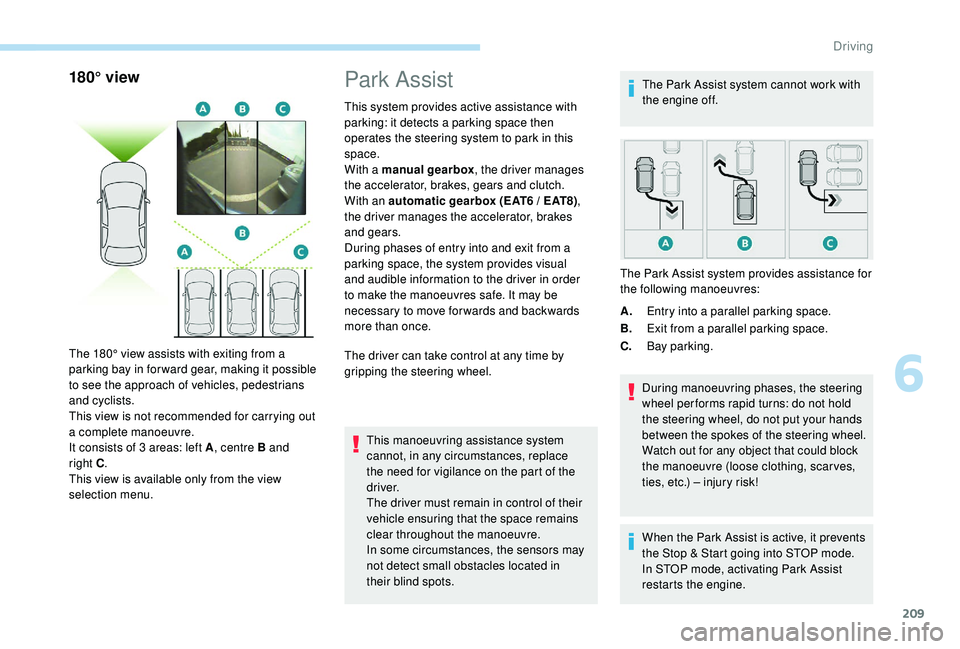
The 180° view assists with exiting from a
parking bay in forward gear, making it possible
to see the approach of vehicles, pedestrians
and cyclists.
This view is not recommended for carrying out
a complete manoeuvre.
It consists of 3 areas: left A, centre B and
right
C.
This view is available only from the view
selection menu.
Park Assist
This system provides active assistance with
parking: it detects a parking space then
operates the steering system to park in this
space.
With a manual gearbox , the driver manages
the accelerator, brakes, gears and clutch.
With an automatic gearbox (EAT6 / EAT8) ,
the driver manages the accelerator, brakes
and gears.
During phases of entry into and exit from a
parking space, the system provides visual
and audible information to the driver in order
to make the manoeuvres safe. It may be
necessary to move for wards and backwards
more than once.
The driver can take control at any time by
gripping the steering wheel.
This manoeuvring assistance system
cannot, in any circumstances, replace
the need for vigilance on the part of the
driver.
The driver must remain in control of their
vehicle ensuring that the space remains
clear throughout the manoeuvre.
In some circumstances, the sensors may
not detect small obstacles located in
their blind spots. The Park Assist system cannot work with
the engine off.
A. Entry into a parallel parking space.
B. Exit from a parallel parking space.
C. Bay parking.
During manoeuvring phases, the steering
wheel per forms rapid turns: do not hold
the steering wheel, do not put your hands
between the spokes of the steering wheel.
Watch out for any object that could block
the manoeuvre (loose clothing, scar ves,
ties, etc.) – injury risk!
When the Park Assist is active, it prevents
the Stop & Start going into STOP mode.
In STOP mode, activating Park Assist
restarts the engine.
The Park Assist system provides assistance for
the following manoeuvres:
6
Driving
Page 234 of 360
232
Air filter
Depending on the environment
(e.g. dusty atmosphere) and the
use of the vehicle (e.g. city driving),
replace it twice as often, if
necessary.
Oil filter
Change the oil filter each time the
engine oil is changed.
Particle filter (Diesel)
The start of saturation of the particle
filter is indicated by the temporary
illumination of this warning lamp
accompanied by a message about
the risk of the filter clogging up.
As soon as the traffic conditions permit,
regenerate the filter by driving at a speed
of at least 37
mph (60 km/h) until the
warning lamp goes off.
If the warning lamp stays on, this indicates
a low Diesel additive level.
For more information on Checking levels ,
refer to the corresponding section. On a new vehicle, the first particle
filter regeneration operations may be
accompanied by a "burning" smell, which
is per fectly normal.
Following prolonged operation of the
vehicle at very low speed or at idle,
you may, in exceptional circumstances,
notice the emission of water vapour at the
exhaust on acceleration. This does not
affect the behaviour of the vehicle or the
environment.
Manual gearbox
The gearbox does not require any
maintenance (no oil change).
Automatic gearbox
The gearbox does not require any
maintenance (no oil change).
Brake pads
Brake wear depends on the style
of driving, particularly in the case
of vehicles used in town, over short
distances. It may be necessary to
have the condition of the brakes
checked, even between vehicle
services.
Unless there is a leak in the circuit, a drop in
the brake fluid level indicates that the brake
pads are worn.
Brake disc wear
For information on checking brake
disc wear, contact a PEUGEOT
dealer or a qualified workshop.
Electric parking brake
This system does not require any
routine servicing. However, in the
event of a problem, have the system
checked by a PEUGEOT dealer or a
qualified workshop.
Practical information
Page 235 of 360
233
For more information on the Electric
parking brake, refer to the corresponding
section.
Wheels and tyres
The pressure must be checked on
all tyres, including the spare wheel,
when the tyres are "cold", at least
once a month and before a long
j o u r n ey. Using different size wheels and tyres from
those specified can affect the lifetime of tyres,
wheel rotation, ground clearance and the
speedometer reading and have an adverse
effect on road holding.
Fitting different tyres on the front and rear axles
can cause the ESC to mistime.
Only use products recommended by
PEUGEOT or products of equivalent
quality and specification.
In order to optimise the operation of
components as important as those in the
braking system, PEUGEOT selects and
offers very specific products.
After washing the vehicle, dampness, or
in wintry conditions, ice can form on the
brake discs and pads: braking efficiency
may be reduced. Make light brake
applications to dry and defrost the brakes.
The pressures given on the tyre pressure label
are valid for "cold" tyres. If you have driven for
more than 10
minutes or more than 6 miles
(10
kilometres) at more than 31 mph (50 km/h),
0.3
bar (30 kPa) should be added to the values
given on the label.
Under-inflation increases fuel consumption.
Non-compliant tyre pressure causes premature
wear on tyres and has an adverse effect on the
vehicle's road holding
– Risk of an accident!
Driving with worn or damaged tyres reduces
braking efficiency and control of the vehicle's
steering. Regular inspections of the condition
of tyres (tread and sides) and rims are
recommended as well as making sure that
valves are fitted.
7
Practical information
Page 351 of 360
267
A
180° rear vision .....................................20 6-207
Accessories .......................................... 121, 15 6
Active Safety Brake..................... 16 -17, 18 9 -191
AdBlue
® ............................................ 20, 32, 234
Additive, Diesel ............................................. 232
Adjusting headlamps
.................................... 112
Adjusting head restraints
................................ 73
Adjusting seats
........................................... 71-73
Adjusting the air distribution
.....................87- 8 9
Adjusting the air flow
................................. 8
7- 8 9
Adjusting the date
......................... 38-40, 31, 18
Adjusting the height and reach of the steering wheel
.................................... 76
Adjusting the lumbar support
..................... 71
-73
Adjusting the seat belt height
................ 1
2 9 -13 0
Adjusting the temperature
........................87- 8 9
Adjusting the time
......................... 38-40, 31, 17
Advanced Grip Control
.......................... 127-128
Advice on driving
................................... 151-152
Airbags
...............................
.............18, 13 3 , 13 8
Airbags, curtain
...................................... 13 4 -13 6
Airbags, front .................................. 13 3 -13 4, 13 6
Airbags, lateral
...................................... 13 4, 13 6
Air conditioning
......................................... 84-86
Air conditioning, automatic
.............................83
Air conditioning, dual-zone automatic
.....86, 90
Air conditioning, manual
..................... 83
-84, 90
Air conditioning, mono-zone
...............84-86, 90
Air intake
................................................... 87- 8 9
Air vents
.................................................... 81- 82
Alarm
............................................................... 58
Amplifier, audio
...............................
................98
Anti-lock braking system (ABS)
..............15, 124
Apple CarPlay connection
........................16, 12
Armrest, front
................................................ 10 0
Armrest, rear
...............................
..................105
Assistance call
...............................
........12 2-123
Assistance, emergency braking
...........124, 19 0
Audio streaming (Bluetooth)
...................24, 9 , 9
B
Backrest, folding ........................................ 7 2-73
Battery ..................... 13, 223 , 231, 257-258 , 260
Battery charge (warning lamp)
.......................13
Battery, charging
................................... 259-260
Battery, remote control
.............................54, 56
Blind
..............................
..................................67
Blind spot monitoring system
..........24, 200-202
Blind spot monitoring system, active
......24, 202
Blind spot sensors
..........................24, 200-201
BlueHDi
............................. 32, 35 , 234 , 237-238
Bluetooth (hands-free)
........ 2
5 -26, 13 -14 , 1 0 -11
Bluetooth (telephone)
......................
25 -27, 13 -15
Bonnet
................................................... 226-227
Boot
............................................. 61- 62, 64, 108
Brake discs
............................................ 232-233
Brake lamps
...............................
...................250
Brakes
........................................ 14 -15, 232-233
Braking assistance system
...........................124
Braking, automatic emergency
...16 -17 , 18 9 -191
Braking, emergency
...................................... 16
0
Brightness
....................................................... 16
Bulbs
............................................................. 248
Bulbs (changing)
....................247-248, 250-252
C
Cable, audio ................................................ 23, 9
Cable, Jack ................................................. 23, 9
Capacity, fuel tank
........................................ 216
Cartridge, fragrance
.............................. 10
0 -101
CD
..................................................... 23 -24, 9, 9
CD, MP3
............................................ 23 -24, 9, 9
Central locking
.......................................... 51,
57
Changing a bulb
..................... 24
7-248, 250-252
Changing a fuse
............................ 25
3-254, 256
Changing a wheel
......................... 2
38-240, 243 Changing a wiper blade
.................
11
9
, 252-253
Changing the remote control battery
..............
56
Charger, induction
.....................................
98-99
Charger, wireless
...................................... 98
-99
Checking the engine oil level
.............................31
Checking the levels .................................. 229 -231
Checking tyre pressures (using the kit)
...240 , 242
Checks .......................................... 228, 231-233
Child lock ................................................ 14 9 -15 0
Children
.................................................. 142-14 6
Children (safety)
..................................... 14 9 -15 0
Child seats
.............13
2, 137-13 8 , 141-142, 148
Child seats, conventional
.......................141-142
Child seats, i-Size
......................................... 14 6
Child seats, ISOFIX
...............................143 -14 6
Cigarette lighter
.............................................. 97
Closing the boot
.................................. 49, 52 , 61
Closing the doors
..........................49, 51- 5 2 , 61
Configuration, vehicle
......................... 3
8-43, 46
Connection, Bluetooth
........ 19,
25 -27, 13 -15 , 11
Connection, MirrorLink
.........................17, 11 -12
Connection, Wi-Fi network
.............................20
Connectivity
.................................................... 98
Container, AdBlue
® ....................................... 23 5
Control, emergency boot release ...................62
Control, emergency door
................................ 54
C
ontrol, heated seats
...................................... 75
Controls, steering mounted
................... 161-165
Control stalk, lighting
................. 25 -26, 109, 111
Control stalk, wipers
.............................. 11
7-12 0
Courtesy lamps
...................................... 102-103
Cover, load space
......................................... 10 6
Cruise control ....172 , 174 -175 , 178 -18 4 , 187 , 189Cruise control, adaptive with
Stop function .........174 -175 , 18 0 -18 4 , 187, 189
Cruise control by speed limit recognition
...............................
............174 -175
Cup holder
....................................................... 96
Customisation
................................................... 9
.
Alphabetical index