boot Peugeot 308 2021 User Guide
[x] Cancel search | Manufacturer: PEUGEOT, Model Year: 2021, Model line: 308, Model: Peugeot 308 2021Pages: 244, PDF Size: 8.21 MB
Page 37 of 244
35
Ease of use and comfort
3lightens automatically when reverse gear is
engaged.
Rear seats (hatchback)
Bench seat with fixed one-piece cushion and
folding backrest (1/3 - 2/3) to adapt the loading
space in the boot.
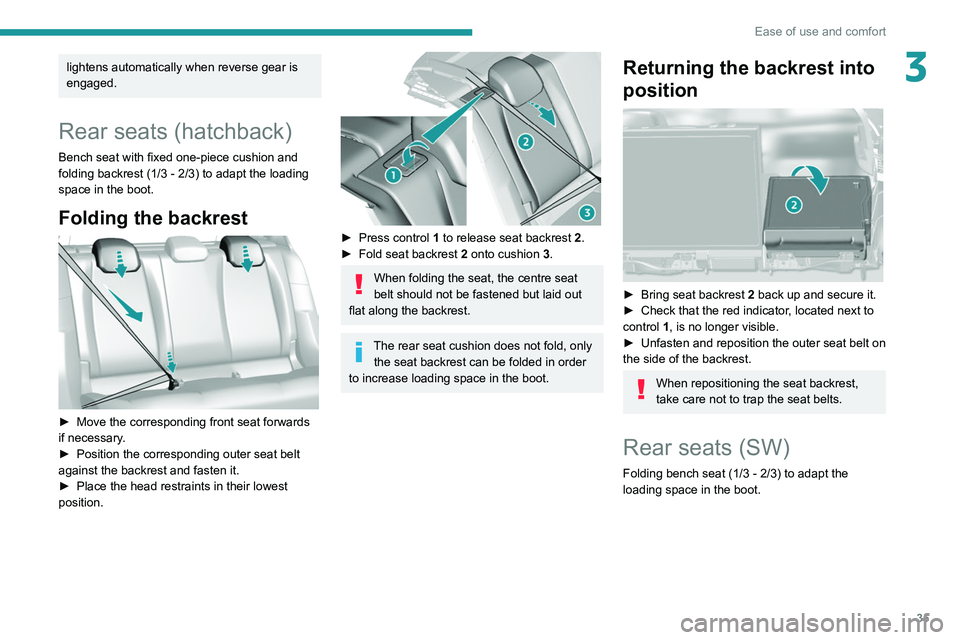
Folding the backrest
► Move the corresponding front seat forwards
if necessary .
►
Position the corresponding outer seat belt
against the backrest and fasten it.
►
Place the head restraints in their lowest
position.
► Press control 1 to release seat backrest 2.
► Fold seat backrest 2 onto cushion 3.
When folding the seat, the centre seat
belt should not be fastened but laid out
flat along the backrest.
The rear seat cushion does not fold, only the seat backrest can be folded in order
to increase loading space in the boot.
Returning the backrest into
position
► Bring seat backrest 2 back up and secure it.
► Check that the red indicator , located next to
control 1, is no longer visible.
►
Unfasten and reposition the outer seat belt on
the side of the backrest.
When repositioning the seat backrest,
take care not to trap the seat belts.
Rear seats (SW)
Folding bench seat (1/3 - 2/3) to adapt the
loading space in the boot.
Page 38 of 244
36
Ease of use and comfort
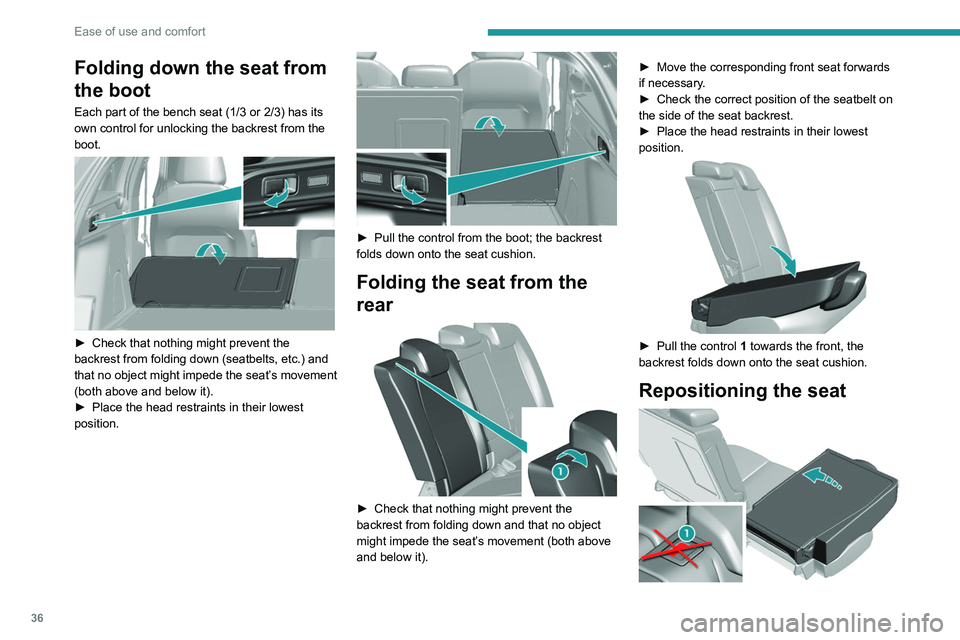
Folding down the seat from
the boot
Each part of the bench seat (1/3 or 2/3) has its
own control for unlocking the backrest from the
boot.
► Check that nothing might prevent the
backrest from folding down (seatbelts, etc.) and
that
no object might impede the seat’s movement
(both above and below it).
►
Place the head restraints in their lowest
position.
► Pull the control from the boot; the backrest
folds down onto the seat cushion.
Folding the seat from the
rear
► Check that nothing might prevent the
backrest from folding down and that no object
might
impede the seat’s movement (both above
and below it). ►
Move the corresponding front seat forwards
if necessary
.
►
Check the correct position of the seatbelt on
the side of the seat backrest.
►
Place the head restraints in their lowest
position.
► Pull the control 1 towards the front, the
backrest folds down onto the seat cushion.
Repositioning the seat
Page 42 of 244
40
Ease of use and comfort
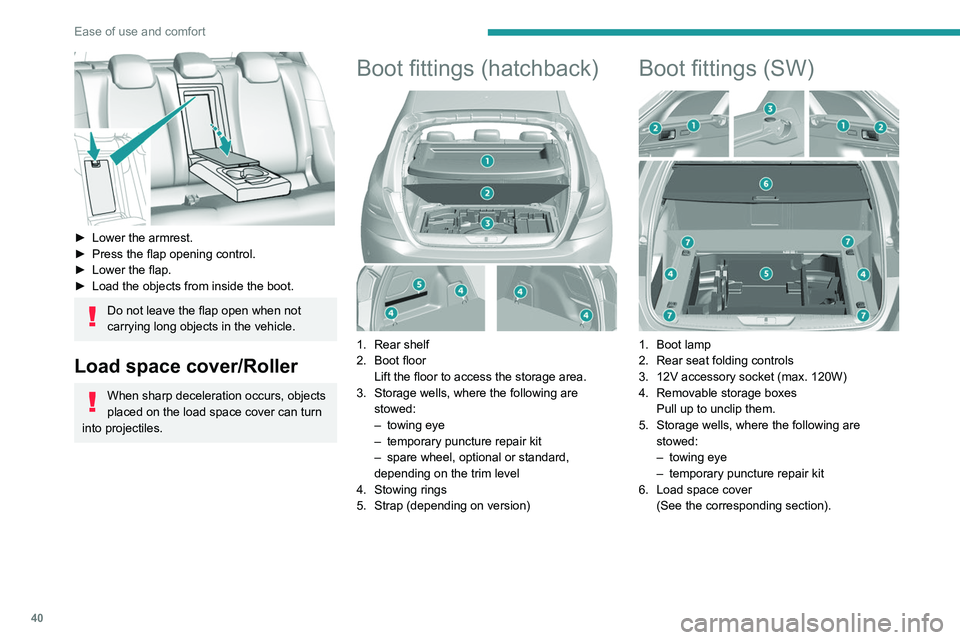
► Lower the armrest.
► Press the flap opening control.
►
Lower the flap.
►
Load the objects from inside the boot.
Do not leave the flap open when not
carrying long objects in the vehicle.
Load space cover/Roller
When sharp deceleration occurs, objects
placed on the load space cover can turn
into projectiles.
Boot fittings (hatchback)
1. Rear shelf
2. Boot floor
Lift the floor to access the storage area.
3. Storage wells, where the following are stowed:
–
towing eye
–
temporary puncture repair kit
–
spare wheel, optional or standard,
depending on the trim level
4. Stowing rings
5. Strap (depending on version)
Boot fittings (SW)
1. Boot lamp
2. Rear seat folding controls
3. 12V accessory socket (max. 120W)
4. Removable storage boxes Pull up to unclip them.
5. Storage wells, where the following are stowed:
–
towing eye
–
temporary puncture repair kit
6. Load space cover (See the corresponding section).
Page 43 of 244
41
Ease of use and comfort
3
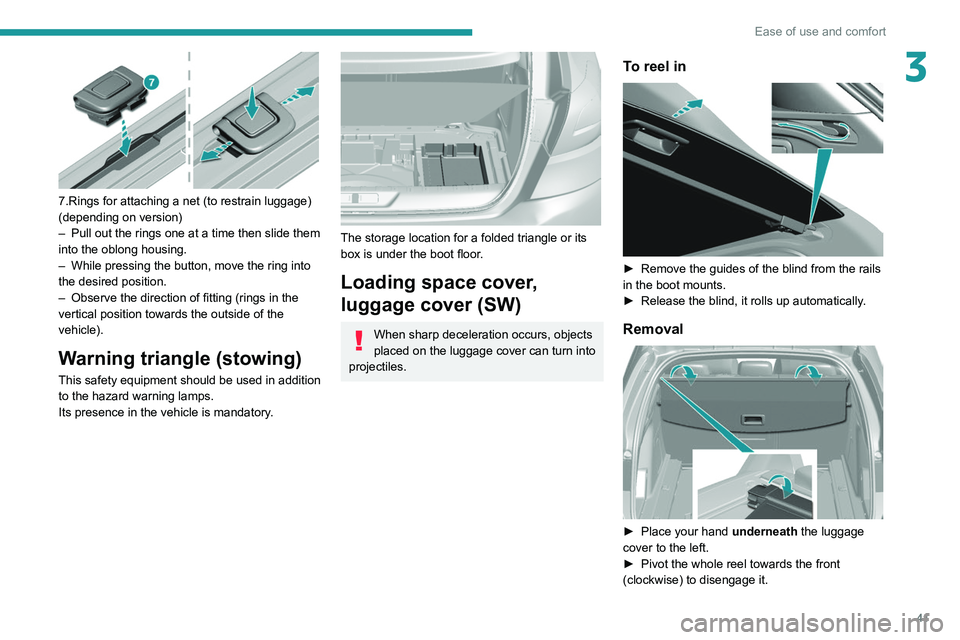
7.Rings for attaching a net (to restrain luggage)
(depending on version)
–
Pull out the rings one at a time then slide them
into the oblong housing.
–
While pressing the button, move the ring into
the desired position.
–
Observe the direction of fitting (rings in the
vertical position towards the outside of the
vehicle).
Warning triangle (stowing)
This safety equipment should be used in addition
to the hazard warning lamps.
Its presence in the vehicle is mandatory.
The storage location for a folded triangle or its
box is under the boot floor.
Loading space cover,
luggage cover (SW)
When sharp deceleration occurs, objects
placed on the luggage cover can turn into
projectiles.
To reel in
► Remove the guides of the blind from the rails
in the boot mounts.
►
Release the blind, it rolls up automatically
.
Removal
► Place your hand underneath the luggage
cover to the left.
►
Pivot the whole reel towards the front
(clockwise) to disengage it.
Page 44 of 244
42
Ease of use and comfort
► Proceed in the same way for the right side
(anti-clockwise).
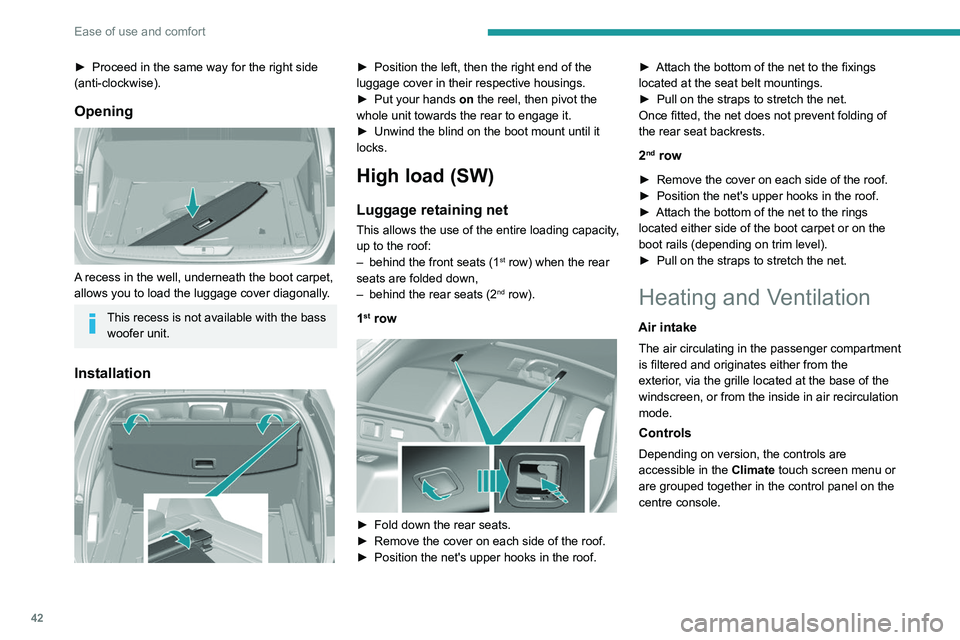
Opening
A recess in the well, underneath the boot carpet,
allows you to load the luggage cover diagonally.
This recess is not available with the bass woofer unit.
Installation
► Position the left, then the right end of the
luggage cover in their respective housings.
►
Put your hands
on the reel, then pivot the
whole unit towards the rear to engage it.
►
Unwind the blind on the boot mount until it
locks.
High load (SW)
Luggage retaining net
This allows the use of the entire loading capacity,
up to the roof:
–
behind the front seats (1st row) when the rear
seats are folded down,
–
behind the rear seats (2nd row).
1st row
► Fold down the rear seats.
► Remove the cover on each side of the roof.
►
Position the net's upper hooks in the roof. ►
Attach the bottom of the net to the fixings
located at the seat belt mountings.
►
Pull on the straps to stretch the net.
Once fitted, the net does not prevent folding of
the rear seat backrests.
2nd row
► Remove the cover on each side of the roof.
► Position the net's upper hooks in the roof.
►
Attach the bottom of the net to the rings
located either side of the boot carpet or on the
boot rails (depending on trim level).
►
Pull on the straps to stretch the net.
Heating and Ventilation
Air intake
The air circulating in the passenger compartment
is filtered and originates either from the
exterior, via the grille located at the base of the
windscreen, or from the inside in air recirculation
mode.
Controls
Depending on version, the controls are
accessible in the Climate touch screen menu or
are grouped together in the control panel on the
centre console.
Page 45 of 244
43
Ease of use and comfort
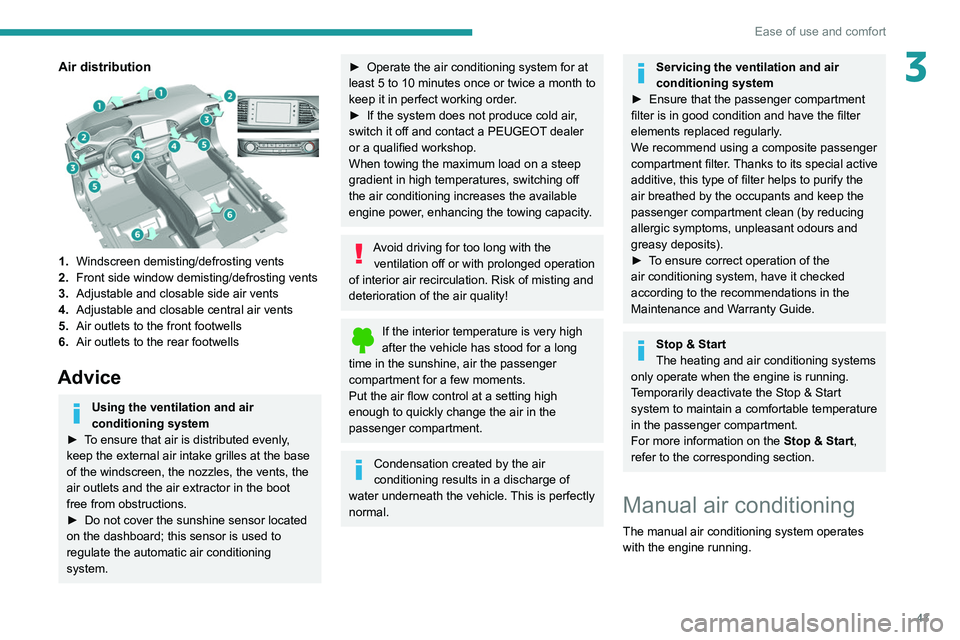
3Air distribution
1.Windscreen demisting/defrosting vents
2. Front side window demisting/defrosting vents
3. Adjustable and closable side air vents
4. Adjustable and closable central air vents
5. Air outlets to the front footwells
6. Air outlets to the rear footwells
Advice
Using the ventilation and air
conditioning system
►
T
o ensure that air is distributed evenly,
keep the external air intake grilles at the base
of the windscreen, the nozzles, the vents, the
air outlets and the air extractor in the boot
free from obstructions.
►
Do not cover the sunshine sensor located
on the dashboard; this sensor is used to
regulate the automatic air conditioning
system.
► Operate the air conditioning system for at
least 5 to 10 minutes once or twice a month to
keep it in perfect working order
.
►
If the system does not produce cold air
,
switch it off and contact a PEUGEOT dealer
or a qualified workshop.
When towing the maximum load on a steep
gradient in high temperatures, switching off
the air conditioning increases the available
engine power, enhancing the towing capacity.
Avoid driving for too long with the ventilation off or with prolonged operation
of interior air recirculation. Risk of misting and
deterioration of the air quality!
If the interior temperature is very high
after the vehicle has stood for a long
time in the sunshine, air the passenger
compartment for a few moments.
Put the air flow control at a setting high
enough to quickly change the air in the
passenger compartment.
Condensation created by the air
conditioning results in a discharge of
water underneath the vehicle. This is perfectly
normal.
Servicing the ventilation and air
conditioning system
►
Ensure that the passenger compartment
filter is in good condition and have the filter
elements replaced regularly
.
We recommend using a composite passenger
compartment filter. Thanks to its special active
additive, this type of filter helps to purify the
air breathed by the occupants and keep the
passenger compartment clean (by reducing
allergic symptoms, unpleasant odours and
greasy deposits).
►
T
o ensure correct operation of the
air conditioning system, have it checked
according to the recommendations in the
Maintenance and Warranty Guide.
Stop & Start
The heating and air conditioning systems
only operate when the engine is running.
Temporarily deactivate the Stop & Start
system to maintain a comfortable temperature
in the passenger compartment.
For more information on the Stop & Start,
refer to the corresponding section.
Manual air conditioning
The manual air conditioning system operates
with the engine running.
Page 56 of 244
54
Lighting and visibility
Three flashes
► Press briefly upwards or downwards, without
going beyond the point of resistance; the
direction indicators will flash 3 times.
Headlamp beam height
adjustment
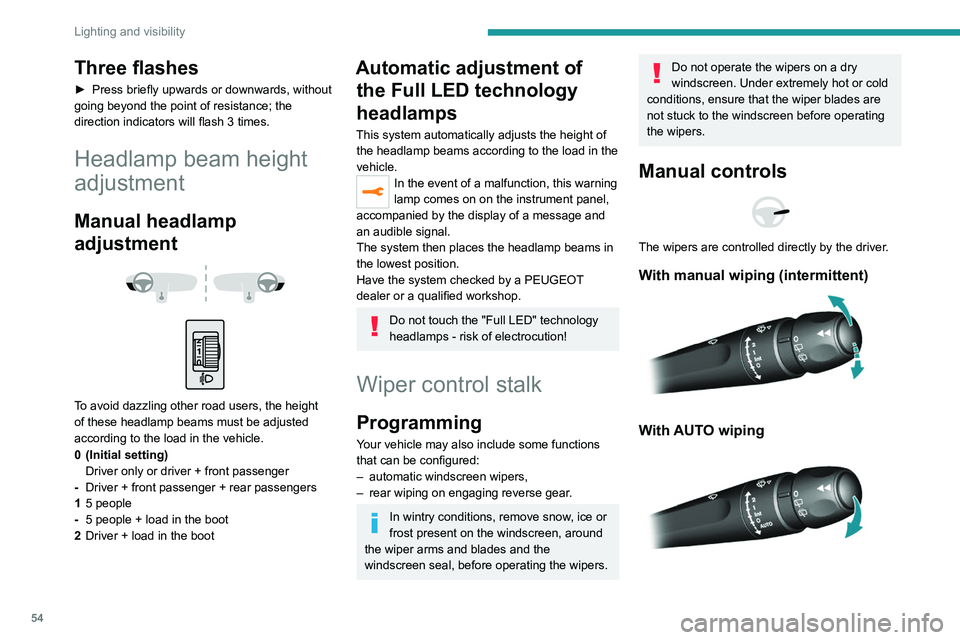
Manual headlamp
adjustment
To avoid dazzling other road users, the height
of these headlamp beams must be adjusted
according to the load in the vehicle.
0 (Initial setting) Driver only or driver + front passenger
- Driver + front passenger + rear passengers
1 5 people
- 5 people + load in the boot
2 Driver + load in the boot
Automatic adjustment of
the Full LED technology
headlamps
This system automatically adjusts the height of
the headlamp beams according to the load in the
vehicle.
In the event of a malfunction, this warning
lamp comes on on the instrument panel,
accompanied by the display of a message and
an audible signal.
The system then places the headlamp beams in
the lowest position.
Have the system checked by a PEUGEOT
dealer or a qualified workshop.
Do not touch the "Full LED" technology
headlamps - risk of electrocution!
Wiper control stalk
Programming
Your vehicle may also include some functions
that can be configured:
–
automatic windscreen wipers,
–
rear wiping on engaging reverse gear
.
In wintry conditions, remove snow, ice or
frost present on the windscreen, around
the wiper arms and blades and the
windscreen seal, before operating the wipers.
Do not operate the wipers on a dry
windscreen. Under extremely hot or cold
conditions, ensure that the wiper blades are
not stuck to the windscreen before operating
the wipers.
Manual controls
The wipers are controlled directly by the driver.
With manual wiping (intermittent)
With AUTO wiping
Windscreen wipers
► To select the wiping speed: raise or lower the
stalk to the desired position.
Fast wiping (heavy rain)
Normal wiping (moderate rain)
Intermittent wiping (proportional to the
vehicle’s speed)
Switching off
Single wipe (press down and release).
or
Automatic wiping
Refer to the corresponding section.
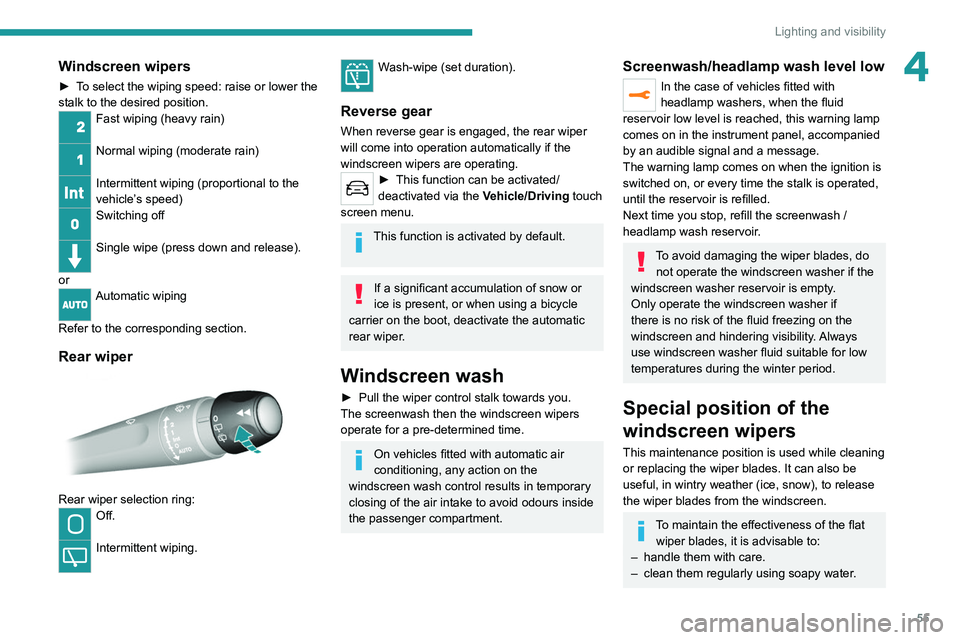
Rear wiper
Rear wiper selection ring:Off.
Intermittent wiping.
Page 57 of 244
55
Lighting and visibility
4Windscreen wipers
► To select the wiping speed: raise or lower the
stalk to the desired position.
Fast wiping (heavy rain)
Normal wiping (moderate rain)
Intermittent wiping (proportional to the
vehicle’s speed)
Switching off
Single wipe (press down and release).
or
Automatic wiping
Refer to the corresponding section.
Rear wiper
Rear wiper selection ring:Off.
Intermittent wiping.
Wash-wipe (set duration).
Reverse gear
When reverse gear is engaged, the rear wiper
will come into operation automatically if the
windscreen wipers are operating.
► This function can be activated/
deactivated via the V
ehicle/Driving touch
screen menu.
This function is activated by default.
If a significant accumulation of snow or
ice is present, or when using a bicycle
carrier on the boot, deactivate the automatic
rear wiper.
Windscreen wash
► Pull the wiper control stalk towards you.
The screenwash then the windscreen wipers
operate for a pre-determined time.
On vehicles fitted with automatic air
conditioning, any action on the
windscreen wash control results in temporary
closing of the air intake to avoid odours inside
the passenger compartment.
Screenwash/headlamp wash level low
In the case of vehicles fitted with
headlamp washers, when the fluid
reservoir low level is reached, this warning lamp
comes on in the instrument panel, accompanied
by an audible signal and a message.
The warning lamp comes on when the ignition is
switched on, or every time the stalk is operated,
until the reservoir is refilled.
Next time you stop, refill the screenwash /
headlamp wash reservoir.
To avoid damaging the wiper blades, do not operate the windscreen washer if the
windscreen washer reservoir is empty.
Only operate the windscreen washer if
there is no risk of the fluid freezing on the
windscreen and hindering visibility. Always
use windscreen washer fluid suitable for low
temperatures during the winter period.
Special position of the
windscreen wipers
This maintenance position is used while cleaning
or replacing the wiper blades. It can also be
useful, in wintry weather (ice, snow), to release
the wiper blades from the windscreen.
To maintain the effectiveness of the flat wiper blades, it is advisable to:
–
handle them with care.
–
clean them regularly using soapy water
.
Page 76 of 244
74
Safety
“ISOFIX" mountings
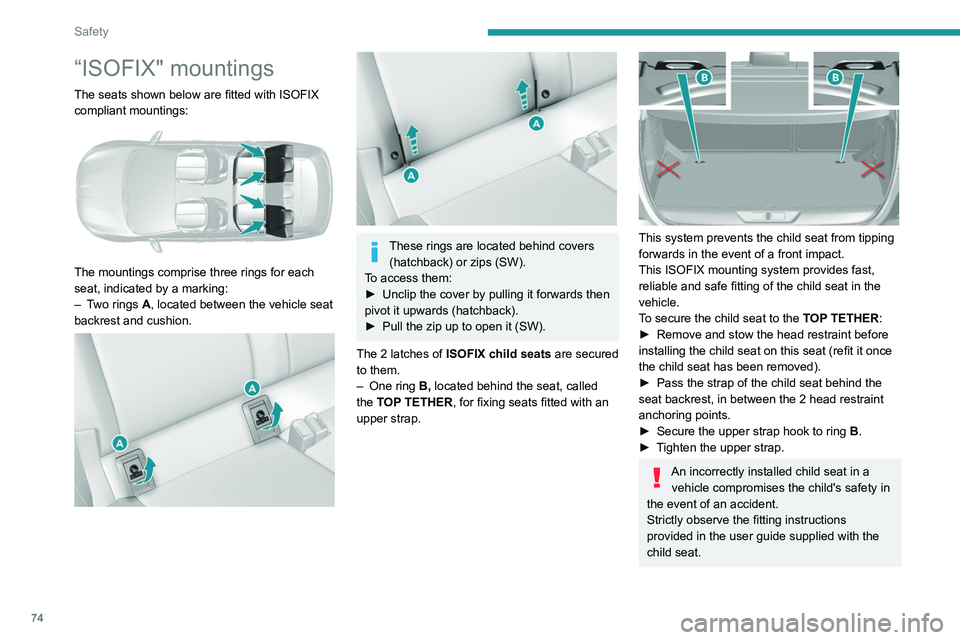
The seats shown below are fitted with ISOFIX
compliant mountings:
The mountings comprise three rings for each
seat, indicated by a marking:
–
T
wo rings A, located between the vehicle seat
backrest and cushion.
These rings are located behind covers (hatchback) or zips (SW).
To access them:
►
Unclip the cover by pulling it forwards then
pivot it upwards (hatchback).
►
Pull the zip up to open it (SW).
The 2
latches of ISOFIX child seats are secured
to them.
–
One ring
B, located behind the seat, called
the TOP TETHER, for fixing seats fitted with an
upper strap.
This system prevents the child seat from tipping
forwards in the event of a front impact.
This ISOFIX mounting system provides fast,
reliable and safe fitting of the child seat in the
vehicle.
To secure the child seat to the TOP TETHER:
►
Remove and stow the head restraint before
installing the child seat on this seat (refit it once
the child seat has been removed).
►
Pass the strap of the child seat behind the
seat backrest, in between the 2 head restraint
anchoring points.
►
Secure the upper strap hook to ring
B
.
►
T
ighten the upper strap.
An incorrectly installed child seat in a vehicle compromises the child's safety in
the event of an accident.
Strictly observe the fitting instructions
provided in the user guide supplied with the
child seat.
For information about the options for
fitting ISOFIX child seats in your vehicle,
refer to the summary table.
If your vehicle has a spare wheel of the same
size as the other four wheels, follow the
procedure below:
► pass the strap and spring hook over the boot
floor (in the slot),
► raise the boot floor,
► lift out the upper storage box, located
alongside the wheel,
► attach the spring hook to the TOP TETHER
ring,
► refit the storage box and boot floor.
Recommended ISOFIX child
seats
Also consult the user guide from the child
seat’s manufacturer to find out how to
install and remove the seat.
Page 77 of 244
75
Safety
5For information about the options for
fitting ISOFIX child seats in your vehicle,
refer to the summary table.
If your vehicle has a spare wheel of the same
size as the other four wheels, follow the
procedure below:
►
pass the strap and spring hook over the boot
floor (in the slot),
►
raise the boot floor
,
►
lift out the upper storage box, located
alongside the wheel,
►
attach the spring hook to the
TOP TETHER
ring,
►
refit the storage box and boot floor
.
Recommended ISOFIX child
seats
Also consult the user guide from the child seat’s manufacturer to find out how to
install and remove the seat.
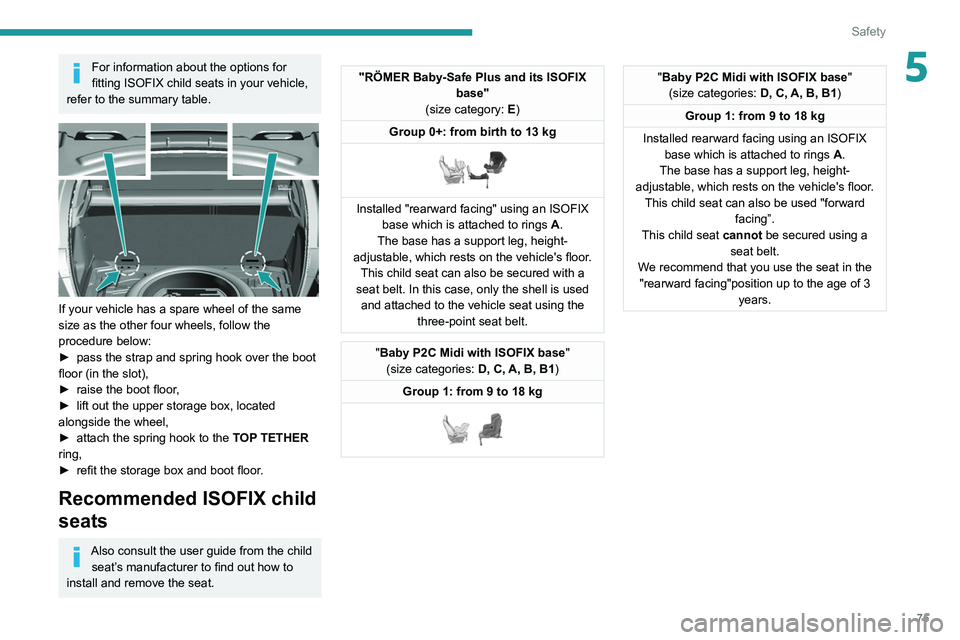
"RÖMER Baby-Safe Plus and its ISOFIX base"
(size category: E)
Group 0+: from birth to 13 kg
Installed "rearward facing" using an ISOFIX base which is attached to rings A .
The base has a support leg, height-
adjustable, which rests on the vehicle's floor. This child seat can also be secured with a
seat belt. In this case, only the shell is used and attached to the vehicle seat using the three-point seat belt.
"Baby P2C Midi with ISOFIX base "
(size categories: D, C, A, B, B1)
Group 1: from 9 to 18 kg
"Baby P2C Midi with ISOFIX base "
(size categories: D, C, A, B, B1)
Group 1: from 9 to 18 kg
Installed rearward facing using an ISOFIX base which is attached to rings A.
The base has a support leg, height-
adjustable, which rests on the vehicle's floor. This child seat can also be used "forward facing”.
This child seat cannot be secured using a seat belt.
We recommend that you use the seat in the "rearward facing"position up to the age of 3 years.