brake PEUGEOT 308 CC 2013 User Guide
[x] Cancel search | Manufacturer: PEUGEOT, Model Year: 2013, Model line: 308 CC, Model: PEUGEOT 308 CC 2013Pages: 268, PDF Size: 15.28 MB
Page 118 of 268
8
11 6
DRIVING
"PORSCHE TIPTRONIC SYSTEM" AUTOMATIC GEARBOX
Six speed automatic gearbox which of-
fers a choice between the comfort of
fully automatic operation, enhanced by
sport and snow programmes, or manual
gear changing.
There are two driving modes:
- automatic operation for electronic management of the gears by the
gearbox, with the sport programme
for a more dynamic driving style or
the snow programme to facilitate
driving when grip is poor.
- manual operation for sequential changing of the gears by the driver.
Gear lever positions
P. Park.
- Immobilisation of the vehicle, park- ing brake on or off.
- Starting the engine.
R. Reverse.
- Reversing manoeuvres, vehicle sta- tionary, engine at idle.
N. Neutral.
- Immobilisation of the vehicle, park- ing brake on.
- Starting the engine.
D. Automatic operation.
M. + / - Manual operation with sequen- tial changing of the six gears.
Press forwards to change up through the gears.
or
Press rearwards to change down through the gears.
Displays in the instrument panel
When you move the lever in the gate
to select a position, the corresponding
symbol is displayed in the instrument
panel.
P. Park
R. Reverse
N. Neutral
D1... D6. Drive (Automatic driving)
S. Sport programme
. Snow programme
M1... M6. Manual (Sequential driving)
-. Invalid value during manual operation
Gear selection gate
1. Gear lever.
2. Button "S" (sport) .
3. Button " " (snow) .
Page 119 of 268
8
!
!
i
i
11 7
DRIVING
Moving off
Apply the parking brake.
Select position P or N .
Start the engine.
If this procedure is not followed, there
is an audible signal, accompanied by a
message in the screen.
With the engine running, press the brake pedal.
Release the parking brake.
Select position R , D or M ,
Gradually release the brake pedal.
The vehicle then moves off.
If position N is engaged inadver-
tently while driving, allow the en-
gine to return to idle then engage
position D to accelerate.
When the engine is running at idle,
with the brakes released, if posi-
tion R , D or M is selected, the vehicle moves even without the accelerator
being pressed.
When the engine is running, never
leave children in the vehicle without
supervision.
When carrying out maintenance with
the engine running, apply the park-
ing brake and select position P . A message is displayed if you try
to move the gear lever from posi-
tion
P without pressing the brake
pedal.
Automatic operation
Select position D for automatic
changing of the six gears.
The gearbox then operates in auto-
adaptive mode, without any intervention
on the part of the driver. It continuously
selects the most suitable gear accord-
ing to the style of driving, the profi le of
the road and the load in the vehicle.
D and the gears selected automatically
appear in succession in the instrument
panel.
For maximum acceleration without
touching the lever, press the accelera-
tor pedal down fully (kick down). The
gearbox changes down automatically
or maintains the gear selected until the
maximum engine speed is reached.
On braking, the gearbox changes down
automatically to provide effi cient engine
braking.
If you release the accelerator sharply,
the gearbox will not change to a higher
gear for safety reasons. Never select position
N while the
vehicle is moving.
Never select positions P or R un-
less the vehicle is completely sta-
tionary. Sport and snow programmes
These two special programmes supple-
ment the automatic operation in very
specifi c conditions of use.
Sport programme "S"
Press button "S" , after starting the
engine.
The gearbox automatically favours a
dynamic style of driving.
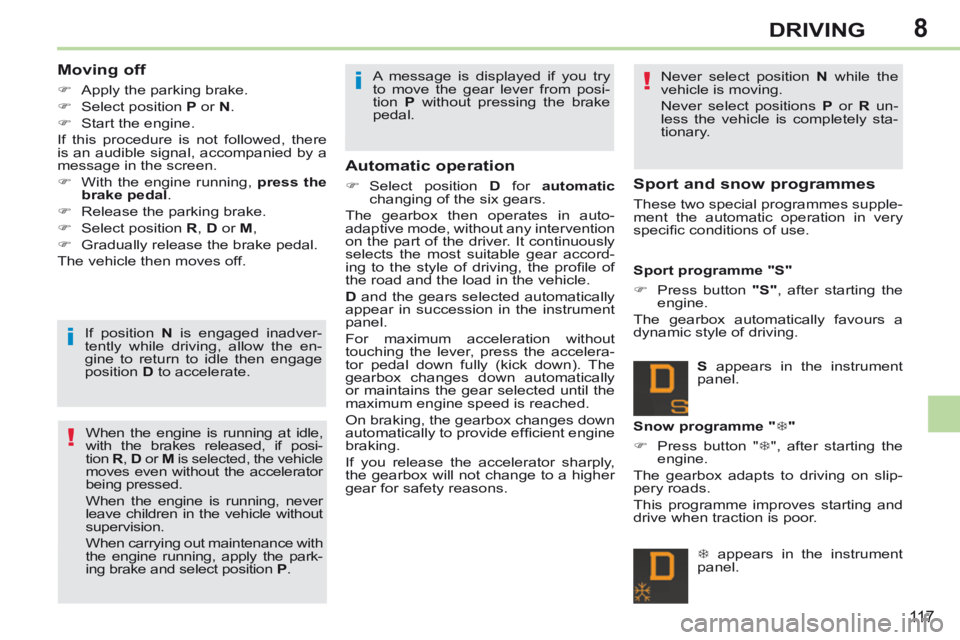
S appears in the instrument
panel.
Snow programme " "
Press button " ", after starting the
engine.
The gearbox adapts to driving on slip-
pery roads.
This programme improves starting and
drive when traction is poor.
appears in the instrument
panel.
Page 120 of 268
8
PRND
!i
11 8
DRIVING
Return to automatic operation
At any time, press the button select-ed again to quit the programme en-
gaged and return to auto-adaptive
mode.
Manual operation
Select position M for sequential
changing of the six gears.
Push the lever towards the + sign to
change up a gear.
Pull the lever towards the - sign to
change down a gear.
It is only possible to change from one
gear to another if the vehicle speed and
engine speed permit; otherwise, the
gearbox will operate temporarily in au-
tomatic mode.
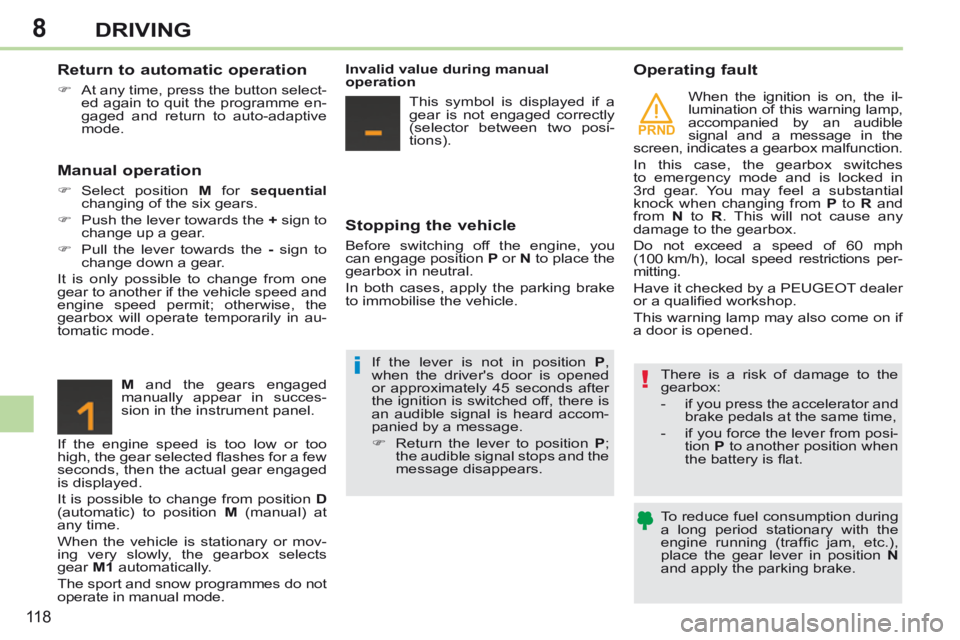
M and the gears engaged
manually appear in succes-
sion in the instrument panel.
If the engine speed is too low or too
high, the gear selected fl ashes for a few
seconds, then the actual gear engaged
is displayed.
It is possible to change from position D
(automatic) to position M (manual) at
any time.
When the vehicle is stationary or mov-
ing very slowly, the gearbox selects
gear M1 automatically.
The sport and snow programmes do not
operate in manual mode. Invalid value during manual
operation
This symbol is displayed if a
gear is not engaged correctly
(selector between two posi-
tions).
Stopping the vehicle
Before switching off the engine, you
can engage position P or N to place the
gearbox in neutral.
In both cases, apply the parking brake
to immobilise the vehicle.
Operating fault
There is a risk of damage to the
gearbox:
- if you press the accelerator and brake pedals at the same time,
- if you force the lever from posi- tion P to another position when
the battery is fl at.
To reduce fuel consumption during
a long period stationary with the
engine running (traffi c jam, etc.),
place the gear lever in position N
and apply the parking brake.
If the lever is not in position
P ,
when the driver's door is opened
or approximately 45 seconds after
the ignition is switched off, there is
an audible signal is heard accom-
panied by a message.
Return the lever to position P ;
the audible signal stops and the
message disappears. When the ignition is on, the il-
lumination of this warning lamp,
accompanied by an audible
signal and a message in the
screen, indicates a gearbox malfunction.
In this case, the gearbox switches
to emergency mode and is locked in
3rd gear. You may feel a substantial
knock when changing from P to R and
from N to R . This will not cause any
damage to the gearbox.
Do not exceed a speed of 60 mph
(100 km/h), local speed restrictions per-
mitting.
Have it checked by a PEUGEOT dealer
or a qualifi ed workshop.
This warning lamp may also come on if
a door is opened.
Page 125 of 268
8
i
!
i
!
123
DRIVING
The alert is given by the fi xed il-
lumination of this warning lamp,
accompanied by an audible signal
and the display of a message.
Operating fault
Under-inflation alert
The loss of pressure detected does
not always lead to visible deforma-
tion of the tyre. Do not rely on just
a visual check. The alert is maintained until the
tyre or tyres concerned is reinfl at-
ed, repaired or replaced.
The fl ashing and then fi xed il-
lumination of this warning lamp
accompanied by the illumination
of the service warning lamp in-
dicates a fault with the system.
This alert is also displayed when
one or more wheels is not fi tted
with a sensor (steel spare wheel *
or other wheels fi tted with winter
tyres).
Go to a PEUGEOT dealer or a
qualifi ed workshop to have the
system checked or, following the
repair of a puncture, to have the
original wheel, equipped with a
sensor, refi tted.
In this case, monitoring of the tyre pres-
sures is not assured.
Reduce speed, avoid sudden steer- ing movements or harsh brake ap-
plications.
Stop as soon as it is safe to do so.
In the event of a puncture, use the temporary puncture repair kit or the
spare wheel (according to equip-
ment),
or
if you have a compressor, the one in the temporary puncture repair kit for
example, check the four tyre pres-
sures when cold,
or
if it is not possible to check the tyre pressures at the time, drive carefully
at reduced speed.
* Depending on version.
In the event of a problem on one of the
tyres, a symbol or a message is dis-
played, depending on equipment, to
identify it.
Page 128 of 268
8
i
126
DRIVING
CRUISE CONTROL
System which automatically maintains
the speed of the vehicle at the value
programmed by the driver, without any
action on the accelerator pedal.
The cruise control is switched on
manually: it requires a minimum vehicle
speed of 25 mph (40 km/h) and the en-
gagement of:
- fourth gear on a manual gearbox,
- second gear on an automatic gear- box, in sequential driving mode,
- position D on an automatic gearbox.
The cruise control is switched off man-
ually or by pressing the brake or clutch
pedal or on triggering of the DSC/ASR
systems for safety reasons.
It is possible to exceed the programmed
speed temporarily by pressing the ac-
celerator pedal.
To return to the programmed speed,
simply release the accelerator pedal.
Switching off the ignition cancels any
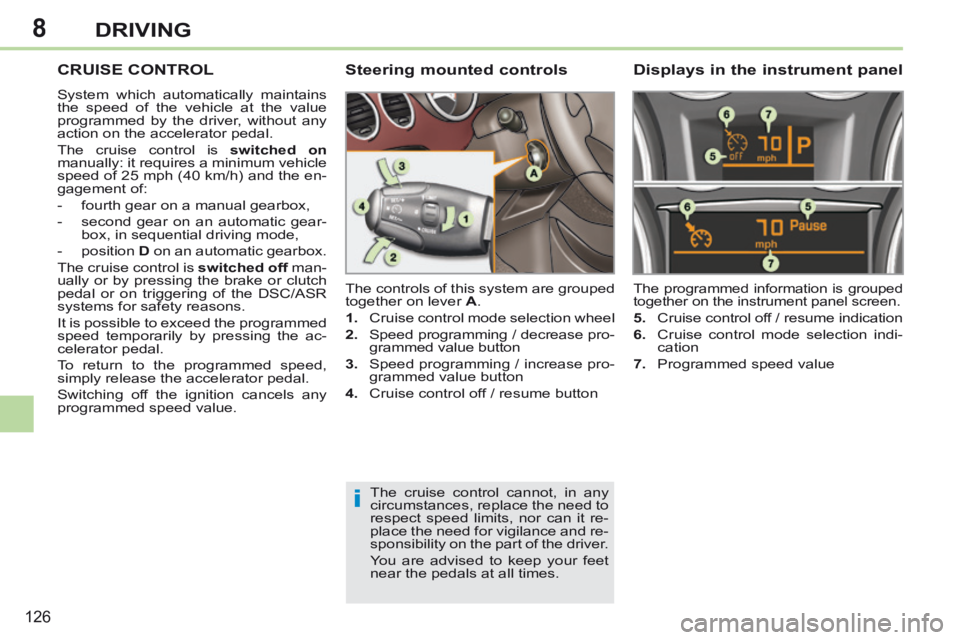
programmed speed value. The controls of this system are grouped
together on lever
A .
1. Cruise control mode selection wheel
2. Speed programming / decrease pro- grammed value button
3. Speed programming / increase pro- grammed value button
4. Cruise control off / resume button
The programmed information is grouped
together on the instrument panel screen.
5. Cruise control off / resume indication
6. Cruise control mode selection indi- cation
7. Programmed speed value
Steering mounted controls Displays in the instrument panel
The cruise control cannot, in any
circumstances, replace the need to
respect speed limits, nor can it re-
place the need for vigilance and re-
sponsibility on the part of the driver.
You are advised to keep your feet
near the pedals at all times.
Page 135 of 268
9
133
CHECKS
PETROL ENGINES
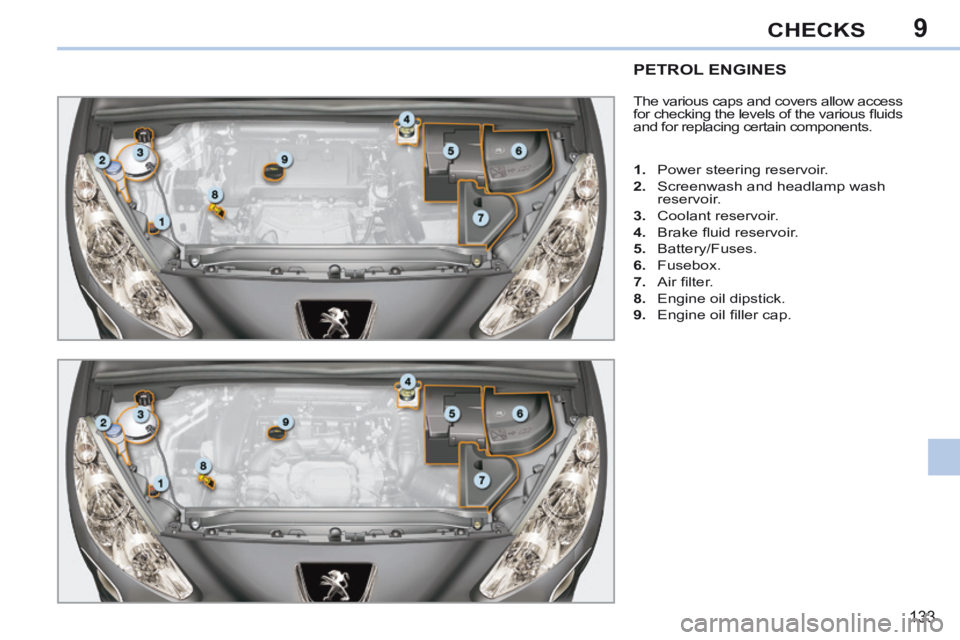
The various caps and covers allow access
for checking the levels of the various fl uids
and for replacing certain components.
1. Power steering reservoir.
2. Screenwash and headlamp wash reservoir.
3. Coolant reservoir.
4. Brake fl uid reservoir.
5. Battery/Fuses.
6. Fusebox.
7. Air fi lter.
8. Engine oil dipstick.
9. Engine oil fi ller cap.
Page 136 of 268
9
134
CHECKS
DIESEL ENGINES
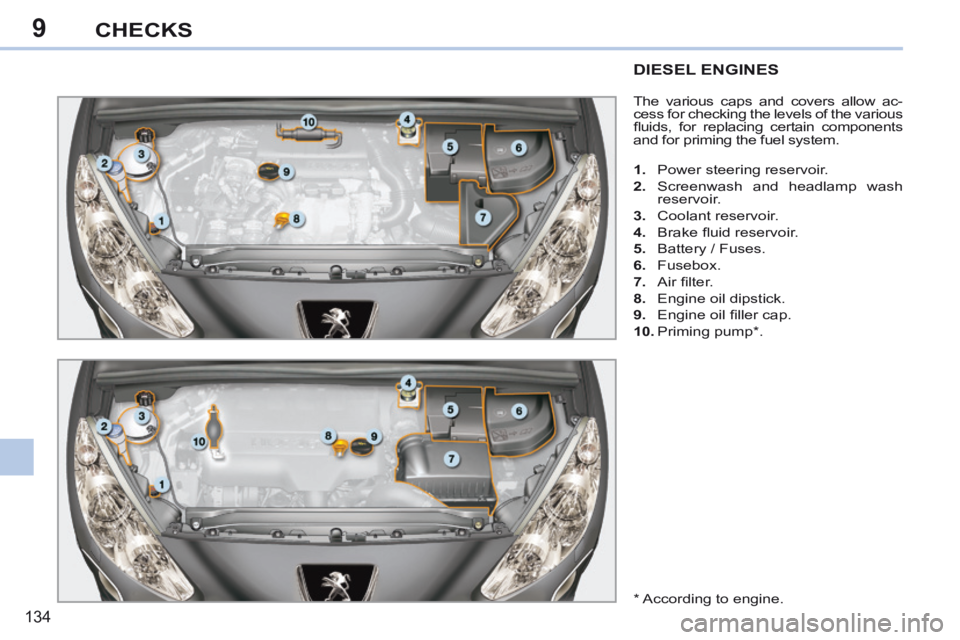
The various caps and covers allow ac-
cess for checking the levels of the various
fl uids, for replacing certain components
and for priming the fuel system.
1. Power steering reservoir.
2. Screenwash and headlamp wash reservoir.
3. Coolant reservoir.
4. Brake fl uid reservoir.
5. Battery / Fuses.
6. Fusebox.
7. Air fi lter.
8. Engine oil dipstick.
9. Engine oil fi ller cap.
10. Priming pump * .
* According to engine.
Page 138 of 268
9
i
136
CHECKS
Brake fluid level
The brake fl uid level should be
close to the "MAX" mark. If it is
not, check the brake pad wear.
Power steering fluid level
The power steering fl uid level
should be close to the "MAX"
mark. With the engine cold,
unscrew the cap to check the
level.
Changing the fl uid
Refer to the warranty and maintenance
record for details of the interval for this
operation.
When the engine is warm, the tempera-
ture of the coolant is regulated by the
fan.
Coolant level
The coolant level should be
close to the "MAX" mark but
should never exceed it.
The cooling fan may start after
switching off the engine: take care
with articles and clothing that might
become caught by the fan blades.
Fluid specifi cation
The coolant must conform to the manu-
facturer's recommendations.
Fluid specifi cation
The brake fl uid must conform to the
manufacturer's recommendations.
In addition, as the cooling system is
pressurised, wait at least one hour after
switching off the engine before carrying
out any work.
To avoid any risk of scalding, unscrew
the cap by two turns to allow the pres-
sure to drop. When the pressure has
dropped, remove the cap and top up
the level.
Topping up the engine oil level
Refer to the "Petrol engine" or "Diesel
engine" section for the location of the oil
fi ller cap in the engine compartment of
your vehicle.
Unscrew the oil fi ller cap to reveal
the fi ller aperture.
Add oil in small quantities, avoiding any spills on engine components
(risk of fi re).
Wait a few minutes before checking the level again using the dipstick.
Add more oil if necessary.
After checking the level, carefully re- fi t the oil fi ller cap and the dipstick in
its tube.
After topping up the oil, the check
when switching on the ignition with
the oil level indicator in the instru-
ment panel is not valid during the
30 minutes after topping up.
Engine oil change
Refer to the warranty and maintenance
record for details of the interval for this
operation.
In order to maintain the reliability of the
engine and emission control system,
the use of additives in the engine oil is
prohibited.
Page 141 of 268
9
!
139
CHECKS
Only use products recommended
by PEUGEOT or products of equiv-
alent quality and specifi cation.
In order to optimise the operation
of units as important as those in the
braking system, PEUGEOT selects
and offers very specifi c products.
After washing the vehicle, damp-
ness, or in wintry conditions, ice
can form on the brake discs and
pads: braking effi ciency may be
reduced. Make light brake applica-
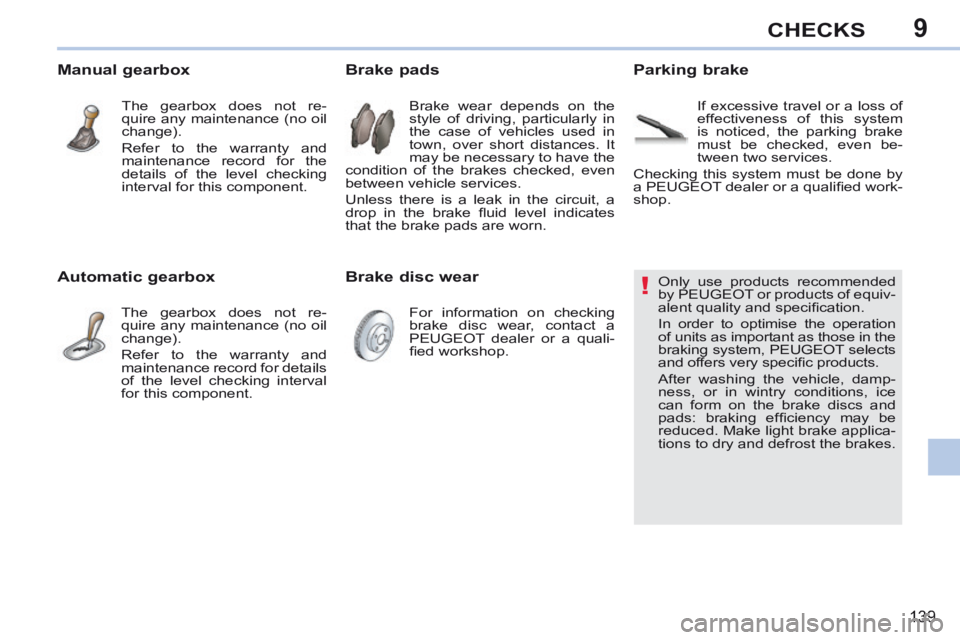
tions to dry and defrost the brakes. Brake disc wear Brake pads Parking brake
Brake wear depends on the
style of driving, particularly in
the case of vehicles used in
town, over short distances. It
may be necessary to have the
condition of the brakes checked, even
between vehicle services.
Unless there is a leak in the circuit, a
drop in the brake fl uid level indicates
that the brake pads are worn.
For information on checking
brake disc wear, contact a
PEUGEOT dealer or a quali-
fi ed workshop. If excessive travel or a loss of
effectiveness of this system
is noticed, the parking brake
must be checked, even be-
tween two services.
Checking this system must be done by
a PEUGEOT dealer or a qualifi ed work-
shop.
Manual gearbox
The gearbox does not re-
quire any maintenance (no oil
change).
Refer to the warranty and
maintenance record for the
details of the level checking
interval for this component.
Automatic gearbox
The gearbox does not re-
quire any maintenance (no oil
change).
Refer to the warranty and
maintenance record for details
of the level checking interval
for this component.
Page 149 of 268
10
i
147
PRACTICAL INFORMATION
Parking the vehicle
Immobilise the vehicle where it
does not block traffi c: the ground
must be level, stable and non-
slippery ground.
Apply the parking brake, switch off
the ignition and engage fi rst gear *
to lock the wheels.
If necessary, place a chock under
the wheel diagonally opposite the
wheel to be changed.
It is imperative that you ensure that
the occupants get out of the ve-
hicle and wait where they are safe.
Never go underneath a vehicle
raised using a jack; use an axle
stand.
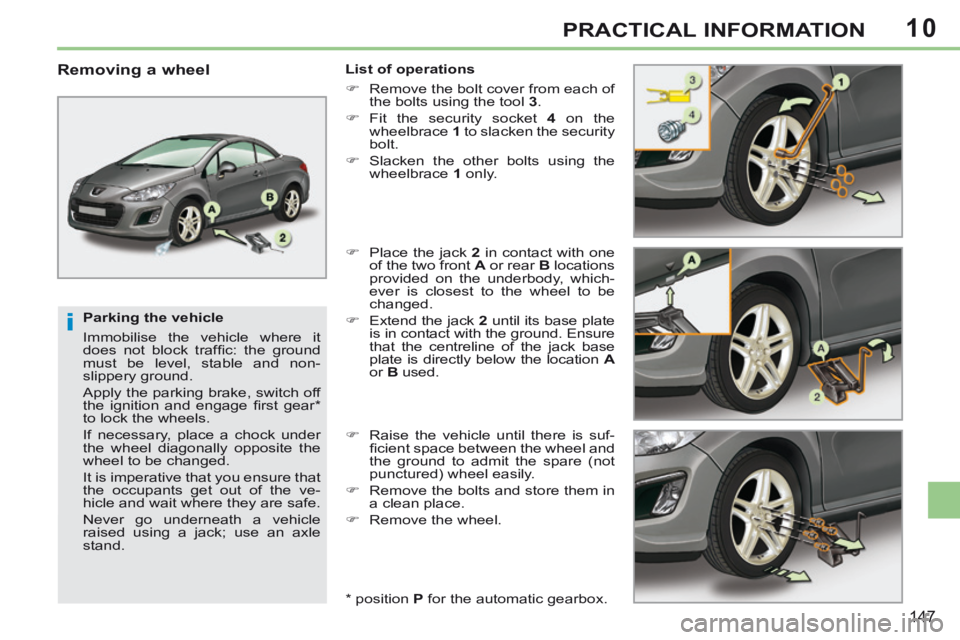
Removing a wheel List of operations
Remove the bolt cover from each of the bolts using the tool 3 .
Fit the security socket 4 on the
wheelbrace 1 to slacken the security
bolt.
Slacken the other bolts using the wheelbrace 1 only.
Place the jack 2 in contact with one
of the two front A or rear B locations
provided on the underbody, which-
ever is closest to the wheel to be
changed.
Extend the jack 2 until its base plate
is in contact with the ground. Ensure
that the centreline of the jack base
plate is directly below the location A
or B used.
Raise the vehicle until there is suf- fi cient space between the wheel and
the ground to admit the spare (not
punctured) wheel easily.
Remove the bolts and store them in a clean place.
Remove the wheel.
* position P for the automatic gearbox.