service PEUGEOT 308 CC 2013 User Guide
[x] Cancel search | Manufacturer: PEUGEOT, Model Year: 2013, Model line: 308 CC, Model: PEUGEOT 308 CC 2013Pages: 268, PDF Size: 15.28 MB
Page 36 of 268
1
i
i
34
MONITORING
Following this operation, if you wish
to disconnect the battery, lock the
vehicle and wait at least fi ve minutes
for the zero reset to be registered.
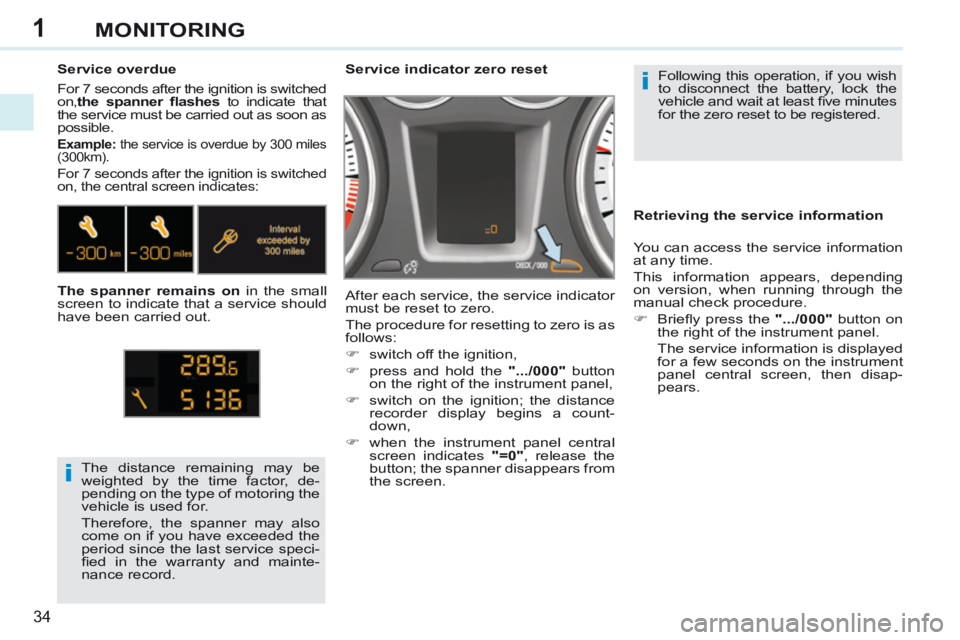
Service indicator zero reset
After each service, the service indicator
must be reset to zero.
The procedure for resetting to zero is as
follows:
switch off the ignition,
press and hold the
".../000" button
on the right of the instrument panel,
switch on the ignition; the distance recorder display begins a count-
down,
when the instrument panel central screen indicates "=0" , release the
button; the spanner disappears from
the screen.
The distance remaining may be
weighted by the time factor, de-
pending on the type of motoring the
vehicle is used for.
Therefore, the spanner may also
come on if you have exceeded the
period since the last service speci-
fi ed in the warranty and mainte-
nance record.
Service overdue For 7 seconds after the ignition is switched
on,
the spanner fl ashes to indicate that
the service must be carried out as soon as
possible.
Example: the service is overdue by 300 miles
(300km).
For 7 seconds after the ignition is switched
on, the central screen indicates:
The spanner remains on in the small
screen to indicate that a service should
have been carried out. Retrieving the service information
You can access the service information
at any time.
This information appears, depending
on version, when running through the
manual check procedure.
Briefl y press the
".../000" button on
the right of the instrument panel.
The service information is displayed for a few seconds on the instrument
panel central screen, then disap-
pears.
Page 37 of 268
1
35
MONITORING
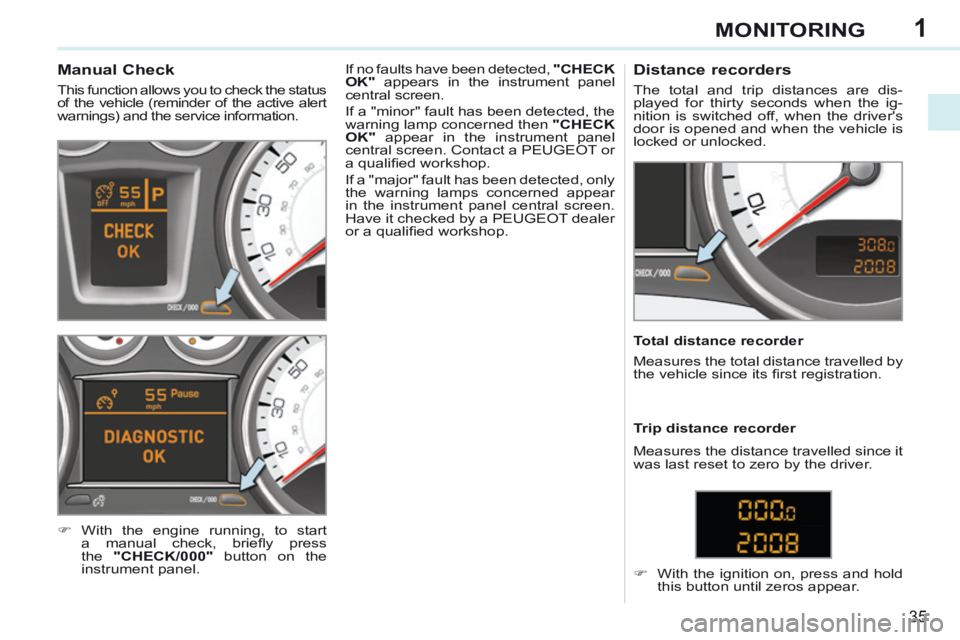
Manual Check
This function allows you to check the status
of the vehicle (reminder of the active alert
warnings) and the service information.
With the engine running, to start a manual check, briefl y press
the "CHECK/000" button on the
instrument panel. If no faults have been detected,
"CHECK
OK" appears in the instrument panel
central screen.
If a "minor" fault has been detected, the
warning lamp concerned then "CHECK
OK" appear in the instrument panel
central screen. Contact a PEUGEOT or
a qualifi ed workshop.
If a "major" fault has been detected, only
the warning lamps concerned appear
in the instrument panel central screen.
Have it checked by a PEUGEOT dealer
or a qualifi ed workshop.
Distance recorders
The total and trip distances are dis-
played for thirty seconds when the ig-
nition is switched off, when the driver's
door is opened and when the vehicle is
locked or unlocked.
Total distance recorder
Measures the total distance travelled by
the vehicle since its fi rst registration.
With the ignition on, press and hold this button until zeros appear.
Trip distance recorder
Measures the distance travelled since it
was last reset to zero by the driver.
Page 42 of 268
2
40
MULTIFUNCTION SCREENS
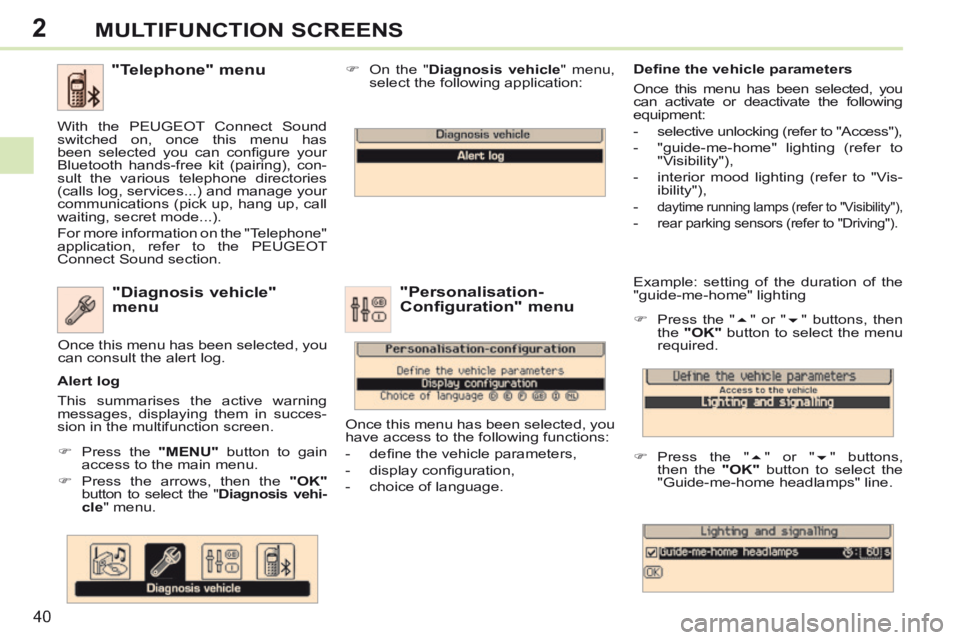
Example: setting of the duration of the
"guide-me-home" lighting
Press the " " or " " buttons, then
the "OK" button to select the menu
required.
Press the " " or " " buttons,
then the "OK" button to select the
"Guide-me-home headlamps" line. "Diagnosis vehicle"
menu
Press the "MENU" button to gain
access to the main menu.
Press the arrows, then the "OK"
button to select the " Diagnosis vehi-cle " menu. On the "
Diagnosis vehicle " menu,
select the following application:
Alert log
This summarises the active warning
messages, displaying them in succes-
sion in the multifunction screen. Once this menu has been selected, you
can consult the alert log.
Defi ne the vehicle parameters
Once this menu has been selected, you
can activate or deactivate the following
equipment:
- selective unlocking (refer to "Access"),
- "guide-me-home" lighting (refer to
"Visibility"),
- interior mood lighting (refer to "Vis- ibility"),
-
daytime running lamps (refer to "Visibility"),
- rear parking sensors (refer to "Driving").
"Personalisation-
Configuration" menu
Once this menu has been selected, you
have access to the following functions:
- defi ne the vehicle parameters,
- display confi guration,
- choice of language.
"Telephone" menu
With the PEUGEOT Connect Sound
switched on, once this menu has
been selected you can confi gure your
Bluetooth hands-free kit (pairing), con-
sult the various telephone directories
(calls log, services...) and manage your
communications (pick up, hang up, call
waiting, secret mode...).
For more information on the "Telephone"
application, refer to the PEUGEOT
Connect Sound section.
Page 67 of 268
4
!
65
ACCESS
Lost keys
Go to a PEUGEOT dealer with the vehicle's registration document, your
p ersonal identifi cation documents and if possible the key code label.
The PEUGEOT dealer will be able to look up the key code and the transpon-
der code required to order a new key. Do not throw the remote control
batteries away, they contain metals
which are harmful to the environ-
ment.
Take them to an approved collec-
tion point.
Remote control
The high frequency remote control is a sensitive system; do not operate \
it while it is in your
pocket as there is a possibility that it may unlock the vehicle, without\
you being aware of it.
Do not repeatedly press the buttons of your remote control out of range \
and out of sight of
your vehicle. You run the risk of stopping it from working and the remote control would have
to be reinitialised.
No remote control can operate when the key is in the ignition switch, ev\
en when the ignition
is switched off, except for reinitialisation.
Locking the vehicle
Driving with the doors locked may make access to the passenger compart-
ment by the emergency services more diffi cult in an emergency.
As a safety precaution, never leave children alone in the vehicle, except for a
very short period.
In all cases, it is essential to remove the key from the ignition switch\
when
leaving the vehicle.
Anti-theft protection
Do not make any modifi cations to the electronic engine immobiliser system;
this could cause malfunctions.
When purchasing a second-hand vehicle
Have the pairing of all of the keys in your possession checked by a PEUGEOT
dealer, to ensure that only your keys can be used to open and start the vehicl\
e.
Page 68 of 268
4
!
i
66
ACCESS
ALARM
System which protects and provides a de-
terrent against theft and break-ins. It pro-
vides the following types of monitoring.
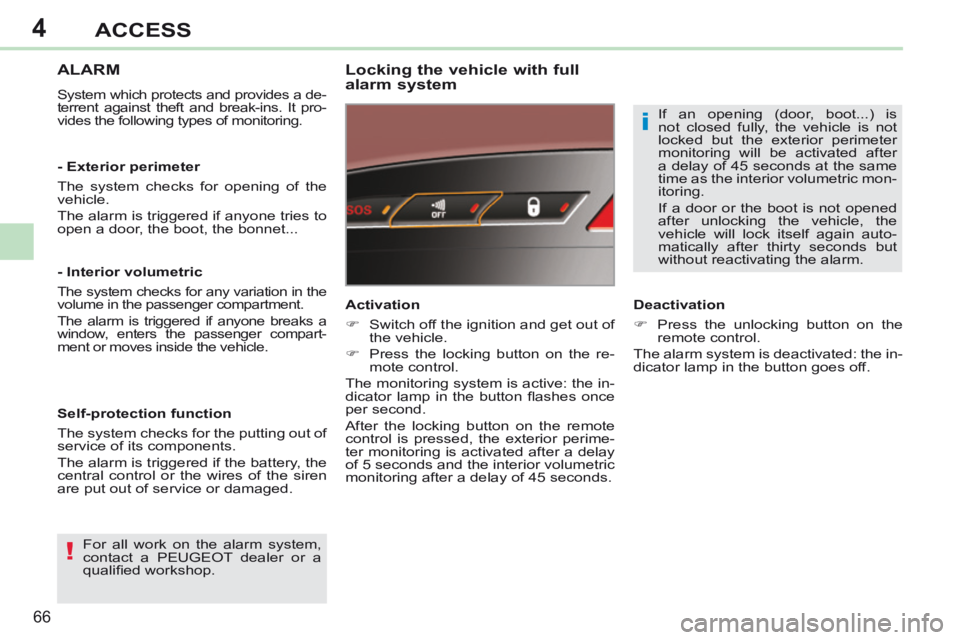
Locking the vehicle with full
alarm system
For all work on the alarm system,
contact a PEUGEOT dealer or a
qualifi ed workshop. Activation
Switch off the ignition and get out of
the vehicle.
Press the locking button on the re- mote control.
The monitoring system is active: the in-
dicator lamp in the button fl ashes once
per second.
After the locking button on the remote
control is pressed, the exterior perime-
ter monitoring is activated after a delay
of 5 seconds and the interior volumetric
monitoring after a delay of 45 seconds.
- Exterior perimeter
The system checks for opening of the
vehicle.
The alarm is triggered if anyone tries to
open a door, the boot, the bonnet...
- Interior volumetric
The system checks for any variation in the
volume in the passenger compartment.
The alarm is triggered if anyone breaks a
window, enters the passenger compart-
ment or moves inside the vehicle.
Self-protection function
The system checks for the putting out of
service of its components.
The alarm is triggered if the battery, the
central control or the wires of the siren
are put out of service or damaged.
Deactivation
Press the unlocking button on the
remote control.
The alarm system is deactivated: the in-
dicator lamp in the button goes off. If an opening (door, boot...) is
not closed fully, the vehicle is not
locked but the exterior perimeter
monitoring will be activated after
a delay of 45 seconds at the same
time as the interior volumetric mon-
itoring.
If a door or the boot is not opened
after unlocking the vehicle, the
v ehicle will lock itself again auto-
matically after thirty seconds but
without reactivating the alarm.
Page 85 of 268
5
!
i
83
VISIBILITY
Screenwash/headlamp wash low In the case of vehicles fi tted
with headlamp washers, when
the minimum level of the res-
ervoir is reached, this warning
lamp and/or the service warning lamp
is displayed in the instrument panel, ac-
companied by an audible signal and a
message in the screen.
Next time you stop, fi ll the screenwash /
headlamp wash fl uid reservoir.
The warning lamp is displayed when
the ignition is switched on, or every time
the stalk is operated, until the reservoir
is fi lled. Automatic rain sensitive
windscreen wipers
The windscreen wipers operate automati-
cally, without any action on the part of the
driver, if rain is detected (sensor behind
the rear view mirror), adapting their speed
to the intensity of the rainfall.
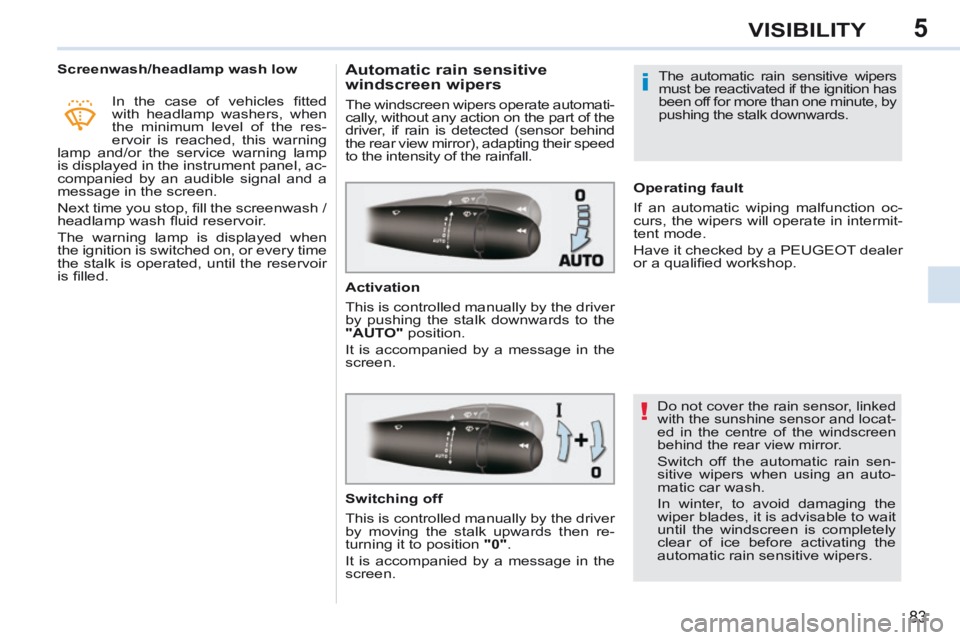
Activation
This is controlled manually by the driver
by pushing the stalk downwards to the
"AUTO" position.
It is accompanied by a message in the
screen.
Do not cover the rain sensor, linked
with the sunshine sensor and locat-
ed in the centre of the windscreen
behind the rear view mirror.
Switch off the automatic rain sen-
sitive wipers when using an auto-
matic car wash.
In winter, to avoid damaging the
wiper blades, it is advisable to wait
until the windscreen is completely
clear of ice before activating the
automatic rain sensitive wipers. The automatic rain sensitive wipers
must be reactivated if the ignition has
been off for more than one minute, by
pushing the stalk downwards.
Switching off
This is controlled manually by the driver
by moving the stalk upwards then re-
turning it to position "0" .
It is accompanied by a message in the
screen. Operating fault
If an automatic wiping malfunction oc-
curs, the wipers will operate in intermit-
tent mode.
Have it checked by a PEUGEOT dealer
or a qualifi ed workshop.
Page 96 of 268
7
!
i
!
94
SAFETY
BRAKING ASSISTANCE SYSTEMS
Group of supplementary systems which
help you to obtain optimum braking in
complete safety in emergency situations:
- anti-lock braking system (ABS),
- electronic brake force distribution (EBFD),
- emergency braking assistance (EBA).
Anti-lock braking system
and electronic brake force
distribution
Linked systems which improve the sta-
bility and manoeuvrability of your vehi-
cle when braking, in particular on poor
or slippery surfaces.
When braking in an emergency,
press very fi rmly without releasing
the pressure. When replacing wheels (tyres and
rims), ensure that they conform to
the manufacturer's recommenda-
tions.
Operating fault If this warning lamp comes on,
accompanied by an audible
signal and a message in the
screen, it indicates a malfunc-
tion of the anti-lock braking system
which could result in loss of control of
the vehicle when braking. If this warning lamp comes on,
together with the
STOP and
ABS warning lamps, accompa-
nied by an audible signal and
a message in the screen, it indicates a
malfunction of the electronic brake force
distribution which could result in loss of
control of the vehicle when braking.
Emergency braking assistance
System which, in an emergency, en-
ables you to obtain the optimum braking
pressure more quickly, thus reducing the
stopping distance.
Activation
The anti-lock braking system comes
into operation automatically when there
is a risk of wheel lock.
Normal operation of the ABS may make
itself felt by slight vibration of the brake
pedal.
Activation
It is triggered by the speed at which the
brake pedal is pressed.
The effect of this is a reduction in the
resistance of the pedal and an increase
in braking effi ciency. When braking in an emergency,
press fi rmly without releasing the
pressure.
You must stop as soon as it is safe
to do so.
In either case, contact a PEUGEOT
dealer or a qualifi ed workshop.
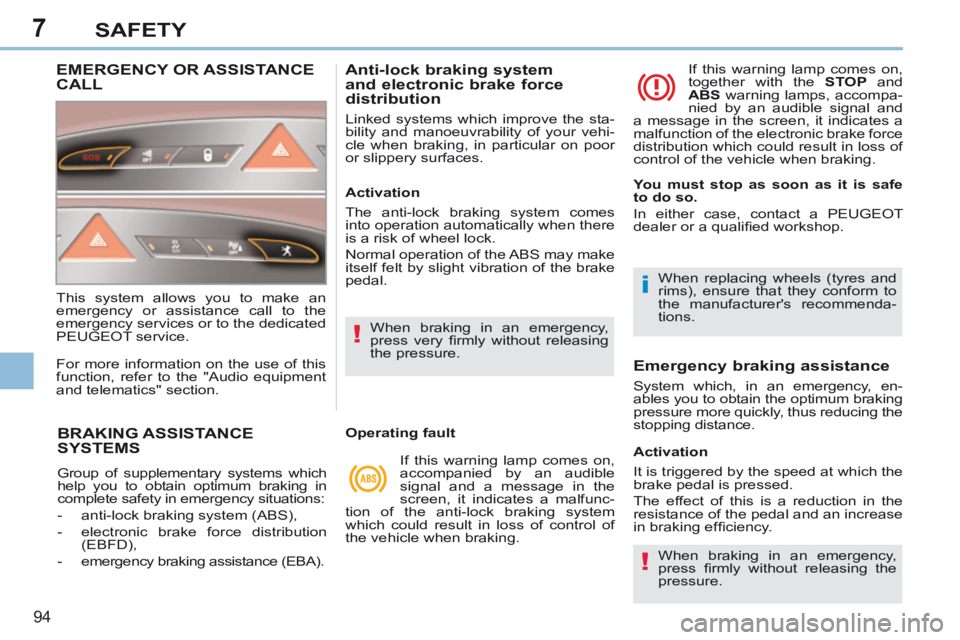
EMERGENCY OR ASSISTANCE CALL
This system allows you to make an
emergency or assistance call to the
emergency services or to the dedicated
PEUGEOT service.
For more information on the use of this
function, refer to the "Audio equipment
and telematics" section.
Page 125 of 268
8
i
!
i
!
123
DRIVING
The alert is given by the fi xed il-
lumination of this warning lamp,
accompanied by an audible signal
and the display of a message.
Operating fault
Under-inflation alert
The loss of pressure detected does
not always lead to visible deforma-
tion of the tyre. Do not rely on just
a visual check. The alert is maintained until the
tyre or tyres concerned is reinfl at-
ed, repaired or replaced.
The fl ashing and then fi xed il-
lumination of this warning lamp
accompanied by the illumination
of the service warning lamp in-
dicates a fault with the system.
This alert is also displayed when
one or more wheels is not fi tted
with a sensor (steel spare wheel *
or other wheels fi tted with winter
tyres).
Go to a PEUGEOT dealer or a
qualifi ed workshop to have the
system checked or, following the
repair of a puncture, to have the
original wheel, equipped with a
sensor, refi tted.
In this case, monitoring of the tyre pres-
sures is not assured.
Reduce speed, avoid sudden steer- ing movements or harsh brake ap-
plications.
Stop as soon as it is safe to do so.
In the event of a puncture, use the temporary puncture repair kit or the
spare wheel (according to equip-
ment),
or
if you have a compressor, the one in the temporary puncture repair kit for
example, check the four tyre pres-
sures when cold,
or
if it is not possible to check the tyre pressures at the time, drive carefully
at reduced speed.
* Depending on version.
In the event of a problem on one of the
tyres, a symbol or a message is dis-
played, depending on equipment, to
identify it.
Page 132 of 268
9
130
CHECKS
PEUGEOT & TOTAL PEUGEOT & TOTAL
Partners in performance and
protection of the environment
Innovation at the service of performance
The TOTAL Research and Development teams
develop lubricants for PEUGEOT which satisfy
the requirements of the latest technical innova-
tions incorporated in PEUGEOT vehicles.
This ensures that you obtain the best perfor-
mance and the maximum engine life.
RECOMMENDS
Reduced exhaust emissions
TOTAL lubricants are formulated to optimise
the effi ciency of engines and the protection
of the emissions post-treatment systems. It is
crucial to observe the servicing recommenda-
tions made by PEUGEOT to ensure correct
operation.
Page 137 of 268
9
!
i
135
CHECKS
CHECKING LEVELS
Engine oil level
The check is carried out either
when the ignition is switched
on using the oil level indicator
in the instrument panel for ve-
hicles with and electric oil level gauge,
or using the dipstick. It is normal to top up the oil level
between two services (or oil chang-es). PEUGEOT recommends that
you check the level, and top up
if necessary, every 3 000 miles
(5 000 kms).
Take care when working under the
bonnet, as certain areas of the en-
gine may be extremely hot (risk of
burns) and the cooling fan could
start at any time (even with the igni-
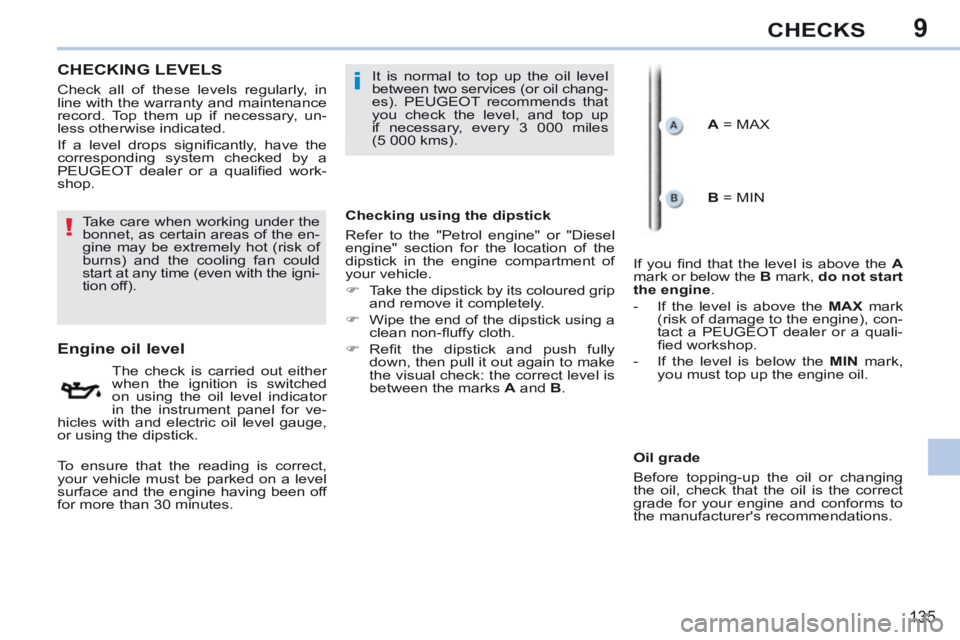
tion off). A = MAX
To ensure that the reading is correct,
your vehicle must be parked on a level
surface and the engine having been off
for more than 30 minutes. Check all of these levels regularly, in
line with the warranty and maintenance
record. Top them up if necessary, un-
less otherwise indicated.
If a level drops signifi cantly, have the
corresponding system checked by a
PEUGEOT dealer or a qualifi ed work-
shop. Checking using the dipstick
Refer to the "Petrol engine" or "Diesel
engine" section for the location of the
dipstick in the engine compartment of
your vehicle.
Take the dipstick by its coloured grip and remove it completely.
Wipe the end of the dipstick using a clean non-fl uffy cloth.
Refi t the dipstick and push fully down, then pull it out again to make
the visual check: the correct level is
between the marks A and B . B = MIN
If you fi nd that the level is above the A
mark or below the B mark, do not start
the engine .
- If the level is above the MAX mark
(risk of damage to the engine), con-
tact a PEUGEOT dealer or a quali-
fi ed workshop.
- If the level is below the MIN mark,
you must top up the engine oil.
Oil grade
Before topping-up the oil or changing
the oil, check that the oil is the correct
grade for your engine and conforms to
the manufacturer's recommendations.