wheel PEUGEOT 308 CC 2013 Owner's Manual
[x] Cancel search | Manufacturer: PEUGEOT, Model Year: 2013, Model line: 308 CC, Model: PEUGEOT 308 CC 2013Pages: 268, PDF Size: 15.28 MB
Page 128 of 268
8
i
126
DRIVING
CRUISE CONTROL
System which automatically maintains
the speed of the vehicle at the value
programmed by the driver, without any
action on the accelerator pedal.
The cruise control is switched on
manually: it requires a minimum vehicle
speed of 25 mph (40 km/h) and the en-
gagement of:
- fourth gear on a manual gearbox,
- second gear on an automatic gear- box, in sequential driving mode,
- position D on an automatic gearbox.
The cruise control is switched off man-
ually or by pressing the brake or clutch
pedal or on triggering of the DSC/ASR
systems for safety reasons.
It is possible to exceed the programmed
speed temporarily by pressing the ac-
celerator pedal.
To return to the programmed speed,
simply release the accelerator pedal.
Switching off the ignition cancels any
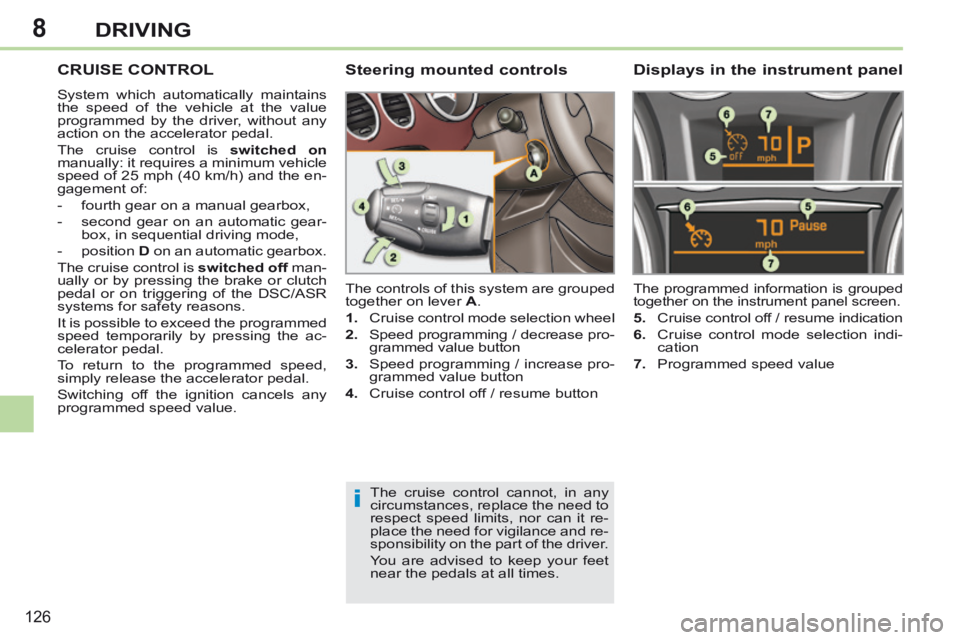
programmed speed value. The controls of this system are grouped
together on lever
A .
1. Cruise control mode selection wheel
2. Speed programming / decrease pro- grammed value button
3. Speed programming / increase pro- grammed value button
4. Cruise control off / resume button
The programmed information is grouped
together on the instrument panel screen.
5. Cruise control off / resume indication
6. Cruise control mode selection indi- cation
7. Programmed speed value
Steering mounted controls Displays in the instrument panel
The cruise control cannot, in any
circumstances, replace the need to
respect speed limits, nor can it re-
place the need for vigilance and re-
sponsibility on the part of the driver.
You are advised to keep your feet
near the pedals at all times.
Page 129 of 268
8
!
127
DRIVING
When the cruise control is switched
on, be careful if you maintain the
pressure on one of the programmed
speed changing buttons: this may
result in a very rapid change in the
speed of your vehicle.
Do not use the cruise control on
slippery roads or in heavy traffi c.
On a steep descent, the cruise
control will not be able to prevent
the vehicle from exceeding the pro-
grammed speed.
To avoid any risk of jamming of the
pedals:
- ensure that the mat is posi-tioned correctly,
- never fi t one mat on top of an- other.
Programming
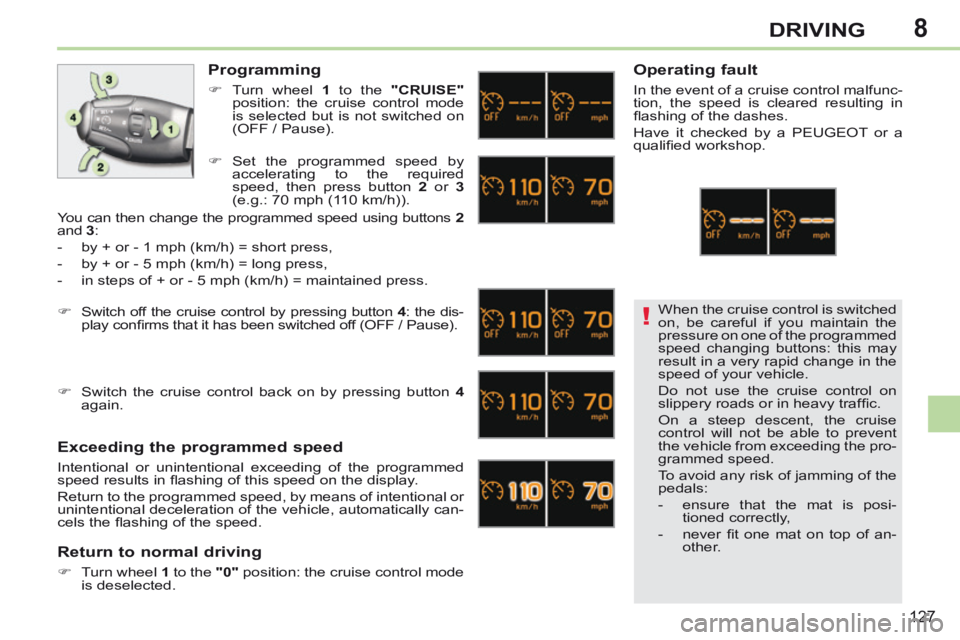
Turn wheel 1 to the "CRUISE"
position: the cruise control mode
is selected but is not switched on
(OFF / Pause).
Exceeding the programmed speed
Intentional or unintentional exceeding of the programmed
speed results in fl ashing of this speed on the display.
Return to the programmed speed, by means of intentional or
unintentional deceleration of the vehicle, automatically can-
cels the fl ashing of the speed.
Return to normal driving
Turn wheel 1 to the "0" position: the cruise control mode
is deselected.
Operating fault
In the event of a cruise control malfunc-
tion, the speed is cleared resulting in
fl ashing of the dashes.
Have it checked by a PEUGEOT or a
qualifi ed workshop.
Set the programmed speed by accelerating to the required
speed, then press button 2 or 3
(e.g.: 70 mph (110 km/h)).
Switch off the cruise control by pressing button 4 : the dis-
play confi rms that it has been switched off (OFF / Pause).
Switch the cruise control back on by pressing button 4
again.
You can then change the programmed speed using buttons
2
and 3 :
- by + or - 1 mph (km/h) = short press,
- by + or - 5 mph (km/h) = long press,
- in steps of + or - 5 mph (km/h) = maintained press.
Page 142 of 268
10
i
140
PRACTICAL INFORMATION
Access to the kit
The kit is stowed in the boot under
the fl oor. It is installed in the tool box,
located under the storage box.
TEMPORARY PUNCTURE REPAIR KIT
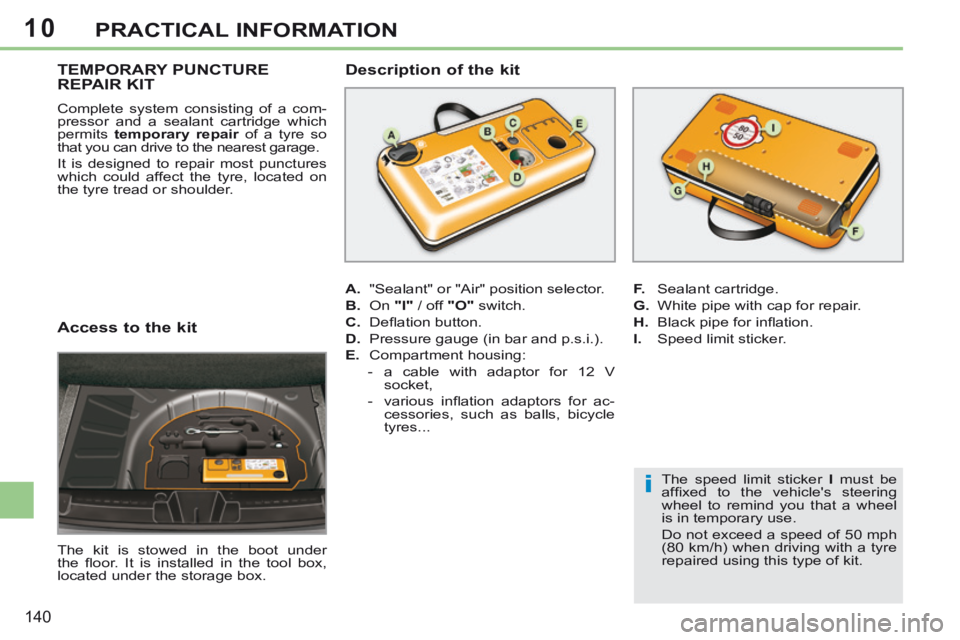
A. "Sealant" or "Air" position selector.
B. On "I" / off "O" switch.
C. Defl ation button.
D. Pressure gauge (in bar and p.s.i.).
E. Compartment housing: - a cable with adaptor for 12 V socket,
- various infl ation adaptors for ac- cessories, such as balls, bicycle
tyres...
Description of the kit
F. Sealant cartridge.
G. White pipe with cap for repair.
H. Black pipe for infl ation.
I. Speed limit sticker.
The speed limit sticker I must be
affi xed to the vehicle's steering
wheel to remind you that a wheel
is in temporary use.
Do not exceed a speed of 50 mph
(80 km/h) when driving with a tyre
repaired using this type of kit.
Complete system consisting of a com-
pressor and a sealant cartridge which
permits
temporary repair of a tyre so
that you can drive to the nearest garage.
It is designed to repair most punctures
which could affect the tyre, located on
the tyre tread or shoulder.
Page 144 of 268
10
iii
142
PRACTICAL INFORMATION
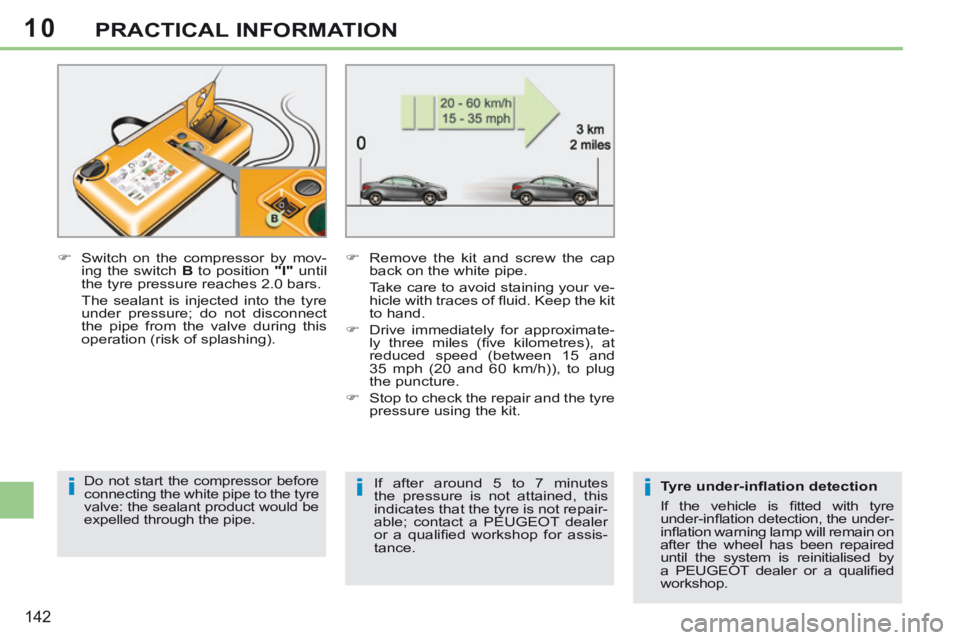
Switch on the compressor by mov-ing the switch B to position "I" until
the tyre pressure reaches 2.0 bars.
The sealant is injected into the tyre under pressure; do not disconnect
the pipe from the valve during this
operation (risk of splashing). Remove the kit and screw the cap
back on the white pipe.
Take care to avoid staining your ve- hicle with traces of fl uid. Keep the kit
to hand.
Drive immediately for approximate- ly three miles (fi ve kilometres), at
reduced speed (between 15 and
35 mph (20 and 60 km/h)), to plug
the puncture.
Stop to check the repair and the tyre pressure using the kit.
Do not start the compressor before
connecting the white pipe to the tyre
valve: the sealant product would be
expelled through the pipe. Tyre under-infl ation detection
If the vehicle is fi tted with tyre
under-infl ation detection, the under-
infl ation warning lamp will remain on
after the wheel has been repaired
until the system is reinitialised by
a PEUGEOT dealer or a qualifi ed
workshop.
If after around 5 to 7 minutes
the pressure is not attained, this
i ndicates that the tyre is not repair-
able; contact a PEUGEOT dealer
or a qualifi ed workshop for assis-
tance.
Page 145 of 268
10
!
143
PRACTICAL INFORMATION
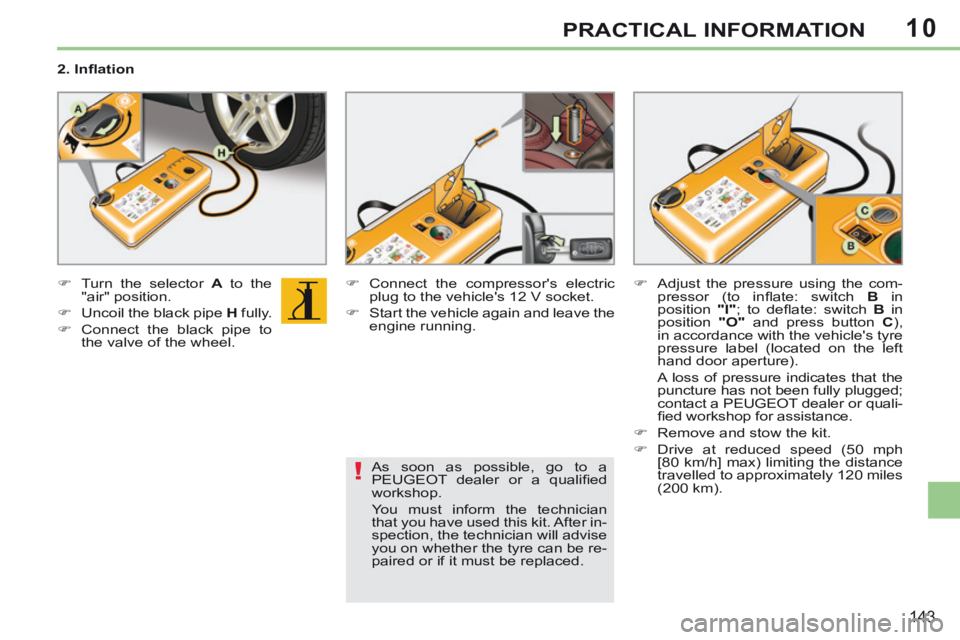
2. Infl ation
Turn the selector A to the
"air" position.
Uncoil the black pipe H fully.
Connect the black pipe to the valve of the wheel. Connect the compressor's electric
plug to the vehicle's 12 V socket.
Start the vehicle again and leave the engine running. Adjust the pressure using the com-
pressor (to infl ate: switch B in
p osition "I" ; to defl ate: switch B in
position "O" and press button C ),
in accordance with the vehicle's tyre
pressure label (located on the left
hand door aperture).
A loss of pressure indicates that the puncture has not been fully plugged;
contact a PEUGEOT dealer or quali-
fi ed workshop for assistance.
Remove and stow the kit.
Drive at reduced speed (50 mph [80 km/h] max) limiting the distance
travelled to approximately 120 miles
(200 km).
As soon as possible, go to a
PEUGEOT dealer or a qualifi ed
workshop.
You must inform the technician
that you have used this kit. After in-
spection, the technician will advise
you on whether the tyre can be re-
paired or if it must be replaced.
Page 146 of 268
10
!
!
144
PRACTICAL INFORMATION
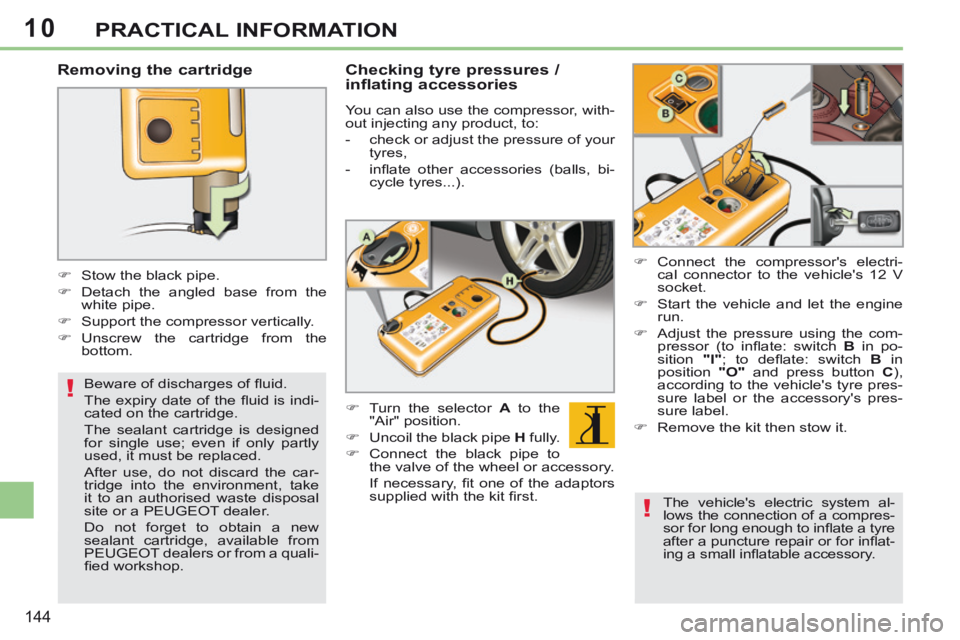
Removing the cartridge
Stow the black pipe.
Detach the angled base from the white pipe.
Support the compressor vertically.
Unscrew the cartridge from the bottom.
Beware of discharges of fl uid.
The expiry date of the fl uid is indi-
cated on the cartridge.
The sealant cartridge is designed
for single use; even if only partly
used, it must be replaced.
After use, do not discard the car-
tridge into the environment, take
it to an authorised waste disposal
site or a PEUGEOT dealer.
Do not forget to obtain a new
sealant cartridge, available from
PEUGEOT dealers or from a quali-
fi ed workshop.
Checking tyre pressures /
inflating accessories
You can also use the compressor, with-
out injecting any product, to:
- check or adjust the pressure of your tyres,
- infl ate other accessories (balls, bi- cycle tyres...).
Turn the selector A to the
"Air" position.
Uncoil the black pipe H fully.
Connect the black pipe to the valve of the wheel or accessory.
If necessary, fi t one of the adaptors supplied with the kit fi rst. Connect the compressor's electri-
cal connector to the vehicle's 12 V
socket.
Start the vehicle and let the engine run.
Adjust the pressure using the com- pressor (to infl ate: switch B in po-
sition "I" ; to defl ate: switch B in
position "O" and press button C ),
according to the vehicle's tyre pres-
sure label or the accessory's pres-
sure label.
Remove the kit then stow it.
The vehicle's electric system al-
lows the connection of a compres-
sor for long enough to infl ate a tyre
after a puncture repair or for infl at-
ing a small infl atable accessory.
Page 147 of 268
10
i
145
PRACTICAL INFORMATION
CHANGING A WHEEL
Procedure for changing a faulty wheel
for the spare wheel using the tools pro-
vided with the vehicle.
The tools are installed in the boot under
the fl oor.
For access to them:
change to the "coupé" confi guration,
open the boot,
raise the fl oor,
secure it by hooking its handle on the boot seal,
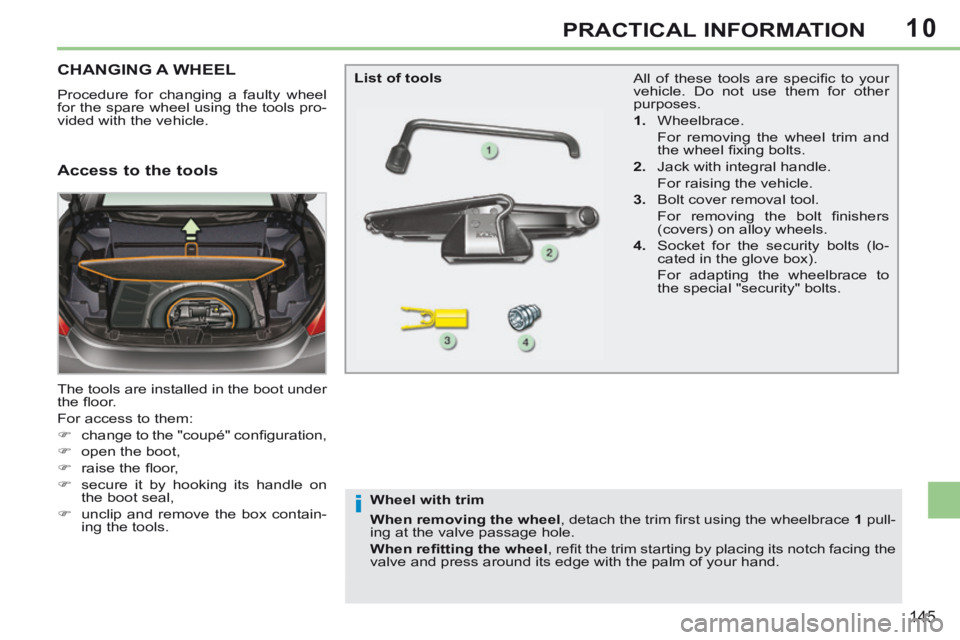
unclip and remove the box contain- ing the tools. All of these tools are specifi c to your
vehicle. Do not use them for other
purposes.
1. Wheelbrace.
For removing the wheel trim and
the wheel fi xing bolts.
2. Jack with integral handle.
For raising the vehicle.
3. Bolt cover removal tool.
For removing the bolt fi nishers (covers) on alloy wheels.
4. Socket for the security bolts (lo- cated in the glove box).
For adapting the wheelbrace to the special "security" bolts.
List of tools
Access to the tools
Wheel with trim
When removing the wheel , detach the trim fi rst using the wheelbrace
1 pull-
ing at the valve passage hole.
When refi tting the wheel , refi t the trim starting by placing its notch facing the
valve and press around its edge with the palm of your hand.
Page 148 of 268
10
i
i
146
PRACTICAL INFORMATION
Fitting the steel spare wheel
If your vehicle is fi tted with alloy
wheels, it is normal to notice, when
tightening the bolts on fi tting, that
the washers do not come into con-
tact with the steel spare wheel. The
wheel is secured by the conical
contact of each bolt.
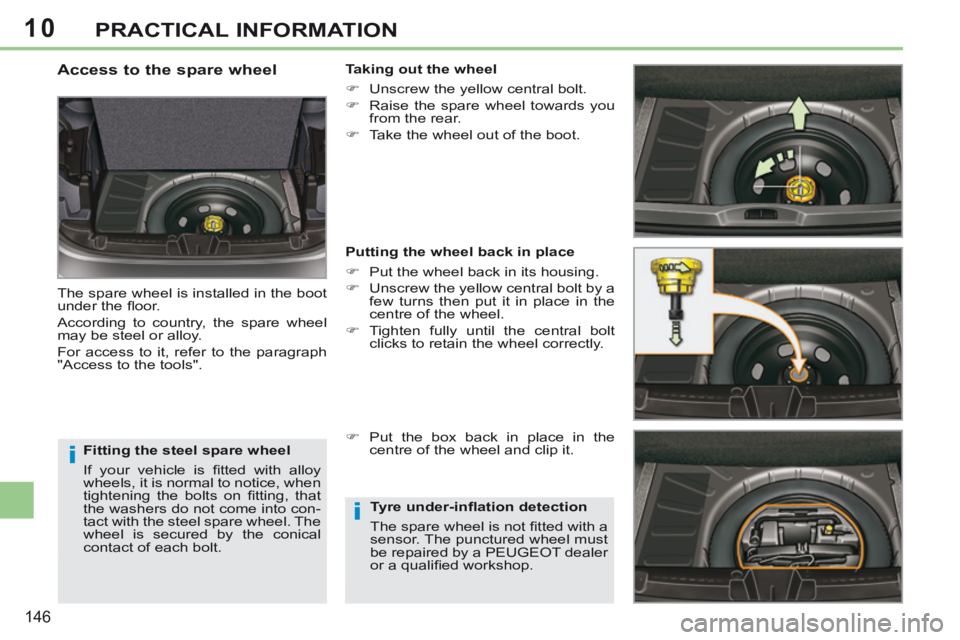
Access to the spare wheel
The spare wheel is installed in the boot
under the fl oor.
According to country, the spare wheel
may be steel or alloy.
For access to it, refer to the paragraph
"Access to the tools". Taking out the wheel
Unscrew the yellow central bolt.
Raise the spare wheel towards you
from the rear.
Take the wheel out of the boot.
Putting the wheel back in place
Put the wheel back in its housing.
Unscrew the yellow central bolt by a few turns then put it in place in the
centre of the wheel.
Tighten fully until the central bolt clicks to retain the wheel correctly.
Put the box back in place in the c entre of the wheel and clip it.
Tyre under-infl ation detection
The spare wheel is not fi tted with a
sensor. The punctured wheel must
be repaired by a PEUGEOT dealer
or a qualifi ed workshop.
Page 149 of 268
10
i
147
PRACTICAL INFORMATION
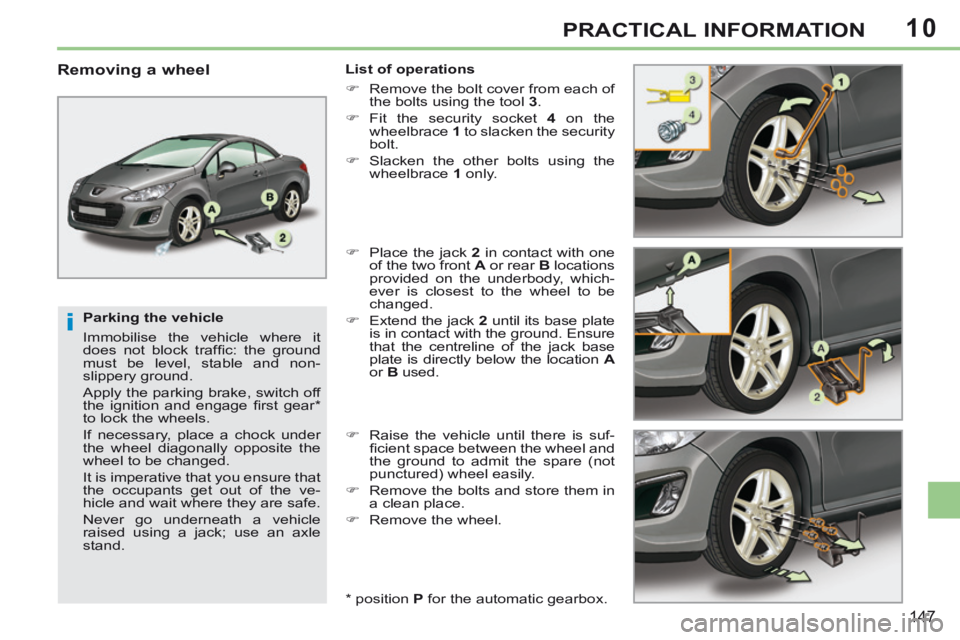
Parking the vehicle
Immobilise the vehicle where it
does not block traffi c: the ground
must be level, stable and non-
slippery ground.
Apply the parking brake, switch off
the ignition and engage fi rst gear *
to lock the wheels.
If necessary, place a chock under
the wheel diagonally opposite the
wheel to be changed.
It is imperative that you ensure that
the occupants get out of the ve-
hicle and wait where they are safe.
Never go underneath a vehicle
raised using a jack; use an axle
stand.
Removing a wheel List of operations
Remove the bolt cover from each of the bolts using the tool 3 .
Fit the security socket 4 on the
wheelbrace 1 to slacken the security
bolt.
Slacken the other bolts using the wheelbrace 1 only.
Place the jack 2 in contact with one
of the two front A or rear B locations
provided on the underbody, which-
ever is closest to the wheel to be
changed.
Extend the jack 2 until its base plate
is in contact with the ground. Ensure
that the centreline of the jack base
plate is directly below the location A
or B used.
Raise the vehicle until there is suf- fi cient space between the wheel and
the ground to admit the spare (not
punctured) wheel easily.
Remove the bolts and store them in a clean place.
Remove the wheel.
* position P for the automatic gearbox.
Page 150 of 268
10
i
148
PRACTICAL INFORMATION
After changing a wheel
To store the punctured wheel in the
boot correctly, fi rst remove the cen-
tral cover.
Have the tightening of the bolts and
the pressure of the spare wheel
checked by a PEUGEOT dealer or
a qualifi ed workshop without delay.
Have the punctured wheel repaired
without delay and replace it on the
vehicle as soon as possible.
When the spare wheel is different
from the other wheels, we strongly
recommend that your drive with
particular care.
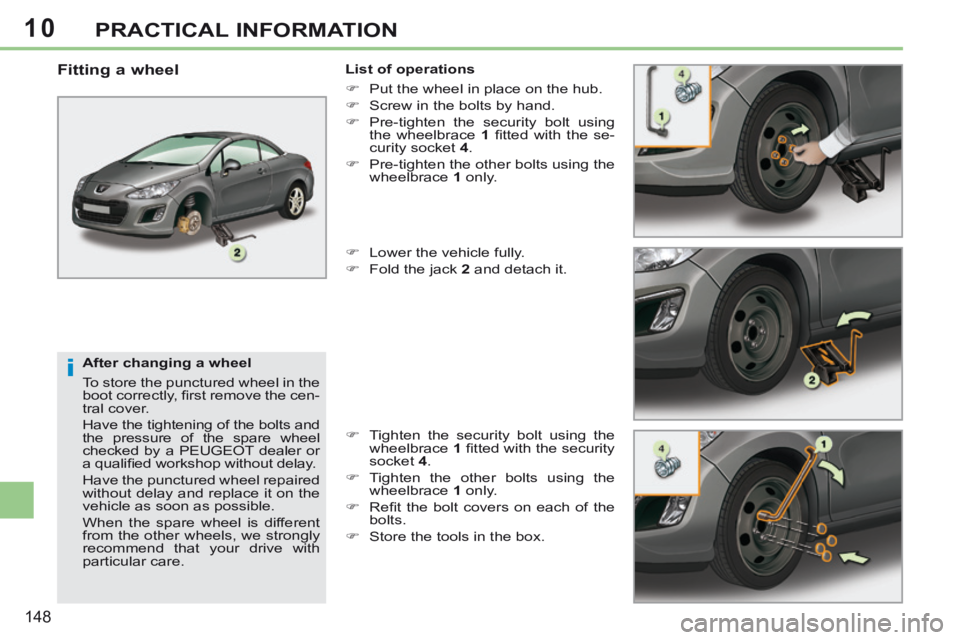
Fitting a wheel List of operations
Put the wheel in place on the hub.
Screw in the bolts by hand.
Pre-tighten the security bolt using the wheelbrace 1 fi tted with the se-
curity socket 4 .
Pre-tighten the other bolts using the wheelbrace 1 only.
Lower the vehicle fully.
Fold the jack 2 and detach it.
Tighten the security bolt using the wheelbrace 1 fi tted with the security
socket 4 .
Tighten the other bolts using the wheelbrace 1 only.
Refi t the bolt covers on each of the bolts.
Store the tools in the box.