engine PEUGEOT 308 SW BL 2010 Owner's Guide
[x] Cancel search | Manufacturer: PEUGEOT, Model Year: 2010, Model line: 308 SW BL, Model: PEUGEOT 308 SW BL 2010Pages: 336, PDF Size: 21.2 MB
Page 94 of 336
i
92
ACCESS
Quality of the fuel used for
petrol engines
The petrol engines are perfectly com-
patible with E10 type petrol biofuels
(containing 10 % ethanol), conforming
to European standards EN 228 and
EN 15376.
E85 type fuels (containing up to 85 %
ethanol) are reserved exclusively for ve-
hicles marketed for the use of this type
of fuel (BioFlex vehicles). The quality of
the ethanol must comply with European
standard EN 15293.
For Brazil only, special vehicles are
marketed to run on fuels containing up
to 100 % ethanol (E100 type).
Quality of the fuel used for
Diesel engines
The Diesel engines are perfectly com-
patible with biofuels which conform to
current and future European standards
(Diesel fuel which complies with stan-
dard EN 590 mixed with a biofuel which
complies with standard EN 14214)
available at the pumps (containing up
to 7 % Fatty Acid Methyl Ester).
The B30 biofuel can be used in cer-
tain Diesel engines; however, this use
is subject to strict application of the
special servicing conditions. Consult a
PEUGEOT dealer.
The use of any other type of (bio)fuel
(vegetable or animal oils, pure or dilut-
ed, domestic fuel...) is strictly prohibited
(risk of damage to the engine and fuel
system).
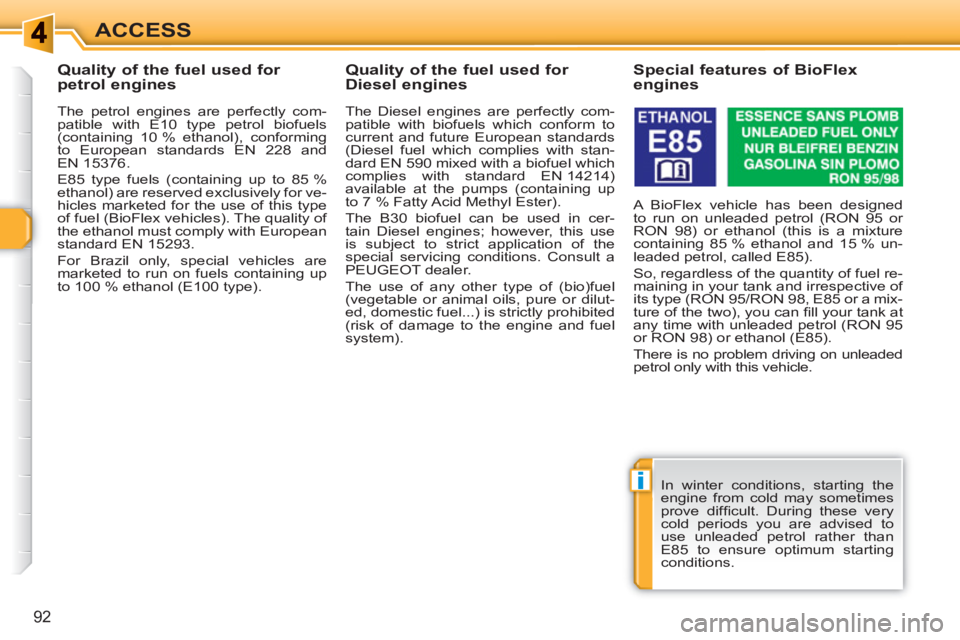
Special features of BioFlex
engines
A BioFlex vehicle has been designed
to run on unleaded petrol (RON 95 or
RON 98) or ethanol (this is a mixture
containing 85 % ethanol and 15 % un-
leaded petrol, called E85).
So, regardless of the quantity of fuel re-
maining in your tank and irrespective of
its type (RON 95/RON 98, E85 or a mix-
ture of the two), you can fi ll your tank at
any time with unleaded petrol (RON 95
or RON 98) or ethanol (E85).
There is no problem driving on unleaded
petrol only with this vehicle.
In winter conditions, starting the
engine from cold may sometimes
prove diffi cult. During these very
cold periods you are advised to
use unleaded petrol rather than
E85 to ensure optimum starting
conditions.
Page 97 of 336
i
95
VISIBILITY
Manual guide-me-home lighting
Temporarily keeping the dipped beam
headlamps on after the vehicle's igni-
tion has been switched off makes the
driver's exit easier when the light is
poor.
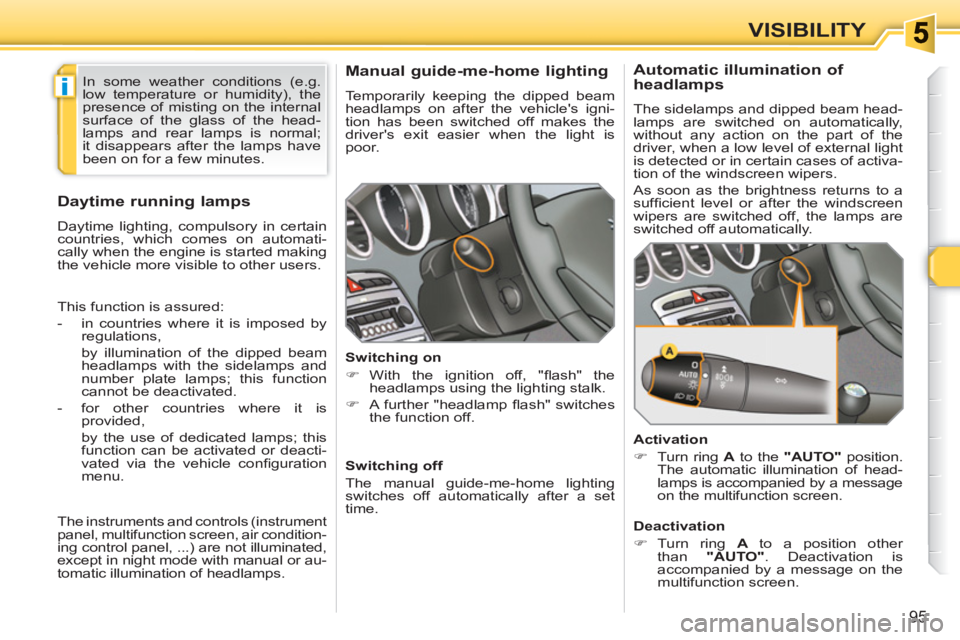
Switching on
)
With the ignition off, "fl ash" the
headlamps using the lighting stalk.
)
A further "headlamp fl ash" switches
the function off.
Switching off
The manual guide-me-home lighting
switches off automatically after a set
time.
Daytime running lamps
Daytime lighting, compulsory in certain
countries, which comes on automati-
cally when the engine is started making
the vehicle more visible to other users. In some weather conditions (e.g.
low temperature or humidity), the
presence of misting on the internal
surface of the glass of the head-
lamps and rear lamps is normal;
it disappears after the lamps have
been on for a few minutes.
The instruments and controls (instrument
panel, multifunction screen, air condition-
ing control panel, ...) are not illuminated,
except in night mode with manual or au-
tomatic illumination of headlamps.
Automatic illumination of
headlamps
The sidelamps and dipped beam head-
lamps are switched on automatically,
without any action on the part of the
driver, when a low level of external light
is detected or in certain cases of activa-
tion of the windscreen wipers.
As soon as the brightness returns to a
suffi cient level or after the windscreen
wipers are switched off, the lamps are
switched off automatically.
Activation
)
Turn ring A
to the "AUTO"
position.
The automatic illumination of head-
lamps is accompanied by a message
on the multifunction screen.
Deactivation
)
Turn ring A
to a position other
than "AUTO"
. Deactivation is
accompanied by a message on the
multifunction screen.
This function is assured:
- in countries where it is imposed by
regulations,
by illumination of the dipped beam
headlamps with the sidelamps and
number plate lamps; this function
cannot be deactivated.
- for other countries where it is
provided,
by the use of dedicated lamps; this
function can be activated or deacti-
vated via the vehicle confi guration
menu.
Page 103 of 336
i
i
!
101
VISIBILITY
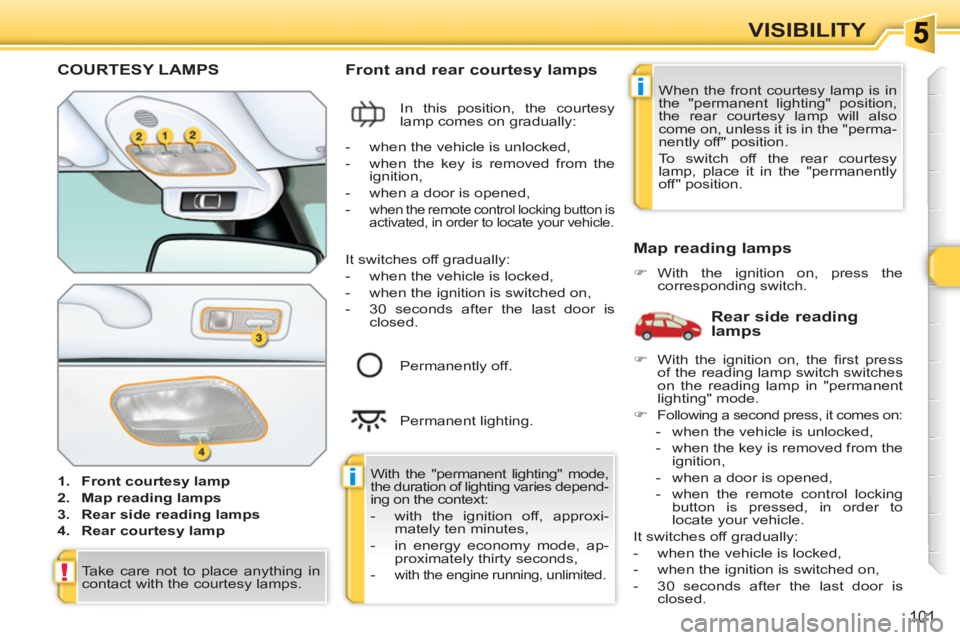
COURTESY LAMPS
1.
Front courtesy lamp
2.
Map reading lamps
3.
Rear side reading lamps
4.
Rear courtesy lamp
Front and rear courtesy lamps
In this position, the courtesy
lamp comes on gradually:
Map reading lamps
)
With the ignition on, press the
corresponding switch.
With the "permanent lighting" mode,
the duration of lighting varies depend-
ing on the context:
- with the ignition off, approxi-
mately ten minutes,
- in energy economy mode, ap-
proximately thirty seconds,
-
with the engine running, unli mited.
- when the vehicle is unlocked,
- when the key is removed from the
ignition,
- when a door is opened,
-
when the remote control locking button is
activated, in order to locate your vehicle.
Permanently off.
Permanent lighting.
When the front courtesy lamp is in
the "permanent lighting" position,
the rear courtesy lamp will also
come on, unless it is in the "perma-
nently off" position.
To switch off the rear courtesy
lamp, place it in the "permanently
off" position.
Rear side reading
lamps
It switches off gradually:
- when the vehicle is locked,
- when the ignition is switched on,
- 30 seconds after the last door is
closed.
Take care not to place anything in
contact with the courtesy lamps.
)
With the ignition on, the fi rst press
of the reading lamp switch switches
on the reading lamp in "permanent
lighting" mode.
)
Following a second press, it comes on:
- when the vehicle is unlocked,
- when the key is removed from the
ignition,
- when a door is opened,
- when the remote control locking
button is pressed, in order to
locate your vehicle.
It switches off gradually:
- when the vehicle is locked,
- when the ignition is switched on,
- 30 seconds after the last door is
closed.
Page 104 of 336
i
i
102
VISIBILITY
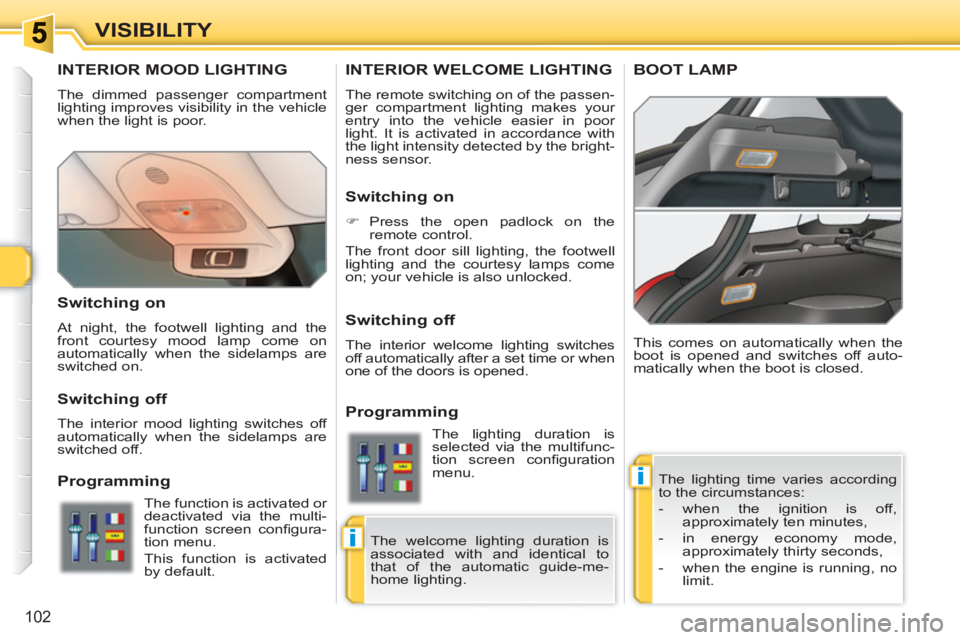
INTERIOR MOOD LIGHTING
The dimmed passenger compartment
lighting improves visibility in the vehicle
when the light is poor.
The lighting time varies according
to the circumstances:
- when the ignition is off,
approximately ten minutes,
- in energy economy mode,
approximately thirty seconds,
- when the engine is running, no
limit. This comes on automatically when the
boot is opened and switches off auto-
matically when the boot is closed.
INTERIOR WELCOME LIGHTING
The remote switching on of the passen-
ger compartment lighting makes your
entry into the vehicle easier in poor
light. It is activated in accordance with
the light intensity detected by the bright-
ness sensor.
BOOT LAMP
Switching on
)
Press the open padlock on the
remote control.
The front door sill lighting, the footwell
lighting and the courtesy lamps come
on; your vehicle is also unlocked.
Switching off
The interior welcome lighting switches
off automatically after a set time or when
one of the doors is opened.
Programming
Switching on
At night, the footwell lighting and the
front courtesy mood lamp come on
automatically when the sidelamps are
switched on.
Switching off
The interior mood lighting switches off
automatically when the sidelamps are
switched off.
Programming
The welcome lighting duration is
associated with and identical to
that of the automatic guide-me-
home lighting. The function is activated or
deactivated via the multi-
function screen confi gura-
tion menu.
This function is activated
by default. The lighting duration is
selected via the multifunc-
tion screen confi guration
menu.
Page 132 of 336
!
i
!
130
SAFETY
BRAKING ASSISTANCE SYSTEMS
Group of supplementary systems which
help you to obtain optimum braking in
complete safety in emergency situations:
- anti-lock braking system (ABS),
- electronic brake force distribution
(EBFD),
- emergency braking assistance (EBA).
Anti-lock braking system
and electronic brake force
distribution
Linked systems which improve the sta-
bility and manoeuvrability of your vehicle
when braking, in particular on poor or
slippery surfaces.
When braking in an emergency,
press very fi rmly without releasing
the pressure.
When replacing wheels (tyres and
rims), ensure that they conform to the manufacturer's recommendations.
Operating fault
If this warning lamp comes on,
accompanied by an audible sig-
nal and a message on the mul-
tifunction screen, it indicates a
malfunction of the anti-lock braking sys-
tem which could result in loss of control
of the vehicle when braking.
If this warning lamp comes on,
together with the STOP
and
ABS
warning lamps, accompa-
nied by an audible signal and a
message on the multifunction screen, it
indicates a malfunction of the electron-
ic brake force distribution which could
result in loss of control of the vehicle
when braking.
You must stop as soon as it is safe
to do so.
Emergency braking assistance
System which, in an emergency, enables
you to obtain the optimum braking
pressure more quickly, thus reducing the
stopping distance.
Activation
The anti-lock braking system comes
into operation automatically when there
is a risk of wheel lock.
Normal operation of the ABS may make
itself felt by slight vibration of the brake
pedal.
Activation
It is triggered by the speed at which the
brake pedal is pressed.
The effect of this is a reduction in the
resistance of the pedal and an increase
in braking effi ciency.
In either case, contact a PEUGEOT
dealer. When braking in an emergency,
press fi rmly without releasing the
pressure.
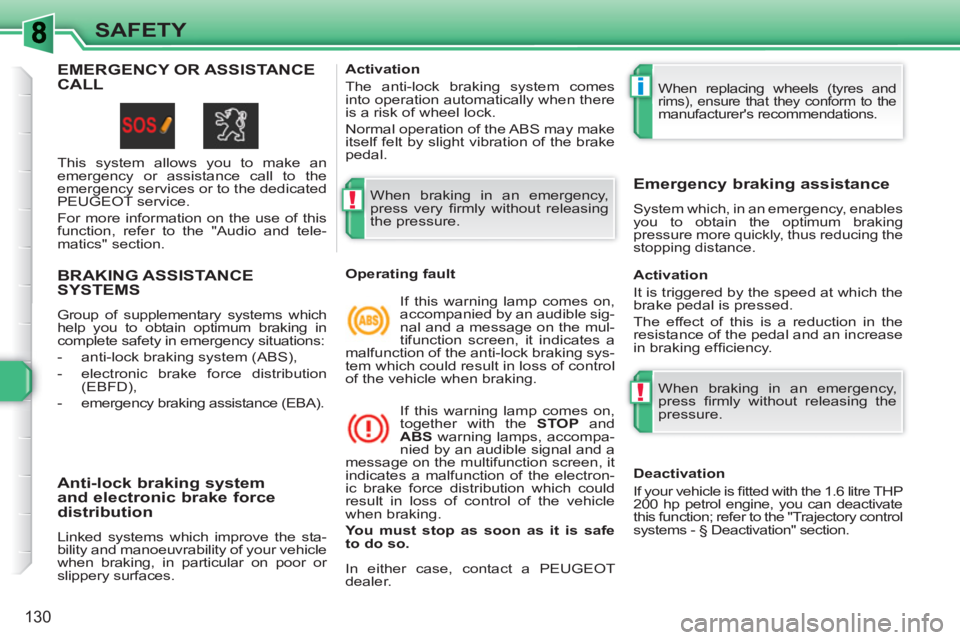
EMERGENCY OR ASSISTANCECALL
This system allows you to make an
emergency or assistance call to the
emergency services or to the dedicated
PEUGEOT service.
For more information on the use of this
function, refer to the "Audio and tele-
matics" section.
Deactivation
If your vehicle is fi tted with the 1.6 litre THP
200 hp petrol engine, you can deactivate
this function; refer to the "Trajectory control
systems - § Deactivation" section.
Page 133 of 336
!
SAFETY
The ESP/ASR systems offer ex-
ceptional safety in normal driving,
but this should not encourage the
driver to take extra risks or drive at
high speed.
The correct functioning of these
systems depends on observation
of the manufacturer's recommen-
dations regarding the wheels (tyres
and rims), the braking components,
the electronic components and the
repair and assembly procedures
used by PEUGEOT dealers.
After an impact, have these sys-
tems checked by a PEUGEOT
dealer.
Deactivation
In exceptional conditions (starting a ve-
hicle which is bogged down, stuck in
snow, on soft ground, ...), it may be ad-
visable to deactivate the ASR and ESP
systems, so that the wheels can move
freely and regain grip.
)
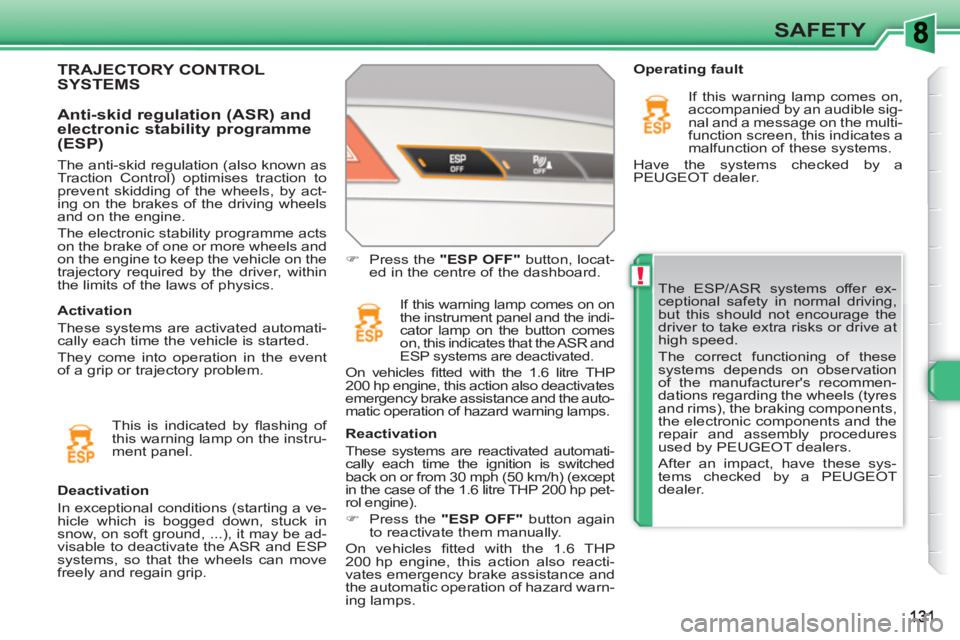
Press the "ESP OFF"
button, locat-
ed in the centre of the dashboard.
If this warning lamp comes on on
the instrument panel and the indi-
cator lamp on the button comes
on, this indicates that the ASR and
ESP systems are deactivated.
On vehicles fi tted with the 1.6 litre THP
200 hp engine, this action also deactivates
emergency brake assistance and the auto-
matic operation of hazard warning lamps.
Reactivation
These systems are reactivated automati-
cally each time the ignition is switched
back on or from 30 mph (50 km/h) (except
in the case of the 1.6 litre THP 200 hp pet-
rol engine).
)
Press the "ESP OFF"
button again
to reactivate them manually.
On vehicles fi tted with the 1.6 THP
200 hp engine, this action also reacti-
vates emergency brake assistance and
the automatic operation of hazard warn-
ing lamps.
Operating fault
If this warning lamp comes on,
accompanied by an audible sig-
nal and a message on the multi-
function screen, this indicates a
malfunction of these systems.
Have the systems checked by a
PEUGEOT dealer.
TRAJECTORY CONTROLSYSTEMS
Activation
These systems are activated automati-
cally each time the vehicle is started.
They come into operation in the event
of a grip or trajectory problem.
Anti-skid regulation (ASR) and
electronic stability programme
(ESP)
This is indicated by fl ashing of
this warning lamp on the instru-
ment panel.
The anti-skid regulation (also known as
Traction Control) optimises traction to
prevent skidding of the wheels, by act-
ing on the brakes of the driving wheels
and on the engine.
The electronic stability programme acts
on the brake of one or more wheels and
on the engine to keep the vehicle on the
trajectory required by the driver, within
the limits of the laws of physics.
Page 136 of 336
134
SAFETY
Unfastening
)
Press the red button on the buckle.
)
Guide the seat belt as it reels in.
)
On the outer seat belts, raise the bar
to the top of the backrest to prevent
the tongue from knocking against
the side trim.
Seat belt unfastened warning lamp
This warning lamp comes on,
either on the instrument panel
or on the seat belt and pas-
senger's front airbag warning
lamps display, when one or more rear
passengers unfasten their seat belt.
From approximately 12 mph (20 km/h),
this warning lamp fl ashes for two minutes
accompanied by an audible signal of in-
creasing volume. Once these two minutes
have elapsed, this warning lamp remains
on until the one or more rear passengers
fasten their seat belt.
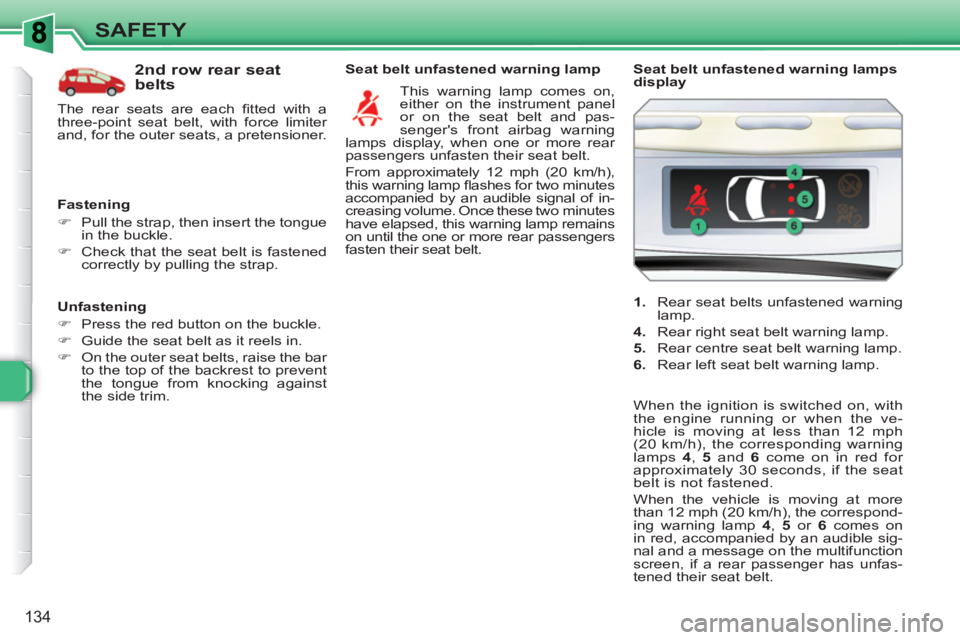
1.
Rear seat belts unfastened warning
lamp.
4.
Rear right seat belt warning lamp.
5.
Rear centre seat belt warning lamp.
6.
Rear left seat belt warning lamp.
Seat belt unfastened warning lamps
display
When the ignition is switched on, with
the engine running or when the ve-
hicle is moving at less than 12 mph
(20 km/h), the corresponding warning
lamps 4
, 5
and 6
come on in red for
approximately 30 seconds, if the seat
belt is not fastened.
When the vehicle is moving at more
than 12 mph (20 km/h), the correspond-
ing warning lamp 4
, 5
or 6
comes on
in red, accompanied by an audible sig-
nal and a message on the multifunction
screen, if a rear passenger has unfas-
tened their seat belt.
2nd row rear seat
belts
The rear seats are each fi tted with a
three-point seat belt, with force limiter
and, for the outer seats, a pretensioner.
Fastening
)
Pull the strap, then insert the tongue
in the buckle.
)
Check that the seat belt is fastened
correctly by pulling the strap.
Page 143 of 336
!
i
!
141
DRIVING
When parking on a slope, direct
your wheels against the pavement,
apply the parking brake and engage
a gear.
PARKING BRAKE
Applying
)
Pull the parking brake lever fully up
to immobilise your vehicle.
When the vehicle is being driven,
if this warning lamp and the STOP
warning lamp come on, accom-
panied by an audible signal and a
message on the multifunction screen, this
indicates that the parking brake is still on
or has not been properly released.
Releasing
)
Pull the parking brake lever gently,
press the release button then lower
the lever fully.
6-SPEED MANUAL GEARBOX
As a safety precaution and to facili-
tate starting of the engine:
- always select neutral,
- press the clutch pedal.
Only engage reverse gear when
the vehicle is stationary with the
engine at idle.
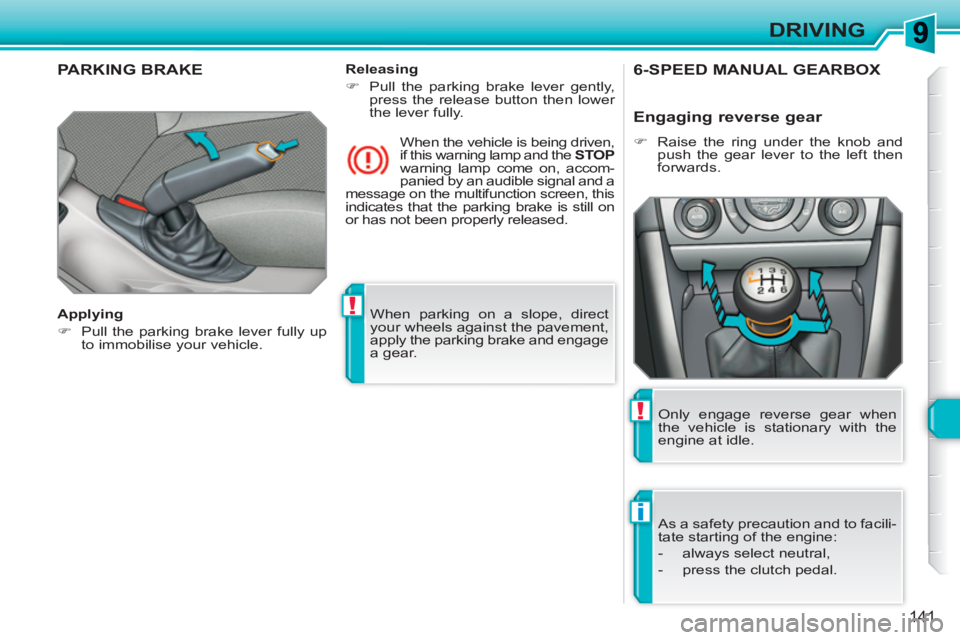
Engaging reverse gear
)
Raise the ring under the knob and
push the gear lever to the left then
forwards.
Page 144 of 336
i
142
DRIVING
GEAR SHIFT INDICATOR *
System which reduces fuel consumption
by advising the driver to change up on
vehicles fi tted with a manual gearbox.
Operation
The system intervenes only when driv-
ing economically.
Depending on the driving situation and
your vehicle's equipment, the system
may advise you to skip one or more
gears. You can follow this instruc-
tion without engaging the intermediate
gears.
The gear recommended should not
be considered compulsory. In fact, the
confi guration of the road, the amount
of traffi c and safety remain determining
factors when choosing the best gear.
Therefore, the driver remains responsi-
ble for deciding whether or not to follow
the advice given by the system.
This function cannot be deactivated.
*
According to engine.
Example:
- You are in third gear.
- You press the accelerator pedal
moderately.
- The system may suggest that you
engage a higher gear, if appropriate.
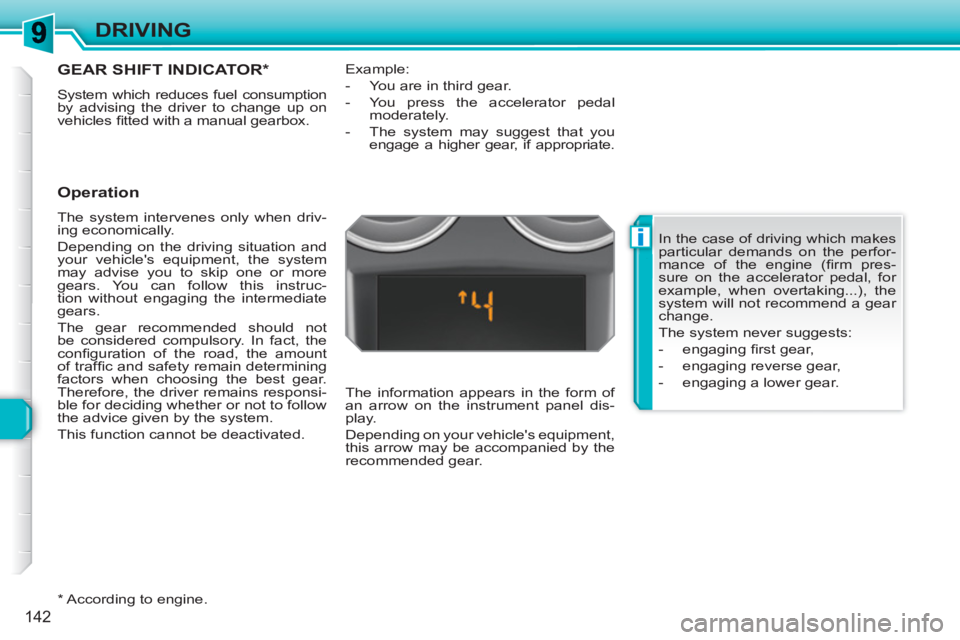
The information appears in the form of
an arrow on the instrument panel dis-
play.
Depending on your vehicle's equipment,
this arrow may be accompanied by the
recommended gear.
In the case of driving which makes
particular demands on the perfor-
mance of the engine (fi rm pres-
sure on the accelerator pedal, for
example, when overtaking...), the
system will not recommend a gear
change.
The system never suggests:
- engaging fi rst gear,
- engaging reverse gear,
- engaging a lower gear.
Page 146 of 336
ii
!i
144
DRIVING
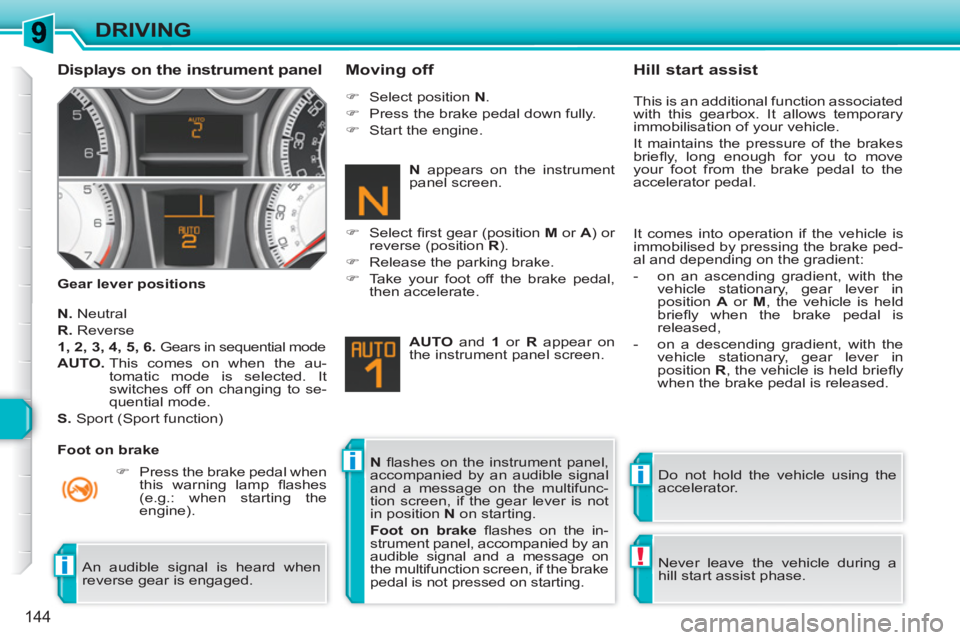
Displays on the instrument panel
Gear lever positions
Moving off
N.
Neutral
R.
Reverse
1, 2, 3, 4, 5, 6.
Gears in sequential mode
AUTO.
This comes on when the au-
tomatic mode is selected. It
switches off on changing to se-
quential mode.
S.
Sport (Sport function)
)
Press the brake pedal when
this warning lamp fl ashes
(e.g.: when starting the
engine).
)
Select position N
.
)
Press the brake pedal down fully.
)
Start the engine.
)
Select fi rst gear (position M
or A
) or
reverse (position R
).
)
Release the parking brake.
)
Take your foot off the brake pedal,
then accelerate.
AUTO
and 1
or R
appear on
the instrument panel screen.
Do not hold the vehicle using the
accelerator.
N
fl ashes on the instrument panel,
accompanied by an audible signal
and a message on the multifunc-
tion screen, if the gear lever is not
in position N
on starting.
Foot on brake
fl ashes on the in-
strument panel, accompanied by an
audible signal and a message on
the multifunction screen, if the brake
pedal is not pressed on starting.
Hill start assist
This is an additional function associated
with this gearbox. It allows temporary
immobilisation of your vehicle.
It maintains the pressure of the brakes
briefl y, long enough for you to move
your foot from the brake pedal to the
accelerator pedal.
Never leave the vehicle during a
hill start assist phase. It comes into operation if the vehicle is
immobilised by pressing the brake ped-
al and depending on the gradient:
- on an ascending gradient, with the
vehicle stationary, gear lever in
position A
or M
, the vehicle is held
briefl y when the brake pedal is
released,
- on a descending gradient, with the
vehicle stationary, gear lever in
position R
, the vehicle is held briefl y
when the brake pedal is released.
An audible signal is heard when
reverse gear is engaged.
N
appears on the instrument
panel screen.
Foot on brake