ECO mode Peugeot 308 SW BL 2011 Owner's Guide
[x] Cancel search | Manufacturer: PEUGEOT, Model Year: 2011, Model line: 308 SW BL, Model: Peugeot 308 SW BL 2011Pages: 336, PDF Size: 21.26 MB
Page 154 of 336
i
152
DRIVING
CRUISE CONTROL
System which automatically maintains
the speed of the vehicle at the value
programmed by the driver, without any
action on the accelerator pedal.
The cruise control is switched on
manually: it requires a minimum vehicle
speed of 25 mph (40 km/h) and the en-
gaging:
- of fourth gear on the manual
gearbox,
- of second gear on the electronic
gear control gearbox or automatic
gearbox, in sequential driving mode,
- of position A
on the electronic
gear control gearbox or D
on the
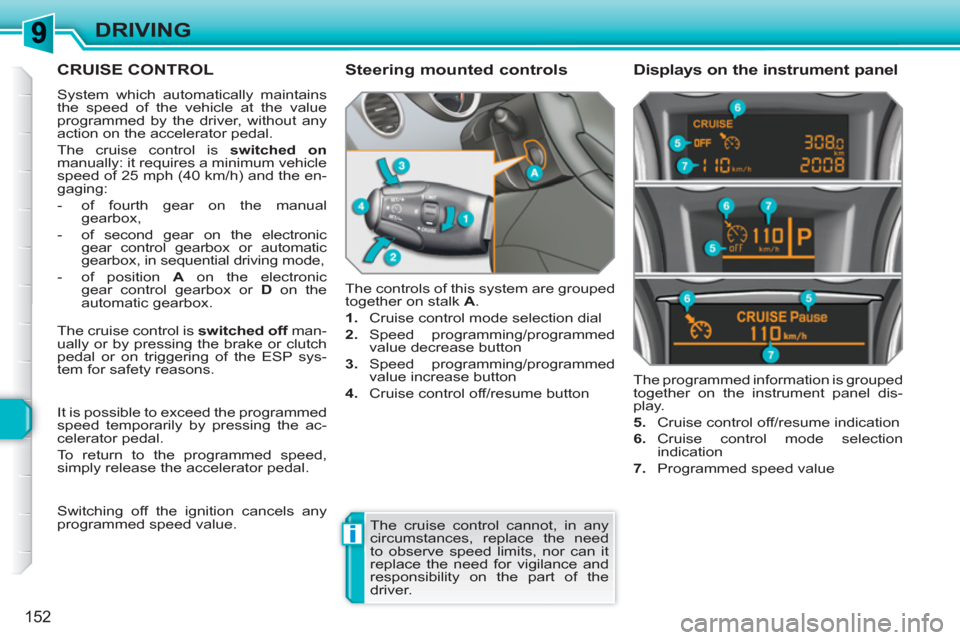
automatic gearbox. The controls of this system are grouped
together on stalk A
.
1.
Cruise control mode selection dial
2.
Speed programming/programmed
value decrease button
3.
Speed programming/programmed
value increase button
4.
Cruise control off/resume button The programmed information is grouped
together on the instrument panel dis-
play.
5.
Cruise control off/resume indication
6.
Cruise control mode selection
indication
7.
Programmed speed value
Steering mounted controls
Displays on the instrument panel
The cruise control cannot, in any
circumstances, replace the need
to observe speed limits, nor can it
replace the need for vigilance and
responsibility on the part of the
driver. The cruise control is switched off
man-
ually or by pressing the brake or clutch
pedal or on triggering of the ESP sys-
tem for safety reasons.
It is possible to exceed the programmed
speed temporarily by pressing the ac-
celerator pedal.
To return to the programmed speed,
simply release the accelerator pedal.
Switching off the ignition cancels any
programmed speed value.
Page 155 of 336
!
DRIVING
When the cruise control is switched
on, be careful if you maintain the
pressure on one of the programmed
speed changing buttons: this may
result in a very rapid change in the
speed of your vehicle.
Do not use the cruise control on
slippery roads or in heavy traffi c.
On a steep descent, the cruise
control will not be able to prevent
the vehicle from exceeding the pro-
grammed speed.
To avoid any risk of jamming of the
pedals:
- ensure that the mat is positioned
correctly,
- never fi t one mat on top of
another.
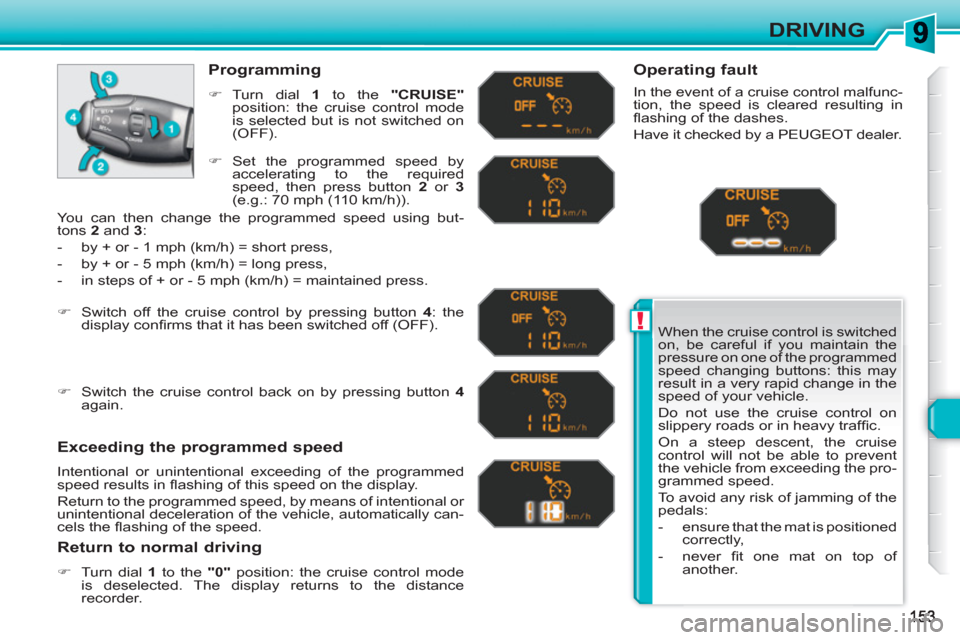
Programming
)
Turn dial 1
to the "CRUISE"
position: the cruise control mode
is selected but is not switched on
(OFF).
Exceeding the programmed speed
Intentional or unintentional exceeding of the programmed
speed results in fl ashing of this speed on the display.
Return to the programmed speed, by means of intentional or
unintentional deceleration of the vehicle, automatically can-
cels the fl ashing of the speed.
Return to normal driving
)
Turn dial 1
to the "0"
position: the cruise control mode
is deselected. The display returns to the distance
recorder.
Operating fault
In the event of a cruise control malfunc-
tion, the speed is cleared resulting in
fl ashing of the dashes.
Have it checked by a PEUGEOT dealer.
)
Set the programmed speed by
accelerating to the required
speed, then press button 2
or 3
(e.g.: 70 mph (110 km/h)).
)
Switch off the cruise control by pressing button 4
: the
display confi rms that it has been switched off (OFF).
)
Switch the cruise control back on by pressing button 4
again.
You can then change the programmed speed using but-
tons 2
and 3
:
- by + or - 1 mph (km/h) = short press,
- by + or - 5 mph (km/h) = long press,
- in steps of + or - 5 mph (km/h) = maintained press.
Page 196 of 336
1
!
i
194
PRACTICAL INFORMATION
A fl at battery prevents the engine
from starting (refer to the corre-
sponding paragraph). If the telephone is being used at
this time:
- it will be maintained for 10 minutes
with the hands-free kit of your
Peugeot Connect Sound,
- it will be maintained for 10 minutes
with the Peugeot Connect
Navigation or the Peugeot
Connect Media, then it will transfer
to your telephone depending on
the telephone model.
ENERGY ECONOMY MODE
System which manages the duration of
use of certain functions to conserve a
suffi cient level of charge in the battery.
After the engine has stopped, you can
still use functions such as the audio and
telematics system, windscreen wip-
ers, dipped beam headlamps, courtesy
lamps, etc. for a maximum combined
duration of thirty minutes.
Exiting economy mode
These functions are reactivated auto-
matically next time the vehicle is driven.
)
In order to resume the use of these
functions immediately, start the
engine and let it run:
- for less than ten minutes, to use
the equipment for approximately
fi ve minutes,
- for more than ten minutes, to
use the equipment for up to
approximately thirty minutes.
Switching to economy mode
Once the thirty minutes are over, a
message appears on the multi-function
screen indicating that the vehicle has
switched to economy mode and the ac-
tive functions are put on standby.
CHANGING A WIPER BLADE
Removing
)
Raise the corresponding wiper arm.
)
Unclip the wiper blade and remove it.
Fitting
)
Put the corresponding new wiper
blade in place and clip it.
)
Fold down the wiper arm carefully.
Before removing a front wiper
blade
)
Within one minute after switching off
the ignition, operate the wiper stalk
to position the wiper blades vertically
on the windscreen.
After fitting a front wiper blade
)
Switch on the ignition.
)
Operate the wiper stalk again to
park the wiper blades.
LOAD REDUCTION MODE
System which manages the use of certain
functions according to the level of charge
remaining in the battery.
When the vehicle is being driven, the load
reduction function temporarily deactivates
certain functions, such as the air condition-
ing, the heated rear screen...
The deactivated functions are reactivated
automatically as soon as conditions permit.
Page 207 of 336
1
205
TECHNICAL DATA
The GTW and towed load values indicated are valid up to a maximum altitude of 1 000 metres; the towed load mentioned
must be reduced by 10 % for each additional 1 000 metres of altitude.
The speed of a towing vehicle must not exceed 60 mph (100 km/h) (comply with the legislation in force in your country).
High ambient temperatures may result in a reduction in the performance of the vehicle to protect the engine; if the ambient
temperature is above 37 °C, limit the towed load.
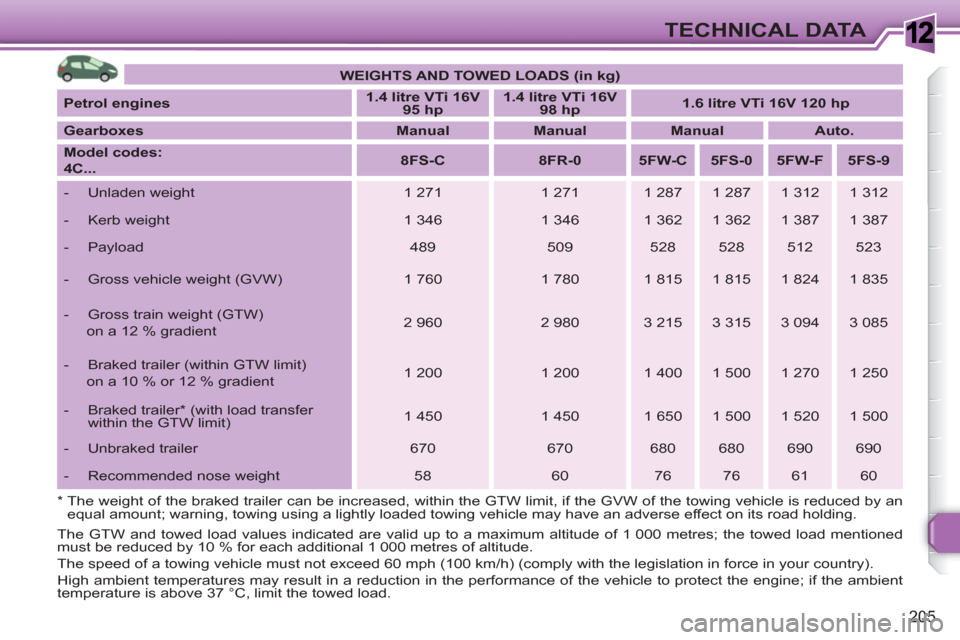
WEIGHTS AND TOWED LOADS (in kg)
Petrol engines
1.4 litre VTi 16V
95 hp
1.4 litre VTi 16V
98 hp
1.6 litre VTi 16V 120 hp
Gearboxes
Manual
Manual
Manual
Auto.
Model codes:
4C...
8FS-C
8FR-0
5FW-C
5FS-0
5FW-F
5FS-9
- Unladen weight
1 271
1 271
1 287
1 287
1 312
1 312
- Kerb weight
1 346
1 346
1 362
1 362
1 387
1 387
- Payload
489
509
528
528
512
523
- Gross vehicle weight (GVW)
1 760
1 780
1 815
1 815
1 824
1 835
- Gross train weight (GTW)
on a 12 % gradient
2 960
2 980
3 215
3 315
3 094
3 085
- Braked trailer (within GTW limit)
on a 10 % or 12 % gradient
1 200
1 200
1 400
1 500
1 270
1 250
- Braked trailer * (with load transfer
within the GTW limit)
1 450
1 450
1 650
1 500
1 520
1 500
- Unbraked trailer
670
670
680
680
690
690
- Recommended nose weight
58
60
76
76
61
60
*
The weight of the braked trailer can be increased, within the GTW limit, if the GVW of the towing vehicle is reduced by an
equal amount; warning, towing using a lightly loaded towing vehicle may have an adverse effect on its road holding.
Page 208 of 336
1
206
TECHNICAL DATA
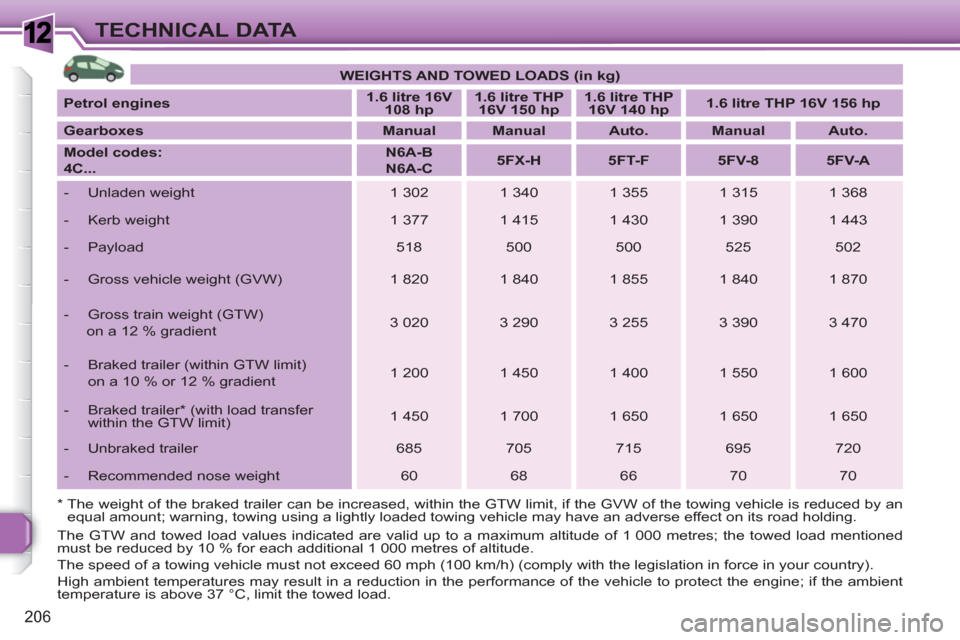
WEIGHTS AND TOWED LOADS (in kg)
Petrol engines
1.6 litre 16V
108 hp
1.6 litre THP
16V 150 hp
1.6 litre THP
16V 140 hp
1.6 litre THP 16V 156 hp
Gearboxes
Manual
Manual
Auto.
Manual
Auto.
Model codes:
4C...
N6A-B
N6A-C
5FX-H
5FT-F
5FV-8
5FV-A
- Unladen weight
1 302
1 340
1 355
1 315
1 368
- Kerb weight
1 377
1 415
1 430
1 390
1 443
- Payload
518
500
500
525
502
- Gross vehicle weight (GVW)
1 820
1 840
1 855
1 840
1 870
- Gross train weight (GTW)
on a 12 % gradient
3 020
3 290
3 255
3 390
3 470
- Braked trailer (within GTW limit)
on a 10 % or 12 % gradient
1 200
1 450
1 400
1 550
1 600
- Braked trailer * (with load transfer
within the GTW limit)
1 450
1 700
1 650
1 650
1 650
- Unbraked trailer
685
705
715
695
720
- Recommended nose weight
60
68
66
70
70
The GTW and towed load values indicated are valid up to a maximum altitude of 1 000 metres; the towed load mentioned
must be reduced by 10 % for each additional 1 000 metres of altitude.
The speed of a towing vehicle must not exceed 60 mph (100 km/h) (comply with the legislation in force in your country).
High ambient temperatures may result in a reduction in the performance of the vehicle to protect the engine; if the ambient
temperature is above 37 °C, limit the towed load. *
The weight of the braked trailer can be increased, within the GTW limit, if the GVW of the towing vehicle is reduced by an
equal amount; warning, towing using a lightly loaded towing vehicle may have an adverse effect on its road holding.
Page 209 of 336
1TECHNICAL DATA
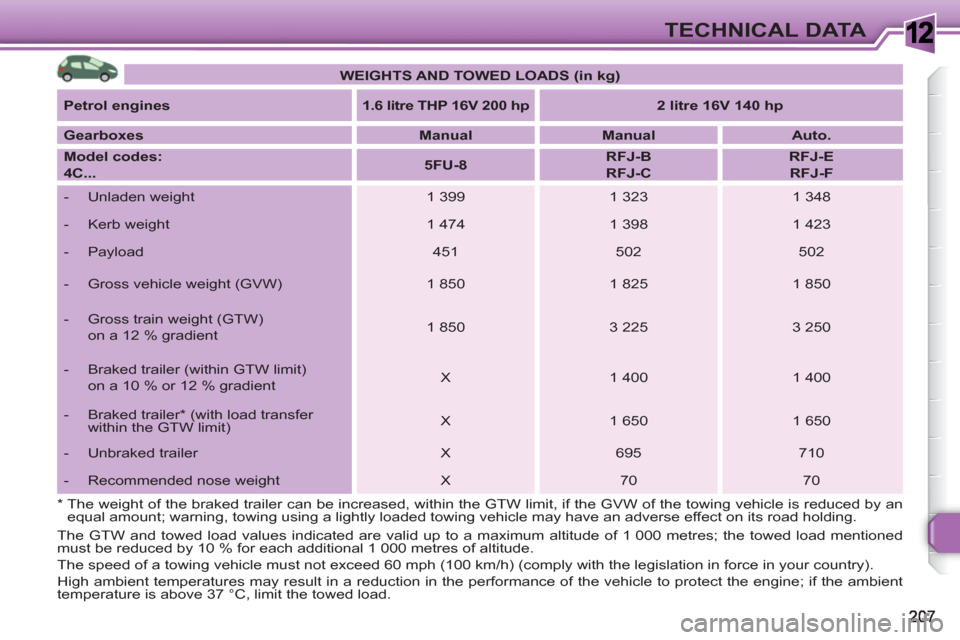
WEIGHTS AND TOWED LOADS (in kg)
Petrol engines
1.6 litre THP 16V 200 hp
2 litre 16V 140 hp
Gearboxes
Manual
Manual
Auto.
Model codes:
4C...
5FU-8
RFJ-B
RFJ-C
RFJ-E
RFJ-F
- Unladen weight
1 399
1 323
1 348
- Kerb weight
1 474
1 398
1 423
- Payload
451
502
502
- Gross vehicle weight (GVW)
1 850
1 825
1 850
- Gross train weight (GTW)
on a 12 % gradient
1 850
3 225
3 250
- Braked trailer (within GTW limit)
on a 10 % or 12 % gradient
X
1 400
1 400
- Braked trailer * (with load transfer
within the GTW limit)
X
1 650
1 650
- Unbraked trailer
X
695
710
- Recommended nose weight
X
70
70
The GTW and towed load values indicated are valid up to a maximum altitude of 1 000 metres; the towed load mentioned
must be reduced by 10 % for each additional 1 000 metres of altitude.
The speed of a towing vehicle must not exceed 60 mph (100 km/h) (comply with the legislation in force in your country).
High ambient temperatures may result in a reduction in the performance of the vehicle to protect the engine; if the ambient
temperature is above 37 °C, limit the towed load. *
The weight of the braked trailer can be increased, within the GTW limit, if the GVW of the towing vehicle is reduced by an
equal amount; warning, towing using a lightly loaded towing vehicle may have an adverse effect on its road holding.
Page 210 of 336
1
208
TECHNICAL DATA
* The weight of the braked trailer can be increased, within the GTW limit, if the GVW of the towing vehicle is reduced by an
equal amount; warning, towing using a lightly loaded towing vehicle may have an adverse effect on its road holding.
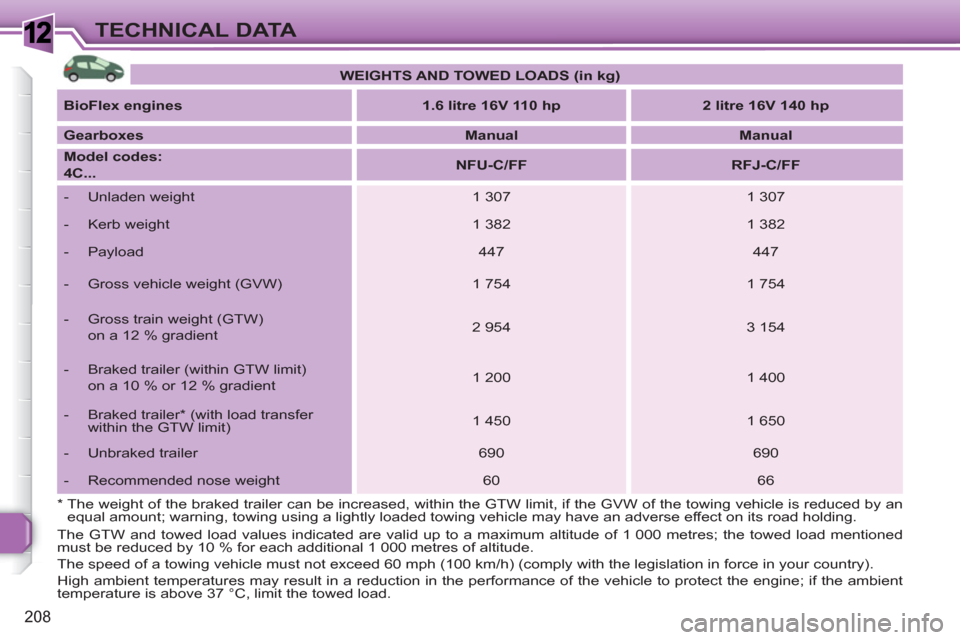
WEIGHTS AND TOWED LOADS (in kg)
BioFlex engines
1.6 litre 16V 110 hp
2 litre 16V 140 hp
Gearboxes
Manual
Manual
Model codes:
4C...
NFU-C/FF
RFJ-C/FF
- Unladen weight
1 307
1 307
- Kerb weight
1 382
1 382
- Payload
447
447
- Gross vehicle weight (GVW)
1 754
1 754
- Gross train weight (GTW)
on a 12 % gradient
2 954
3 154
- Braked trailer (within GTW limit)
on a 10 % or 12 % gradient
1 200
1 400
- Braked trailer * (with load transfer
within the GTW limit)
1 450
1 650
- Unbraked trailer
690
690
- Recommended nose weight
60
66
The GTW and towed load values indicated are valid up to a maximum altitude of 1 000 metres; the towed load mentioned
must be reduced by 10 % for each additional 1 000 metres of altitude.
The speed of a towing vehicle must not exceed 60 mph (100 km/h) (comply with the legislation in force in your country).
High ambient temperatures may result in a reduction in the performance of the vehicle to protect the engine; if the ambient
temperature is above 37 °C, limit the towed load.
Page 211 of 336
1
209
TECHNICAL DATA
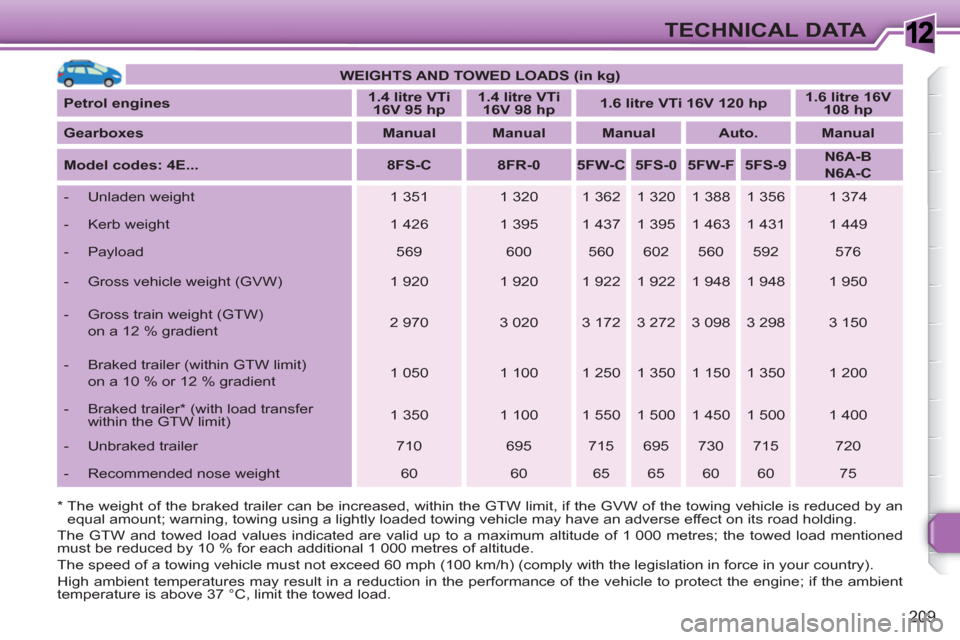
WEIGHTS AND TOWED LOADS (in kg)
Petrol engines
1.4 litre VTi
16V 95 hp
1.4 litre VTi
16V 98 hp
1.6 litre VTi 16V 120 hp
1.6 litre 16V
108 hp
Gearboxes
Manual
Manual
Manual
Auto.
Manual
Model codes: 4E...
8FS-C
8FR-0
5FW-C
5FS-0
5FW-F
5FS-9
N6A-B
N6A-C
- Unladen weight
1 351
1 320
1 362
1 320
1 388
1 356
1 374
- Kerb weight
1 426
1 395
1 437
1 395
1 463
1 431
1 449
- Payload
569
600
560
602
560
592
576
- Gross vehicle weight (GVW)
1 920
1 920
1 922
1 922
1 948
1 948
1 950
- Gross train weight (GTW)
on a 12 % gradient
2 970
3 020
3 172
3 272
3 098
3 298
3 150
- Braked trailer (within GTW limit)
on a 10 % or 12 % gradient
1 050
1 100
1 250
1 350
1 150
1 350
1 200
- Braked trailer * (with load transfer
within the GTW limit)
1 350
1 100
1 550
1 500
1 450
1 500
1 400
- Unbraked trailer
710
695
715
695
730
715
720
- Recommended nose weight
60
60
65
65
60
60
75
The GTW and towed load values indicated are valid up to a maximum altitude of 1 000 metres; the towed load mentioned
must be reduced by 10 % for each additional 1 000 metres of altitude.
The speed of a towing vehicle must not exceed 60 mph (100 km/h) (comply with the legislation in force in your country).
High ambient temperatures may result in a reduction in the performance of the vehicle to protect the engine; if the ambient
temperature is above 37 °C, limit the towed load.
* The weight of the braked trailer can be increased, within the GTW limit, if the GVW of the towing vehicle is reduced by an
equal amount; warning, towing using a lightly loaded towing vehicle may have an adverse effect on its road holding.
Page 212 of 336
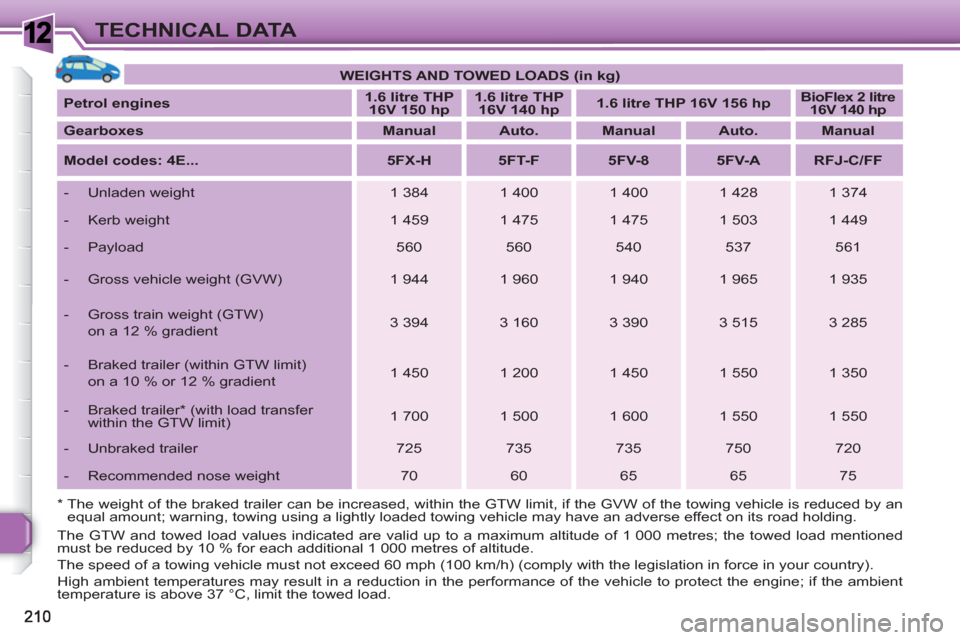
1TECHNICAL DATA
WEIGHTS AND TOWED LOADS (in kg)
Petrol engines
1.6 litre THP
16V 150 hp
1.6 litre THP
16V 140 hp
1.6 litre THP 16V 156 hp
BioFlex 2 litre
16V 140 hp
Gearboxes
Manual
Auto.
Manual
Auto.
Manual
Model codes: 4E...
5FX-H
5FT-F
5FV-8
5FV-A
RFJ-C/FF
- Unladen weight
1 384
1 400
1 400
1 428
1 374
- Kerb weight
1 459
1 475
1 475
1 503
1 449
- Payload
560
560
540
537
561
- Gross vehicle weight (GVW)
1 944
1 960
1 940
1 965
1 935
- Gross train weight (GTW)
on a 12 % gradient
3 394
3 160
3 390
3 515
3 285
- Braked trailer (within GTW limit)
on a 10 % or 12 % gradient
1 450
1 200
1 450
1 550
1 350
- Braked trailer * (with load transfer
within the GTW limit)
1 700
1 500
1 600
1 550
1 550
- Unbraked trailer
725
735
735
750
720
- Recommended nose weight
70
60
65
65
75
The GTW and towed load values indicated are valid up to a maximum altitude of 1 000 metres; the towed load mentioned
must be reduced by 10 % for each additional 1 000 metres of altitude.
The speed of a towing vehicle must not exceed 60 mph (100 km/h) (comply with the legislation in force in your country).
High ambient temperatures may result in a reduction in the performance of the vehicle to protect the engine; if the ambient
temperature is above 37 °C, limit the towed load.
* The weight of the braked trailer can be increased, within the GTW limit, if the GVW of the towing vehicle is reduced by an
equal amount; warning, towing using a lightly loaded towing vehicle may have an adverse effect on its road holding.
Page 213 of 336
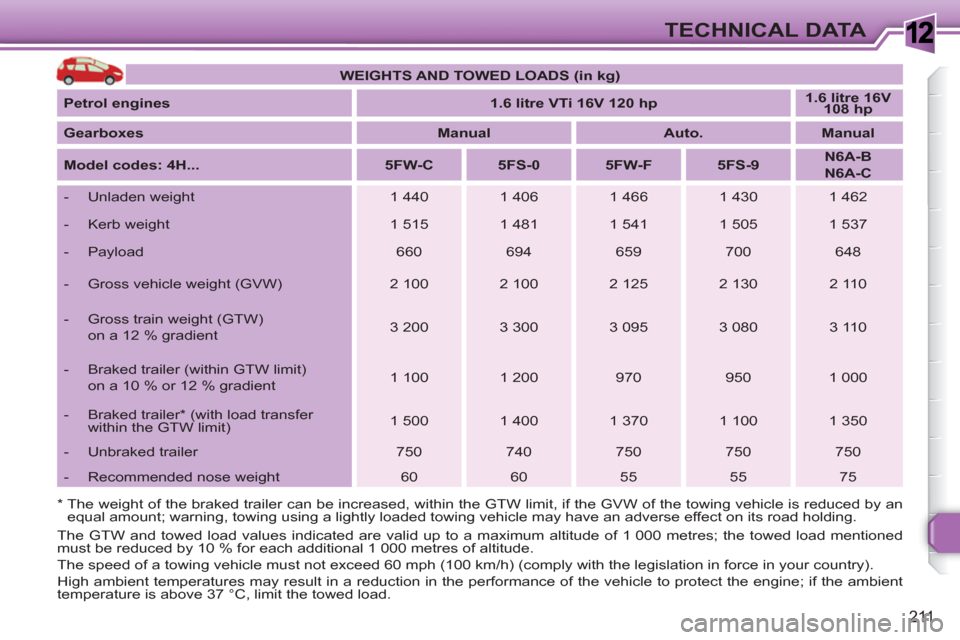
1
211
TECHNICAL DATA
WEIGHTS AND TOWED LOADS (in kg)
Petrol engines
1.6 litre VTi 16V 120 hp
1.6 litre 16V
108 hp
Gearboxes
Manual
Auto.
Manual
Model codes: 4H...
5FW-C
5FS-0
5FW-F
5FS-9
N6A-B
N6A-C
- Unladen weight
1 440
1 406
1 466
1 430
1 462
- Kerb weight
1 515
1 481
1 541
1 505
1 537
- Payload
660
694
659
700
648
- Gross vehicle weight (GVW)
2 100
2 100
2 125
2 130
2 110
- Gross train weight (GTW)
on a 12 % gradient
3 200
3 300
3 095
3 080
3 110
- Braked trailer (within GTW limit)
on a 10 % or 12 % gradient
1 100
1 200
970
950
1 000
- Braked trailer * (with load transfer
within the GTW limit)
1 500
1 400
1 370
1 100
1 350
- Unbraked trailer
750
740
750
750
750
- Recommended nose weight
60
60
55
55
75
* The weight of the braked trailer can be increased, within the GTW limit, if the GVW of the towing vehicle is reduced by an
equal amount; warning, towing using a lightly loaded towing vehicle may have an adverse effect on its road holding.
The GTW and towed load values indicated are valid up to a maximum altitude of 1 000 metres; the towed load mentioned
must be reduced by 10 % for each additional 1 000 metres of altitude.
The speed of a towing vehicle must not exceed 60 mph (100 km/h) (comply with the legislation in force in your country).
High ambient temperatures may result in a reduction in the performance of the vehicle to protect the engine; if the ambient
temperature is above 37 °C, limit the towed load.