belt PEUGEOT 308 SW BL 2012 User Guide
[x] Cancel search | Manufacturer: PEUGEOT, Model Year: 2012, Model line: 308 SW BL, Model: PEUGEOT 308 SW BL 2012Pages: 382, PDF Size: 17.71 MB
Page 129 of 382
7CHILD SAFETY
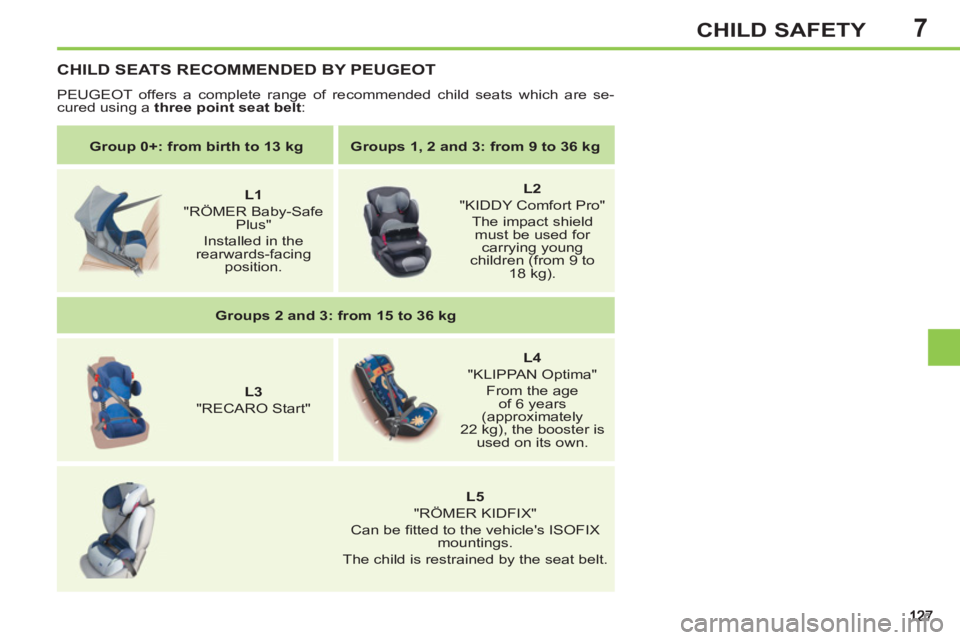
Group 0+: from birth to 13 kg
Groups 1, 2 and 3: from 9 to 36 kg
L1
"RÖMER Baby-Safe
Plus"
Installed in the
rearwards-facing
position.
L2
"KIDDY Comfort Pro"
The impact shield
must be used for
carrying young
children (from 9 to
18 kg).
Groups 2 and 3: from 15 to 36 kg
L3
"RECARO Start''
L4
"KLIPPAN Optima"
From the age
of 6 years
(approximately
22 kg), the booster is
used on its own.
L5
"RÖMER KIDFIX"
Can be fi tted to the vehicle's ISOFIX
mountings.
The child is restrained by the seat belt.
CHILD SEATS RECOMMENDED BY PEUGEOT
PEUGEOT offers a complete range of recommended child seats which are se-
cured using a three point seat belt
:
Page 130 of 382
7
128
CHILD SAFETY
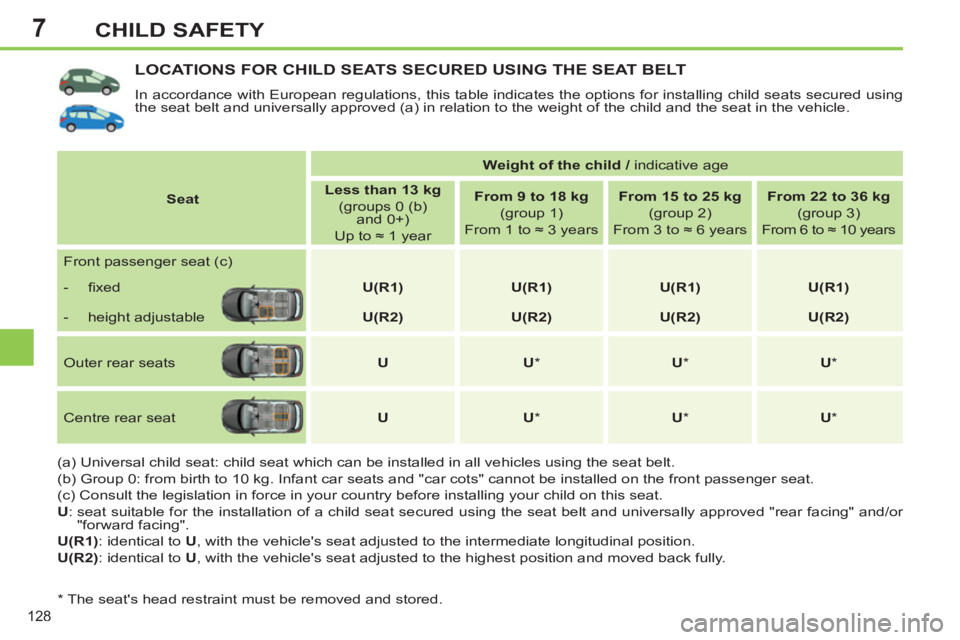
LOCATIONS FOR CHILD SEATS SECURED USING THE SEAT BELT
In accordance with European regulations, this table indicates the options for installing child seats secured using
the seat belt and universally approved (a) in relation to the weight of the child and the seat in the vehicle.
(a) Universal child seat: child seat which can be installed in all vehicles using the seat belt.
(b) Group 0: from birth to 10 kg. Infant car seats and "car cots" cannot be installed on the front passenger seat.
(c) Consult the legislation in force in your country before installing your child on this seat.
U
: seat suitable for the installation of a child seat secured using the seat belt and universally approved "rear facing" and/or
"forward facing".
U(R1)
: identical to U
, with the vehicle's seat adjusted to the intermediate longitudinal position.
U(R2)
: identical to U
, with the vehicle's seat adjusted to the highest position and moved back fully.
*
The seat's head restraint must be removed and stored.
Seat
Weight of the child /
indicative age
Less than 13 kg
(groups 0 (b)
and 0+)
Up to ≈ 1 year
From 9 to 18 kg
(group 1)
From 1 to ≈ 3 years
From 15 to 25 kg
(group 2)
From 3 to ≈ 6 years
From 22 to 36 kg
(group 3)
From 6 to ≈ 10 years
Front passenger seat (c)
- fi xed
U(R1)
U(R1)
U(R1)
U(R1)
- height adjustable
U(R2)
U(R2)
U(R2)
U(R2)
Outer rear seats
U
U
*
U
*
U
*
Centre rear seat
U
U
*
U
*
U
*
Page 131 of 382
7
129
CHILD SAFETY
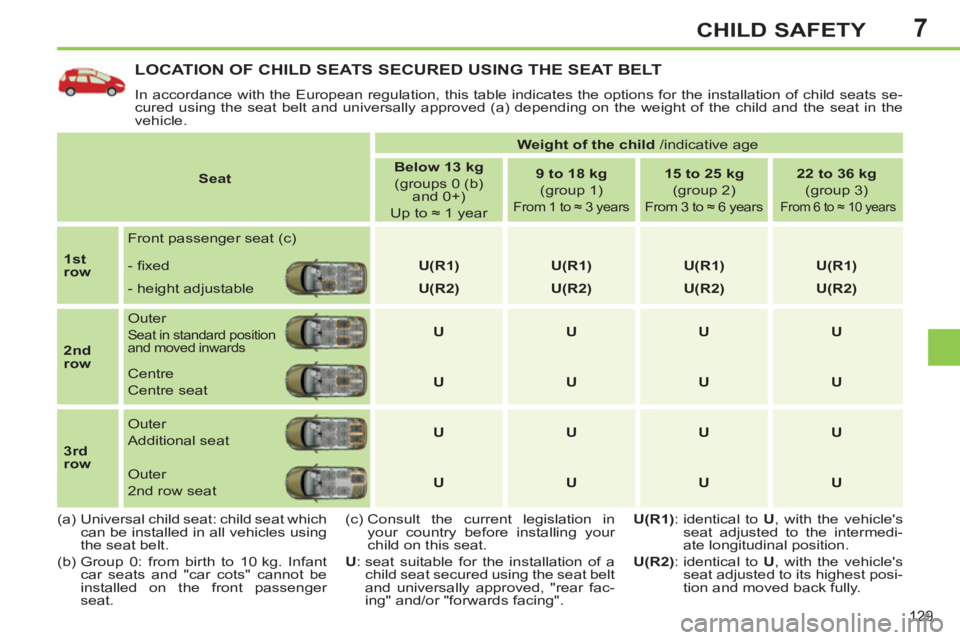
LOCATION OF CHILD SEATS SECURED USING THE SEAT BELT
In accordance with the European regulation, this table indicates the options for the installation of child seats se-
cured using the seat belt and universally approved (a) depending on the weight of the child and the seat in the
vehicle.
(a) Universal child seat: child seat which
can be installed in all vehicles using
the seat belt.
(b) Group 0: from birth to 10 kg. Infant
car seats and "car cots" cannot be
installed on the front passenger
seat.
Seat
Weight of the child
/indicative age
Below 13 kg
(groups 0 (b)
and 0+)
Up to ≈ 1 year
9 to 18 kg
(group 1)
From 1 to ≈ 3 years
15 to 25 kg
(group 2)
From 3 to ≈ 6 years
22 to 36 kg
(group 3)
From 6 to ≈ 10 years
1st
row
Front passenger seat (c)
- fi xed
U(R1)
U(R1)
U(R1)
U(R1)
- height adjustable
U(R2)
U(R2)
U(R2)
U(R2)
2nd
row
Outer
Seat in standard position
and moved inwards
U
U
U
U
Centre
Centre seat
U
U
U
U
3rd
row
Outer
Additional seat
U
U
U
U
Outer
2nd row seat
U
U
U
U
(c) Consult the current legislation in
your country before installing your
child on this seat.
U
: seat suitable for the installation of a
child seat secured using the seat belt
and universally approved, "rear fac-
ing" and/or "forwards facing".
U(R1)
: identical to U
, with the vehicle's
seat adjusted to the intermedi-
ate longitudinal position.
U(R2)
: identical to U
, with the vehicle's
seat adjusted to its highest posi-
tion and moved back fully.
Page 132 of 382
7
130
CHILD SAFETY
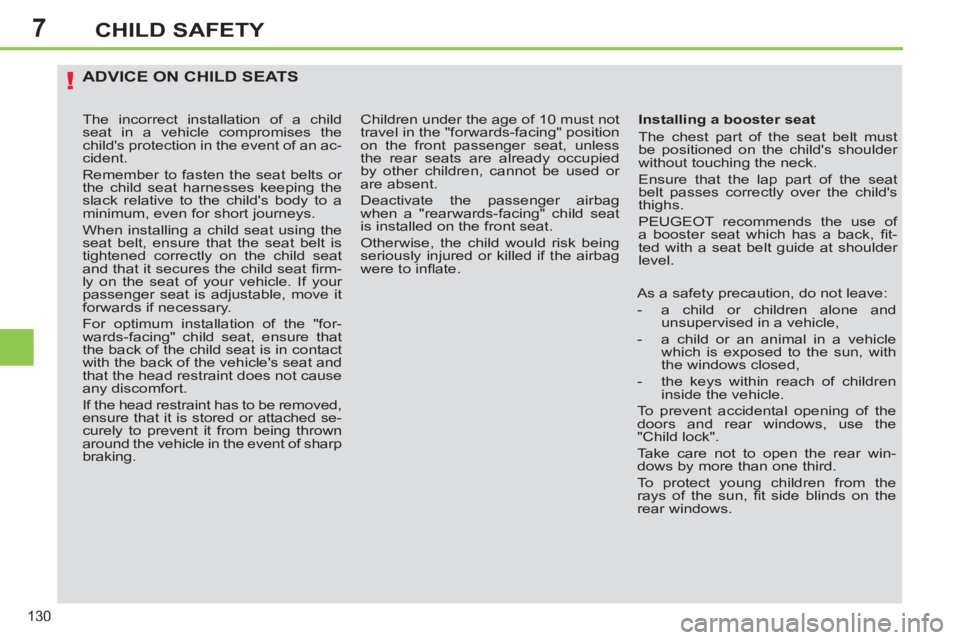
ADVICE ON CHILD SEATS
Installing a booster seat
The chest part of the seat belt must
be positioned on the child's shoulder
without touching the neck.
Ensure that the lap part of the seat
belt passes correctly over the child's
thighs.
PEUGEOT recommends the use of
a booster seat which has a back, fi t-
ted with a seat belt guide at shoulder
level.
As a safety precaution, do not leave:
- a child or children alone and
unsupervised in a vehicle,
- a child or an animal in a vehicle
which is exposed to the sun, with
the windows closed,
- the keys within reach of children
inside the vehicle.
To prevent accidental opening of the
doors and rear windows, use the
"Child lock".
Take care not to open the rear win-
dows by more than one third.
To protect young children from the
rays of the sun, fi t side blinds on the
rear windows.
The incorrect installation of a child
seat in a vehicle compromises the
child's protection in the event of an ac-
cident.
Remember to fasten the seat belts or
the child seat harnesses keeping the
slack relative to the child's body to a
minimum, even for short journeys.
When installing a child seat using the
seat belt, ensure that the seat belt is
tightened correctly on the child seat
and that it secures the child seat fi rm-
ly on the seat of your vehicle. If your
passenger seat is adjustable, move it
forwards if necessary.
For optimum installation of the "for-
wards-facing" child seat, ensure that
the back of the child seat is in contact
with the back of the vehicle's seat and
that the head restraint does not cause
any discomfort.
If the head restraint has to be removed,
ensure that it is stored or attached se-
curely to prevent it from being thrown
around the vehicle in the event of sharp
braking. Children under the age of 10 must not
travel in the "forwards-facing" position
on the front passenger seat, unless
the rear seats are already occupied
by other children, cannot be used or
are absent.
Deactivate the passenger airbag
when a "rearwards-facing" child seat
is installed on the front seat.
Otherwise, the child would risk being
seriously injured or killed if the airbag
were to infl ate.
Page 133 of 382
7
131
CHILD SAFETY
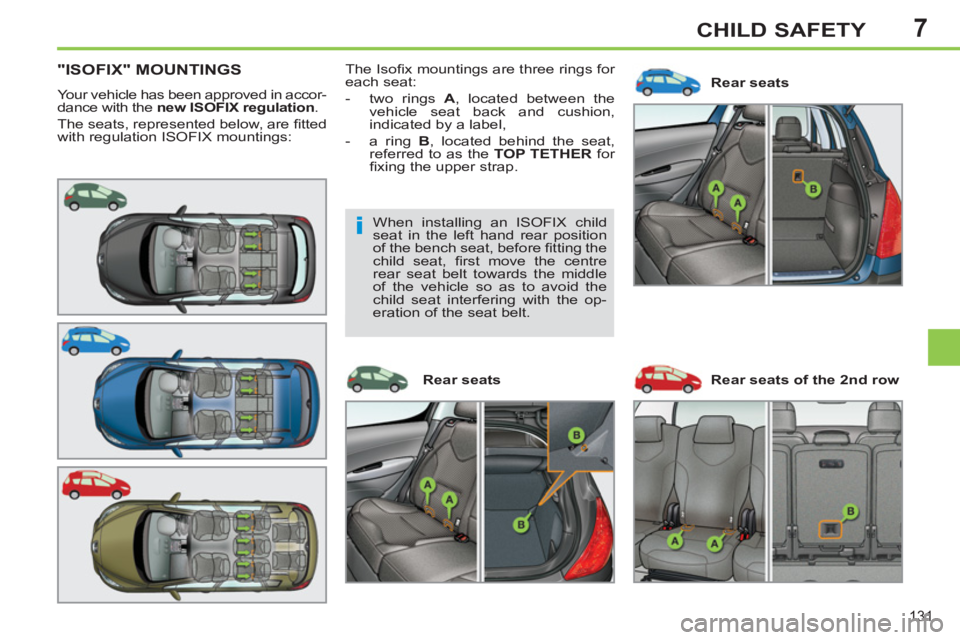
"ISOFIX" MOUNTINGS
Your vehicle has been approved in accor-
dance with the new ISOFIX regulation
.
The seats, represented below, are fi tted
with regulation ISOFIX mountings: Rear seats The Isofi x mountings are three rings for
each seat:
- two rings A
, located between the
vehicle seat back and cushion,
indicated by a label,
- a ring B
, located behind the seat,
referred to as the TOP TETHER
for
fi xing the upper strap.
Rear seats Rear seats of the 2nd row
When installing an ISOFIX child
seat in the left hand rear position
of the bench seat, before fi tting the
child seat, fi rst move the centre
rear seat belt towards the middle
of the vehicle so as to avoid the
child seat interfering with the op-
eration of the seat belt.
Page 135 of 382
7
133
CHILD SAFETY
Follow the instructions for fi tting child seats contained in the seat manufacturer's installation guide.
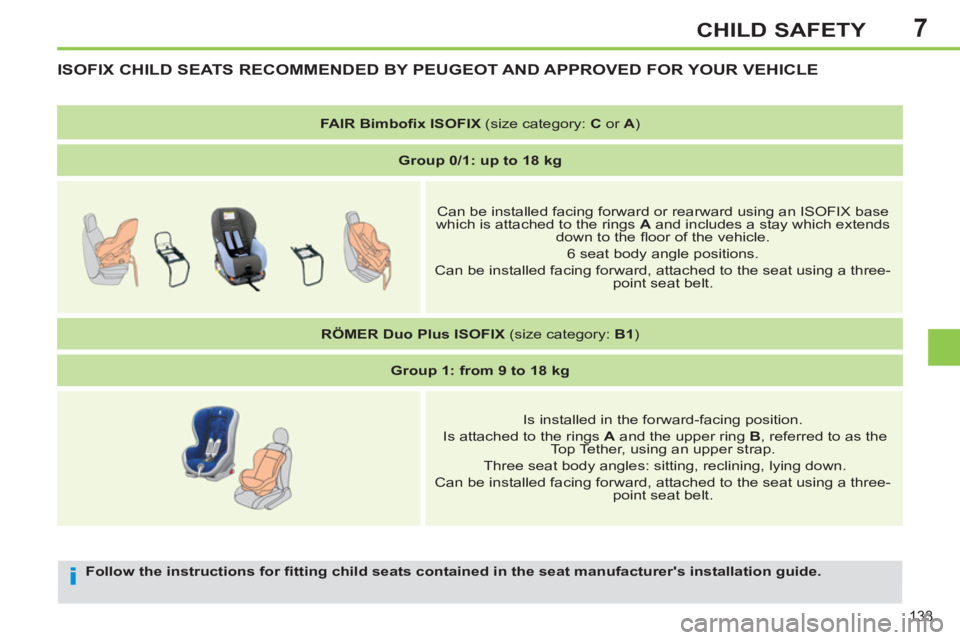
ISOFIX CHILD SEATS RECOMMENDED BY PEUGEOT AND APPROVED FOR YOUR VEHICLE
FAIR Bimbofi x ISOFIX
(size category: C
or A
)
Group 0/1: up to 18 kg
Can be installed facing forward or rearward using an ISOFIX base
which is attached to the rings A
and includes a stay which extends
down to the fl oor of the vehicle.
6 seat body angle positions.
Can be installed facing forward, attached to the seat using a three-
point seat belt.
RÖMER Duo Plus ISOFIX
(size category: B1
)
Group 1: from 9 to 18 kg
Is installed in the forward-facing position.
Is attached to the rings A
and the upper ring B
, referred to as the
Top Tether, using an upper strap.
Three seat body angles: sitting, reclining, lying down.
Can be installed facing forward, attached to the seat using a three-
point seat belt.
Page 143 of 382
8
141
SAFETY
SEAT BELTS
Front seat belts
The front seat belts are fi tted with a pre-
tensioning and force limiting system.
This system improves safety in the front
seats in the event of a front or side im-
pact. Depending on the severity of the
impact, the pretensioning system in-
stantly tightens the seat belts against
the body of the occupants.
The pretensioning seat belts are active
when the ignition is on.
The force limiter reduces the pressure
of the seat belt on the chest of the occu-
pant, so improving their protection.
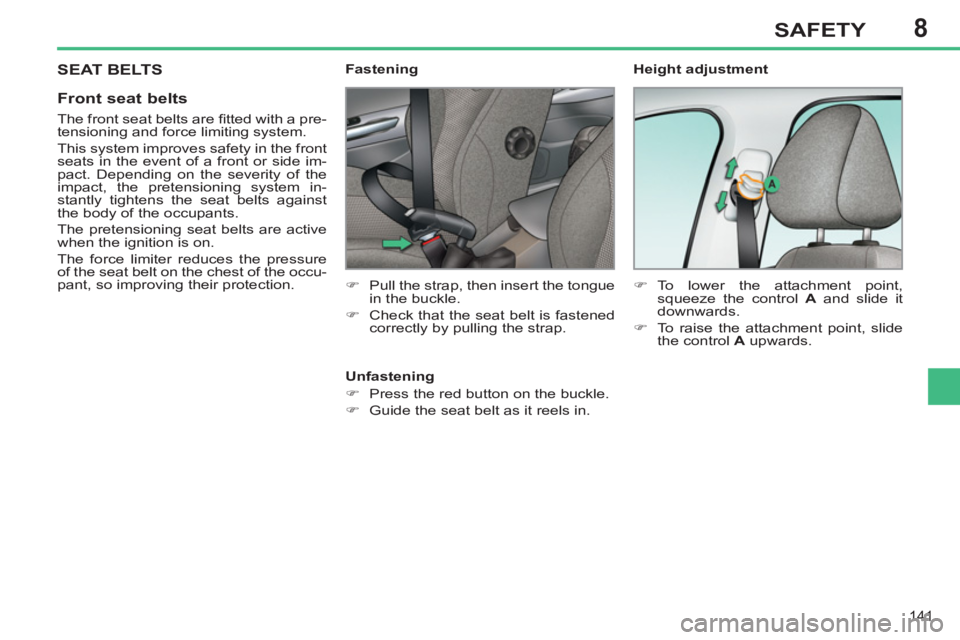
Fastening
Unfastening
)
Press the red button on the buckle.
)
Guide the seat belt as it reels in.
Height adjustment
)
Pull the strap, then insert the tongue
in the buckle.
)
Check that the seat belt is fastened
correctly by pulling the strap.
)
To lower the attachment point,
squeeze the control A
and slide it
downwards.
)
To raise the attachment point, slide
the control A
upwards.
Page 144 of 382
8
142
SAFETY
Seat belt not fastened / unfastened
warning lamp
When the ignition is switched
on, this warning lamp comes
on, either on the instrument
panel or on the seat belt and
passenger's front airbag warning lamps
display, if the driver and/or the front pas-
senger has not fastened their seat belt.
From approximately 12 mph (20 km/h)
this warning lamp fl ashes for two min-
utes accompanied by an audible signal
of increasing volume. Once these two
minutes have elapsed, this warning
lamp remains on until the driver and/or
the front passenger fastens their seat
belt.
*
According to version and/or country.
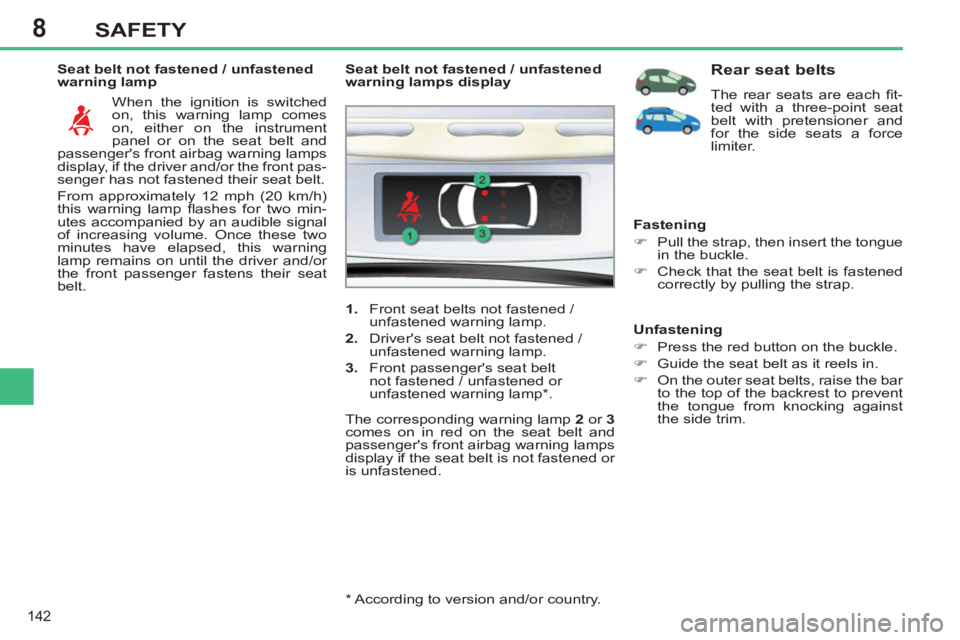
Seat belt not fastened / unfastened
warning lamps display
1.
Front seat belts not fastened /
unfastened warning lamp.
2.
Driver's seat belt not fastened /
unfastened warning lamp.
3.
Front passenger's seat belt
not fastened / unfastened or
unfastened warning lamp * .
The corresponding warning lamp 2
or 3
comes on in red on the seat belt and
passenger's front airbag warning lamps
display if the seat belt is not fastened or
is unfastened.
Rear seat belts
The rear seats are each fi t-
ted with a three-point seat
belt with pretensioner and
for the side seats a force
limiter.
Fastening
)
Pull the strap, then insert the tongue
in the buckle.
)
Check that the seat belt is fastened
correctly by pulling the strap.
Unfastening
)
Press the red button on the buckle.
)
Guide the seat belt as it reels in.
)
On the outer seat belts, raise the bar
to the top of the backrest to prevent
the tongue from knocking against
the side trim.
Page 145 of 382
8
143
SAFETY
Unfastening
)
Press the red button on the buckle.
)
Guide the seat belt as it reels in.
)
On the outer seat belts, raise the bar
to the top of the backrest to prevent
the tongue from knocking against
the side trim.
Seat belt unfastened warning lamp
This warning lamp comes on,
either on the instrument panel
or on the seat belt and pas-
senger's front airbag warning
lamps display, when one or more rear
passengers unfasten their seat belt.
From approximately 12 mph (20 km/h),
this warning lamp fl ashes for two min-
utes accompanied by an audible signal
of increasing volume. Once these two
minutes have elapsed, this warning
lamp remains on until the one or more
rear passengers fasten their seat belt.
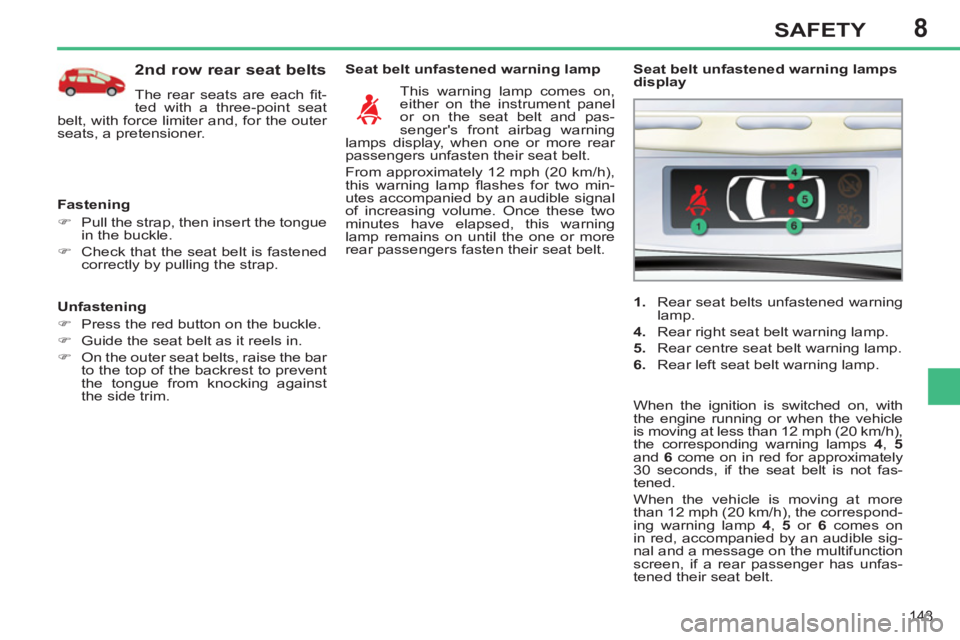
1.
Rear seat belts unfastened warning
lamp.
4.
Rear right seat belt warning lamp.
5.
Rear centre seat belt warning lamp.
6.
Rear left seat belt warning lamp.
Seat belt unfastened warning lamps
display
When the ignition is switched on, with
the engine running or when the vehicle
is moving at less than 12 mph (20 km/h),
the corresponding warning lamps 4
, 5
and 6
come on in red for approximately
30 seconds, if the seat belt is not fas-
tened.
When the vehicle is moving at more
than 12 mph (20 km/h), the correspond-
ing warning lamp 4
, 5
or 6
comes on
in red, accompanied by an audible sig-
nal and a message on the multifunction
screen, if a rear passenger has unfas-
tened their seat belt.
2nd row rear seat belts
The rear seats are each fi t-
ted with a three-point seat
belt, with force limiter and, for the outer
seats, a pretensioner.
Fastening
)
Pull the strap, then insert the tongue
in the buckle.
)
Check that the seat belt is fastened
correctly by pulling the strap.
Page 146 of 382
8
144
SAFETY
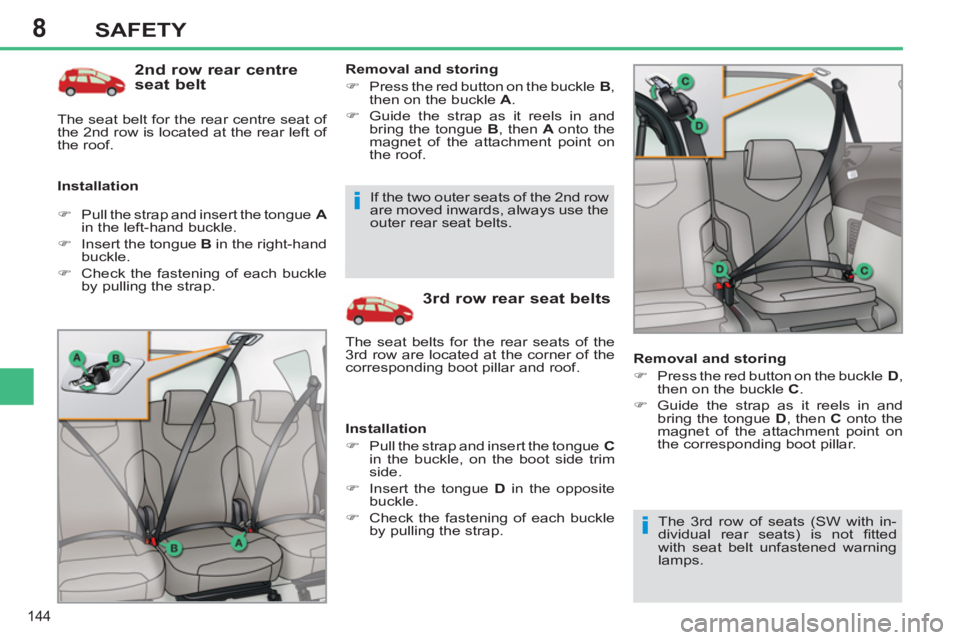
2nd row rear centre
seat belt
Installation
Removal and storing
)
Press the red button on the buckle B
,
then on the buckle A
.
)
Guide the strap as it reels in and
bring the tongue B
, then A
onto the
magnet of the attachment point on
the roof.
3rd row rear seat belts
Installation
)
Pull the strap and insert the tongue C
in the buckle, on the boot side trim
side.
)
Insert the tongue D
in the opposite
buckle.
)
Check the fastening of each buckle
by pulling the strap.
)
Pull the strap and insert the tongue A
in the left-hand buckle.
)
Insert the tongue B
in the right-hand
buckle.
)
Check the fastening of each buckle
by pulling the strap.
The seat belts for the rear seats of the
3rd row are located at the corner of the
corresponding boot pillar and roof. If the two outer seats of the 2nd row
are moved inwards, always use the
outer rear seat belts.
Removal and storing
)
Press the red button on the buckle D
,
then on the buckle C
.
)
Guide the strap as it reels in and
bring the tongue D
, then C
onto the
magnet of the attachment point on
the corresponding boot pillar.
The seat belt for the rear centre seat of
the 2nd row is located at the rear left of
the roof.
The 3rd row of seats (SW with in-
dividual rear seats) is not fi tted
with seat belt unfastened warning
lamps.