ECO mode PEUGEOT 308 SW BL 2012 Owner's Manual
[x] Cancel search | Manufacturer: PEUGEOT, Model Year: 2012, Model line: 308 SW BL, Model: PEUGEOT 308 SW BL 2012Pages: 382, PDF Size: 17.71 MB
Page 161 of 382
9
PRND
159
DRIVING
To limit fuel consumption when sta-
tionary for long periods with the en-
gine running (traffi c jam...), place the
gear lever in position N
and apply
the parking brake.
Return to standard automatic
operation
)
At any time, press the button
selected again to quit the programme
engaged and return to auto-adaptive
mode.
Manual operation
)
Select position M
for sequential
changing of the four or six gears.
)
Push the lever towards the +
sign to
change up a gear.
)
Pull the lever towards the -
sign to
change down a gear.
It is only possible to change from one
gear to another if the vehicle speed and
engine speed permit; otherwise, the
gearbox will operate temporarily in au-
tomatic mode.
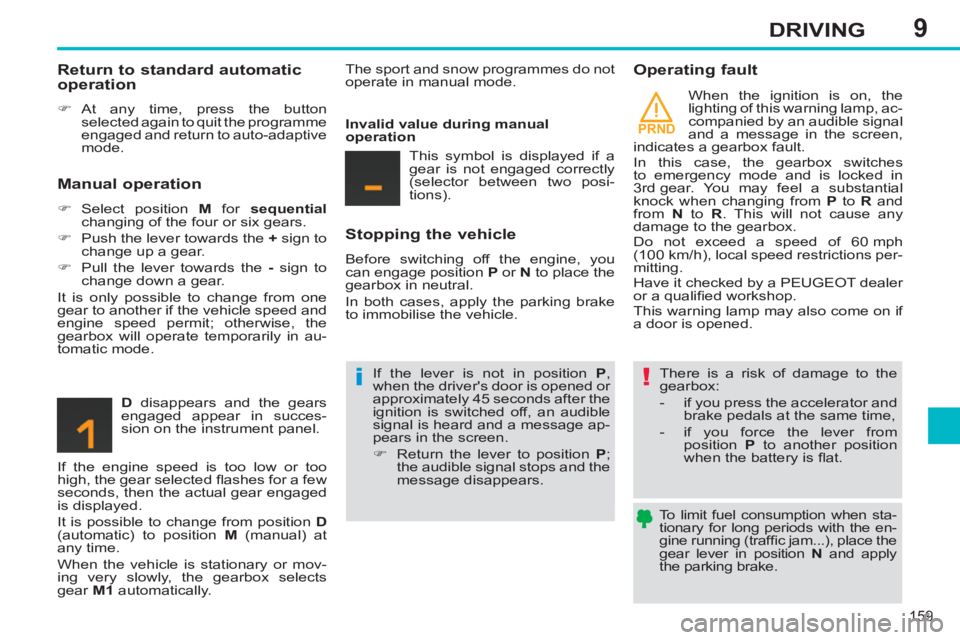
D
disappears and the gears
engaged appear in succes-
sion on the instrument panel.
If the engine speed is too low or too
high, the gear selected fl ashes for a few
seconds, then the actual gear engaged
is displayed.
It is possible to change from position D
(automatic) to position M
(manual) at
any time.
When the vehicle is stationary or mov-
ing very slowly, the gearbox selects
gear M1
automatically. The sport and snow programmes do not
operate in manual mode.
Invalid value during manual
operation
This symbol is displayed if a
gear is not engaged correctly
(selector between two posi-
tions).
Stopping the vehicle
Before switching off the engine, you
can engage position P
or N
to place the
gearbox in neutral.
In both cases, apply the parking brake
to immobilise the vehicle.
If the lever is not in position P
,
when the driver's door is opened or
approximately 45 seconds after the
ignition is switched off, an audible
signal is heard and a message ap-
pears in the screen.
)
Return the lever to position P
;
the audible signal stops and the
message disappears.
Operating fault
There is a risk of damage to the
gearbox:
- if you press the accelerator and
brake pedals at the same time,
- if you force the lever from
position P
to another position
when the battery is fl at.
When the ignition is on, the
lighting of this warning lamp, ac-
companied by an audible signal
and a message in the screen,
indicates a gearbox fault.
In this case, the gearbox switches
to emergency mode and is locked in
3rd gear. You may feel a substantial
knock when changing from P
to R
and
from N
to R
. This will not cause any
damage to the gearbox.
Do not exceed a speed of 60 mph
(100 km/h), local speed restrictions per-
mitting.
Have it checked by a PEUGEOT dealer
or a qualifi ed workshop.
This warning lamp may also come on if
a door is opened.
Page 162 of 382
9
160
DRIVING
STOP & START
The Stop & Start system puts the engine
temporarily on standby - STOP mode -
during stops in the traffi c (red lights, traf-
fi c jams, or other...). The engine restarts
automatically - START mode - as soon as
you want to move off. The restart takes
place instantly, quickly and silently.
Perfect for urban use, the Stop & Start
system reduces fuel consumption and
exhaust emissions as well as the noise
level when stationary.
Operation
Going into engine STOP mode
The "ECO"
warning lamp comes
on in the instrument panel and the engine goes into standby:
- with a manual gearbox
, at speeds
below 12 mph (20 km/h), when you
put the gear lever into neutral and
release the clutch pedal,
- with the 6-speed electronic gear
control gearbox
, at a speed below
5 mph (8 km/h), when you press the
brake pedal or put the gear lever
into position N
. If your vehicle is fi tted with
the system, a time counter
calculates the sum of the
periods in STOP mode dur-
ing a journey. It rests itself to
zero every time the ignition
is switched on with the key.
With the automatic gearbox system, for your comfort during parking ma-
noeuvres, STOP mode is not avail-
able for a few seconds after coming
out of reverse gear.
STOP mode does not affect the
functionality of the vehicle, such as
braking, power steering, for example.
Never refuel with the engine in
STOP mode; you must switch off
the ignition with the key.
Special cases: STOP mode
unavailable
STOP mode is not invoked when:
- the driver's door is open,
- the driver's seat belt is not fastened,
- the vehicle has not exceeded 6 mph
(10 km/h) since the last engine start
using the key,
- the engine is needed to maintain
a comfortable temperature in the
passenger compartment,
- demisting is on,
- some special conditions (battery
charge, engine temperature, braking
assistance, ambient temperature...)
where the engine is needed to assure
control of a system.
In this case, the "ECO"
warning
lamp fl ashes for a few seconds,
then goes off.
This operation is perfectly normal.
Page 163 of 382
9
161
DRIVING
Going into engine START mode
The "ECO"
warning lamp goes
off and the engine starts:
- with a manual gearbox
, when you
fully depress the clutch pedal,
- with the 6-speed electronic gear
control gearbox
:
●
gear lever in position A
or M
, when
you release the brake pedal,
●
or gear lever in position N
and the
brake pedal released, when you
move the gear lever to position A
or M
,
●
or when you engage reverse gear.
Special cases: START invoked
automatically
For your safety and comfort, START is
invoked automatically when:
- you open the driver's door,
- you unfasten the driver's seat belt,
- the speed of the vehicle exceeds
15 mph (25 km/h) with a manual
gearbox or 7 mph (11 km/h) with the
6-speed electronic gearbox system,
- some special conditions (battery
charge, engine temperature, braking
assistance, ambient temperature...)
where the engine is needed to assure
control of a system.
In this case the "ECO"
warning
lamp fl ashes for few seconds,
then goes off.
This operation is perfectly normal.
Deactivation
If the system has been deactivated
in STOP mode, the engine restarts
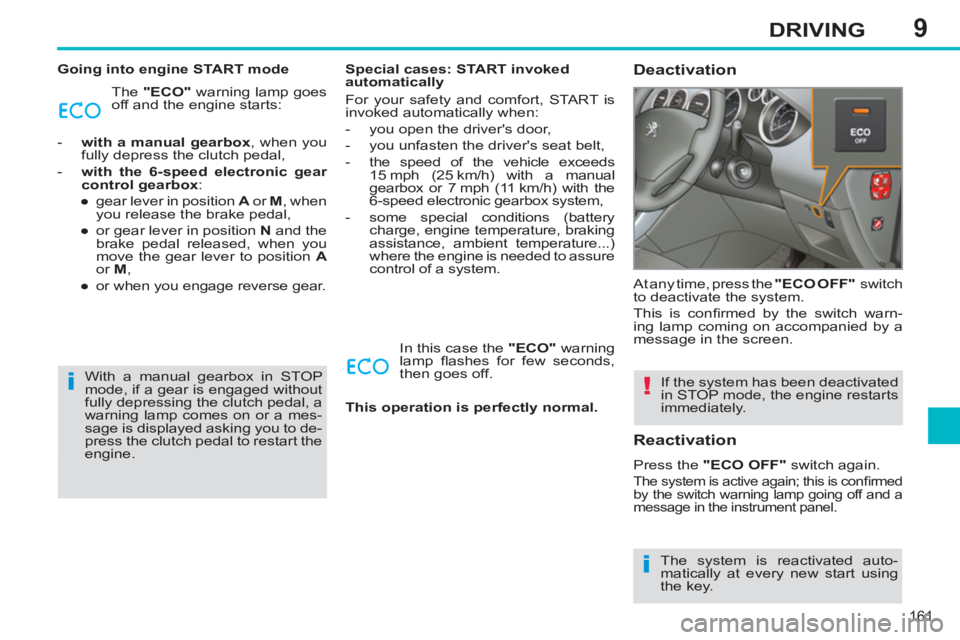
immediately. At any time, press the "ECO OFF"
switch
to deactivate the system.
This is confi rmed by the switch warn-
ing lamp coming on accompanied by a
message in the screen.
Reactivation
Press the "ECO OFF"
switch again.
The system is active again; this is confi rmed
by the switch warning lamp going off and a
message in the instrument panel.
The system is reactivated auto-
matically at every new start using
the key. With a manual gearbox in STOP
mode, if a gear is engaged without
fully depressing the clutch pedal, a
warning lamp comes on or a mes-
sage is displayed asking you to de-
press the clutch pedal to restart the
engine.
Page 164 of 382
9
162
DRIVING
Operating fault
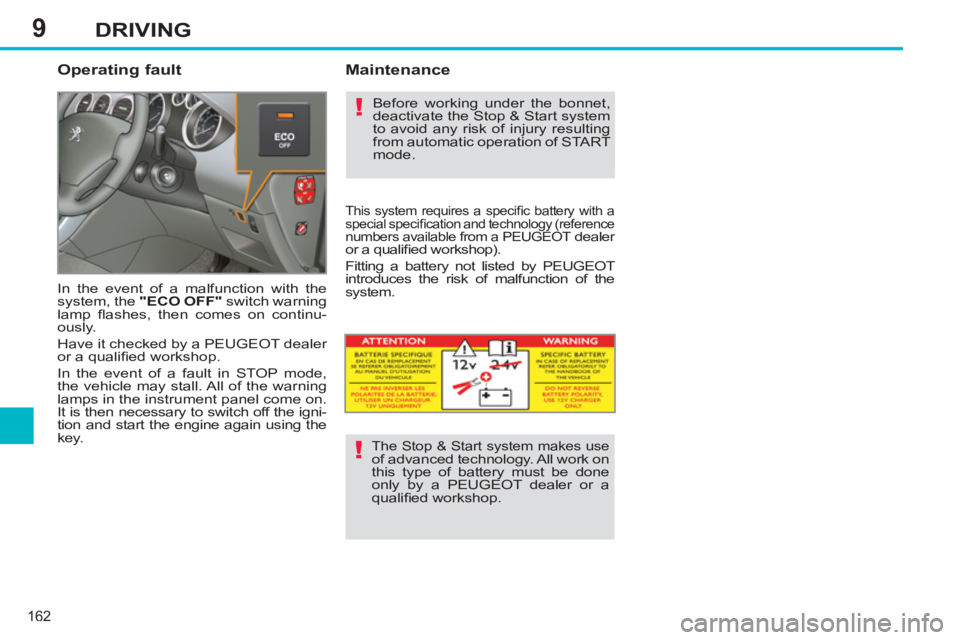
In the event of a malfunction with the
system, the "ECO OFF"
switch warning
lamp fl ashes, then comes on continu-
ously.
Have it checked by a PEUGEOT dealer
or a qualifi ed workshop.
In the event of a fault in STOP mode,
the vehicle may stall. All of the warning
lamps in the instrument panel come on.
It is then necessary to switch off the igni-
tion and start the engine again using the
key.
Maintenance
Before working under the bonnet,
deactivate the Stop & Start system
to avoid any risk of injury resulting
from automatic operation of START
mode.
This system requires a specifi c battery with a
special specifi cation and technology (reference
numbers available from a PEUGEOT dealer
or a qualifi ed workshop).
Fitting a battery not listed by PEUGEOT
introduces the risk of malfunction of the
system.
The Stop & Start system makes use of advanced technology. All work on
this type of battery must be done
only by a PEUGEOT dealer or a
qualifi ed workshop.
Page 166 of 382
9
164
DRIVING
On a steep descent or in the event
of sharp acceleration, the speed
limiter will not be able to prevent
the vehicle from exceeding the pro-
grammed speed.
To avoid any risk of jamming of the
pedals:
- ensure that the mat is positioned
correctly,
-
do not fi t one mat on top of another.
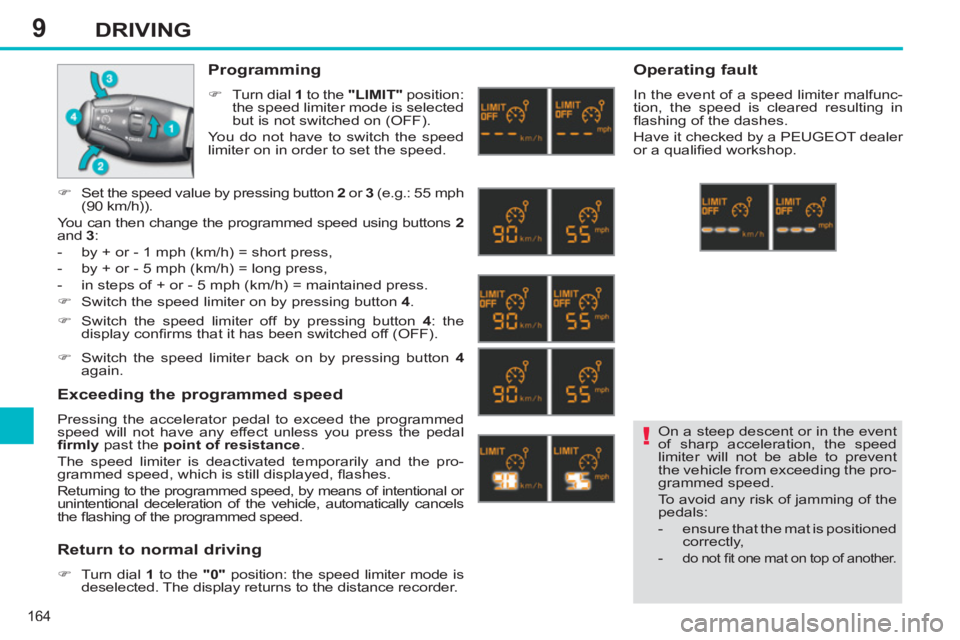
Programming
)
Turn dial 1
to the "LIMIT"
position:
the speed limiter mode is selected
but is not switched on (OFF).
You do not have to switch the speed
limiter on in order to set the speed.
Exceeding the programmed speed
Pressing the accelerator pedal to exceed the programmed
speed will not have any effect unless you press the pedal
fi rmly
past the point of resistance
.
The speed limiter is deactivated temporarily and the pro-
grammed speed, which is still displayed, fl ashes.
Returning to the programmed speed, by means of intentional or
unintentional deceleration of the vehicle, automatically cancels
the fl ashing of the programmed speed.
Return to normal driving
)
Turn dial 1
to the "0"
position: the speed limiter mode is
deselected. The display returns to the distance recorder.
Operating fault
In the event of a speed limiter malfunc-
tion, the speed is cleared resulting in
fl ashing of the dashes.
Have it checked by a PEUGEOT dealer
or a qualifi ed workshop.
)
Switch the speed limiter off by pressing button 4
: the
display confi rms that it has been switched off (OFF).
)
Switch the speed limiter back on by pressing button 4
again.
)
Set the speed value by pressing button 2
or 3
(e.g.: 55 mph
(90 km/h)).
You can then change the programmed speed using buttons 2
and 3
:
- by + or - 1 mph (km/h) = short press,
- by + or - 5 mph (km/h) = long press,
- in steps of + or - 5 mph (km/h) = maintained press.
)
Switch the speed limiter on by pressing button 4
.
Page 167 of 382
9DRIVING
CRUISE CONTROL
System which automatically maintains
the speed of the vehicle at the value
programmed by the driver, without any
action on the accelerator pedal.
The cruise control is switched on
manually: it requires a minimum vehicle
speed of 25 mph (40 km/h) and the en-
gagement of:
- fourth gear on the manual gearbox,
- second gear in sequential mode on
the electronic gear control gearbox
or automatic gearbox,
- position A
on the electronic gear
control gearbox or D
on the
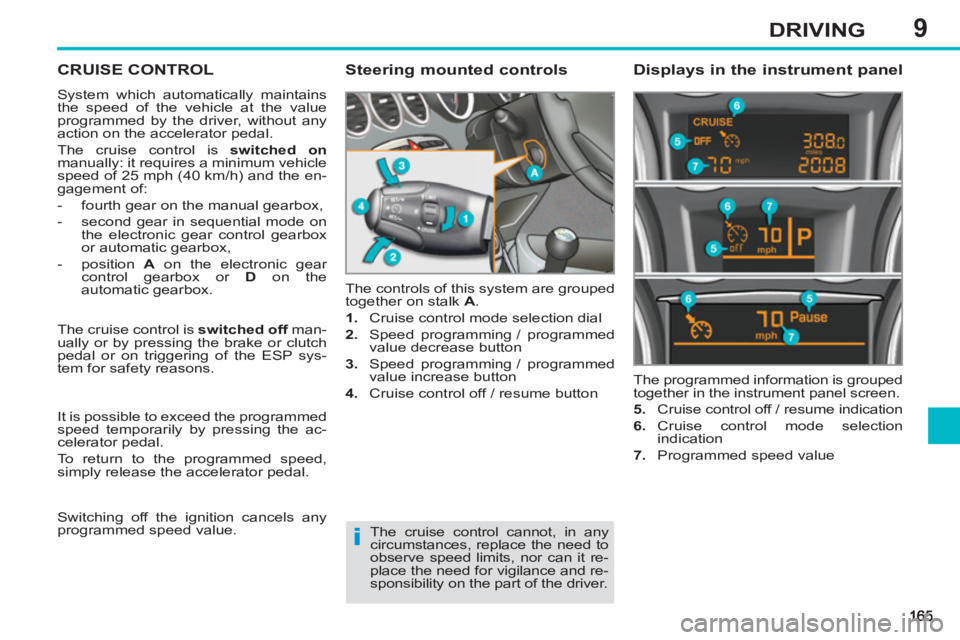
automatic gearbox. The controls of this system are grouped
together on stalk A
.
1.
Cruise control mode selection dial
2.
Speed programming / programmed
value decrease button
3.
Speed programming / programmed
value increase button
4.
Cruise control off / resume button The programmed information is grouped
together in the instrument panel screen.
5.
Cruise control off / resume indication
6.
Cruise control mode selection
indication
7.
Programmed speed value
Steering mounted controls
Displays in the instrument panel
The cruise control cannot, in any
circumstances, replace the need to
observe speed limits, nor can it re-
place the need for vigilance and re-
sponsibility on the part of the driver. The cruise control is switched off
man-
ually or by pressing the brake or clutch
pedal or on triggering of the ESP sys-
tem for safety reasons.
It is possible to exceed the programmed
speed temporarily by pressing the ac-
celerator pedal.
To return to the programmed speed,
simply release the accelerator pedal.
Switching off the ignition cancels any
programmed speed value.
Page 168 of 382
9
166
DRIVING
When the cruise control is switched
on, be careful if you maintain the
pressure on one of the programmed
speed changing buttons: this may
result in a very rapid change in the
speed of your vehicle.
Do not use the cruise control on
slippery roads or in heavy traffi c.
On a steep descent, the cruise
control will not be able to prevent
the vehicle from exceeding the pro-
grammed speed.
To avoid any risk of jamming of the
pedals:
- ensure that the mat is positioned
correctly,
-
never fi t one mat on top of another.
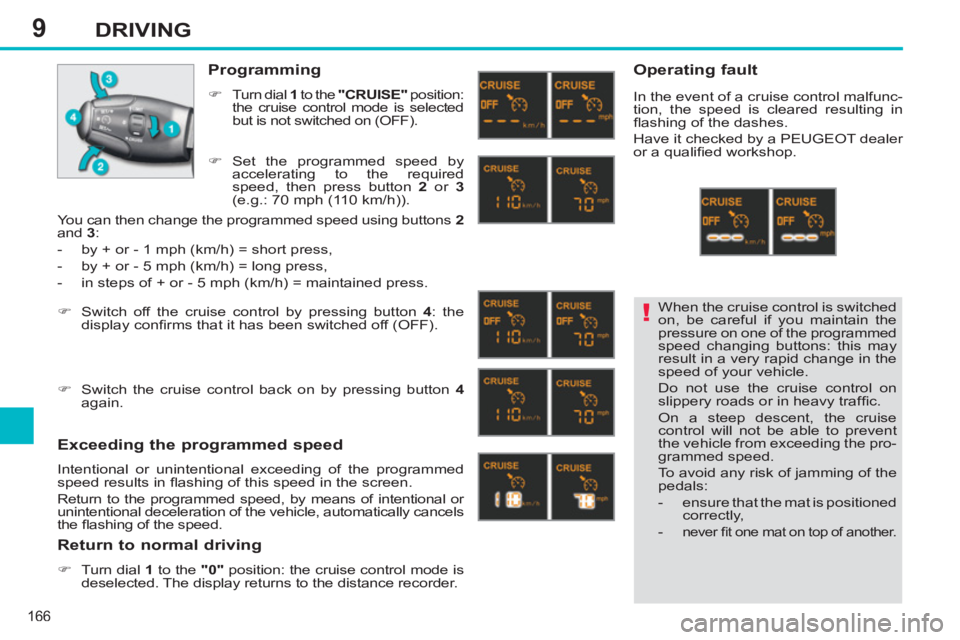
Programming
)
Turn dial 1
to the "CRUISE"
position:
the cruise control mode is selected
but is not switched on (OFF).
Exceeding the programmed speed
Intentional or unintentional exceeding of the programmed
speed results in fl ashing of this speed in the screen.
Return to the programmed speed, by means of intentional or
unintentional deceleration of the vehicle, automatically cancels
the fl ashing of the speed.
Return to normal driving
)
Turn dial 1
to the "0"
position: the cruise control mode is
deselected. The display returns to the distance recorder.
Operating fault
In the event of a cruise control malfunc-
tion, the speed is cleared resulting in
fl ashing of the dashes.
Have it checked by a PEUGEOT dealer
or a qualifi ed workshop.
)
Set the programmed speed by
accelerating to the required
speed, then press button 2
or 3
(e.g.: 70 mph (110 km/h)).
)
Switch off the cruise control by pressing button 4
: the
display confi rms that it has been switched off (OFF).
)
Switch the cruise control back on by pressing button 4
again.
You can then change the programmed speed using buttons 2
and 3
:
- by + or - 1 mph (km/h) = short press,
- by + or - 5 mph (km/h) = long press,
- in steps of + or - 5 mph (km/h) = maintained press.
Page 212 of 382
11
210
PRACTICAL INFORMATION
A fl at battery prevents the engine
from starting (refer to the corre-
sponding section).
If the telephone is being used at
this time:
- it will be maintained for ten minutes
with the hands-free kit of your
Peugeot Connect Sound (RD5),
- it will be maintained for ten
minutes with the Peugeot Connect
Navigation (RT6) or the Peugeot
Connect Media Navigation (NG4
3D), then it will transfer to your
telephone depending on the
telephone model.
ENERGY ECONOMY MODE
System which manages the duration of
use of certain functions to conserve a
suffi cient level of charge in the battery.
After the engine has stopped, you can
still use functions such as the audio and
telematics system, windscreen wip-
ers, dipped beam headlamps, courtesy
lamps, etc. for a maximum combined
duration of thirty minutes.
This period may be greatly reduced if
the battery is not fully charged.
Exiting economy mode
These functions are reactivated auto-
matically next time the vehicle is driven.
To restore the use of these functions im-
mediately, start the engine and let it run
for at least fi ve minutes.
Switching to economy mode
Once this time has elapsed, a message
appears in the screen indicating that
the vehicle has switched to economy
mode and the active functions are put
on standby.
LOAD REDUCTION MODE
System which manages the use of cer-
tain functions according to the level of
charge remaining in the battery.
When the vehicle is being driven, the load
reduction function temporarily deactivates
certain functions, such as the air condi-
tioning, the heated rear screen...
The deactivated functions are reactivat-
ed automatically as soon as conditions
permit.
Page 224 of 382
12
222
TECHNICAL DATA
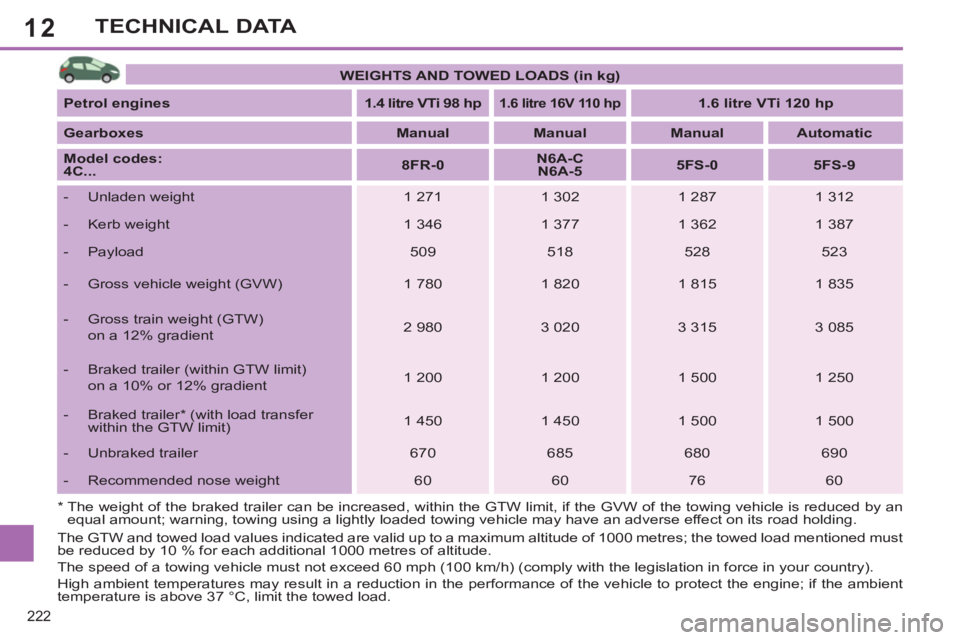
*
The weight of the braked trailer can be increased, within the GTW limit, if the GVW of the towing vehicle is reduced by an
equal amount; warning, towing using a lightly loaded towing vehicle may have an adverse effect on its road holding.
The GTW and towed load values indicated are valid up to a maximum altitude of 1000 metres; the towed load mentioned must
be reduced by 10 % for each additional 1000 metres of altitude.
The speed of a towing vehicle must not exceed 60 mph (100 km/h) (comply with the legislation in force in your country).
High ambient temperatures may result in a reduction in the performance of the vehicle to protect the engine; if the ambient
temperature is above 37 °C, limit the towed load.
WEIGHTS AND TOWED LOADS (in kg)
Petrol engines
1.4 litre VTi 98 hp
1.6 litre 16V 110 hp
1.6 litre VTi 120 hp
Gearboxes
Manual
Manual
Manual
Automatic
Model codes:
4C...
8FR-0
N6A-C
N6A-5
5FS-0
5FS-9
- Unladen weight
1 271
1 302
1 287
1 312
- Kerb weight
1 346
1 377
1 362
1 387
- Payload
509
518
528
523
- Gross vehicle weight (GVW)
1 780
1 820
1 815
1 835
- Gross train weight (GTW)
on a 12% gradient
2 980
3 020
3 315
3 085
- Braked trailer (within GTW limit)
on a 10% or 12% gradient
1 200
1 200
1 500
1 250
- Braked trailer * (with load transfer
within the GTW limit)
1 450
1 450
1 500
1 500
- Unbraked trailer
670
685
680
690
- Recommended nose weight
60
60
76
60
Page 225 of 382
12
223
TECHNICAL DATA
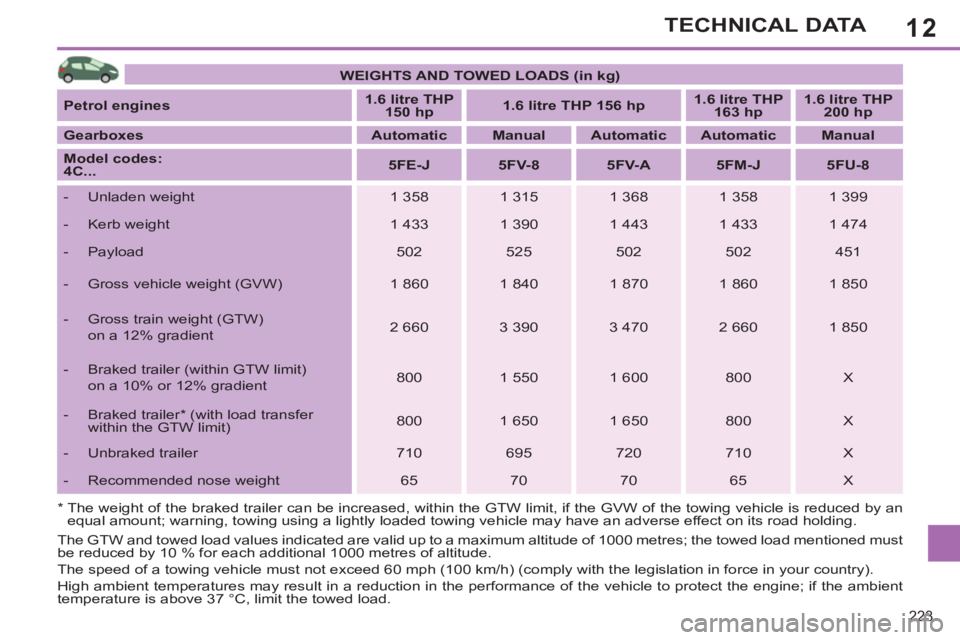
WEIGHTS AND TOWED LOADS (in kg)
Petrol engines
1.6 litre THP
150 hp
1.6 litre THP 156 hp
1.6 litre THP
163 hp
1.6 litre THP
200 hp
Gearboxes
Automatic
Manual
Automatic
Automatic
Manual
Model codes:
4C...
5FE-J
5FV-8
5FV-A
5FM-J
5FU-8
- Unladen weight
1 358
1 315
1 368
1 358
1 399
- Kerb weight
1 433
1 390
1 443
1 433
1 474
- Payload
502
525
502
502
451
- Gross vehicle weight (GVW)
1 860
1 840
1 870
1 860
1 850
- Gross train weight (GTW)
on a 12% gradient
2 660
3 390
3 470
2 660
1 850
- Braked trailer (within GTW limit)
on a 10% or 12% gradient
800
1 550
1 600
800
X
- Braked trailer * (with load transfer
within the GTW limit)
800
1 650
1 650
800
X
- Unbraked trailer
710
695
720
710
X
- Recommended nose weight
65
70
70
65
X
The GTW and towed load values indicated are valid up to a maximum altitude of 1000 metres; the towed load mentioned must
be reduced by 10 % for each additional 1000 metres of altitude.
The speed of a towing vehicle must not exceed 60 mph (100 km/h) (comply with the legislation in force in your country).
High ambient temperatures may result in a reduction in the performance of the vehicle to protect the engine; if the ambient
temperature is above 37 °C, limit the towed load.
* The weight of the braked trailer can be increased, within the GTW limit, if the GVW of the towing vehicle is reduced by an
equal amount; warning, towing using a lightly loaded towing vehicle may have an adverse effect on its road holding.