sensor Peugeot 308 SW BL 2013 Owner's Guide
[x] Cancel search | Manufacturer: PEUGEOT, Model Year: 2013, Model line: 308 SW BL, Model: Peugeot 308 SW BL 2013Pages: 382, PDF Size: 17.75 MB
Page 169 of 382
9
167
DRIVING
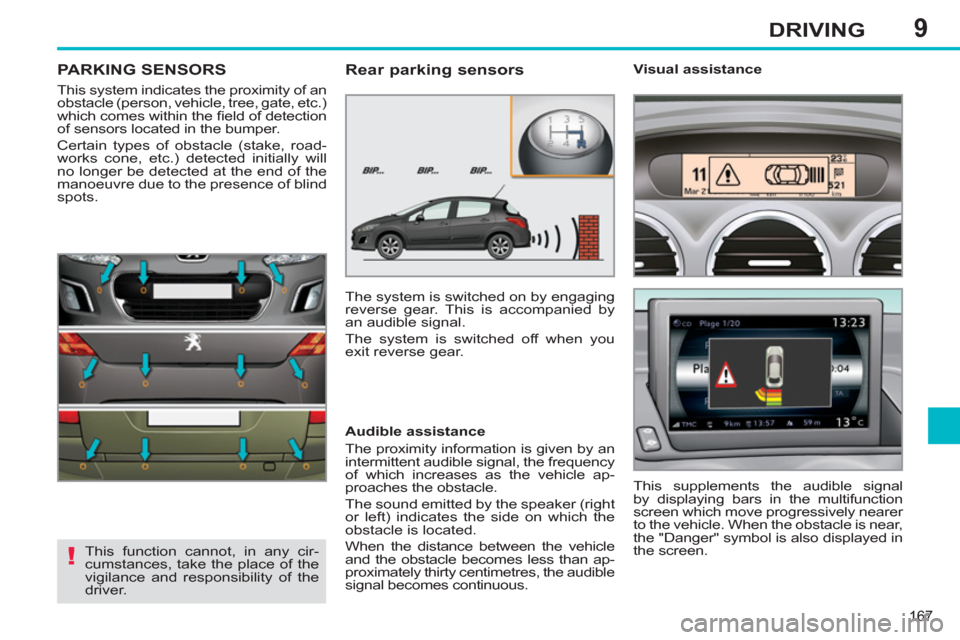
PARKING SENSORS
This system indicates the proximity of an
obstacle (person, vehicle, tree, gate, etc.)
which comes within the fi eld of detection
of sensors located in the bumper.
Certain types of obstacle (stake, road-
works cone, etc.) detected initially will
no longer be detected at the end of the
manoeuvre due to the presence of blind
spots.
This function cannot, in any cir-
cumstances, take the place of the
vigilance and responsibility of the
driver.
Rear parking sensors
The system is switched on by engaging
reverse gear. This is accompanied by
an audible signal.
The system is switched off when you
exit reverse gear.
Audible assistance
The proximity information is given by an
intermittent audible signal, the frequency
of which increases as the vehicle ap-
proaches the obstacle.
The sound emitted by the speaker (right
or left) indicates the side on which the
obstacle is located.
When the distance between the vehicle
and the obstacle becomes less than ap-
proximately thirty centimetres, the audible
signal becomes continuous.
This supplements the audible signal
by displaying bars in the multifunction
screen which move progressively nearer
to the vehicle. When the obstacle is near,
the "Danger" symbol is also displayed in
the screen.
Visual assistance
Page 170 of 382
9
168
DRIVING
Front parking sensors
In addition to the rear parking sensors, the
front parking sensors are triggered when
an obstacle is detected in front and the
speed of the vehicle is still below 6 mph
(10 km/h).
The front parking sensors are interrupted
if the vehicle stops for more than three
seconds in forward gear, if no further ob-
stacles are detected or when the speed of
the vehicle exceeds 6 mph (10 km/h).
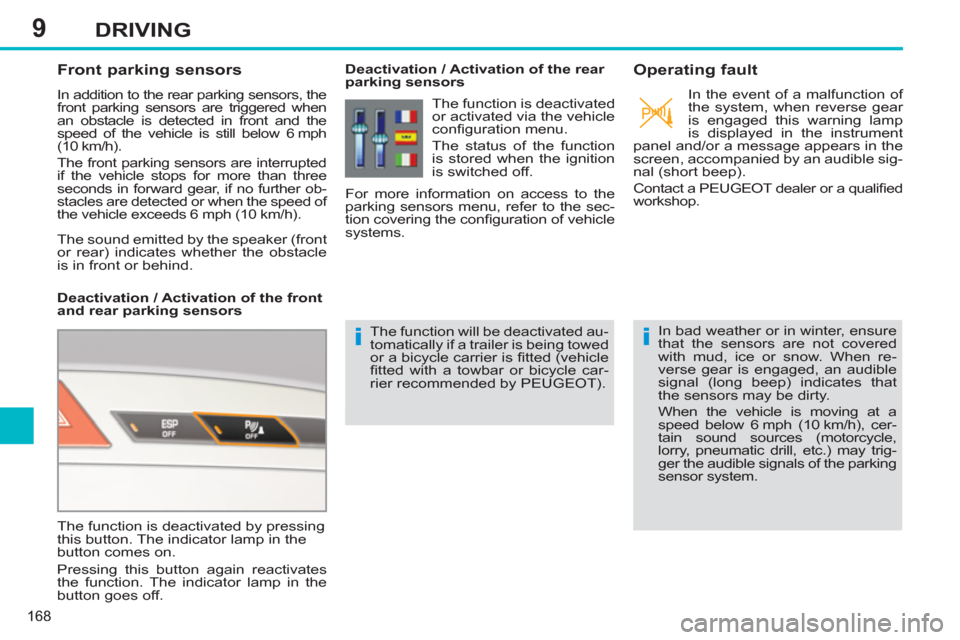
Deactivation / Activation of the front
and rear parking sensors
Deactivation / Activation of the rear
parking sensors
The function will be deactivated au-
tomatically if a trailer is being towed
or a bicycle carrier is fi tted (vehicle
fi tted with a towbar or bicycle car-
rier recommended by PEUGEOT).
Operating fault
In bad weather or in winter, ensure
that the sensors are not covered
with mud, ice or snow. When re-
verse gear is engaged, an audible
signal (long beep) indicates that
the sensors may be dirty.
When the vehicle is moving at a
speed below 6 mph (10 km/h), cer-
tain sound sources (motorcycle,
lorry, pneumatic drill, etc.) may trig-
ger the audible signals of the parking
sensor system.
The function is deactivated by pressing
this button. The indicator lamp in the
button comes on.
Pressing this button again reactivates
the function. The indicator lamp in the
button goes off.
The function is deactivated
or activated via the vehicle
confi guration menu.
The status of the function
is stored when the ignition
is switched off.
For more information on access to the
parking sensors menu, refer to the sec-
tion covering the confi guration of vehicle
systems.
In the event of a malfunction of
the system, when reverse gear
is engaged this warning lamp
is displayed in the instrument
panel and/or a message appears in the
screen, accompanied by an audible sig-
nal (short beep).
Contact a PEUGEOT dealer or a qualifi ed
workshop.
The sound emitted by the speaker (front
or rear) indicates whether the obstacle
is in front or behind.
Page 190 of 382
11
188
PRACTICAL INFORMATION
Fitting a steel spare wheel
If your vehicle is fi tted with alloy
wheels, it is normal to notice, when
tightening the bolts on fi tting, that
the washers do not come into con-
tact with the steel spare wheel. The
wheel is secured by the conical
contact of each bolt.
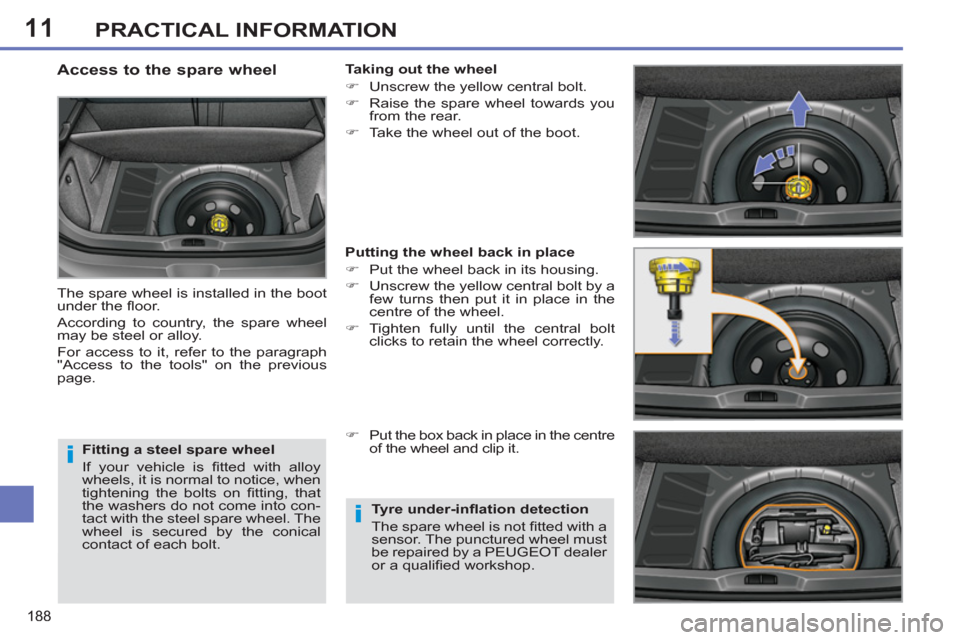
Access to the spare wheel
The spare wheel is installed in the boot
under the fl oor.
According to country, the spare wheel
may be steel or alloy.
For access to it, refer to the paragraph
"Access to the tools" on the previous
page.
Taking out the wheel
)
Unscrew the yellow central bolt.
)
Raise the spare wheel towards you
from the rear.
)
Take the wheel out of the boot.
Putting the wheel back in place
)
Put the wheel back in its housing.
)
Unscrew the yellow central bolt by a
few turns then put it in place in the
centre of the wheel.
)
Tighten fully until the central bolt
clicks to retain the wheel correctly.
)
Put the box back in place in the centre
of the wheel and clip it.
Tyre under-infl ation detection
The spare wheel is not fi tted with a
sensor. The punctured wheel must
be repaired by a PEUGEOT dealer
or a qualifi ed workshop.
Page 193 of 382
11
191
PRACTICAL INFORMATION
Tyre under-infl ation detection
The spare wheel is not fi tted with a
sensor. The punctured wheel must
be repaired by a PEUGEOT dealer
or a qualifi ed workshop.
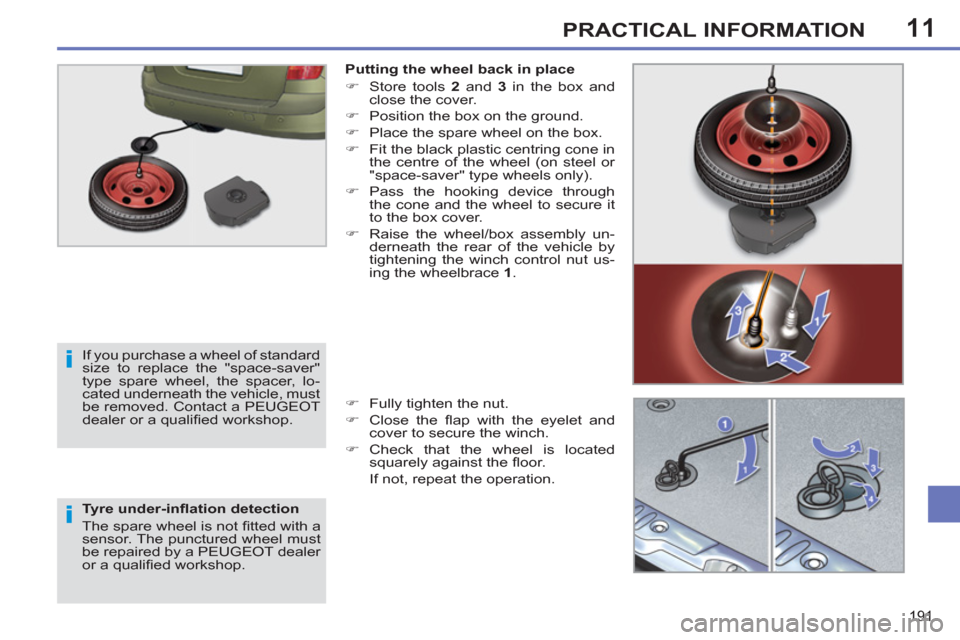
Putting the wheel back in place
)
Store tools 2
and 3
in the box and
close the cover.
)
Position the box on the ground.
)
Place the spare wheel on the box.
)
Fit the black plastic centring cone in
the centre of the wheel (on steel or
"space-saver" type wheels only).
)
Pass the hooking device through
the cone and the wheel to secure it
to the box cover.
)
Raise the wheel/box assembly un-
derneath the rear of the vehicle by
tightening the winch control nut us-
ing the wheelbrace 1
.
)
Fully tighten the nut.
)
Close the fl ap with the eyelet and
cover to secure the winch.
)
Check that the wheel is located
squarely against the fl oor.
If not, repeat the operation.
If you purchase a wheel of standard
size to replace the "space-saver"
type spare wheel, the spacer, lo-
cated underneath the vehicle, must
be removed. Contact a PEUGEOT
dealer or a qualifi ed workshop.
Page 204 of 382
11
202
PRACTICAL INFORMATION
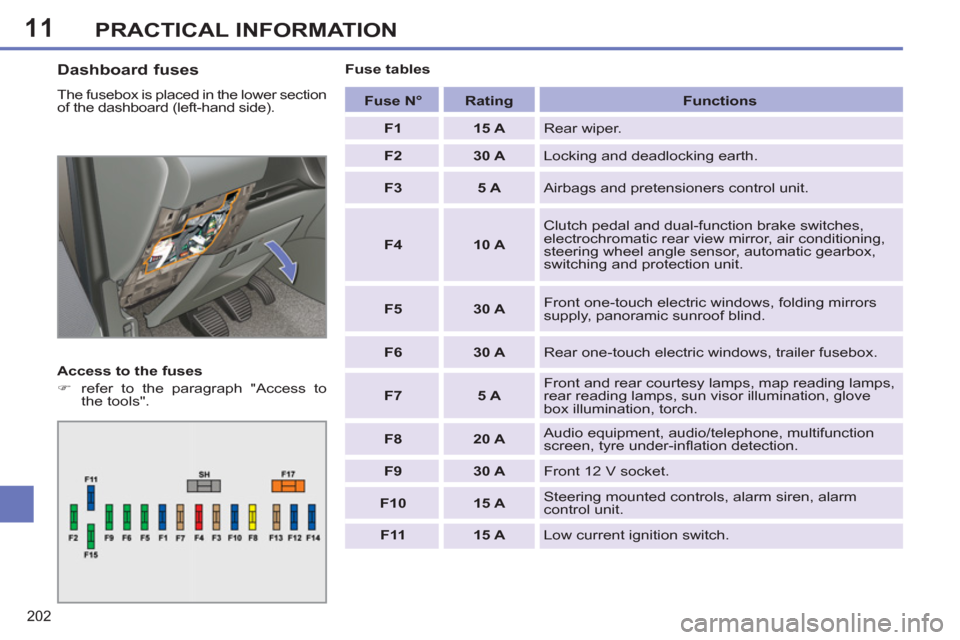
Dashboard fuses
The fusebox is placed in the lower section
of the dashboard (left-hand side).
Access to the fuses
)
refer to the paragraph "Access to
the tools".
Fuse tables
Fuse N°
Rating
Functions
F1
15 A
Rear wiper.
F2
30 A
Locking and deadlocking earth.
F3
5 A
Airbags and pretensioners control unit.
F4
10 A
Clutch pedal and dual-function brake switches,
electrochromatic rear view mirror, air conditioning,
steering wheel angle sensor, automatic gearbox,
switching and protection unit.
F5
30 A
Front one-touch electric windows, folding mirrors
supply, panoramic sunroof blind.
F6
30 A
Rear one-touch electric windows, trailer fusebox.
F7
5 A
Front and rear courtesy lamps, map reading lamps,
rear reading lamps, sun visor illumination, glove
box illumination, torch.
F8
20 A
Audio equipment, audio/telephone, multifunction
screen, tyre under-infl ation detection.
F9
30 A
Front 12 V socket.
F10
15 A
Steering mounted controls, alarm siren, alarm
control unit.
F11
15 A
Low current ignition switch.
Page 205 of 382
11
203
PRACTICAL INFORMATION
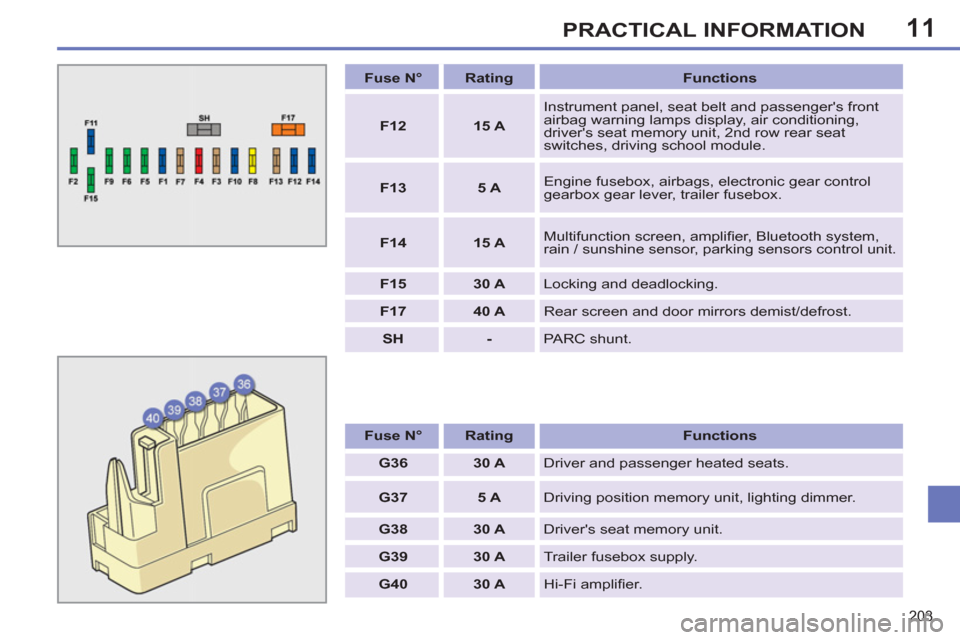
Fuse N°
Rating
Functions
F12
15 A
Instrument panel, seat belt and passenger's front
airbag warning lamps display, air conditioning,
driver's seat memory unit, 2nd row rear seat
switches, driving school module.
F13
5 A
Engine fusebox, airbags, electronic gear control
gearbox gear lever, trailer fusebox.
F14
15 A
Multifunction screen, amplifi er, Bluetooth system,
rain / sunshine sensor, parking sensors control unit.
F15
30 A
Locking and deadlocking.
F17
40 A
Rear screen and door mirrors demist/defrost.
SH
-
PARC shunt.
Fuse N°
Rating
Functions
G36
30 A
Driver and passenger heated seats.
G37
5 A
Driving position memory unit, lighting dimmer.
G38
30 A
Driver's seat memory unit.
G39
30 A
Trailer fusebox supply.
G40
30 A
Hi-Fi amplifi er.
Page 206 of 382
11
204
PRACTICAL INFORMATION
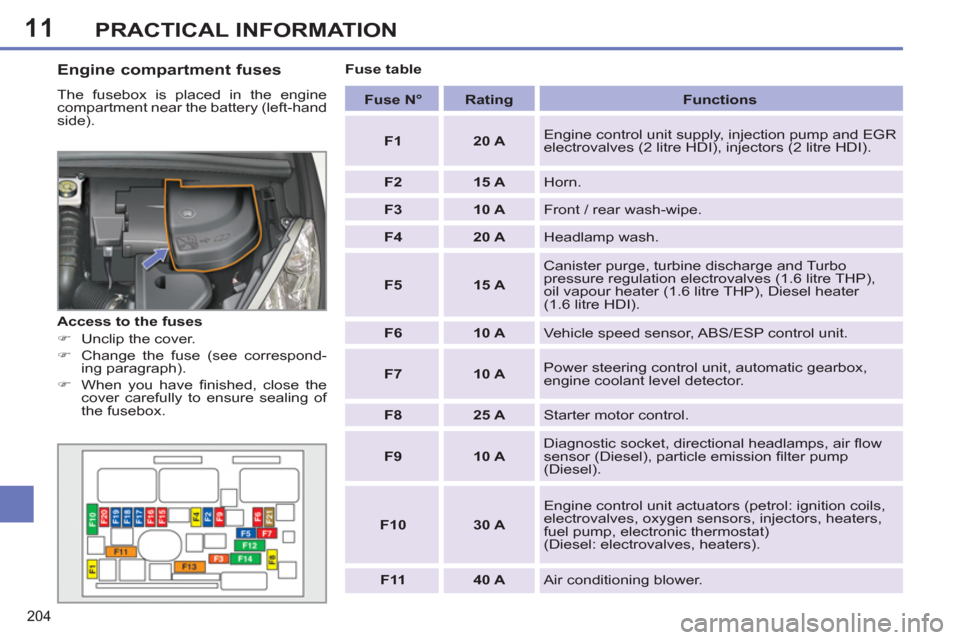
Engine compartment fuses
The fusebox is placed in the engine
compartment near the battery (left-hand
side).
Fuse N°
Rating
Functions
F1
20 A
Engine control unit supply, injection pump and EGR
electrovalves (2 litre HDI), injectors (2 litre HDI).
F2
15 A
Horn.
F3
10 A
Front / rear wash-wipe.
F4
20 A
Headlamp wash.
F5
15 A
Canister purge, turbine discharge and Turbo
pressure regulation electrovalves (1.6 litre THP),
oil vapour heater (1.6 litre THP), Diesel heater
(1.6 litre HDI).
F6
10 A
Vehicle speed sensor, ABS/ESP control unit.
F7
10 A
Power steering control unit, automatic gearbox,
engine coolant level detector.
F8
25 A
Starter motor control.
F9
10 A
Diagnostic socket, directional headlamps, air fl ow
sensor (Diesel), particle emission fi lter pump
(Diesel).
F10
30 A
Engine control unit actuators (petrol: ignition coils,
electrovalves, oxygen sensors, injectors, heaters,
fuel pump, electronic thermostat)
(Diesel: electrovalves, heaters).
F11
40 A
Air conditioning blower.
Access to the fuses
)
Unclip the cover.
)
Change the fuse (see correspond-
ing paragraph).
)
When you have fi nished, close the
cover carefully to ensure sealing of
the fusebox.
Fuse table
Page 207 of 382
11
205
PRACTICAL INFORMATION
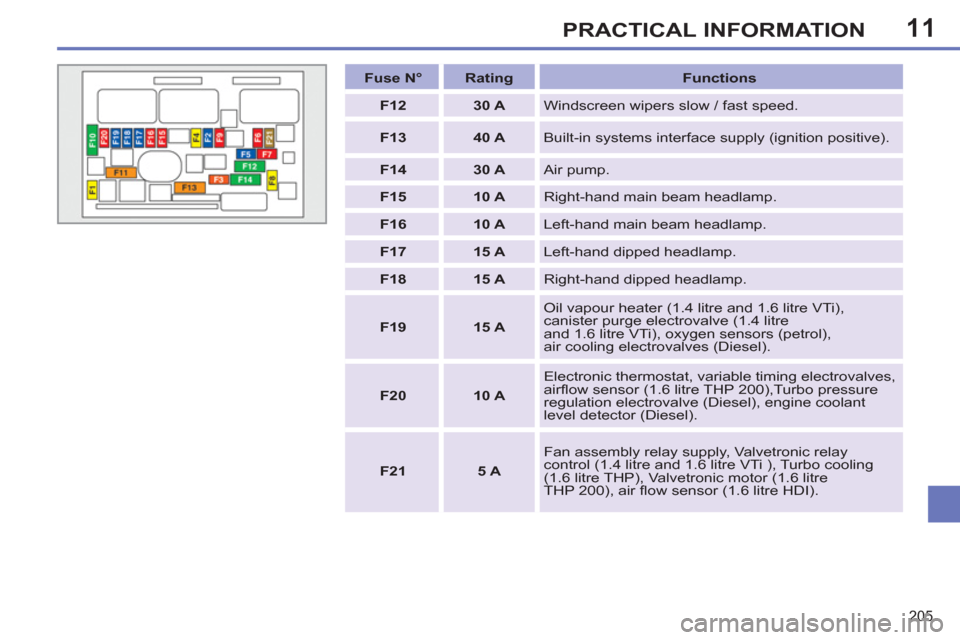
Fuse N°
Rating
Functions
F12
30 A
Windscreen wipers slow / fast speed.
F13
40 A
Built-in systems interface supply (ignition positive).
F14
30 A
Air pump.
F15
10 A
Right-hand main beam headlamp.
F16
10 A
Left-hand main beam headlamp.
F17
15 A
Left-hand dipped headlamp.
F18
15 A
Right-hand dipped headlamp.
F19
15 A
Oil vapour heater (1.4 litre and 1.6 litre VTi),
canister purge electrovalve (1.4 litre
and 1.6 litre VTi), oxygen sensors (petrol),
air cooling electrovalves (Diesel).
F20
10 A
Electronic thermostat, variable timing electrovalves,
airfl ow sensor (1.6 litre THP 200),Turbo pressure
regulation electrovalve (Diesel), engine coolant
level detector (Diesel).
F21
5 A
Fan assembly relay supply, Valvetronic relay
control (1.4 litre and 1.6 litre VTi ), Turbo cooling
(1.6 litre THP), Valvetronic motor (1.6 litre
THP 200), air fl ow sensor (1.6 litre HDI).
Page 217 of 382
11
215
PRACTICAL INFORMATION
VERY COLD CLIMATE SCREEN *
Removable protective screen which
prevents the accumulation of snow at
the radiator cooling fan.
Fitting
)
Offer up the very cold climate screen
to the front of the lower section of
the front bumper.
)
Press around its edge to engage its
fi xing clips one by one.
Do not forget to remove the very
cold climate screen:
- when the ambient temperature
exceeds 10 °C,
- when towing,
-
at speeds above 75 mph (120 km/h).
Removal
)
Use a screwdriver as a lever to re-
lease each fi xing clip in turn. As the fan is electrically controlled, its
cooling capacity is not dependent on
the engine speed.
)
To lower the engine speed, reduce
your speed.
The maximum towed load on a long in-
cline depends on the gradient and the
ambient temperature.
In all cases, keep a check on the cool-
ant temperature.
Braking
Towing a trailer increases the braking
distance.
To avoid overheating of the brakes on a
long mountain type of descent, the use
of engine braking is recommended.
Tyres
)
Check the tyre pressures of the towing
vehicle and of the trailer, observing the
recommended pressures.
Lighting
)
Check the electrical lighting and sig-
nalling on the trailer.
The rear parking sensors will be
deactivated automatically if a gen-
uine PEUGEOT towbar is used.
)
If the warning lamp and the
STOP
warning lamp come
on, stop the vehicle and
switch off the engine as
soon as possible.
*
According to country.
Page 219 of 382
11
217
PRACTICAL INFORMATION
"Protection":
mats * , mud fl aps, seat covers compat-
ible with lateral airbags, vehicle covers,
door sill protectors, translucent bumper
protectors.
*
To avoid any risk of jamming of the
pedals:
- ensure that the mat is positioned
and secured correctly,
- never fi t one mat on top of
another.
ACCESSORIES
A wide range of accessories and genu-
ine parts is available from the PEUGEOT
dealer network.
These accessories and parts have been
tested and approved for reliability and
safety.
They are all adapted to your vehicle and
benefi t from PEUGEOT's recommenda-
tion and warranty.
"Comfort":
parking sensors, side and rear blinds,
door defl ectors, isotherm module, head
restraint-mounted coat hanger, front
centre armrest, reading lamp, scented
air freshener...
Conversion kits
You can obtain an "Enterprise" kit to
convert a trade vehicle to a private car
and vice-versa.
"Transport solutions":
boot liner, boot mat, boot spacers, stor-
age under parcel shelf, transverse roof
bars, bicycle carrier, ski carrier, roof
box, towbars, wiring harnesses...
"Style":
leather steering wheel, aluminium gear
lever knob, alloy wheels, wheel trims,
body styling kit...
"Security and safety":
anti-theft alarm, wheel security locks,
vehicle tracking system, child seats and
booster cushions, breathalyser, fi rst aid
kit, warning triangle, high visibility vest,
dog guard, front foglamp kit, temporary
puncture repair kit, snow chains, anti-
skid covers.
Where the towbar and its wiring har-
ness are not fi tted by a PEUGEOT
dealer, they must be fi tted in line
with the vehicle manufacturer's rec-
ommendations.