instrument panel PEUGEOT 4007 2007 Owner's Manual
[x] Cancel search | Manufacturer: PEUGEOT, Model Year: 2007, Model line: 4007, Model: PEUGEOT 4007 2007Pages: 221, PDF Size: 13.99 MB
Page 110 of 221
6ii
SAFETY
BRAKING ASSISTANCE
SYSTEMS
Group of supplementary systems which
help you to obtain optimum braking in
complete safety in emergency situa-
tions:
- the anti-lock braking system (ABS),
- the electronic brake force distribu-tion (EBFD).
Anti-lock braking system
and electronic brake force
distribution
Linked systems which improve the sta-
bility and manoeuvrability of your vehi-
cle when braking, in particular on poor
or slippery surfaces.
When braking in an emergency,
press very fi rmly without releas-
ing the pressure. The two warning lights comes
on at the same time and the two
warnings are displayed alter-
nately on the instrument panel
display.
When replacing wheels (tyres
and rims), ensure that they con-
form to the manufacturer’s rec-
ommendations.
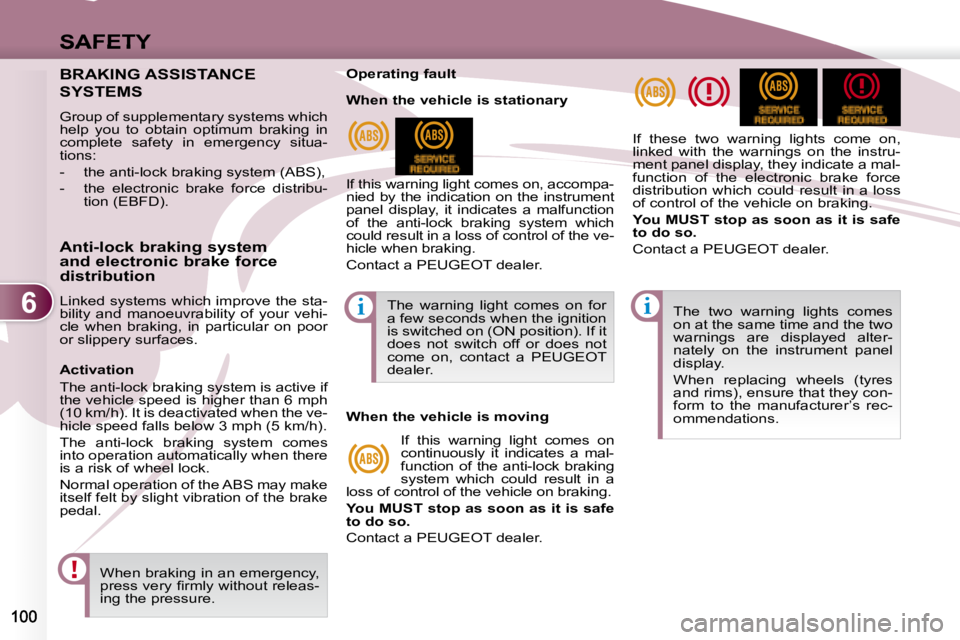
Operating fault
If this warning light comes on, accompa-
nied by the indication on the instrument
panel display, it indicates a malfunction
of the anti-lock braking system which
could result in a loss of control of the ve-
hicle when braking.
Contact a PEUGEOT dealer.
If these two warning lights come on,
linked with the warnings on the instru-
ment panel display, they indicate a mal-
function of the electronic brake force
distribution which could result in a loss
of control of the vehicle on braking.
You MUST stop as soon as it is safe
to do so.
Contact a PEUGEOT dealer.
Activation
The anti-lock braking system is active if
the vehicle speed is higher than 6 mph
(10 km/h). It is deactivated when the ve-
hicle speed falls below 3 mph (5 km/h).
The anti-lock braking system comes
into operation automatically when there
is a risk of wheel lock.
Normal operation of the ABS may make
itself felt by slight vibration of the brake
pedal. The warning light comes on for
a few seconds when the ignition
is switched on (ON position). If it
does not switch off or does not
come on, contact a PEUGEOT
dealer.
When the vehicle is stationary
When the vehicle is moving
If this warning light comes on
continuously it indicates a mal-
function of the anti-lock braking
system which could result in a
loss of control of the vehicle on braking.
You MUST stop as soon as it is safe
to do so.
Contact a PEUGEOT dealer.
Page 111 of 221
6
SAFETY
101
The ASC/TCL systems offer ex-
ceptional safety in normal driving,
but this should not encourage the
driver to take extra risks or drive
at high speed.
The correct functioning of these
systems depends on observation
of the manufacturer’s recommen-
dations regarding the wheels (tyres
and rims), the braking compo-
nents, the electronic components
and the PEUGEOT assembly and
operation procedures.
After an impact, have these sys-
tems checked by a PEUGEOT
dealer.
Disarming
In exceptional conditions (starting a
vehicle which is bogged down, stuck
in snow, on soft ground, ...), it may be
advisable to disarm the ASC system,
so that the wheels can move freely and
regain grip.
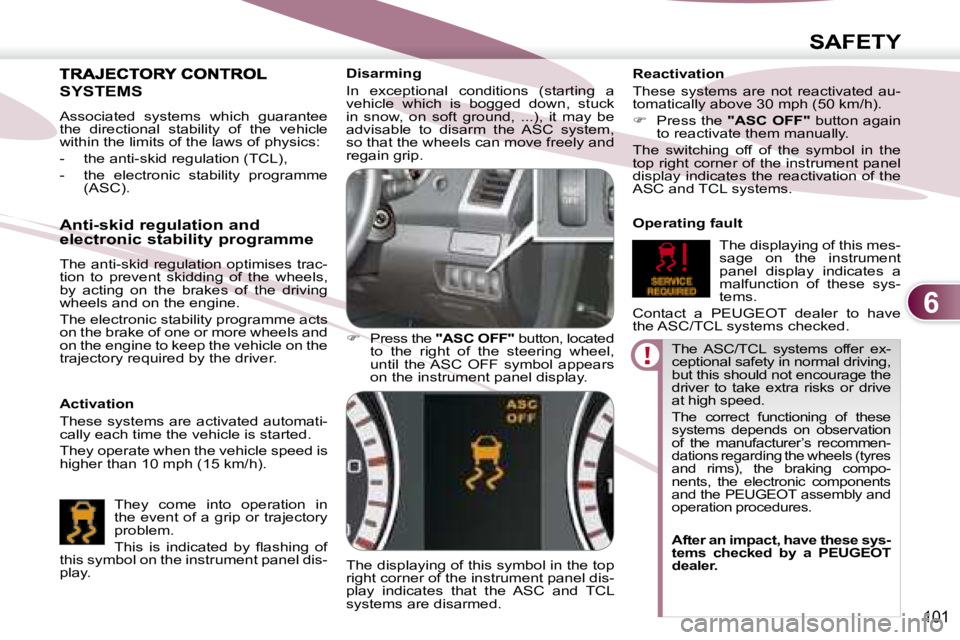
Press the "ASC OFF" button, located
to the right of the steering wheel,
until the ASC OFF symbol appears
on the instrument panel display.
The displaying of this symbol in the top
right corner of the instrument panel dis-
play indicates that the ASC and TCL
systems are disarmed. Reactivation
These systems are not reactivated au-
tomatically above 30 mph (50 km/h).
Press the "ASC OFF" button again
to reactivate them manually.
The switching off of the symbol in the
top right corner of the instrument panel
display indicates the reactivation of the
ASC and TCL systems.
Operating fault
The displaying of this mes-
sage on the instrument
panel display indicates a
malfunction of these sys-
tems.
Contact a PEUGEOT dealer to have
the ASC/TCL systems checked.
SYSTEMS
Associated systems which guarantee
the directional stability of the vehicle
within the limits of the laws of physics:
- the anti-skid regulation (TCL),
- the electronic stability programme (ASC).
Activation
These systems are activated automati-
cally each time the vehicle is started.
They operate when the vehicle speed is
higher than 10 mph (15 km/h).
Anti-skid regulation and
electronic stability programme
The anti-skid regulation optimises trac-
tion to prevent skidding of the wheels,
by acting on the brakes of the driving
wheels and on the engine.
The electronic stability programme acts
on the brake of one or more wheels and
on the engine to keep the vehicle on the
trajectory required by the driver.
They come into operation in
the event of a grip or trajectory
problem.
This is indicated by fl ashing of
this symbol on the instrument panel dis-
play.
Page 113 of 221
6
SAFETY
103
Front seat belt not fastened/
unfastened warning light
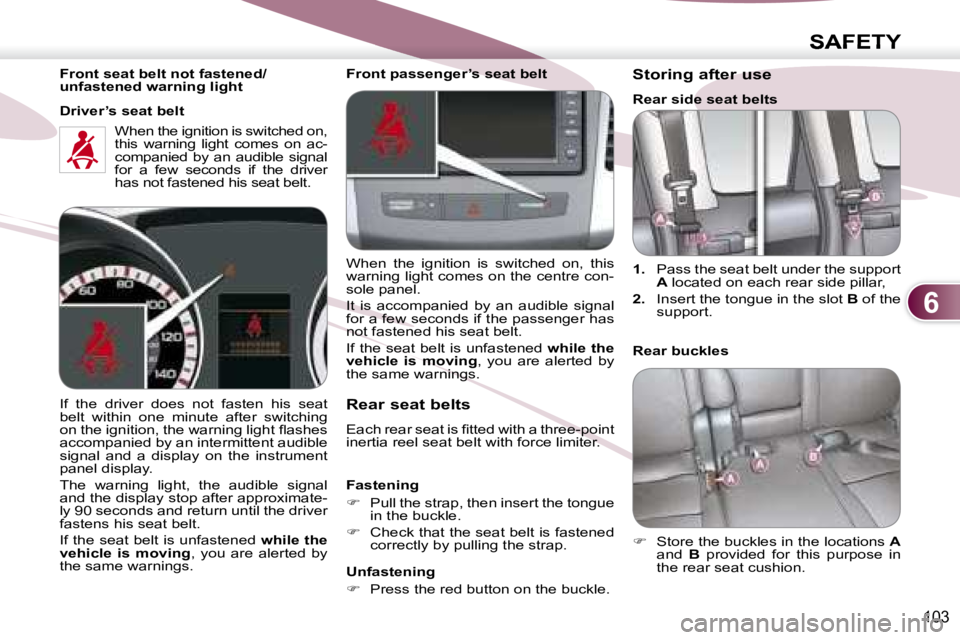
Driver’s seat belt When the ignition is switched on,
this warning light comes on ac-
companied by an audible signal
for a few seconds if the driver
has not fastened his seat belt.
Rear seat belts
Each rear seat is fi tted with a three-point
inertia reel seat belt with force limiter.
Fastening
Pull the strap, then insert the tongue
in the buckle.
Check that the seat belt is fastened
correctly by pulling the strap.
Unfastening
Press the red button on the buckle.
If the driver does not fasten his seat
belt within one minute after switching
on the ignition, the warning light fl ashes
accompanied by an intermittent audible
signal and a display on the instrument
panel display.
The warning light, the audible signal
and the display stop after approximate-
ly 90 seconds and return until the driver
fastens his seat belt.
If the seat belt is unfastened
while the
vehicle is moving , you are alerted by
the same warnings. Storing after use
Rear side seat belts
1. Pass the seat belt under the support
A located on each rear side pillar,
2. Insert the tongue in the slot B of the
support.
Rear buckles
Store the buckles in the locations A
and B provided for this purpose in
the rear seat cushion.
Front passenger’s seat belt
When the ignition is switched on, this
warning light comes on the centre con-
sole panel.
It is accompanied by an audible signal
for a few seconds if the passenger has
not fastened his seat belt.
If the seat belt is unfastened
while the
vehicle is moving , you are alerted by
the same warnings.
Page 116 of 221
6
SAFETY
If the air bag warning light and
the display come on continuous-
ly, do not install a "rear facing"
child seat on the front passen-
ger seat.
Contact a PEUGEOT dealer.
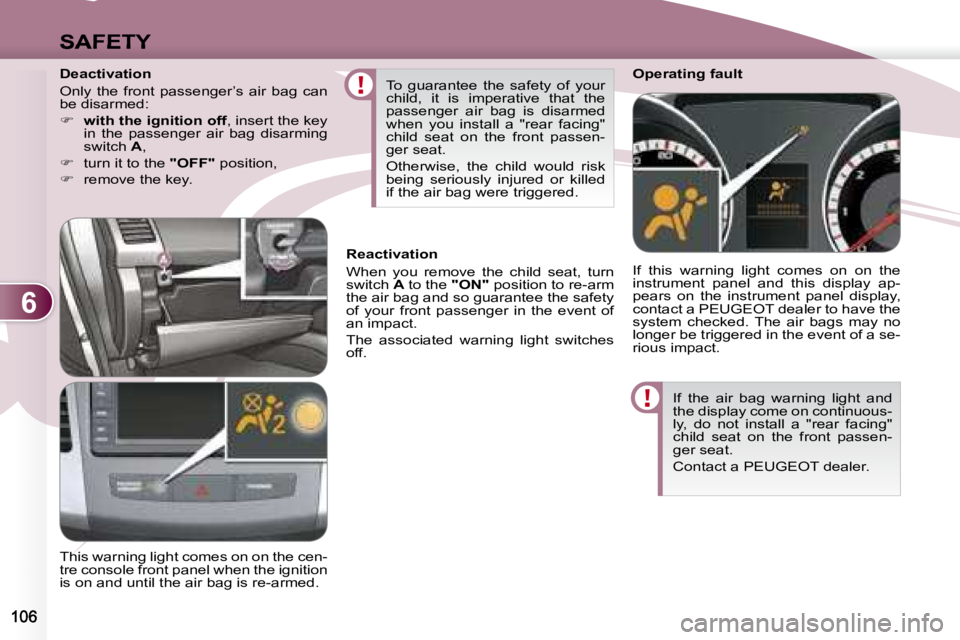
Operating fault
If this warning light comes on on the
instrument panel and this display ap-
pears on the instrument panel display,
contact a PEUGEOT dealer to have the
system checked. The air bags may no
longer be triggered in the event of a se-
rious impact.
To guarantee the safety of your
child, it is imperative that the
passenger air bag is disarmed
when you install a "rear facing"
child seat on the front passen-
ger seat.
Otherwise, the child would risk
being seriously injured or killed
if the air bag were triggered.
This warning light comes on on the cen-
tre console front panel when the ignition
is on and until the air bag is re-armed. Reactivation
When you remove the child seat, turn
switch
A to the "ON" position to re-arm
the air bag and so guarantee the safety
of your front passenger in the event of
an impact.
The associated warning light switches
off.
Deactivation
Only the front passenger’s air bag can
be disarmed:
with the ignition off , insert the key
in the passenger air bag disarming
switch A ,
turn it to the "OFF" position,
remove the key.
Page 117 of 221
6
SAFETY
107
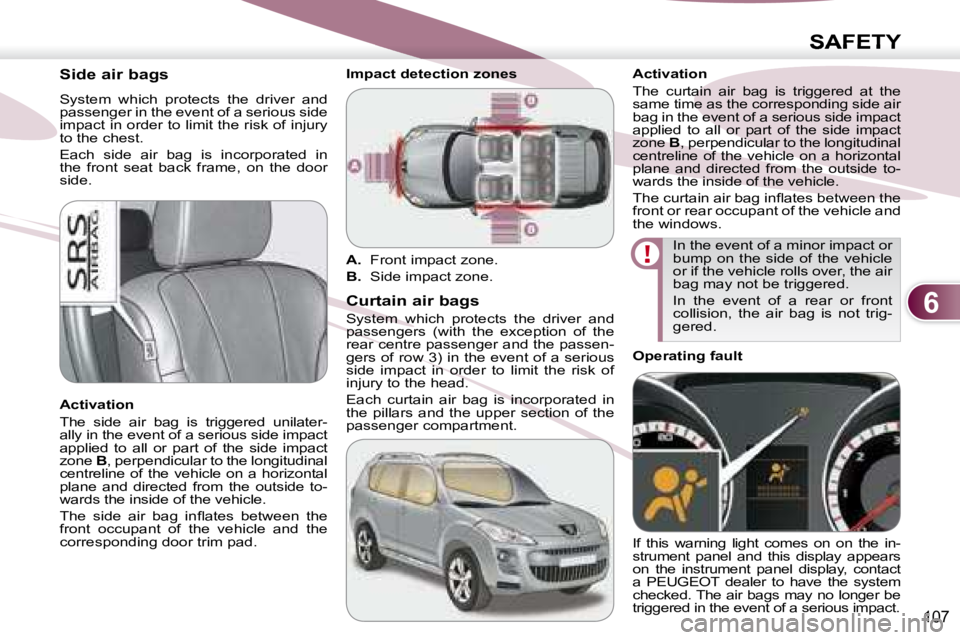
Side air bags
System which protects the driver and
passenger in the event of a serious side
impact in order to limit the risk of injury
to the chest.
Each side air bag is incorporated in
the front seat back frame, on the door
side.
Activation
The side air bag is triggered unilater-
ally in the event of a serious side impact
applied to all or part of the side impact
zone B , perpendicular to the longitudinal
centreline of the vehicle on a horizontal
plane and directed from the outside to-
wards the inside of the vehicle.
The side air bag infl ates between the
front occupant of the vehicle and the
corresponding door trim pad. Curtain air bags
System which protects the driver and
passengers (with the exception of the
rear centre passenger and the passen-
gers of row 3) in the event of a serious
side impact in order to limit the risk of
injury to the head.
Each curtain air bag is incorporated in
the pillars and the upper section of the
passenger compartment. Activation
The curtain air bag is triggered at the
same time as the corresponding side air
bag in the event of a serious side impact
applied to all or part of the side impact
zone
B , perpendicular to the longitudinal
centreline of the vehicle on a horizontal
plane and directed from the outside to-
wards the inside of the vehicle.
The curtain air bag infl ates between the
front or rear occupant of the vehicle and
the windows.
In the event of a minor impact or
bump on the side of the vehicle
or if the vehicle rolls over, the air
bag may not be triggered.
In the event of a rear or front
collision, the air bag is not trig-
gered.
Impact detection zones
A. Front impact zone.
B. Side impact zone.
Operating fault
If this warning light comes on on the in-
strument panel and this display appears
on the instrument panel display, contact
a PEUGEOT dealer to have the system
checked. The air bags may no longer be
triggered in the event of a serious impact.
Page 120 of 221
7
2WD4WD LOCK4WD AUTO
DRIVING
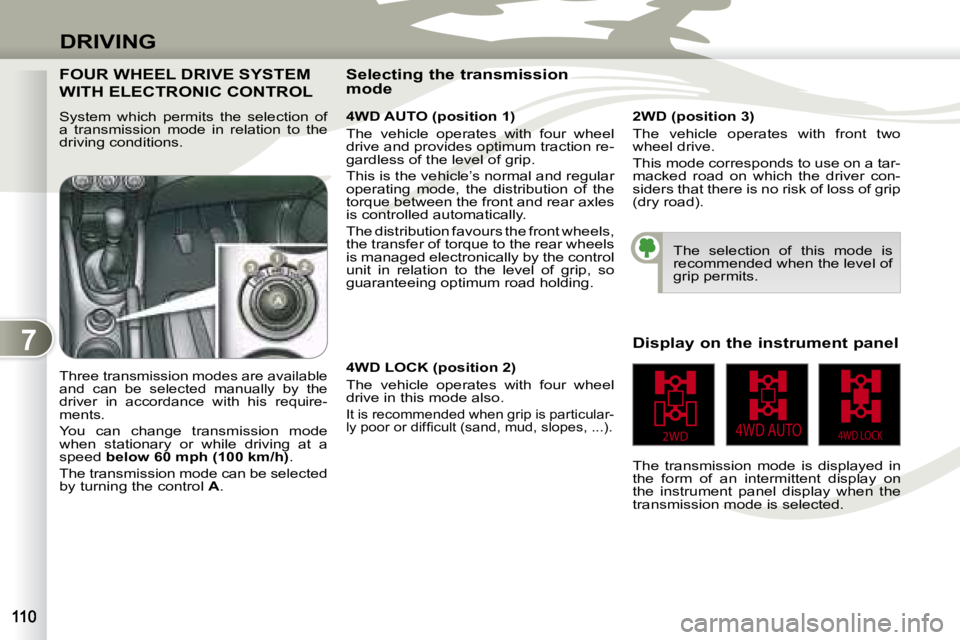
FOUR WHEEL DRIVE SYSTEM
WITH ELECTRONIC CONTROL
System which permits the selection of
a transmission mode in relation to the
driving conditions. 4WD AUTO (position 1)
The vehicle operates with four wheel
drive and provides optimum traction re-
gardless of the level of grip.
This is the vehicle’s normal and regular
operating mode, the distribution of the
torque between the front and rear axles
is controlled automatically.
The distribution favours the front wheels,
the transfer of torque to the rear wheels
is managed electronically by the control
unit in relation to the level of grip, so
guaranteeing optimum road holding.
Three transmission modes are available
and can be selected manually by the
driver in accordance with his require-
ments.
You can change transmission mode
when stationary or while driving at a
speed
below 60 mph (100 km/h) .
The transmission mode can be selected
by turning the control A . Display on the instrument panel
The transmission mode is displayed in
the form of an intermittent display on
the instrument panel display when the
transmission mode is selected.
Selecting the transmission
mode
The selection of this mode is
recommended when the level of
grip permits.
2WD (position 3)
The vehicle operates with front two
wheel drive.
This mode corresponds to use on a tar-
macked road on which the driver con-
siders that there is no risk of loss of grip
(dry road).
4WD LOCK (position 2)
The vehicle operates with four wheel
drive in this mode also.
It is recommended when grip is particular-
ly poor or diffi cult (sand, mud, slopes, ...).
Page 121 of 221
7
i
DRIVING
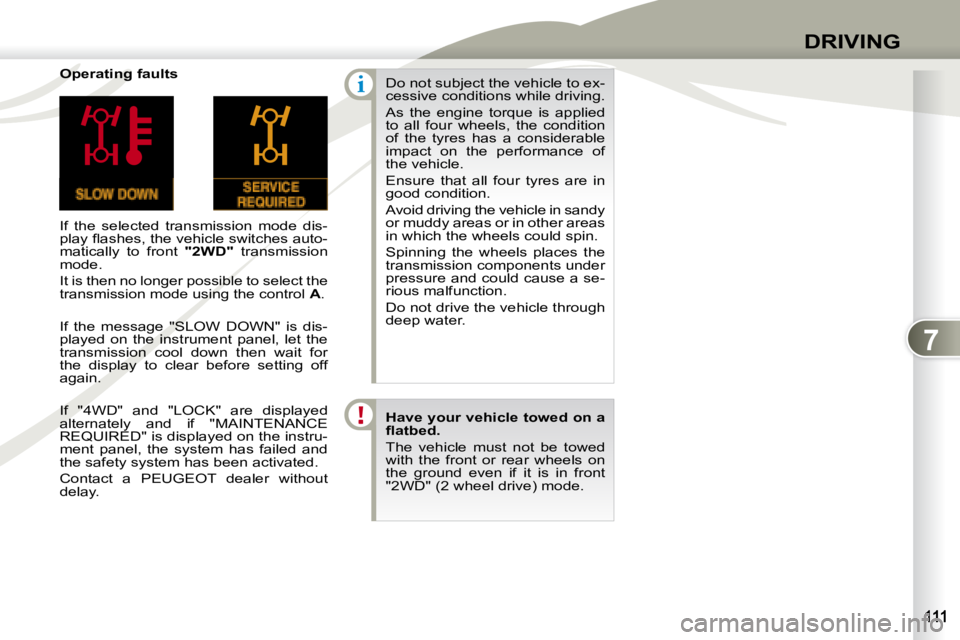
Operating faults
If the selected transmission mode dis-
play fl ashes, the vehicle switches auto-
matically to front "2WD" transmission
mode.
It is then no longer possible to select the
transmission mode using the control A .
If the message "SLOW DOWN" is dis-
played on the instrument panel, let the
transmission cool down then wait for
the display to clear before setting off
again.
If "4WD" and "LOCK" are displayed
alternately and if "MAINTENANCE
REQUIRED" is displayed on the instru-
ment panel, the system has failed and
the safety system has been activated.
Contact a PEUGEOT dealer without
delay. Do not subject the vehicle to ex-
cessive conditions while driving.
As the engine torque is applied
to all four wheels, the condition
of the tyres has a considerable
impact on the performance of
the vehicle.
Ensure that all four tyres are in
good condition.
Avoid driving the vehicle in sandy
or muddy areas or in other areas
in which the wheels could spin.
Spinning the wheels places the
transmission components under
pressure and could cause a se-
rious malfunction.
Do not drive the vehicle through
deep water.
Have your vehicle towed on a
fl atbed.
The vehicle must not be towed
with the front or rear wheels on
the ground even if it is in front
"2WD" (2 wheel drive) mode.
Page 122 of 221
7
i
DRIVING
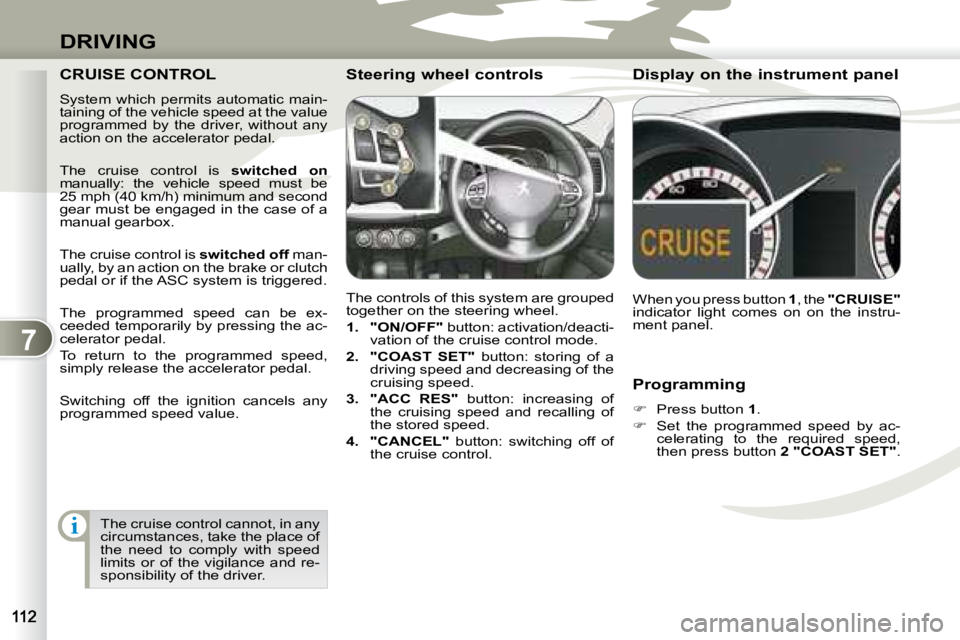
Programming
Press button 1 .
Set the programmed speed by ac-
celerating to the required speed,
then press button 2 "COAST SET" .
CRUISE CONTROL
System which permits automatic main-
taining of the vehicle speed at the value
programmed by the driver, without any
action on the accelerator pedal.
The cruise control is switched on
manually: the vehicle speed must be
25 mph (40 km/h) minimum and second
gear must be engaged in the case of a
manual gearbox.
The cruise control is switched off man-
ually, by an action on the brake or clutch
pedal or if the ASC system is triggered.
The programmed speed can be ex-
ceeded temporarily by pressing the ac-
celerator pedal.
To return to the programmed speed,
simply release the accelerator pedal.
Switching off the ignition cancels any
programmed speed value. The controls of this system are grouped
together on the steering wheel.
1. "ON/OFF" button: activation/deacti-
vation of the cruise control mode.
2. "COAST SET" button: storing of a
driving speed and decreasing of the
cruising speed.
3. "ACC RES" button: increasing of
the cruising speed and recalling of
the stored speed.
4. "CANCEL" button: switching off of
the cruise control. When you press button
1 , the "CRUISE"
indicator light comes on on the instru-
ment panel.
Steering wheel controls Display on the instrument p
anel
The cruise control cannot, in any
circumstances, take the place of
the need to comply with speed
limits or of the vigilance and re-
sponsibility of the driver.
Page 129 of 221
8
CHECKSCHECKS
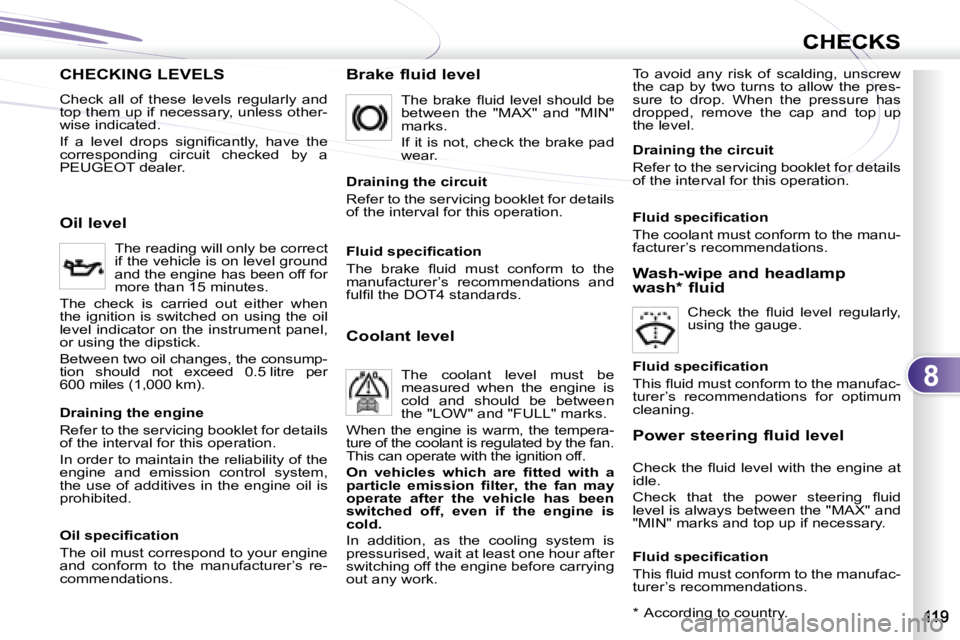
CHECKING LEVELS
Check all of these levels regularly and
top them up if necessary, unless other-
wise indicated.
If a level drops signifi cantly, have the
corresponding circuit checked by a
PEUGEOT dealer. Brake fluid level
To avoid any risk of scalding, unscrew
the cap by two turns to allow the pres-
sure to drop. When the pressure has
dropped, remove the cap and top up
the level.
Oil level The reading will only be correct
if the vehicle is on level ground
and the engine has been off for
more than 15 minutes.
The check is carried out either when
the ignition is switched on using the oil
level indicator on the instrument panel,
or using the dipstick.
Between two oil changes, the consump-
tion should not exceed 0.5 litre per
600 miles (1,000 km). The brake fl uid level should be
between the "MAX" and "MIN"
marks.
If it is not, check the brake pad
wear.
Draining the circuit
Refer to the servicing booklet for details
of the interval for this operation.
Coolant level
The coolant level must be
measured when the engine is
cold and should be between
the "LOW" and "FULL" marks.
When the engine is warm, the tempera-
ture of the coolant is regulated by the fan.
This can operate with the ignition off.
On vehicles which are fi tted with a
particle emission fi lter, the fan may
operate after the vehicle has been
switched off, even if the engine is
cold.
In addition, as the cooling system is
pressurised, wait at least one hour after
switching off the engine before carrying
out any work. Wash-wipe and headlamp
wash * fluid
Check the fl uid level regularly,
using the gauge.
* According to country.
Draining the engine
Refer to the servicing booklet for details
of the interval for this operation.
In order to maintain the reliability of the
engine and emission control system,
the use of additives in the engine oil is
prohibited.
Oil specifi cation
The oil must correspond to your engine
and conform to the manufacturer’s re-
commendations. Fluid specifi cation
The brake fl uid must conform to the
manufacturer’s recommendations and
fulfi l the DOT4 standards.
Draining the circuit
Refer to the servicing booklet for details
of the interval for this operation.
Fluid specifi cation
The coolant must conform to the manu-
facturer’s recommendations.
Fluid specifi cation
This fl uid must conform to the manufac-
turer’s recommendations for optimum
cleaning.
Power steering fluid level
Check the fl uid level with the engine at
idle.
Check that the power steering fl uid
level is always between the "MAX" and
"MIN" marks and top up if necessary.
Fluid specifi cation
This fl uid must conform to the manufac-
turer’s recommendations.
Page 145 of 221

9
PRACTICAL INFORMATION
Fascia fuses
The fuse boxes are placed in the lower
part of the fascia behind the glove box.
Access to the fuses
Open the glove box,
Push the two opening guides A in-
wards to pass the fi rst notch,
Remove the retaining tab B pulling
it outwards,
Support the cover and tilt it down-
wards,
Change the fuse (refer to the cor-
responding paragraph).
Fuse N° Rating Functions
1 * 30 A Heating.
2
15 A Brake lights, third brake light, built-in systems
interface.
3 10 A Rear fog lamps.
4 30 A Windscreen wipers and wash-wipe.
5 10 A Diagnostic socket.
6 20 A Central locking, exterior mirrors.
7 15 A Audio equipment, telematics, multifunction display,
hands-free kit, rear DVD player.
8 7.5 A Remote control key, air conditioning control unit,
instrument panel, controls bar, steering wheel
controls.
9 15 A Multifunction display, instrument panel.
10 15 A Built-in systems interface.
11 15 A Rear wiper.
12 7.5 A Instrument panel, 4 wheel drive control unit,
air conditioning control panel, ABS control
unit, multifunction display, automatic headlamp
adjustment, heated seats, air bags control unit,
steering wheel angle sensor, sunroof, rear screen
demisting, remote control.
13 -
Not used.
14 10 A Ignition switch.
15 20 A Sunroof.
16 10 A Exterior mirrors, audio equipment, telematics, rear
DVD player.