ECO mode PEUGEOT 4007 2009 User Guide
[x] Cancel search | Manufacturer: PEUGEOT, Model Year: 2009, Model line: 4007, Model: PEUGEOT 4007 2009Pages: 230, PDF Size: 16.57 MB
Page 124 of 230
7
DRIVING
Stopping - Starting on a slope
Do not use the accelerator pedal to
immobilise the vehicle on a slope,
apply the handbrake instead.
When starting on a slope, accelerate
gradually while releasing the hand-
brake.
Switching to sequential mode
Once you have moved off, you can
switch to sequential mode by selecting
position +/- .
"D" disappears and the gears engaged
appear in succession on the instrument
panel display.
The gear change requests are only car-
ried out if the engine speed permits it.
Take your foot off the accelerator pedal
gently to engage the gear. Switching to automated mode
Automated mode
After using the sequential mode, you
can return to the automated mode by
selecting position
D .
"D" appears on the instrument panel
display.
The gearbox then operates in auto-
active mode, without any action on
the part of the driver.
It continuously selects the gear most
suited to the following parameters:
- driving style,
- road characteristics,
- vehicle load.
To optimise driving comfort and obtain
the most suitable gear, avoid sharp vari-
ations in the pressure on the accelerator
pedal.
"Auto sequential" mode
In the automated mode, you can
resume control temporarily at any time
using the steering wheel controls.
The use of these controls permits manual
selection of the gears in situations which
require a faster changedown than that
offered in automated mode (arrival at a
roundabout, exit from a car park with a
steep gradient, overtaking...). Stopping the vehicle
Before switching off the engine, you can:
- move to position
N to leave the
gearbox in neutral.
- leave a gear engaged, such as fi rst or reverse.
In both cases, it is imperative that you
apply the handbrake to immobilise the
vehicle.
Operating anomaly
With the ignition on, if the message
"Slow down" or "Maintenance re-
quired" appears on the multifunction
display, this indicates a gearbox mal-
function.
When a message is displayed, carry
out the following operations:
- slow down and stop your vehicle in a safe place,
- place the lever in position N and let
the engine run,
- open the bonnet to allow the engine to cool.
If the message disappears for a long
period, you can set off again.
If the message remains displayed or ap-
pears frequently, contact a PEUGEOT
dealer without delay.
Press the brake pedal fi rmly
while starting the engine.
Start the engine. "N" appears on the in-
strument panel display.
Select fi rst gear (position D or +/- ) or re-
verse (position R ).
Release the handbrake.
Release the brake pedal then accelerate.
"D" or "1" or "R" appear on the instru-
ment panel display. The gearbox engages the gear re-
quested if the engine speed permits it.
The gear engaged appears.
To return to the automated mode, press
the back of the
"+/OFF" control for ap-
proximately 2 seconds.
At low speeds, when approaching a
stop or traffi c lights for example, the
gearbox changes down to fi rst gear au-
tomatically.
Page 125 of 230
7
DRIVING
"DCS" GEARBOX
The six-speed robotised gearbox of-
fers a choice between the comfort of
automatic regulation or the pleasure of
manual gear changing.
This gearbox enables you to access
three driving modes:
- a manual mode for changing of the
gears by the driver using the steer-
ing wheel controls or the gear lever,
- a "
Normal
" automatic mode for
economical control of the gears
(everyday use),
- a "
Sport
" automatic mode which
permits a more dynamic style of
driving, with improved acceleration
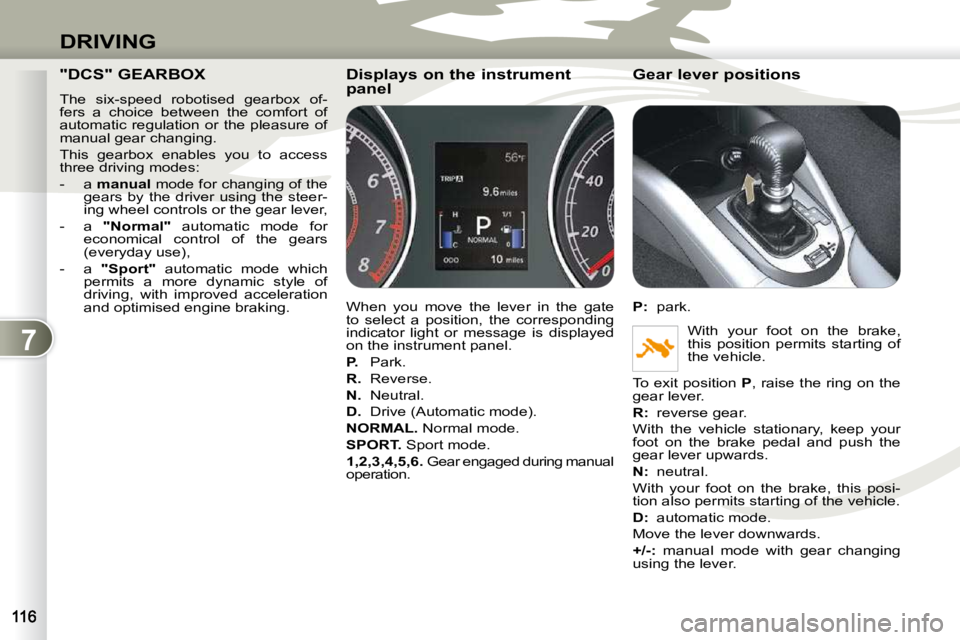
and optimised engine braking. Displays on the instrument
panel
When you move the lever in the gate
to select a position, the corresponding
indicator light or message is displayed
on the instrument panel.
P. Park.
R. Reverse.
N. Neutral.
D. Drive (Automatic mode).
NORMAL. Normal mode.
SPORT. Sport mode.
1,2,3,4,5,6. Gear engaged during manual
operation. Gear lever positions
P
: park.
With your foot on the brake,
this position permits starting of
the vehicle.
To exit position P , raise the ring on the
gear lever.
R
: reverse gear.
With the vehicle stationary, keep your
foot on the brake pedal and push the
gear lever upwards.
N
: neutral.
With your foot on the brake, this posi-
tion also permits starting of the vehicle.
D
: automatic mode.
Move the lever downwards.
+/- : manual mode with gear changing
using the lever.
Page 127 of 230

7
DRIVING
"Normal" automatic mode
Select position D .
"D" appears on the instrument panel
display.
The gearbox then operates in automatic
mode, without any action on the part of
the driver.
To optimise driving comfort and obtain
the most suitable gear, avoid sharp vari-
ations in the pressure on the accelerator
pedal.
"Temporary" manual mode
In the automatic mode, you can resume
control temporarily at any time using
the steering wheel controls.
The use of these controls permits man-
ual selection of the gears in situations
which require a faster changedown than
that offered in automatic mode (arrival
at a roundabout, exit from a car park
with a steep gradient, overtaking...).
The gearbox engages the gear re-
quested if the engine speed permits it.
The gear engaged appears.
To return to the automatic mode, press
the back of the "+/OFF" control for at
least 2 seconds. "Sport" automatic mode
From the automatic mode, you can en-
gage the "Sport" mode.
With the vehicle moving or stationary,
push the dial
A forward.
"SPORT" appears on the instrument
panel display.
Switching off the "Sport" automatic
mode
You can return to the "Normal" auto-
matic mode at any time:
Push the dial A rearward once. Stopping the vehicle
Before switching off the engine, you
must engage position
P or N to place
the gearbox in neutral.
It is imperative that you apply the hand-
brake to immobilise the vehicle.
In order to remove the key from the ig-
nition, the gear lever must be in posi-
tion P .
Stopping - Starting on a hill
To assist you when starting on a hill,
your vehicle is fi tted with a system
which immobilises it briefl y (approxi-
mately 2 seconds), the time required to
move your foot from the brake pedal to
the accelerator pedal. This function is
only active when the vehicle has been
completely immobilised with your foot
on the brake pedal and on certain gra-
dients.
Do not get out of the vehicle during
the hill start assistance temporary
immobilisation phase.
To immobilise the vehicle on a hill for a
longer period, you must use the hand-
brake, not the accelerator.
When starting on a hill, accelerate gradu-
ally while releasing the handbrake.
Page 129 of 230
7
DRIVING
FOUR WHEEL DRIVE SYSTEM
WITH ELECTRONIC CONTROL
4WD AUTO (position 1)
The vehicle operates with four wheel
drive and provides optimum traction re-
gardless of the level of grip.
This is the vehicle's normal and regular
operating mode, the distribution of the
torque between the front and rear axles
is controlled automatically.
The distribution favours the front wheels,
the transfer of torque to the rear wheels
is managed electronically by the control
unit in relation to the level of grip, so
guaranteeing optimum road holding.
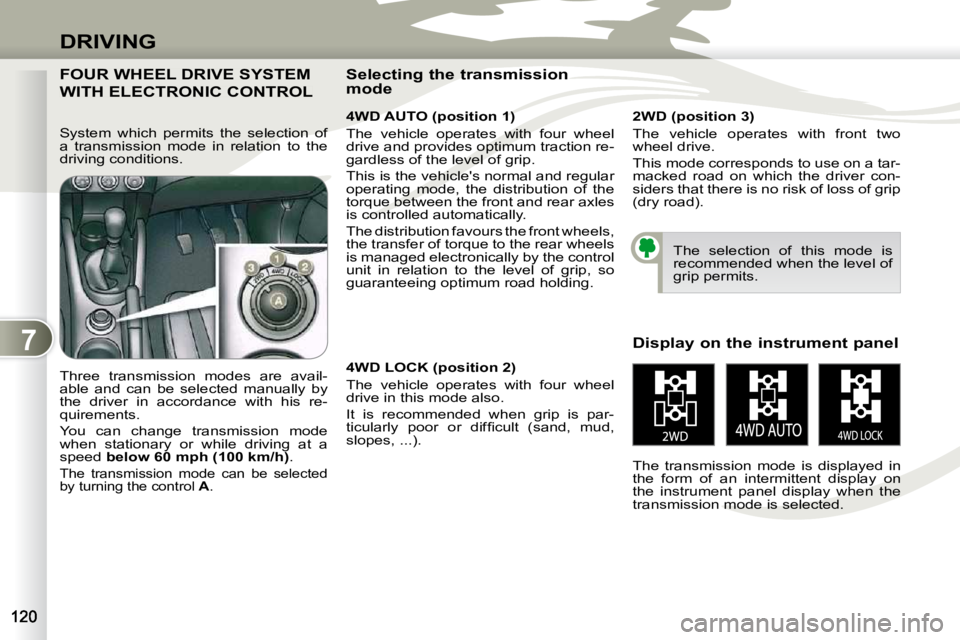
Three transmission modes are avail-
able and can be selected manually by
the driver in accordance with his re-
quirements.
You can change transmission mode
when stationary or while driving at a
speed below 60 mph (100 km/h) .
The transmission mode can be selected
by turning the control A .
Display on the instrument panel
The transmission mode is displayed in
the form of an intermittent display on
the instrument panel display when the
transmission mode is selected.
Selecting the transmission
mode
The selection of this mode is
recommended when the level of
grip permits.
2WD (position 3)
The vehicle operates with front two
wheel drive.
This mode corresponds to use on a tar-
macked road on which the driver con-
siders that there is no risk of loss of grip
(dry road).
4WD LOCK (position 2)
The vehicle operates with four wheel
drive in this mode also.
It is recommended when grip is par-
ticularly poor or diffi cult (sand, mud,
slopes, ...).
System which permits the selection of
a transmission mode in relation to the
driving conditions.
Page 174 of 230
11
AUDIO EQUIPMENT and TELEMATICS
STEERING WHEEL CONTROLS STEERING WHEEL CONTROLS
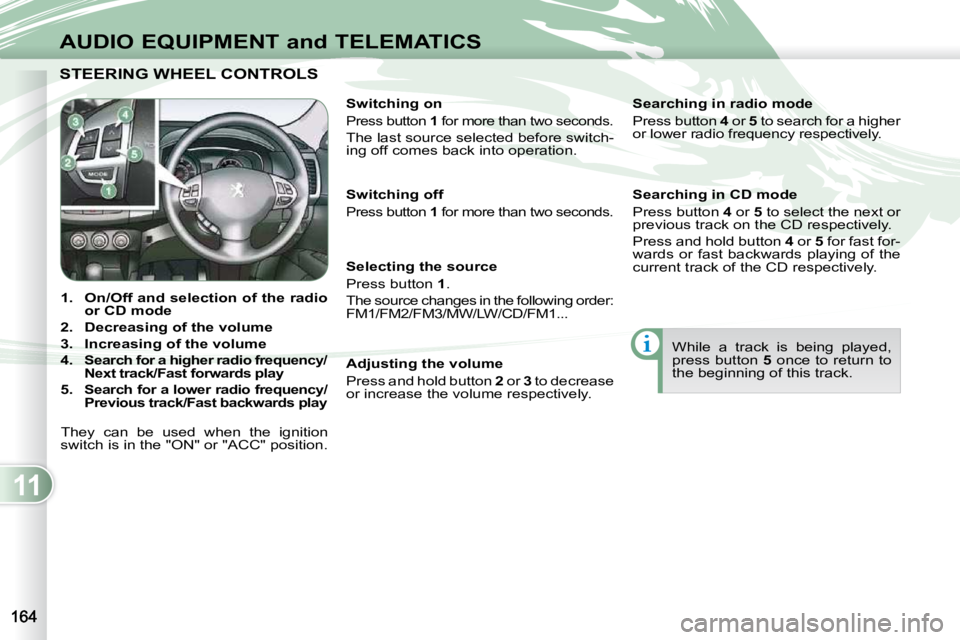
1. On/Off and selection of the radio
or CD mode
2. Decreasing of the volume
3. Increasing of the volume
4.
Search for a higher radio frequency/
Next track/Fast forwards play
5. Search for a lower radio frequency/
Previous track/Fast backwards play
They can be used when the ignition
switch is in the "ON" or "ACC" position. Switching on
Press button
1 for more than two seconds.
The last source selected before switch-
ing off comes back into operation.
Selecting the source
Press button 1 .
The source changes in the following order:
FM1/FM2/FM3/MW/LW/CD/FM1... Searching in radio mode
Press button
4 or 5 to search for a higher
or lower radio frequency respectively.
While a track is being played,
press button 5 once to return to
the beginning of this track.
Adjusting the volume
Press and hold button
2 or 3 to decrease
or increase the volume respectively.
Switching off
Press button
1 for more than two seconds.
Searching in CD mode
Press button 4 or 5 to select the next or
previous track on the CD respectively.
Press and hold button 4 or 5 for fast for-
wards or fast backwards playing of the
current track of the CD respectively.
Page 175 of 230

11
AUDIO EQUIPMENT and TELEMATICS
GENERAL FUNCTIONS
Switching on Press the "PWR" button.
The last source selected be-
fore switching off resumes
operation.
The audio equipment func-
tions can be used when the ignition
switch is in the "ON or "ACC" position.
Adjusting the volume
Turn the "VOL" dial respec-
tively to the left to decrease
the volume or to the right to
increase it.
Switching off
Press the "PWR" button again. Setting the audio modes
Press the "SOUND" but-
ton several times; the audio
modes change in the follow-
ing order:
SUB PUNCH/TYPE/FIELD/
BASS/MID/TREBLE/FADER/
BALANCE/OFF.
Quick access mode
To access the personalised sound func-
tions quickly, press and hold this button,
then turn it to reach the personalised
sound setting of your choice.
Release the button to store the setting.
"Hold" mode
If you press this button for more than
2 seconds in the audio setting mode,
the system switches to "Hold" mode.
The audio mode selected will be re-
tained until you press this button again
for more than 2 seconds. Selecting the musical ambience
"TYPE"
Turn the "SOUND" dial; the
musical ambiences change
in the following order:
CLASSIC/JAZZ/POP/ROCK/
HIP-HOP.
Once the ambience has been selected,
press the "SOUND" button to confi rm.
"CLASSIC": optimises the acoustics to
obtain perfect equalisation of the sound
for classical music.
"JAZZ": optimises the acoustics to
obtain an ambient sound with speciifc
modulations in the bass, mid tone and
treble for jazz.
"POP": optimises the acoustics to obtain
clear vocals and modulation of the bass
and treble for pop music.
"ROCK": optimises the acoustics to
obtain a sound in harmony with the
rhythm which places the emphasis on
the mid tone for rock music.
"HIP-HOP": optimises the acoustics to
obtain a powerful sound and accentua-
tion of the bass for hip-hop music.
If the "TYPE" is changed, the
sound cuts out briefl y.
The audio setting mode is deacti-
vated when the radio is operated
or a CD is played or after approx-
imately 10 seconds without any
action.
Page 176 of 230

11
AUDIO EQUIPMENT and TELEMATICS
Selecting the surround effect
"FIELD" Turn the "SOUND" dial; the
surround effects change in
the following order:
N O R M A L / S TA G E / L I V E /
HALL.
"NORMAL": produces a sound in which
the voices are at the front and the in-
struments surround the listener.
"STAGE": produces a sound in which
the voices are immediately facing the
listener, as on a stage.
"LIVE": produces a sound similar to
that of a live show, in which the sound
reaches the listener from all directions.
"HALL": produces a sound similar to
that of a concert hall with defl ection of
the sound. Setting the bass "BASS"
Turn the "SOUND" dial to
set the required bass value.
Setting the mid tone "MID"
Turn the "SOUND" dial to set the required
mid tone value.
Setting the treble "TREBLE"
Turn the "SOUND" dial to set the required
treble value.
Setting the front/rear sound
distribution "FADER"
Turn the "SOUND" dial to set the bal-
ance of the volume of the front and rear
speakers.
Setting the right/left sound
distribution "BALANCE"
Turn the "SOUND" dial to set the bal-
ance of the volume of the right and left
speakers.
If the "FIELD" is changed, the
sound cuts out briefl y. If the value "0" is set, an audible
signal will be heard. Automatic volume adjustment
"SCV"
This permits automatic adjustment of
the "VOLUME", "BASS", "MID" and
"TREBLE" parameters in relation to the
vehicle speed.
Press the "SOUND" button
for more than two seconds
to gain access to the func-
tions setting mode.
Then, press this same button
several times; the functions
setting mode changes in the following
order:
AF/CT/REG/TP-S/PTY (languages)/SCV/
PHONE/OFF.
Turn the "SOUND" dial respectively to
the left to deactivate the function or to
the right to activate it. If the "SUB PUNCH" is changed,
the sound cuts out briefl y.
Setting the volume of the bass
box "SUB PUNCH"
Turn the "SOUND" dial to set the vol-
ume of the bass box.
Only vehicles fi tted with the "Premium
Sound" system can offer the "SUB PUNCH"
setting.
Once the surround effect has been se-
lected, press the "SOUND" button to
confi rm.
Page 177 of 230
11
AUDIO EQUIPMENT and TELEMATICS
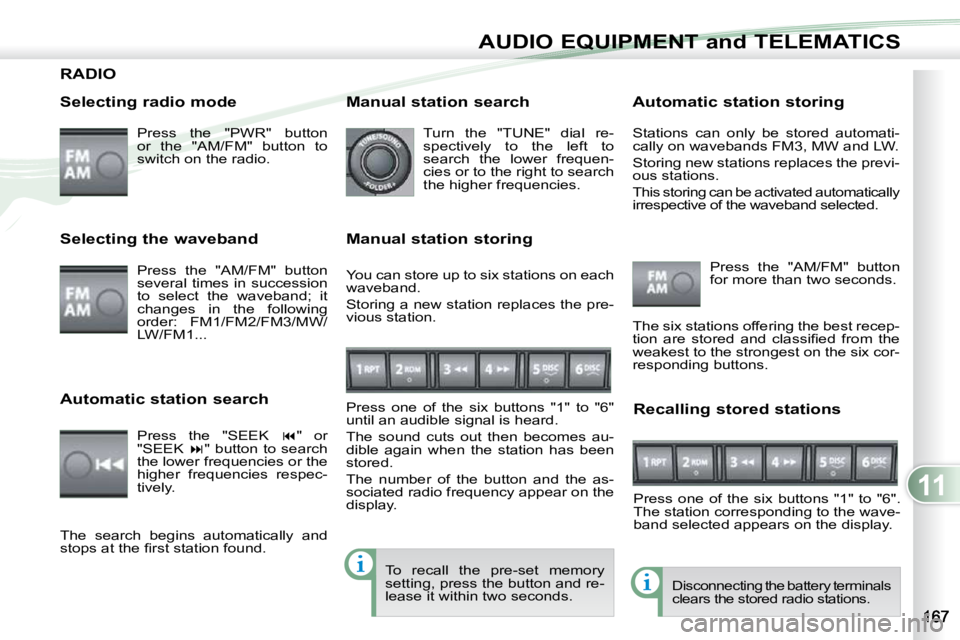
RADIO
Selecting radio mode Press the "PWR" button
or the "AM/FM" button to
switch on the radio.
Disconnecting the battery terminals
clears the stored radio stations.
Selecting the waveband
Press the "AM/FM" button
several times in succession
to select the waveband; it
changes in the following
order: FM1/FM2/FM3/MW/
LW/FM1...
Automatic station search Press the "SEEK " or
"SEEK " button to search
the lower frequencies or the
higher frequencies respec-
tively. Manual station search
Turn the "TUNE" dial re-
spectively to the left to
search the lower frequen-
cies or to the right to search
the higher frequencies.
Manual station storing
Press one of the six buttons "1" to "6"
until an audible signal is heard.
The sound cuts out then becomes au-
dible again when the station has been
stored.
The number of the button and the as-
sociated radio frequency appear on the
display. Automatic station storing
Press the "AM/FM" button
for more than two seconds.
Recalling stored stations
Press one of the six buttons "1" to "6".
The station corresponding to the wave-
band selected appears on the display.
The search begins automatically and
stops at the fi rst station found. The six stations offering the best recep-
tion are stored and classifi ed from the
weakest to the strongest on the six cor-
responding buttons.
You can store up to six stations on each
waveband.
Storing a new station replaces the pre-
vious station. Stations can only be stored automati-
cally on wavebands FM3, MW and LW.
Storing new stations replaces the previ-
ous stations.
This storing can be activated automatically
irrespective of the waveband selected.
To recall the pre-set memory
setting, press the button and re-
lease it within two seconds.
Page 178 of 230
11
AUDIO EQUIPMENT and TELEMATICS
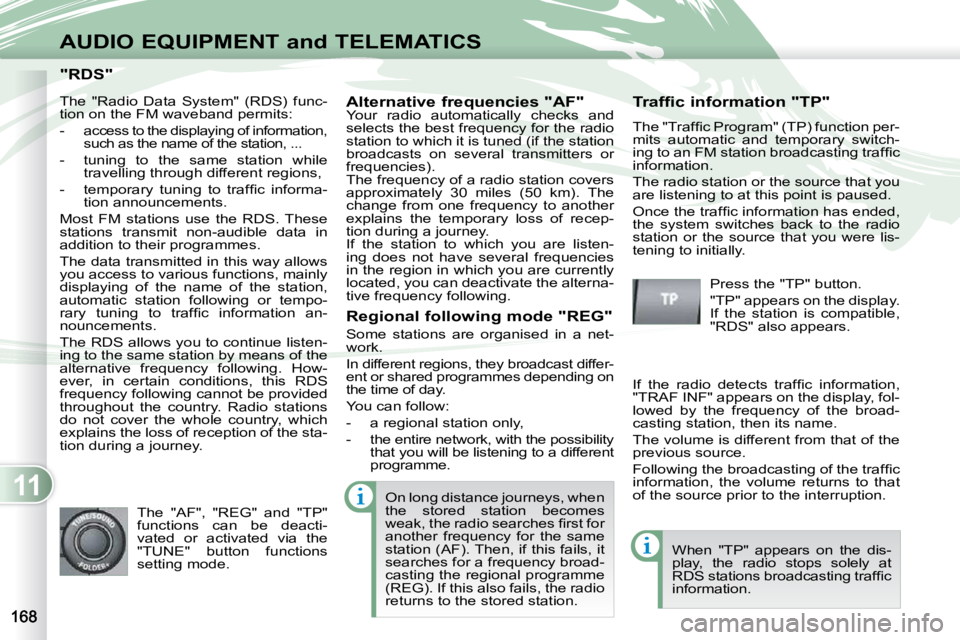
"RDS" "RDS"
Alternative frequencies "AF"
Your radio automatically checks and
selects the best frequency for the radio
station to which it is tuned (if the station
broadcasts on several transmitters or
frequencies).
The frequency of a radio station covers
approximately 30 miles (50 km). The
change from one frequency to another
explains the temporary loss of recep-
tion during a journey.
If the station to which you are listen-
ing does not have several frequencies
in the region in which you are currently
located, you can deactivate the alterna-
tive frequency following. Traffic information "TP"
The "Traffi c Program" (TP) function per-
mits automatic and temporary switch-
ing to an FM station broadcasting traffi c
information.
The radio station or the source that you
are listening to at this point is paused.
Once the traffi c information has ended,
the system switches back to the radio
station or the source that you were lis-
tening to initially.
Regional following mode "REG"
Some stations are organised in a net-
work.
In different regions, they broadcast differ-
ent or shared programmes depending on
the time of day.
You can follow:
- a regional station only,
- the entire network, with the possibility that you will be listening to a different
programme.
The "AF", "REG" and "TP"
functions can be deacti-
vated or activated via the
"TUNE" button functions
setting mode. Press the "TP" button.
"TP" appears on the display.
If the station is compatible,
"RDS" also appears.
If the radio detects traffi c information,
"TRAF INF" appears on the display, fol-
lowed by the frequency of the broad-
casting station, then its name.
The volume is different from that of the
previous source.
Following the broadcasting of the traffi c
information, the volume returns to that
of the source prior to the interruption. When "TP" appears on the dis-
play, the radio stops solely at
RDS stations broadcasting traffi c
information.
On long distance journeys, when
the stored station becomes
weak, the radio searches fi rst for
another frequency for the same
station (AF). Then, if this fails, it
searches for a frequency broad-
casting the regional programme
(REG). If this also fails, the radio
returns to the stored station.
The "Radio Data System" (RDS) func-
tion on the FM waveband permits:
-
access to the displaying of information,
such as the name of the station, ...
- tuning to the same station while
travelling through different regions,
- temporary tuning to traffi c informa- tion announcements.
Most FM stations use the RDS. These
stations transmit non-audible data in
addition to their programmes.
The data transmitted in this way allows
you access to various functions, mainly
displaying of the name of the station,
automatic station following or tempo-
rary tuning to traffi c information an-
nouncements.
The RDS allows you to continue listen-
ing to the same station by means of the
alternative frequency following. How-
ever, in certain conditions, this RDS
frequency following cannot be provided
throughout the country. Radio stations
do not cover the whole country, which
explains the loss of reception of the sta-
tion during a journey.
Page 179 of 230

11
AUDIO EQUIPMENT and TELEMATICS
Themed type of programme
"PTY"
Some stations offer the option of listen-
ing to a themed type of programme as a
priority, selected from the list available
below:
NEWS, AFFAIRS, INFO, SPORT, EDU-
CATE, DRAMA, CULTURE, SCIENCE,
VARIED, POP M, ROCK M, EASY M,
L I G H T M , C L A S S I C S , O T H E R M ,
WEATHER, FINANCE, CHILDREN, SO-
CIAL, RELIGION, PHONE IN, TRAVEL,
LEISURE, JAZZ, COUNTRY, NATION M,
OLDIES, FOLK M, DOCUMENT.
Emergency broadcasts
"ALERT"
An emergency broadcast automatically
and temporarily interrupts the FM station
or the source that you are listening to.
The message "ALERT" appears on the
display and the volume is different from
that of the previous source.
Following the emergency broadcast,
the message disappears and the vol-
ume returns to that of the source prior
to the interruption.
Search for a "PTY" broadcast
Press the "PTY" button.
Turn the "TUNE" dial to se-
lect the type of programme
required.
Two seconds later, the radio searches
for a broadcast which corresponds to
your selection; the type of PTY selected
fl ashes on the display.
Once the station has been found, its
name appears on the display.
You can press the "SEEK " or "SEEK "
buttons to fi nd another station.
If no station is found corre-
sponding to your selected type
of programme, "NONE" appears
on the display for fi ve seconds
and the radio returns to the pre-
vious station.
Storing a "PTY" programme
You can store up to six PTY programmes.
Each new programme stored replaces
the previous one. To recall the pre-set memory
setting, press the button and re-
lease it within two seconds.
Changing the display language of
the "PTY" programme Press the "TUNE" button for
more than two seconds to
access the functions setting
mode.
Then, press this button several times in
succession; the functions setting mode
changes in the following order:
AF/CT/REG/TP-S/PTY (languages)/SCV/
PHONE/OFF.
Turn the "TUNE" dial to the left or to the
right to select the language (ENGLISH,
FRANCAIS, DEUTSCH, SVENSK,
ESPAGNOL, ITALIANO).
The sound cuts out then becomes au-
dible again when the programme has
been stored.
The number of the button and the asso-
ciated PTY programme appear on the
display.
Turn the "TUNE" dial to set
the PTY programme to be
stored.
Press one of the six buttons
"1" to "6" for more than two
seconds.