traction control PEUGEOT 4007 2010.5 Owners Manual
[x] Cancel search | Manufacturer: PEUGEOT, Model Year: 2010.5, Model line: 4007, Model: PEUGEOT 4007 2010.5Pages: 215, PDF Size: 15.37 MB
Page 96 of 215
6
SAFETY
The ASC/TCL systems offer
exceptional safety in normal driv-
ing, but this should not encourage
the driver to take extra risks or
drive at high speed.
The correct functioning of these
systems depends on observa-
tion of the manufacturer's rec-
ommendations regarding the
wheels (tyres and rims), the
braking components, the elec-
tronic components and the as-
sembly and repair procedures
used by PEUGEOT dealers.
After an impact, have these sys-
tems checked by a PEUGEOT
dealer.
Deactivation
In exceptional conditions (starting a
vehicle which is bogged down, stuck
in snow, on soft ground, ...), it may be
better to deactivate the ASC system, so
that the wheels can move freely and re-
gain grip.
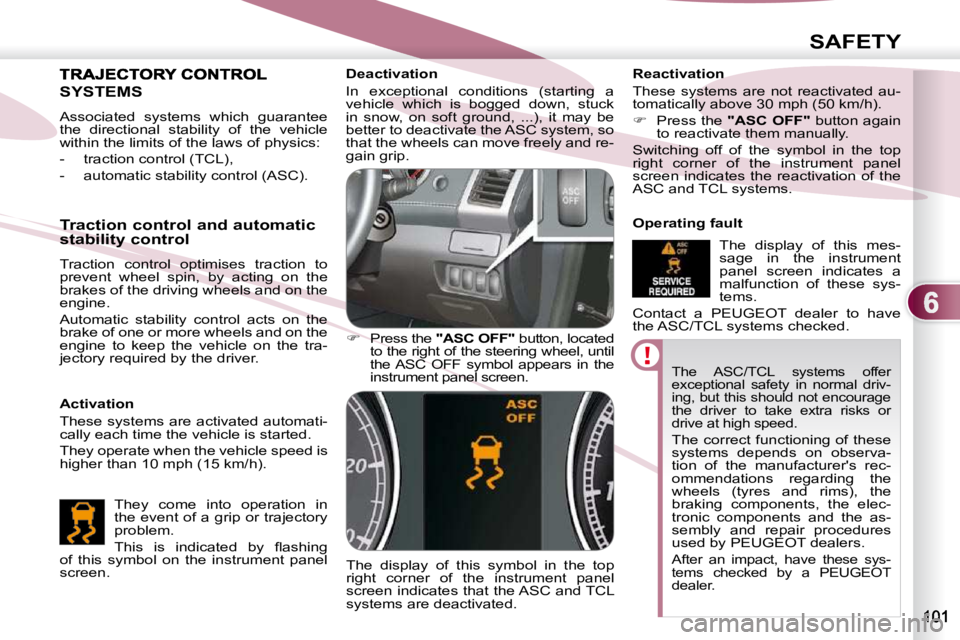
Press the "ASC OFF" button, located
to the right of the steering wheel, until
the ASC OFF symbol appears in the
instrument panel screen.
The display of this symbol in the top
right corner of the instrument panel
screen indicates that the ASC and TCL
systems are deactivated. Reactivation
These systems are not reactivated au-
tomatically above 30 mph (50 km/h).
Press the "ASC OFF" button again
to reactivate them manually.
Switching off of the symbol in the top
right corner of the instrument panel
screen indicates the reactivation of the
ASC and TCL systems.
Operating fault
The display of this mes-
sage in the instrument
panel screen indicates a
malfunction of these sys-
tems.
Contact a PEUGEOT dealer to have
the ASC/TCL systems checked.
SYSTEMS
Activation
These systems are activated automati-
cally each time the vehicle is started.
They operate when the vehicle speed is
higher than 10 mph (15 km/h).
Traction control and automatic
stability control
Traction control optimises traction to
prevent wheel spin, by acting on the
brakes of the driving wheels and on the
engine.
Automatic stability control acts on the
brake of one or more wheels and on the
engine to keep the vehicle on the tra-
jectory required by the driver.
They come into operation in
the event of a grip or trajectory
problem.
This is indicated by fl ashing
of this symbol on the instrument panel
screen.
Associated systems which guarantee
the directional stability of the vehicle
within the limits of the laws of physics:
- traction control (TCL),
- automatic stability control (ASC).
Page 111 of 215
7
DRIVING
FOUR WHEEL DRIVE SYSTEM
WITH ELECTRONIC CONTROL
4WD AUTO (position 1)
The vehicle operates with four wheel
drive and provides optimum traction re-
gardless of the level of grip.
This is the vehicle's normal and regular
operating mode, the distribution of the
torque between the front and rear axles
is controlled automatically.
The distribution favours the front wheels, the transfer of torque to the rear wheels
is managed electronically by the control
unit in relation to the level of grip, so
guaranteeing optimum road holding.
Three transmission modes are avail-
able and can be selected manually by
the driver in accordance with his re-
quirements.
You can change transmission mode
when stationary or while driving at a
speed below 60 mph (100 km/h) .
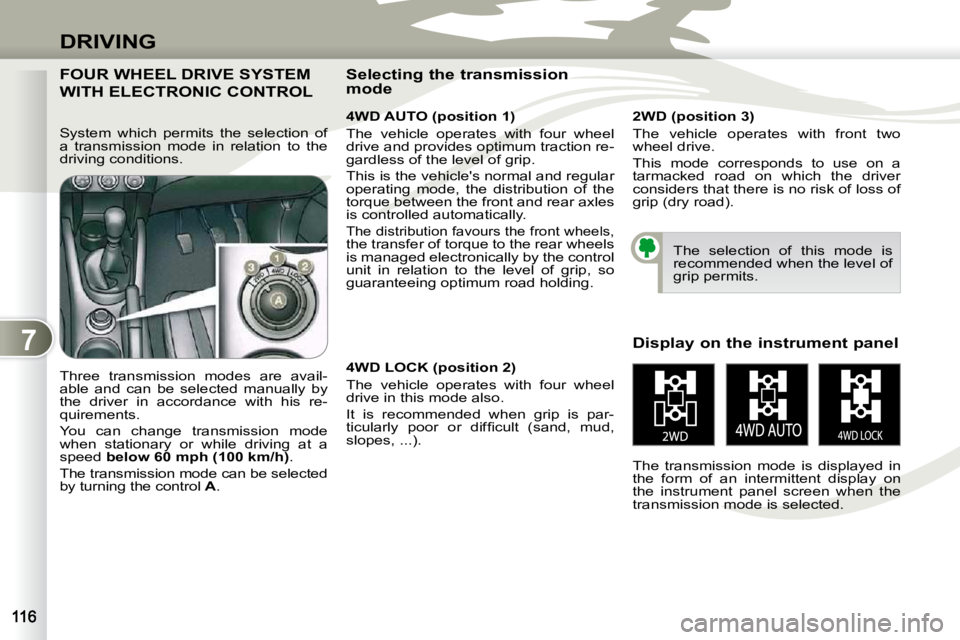
The transmission mode can be selected
by turning the control A . Display on the instrument panel
The transmission mode is displayed in
the form of an intermittent display on
the instrument panel screen when the
transmission mode is selected.
Selecting the transmission
mode
The selection of this mode is
recommended when the level of
grip permits.
2WD (position 3)
The vehicle operates with front two
wheel drive.
This mode corresponds to use on a
tarmacked road on which the driver
considers that there is no risk of loss of
grip (dry road).
4WD LOCK (position 2)
The vehicle operates with four wheel
drive in this mode also.
It is recommended when grip is par-
ticularly poor or diffi cult (sand, mud,
slopes, ...).
System which permits the selection of
a transmission mode in relation to the
driving conditions.