instrument panel PEUGEOT 4007 2010 User Guide
[x] Cancel search | Manufacturer: PEUGEOT, Model Year: 2010, Model line: 4007, Model: PEUGEOT 4007 2010Pages: 215, PDF Size: 15.37 MB
Page 72 of 215
3
ACCESS
Before opening the tailgate,
ensure that no one is within the
radius of opening.
For reasons of safety and cor-
rect operation, do not drive with
the tailgate open.
If the battery is disconnected,
the tailgate cannot be opened.
Do not climb onto the lower tail-
gate and do not subject it to heavy
knocks, it may be damaged.
Always close the lower tailgate
and check that it is secured cor-
rectly before closing the main
tailgate.
When closing the lower tailgate,
ensure that no person or object
is in the proximity of the moving
parts to avoid any risk of injury
or damage.
Do not open the lower tailgate
when a towbar is fi tted.
"Tailgate open" warning
This warning lamp comes on on
the instrument panel screen when
the tailgate is not closed correctly.
LOWER TAILGALOWER TAILGATE
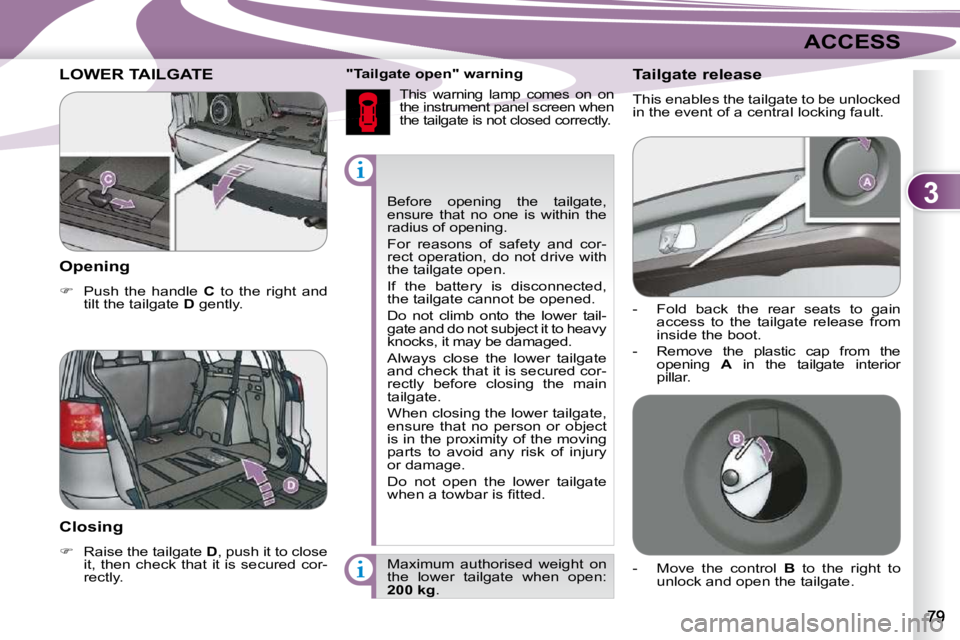
Opening
Push the handle C to the right and
tilt the tailgate D gently.
Closing
Raise the tailgate D , push it to close
it, then check that it is secured cor-
rectly. Maximum authorised weight on
the lower tailgate when open:
200 kg . Tailgate release
This enables the tailgate to be unlocked
in the event of a central locking fault.
- Fold back the rear seats to gain
access to the tailgate release from
inside the boot.
- Remove the plastic cap from the opening A in the tailgate interior
pillar.
- Move the control B to the right to
unlock and open the tailgate.
Page 95 of 215
6
SAFETY
BRAKING ASSISTANCE
SYSTEMS
Group of supplementary systems which
help you to obtain optimum braking in
complete safety in emergency situa-
tions:
- anti-lock braking system (ABS),
- electronic brake force distribution (EBFD).
When braking in an emergency,
press very fi rmly without releas-
ing the pressure. The two warning lamps comes
on at the same time and the two
warnings are displayed alter-
nately on the instrument panel
screen.
When replacing wheels (tyres
and rims), ensure that they
conform to the manufacturer's
recommendations.
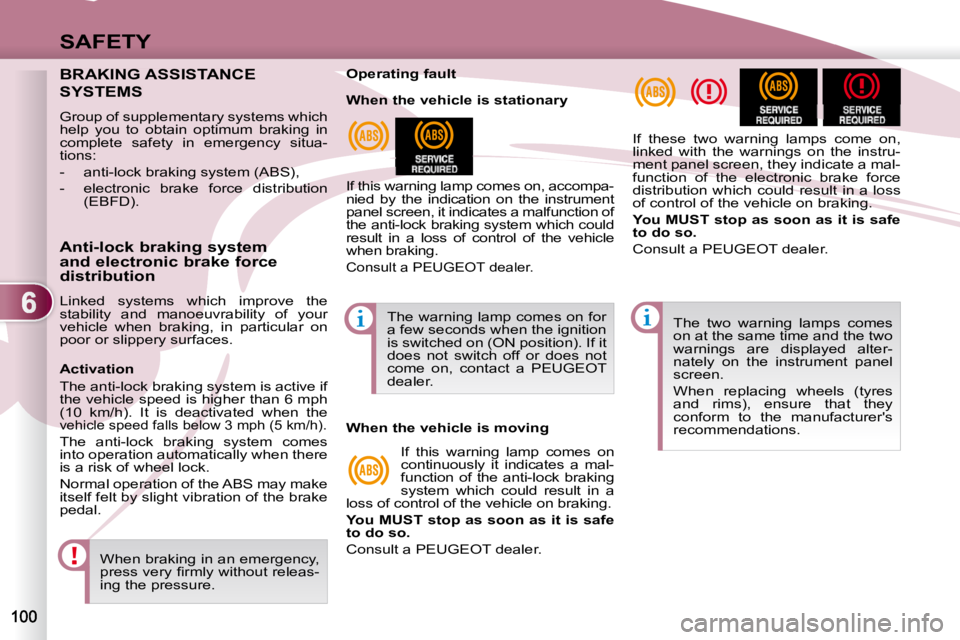
Operating fault
If this warning lamp comes on, accompa-
nied by the indication on the instrument
panel screen, it indicates a malfunction of
the anti-lock braking system which could
result in a loss of control of the vehicle
when braking.
Consult a PEUGEOT dealer.
If these two warning lamps come on,
linked with the warnings on the instru-
ment panel screen, they indicate a mal-
function of the electronic brake force
distribution which could result in a loss
of control of the vehicle on braking.
You MUST stop as soon as it is safe
to do so.
Consult a PEUGEOT dealer.
Anti-lock braking system
and electronic brake force
distribution
Linked systems which improve the
stability and manoeuvrability of your
vehicle when braking, in particular on
poor or slippery surfaces. The warning lamp comes on for
a few seconds when the ignition
is switched on (ON position). If it
does not switch off or does not
come on, contact a PEUGEOT
dealer.
When the vehicle is stationary
When the vehicle is moving
If this warning lamp comes on
continuously it indicates a mal-
function of the anti-lock braking
system which could result in a
loss of control of the vehicle on braking.
You MUST stop as soon as it is safe
to do so.
Consult a PEUGEOT dealer.
Activation
The anti-lock braking system is active if
the vehicle speed is higher than 6 mph
(10 km/h). It is deactivated when the
vehicle speed falls below 3 mph (5 km/h).
The anti-lock braking system comes
into operation automatically when there
is a risk of wheel lock.
Normal operation of the ABS may make
itself felt by slight vibration of the brake
pedal.
Page 96 of 215
6
SAFETY
The ASC/TCL systems offer
exceptional safety in normal driv-
ing, but this should not encourage
the driver to take extra risks or
drive at high speed.
The correct functioning of these
systems depends on observa-
tion of the manufacturer's rec-
ommendations regarding the
wheels (tyres and rims), the
braking components, the elec-
tronic components and the as-
sembly and repair procedures
used by PEUGEOT dealers.
After an impact, have these sys-
tems checked by a PEUGEOT
dealer.
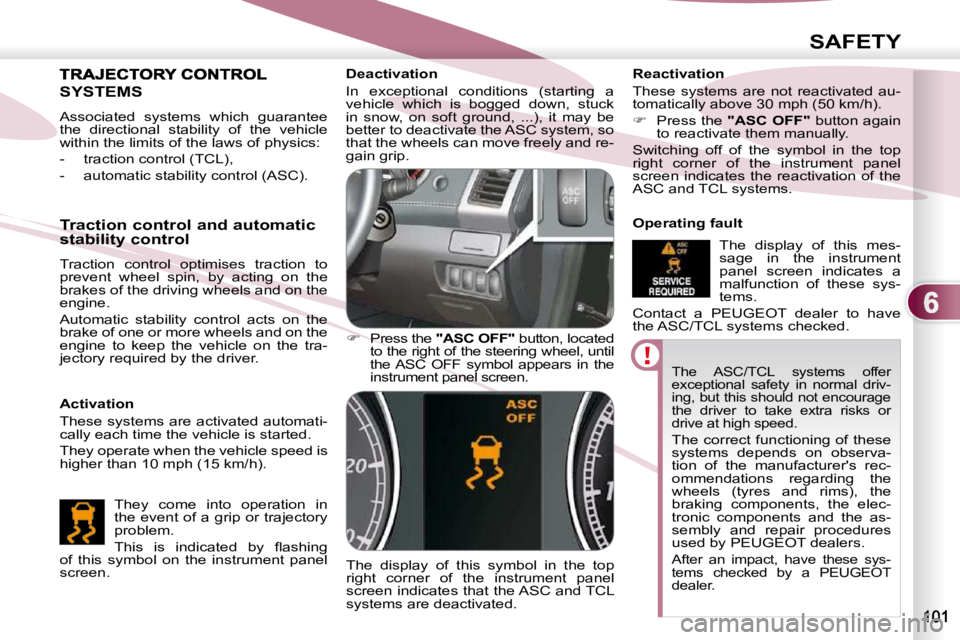
Deactivation
In exceptional conditions (starting a
vehicle which is bogged down, stuck
in snow, on soft ground, ...), it may be
better to deactivate the ASC system, so
that the wheels can move freely and re-
gain grip.
Press the "ASC OFF" button, located
to the right of the steering wheel, until
the ASC OFF symbol appears in the
instrument panel screen.
The display of this symbol in the top
right corner of the instrument panel
screen indicates that the ASC and TCL
systems are deactivated. Reactivation
These systems are not reactivated au-
tomatically above 30 mph (50 km/h).
Press the "ASC OFF" button again
to reactivate them manually.
Switching off of the symbol in the top
right corner of the instrument panel
screen indicates the reactivation of the
ASC and TCL systems.
Operating fault
The display of this mes-
sage in the instrument
panel screen indicates a
malfunction of these sys-
tems.
Contact a PEUGEOT dealer to have
the ASC/TCL systems checked.
SYSTEMS
Activation
These systems are activated automati-
cally each time the vehicle is started.
They operate when the vehicle speed is
higher than 10 mph (15 km/h).
Traction control and automatic
stability control
Traction control optimises traction to
prevent wheel spin, by acting on the
brakes of the driving wheels and on the
engine.
Automatic stability control acts on the
brake of one or more wheels and on the
engine to keep the vehicle on the tra-
jectory required by the driver.
They come into operation in
the event of a grip or trajectory
problem.
This is indicated by fl ashing
of this symbol on the instrument panel
screen.
Associated systems which guarantee
the directional stability of the vehicle
within the limits of the laws of physics:
- traction control (TCL),
- automatic stability control (ASC).
Page 98 of 215
6
SAFETY
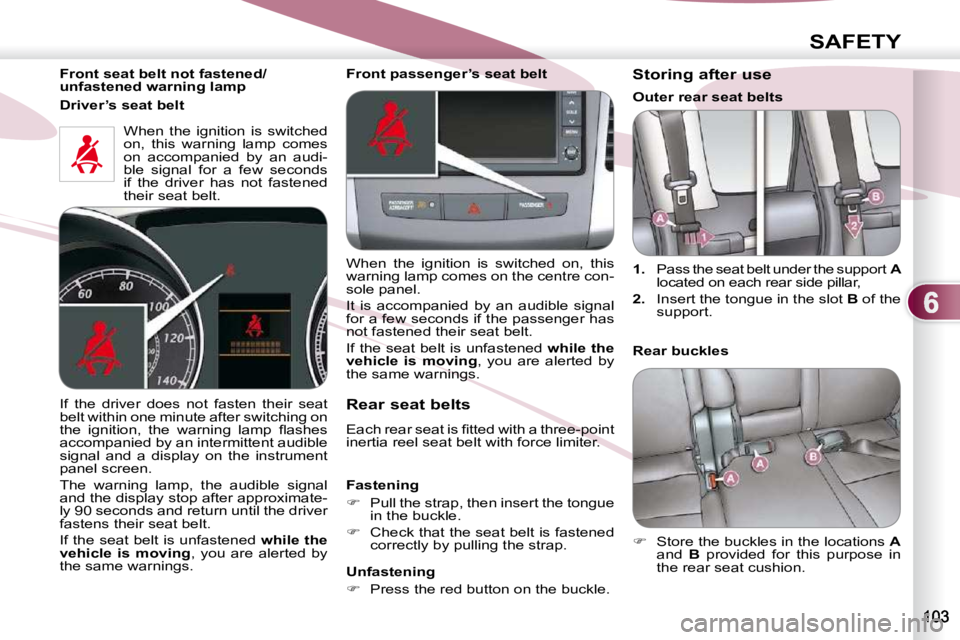
Front seat belt not fastened/
unfastened warning lamp When the ignition is switched
on, this warning lamp comes
on accompanied by an audi-
ble signal for a few seconds
if the driver has not fastened
their seat belt.
Rear seat belts
Each rear seat is fi tted with a three-point
inertia reel seat belt with force limiter.
Fastening
Pull the strap, then insert the tongue
in the buckle.
Check that the seat belt is fastened
correctly by pulling the strap.
Unfastening
Press the red button on the buckle.
If the driver does not fasten their seat
belt within one minute after switching on
the ignition, the warning lamp fl ashes
accompanied by an intermittent audible
signal and a display on the instrument
panel screen.
The warning lamp, the audible signal
and the display stop after approximate-
ly 90 seconds and return until the driver
fastens their seat belt.
If the seat belt is unfastened
while the
vehicle is moving , you are alerted by
the same warnings. Storing after use
1. Pass the seat belt under the support A
located on each rear side pillar,
2. Insert the tongue in the slot B of the
support.
Rear buckles
Store the buckles in the locations A
and B provided for this purpose in
the rear seat cushion.
Driver’s seat belt
Outer rear seat belts
Front passenger’s seat belt
When the ignition is switched on, this
warning lamp comes on the centre con-
sole panel.
It is accompanied by an audible signal
for a few seconds if the passenger has
not fastened their seat belt.
If the seat belt is unfastened
while the
vehicle is moving , you are alerted by
the same warnings.
Page 101 of 215
6
SAFETY
If the airbag warning lamp and
the display come on continuous-
ly, do not install a "rear facing"
child seat on the front passen-
ger seat.
Consult a PEUGEOT dealer.
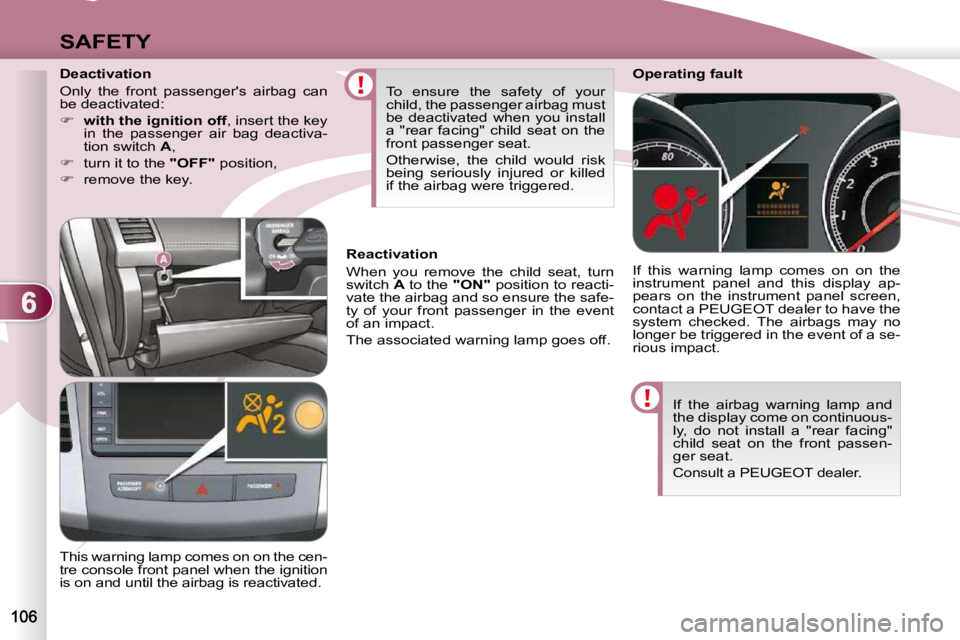
Operating fault
If this warning lamp comes on on the
instrument panel and this display ap-
pears on the instrument panel screen,
contact a PEUGEOT dealer to have the
system checked. The airbags may no
longer be triggered in the event of a se-
rious impact.
To ensure the safety of your
child, the passenger airbag must
be deactivated when you install
a "rear facing" child seat on the
front passenger seat.
Otherwise, the child would risk
being seriously injured or killed
if the airbag were triggered.
This warning lamp comes on on the cen-
tre console front panel when the ignition
is on and until the airbag is reactivated. Reactivation
When you remove the child seat, turn
switch
A to the "ON" position to reacti-
vate the airbag and so ensure the safe-
ty of your front passenger in the event
of an impact.
The associated warning lamp goes off.
Deactivation
Only the front passenger's airbag can
be deactivated:
with the ignition off , insert the key
in the passenger air bag deactiva-
tion switch A ,
turn it to the "OFF" position,
remove the key.
Page 106 of 215
7
DRIVING
Stopping - Starting on a slope
Do not use the accelerator pedal to
immobilise the vehicle on a slope,
apply the
parking brake
instead.
When starting on a slope, accelerate
gradually while releasing the parking
brake.
Switching to sequential mode
Once you have moved off, you can
switch to sequential mode by selecting
position +/- .
"D" disappears and the gears engaged
appear in succession on the instrument
panel screen.
The gear change requests are only car-
ried out if the engine speed permits it.
Take your foot off the accelerator pedal
gently to engage the gear. Switching to automated mode
Automated mode
After using the sequential mode, you
can return to the automated mode by
selecting position
D .
"D" appears on the instrument panel
screen.
The gearbox then operates in auto-
active mode, without any action on the
part of the driver.
It continuously selects the gear most
suited to the conditions of:
- driving style,
- road characteristics,
- vehicle load.
To optimise driving comfort and obtain
the most suitable gear, avoid sharp vari-
ations in the pressure on the accelerator
pedal.
Auto sequential mode
In the automated mode, you can take
over control temporarily at any time us-
ing the steering mounted controls.
The use of these controls permits manual
selection of the gears in situations which
require a faster changedown than that
offered in automated mode (arrival at a
roundabout, exit from a car park with a
steep gradient, overtaking...).
Stopping the vehicle
Before switching off the engine, you
can:
- move to position N to leave the
gearbox in neutral.
- leave a gear engaged, such as fi rst or reverse.
In both cases, you must apply the park-
ing brake to immobilise the vehicle.
Operating anomaly
With the ignition on, if the message
"Slow down" or "Maintenance re-
quired" appears on the multifunction
screen, this indicates a gearbox mal-
function.
When a message is displayed, carry
out the following operations:
- slow down and stop your vehicle in a safe place,
- place the lever in position N and let
the engine run,
- open the bonnet to allow the engine to cool.
If the message disappears for a long
period, you can set off again.
If the message remains displayed or ap-
pears frequently, contact a PEUGEOT
dealer without delay.
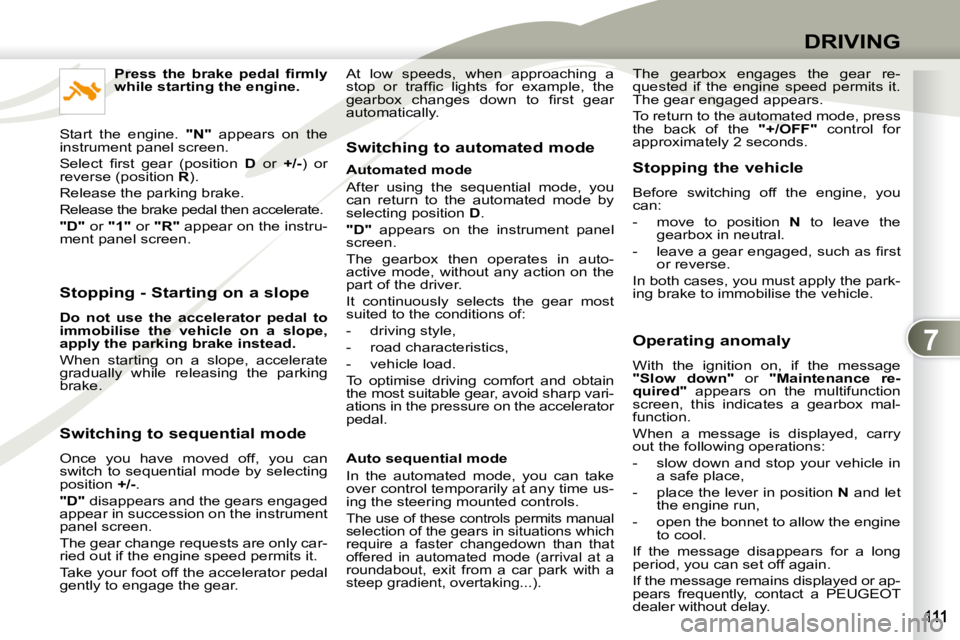
Press the brake pedal fi rmly
while starting the engine.
Start the engine. "N" appears on the
instrument panel screen.
Select fi rst gear (position D or +/- ) or
reverse (position R ).
Release the parking brake.
Release the brake pedal then accelerate.
"D" or "1" or "R" appear on the instru-
ment panel screen. The gearbox engages the gear re-
quested if the engine speed permits it.
The gear engaged appears.
To return to the automated mode, press
the back of the
"+/OFF" control for
approximately 2 seconds.
At low speeds, when approaching a
stop or traffi c lights for example, the
gearbox changes down to fi rst gear
automatically.
Page 107 of 215
7
DRIVING
DCS GEARBOX
The six-speed electronically controlled
gearbox offers a choice between the
comfort of automatic regulation or the
pleasure of manual gear changing.
This gearbox has three driving modes:
- a manual mode for changing of the
gears by the driver using the steer-
ing mounted controls or the gear
lever,
- a "
Normal
" automatic mode for
economical control of the gears
(everyday use),
- a "
Sport
" automatic mode which
permits a more dynamic style of
driving, with improved acceleration
and optimised engine braking. Displays on the instrument
panel
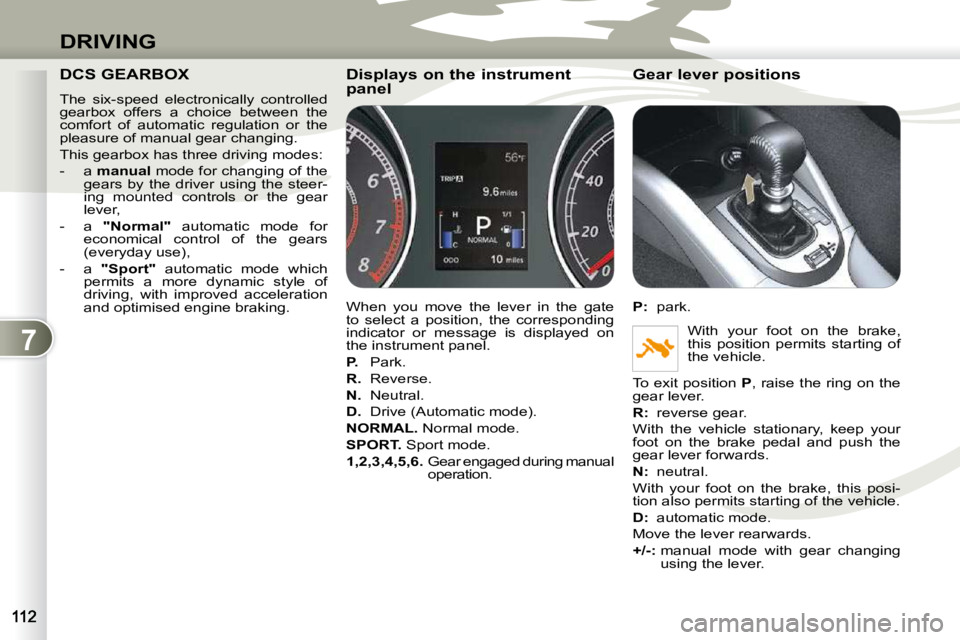
When you move the lever in the gate
to select a position, the corresponding
indicator or message is displayed on
the instrument panel.
P. Park.
R. Reverse.
N. Neutral.
D. Drive (Automatic mode).
NORMAL. Normal mode.
SPORT. Sport mode.
1,2,3,4,5,6. Gear engaged during manual
operation. Gear lever positions
P
: park.
With your foot on the brake,
this position permits starting of
the vehicle.
To exit position P , raise the ring on the
gear lever.
R
: reverse gear.
With the vehicle stationary, keep your
foot on the brake pedal and push the
gear lever forwards.
N
: neutral.
With your foot on the brake, this posi-
tion also permits starting of the vehicle.
D
: automatic mode.
Move the lever rearwards.
+/- : manual mode with gear changing
using the lever.
Page 108 of 215
7
DRIVING
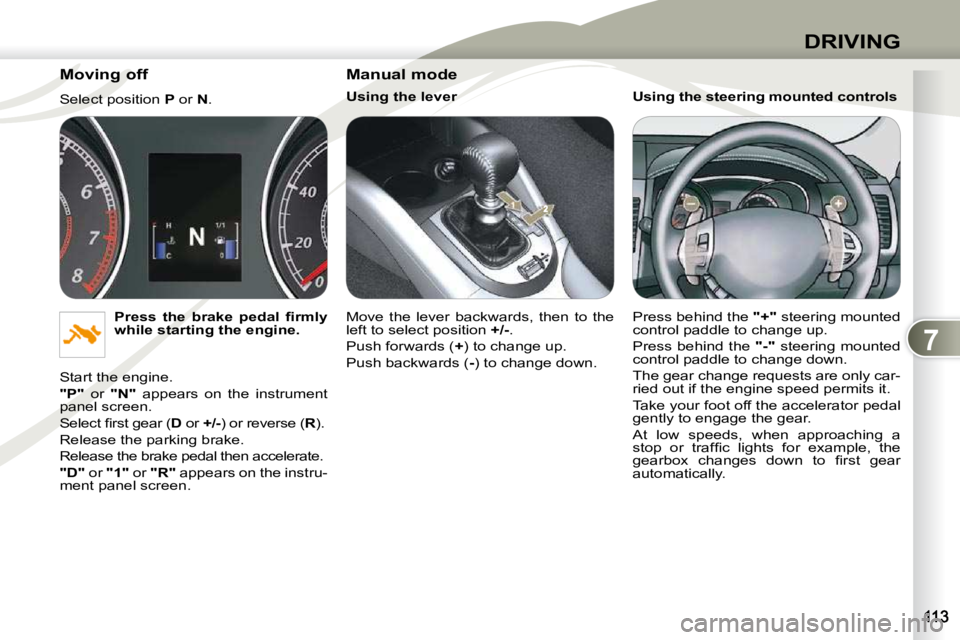
Moving off
Select position P or N .
Press the brake pedal fi rmly
while starting the engine.
Start the engine.
"P" or "N" appears on the instrument
panel screen.
Select fi rst gear ( D or +/- ) or reverse ( R ).
Release the parking brake.
Release the brake pedal then accelerate.
"D" or "1" or "R" appears on the instru-
ment panel screen. Manual mode
Using the lever
Move the lever backwards, then to the
left to select position
+/- .
Push forwards ( + ) to change up.
Push backwards ( - ) to change down. Using the steering mounted controls
Press behind the
"+" steering mounted
control paddle to change up.
Press behind the "-" steering mounted
control paddle to change down.
The gear change requests are only car-
ried out if the engine speed permits it.
Take your foot off the accelerator pedal
gently to engage the gear.
At low speeds, when approaching a
stop or traffi c lights for example, the
gearbox changes down to fi rst gear
automatically.
Page 109 of 215
7
DRIVING
"Normal" automatic mode
Select position D .
"D" appears on the instrument panel
screen.
The gearbox then operates in automatic
mode, without any action on the part of
the driver.
To optimise driving comfort and obtain
the most suitable gear, avoid sharp vari-
ations in the pressure on the accelerator
pedal.
"Temporary" manual mode
In automatic mode, you can take
control temporarily at any time using
the steering mounted controls.
The use of these controls permits man-
ual selection of the gears in situations
which require a faster changedown than
that offered in automatic mode (arrival
at a roundabout, exit from a car park
with a steep gradient, overtaking...).
The gearbox engages the gear re-
quested if the engine speed permits it.
The gear engaged appears.
To return to the automatic mode, press
the back of the "+/OFF" control for at
least 2 seconds. "Sport" automatic mode
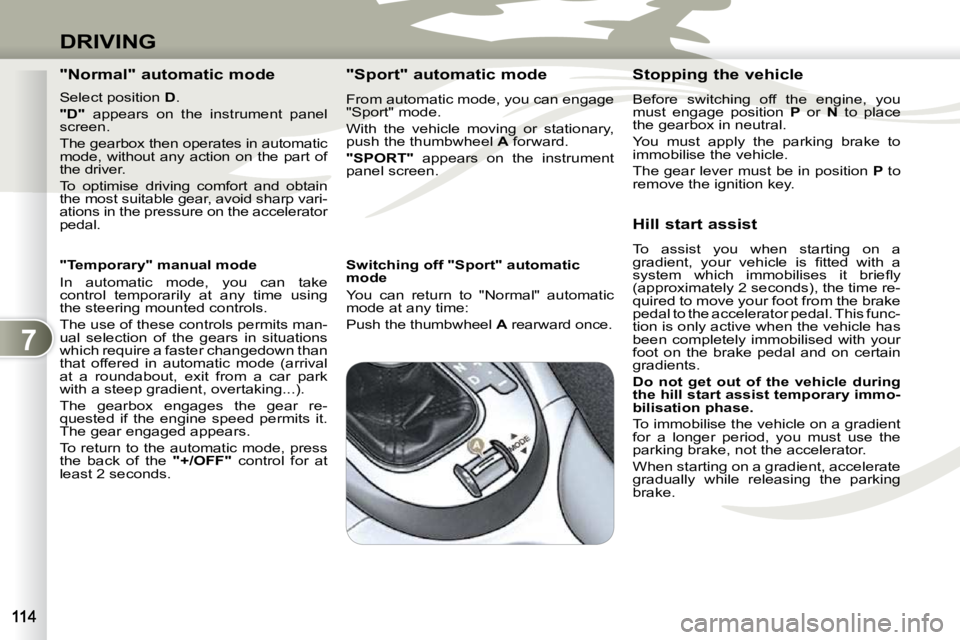
From automatic mode, you can engage
"Sport" mode.
With the vehicle moving or stationary,
push the thumbwheel
A forward.
"SPORT" appears on the instrument
panel screen.
Switching off "Sport" automatic
mode
You can return to "Normal" automatic
mode at any time:
Push the thumbwheel A rearward once. Stopping the vehicle
Before switching off the engine, you
must engage position
P or N to place
the gearbox in neutral.
You must apply the parking brake to
immobilise the vehicle.
The gear lever must be in position P
to
remove the ignition key.
Hill start assist
To assist you when starting on a
gradient, your vehicle is fi tted with a
system which immobilises it briefl y
(approximately 2 seconds), the time re-
quired to move your foot from the brake
pedal to the accelerator pedal. This func-
tion is only active when the vehicle has
been completely immobilised with your
foot on the brake pedal and on certain
gradients.
Do not get out of the vehicle during
the hill start
assist
temporary immo-
bilisation phase.
To immobilise the vehicle on a gradient
for a longer period, you must use the
parking brake, not the accelerator.
When starting on a gradient, accelerate
gradually while releasing the parking
brake.
Page 110 of 215
7
DRIVING
Operating anomaly Reverse gear
Flashing of the indicator
R in the instru-
ment panel screen, accompanied by an
audible signal, indicates a malfunction
on engaging the gear:
Press the brake pedal, position the gear
lever in position N and engage reverse
gear again.
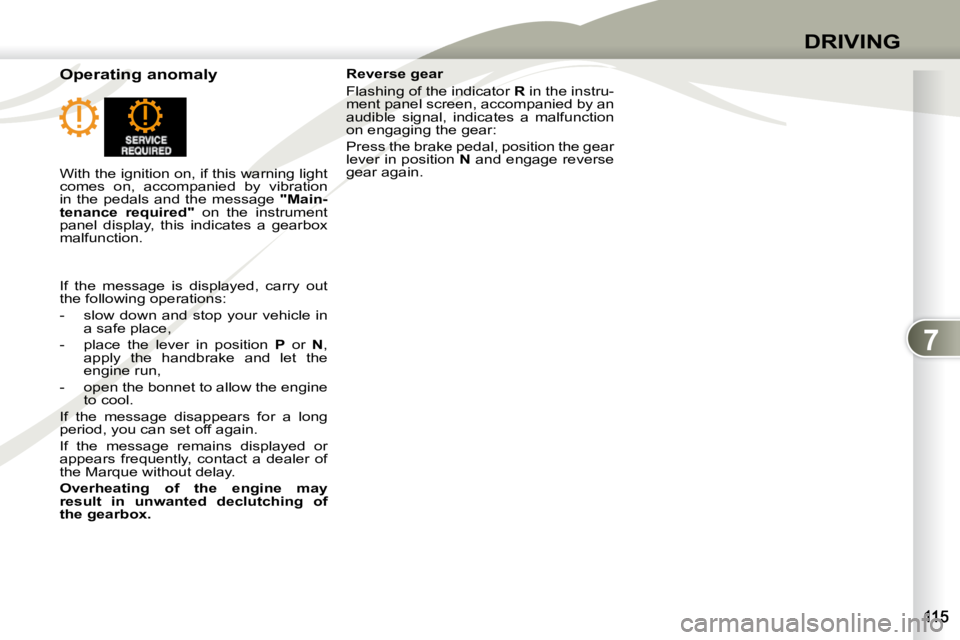
With the ignition on, if this warning light
comes on, accompanied by vibration
in the pedals and the message "Main-
tenance required" on the instrument
panel display, this indicates a gearbox
malfunction.
If the message is displayed, carry out
the following operations:
- slow down and stop your vehicle in a safe place,
- place the lever in position P or N ,
apply the handbrake and let the
engine run,
- open the bonnet to allow the engine to cool.
If the message disappears for a long
period, you can set off again.
If the message remains displayed or
appears frequently, contact a dealer of
the Marque without delay.
Overheating of the engine may
result in unwanted declutching of
the gearbox.