weight PEUGEOT 4007 2010 Owners Manual
[x] Cancel search | Manufacturer: PEUGEOT, Model Year: 2010, Model line: 4007, Model: PEUGEOT 4007 2010Pages: 215, PDF Size: 15.37 MB
Page 71 of 215
3
ACCESS
Before opening the tailgate,
ensure that no one is within the
radius of opening.
For reasons of safety and cor-
rect operation, do not drive with
the tailgate open.
If the battery is disconnected,
the tailgate cannot be opened.
Do not climb onto the lower tail-
gate and do not subject it to heavy
knocks, it may be damaged.
Always close the lower tailgate
and check that it is secured cor-
rectly before closing the main
tailgate.
When closing the lower tailgate,
ensure that no person or object
is in the proximity of the moving
parts to avoid any risk of injury
or damage.
Do not open the lower tailgate
when a towbar is fi tted.
"Tailgate open" warning
This warning lamp comes on on
the instrument panel screen when
the tailgate is not closed correctly.
LOWER TAILGALOWER TAILGATE
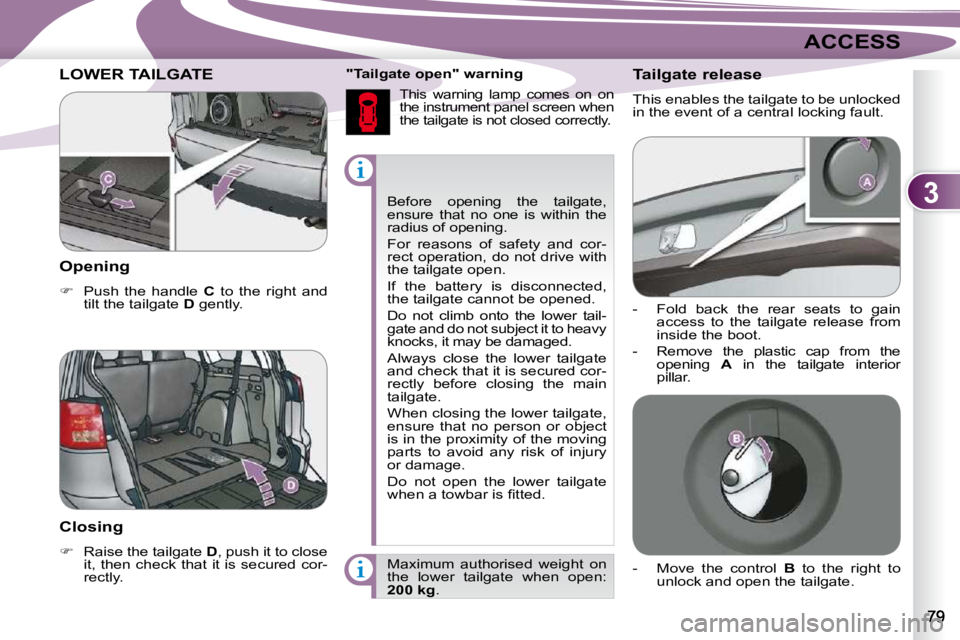
Opening
Push the handle C to the right and
tilt the tailgate D gently.
Closing
Raise the tailgate D , push it to close
it, then check that it is secured cor-
rectly. Maximum authorised weight on
the lower tailgate when open:
200 kg . Tailgate release
This enables the tailgate to be unlocked
in the event of a central locking fault.
- Fold back the rear seats to gain
access to the tailgate release from
inside the boot.
- Remove the plastic cap from the opening A in the tailgate interior
pillar.
- Move the control B to the right to
unlock and open the tailgate.
Page 72 of 215
3
ACCESS
Before opening the tailgate,
ensure that no one is within the
radius of opening.
For reasons of safety and cor-
rect operation, do not drive with
the tailgate open.
If the battery is disconnected,
the tailgate cannot be opened.
Do not climb onto the lower tail-
gate and do not subject it to heavy
knocks, it may be damaged.
Always close the lower tailgate
and check that it is secured cor-
rectly before closing the main
tailgate.
When closing the lower tailgate,
ensure that no person or object
is in the proximity of the moving
parts to avoid any risk of injury
or damage.
Do not open the lower tailgate
when a towbar is fi tted.
"Tailgate open" warning
This warning lamp comes on on
the instrument panel screen when
the tailgate is not closed correctly.
LOWER TAILGALOWER TAILGATE
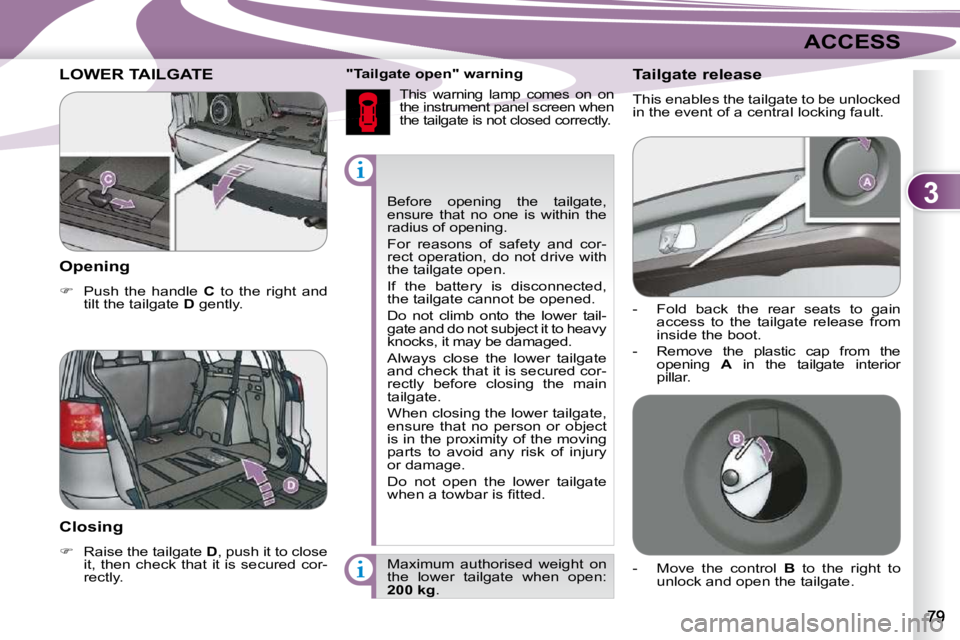
Opening
Push the handle C to the right and
tilt the tailgate D gently.
Closing
Raise the tailgate D , push it to close
it, then check that it is secured cor-
rectly. Maximum authorised weight on
the lower tailgate when open:
200 kg . Tailgate release
This enables the tailgate to be unlocked
in the event of a central locking fault.
- Fold back the rear seats to gain
access to the tailgate release from
inside the boot.
- Remove the plastic cap from the opening A in the tailgate interior
pillar.
- Move the control B to the right to
unlock and open the tailgate.
Page 87 of 215
5
CHILD SAFETY
Although one of PEUGEOT's main cri-
teria when designing your vehicle, the
safety of your children also depends on
you.
CHILD SEAT IN THE FRONT T IN THE FRONT
* The rules for carrying children are specifi c to each country. Refer to the
current legislation in your country.
GENERAL POINTS RELATING
TO CHILD SEATS
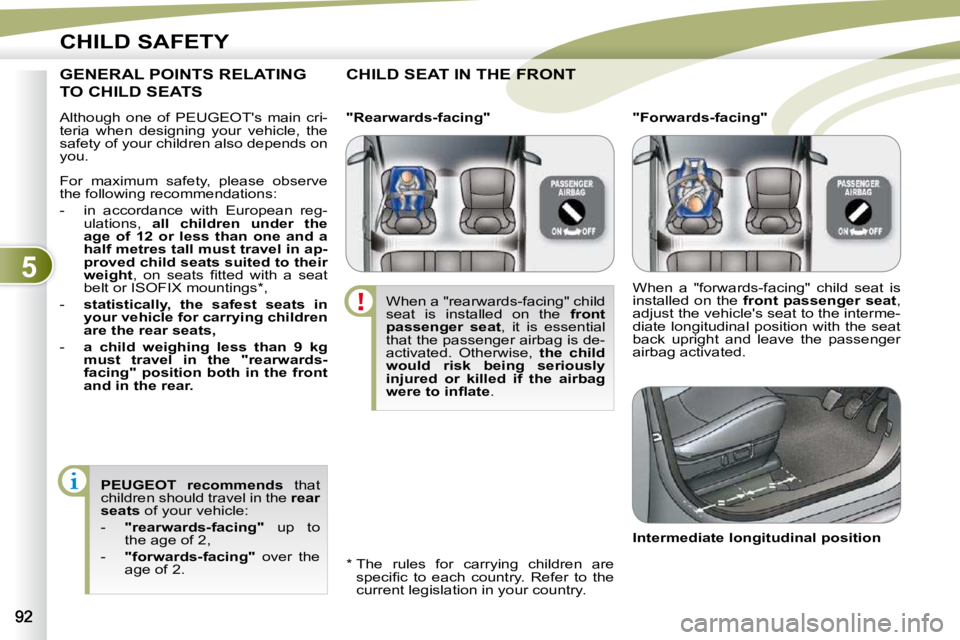
"Rearwards-facing"
PEUGEOT recommends that
children should travel in the rear
seats of your vehicle:
- "rearwards-facing" up to
the age of 2,
- "forwards-facing" over the
age of 2. When a "rearwards-facing" child
seat is installed on the
front
passenger seat , it is essential
that the passenger airbag is de-
activated. Otherwise, the child
would risk being seriously
injured or killed if the airbag
were to infl ate . When a "forwards-facing" child seat is
installed on the
front passenger seat ,
adjust the vehicle's seat to the interme-
diate longitudinal position with the seat
back upright and leave the passenger
airbag activated.
"Forwards-facing"
Intermediate longitudinal position
For maximum safety, please observe
the following recommendations:
- in accordance with European reg-
ulations, all children under the
age of 12 or less than one and a
half metres tall must travel in ap-
proved child seats suited to their
weight , on seats fi tted with a seat
belt or ISOFIX mountings * ,
- statistically, the safest seats in
your vehicle for carrying children
are the rear seats,
- a child weighing less than 9 kg
must travel in the "rearwards-
facing" position both in the front
and in the rear.
Page 89 of 215
5
CHILD SAFETY
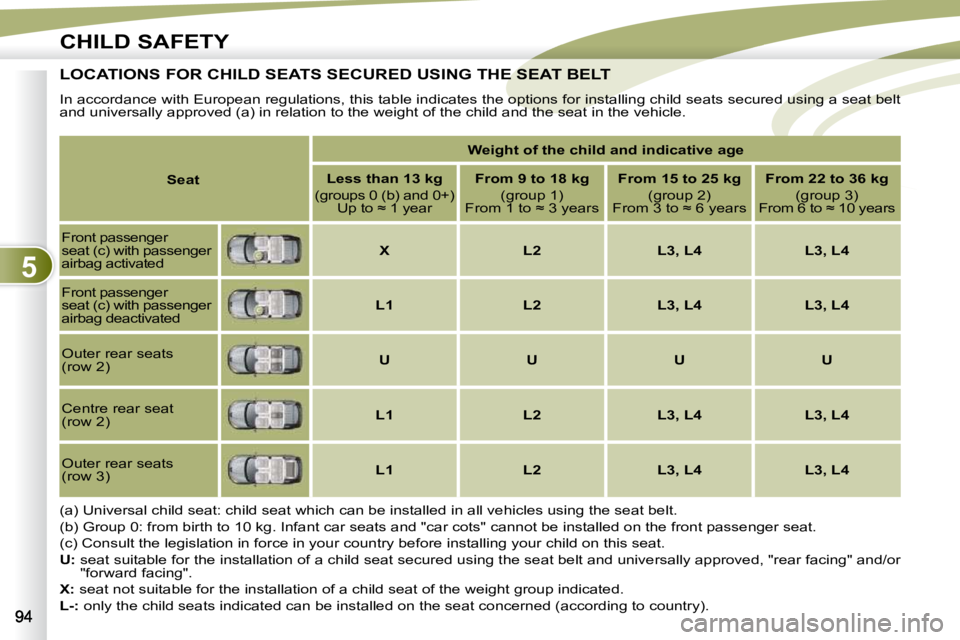
LOCATIONS FOR CHILD SEATS SECURED USING THE SEATS SECURED USING THE SEAT BELT
In accordance with European regulations, this table indicates the options for installing child seats secured using a seat b elt
and universally approved (a) in relation to the weight of th e child and the seat in the vehicle.
(a) Universal child seat: child seat which can be installed in all vehicles using the seat belt.
(b) Group 0: from birth to 10 kg. Infant car seats and "car cots" ca nnot be installed on the front passenger seat.
(c) Consult the legislation in force in your country before inst alling your child on this seat.
U: seat suitable for the installation of a child seat secure d using the seat belt and universally approved, "rear facing" an d/or
"forward facing".
X: seat not suitable for the installation of a child seat of the weight group indicated.
L-: only the child seats indicated can be installed on the se at concerned (according to country).
Seat
Weight of the child and indicative age
Less than 13 kg
(groups 0 (b) and 0+) Up to ≈ 1 year
From 9 to 18 kg
(group 1)
From 1 to ≈ 3 years
From 15 to 25 kg
(group 2)
From 3 to ≈ 6 years
From
22 to 36 kg
(group 3)
From 6 to ≈ 10 years
Front passenger
seat (c) with passenger
airbag activated
X L2 L3, L4 L3, L4
Front passenger
seat (c) with passenger
airbag deactivated
L1 L2 L3, L4 L3, L4
Outer rear seats
(row 2)
U U U U
Centre rear seat
(row 2)
L1 L2 L3, L4 L3, L4
Outer rear seats
(row 3)
L1 L2 L3, L4 L3, L4
Page 92 of 215
5
CHILD SAFETY
LOCATIONS FOR ISOFIX CHILD SEATS LOCATIONS FOR ISOFIX CHILD SEA
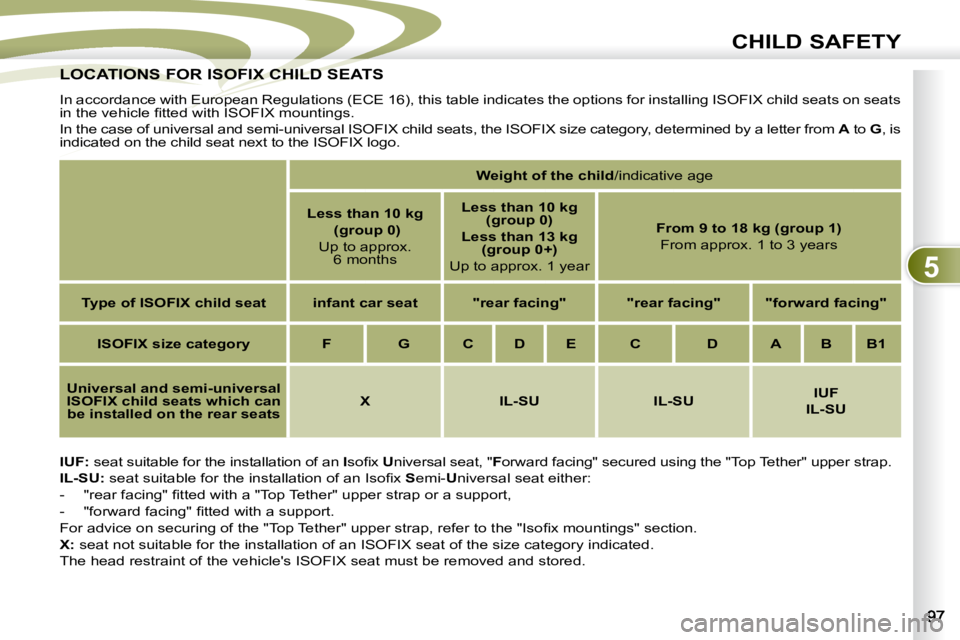
IUF: seat suitable for the installation of an I sofi x U niversal seat, " F orward facing" secured using the "Top Tether" uppe r strap.
IL-SU: seat suitable for the installation of an Isofi x S emi- U niversal seat either:
- "rear facing" fi tted with a "Top Tether" upper strap or a support,
- "forward facing" fi tted with a support.
For advice on securing of the "Top Tether" upper strap, refer to the "Isofi x mountings" section.
X: seat not suitable for the installation of an ISOFIX seat of the size category indicated.
The head restraint of the vehicle's ISOFIX seat must be removed and stored.
In accordance with European Regulations (ECE 16), this table i
ndicates the options for installing ISOFIX child seats on seats
in the vehicle fi tted with ISOFIX mountings.
In the case of universal and semi-universal ISOFIX child seats, the ISOFIX size category, determined by a letter from A to G , is
indicated on the child seat next to the ISOFIX logo .
Weight of the child /indicative age
Less than 10 kg
(group 0)
Up to approx. 6 months
Less than 10 kg
(group 0)
Less than
13 kg
(group 0+)
Up to approx. 1 year
From 9 to 18 kg (group 1)
From approx. 1 to 3 years
Type of ISOFIX child seat infant car seat "rear facing" "rear facing" "forward facing"
ISOFIX size category F G C D E C D A B B1
Universal and semi-universal ISOFIX child seats which can be installed on the rear seats X IL-SU IL-SU
IUF
IL-SU
Page 146 of 215
9
PRACTICAL INFORMATION
TOWING TOWING A TRAILER,
CARAVAN, ETC. CARAVAN, ETC.
Driving advice The maximum towing load on a long
slope depends on the gradient and the
outside temperature.
In all cases, pay attention to the coolant
temperature.
Side wind
Take into account the increased
sensitivity to side wind.
Cooling
Towing a trailer on a slope increases
the temperature of the coolant.
As the fan is electrically controlled, its
cooling capacity is not dependent on
the engine speed.
To lower the engine speed, reduce
your speed. Braking
Towing a trailer increases the braking
distance.
Tyres
Check the tyre pressures of the tow-
ing vehicle and of the trailer, observ-
ing the recommended pressures.
Lighting
Check the lighting and signalling on
the trailer.
If this message is dis-
played, stop your ve-
hicle as soon as it is
safe to do so.
If the message fl ashes
slowly, wait for the engine to cool before
topping up the level, if necessary.
If the message fl ashes rapidly, contact
a PEUGEOT dealer without delay.
Opening of the lower tailgate is
prohibited if a towbar is being
used.
We recommend the use of genu-
ine PEUGEOT towbars and their
harnesses that have been tested
and approved from the design
stage of your vehicle and that the
fi tting of the towbar is entrusted
to a PEUGEOT dealer.
If the towbar is not fi tted by a
PEUGEOT dealer, it is impera-
tive that it is fi tted using the
electrical pre-equipment located
at the rear of the vehicle and in
accordance with the manufac-
turer's instructions.
Driving with a trailer subjects the
towing vehicle to more signifi -
cant stress and its driver must
be particularly careful.
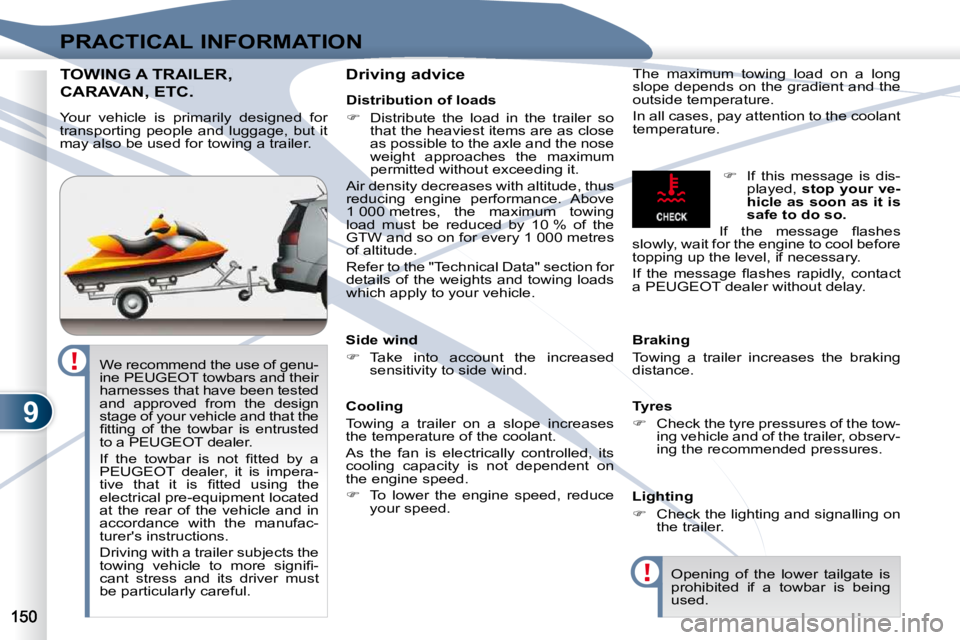
Your vehicle is primarily designed for
transporting people and luggage, but it
may also be used for towing a trailer.
Distribution of loads
Distribute the load in the trailer so
that the heaviest items are as close
as possible to the axle and the nose
weight approaches the maximum
permitted without exceeding it.
Air density decreases with altitude, thus
reducing engine performance. Above
1 000 metres, the maximum towing
load must be reduced by 10 % of the
GTW and so on for every 1 000 metres
of altitude.
Refer to the "Technical Data" section for
details of the weights and towing loads
which apply to your vehicle.
Page 150 of 215
10
TECHNICAL DATA
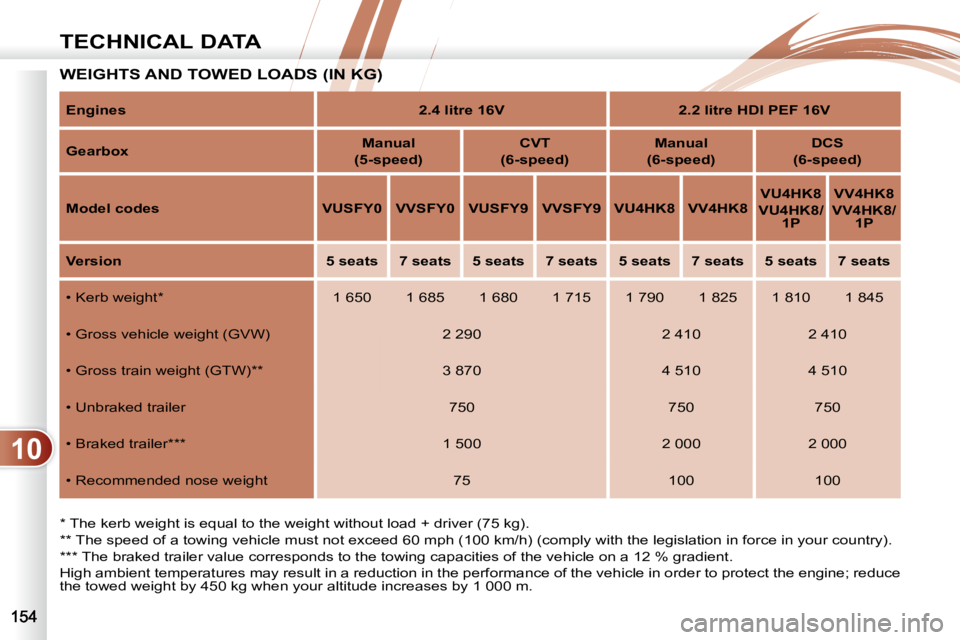
WEIGHTS AND TOWED LOADS (IN KG) OWED LOADS (IN KG)
* The kerb weight is equal to the weight without load + driver (75 kg).
** The speed of a towing vehicle must not exceed 60 mph (100 km/h) (comply with the legislation in force in your country).
*** The braked trailer value corresponds to the towing cap acities of the vehicle on a 12 % gradient.
High ambient temperatures may result in a reduction in the pe rformance of the vehicle in order to protect the engine; reduce
the towed weight by 450 kg when your altitude increases by 1 000 m.
Engines
2.4 litre 16V 2.2 litre HDI PEF 16V
Gearbox
Manual
(5-speed)
CVT
(6-speed)
Manual
(6-speed)
DCS
(6-speed)
Model codes VUSFY0 VVSFY0 VUSFY9 VVSFY9 VU4HK8 VV4HK8
VU4HK8
VU4HK8/
1P
VV4HK8
VV4HK8/
1P
Version 5 seats 7 seats 5 seats 7 seats 5 seats 7 seats 5 seats 7 seats
Page 215 of 215
5
CHILD SAFETY
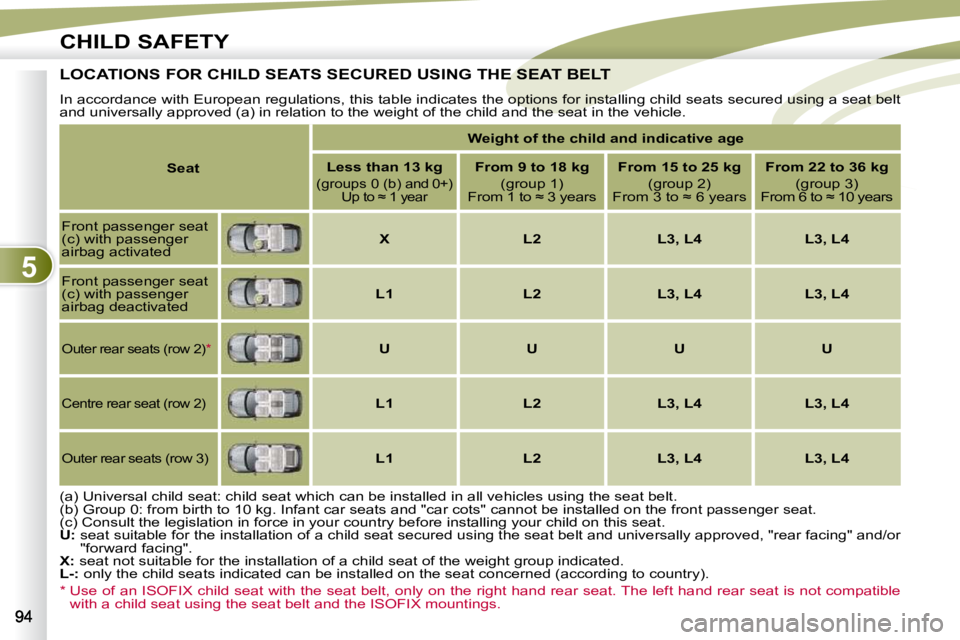
LOCATIONS FOR CHILD SEATS SECURED USING THE SEATS SECURED USING THE SEAT BELT
In accordance with European regulations, this table indicates the options for installing child seats secured using a seat b elt
and universally approved (a) in relation to the weight of th e child and the seat in the vehicle.
(a) Universal child seat: child seat which can be installed in all vehicles using the seat belt.
(b) Group 0: from birth to 10 kg. Infant car seats and "car cots" ca nnot be installed on the front passenger seat.
(c) Consult the legislation in force in your country before inst alling your child on this seat.
U: seat suitable for the installation of a child seat secure d using the seat belt and universally approved, "rear facing" an d/or
"forward facing".
X: seat not suitable for the installation of a child seat of the weight group indicated.
L-: only the child seats indicated can be installed on the se at concerned (according to country).
Seat
Weight of the child and indicative age
Less than 13 kg
(groups 0 (b) and 0+)
Up to ≈ 1 year
From 9 to 18 kg
(group 1)
From 1 to ≈ 3 years
From 15 to 25 kg
(group 2)
From 3 to ≈ 6 years
From
22 to 36 kg
(group 3)
From 6 to ≈ 10 years
Front passenger seat
(c) with passenger
airbag activated
X L2 L3, L4 L3, L4
Front passenger seat
(c) with passenger
airbag deactivated
L1 L2 L3, L4 L3, L4
Outer rear seats (row 2) *
U U U U
Centre rear seat (row 2)
L1 L2 L3, L4 L3, L4
Outer rear seats (row 3)
L1 L2 L3, L4 L3, L4
* Use of an ISOFIX child seat with the seat belt, on ly on the right hand rear seat. The left hand rear seat is n ot compatible
with a child seat using the seat belt and the ISOFIX mount ings.