tow PEUGEOT 4007 2011 Owner's Manual
[x] Cancel search | Manufacturer: PEUGEOT, Model Year: 2011, Model line: 4007, Model: PEUGEOT 4007 2011Pages: 236, PDF Size: 17.56 MB
Page 122 of 236
7
DRIVING
Operating faults
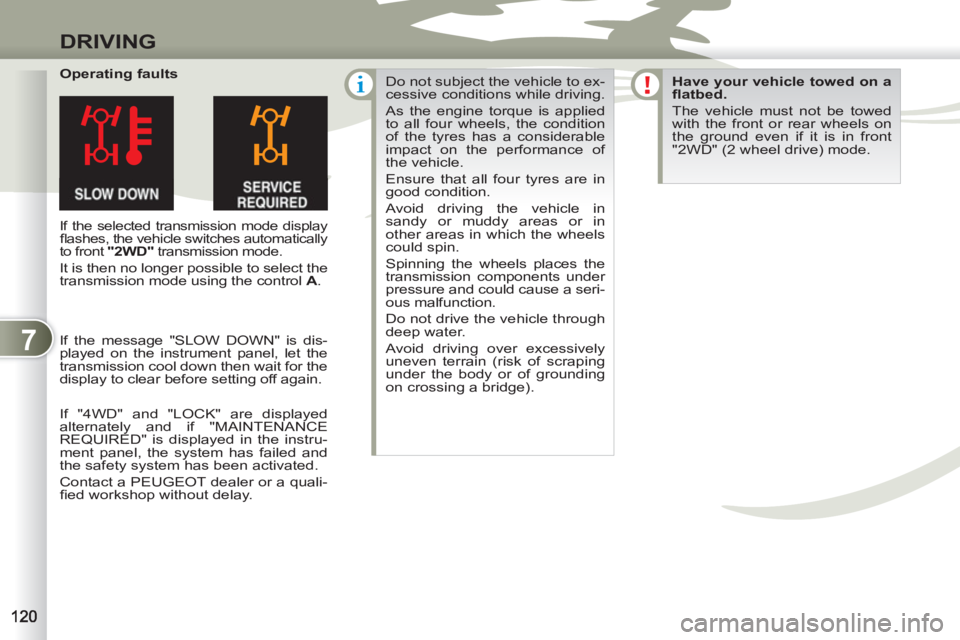
If the selected transmission mode display
fl ashes, the vehicle switches automatically
to front "2WD"
transmission mode.
It is then no longer possible to select the
transmission mode using the control A
. Do not subject the vehicle to ex-
cessive conditions while driving.
As the engine torque is applied
to all four wheels, the condition
of the tyres has a considerable
impact on the performance of
the vehicle.
Ensure that all four tyres are in
good condition.
Avoid driving the vehicle in
sandy or muddy areas or in
other areas in which the wheels
could spin.
Spinning the wheels places the
transmission components under
pressure and could cause a seri-
ous malfunction.
Do not drive the vehicle through
deep water.
Avoid driving over excessively
uneven terrain (risk of scraping
under the body or of grounding
on crossing a bridge).
Have your vehicle towed on a
fl atbed.
The vehicle must not be towed
with the front or rear wheels on
the ground even if it is in front
"2WD" (2 wheel drive) mode.
If the message "SLOW DOWN" is dis-
played on the instrument panel, let the
transmission cool down then wait for the
display to clear before setting off again.
If "4WD" and "LOCK" are displayed
alternately and if "MAINTENANCE
REQUIRED" is displayed in the instru-
ment panel, the system has failed and
the safety system has been activated.
Contact a PEUGEOT dealer or a quali-
fi ed workshop without delay.
Page 125 of 236
7
DRIVING
AUDIBLE REAR PARKINGAUDIBLE
SENSORS NSO
It detects obstacles (person, vehicle,
tree, gate, ...) located behind the vehi-
cle, but it cannot detect obstacles locat-
ed immediately below the bumper.
Activation
The parking sensors are activated by
engaging reverse gear.
The proximity information is indicated by
an audible signal which becomes more
frequent as the vehicle approaches the
obstacle.
When a certain distance between the
rear of the vehicle and the obstacle is
reached, the audible signal becomes
continuous:
An object such as a stake, a road
works cone or any other similar
object may be detected at the
beginning of the manoeuvre but
may no longer be detected when
the vehicle moves closer to it.
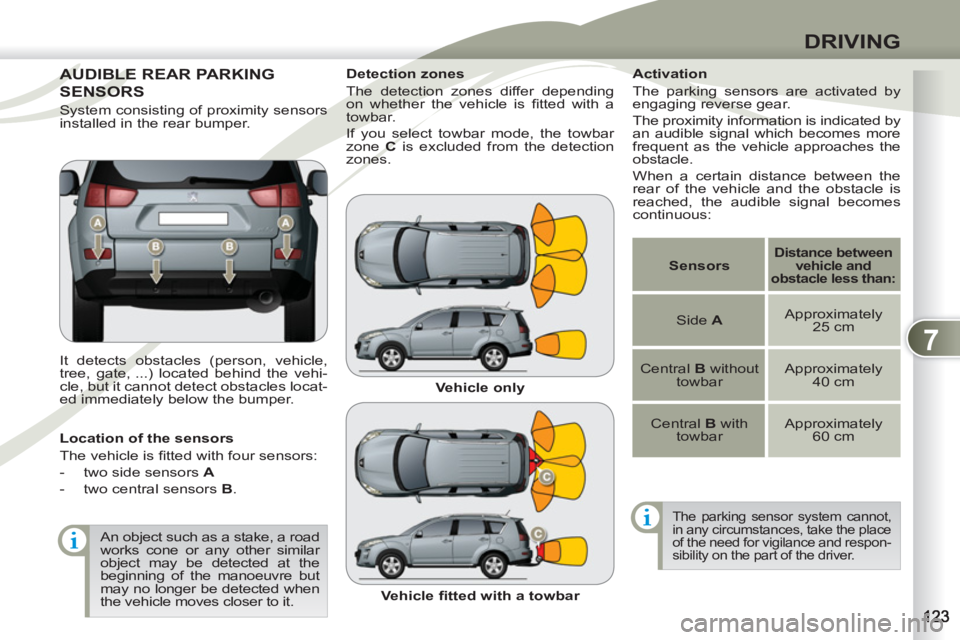
Location of the sensors
The vehicle is fi tted with four sensors:
- two side sensors A
- two central sensors B
.
Vehicle only
Vehicle fi tted with a towbar
Detection zones
The detection zones differ depending
on whether the vehicle is fi tted with a
towbar.
If you select towbar mode, the towbar
zone C
is excluded from the detection
zones.
The parking sensor system cannot,
in any circumstances, take the place
of the need for vigilance and respon-
sibility on the part of the driver.
Sensors
Distance between
vehicle and
obstacle less than:
Side A
Approximately
25 cm
Central B
without
towbar
Approximately
40 cm
Central B
with
towbar
Approximately
60 cm
System consisting of proximity sensors
installed in the rear bumper.
Page 126 of 236
7
DRIVING
REVERSING CAMERA REVERSING CAM
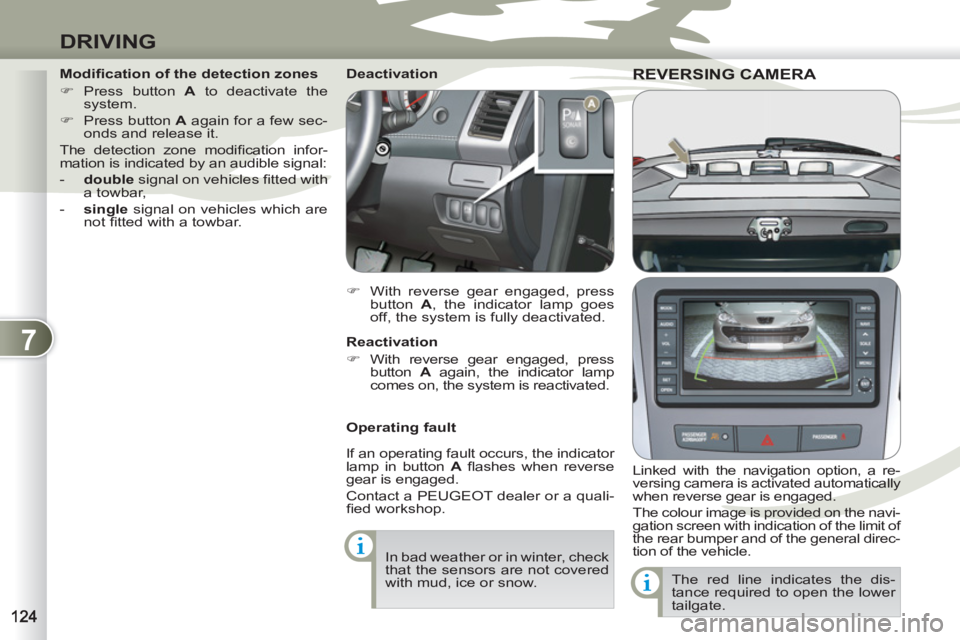
Linked with the navigation option, a re-
versing camera is activated automatically
when reverse gear is engaged.
The colour image is provided on the navi-
gation screen with indication of the limit of
the rear bumper and of the general direc-
tion of the vehicle.
Operating fault
If an operating fault occurs, the indicator
lamp in button A
fl ashes when reverse
gear is engaged.
Contact a PEUGEOT dealer or a quali-
fi ed workshop.
In bad weather or in winter, check
that the sensors are not covered
with mud, ice or snow.
Deactivation
)
With reverse gear engaged, press
button A
, the indicator lamp goes
off, the system is fully deactivated.
Reactivation
)
With reverse gear engaged, press
button A
again, the indicator lamp
comes on, the system is reactivated.
Modifi cation of the detection zones
)
Press button A
to deactivate the
system.
)
Press button A
again for a few sec-
onds and release it.
The detection zone modifi cation infor-
mation is indicated by an audible signal:
- double
signal on vehicles fi tted with
a towbar,
- single
signal on vehicles which are
not fi tted with a towbar.
The red line indicates the dis-
tance required to open the lower
tailgate.
Page 128 of 236
8
CHECKS
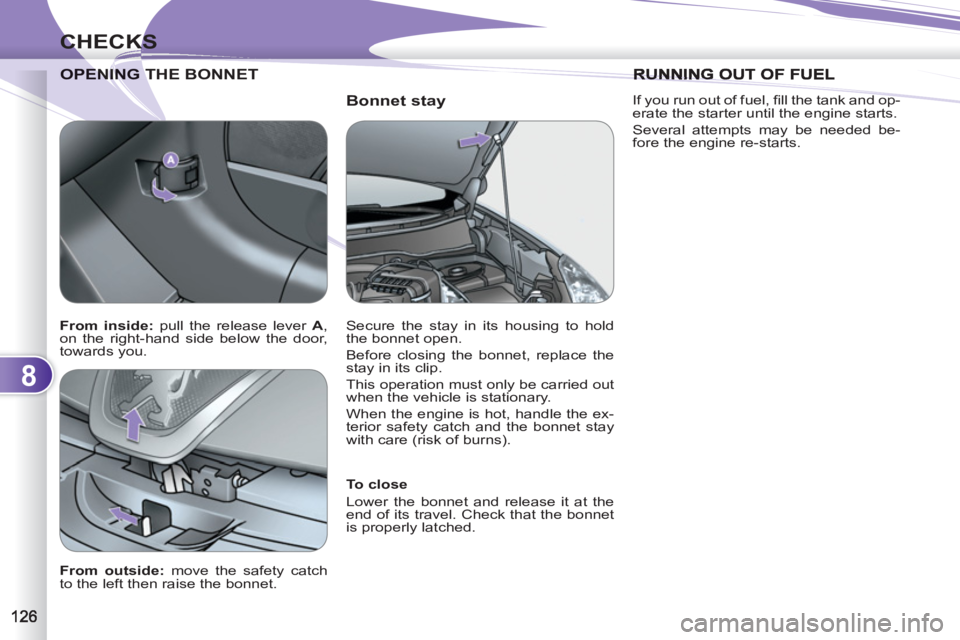
Bonnet stay
ENING THE BONNET
OPENING T
To close
Lower the bonnet and release it at the
end of its travel. Check that the bonnet
is properly latched.
From outside:
move the safety catch
to the left then raise the bonnet. Secure the stay in its housing to hold
the bonnet open.
Before closing the bonnet, replace the
stay in its clip.
This operation must only be carried out
when the vehicle is stationary.
When the engine is hot, handle the ex-
terior safety catch and the bonnet stay
with care (risk of burns).
RUNNING
From inside:
pull the release lever A
,
on the right-hand side below the door,
towards you.
If you run out of fuel, fi ll the tank and op-
erate the starter until the engine starts.
Several attempts may be needed be-
fore the engine re-starts.
Page 133 of 236
8
CHECKS
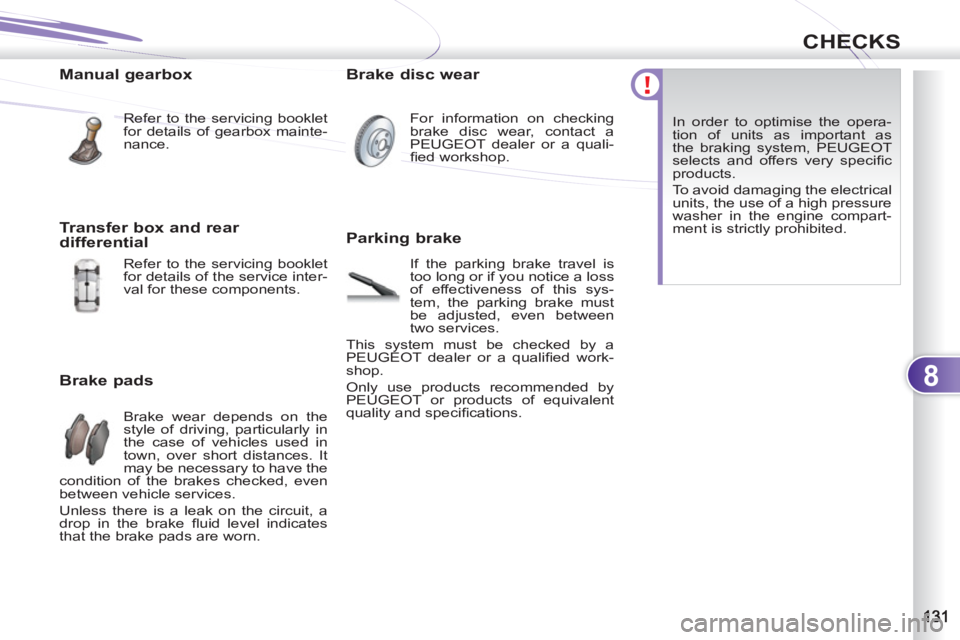
Manual gearbox
Refer to the servicing booklet
for details of gearbox mainte-
nance.
Brake pads
Brake wear depends on the
style of driving, particularly in
the case of vehicles used in
town, over short distances. It
may be necessary to have the
condition of the brakes checked, even
between vehicle services.
Unless there is a leak on the circuit, a
drop in the brake fl uid level indicates
that the brake pads are worn.
Brake disc wear
For information on checking
brake disc wear, contact a
PEUGEOT dealer or a quali-
fi ed workshop.
Parking brake
If the parking brake travel is
too long or if you notice a loss
of effectiveness of this sys-
tem, the parking brake must
be adjusted, even between
two services.
This system must be checked by a
PEUGEOT dealer or a qualifi ed work-
shop.
Only use products recommended by
PEUGEOT or products of equivalent
quality and specifi cations. In order to optimise the opera-
tion of units as important as
the braking system, PEUGEOT
selects and offers very specifi c
products.
To avoid damaging the electrical
units, the use of a high pressure
washer in the engine compart-
ment is strictly prohibited.
Transfer box and rear
differential
Refer to the servicing booklet
for details of the service inter-
val for these components.
Page 134 of 236
9
PRACTICAL INFORMATION
CHANANGING A WHEEL
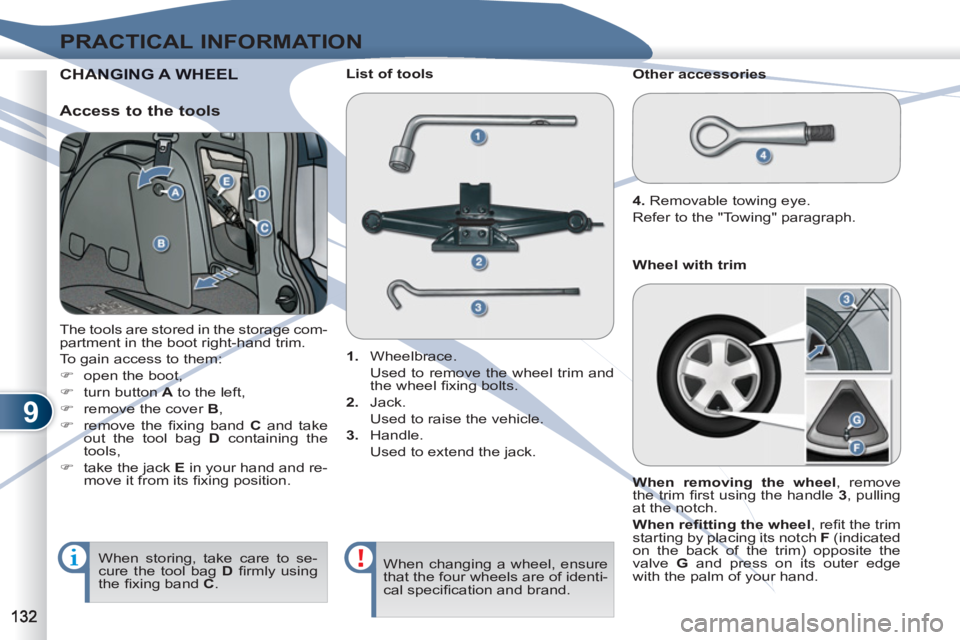
The tools are stored in the storage com-
partment in the boot right-hand trim.
To gain access to them:
)
open the boot,
)
turn button A
to the left,
)
remove the cover B
,
)
remove the fi xing band C
and take
out the tool bag D
containing the
tools,
)
take the jack E
in your hand and re-
move it from its fi xing position.
1.
Wheelbrace.
Used to remove the wheel trim and
the wheel fi xing bolts.
2.
Jack.
Used to raise the vehicle.
3.
Handle.
Used to extend the jack.
List of tools
Other accessories
4.
Removable towing eye.
Refer to the "Towing" paragraph.
Access to the tools
When changing a wheel, ensure
that the four wheels are of identi-
cal specifi cation and brand. When storing, take care to se-
cure the tool bag D
fi rmly using
the fi xing band C
.
When removing the wheel
, remove
the trim fi rst using the handle 3
, pulling
at the notch.
When refi tting the wheel
, refi t the trim
starting by placing its notch F
(indicated
on the back of the trim) opposite the
valve G
and press on its outer edge
with the palm of your hand.
Wheel with trim
Page 140 of 236
9
PRACTICAL INFORMATION
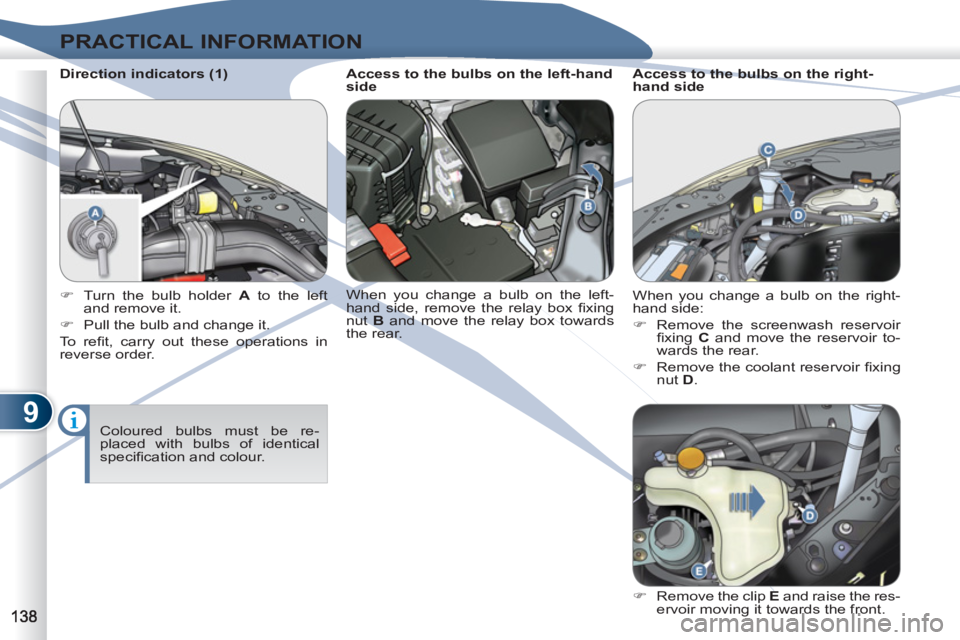
Direction indicators (1)
Coloured bulbs must be re-
placed with bulbs of identical
specifi cation and colour.
)
Turn the bulb holder A
to the left
and remove it.
)
Pull the bulb and change it.
To r efi t, carry out these operations in
reverse order.
Access to the bulbs on the left-hand
side
When you change a bulb on the left-
hand side, remove the relay box fi xing
nut B
and move the relay box towards
the rear.
Access to the bulbs on the right-
hand side
When you change a bulb on the right-
hand side:
)
Remove the screenwash reservoir
fi xing C
and move the reservoir to-
wards the rear.
)
Remove the coolant reservoir fi xing
nut D
.
)
Remove the clip E
and raise the res-
ervoir moving it towards the front.
Page 142 of 236
9
PRACTICAL INFORMATION
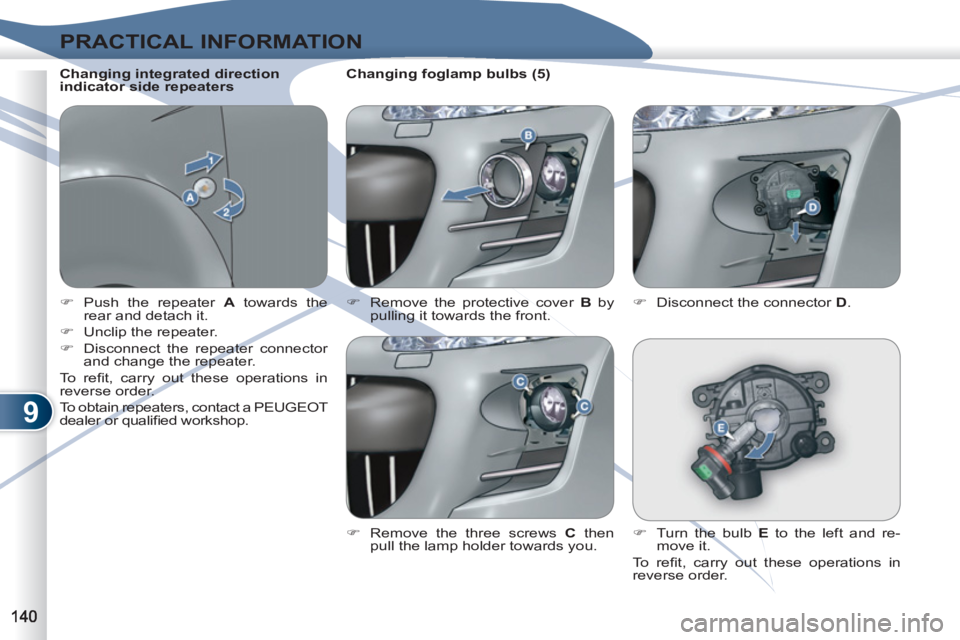
)
Push the repeater A
towards the
rear and detach it.
)
Unclip the repeater.
)
Disconnect the repeater connector
and change the repeater.
To r efi t, carry out these operations in
reverse order.
To obtain repeaters, contact a PEUGEOT
dealer or qualifi ed workshop.
Changing integrated direction
indicator side repeaters
)
Remove the protective cover B
by
pulling it towards the front.
Changing foglamp bulbs (5)
)
Remove the three screws C
then
pull the lamp holder towards you.
)
Disconnect the connector D
.
)
Turn the bulb E
to the left and re-
move it.
To r efi t, carry out these operations in
reverse order.
Page 151 of 236
9
PRACTICAL INFORMATION
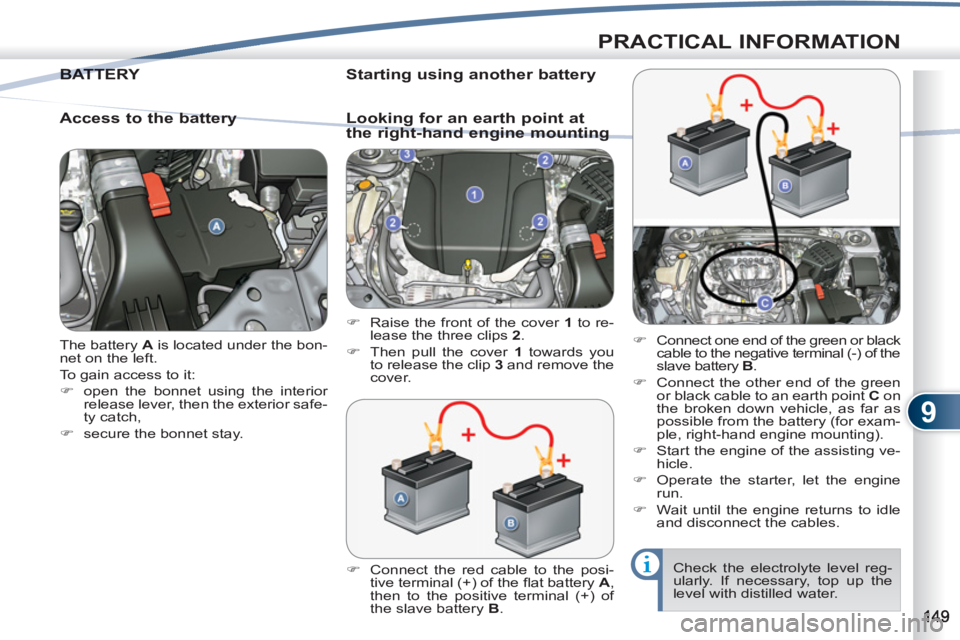
The battery A
is located under the bon-
net on the left.
To gain access to it:
)
open the bonnet using the interior
release lever, then the exterior safe-
ty catch,
)
secure the bonnet stay.
BATTERYBATTE
Access to the battery
)
Connect the red cable to the posi-
tive terminal (+) of the fl at battery A
,
then to the positive terminal (+) of
the slave battery B
.
)
Connect one end of the green or black
cable to the negative terminal (-) of the
slave battery B
.
)
Connect the other end of the green
or black cable to an earth point C
on
the broken down vehicle, as far as
possible from the battery (for exam-
ple, right-hand engine mounting).
)
Start the engine of the assisting ve-
hicle.
)
Operate the starter, let the engine
run.
)
Wait until the engine returns to idle
and disconnect the cables.
)
Raise the front of the cover 1
to re-
lease the three clips 2
.
)
Then pull the cover 1
towards you
to release the clip 3
and remove the
cover.
Check the electrolyte level reg-
ularly. If necessary, top up the
level with distilled water.
Starting using another battery
Looking for an earth point at
the right-hand engine mounting
Page 153 of 236
9
PRACTICAL INFORMATION
CHANGING A WIPER BLADECHANG
Removing a front or rear wiper
blade
)
Raise the corresponding wiper arm.
)
Remove the wiper blade, sliding it
towards the outside.
Fitting a front or rear wiper
blade
)
At the front, check the size of the
wiper blade as the shorter blade is
fi tted on the right-hand side of the
vehicle.
)
Put the corresponding new wiper
blade in place and fi x it.
)
Fold down the wiper arm carefully.