seats PEUGEOT 4007 2012 User Guide
[x] Cancel search | Manufacturer: PEUGEOT, Model Year: 2012, Model line: 4007, Model: PEUGEOT 4007 2012Pages: 236, PDF Size: 17.59 MB
Page 57 of 236
2
COMFORT
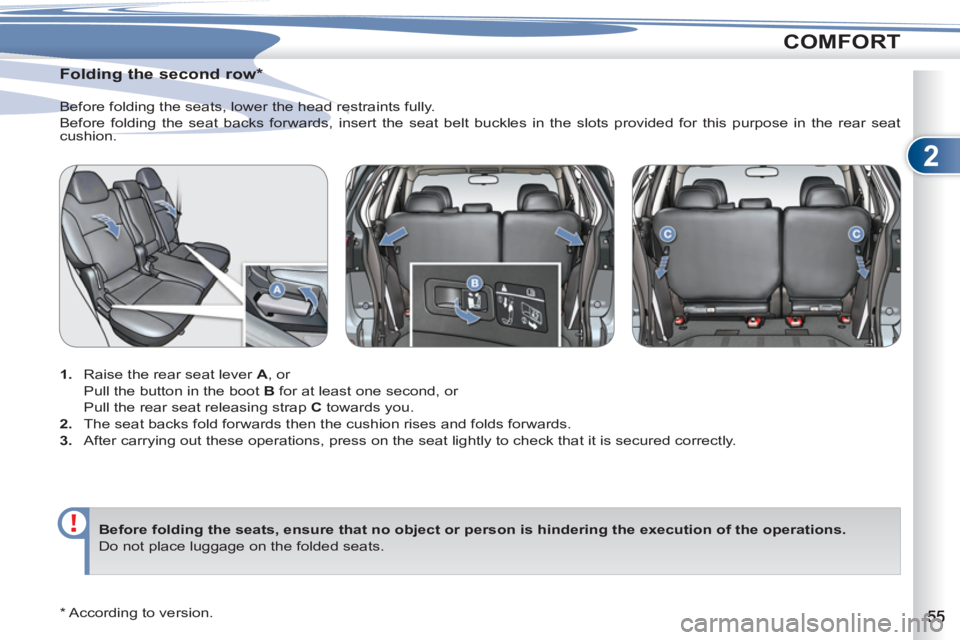
Folding the second row *
1.
Raise the rear seat lever A
, or
Pull the button in the boot B
for at least one second, or
Pull the rear seat releasing strap C
towards you.
2.
The seat backs fold forwards then the cushion rises and folds forwards.
3.
After carrying out these operations, press on the seat lightly to check that it is secured correctly. Before folding the seats, lower the head restraints fully.
Before folding the seat backs forwards, insert the seat belt buckles in the slots provided for this purpose in the rear seat
cushion.
Before
folding
the
seats
,
ensure that no object
or person is hindering
the execution of the operations.
Do not place luggage on the folded seats.
*
According to version.
Page 59 of 236
2
COMFORT
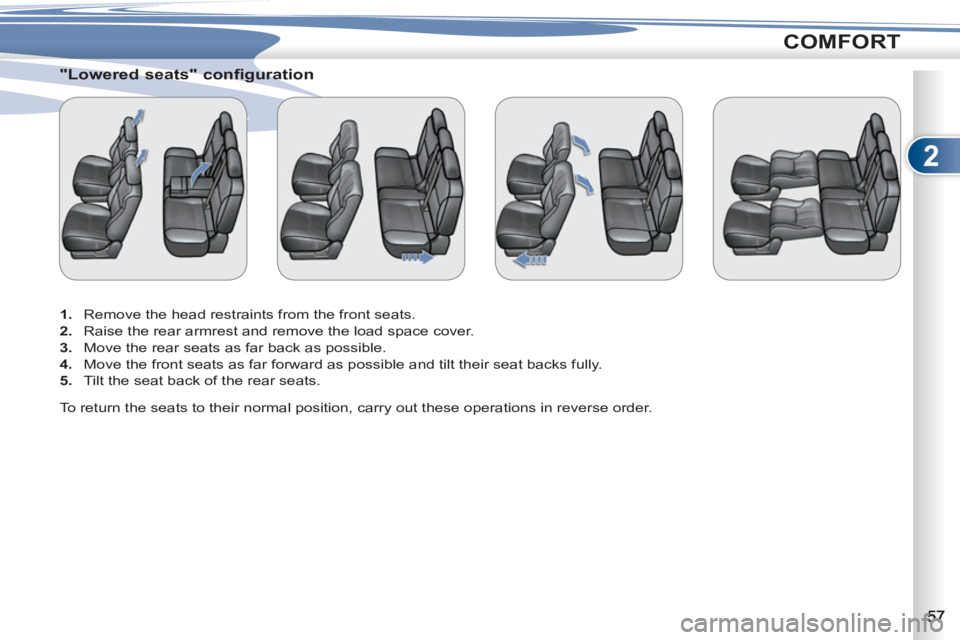
"Lowered seats" configuration
1.
Remove the head restraints from the front seats.
2.
Raise the rear armrest and remove the load space cover.
3.
Move the rear seats as far back as possible.
4.
Move the front seats as far forward as possible and tilt their seat backs fully.
5.
Tilt the seat back of the rear seats.
To return the seats to their normal position, carry out these operations in reverse order.
Page 83 of 236
3
ACCESS
Before opening the tailgate,
ensure that no one is within the
radius of opening.
For reasons of safety and cor-
rect operation, do not drive with
the tailgate open.
If the battery is disconnected,
the tailgate cannot be opened.
Do not climb onto the lower
tailgate and do not subject it to
heavy knocks, it may be dam-
aged.
Always close the lower tailgate
and check that it is secured cor-
rectly before closing the main
tailgate.
When closing the lower tailgate,
ensure that no person or object
is in the proximity of the moving
parts to avoid any risk of injury
or damage.
Do not open the lower tailgate
when a towbar is fi tted.
"Tailgate open" warning
This warning lamp comes on
on the instrument panel screen
when the tailgate is not closed
correctly.
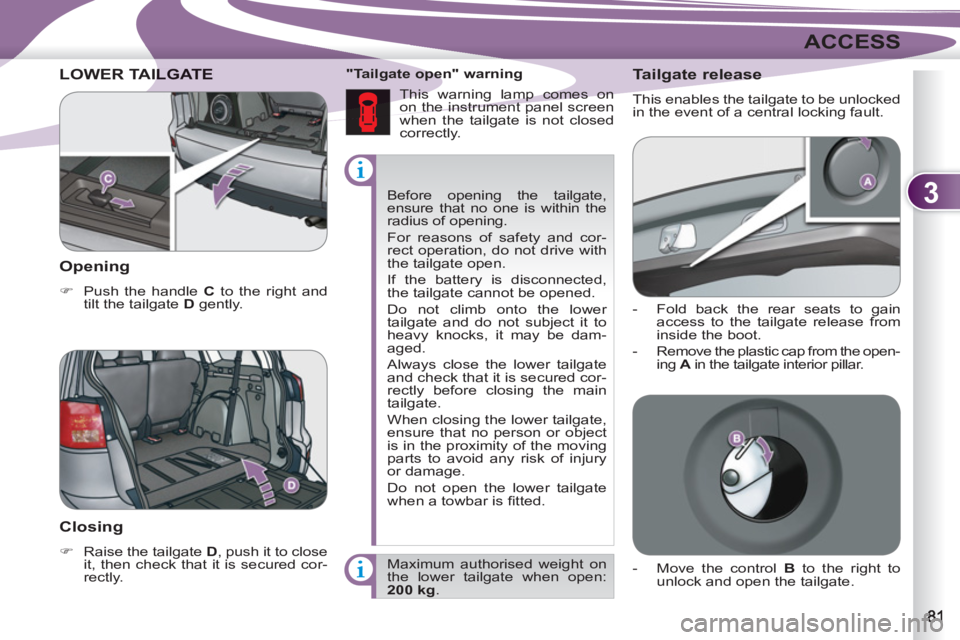
LOWER TAILLGATE
Opening
)
Push the handle C
to the right and
tilt the tailgate D
gently.
Closing
)
Raise the tailgate D
, push it to close
it, then check that it is secured cor-
rectly. Maximum authorised weight on
the lower tailgate when open:
200 kg
.
Tailgate release
This enables the tailgate to be unlocked
in the event of a central locking fault.
- Fold back the rear seats to gain
access to the tailgate release from
inside the boot.
- Remove the plastic cap from the open-
ing A
in the tailgate interior pillar.
- Move the control B
to the right to
unlock and open the tailgate.
Page 96 of 236
5
CHILD SAFETY
Although one of PEUGEOT's main cri-
teria when designing your vehicle, the
safety of your children also depends on
you.
CHILD SEAT IN THE FE FRONT
*
The rules for carrying children are
specifi c to each country. Refer to the
current legislation in your country.
GENERAL POINTS RELATING
TO CHILD SEATS
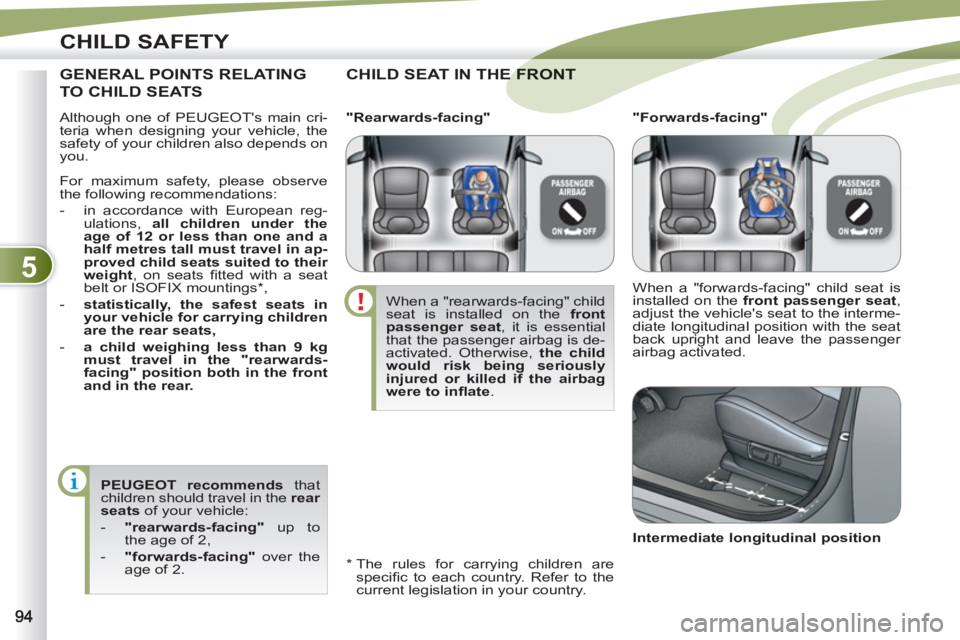
"Rearwards-facing"
PEUGEOT recommends
that
children should travel in the rear
seats
of your vehicle:
- "rearwards-facing"
up to
the age of 2,
- "forwards-facing"
over the
age of 2. When a "rearwards-facing" child
seat is installed on the front
passenger seat
, it is essential
that the passenger airbag is de-
activated. Otherwise, the child
would risk being seriously
injured or killed if the airbag
were to infl ate
. When a "forwards-facing" child seat is
installed on the front passenger seat
,
adjust the vehicle's seat to the interme-
diate longitudinal position with the seat
back upright and leave the passenger
airbag activated.
"Forwards-facing"
Intermediate longitudinal position
For maximum safety, please observe
the following recommendations:
- in accordance with European reg-
ulations, all children under the
age of 12 or less than one and a
half metres tall must travel in ap-
proved child seats suited to their
weight
, on seats fi tted with a seat
belt or ISOFIX mountings * ,
- statistically, the safest seats in
your vehicle for carrying children
are the rear seats,
- a child weighing less than 9 kg
must travel in the "rearwards-
facing" position both in the front
and in the rear.
Page 97 of 236
5
CHILD SAFETY
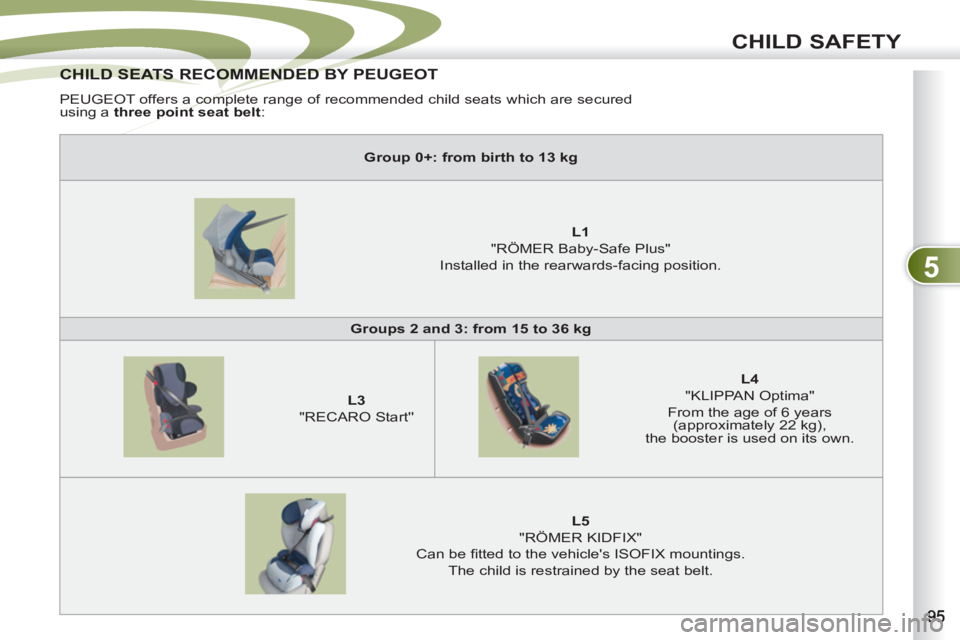
CHILD SEATS RECOMMENDED BY PEUGEOT CHILD SEATS RECOMMENDED B
PEUGEOT offers a complete range of recommended child seats which are secured
using a three point seat belt
:
Group 0+: from birth to 13 kg
L1
"RÖMER Baby-Safe Plus"
Installed in the rearwards-facing position.
Groups 2 and 3: from 15 to 36 kg
L3
"RECARO Start''
L4
"KLIPPAN Optima"
From the age of 6 years
(approximately 22 kg),
the booster is used on its own.
L5
"RÖMER KIDFIX"
Can be fi tted to the vehicle's ISOFIX mountings.
The child is restrained by the seat belt.
Page 99 of 236
5
CHILD SAFETY
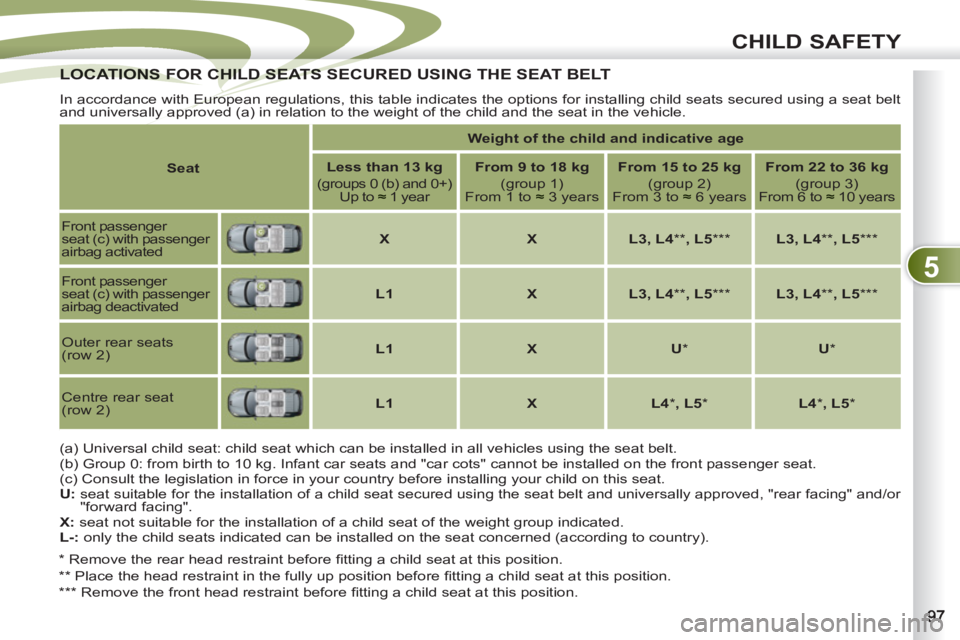
LOCATIONS FOR CHILD SEATS SECURED USING THE SEAT BELTLOCATIONS FOR CHILD SEATS S
In accordance with European regulations, this table indicates the options for installing child seats secured using a seat belt
and universally approved (a) in relation to the weight of the child and the seat in the vehicle.
(a) Universal child seat: child seat which can be installed in all vehicles using the seat belt.
(b) Group 0: from birth to 10 kg. Infant car seats and "car cots" cannot be installed on the front passenger seat.
(c) Consult the legislation in force in your country before installing your child on this seat.
U:
seat suitable for the installation of a child seat secured using the seat belt and universally approved, "rear facing" and/or
"forward facing".
X:
seat not suitable for the installation of a child seat of the weight group indicated.
L-:
only the child seats indicated can be installed on the seat concerned (according to country).
Seat
Weight of the child and indicative age
Less than 13 kg
(groups 0 (b) and 0+)
Up to
≈ 1 year
From 9 to 18 kg
(group 1)
From 1 to ≈ 3 years
From 15 to 25 kg
(group 2)
From 3 to ≈ 6 years
From
22 to 36 kg
(group 3)
From 6 to ≈ 10 years
Front passenger
seat (c) with passenger
airbag activated
X
X
L3, L4
**
, L5
***
L3, L4
**
, L5
***
Front passenger
seat (c) with passenger
airbag deactivated
L1
X
L3, L4
**
, L5
***
L3, L4
**
, L5
***
Outer rear seats
(row 2)
L1
X
U
*
U
*
Centre rear seat
(row 2)
L1
X
L4
*
,
L5
*
L4
*
, L5
*
*
Remove the rear head restraint before fi tting a child seat at this position.
**
Place the head restraint in the fully up position before fi tting a child seat at this position.
***
Remove the front head restraint before fi tting a child seat at this position.
Page 100 of 236
5
CHILD SAFETY
The incorrect installation of a
child seat in a vehicle compro-
mises the child's protection in
the event of an accident.
For information regarding the
ISOFIX child seats which can be
installed in your vehicle, refer to
the table showing the locations
for ISOFIX child seats.
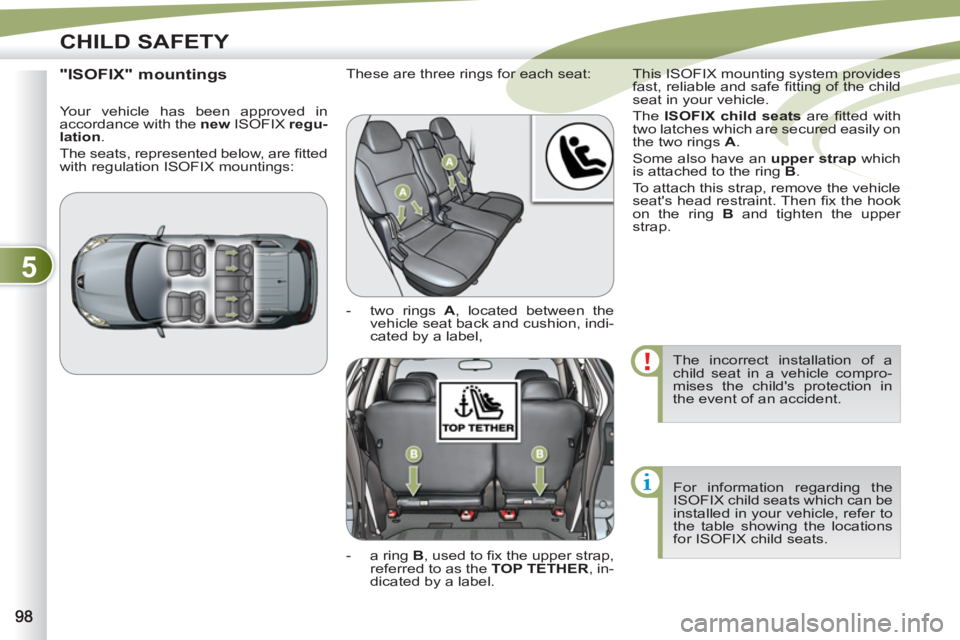
"ISOFIX" mountings
These are three rings for each seat:
- two rings A
, located between the
vehicle seat back and cushion, indi-
cated by a label,
- a ring B
, used to fi x the upper strap,
referred to as the TOP TETHER
, in-
dicated by a label. This ISOFIX mounting system provides
fast, reliable and safe fi tting of the child
seat in your vehicle.
The ISOFIX child seats
are fi tted with
two latches which are secured easily on
the two rings A
.
Some also have an upper strap
which
is attached to the ring B
.
To attach this strap, remove the vehicle
seat's head restraint. Then fi x the hook
on the ring B
and tighten the upper
strap. Your vehicle has been approved in
accordance with the new
ISOFIX regu-
lation
.
The seats, represented below, are fi tted
with regulation ISOFIX mountings:
Page 101 of 236
5
CHILD SAFETY
This child seat can also be used on seats which are not fi tted with ISOFIX mountings.
In this case, it must be attached to the vehicle seat using the three point seat belt.
Follow the instructions for fi tting the child seat given in the seat manufacturer's installation guide.
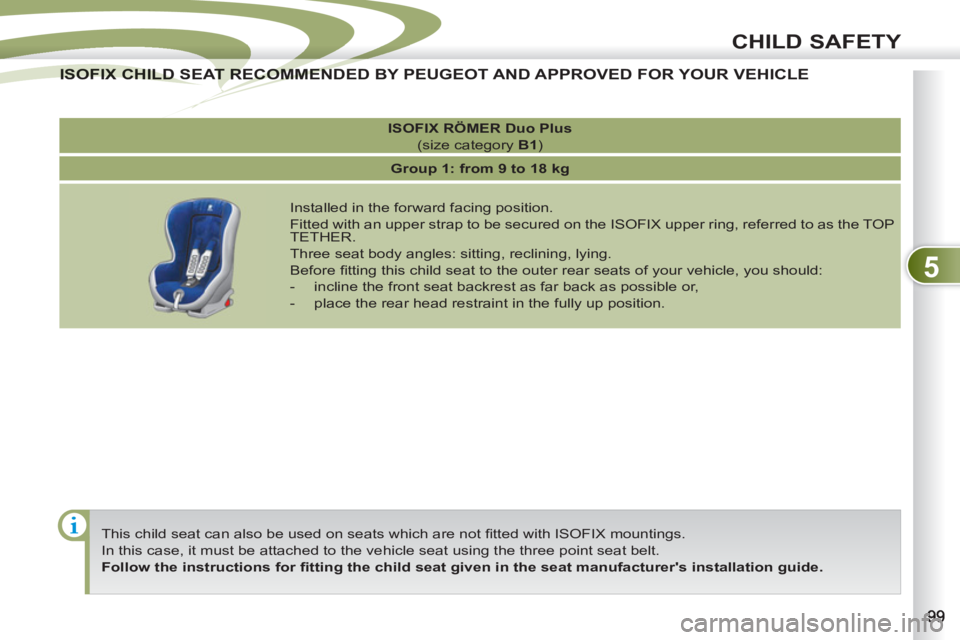
ISOFIX
RÖMER Duo Plus
(size category B1
)
Group 1: from 9 to 18 kg
Installed in the forward facing position.
Fitted with an upper strap to be secured on the ISOFIX upper ring, referred to as the TOP
TETHER.
Three seat body angles: sitting, reclining, lying.
Before fi tting this child seat to the outer rear seats of your vehicle, you should:
- incline the front seat backrest as far back as possible or,
- place the rear head restraint in the fully up position.
ISOFIX CHILD SEAT RECOMMENDED BY PEUGEOT AND APPROVED FOR YOUR VEHICLE
ISOFIX CHILD SEAT RECOMMEN
Page 102 of 236
5
CHILD SAFETY
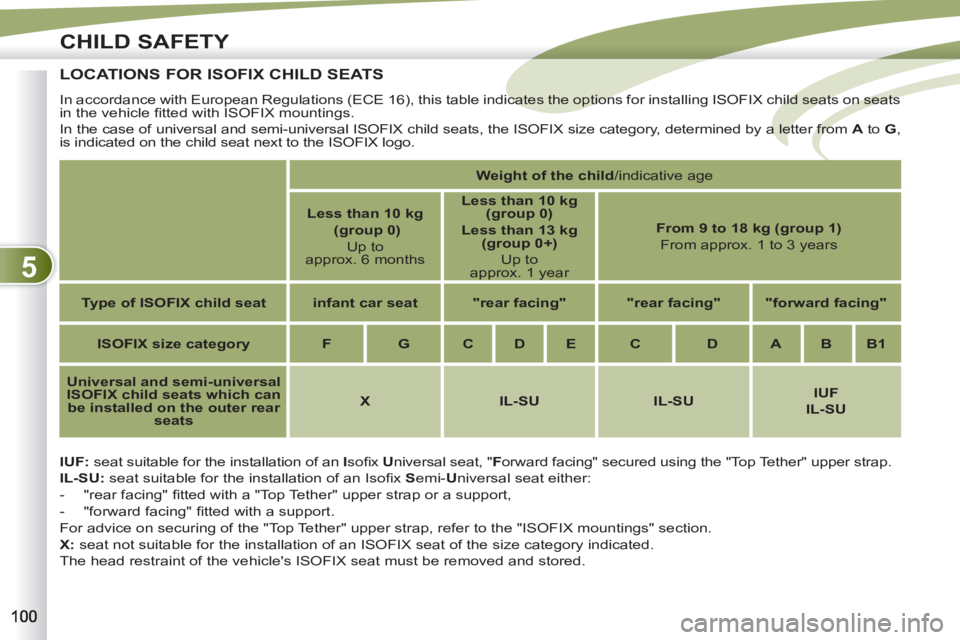
LOCATIONS FOR ISOFIX CHILD SEATS
IUF:
seat suitable for the installation of an I
sofi x U
niversal seat, " F
orward facing" secured using the "Top Tether" upper strap.
IL-SU:
seat suitable for the installation of an Isofi x S
emi- U
niversal seat either:
- "rear facing" fi tted with a "Top Tether" upper strap or a support,
- "forward facing" fi tted with a support.
For advice on securing of the "Top Tether" upper strap, refer to the "ISOFIX mountings" section.
X:
seat not suitable for the installation of an ISOFIX seat of the size category indicated.
The head restraint of the vehicle's ISOFIX seat must be removed and stored. In accordance with European Regulations (ECE 16), this table indicates the options for installing ISOFIX child seats on seats
in the vehicle fi tted with ISOFIX mountings.
In the case of universal and semi-universal ISOFIX child seats, the ISOFIX size category, determined by a letter from A
to G
,
is indicated on the child seat next to the ISOFIX logo.
Weight of the child
/indicative age
Less than 10 kg
(group 0)
Up to
approx. 6 months
Less than 10 kg
(group 0)
Less than
13 kg
(group 0+)
Up to
approx. 1 year
From 9 to 18 kg (group 1)
From approx. 1 to 3 years
Type of ISOFIX child seat
infant car seat
"rear facing"
"rear facing"
"forward facing"
ISOFIX size category
F
G
C
D
E
C
D
A
B
B1
Universal and semi-universal
ISOFIX child seats which can
be installed on the outer rear
seats
X
IL-SU
IL-SU
IUF
IL-SU
Page 103 of 236
5
CHILD SAFETY
The incorrect installation of a
child seat in a vehicle compro-
mises the child's protection in
the event of an accident.
Remember to fasten the seat
belts or the child seat harnesses
keeping the slack
in relation to
the child's body to a minimum
,
even for short journeys.
For optimum installation of the
"forward facing" child seat, en-
sure that the back of the child
seat is in contact with the back
of the vehicle's seat and that the
head restraint does not cause
any discomfort.
If the head restraint has to be
removed, ensure that it is stored
or attached securely to prevent
it from being thrown around the
vehicle in the event of sharp
braking.
Children under the age of
10 must not travel in the "for-
ward facing" position on the front
passenger seat, unless the rear
seats are already occupied by
other children, cannot be used
or are absent.
Deactivate the passenger's airbag
when a "rear facing" child seat is
installed on the front seat. Other-
wise, the child would risk being se-
riously injured or killed if the airbag
were to infl ate.
Installing a booster seat
The chest part of the seat belt must
be positioned on the child's shoulder
without touching the neck.
Ensure that the lap part of the seat
belt passes correctly over the child's
thighs.
PEUGEOT recommends the use of
a booster seat which has a back, fi t-
ted with a seat belt guide at shoulder
level.
As a safety precaution, do not leave:
- one or more children alone and un-
supervised in a vehicle,
- a child or an animal in a vehicle
which is exposed to the sun, with
the windows closed,
- the keys within reach of children
inside the vehicle.
To prevent accidental opening of the
doors, use the "Child lock".
Take care not to open the rear windows
by more than one third.
To protect young children from the
rays of the sun, fi t side blinds on the
rear windows.
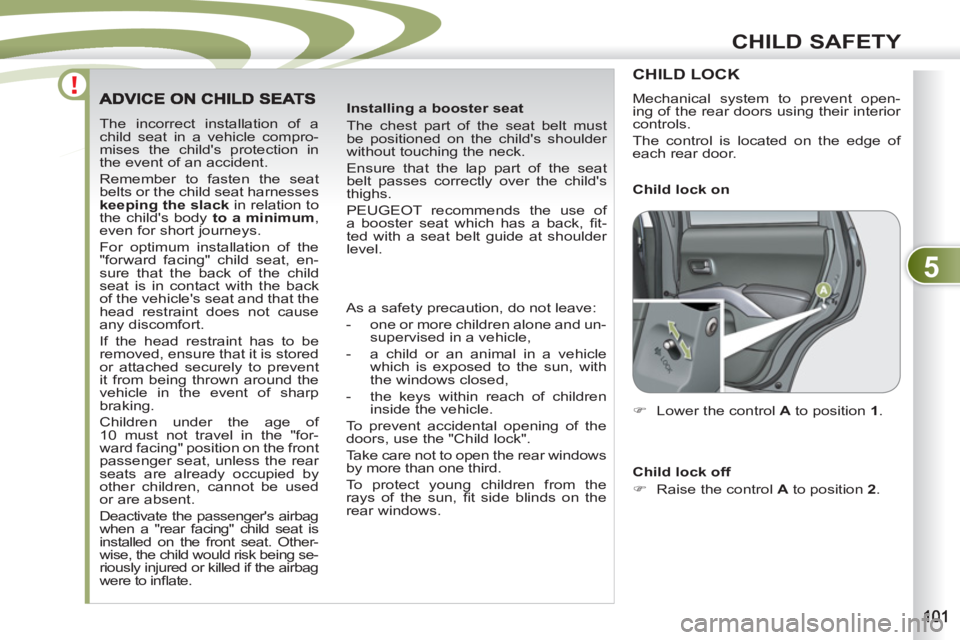
CHILD LOCK
)
Lower the control A
to position 1
.
Child lock on
Child lock off
)
Raise the control A
to position 2
.
Mechanical system to prevent open-
ing of the rear doors using their interior
controls.
The control is located on the edge of
each rear door.