wheel PEUGEOT 4008 2012 User Guide
[x] Cancel search | Manufacturer: PEUGEOT, Model Year: 2012, Model line: 4008, Model: PEUGEOT 4008 2012Pages: 332, PDF Size: 9.17 MB
Page 40 of 332
38
Instruments and controls
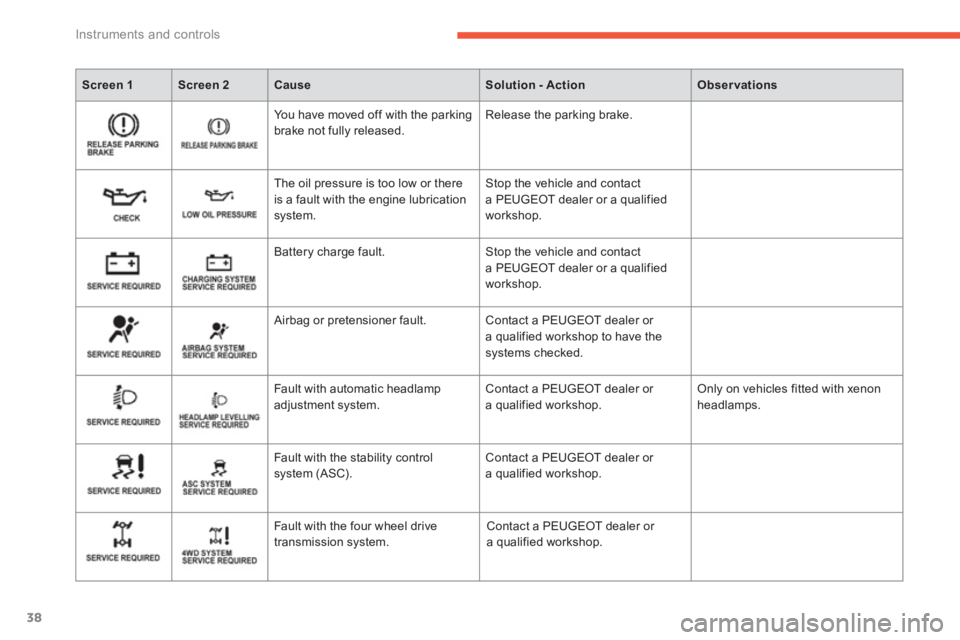
Screen 1Screen 2CauseSolution - ActionObservations
You have moved off with the parkingbrake not fully released. Release the parking brake.
The oil pressure is too low or there
is a
fault with the engine lubrication
system. Stop the vehicle and contact
a PEUGEOT dealer or a qualified
workshop.
Battery charge
fault. Stop the vehicle and contact
a PEUGEOT dealer or a qualified
workshop.
Airba
g or pretensioner fault. Contact a PEUGEOT dealer or
a qualified workshop to have the
systems checked.
Fault with automatic headlampadjustment system. Contact a PEUGEOT dealer or
a qualified workshop. Only on vehicles fitted with xenon headlamps.
Fault with the stabilit
y control
system (ASC). Contact a PEUGEOT dealer or
a qualified workshop.
F
ault with the four wheel drive
transmission system. Contact a PEUGEOT dealer or
a qualified workshop.
Page 41 of 332
1
39
Instruments and controls
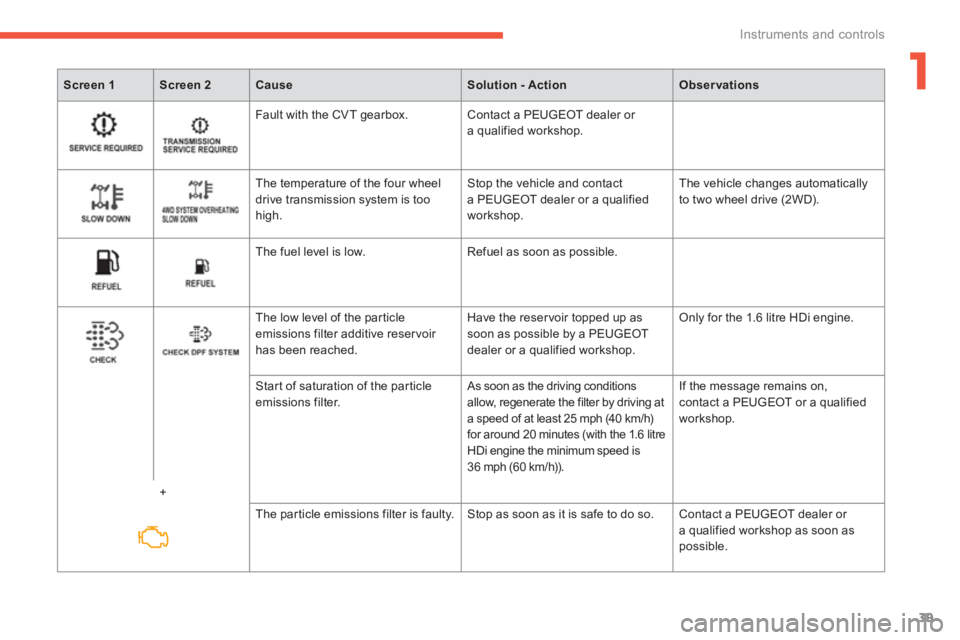
Screen 1Screen 2CauseSolution - ActionObservations
Fault with the CVT gearbox. Contact a PEUGEOT dealer or
a qualified workshop.
The temperature of the four wheel
drive transmission system is toohigh. Stop the vehicle and contact
a PEUGEOT dealer or a qualified workshop. The vehicle chan
ges automatically
to two wheel drive (2WD).
Th
e fuel level is low. Refuel as soon as possible.
The low level o
f the particleemissions filter additive reservoir has been reached.
Have the reser voir topped up as
soon as possible by a PEUGEOT
dealer or a qualified workshop.
Only for the 1.6 litre HDi engine.
+Star t of saturation of the par ticle
emissions filter. As soon as the driving conditions
allow, regenerate the filter by driving at
a speed of at least 25 mph (40 km/h)
for around 20 minutes (with the 1.6 litre HDi engine the minimum speed is
36 mph (60 km/h)). If the messa
ge remains on, contact a PEUGEOT or a qualified
workshop.
The par ticle emissions filter is fault
y. Stop as soon as it is safe to do so. Contact a PEUGEOT dealer or
a qualified workshop as soon as
possible.
Page 43 of 332
1
41
Instruments and controls
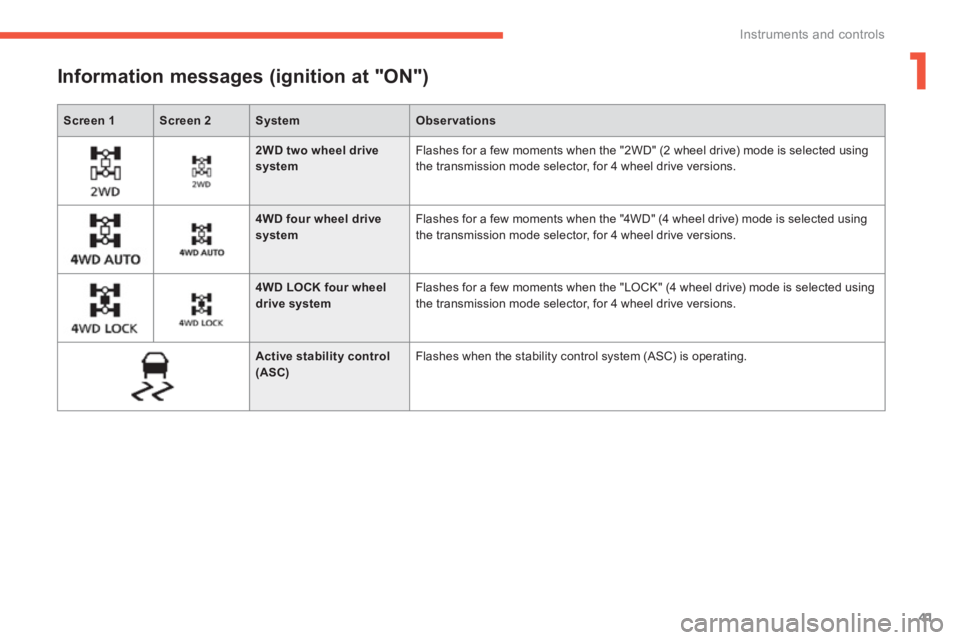
Screen 1Screen 2SystemObservations
Information messages (ignition at "ON")
2WD two wheel drive system
Flashes for a few moments when the "2WD" (2 wheel drive) mode is selected usingthe transmission mode selector, for 4 wheel drive versions.
4WD four wheel drive system
Flashes for a few moments when the "4WD" (4 wheel drive) mode is selected using
the transmission mode selector, for 4 wheel drive versions.
4WD LOCK four wheel drive system Flashes for a few moments when the "LOCK" (4 wheel drive) mode is selected usingthe transmission mode selector, for 4 wheel drive versions.
Active stability control (ASC)
Flashes when the stability control system (ASC) is operating.
Page 89 of 332
87
3
Comfort
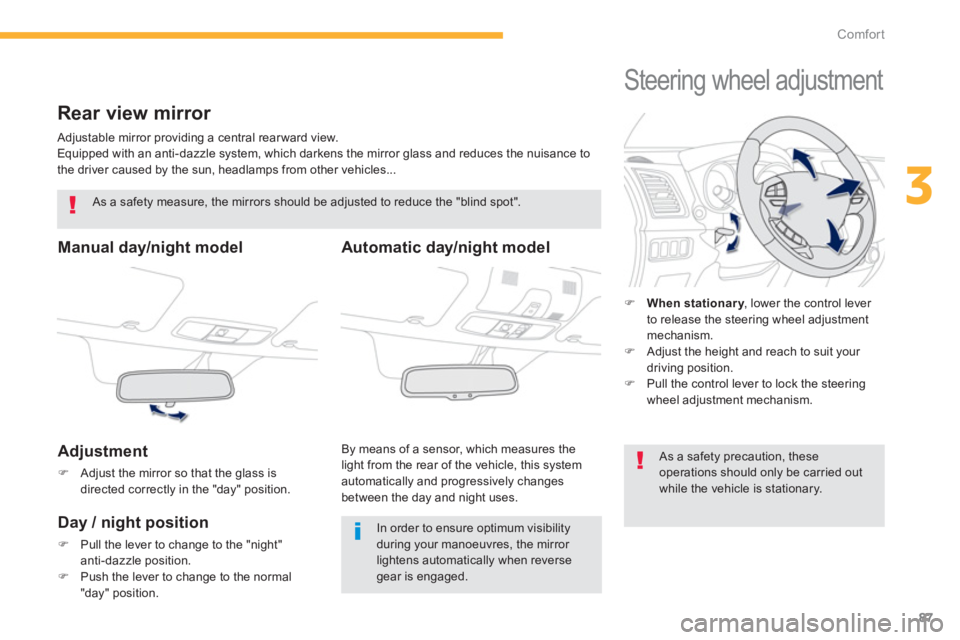
Rear view mirror
Adjustable mirror providing a central rear ward view.
Equipped with an anti-dazzle system, which darkens the mirror glass and reduces the nuisance to
the driver caused by the sun, headlamps from other vehicles...
Manual day/night model
Ad
justment
)
Adjust the mirror so that the glass is directed correctly in the "day" position.
As a safety measure, the mirrors should be adjusted to reduce the "blind spot".
In order to ensure optimum visibilityduring your manoeuvres, the mirror lightens automatically when reverse gear is engaged.
Day / night position
)
Pull the lever to change to the "night"
anti-dazzle position.) Push the lever to change to the normal
"day" position.
Automatic day/night model
By means of a sensor, which measures the
light from the rear of the vehicle, this system automatically and progressively changes
between the day and night uses.
Steering wheel adjustment
)When stationary, lower the control lever yto release the steering wheel adjustment mechanism. )
Adjust the height and reach to suit your
driving position.) Pull the control lever to lock the steering
wheel adjustment mechanism.
As a safety precaution, these operations should only be carried out while the vehicle is stationary.
Page 108 of 332
106
Driving
Starting - stopping the engine with the key
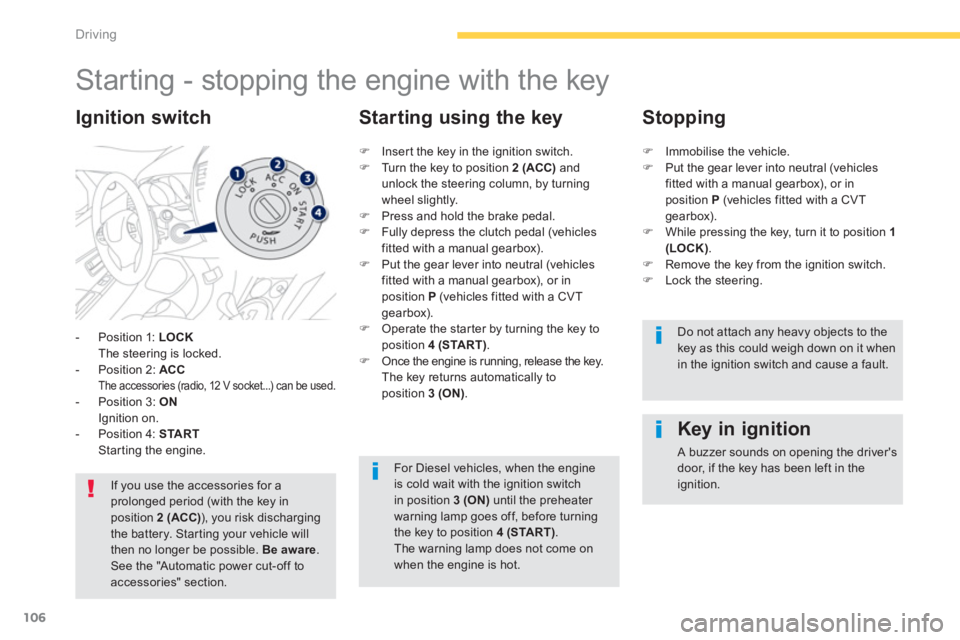
- Position 1: LOCKThe steering is locked.
- Position 2: ACCThe accessories (radio, 12 V socket...) can be used. - Position 3: ONIgnition on.
- P
osition 4: STARTStarting the engine.
Ignition switch
If you use the accessories for aprolonged period (with the key in position 2 (ACC)), you risk dischargingthe battery. Starting your vehicle will then no longer be possible. Be aware. See the "Automatic power cut-off toaccessories" section.
Key in ignition
A buzzer sounds on opening the driver'sdoor, if the key has been left in the ignition.
)
Inser t the key in the ignition switch.)
Turn the key to position 2 (ACC)
and unlock the steering column, by turning
wheel slightly. ) Press and hold the brake pedal.)
Fully depress the clutch pedal (vehicles fitted with a manual gearbox). )
Put the gear lever into neutral (vehicles fitted with a manual gearbox), or in position P(vehicles fitted with a CVT
gearbox). ) Operate the star ter by turning the key to
position 4 (START).) Once the engine is running, release the key.
The key returns automatically to
position 3 (ON).
Starting using the key
Stopping
)Immobilise the vehicle. )Put the gear lever into neutral (vehiclesfitted with a manual gearbox), or inposition P
(vehicles fitted with a CVT gearbox).)While pressing the key, turn it to position 1 (LOCK).)Remove the key from the ignition switch.)Lock the steering.
Do not attach any heavy objects to the key as this could weigh down on it whenin the ignition switch and cause a fault.
For Diesel vehicles, when the engineis cold wait with the ignition switchin position 3 (ON)
until the preheater warning lamp goes off, before turningthe key to position 4 (START)
. The warning lamp does not come on when the engine is hot.
Page 110 of 332
108
Driving
For Diesel vehicles, when the engine is cold star ting does not take place until thepre-heater warning lamp has gone off.
If one of the star ting conditions is not met, a reminder message appears inthe instrument panel screen. In somecircumstances, it is necessary toturn the steering wheel slightly whilepressing the "START/STOP" buttonto assist unlocking of the steering; a message warns you when this isneeded.
The presence of the electronic keyin the defined zone is essential. For
reasons of safety, do not leave this area when the engine is running.
Switching off using the
electronic key
If the vehicle is not immobilised, theengine will not stop.
This messa
ge is displayed
when the driver's door isopened and the vehicle is not
in "OFF" mode.
)Press the "START/STOP" button again to change to "OFF" mode.
)Immobilise the vehicle.
)Place the gear lever in neutral for vehicles fitted with a manual gearbox, or on P
for
vehicles fitted with a CVT gearbox
. )With the electronic key inside the vehicle, press the " START/STOP
" button.
The engine stops.
The steering locks when a door is opened or on
locking the vehicle. Each attempt at star tin
g takes around
15 seconds. If the en
gine does not star t, press
the "START/STOP
" button once more to tryagain.
The presence of the electronic key inthe vehicle is essential for switching on the ignition and star ting only. Once theengine has started, make sure that the electronic key remains with the vehicle until the end of the journey: other wiseyou would not be able to lock the vehicle.
Page 112 of 332
110
Driving
Anti-theft protection
Electronic engine immobiliser
The keys contain an electronic chip which has a secret code. When the ignition is switched
on, this code must be recognised in order for starting to be possible. This electronic engine immobiliser locks the engine management system a few minutesafter the ignition is switched off and prevents starting of the engine by anyone who does nothave the key.
In the event of a malfunction, you are informed by a message in the instrument panel screen.In this case, your vehicle does not start; contacta PEUGEOT dealer as soon as possible.
Applying
)
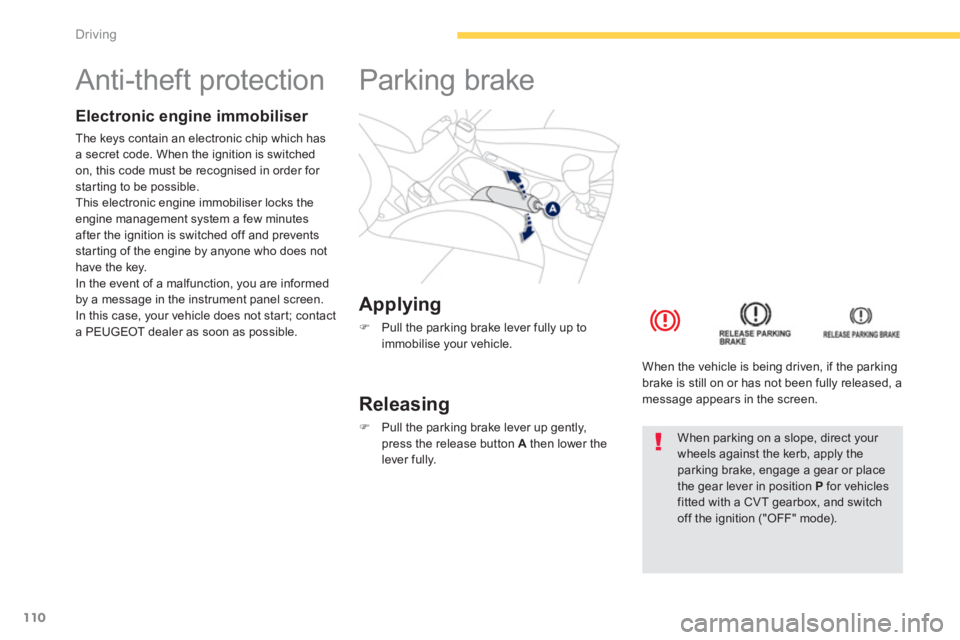
Pull the parking brake lever fully up to
immobilise your vehicle.
Parking brake
Releasing
)
Pull the parking brake lever up gently,
press the release button Athen lower thelever fully.
When the vehicle is bein
g driven, if the parkingbrake is still on or has not been fully released, a message appears in the screen.
When parking on a slope, direct your wheels against the kerb, apply theparking brake, engage a gear or place the gear lever in position Pfor vehiclesfitted with a CVT gearbox, and switch off the ignition ("OFF" mode).
Page 124 of 332
122
Driving
Four wheel drive system
System which permits the selection of a transmission mode in relation to the driving conditions.
Three transmission modes are available and can be selected manually by the driver in accordance with his requirements.
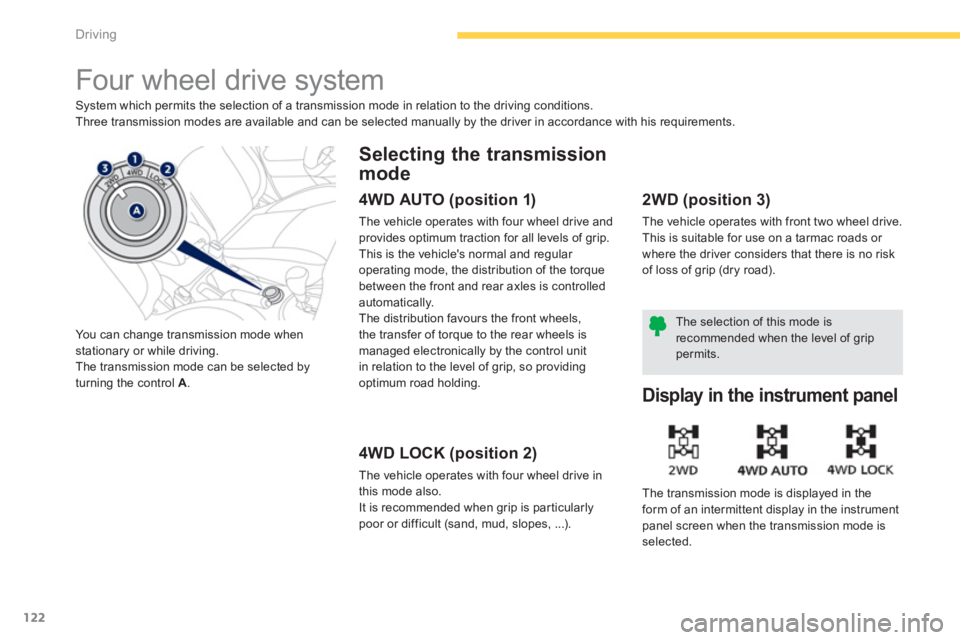
You can chan
ge transmission mode when stationary or while driving.
The transmission mode can be selected byturning the control A .
Selecting the transmission
mode
4WD AUTO (position 1)
The vehicle operates with four wheel drive and
provides optimum traction for all levels of grip.
This is the vehicle's normal and regular
operating mode, the distribution of the torque between the front and rear axles is controlled
automatically.
The distribution favours the front wheels,
the transfer of torque to the rear wheels is
mana
ged electronically by the control unit
in relation to the level of grip, so providing
optimum road holding.
4WD LOCK (position 2)
The vehicle operates with four wheel drive in
this mode also.
It is recommended when grip is par ticularly
poor or di
fficult (sand, mud, slopes, ...).
2WD (position 3)
The vehicle operates with front two wheel drive.
This is suitable for use on a tarmac roads or
where the driver considers that there is no riskof loss of grip (dry road).
Display in the instrument panel
The transmission mode is displayed in the
form of an intermittent display in the instrumentpanel screen when the transmission mode is
selected.
The selection of this mode isrecommended when the level of grippermits.
Page 125 of 332
123
4
Driving
As the engine torque is applied to all four wheels, the condition of the tyres
has a considerable impact on theperformance of the vehicle. Ensure that all four tyres are in good condition. Avoid driving the vehicle in sandy or muddy areas or in other areas in whichthe wheels could spin. Spinning the wheels places thetransmission components under pressure and could cause a seriousmalfunction. Do not drive the vehicle through deep water. Avoid driving over excessively uneventerrain (risk of scraping under the body or of grounding on crossing a bridge).
Operating faults
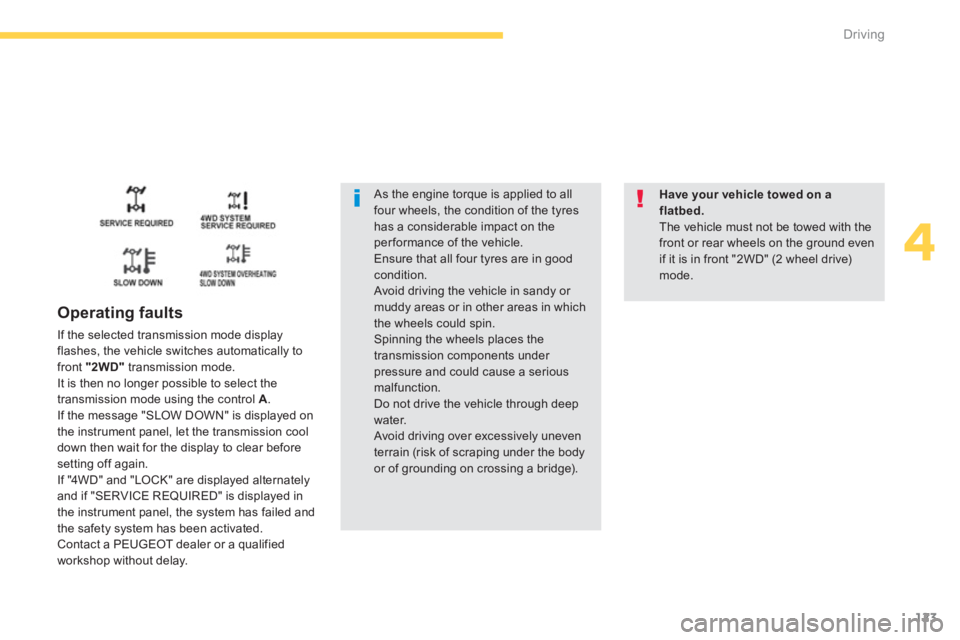
If the selected transmission mode display flashes, the vehicle switches automatically to front "2WD"
transmission mode.
It is then no longer possible to select the
transmission mode using the control A
.
If the message "SLOW DOWN" is displayed on
the instrument panel, let the transmission cool
down then wait for the displa
y to clear beforesetting off again.
If "4WD" and "LOCK" are displayed alternatelyand if "SERVICE REQUIRED" is displayed in
the instrument panel, the system has failed and
the safety system has been activated.
Contact a PEUGEOT dealer or a qualified
workshop without delay.
Have your vehicle towed on a flatbed. The vehicle must not be towed with the front or rear wheels on the ground evenif it is in front "2WD" (2 wheel drive)mode.
Page 126 of 332
124
Driving
Cruise control
System which automatically maintains the vehicle speed at the value programmed by the driver, without any action on the accelerator pedal.
The cruise control is switched on
manually:
the vehicle speed must be at least 25 mph(40 km/h) and second gear or higher must be engaged in the case of a manual gearbox.
Th
e cruise control is switched offmanually, byfan action on the brake or clutch pedal or if theASC system is triggered.
The pro
grammed speed can be exceeded
temporarily by pressing the accelerator pedal.
The cruise control cannot, in any circumstances, take the place of the need to comply with speed limits or of the vigilance and responsibility of the driver. The controls o
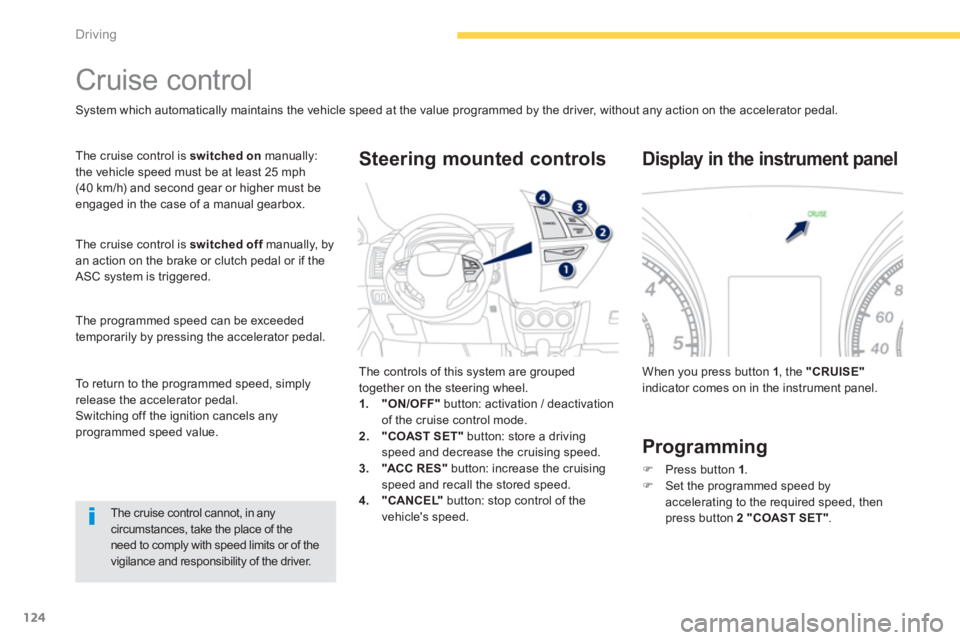
f this system are grouped
together on the steering wheel.1."ON/OFF"
button: activation / deactivation of the cruise control mode.
2
."COAST SET"button: store a drivingspeed and decrease the cruising speed. 3."ACC RES"
button: increase the cruising speed and recall the stored speed.4."CANCEL"button: stop control of the
vehicle's speed.
Steering mounted controls
When you press button 1, the "CRUISE"indicator comes on in the instrument panel.
Display in the instrument panel
Programming
)Press button 1.)Set the programmed speed byaccelerating to the required speed, then press button 2 "COAST SET" .
To return to the pro
grammed speed, simply release the accelerator pedal.
Switching off the ignition cancels any programmed speed value.