brake PEUGEOT 4008 2012 Owner's Manual
[x] Cancel search | Manufacturer: PEUGEOT, Model Year: 2012, Model line: 4008, Model: PEUGEOT 4008 2012Pages: 332, PDF Size: 9.17 MB
Page 126 of 332
124
Driving
Cruise control
System which automatically maintains the vehicle speed at the value programmed by the driver, without any action on the accelerator pedal.
The cruise control is switched on
manually:
the vehicle speed must be at least 25 mph(40 km/h) and second gear or higher must be engaged in the case of a manual gearbox.
Th
e cruise control is switched offmanually, byfan action on the brake or clutch pedal or if theASC system is triggered.
The pro
grammed speed can be exceeded
temporarily by pressing the accelerator pedal.
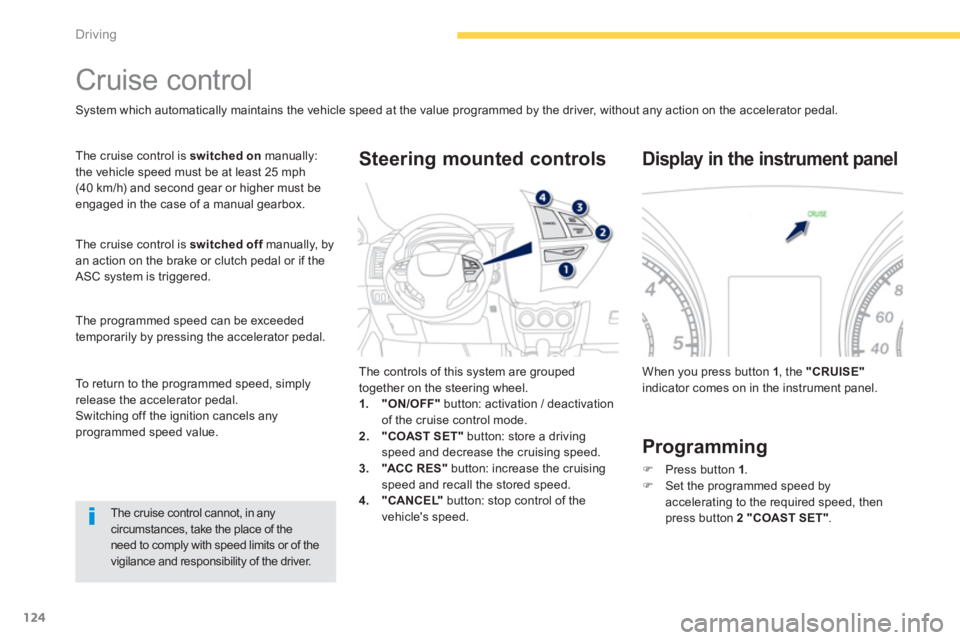
The cruise control cannot, in any circumstances, take the place of the need to comply with speed limits or of the vigilance and responsibility of the driver. The controls o
f this system are grouped
together on the steering wheel.1."ON/OFF"
button: activation / deactivation of the cruise control mode.
2
."COAST SET"button: store a drivingspeed and decrease the cruising speed. 3."ACC RES"
button: increase the cruising speed and recall the stored speed.4."CANCEL"button: stop control of the
vehicle's speed.
Steering mounted controls
When you press button 1, the "CRUISE"indicator comes on in the instrument panel.
Display in the instrument panel
Programming
)Press button 1.)Set the programmed speed byaccelerating to the required speed, then press button 2 "COAST SET" .
To return to the pro
grammed speed, simply release the accelerator pedal.
Switching off the ignition cancels any programmed speed value.
Page 127 of 332
125
4
Driving
Increasing the programmed
speed
Decreasing the
pro
grammed speed
Te m p o r a r
y acceleration/
deceleration
Te m p o r a ry acceleration
Press the accelerator pedal as normal. When
the pedal is released, you return to the stored speed.
) Using button 2 "COAST SET":- successive presses decrease the speed in steps of approximately 1 mph (1.6 km/h).
- a maintained press of this button
decreases the speed pro
gressively. Once the speed required has been reached,release the button, the new speed is stored.)
Using the brake pedal:
- brake to deactivate the cruise control, then press button 2 "COAST SET"
. Release to store the new speed.
)Using button 3 "ACC R ES":
- successive presses increase the speed insteps of approximately 1 mph (1.6 km/h).
- a maintained press of this button increases
the pro
grammed speed progressively.
Once the speed required has been reached,
release the button, the new speed is stored.
)Using the accelerator pedal:
- accelerate to reach the speed required,
then press button 2 "COAST SET".Release the button to store the new speed.
Temporary deceleration
Press the brake pedal to reduce the speed. To return to the stored speed, press button 3 "ACC RES".
Page 128 of 332
126
Driving
When the cruise control is in operation,pay attention if you press and hold oneof the programmed speed adjustment buttons: this can result in a very rapidchange in the speed of your vehicle.
Do not use the cruise control on slippery roads or in heavy traffic. On a steep descent, the cruise control will not be able to prevent the vehiclefrom exceeding the programmed speed.
To prevent the mat from becomingcaught under the pedals:
- ensure that the mat is positioned correctly,
- never fit one mat on top of another.
T
o deactivate the cruise control:
)press the brakeor clutchpedal, or )press button 1 "ON OFF", or )press button 4 "CANCEL".
Deactivating the function
Reactivating the function
When the cruise control has been deactivated using
the button 4 "CANCEL", you can return to the stored "speed by pressing button 3 "ACC RES"when youreach a minimum speed of 25 mph (40 km/h).
The cruise control may be deactivatedautomatically: )when the vehicle reaches a speed below
20 mph (35 km/h),)when the active stability control system (ASC) comes into operation.
Page 148 of 332
146
Safety
Group of supplementary systems which helpyou to obtain optimum braking in complete safety in emergency situations:
- anti-lock braking system (ABS),
- electronic brake force distribution (EBFD).
Braking assistance systems
Anti-lock braking system
and electronic brake force
distribution
Linked systems which improve the stability and
manoeuvrability of your vehicle when braking,
in par ticular on poor or slippery surfaces.
Activation
The anti-lock braking system is active if the
vehicle speed is higher than 6 mph (10 km/h).
It is deactivated when the vehicle speed falls
below 3 mph (5 km/h).
The anti-lock braking system comes into
operation automatically when there is a risk of
wheel lock.
Normal operation of the ABS may make itself felt by slight vibration of the brake pedal.
Operating fault
When the vehicle is stationar
y
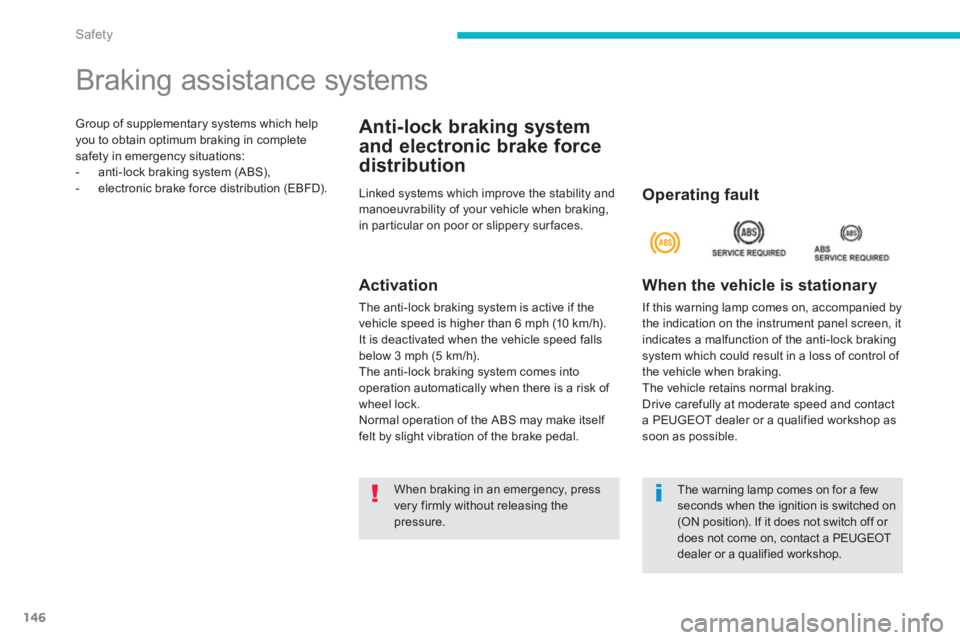
If this warning lamp comes on, accompanied by
the indication on the instrument panel screen, it
indicates a malfunction of the anti-lock brakin
gsystem which could result in a loss of control of
the vehicle when braking.
The vehicle retains normal braking.
Drive carefully at moderate speed and contact
a PEUGEOT dealer or a qualified workshop assoon as possible.
When braking in an emergency, pressvery firmly without releasing thepressure.
The warning lamp comes on for a fewseconds when the ignition is switched on (ON position). If it does not switch off or does not come on, contact a PEUGEOT dealer or a qualified workshop.
Page 149 of 332
147
6
Safety
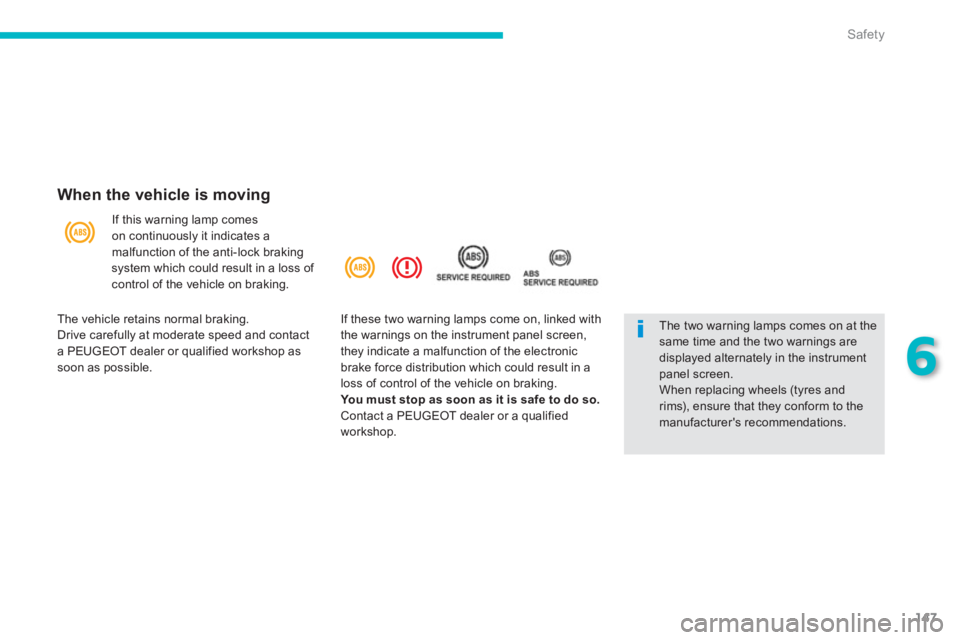
When the vehicle is moving
If this warning lamp comes
on continuously it indicates a
malfunction of the anti-lock brakingsystem which could result in a loss of control of the vehicle on braking.
The two warning lamps comes on at the same time and the two warnings aredisplayed alternately in the instrumentpanel screen. When replacing wheels (tyres and rims), ensure that they conform to themanufacturer's recommendations.
The vehicle retains normal braking.
Drive carefully at moderate speed and contact
a PEUGEOT dealer or qualified workshop assoon as possible. I
f these two warning lamps come on, linked with
the warnings on the instrument panel screen,
the
y indicate a malfunction of the electronic brake force distribution which could result in a loss of control of the vehicle on braking.
You must stop as soon as it is safe to do so.Contact a PEUGEOT dealer or a qualifiedworkshop.
Page 150 of 332
148
Safety
Associated systems which guarantee the directional stability of the vehicle within the limits of the laws of physics:
- traction control (TCL),
- active stability control (ASC).
Traction control and active stability control
Traction control optimises traction to prevent
wheel spin, by acting on the brakes of the
driving wheels and on the engine.
Active stability control acts on the brake of one
or more wheels and on the engine to keep the
vehicle on the trajectory required by the driver.
Activation
These systems are activated automaticallyeach time the vehicle is started.
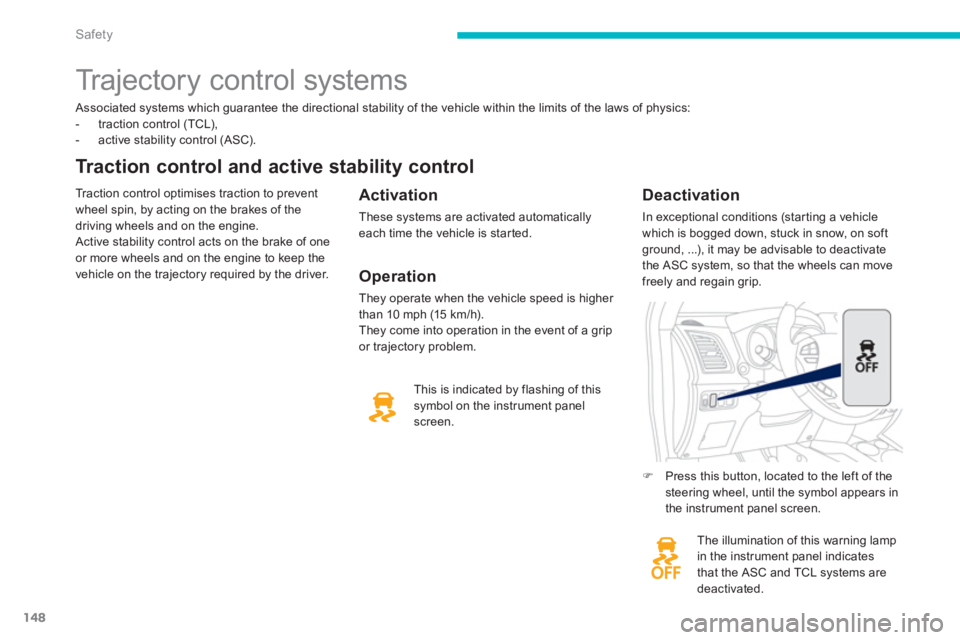
The illumination o
f this warning lamp
in the instrument panel indicates
that the ASC and TCL systems are deactivated.
Deactivation
In exceptional conditions (starting a vehicle
which is bogged down, stuck in snow, on soft ground, ...), it may be advisable to deactivate
the ASC system, so that the wheels can movefreely and regain grip.
This is indicated b
y flashing of this symbol on the instrument panel screen.
Trajectory control systems
)Press this button, located to the left of thesteering wheel, until the symbol appears in
the instrument panel screen.
Operation
They operate when the vehicle speed is higher
than 10 mph (15 km / h).
They come into operation in the event of a grip
or trajectory problem.
Page 173 of 332
171
7
Practical information
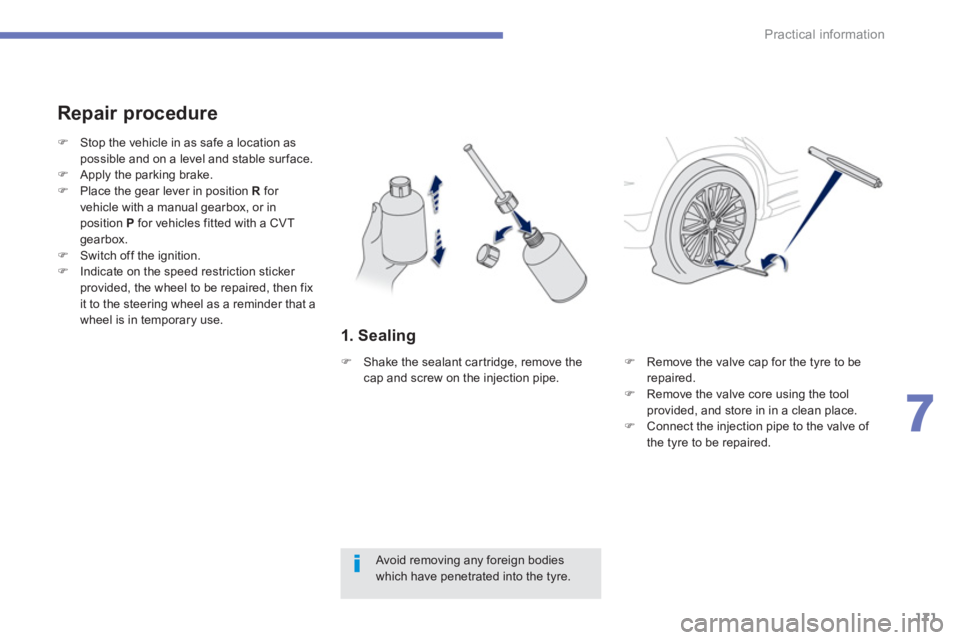
1. Sealing
Repair procedure
Avoid removing any foreign bodies which have penetrated into the tyre.
)Stop the vehicle in as safe a location as
possible and on a level and stable surface. )Apply the parking brake. )Place the gear lever in position Rfor
vehicle with a manual gearbox, or inposition P for vehicles fitted with a CVT
gearbox. )Switch off the ignition. )Indicate on the speed restriction sticker provided, the wheel to be repaired, then fixit to the steering wheel as a reminder that a
wheel is in temporary use.
)
Remove the valve cap for the tyre to be
repaired. ) Remove the valve core using the toolprovided, and store in in a clean place.)
Connect the injection pipe to the valve of
the tyre to be repaired.
) Shake the sealant car tridge, remove thecap and screw on the injection pipe.
Page 178 of 332
176
Practical information
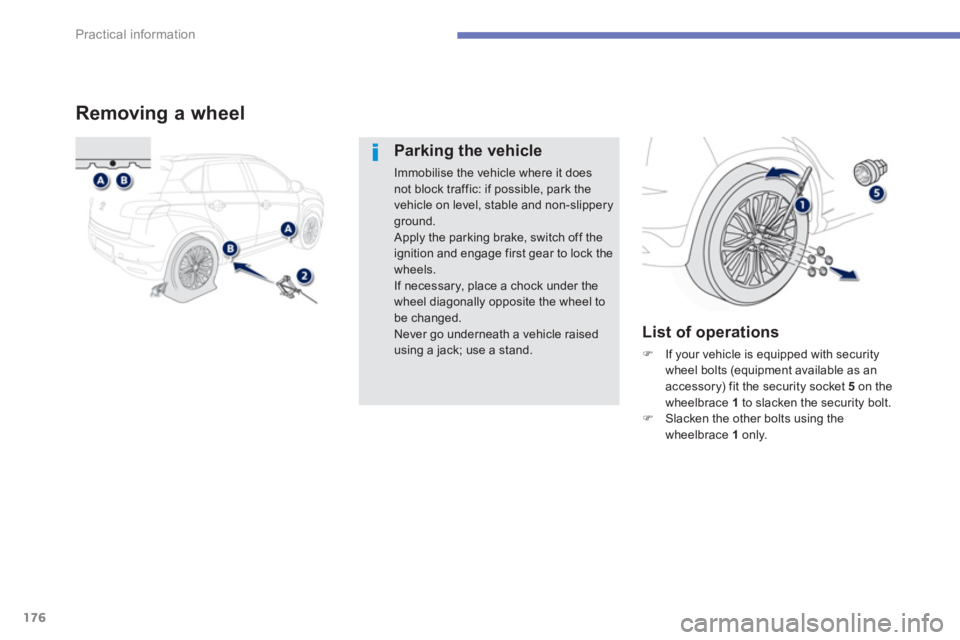
Removing a wheel
Parking the vehicle
Immobilise the vehicle where it does not block traffic: if possible, park the vehicle on level, stable and non-slippery ground.
Apply the parking brake, switch off theignition and engage first gear to lock the wheels.If necessary, place a chock under the wheel diagonally opposite the wheel tobe changed. Never go underneath a vehicle raisedusing a jack; use a stand.
List of operations
)If your vehicle is equipped with security
wheel bolts (equipment available as an accessory) fit the security socket 5on the
wheelbrace 1to slacken the security bolt. )Slacken the other bolts using the
wheelbrace 1only.
Page 186 of 332
184
Practical information
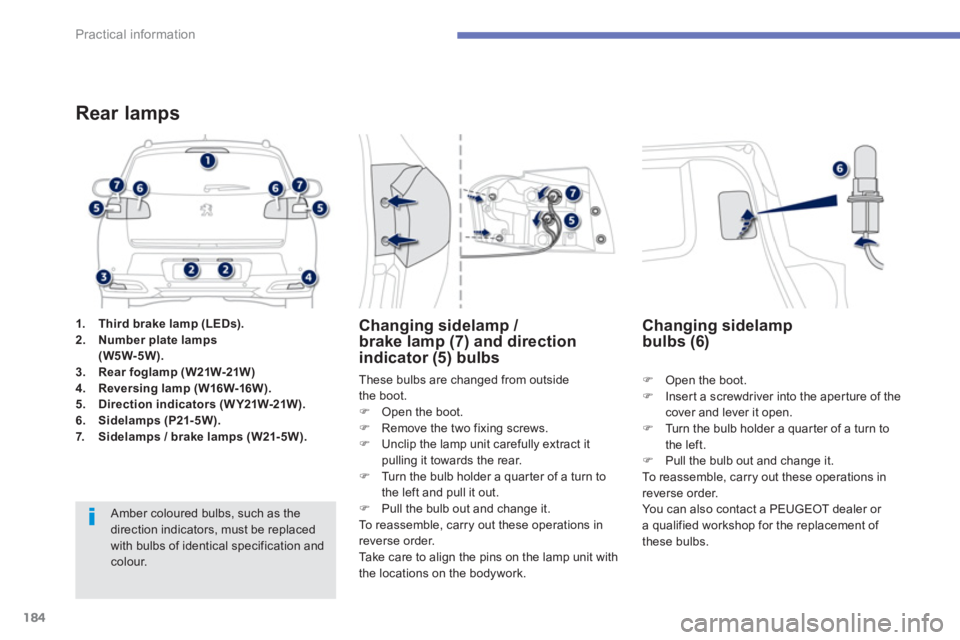
1.Third brake lamp (LEDs).2.Number plate lamps(W5W-5W).3.Rear foglamp (W21W-21W)4.Reversing lamp (W16W-16W).5.Direction indicators (W Y21W-21W).6.Sidelamps (P21-5W).7.Sidelamps / brake lamps (W21-5W).
Rear lamps
Amber coloured bulbs, such as the direction indicators, must be replaced with bulbs of identical specification andcolour. These bulbs are chan
ged from outside
the boot.) Open the boot. )
Remove the two fixing screws.
)
Unclip the lamp unit carefully extract it
pulling it towards the rear.) Turn the bulb holder a quar ter of a turn to
the left and pull it out.) Pull the bulb out and change it.
To reassemble, carry out these operations in reverse order.
Take care to align the pins on the lamp unit with
the locations on the bodywork.
Changing sidelamp /brake lamp (7) and direction
indicator (5) bulbs
)Open the boot.)Inser t a screwdriver into the aper ture of thecover and lever it open.)Turn the bulb holder a quarter of a turn to
th
e left.)Pull the bulb out and change it.
To r e a s s e m b l e , c a r ry out these operations in
reverse order.
You can also contact a PEUGEOT dealer or
a qualified workshop for the replacement of
these bulbs.
Changing sidelamp
bulbs (6)
Page 187 of 332
185
7
Practical information
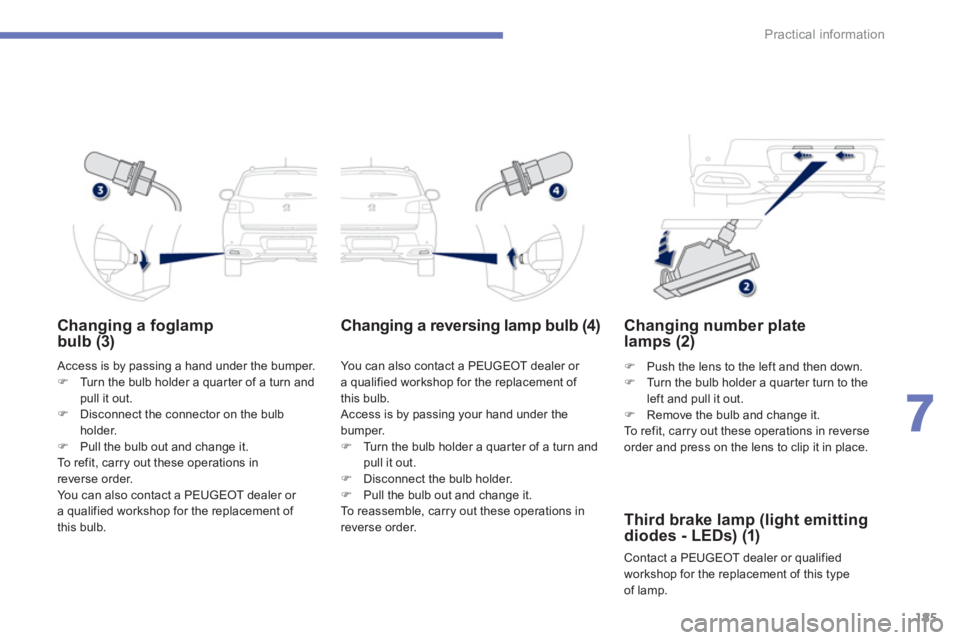
Changing a foglamp
bulb (3)
Access is by passing a hand under the bumper. )Turn the bulb holder a quar ter of a turn andpull it out.)Disconnect the connector on the bulb holder. )Pull the bulb out and change it.
To r efit, carry out these operations in
reverse order.
You can also contact a PEUGEOT dealer or
a qualified workshop for the replacement of
this bulb.
Changing a reversing lamp bulb (4)
You can also contact a PEUGEOT dealer or a qualified workshop for the replacement of
this bulb.
Access is by passing your hand under the
bumper.
) Turn the bulb holder a quar ter of a turn and
pull it out. ) Disconnect the bulb holder. )
Pull the bulb out and change it.
To reassemble, carry out these operations in
reverse order.
Changing number platelamps (2)
)
Push the lens to the left and then down. )
Turn the bulb holder a quar ter turn to the
left and pull it out.) Remove the bulb and change it.
To r e f i t , c a r ry out these operations in reverseorder and press on the lens to clip it in place.
Third brake lamp (light emitting diodes - LEDs) (1)
Contact a PEUGEOT dealer or qualified
workshop for the replacement of this type
of lamp.