instrument panel PEUGEOT 4008 2012 Owner's Guide
[x] Cancel search | Manufacturer: PEUGEOT, Model Year: 2012, Model line: 4008, Model: PEUGEOT 4008 2012Pages: 332, PDF Size: 9.17 MB
Page 123 of 332
121
4
Driving
The system is reactivated automatically at every new star t using the key or the STA R T/STOP button.
Reactivation
Press the "AS&G OFF"switch again.
The s
ystem is active again; this is confirmed by
the "AS &G O FF "
warning lamp going off in the
instrument panel or instrument panel screen.
Operating fault
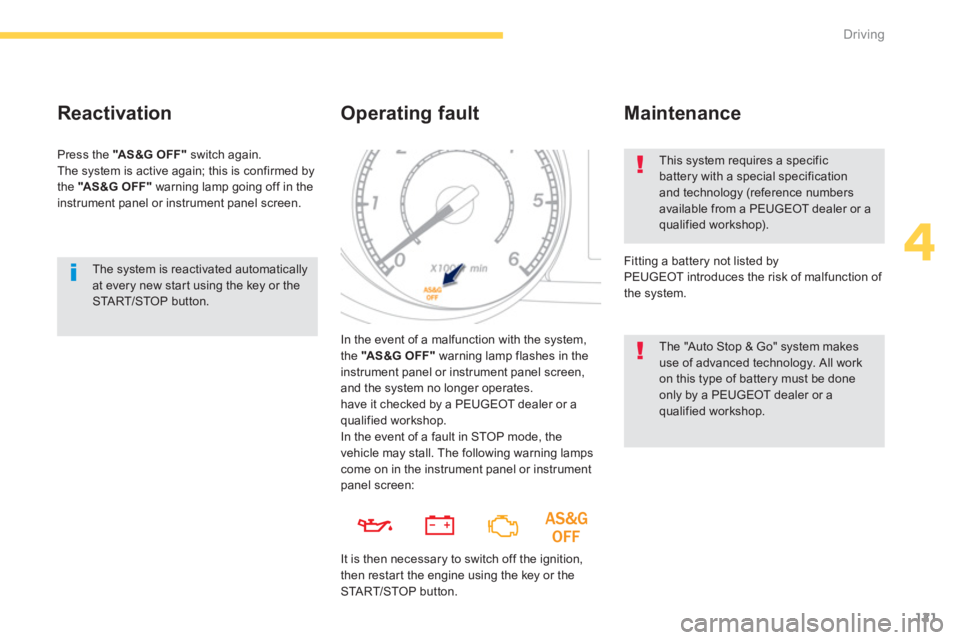
In the event of a malfunction with the system,
the "AS&G OFF"warning lamp flashes in theinstrument panel or instrument panel screen,and the system no longer operates.
have it checked by a PEUGEOT dealer or a qualified workshop.
This system requires a specific battery with a special specification and technology (reference numbersavailable from a PEUGEOT dealer or aqualified workshop).
Fitting a battery not listed by
PEU
GEOT introduces the risk of malfunction of
the system.
Maintenance
The "Auto Stop & Go" system makes use of advanced technology. All work on this type of battery must be doneonly by a PEUGEOT dealer or aqualified workshop.
In the event o
f a fault in STOP mode, the
vehicle may stall. The following warning lampscome on in the instrument panel or instrumentpanel screen:
It is then necessar
y to switch off the ignition,
then restart the engine using the key or theSTA R T/STOP button.
Page 124 of 332
122
Driving
Four wheel drive system
System which permits the selection of a transmission mode in relation to the driving conditions.
Three transmission modes are available and can be selected manually by the driver in accordance with his requirements.
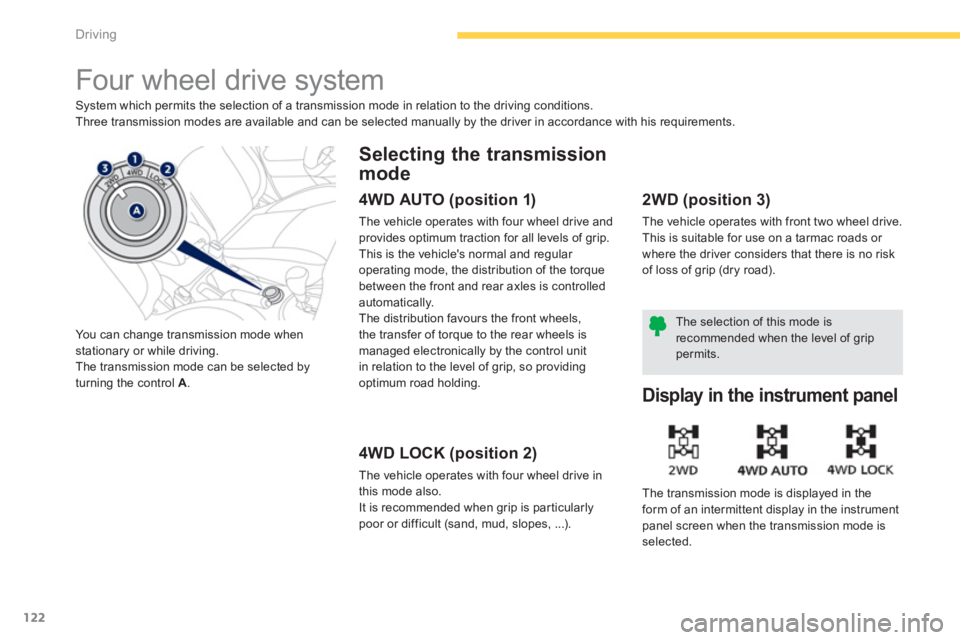
You can chan
ge transmission mode when stationary or while driving.
The transmission mode can be selected byturning the control A .
Selecting the transmission
mode
4WD AUTO (position 1)
The vehicle operates with four wheel drive and
provides optimum traction for all levels of grip.
This is the vehicle's normal and regular
operating mode, the distribution of the torque between the front and rear axles is controlled
automatically.
The distribution favours the front wheels,
the transfer of torque to the rear wheels is
mana
ged electronically by the control unit
in relation to the level of grip, so providing
optimum road holding.
4WD LOCK (position 2)
The vehicle operates with four wheel drive in
this mode also.
It is recommended when grip is par ticularly
poor or di
fficult (sand, mud, slopes, ...).
2WD (position 3)
The vehicle operates with front two wheel drive.
This is suitable for use on a tarmac roads or
where the driver considers that there is no riskof loss of grip (dry road).
Display in the instrument panel
The transmission mode is displayed in the
form of an intermittent display in the instrumentpanel screen when the transmission mode is
selected.
The selection of this mode isrecommended when the level of grippermits.
Page 125 of 332
123
4
Driving
As the engine torque is applied to all four wheels, the condition of the tyres
has a considerable impact on theperformance of the vehicle. Ensure that all four tyres are in good condition. Avoid driving the vehicle in sandy or muddy areas or in other areas in whichthe wheels could spin. Spinning the wheels places thetransmission components under pressure and could cause a seriousmalfunction. Do not drive the vehicle through deep water. Avoid driving over excessively uneventerrain (risk of scraping under the body or of grounding on crossing a bridge).
Operating faults
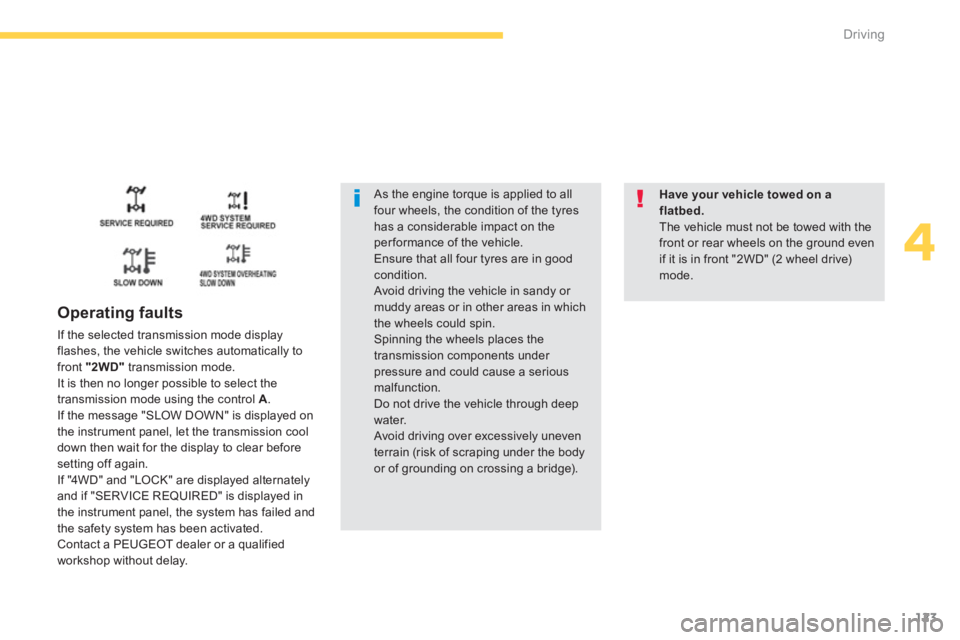
If the selected transmission mode display flashes, the vehicle switches automatically to front "2WD"
transmission mode.
It is then no longer possible to select the
transmission mode using the control A
.
If the message "SLOW DOWN" is displayed on
the instrument panel, let the transmission cool
down then wait for the displa
y to clear beforesetting off again.
If "4WD" and "LOCK" are displayed alternatelyand if "SERVICE REQUIRED" is displayed in
the instrument panel, the system has failed and
the safety system has been activated.
Contact a PEUGEOT dealer or a qualified
workshop without delay.
Have your vehicle towed on a flatbed. The vehicle must not be towed with the front or rear wheels on the ground evenif it is in front "2WD" (2 wheel drive)mode.
Page 126 of 332
124
Driving
Cruise control
System which automatically maintains the vehicle speed at the value programmed by the driver, without any action on the accelerator pedal.
The cruise control is switched on
manually:
the vehicle speed must be at least 25 mph(40 km/h) and second gear or higher must be engaged in the case of a manual gearbox.
Th
e cruise control is switched offmanually, byfan action on the brake or clutch pedal or if theASC system is triggered.
The pro
grammed speed can be exceeded
temporarily by pressing the accelerator pedal.
The cruise control cannot, in any circumstances, take the place of the need to comply with speed limits or of the vigilance and responsibility of the driver. The controls o
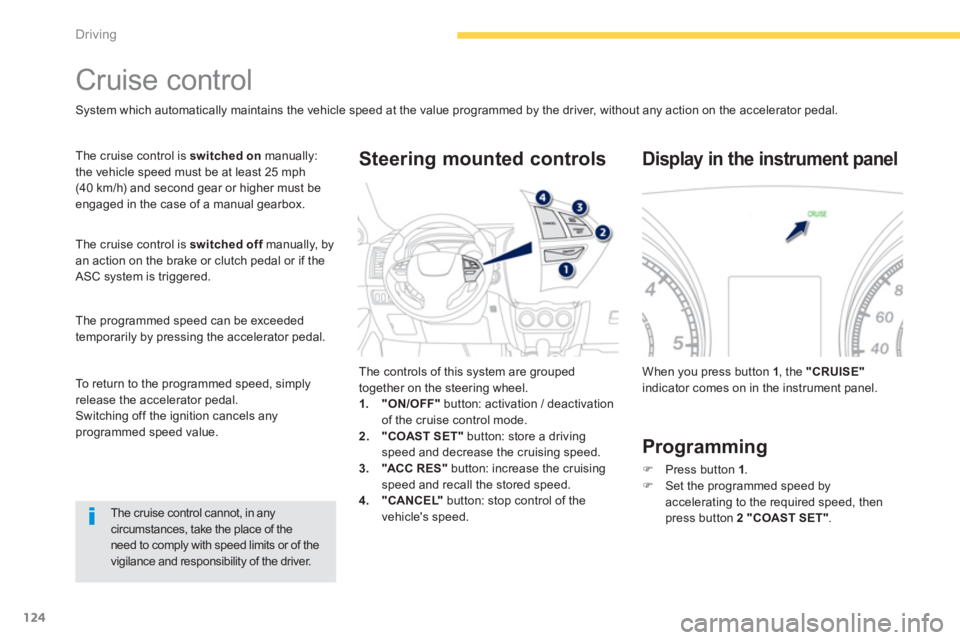
f this system are grouped
together on the steering wheel.1."ON/OFF"
button: activation / deactivation of the cruise control mode.
2
."COAST SET"button: store a drivingspeed and decrease the cruising speed. 3."ACC RES"
button: increase the cruising speed and recall the stored speed.4."CANCEL"button: stop control of the
vehicle's speed.
Steering mounted controls
When you press button 1, the "CRUISE"indicator comes on in the instrument panel.
Display in the instrument panel
Programming
)Press button 1.)Set the programmed speed byaccelerating to the required speed, then press button 2 "COAST SET" .
To return to the pro
grammed speed, simply release the accelerator pedal.
Switching off the ignition cancels any programmed speed value.
Page 131 of 332
129
4
Driving
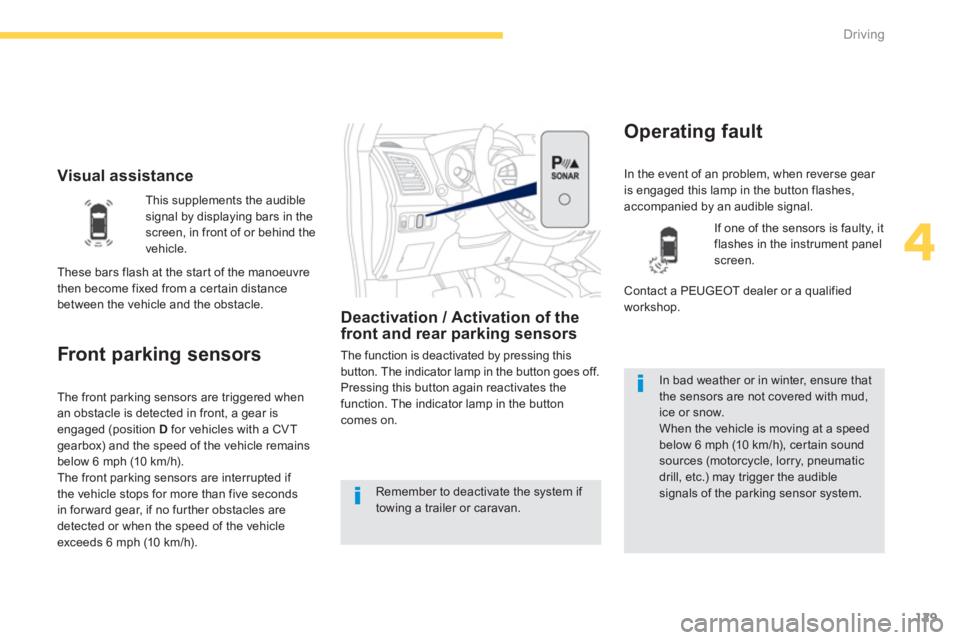
Visual assistance
Front par king sensors
Deactivation / Activation of thefront and rear parking sensors
The function is deactivated by pressing this
button. The indicator lamp in the button goes off.
Pressing this button again reactivates the
function. The indicator lamp in the button
comes on.
Operating fault
The front parking sensors are triggered when
an obstacle is detected in front, a gear isengaged (position Dfor vehicles with a CVT gearbox) and the speed of the vehicle remains
below 6 mph (10 km/h).
The front parking sensors are interrupted if
the vehicle stops for more than five seconds
in for ward
gear, if no fur ther obstacles are
detected or when the speed of the vehicle
exceeds 6 mph (10 km/h).
Remember to deactivate the system if towing a trailer or caravan.
In bad weather or in winter, ensure thatthe sensors are not covered with mud, ice or snow. When the vehicle is moving at a speed below 6 mph (10 km/h), cer tain soundsources (motorcycle, lorry, pneumatic drill, etc.) may trigger the audible signals of the parking sensor system.
In the event o
f an problem, when reverse gear
is engaged this lamp in the button flashes,
accompanied by an audible signal.This supplements the audiblesignal by displaying bars in the screen, in front of or behind the
vehicle.If one of the sensors is fault
y, it
flashes in the instrument panel
screen.
Contact a PEUGEOT dealer or a qualified
workshop. Th
ese bars flash at the start of the manoeuvrethen become fixed from a certain distance between the vehicle and the obstacle.
Page 134 of 332
132
Visibility
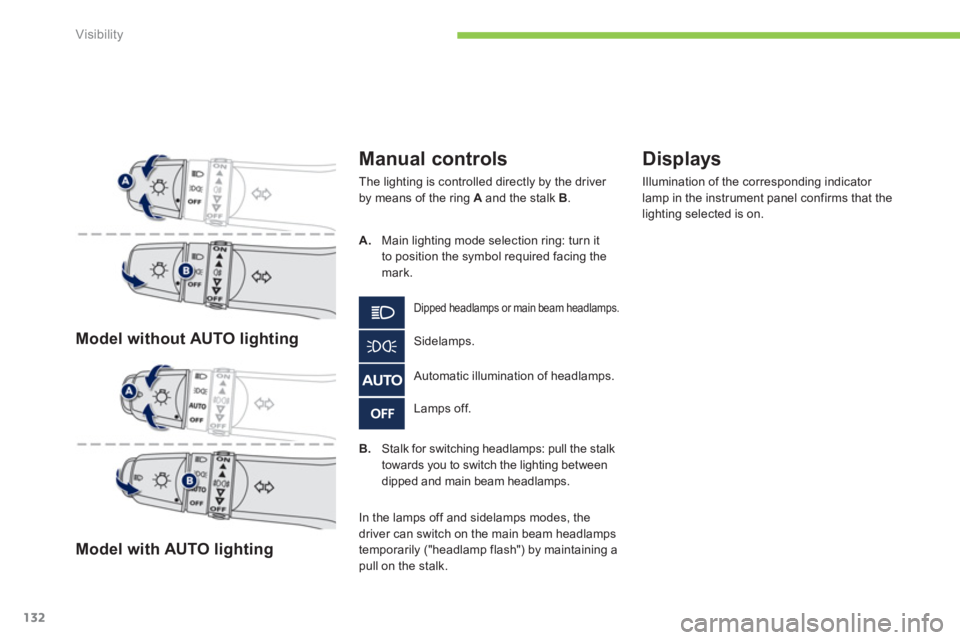
Model without AUTO lighting
Model with AUTO lighting
Manual controls
The lighting is controlled directly by the driver by means of the ring A
and the stalk B
.
Lamps off.
Automatic illumination of headlamps.
Sidelamps.
Dipped headlamps or main beam headlamps.
Displays
Illumination of the corresponding indicator
lamp in the instrument panel confirms that the
lighting selected is on.
A. Main lighting mode selection ring: turn it
to position the symbol required facing the
mark.
B. Stalk for switching headlamps: pull the stalk
towards you to switch the lighting between dipped and main beam headlamps.
In the lamps o
ff and sidelamps modes, thedriver can switch on the main beam headlamps
temporarily ("headlamp flash") by maintaining a pull on the stalk.
Page 148 of 332
146
Safety
Group of supplementary systems which helpyou to obtain optimum braking in complete safety in emergency situations:
- anti-lock braking system (ABS),
- electronic brake force distribution (EBFD).
Braking assistance systems
Anti-lock braking system
and electronic brake force
distribution
Linked systems which improve the stability and
manoeuvrability of your vehicle when braking,
in par ticular on poor or slippery surfaces.
Activation
The anti-lock braking system is active if the
vehicle speed is higher than 6 mph (10 km/h).
It is deactivated when the vehicle speed falls
below 3 mph (5 km/h).
The anti-lock braking system comes into
operation automatically when there is a risk of
wheel lock.
Normal operation of the ABS may make itself felt by slight vibration of the brake pedal.
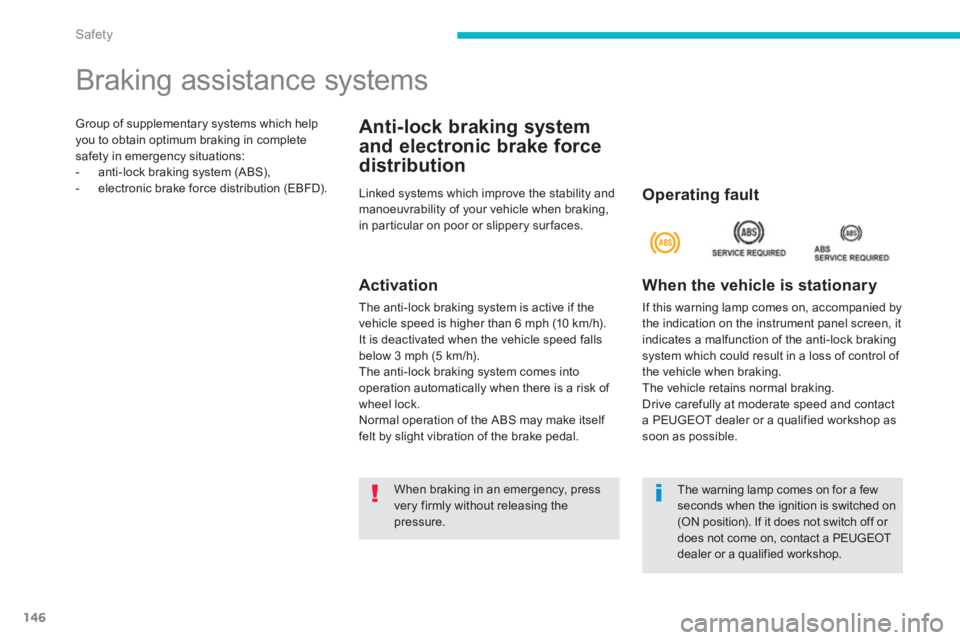
Operating fault
When the vehicle is stationar
y
If this warning lamp comes on, accompanied by
the indication on the instrument panel screen, it
indicates a malfunction of the anti-lock brakin
gsystem which could result in a loss of control of
the vehicle when braking.
The vehicle retains normal braking.
Drive carefully at moderate speed and contact
a PEUGEOT dealer or a qualified workshop assoon as possible.
When braking in an emergency, pressvery firmly without releasing thepressure.
The warning lamp comes on for a fewseconds when the ignition is switched on (ON position). If it does not switch off or does not come on, contact a PEUGEOT dealer or a qualified workshop.
Page 149 of 332
147
6
Safety
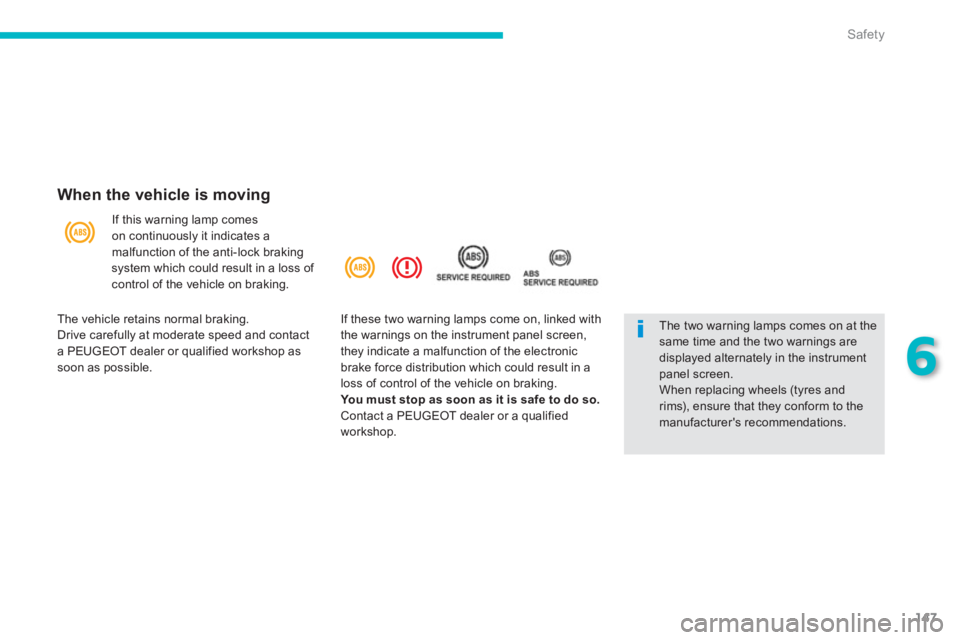
When the vehicle is moving
If this warning lamp comes
on continuously it indicates a
malfunction of the anti-lock brakingsystem which could result in a loss of control of the vehicle on braking.
The two warning lamps comes on at the same time and the two warnings aredisplayed alternately in the instrumentpanel screen. When replacing wheels (tyres and rims), ensure that they conform to themanufacturer's recommendations.
The vehicle retains normal braking.
Drive carefully at moderate speed and contact
a PEUGEOT dealer or qualified workshop assoon as possible. I
f these two warning lamps come on, linked with
the warnings on the instrument panel screen,
the
y indicate a malfunction of the electronic brake force distribution which could result in a loss of control of the vehicle on braking.
You must stop as soon as it is safe to do so.Contact a PEUGEOT dealer or a qualifiedworkshop.
Page 150 of 332
148
Safety
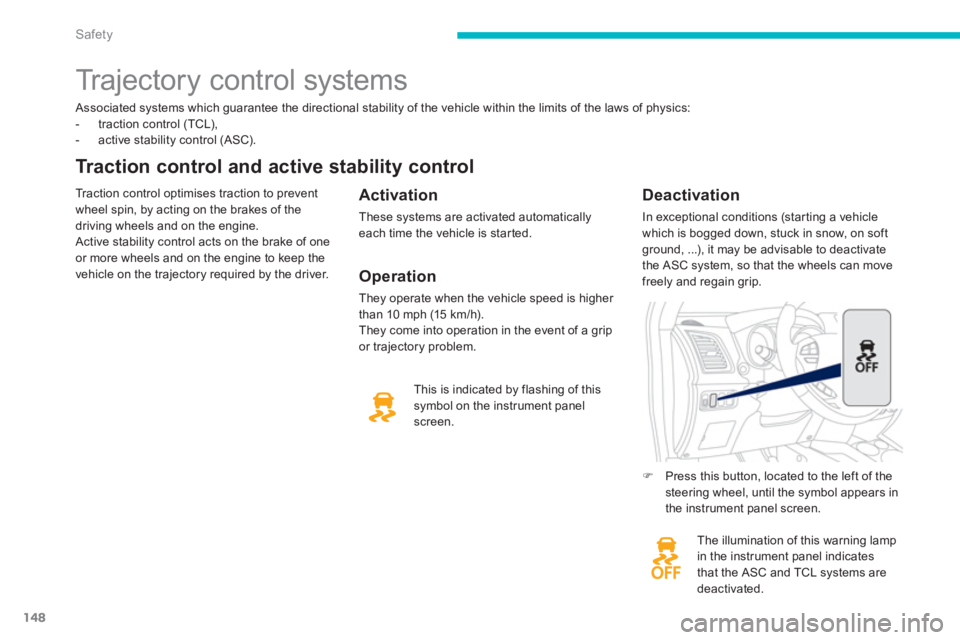
Associated systems which guarantee the directional stability of the vehicle within the limits of the laws of physics:
- traction control (TCL),
- active stability control (ASC).
Traction control and active stability control
Traction control optimises traction to prevent
wheel spin, by acting on the brakes of the
driving wheels and on the engine.
Active stability control acts on the brake of one
or more wheels and on the engine to keep the
vehicle on the trajectory required by the driver.
Activation
These systems are activated automaticallyeach time the vehicle is started.
The illumination o
f this warning lamp
in the instrument panel indicates
that the ASC and TCL systems are deactivated.
Deactivation
In exceptional conditions (starting a vehicle
which is bogged down, stuck in snow, on soft ground, ...), it may be advisable to deactivate
the ASC system, so that the wheels can movefreely and regain grip.
This is indicated b
y flashing of this symbol on the instrument panel screen.
Trajectory control systems
)Press this button, located to the left of thesteering wheel, until the symbol appears in
the instrument panel screen.
Operation
They operate when the vehicle speed is higher
than 10 mph (15 km / h).
They come into operation in the event of a grip
or trajectory problem.
Page 151 of 332
149
6
Safety
Reactivation Operating fault
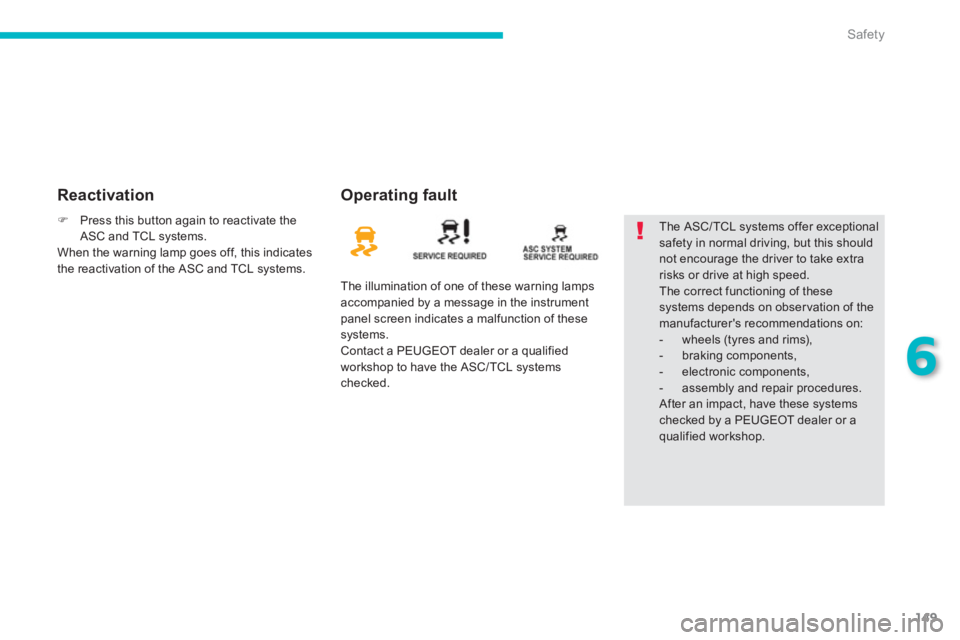
The illumination of one of these warning lamps accompanied by a message in the instrument panel screen indicates a malfunction of these
systems.
Contact a PEUGEOT dealer or a qualifiedworkshop to have the ASC/ TCL systemschecked.
The ASC/TCL systems offer exceptional safety in normal driving, but this should not encourage the driver to take extra risks or drive at high speed.
The correct functioning of these systems depends on obser vation of themanufacturer's recommendations on:
- wheels (tyres and rims),
- braking components,
- electronic components,
- assembly and repair procedures.
After an impact, have these systems checked by a PEUGEOT dealer or a qualified workshop.
)Press this button again to reactivate theASC and TCL systems.
When the warning lamp goes off, this indicates
the reactivation of the ASC and TCL systems.