instrument panel PEUGEOT 4008 2015 Owner's Manual
[x] Cancel search | Manufacturer: PEUGEOT, Model Year: 2015, Model line: 4008, Model: PEUGEOT 4008 2015Pages: 389, PDF Size: 15.89 MB
Page 110 of 389
108
4008_en_Chap04_conduite_ed01-2014
Manual gear changing
In the automated mode, you can take over
control temporarily at any time using the
steering mounted controls.
th
e use of these controls permits manual
selection of the gears in situations which
require a faster change down than that offered
in automated mode (arrival at a roundabout,
exit from a car park with a steep gradient,
over taking...).
th
e gearbox engages the gear requested if
the engine speed permits it.
t
he
gear engaged
appears.
to r
eturn to the automated mode, do one of the
following:
-
p
ress the back of the "+/OFF" steering
mounted control 3 for approximately
2
seconds,
-
m
ove the gear lever quickly towards
position +/- and then return it to position D ,
-
s
top the vehicle.
Stopping the vehicle Operating fault
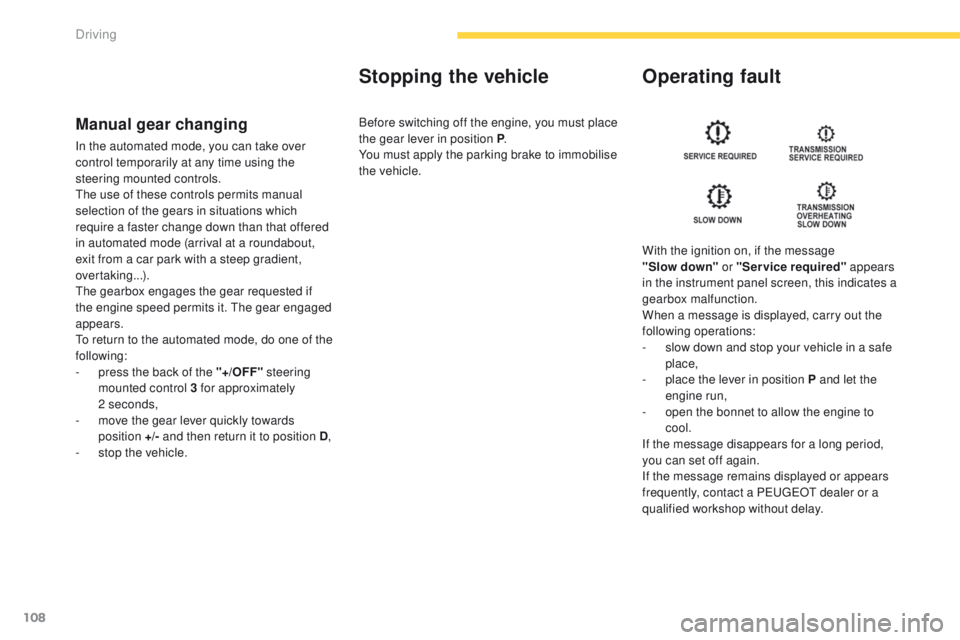
With the ignition on, if the message
"Slow
down" or "Service required" appears
in the instrument panel screen, this indicates a
gearbox malfunction.
When a message is displayed, carry out the
following operations:
-
s
low down and stop your vehicle in a safe
place,
-
p
lace the lever in position P and let the
engine run,
-
o
pen the bonnet to allow the engine to
cool.
If the message disappears for a long period,
you can set off again.
If the message remains displayed or appears
frequently, contact a P
e
uge
Ot
dealer or a
qualified workshop without delay.
Before switching off the engine, you must place
the gear lever in position P
.
You must apply the parking brake to immobilise
the vehicle.
Driving
Page 112 of 389
110
4008_en_Chap04_conduite_ed01-2014
Hill start assist
System which keeps your vehicle immobilised
temporarily (approximately 2 seconds) when
starting on a gradient, the time it takes to
move your foot from the brake pedal to the
accelerator pedal.
th
is function is only active when:
-
t
he vehicle is completely stationary, with
your foot on the brake pedal,
-
w
hen certain conditions of gradient are
met,
-
w
ith the driver’s door closed.
th
e hill start assist function cannot be
deactivated.
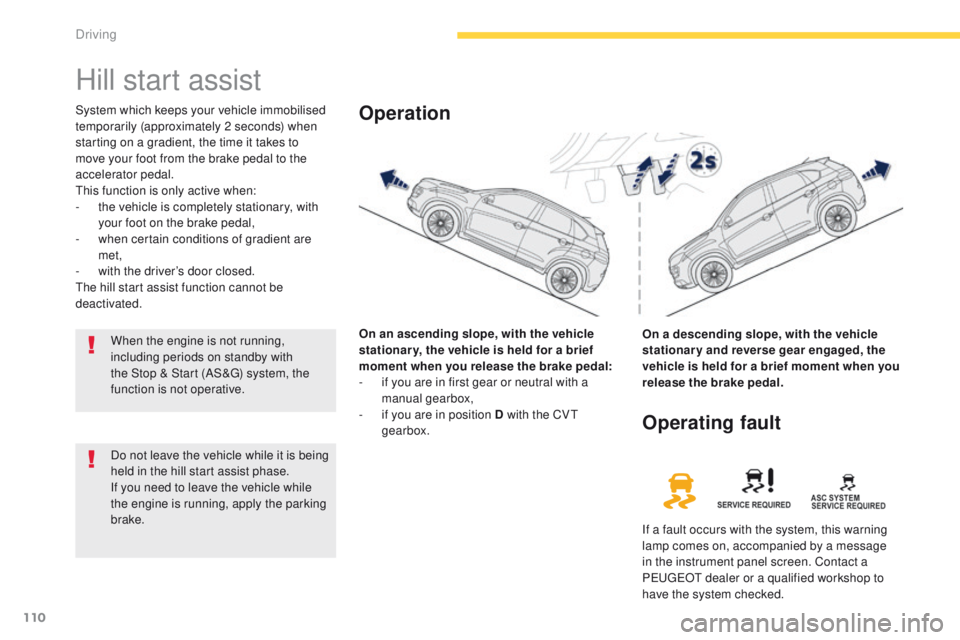
On an ascending slope, with the vehicle
stationar y, the vehicle is held for a brief
moment when you release the brake pedal:
-
i
f you are in first gear or neutral with a
manual gearbox,
-
i
f you are in position D with the CV
t
gearbox.Operation
On a descending slope, with the vehicle
stationary and reverse gear engaged, the
vehicle is held for a brief moment when you
release the brake pedal.
Do not leave the vehicle while it is being
held in the hill start assist phase.
If you need to leave the vehicle while
the engine is running, apply the parking
brake.
Operating fault
If a fault occurs with the system, this warning
lamp comes on, accompanied by a message
in the instrument panel screen. Contact a
P
e
uge
Ot
dealer or a qualified workshop to
have the system checked.
When the engine is not running,
including periods on standby with
the Stop & Start (AS&
g) s
ystem, the
function is not operative.
Driving
Page 113 of 389
111
4008_en_Chap04_conduite_ed01-2014
Stop & Start (Auto Stop & go) function
Operation
Going into engine STOP mode
the "AS &G" warning lamp comes on in
the instrument panel or the instrument
panel screen and the engine goes into
standby after a few seconds:
-
w
ith a manual gearbox , with the vehicle
stationary and your foot on the brake, when
you put the gear lever into neutral and
release the clutch pedal.
Never refuel with the engine in
S
tO
P mode; you must switch off the
ignition with the key or the S
tA
R
t/
St
OP
button.
When the engine is stopped
automatically, the operation of certain
vehicle systems, such as for example,
braking, power steering... are modified.
Ta k e c a r e
.
Special cases: STOP mode not
available
StOP mode is not invoked when:
-
t he driver's seat belt is not fastened,
-
t
he driver's door is open,
-
t
he bonnet is open,
-
t
he minimum time period of 30 seconds
since starting the engine has not elapsed,
-
t
he vehicle has not exceeded 3 mph
(5
km/h) since the last engine start,
-
t
he vehicle has restarted less than
10
seconds ago,
-
t
he engine is needed to maintain a
comfortable temperature in the passenger
compartment,
-
d
emisting is active,
-
s
ome special conditions (battery charge,
engine temperature, braking assistance,
ambient temperature...) where the engine is
needed to assure control of a system,
-
the "AS &G" warning lamp is
flashing in the instrument panel.
This operation is perfectly normal.
th
e Stop & Start (Auto Stop &
g
o
) function puts the engine temporarily into standby during stops in the traffic (red lights, traffic jams, or other...).
th
e engine restarts automatically as soon as you want to move off.
t
h
e restart takes place instantly, quickly and silently.
Per fect for urban use, the Stop & Start (Auto Stop &
g
o
) function reduces fuel consumption and exhaust emissions as well as the noise level when
stationary.
If you move the gear lever, the "AS &G"
warning lamp flashes, accompanied by
an audible signal.
th
e alert stops as soon as the gear
lever is returned to the neutral position.
4
Driving
Page 114 of 389
112
4008_en_Chap04_conduite_ed01-2014
Going into engine START mode
the "AS &G" warning lamp goes off
and the engine starts automatically:
-
w
ith a manual gearbox , when you fully
depress the clutch pedal. For safety reasons or to ensure smooth
operation, StA
Rt mo de is invoked
automatically when:
Special cases: START invoked
automatically
- the speed of the vehicle exceeds 2 mph (3 km/h),
-
y
ou open the driver's door,
-
y
ou unfasten the driver's seatbelt,
-
s
ome special conditions (battery charge,
engine temperature, braking assistance,
ambient temperature...) where the engine is
needed to assure control of a system.
If the system has been deactivated in
S
tO
P mode, the engine will not start.
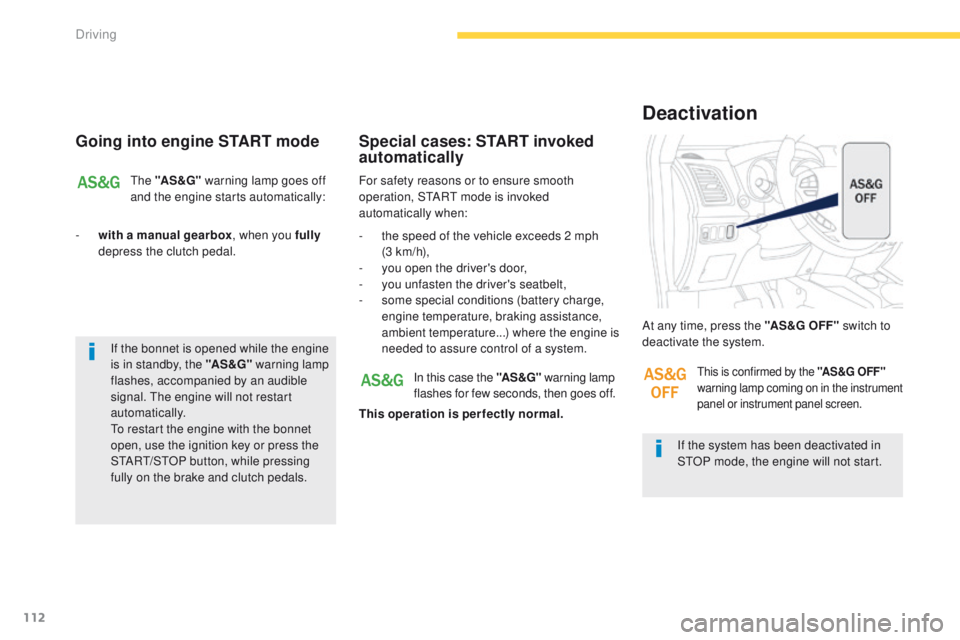
At any time, press the "AS &G O FF "
switch to
deactivate the system.
Deactivation
In this case the "AS &G" warning lamp
flashes for few seconds, then goes off.
This operation is perfectly normal.this is confirmed by the "AS &G O FF "
warning lamp coming on in the instrument
panel or instrument panel screen.
If the bonnet is opened while the engine
is in standby, the "AS &G" warning lamp
flashes, accompanied by an audible
signal.
t
h
e engine will not restart
automatically.
to r
estart the engine with the bonnet
open, use the ignition key or press the
S
tA
R
t/
S
tO
P button, while pressing
fully on the brake and clutch pedals.
Driving
Page 115 of 389
113
4008_en_Chap04_conduite_ed01-2014
the system is reactivated automatically
at every new start using the key or the
St
A
R
t/
S t
O
P button.
Reactivation
Press the "AS &G O FF " switch again.th
e system is active again; this is confirmed by
the "AS &G O FF " warning lamp going off in the
instrument panel or instrument panel screen.
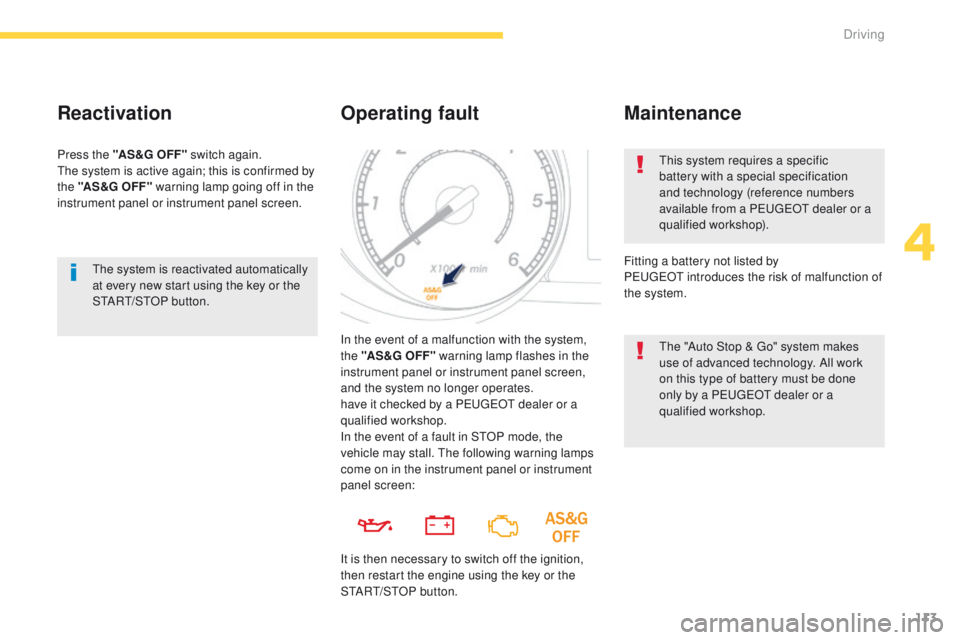
Operating fault
In the event of a malfunction with the system,
the "AS &G O FF " warning lamp flashes in the
instrument panel or instrument panel screen,
and the system no longer operates.
have it checked by a P
e
uge
Ot
dealer or a
qualified workshop.
th
is system requires a specific
battery with a special specification
and technology (reference numbers
available from a P
e
uge
Ot
dealer or a
qualified workshop).
Fitting a battery not listed by
P
e
uge
Ot
introduces the risk of malfunction of
the system.
Maintenance
the "Auto Stop & go" s ystem makes
use of advanced technology. All work
on this type of battery must be done
only by a P
e
uge
Ot
dealer or a
qualified workshop.
In the event of a fault in S
tO
P mode, the
vehicle may stall.
t
h
e following warning lamps
come on in the instrument panel or instrument
panel screen:
It is then necessary to switch off the ignition,
then restart the engine using the key or the
S
t
A
R
t/
S
t
O
P button.
4
Driving
Page 118 of 389
116
4008_en_Chap04_conduite_ed01-2014
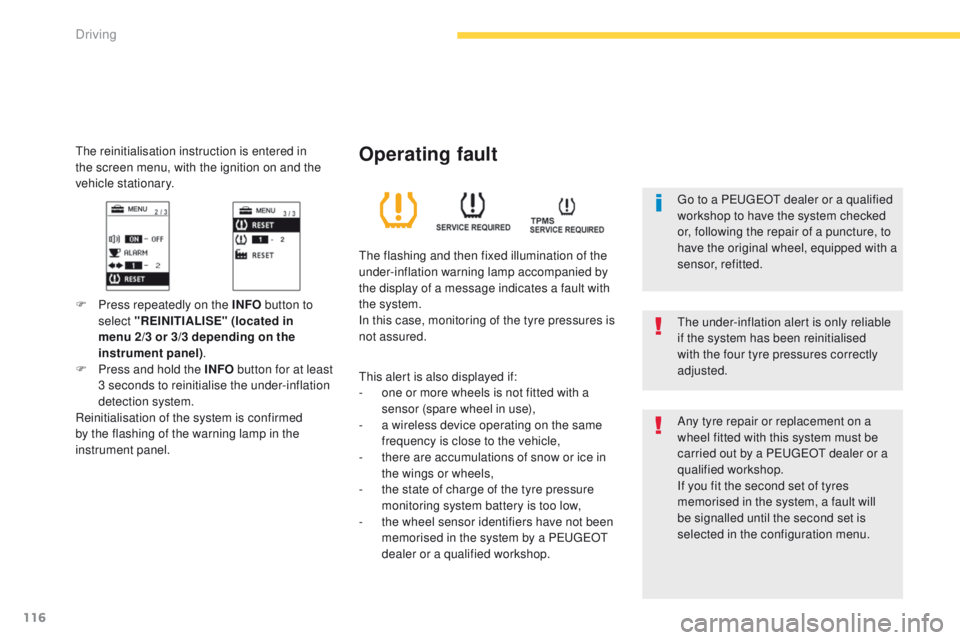
the reinitialisation instruction is entered in
the screen menu, with the ignition on and the
vehicle stationary.
F Press repeatedly on the INFO button to
select "REINITIALISE" (located in
menu 2/3 or 3/3 depending on the
instrument panel) .
F
P
ress and hold the INFO button for at least
3 seconds to reinitialise the under-inflation
detection system.
Reinitialisation of the system is confirmed
by the flashing of the warning lamp in the
instrument panel.
th
e under-inflation alert is only reliable
if the system has been reinitialised
with the four tyre pressures correctly
adjusted.
Operating fault
the flashing and then fixed illumination of the
under-inflation warning lamp accompanied by
the display of a message indicates a fault with
the system.
In this case, monitoring of the tyre pressures is
not assured.
th
is alert is also displayed if:
-
o
ne or more wheels is not fitted with a
sensor (spare wheel in use),
-
a w
ireless device operating on the same
frequency is close to the vehicle,
-
t
here are accumulations of snow or ice in
the wings or wheels,
-
t
he state of charge of the tyre pressure
monitoring system battery is too low,
-
t
he wheel sensor identifiers have not been
memorised in the system by a P
e
uge
Ot
dealer or a qualified workshop. Any tyre repair or replacement on a
wheel fitted with this system must be
carried out by a P
e
uge
Ot
dealer or a
qualified workshop.
If you fit the second set of tyres
memorised in the system, a fault will
be signalled until the second set is
selected in the configuration menu.
go t
o a P
e
uge
Ot
dealer or a qualified
workshop to have the system checked
or, following the repair of a puncture, to
have the original wheel, equipped with a
sensor, refitted.
Driving
Page 120 of 389
118
4008_en_Chap04_conduite_ed01-2014
Four wheel drive system
System which permits the selection of a transmission mode in relation to the driving conditions.three transmission modes are available and can be selected manually by the driver in accordance with his requirements.
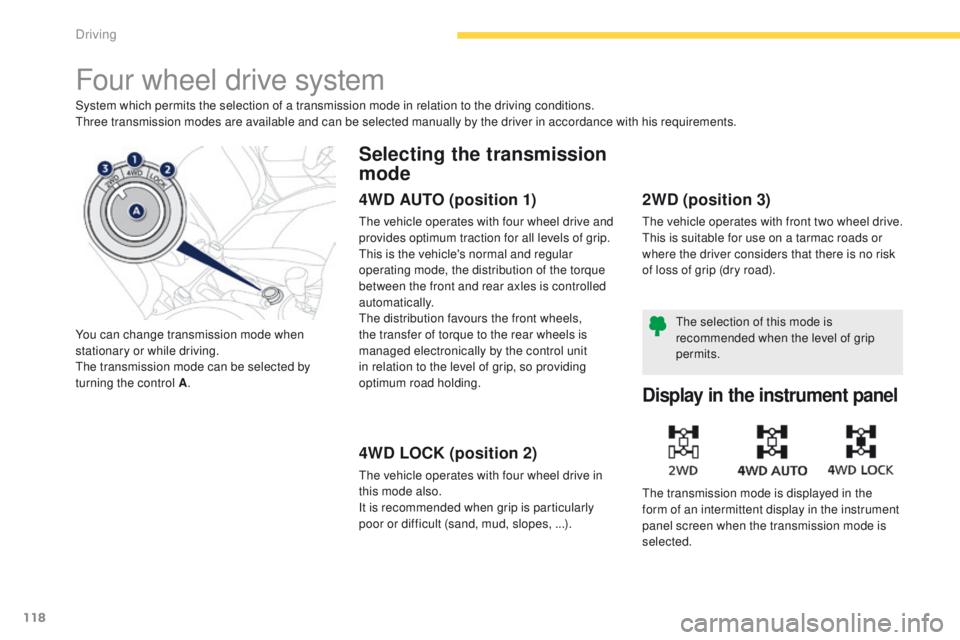
You can change transmission mode when
stationary or while driving.
th
e transmission mode can be selected by
turning the control A .
Selecting the transmission
mode
4WD AUTO (position 1)
the vehicle operates with four wheel drive and
provides optimum traction for all levels of grip.
th
is is the vehicle's normal and regular
operating mode, the distribution of the torque
between the front and rear axles is controlled
automatically.
th
e distribution favours the front wheels,
the transfer of torque to the rear wheels is
managed electronically by the control unit
in relation to the level of grip, so providing
optimum road holding.
4WD LOCK (position 2)
the vehicle operates with four wheel drive in
this mode also.
It is recommended when grip is particularly
poor or difficult (sand, mud, slopes, ...).
2WD (position 3)
the vehicle operates with front two wheel drive.th is is suitable for use on a tarmac roads or
where the driver considers that there is no risk
of loss of grip (dry road).
Display in the instrument panel
the transmission mode is displayed in the
form of an intermittent display in the instrument
panel screen when the transmission mode is
selected.
th
e selection of this mode is
recommended when the level of grip
permits.
Driving
Page 121 of 389
119
4008_en_Chap04_conduite_ed01-2014
As the engine torque is applied to all
four wheels, the condition of the tyres
has a considerable impact on the
performance of the vehicle.
en
sure that all four tyres are in good
condition.
Avoid driving the vehicle in sandy or
muddy areas or in other areas in which
the wheels could spin.
Spinning the wheels places the
transmission components under
pressure and could cause a serious
malfunction.
Do not drive the vehicle through deep
water.
Avoid driving over excessively uneven
terrain (risk of scraping under the body
or of grounding on crossing a bridge).
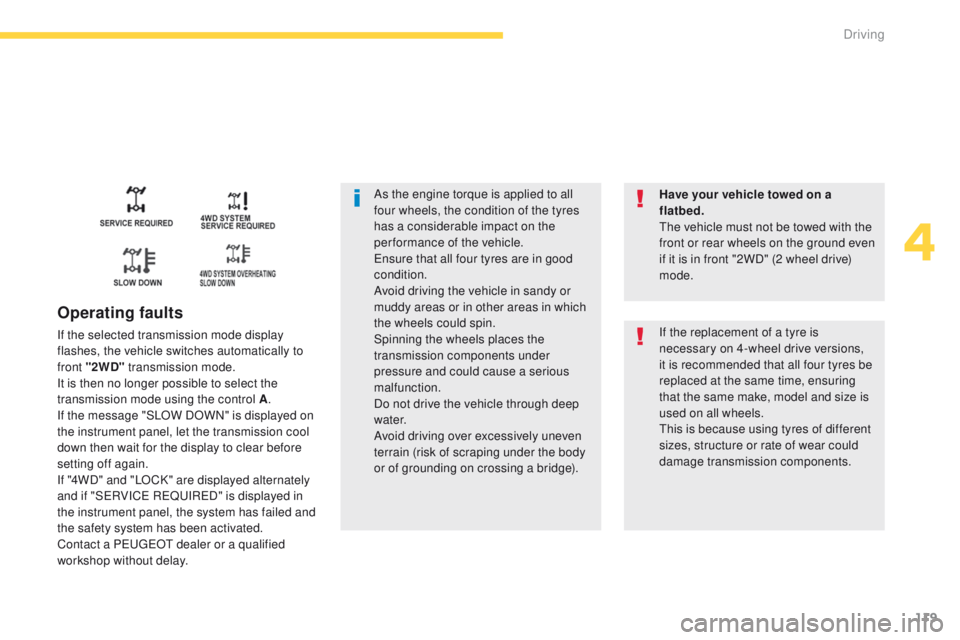
Operating faults
If the selected transmission mode display
flashes, the vehicle switches automatically to
front "2WD" transmission mode.
It is then no longer possible to select the
transmission mode using the control A .
If the message "SLOW DOWN" is displayed on
the instrument panel, let the transmission cool
down then wait for the display to clear before
setting off again.
If "4WD" and "LOCK" are displayed alternately
and if "S
eR
VIC
e
R
eQuI
R
eD
" is displayed in
the instrument panel, the system has failed and
the safety system has been activated.
Contact a P
e
uge
Ot
dealer or a qualified
workshop without delay. Have your vehicle towed on a
flatbed.
th
e vehicle must not be towed with the
front or rear wheels on the ground even
if it is in front "2WD" (2 wheel drive)
mode.If the replacement of a tyre is
necessary on 4-wheel drive versions,
it is recommended that all four tyres be
replaced at the same time, ensuring
that the same make, model and size is
used on all wheels.
th
is is because using tyres of different
sizes, structure or rate of wear could
damage transmission components.
4
Driving
Page 122 of 389
120
4008_en_Chap04_conduite_ed01-2014
Cruise control
System which automatically maintains the vehicle speed at the value programmed by the driver, without any action on the accelerator pedal.
th
e cruise control is switched on manually:
the vehicle speed must be at least 25 mph
(40 km/h) and second gear or higher must be
engaged in the case of a manual gearbox.
th
e cruise control is switched off manually, by
an action on the brake or clutch pedal or if the
ASC system is triggered.
th
e programmed speed can be exceeded
temporarily by pressing the accelerator pedal.
th
e cruise control cannot, in any
circumstances, take the place of the
need to comply with speed limits or of the
vigilance and responsibility of the driver.
th
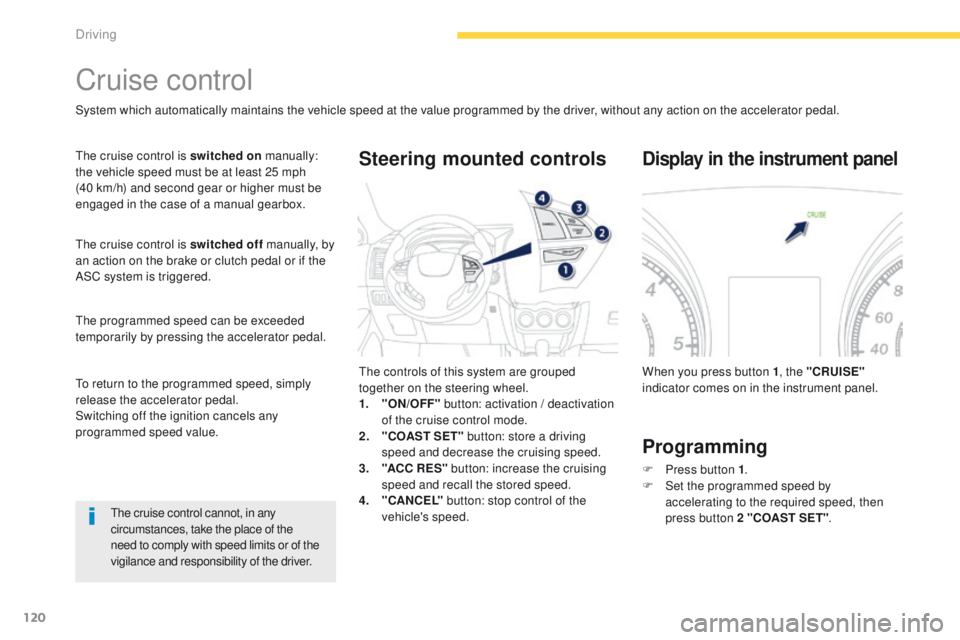
e controls of this system are grouped
together on the steering wheel.
1.
"
ON/OFF" button: activation / deactivation
of the cruise control mode.
2.
"
COAST SET" button: store a driving
speed and decrease the cruising speed.
3.
"A
CC R ES" button: increase the cruising
speed and recall the stored speed.
4.
"C
ANCEL" button: stop control of the
vehicle's speed.
Steering mounted controls
When you press button 1 , the "CRUISE"
indicator comes on in the instrument panel.
Display in the instrument panel
Programming
F Press button 1 .
F S et the programmed speed by
accelerating
to the required speed, then
press button 2 "COAST SET" .
to r
eturn to the programmed speed, simply
release the accelerator pedal.
Switching off the ignition cancels any
programmed speed value.
Driving
Page 127 of 389
125
4008_en_Chap04_conduite_ed01-2014
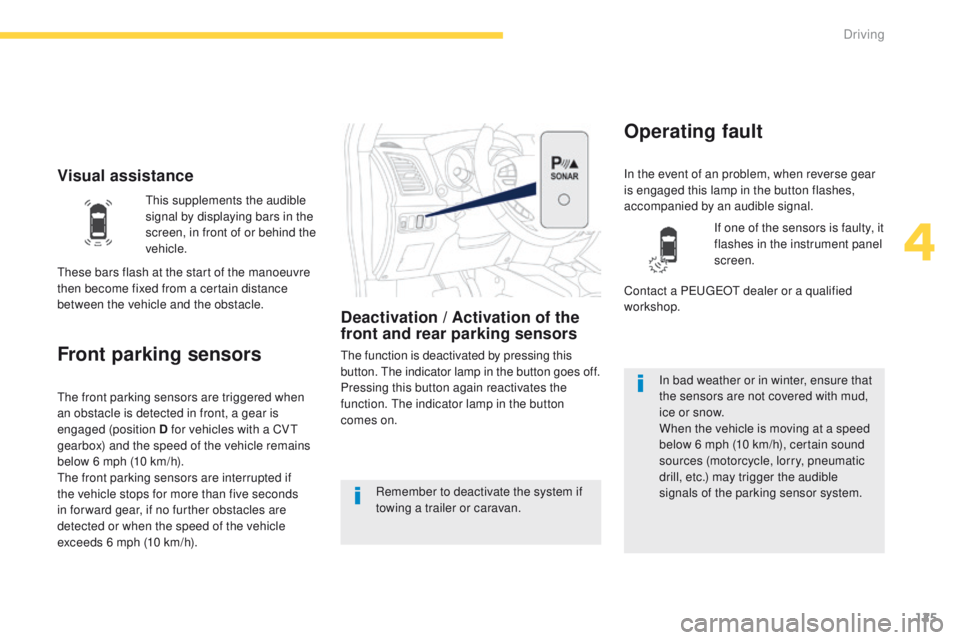
Visual assistance
Front parking sensors
Deactivation / Activation of the
front and rear parking sensors
the function is deactivated by pressing this
button. th e indicator lamp in the button goes off.
Pressing this button again reactivates the
function.
t
h
e indicator lamp in the button
comes on.
Operating fault
the front parking sensors are triggered when
an obstacle is detected in front, a gear is
engaged (position D for vehicles with a CV
t
gearbox) and the speed of the vehicle remains
below 6 mph (10 km/h).
th
e front parking sensors are interrupted if
the vehicle stops for more than five seconds
in for ward gear, if no further obstacles are
detected or when the speed of the vehicle
exceeds 6 mph (10 km/h). Remember to deactivate the system if
towing a trailer or caravan.In bad weather or in winter, ensure that
the sensors are not covered with mud,
ice or snow.
When the vehicle is moving at a speed
below 6 mph (10 km/h), certain sound
sources (motorcycle, lorry, pneumatic
drill, etc.) may trigger the audible
signals of the parking sensor system.
In the event of an problem, when reverse gear
is engaged this lamp in the button flashes,
accompanied by an audible signal.
th
is supplements the audible
signal by displaying bars in the
screen, in front of or behind the
vehicle. If one of the sensors is faulty, it
flashes in the instrument panel
screen.
Contact a P
e
uge
Ot
dealer or a qualified
workshop.
th
ese bars flash at the start of the manoeuvre
then become fixed from a certain distance
between the vehicle and the obstacle.
4
Driving