steering PEUGEOT 4008 2015 Owner's Manual
[x] Cancel search | Manufacturer: PEUGEOT, Model Year: 2015, Model line: 4008, Model: PEUGEOT 4008 2015Pages: 389, PDF Size: 15.89 MB
Page 146 of 389
144
4008_en_Chap06_securite_ed01-2014
Associated systems which guarantee the directional stability of the vehicle within the limits of the laws of physics:
- t raction control (tC L),
-
a
ctive stability control (ASC).
Traction control and active stability control
traction control optimises traction to prevent
wheel spin, by acting on the brakes of the
driving wheels and on the engine.
Active stability control acts on the brake of one
or more wheels and on the engine to keep the
vehicle on the trajectory required by the driver.Activation
these systems are activated automatically
each time the vehicle is started.
th
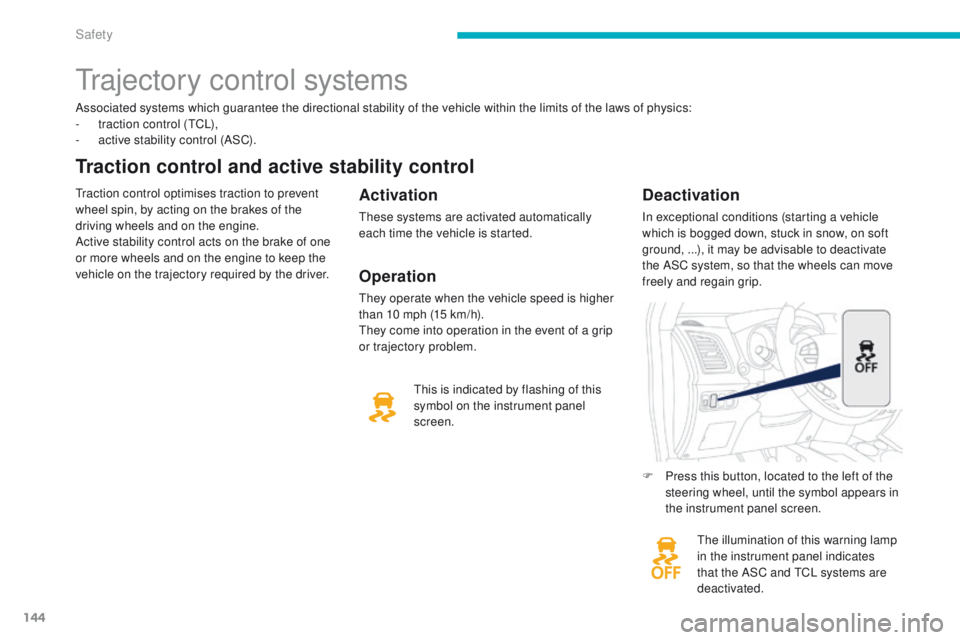
e illumination of this warning lamp
in the instrument panel indicates
that the ASC and
t
C
L systems are
deactivated.
Deactivation
In exceptional conditions (starting a vehicle
which is bogged down, stuck in snow, on soft
ground, ...), it may be advisable to deactivate
the ASC system, so that the wheels can move
freely and regain grip.
th
is is indicated by flashing of this
symbol on the instrument panel
screen.
trajectory control systems
F Press this button, located to the left of the steering wheel, until the symbol appears in
the instrument panel screen.
Operation
they operate when the vehicle speed is higher
than 10 mph (15 km/h).
th
ey come into operation in the event of a grip
or trajectory problem.
Safety
Page 152 of 389
150
4008_en_Chap06_securite_ed01-2014
Airbags
System designed to contribute towards
improving the safety of the occupants (with
the exception of the rear centre passenger)
in the event of violent collisions. t
h
e airbags
supplement the action of the force-limiting
seat belts (with the exception of the centre rear
passenger).
If a collision occurs, the electronic detectors
record and analyse the front and side impacts
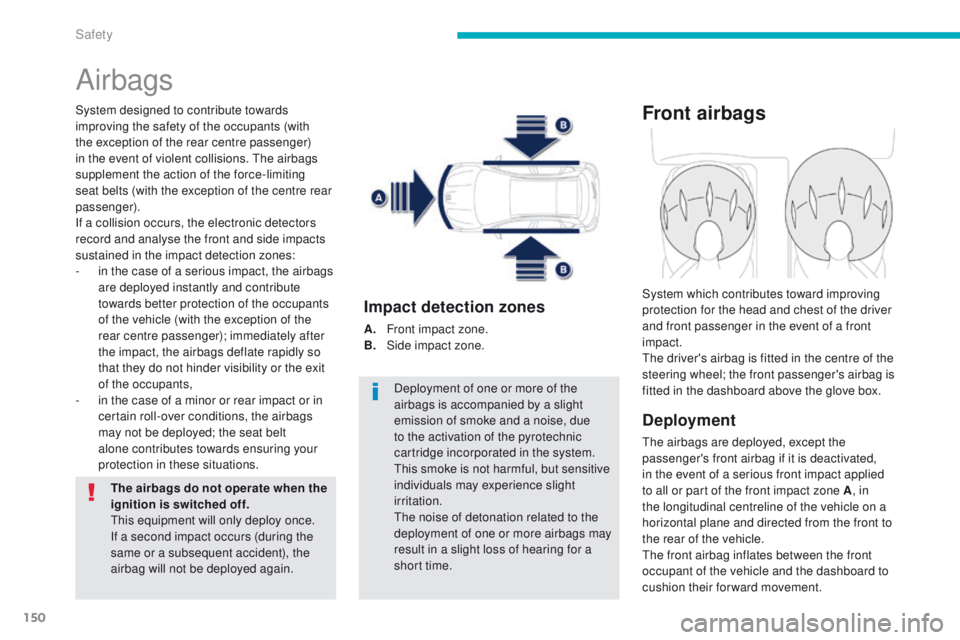
sustained in the impact detection zones:
-
i
n the case of a serious impact, the airbags
are deployed instantly and contribute
towards better protection of the occupants
of the vehicle (with the exception of the
rear centre passenger); immediately after
the impact, the airbags deflate rapidly so
that they do not hinder visibility or the exit
of the occupants,
-
i
n the case of a minor or rear impact or in
certain roll-over conditions, the airbags
may not be deployed; the seat belt
alone contributes towards ensuring your
protection in these situations.
The airbags do not operate when the
ignition is switched off.
th
is equipment will only deploy once.
If a second impact occurs (during the
same or a subsequent accident), the
airbag will not be deployed again. Deployment of one or more of the
airbags is accompanied by a slight
emission of smoke and a noise, due
to the activation of the pyrotechnic
cartridge incorporated in the system.
th
is smoke is not harmful, but sensitive
individuals may experience slight
irritation.
th
e noise of detonation related to the
deployment of one or more airbags may
result in a slight loss of hearing for a
short time.
Impact detection zones
A. Front impact zone.
B. S ide impact zone.
Front airbags
Deployment
the airbags are deployed, except the
passenger's front airbag if it is deactivated,
in the event of a serious front impact applied
to all or part of the front impact zone A , in
the longitudinal centreline of the vehicle on a
horizontal plane and directed from the front to
the rear of the vehicle.
th
e front airbag inflates between the front
occupant of the vehicle and the dashboard to
cushion their forward movement. System which contributes toward improving
protection for the head and chest of the driver
and front passenger in the event of a front
impact.
th
e driver's airbag is fitted in the centre of the
steering wheel; the front passenger's airbag is
fitted in the dashboard above the glove box.
Safety
Page 154 of 389
152
4008_en_Chap06_securite_ed01-2014
Knee airbag*
Deployment
It is deployed at the same time as the front
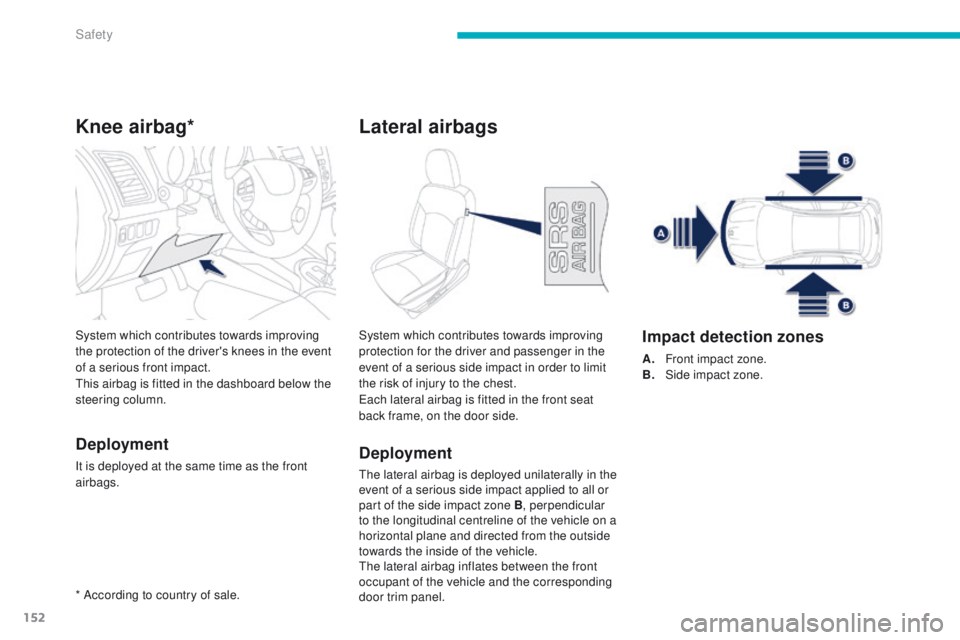
airbags. System which contributes towards improving
the protection of the driver's knees in the event
of a serious front impact.
th
is airbag is fitted in the dashboard below the
steering column. System which contributes towards improving
protection for the driver and passenger in the
event of a serious side impact in order to limit
the risk of injury to the chest.
ea
ch lateral airbag is fitted in the front seat
back frame, on the door side.Deployment
the lateral airbag is deployed unilaterally in the
event of a serious side impact applied to all or
part of the side impact zone B, perpendicular
to the longitudinal centreline of the vehicle on a
horizontal plane and directed from the outside
towards the inside of the vehicle.
th
e lateral airbag inflates between the front
occupant of the vehicle and the corresponding
door trim panel.
Impact detection zones
A. Front impact zone.
B. S
ide impact zone.
* According to country of sale.
Lateral airbags
Safety
Page 156 of 389
154
4008_en_Chap06_securite_ed01-2014
Sit in a normal upright position.
Wear a correctly adjusted seat belt.
Do not leave anything between the
occupants and the airbags (a child, pet,
object...). t
h
is could hamper the operation of
the airbags or injure the occupants.
After an accident or if the vehicle has been
stolen or broken into, have the airbag
systems checked.
All work on the airbag system must be
carried out by a P
e
uge
Ot
dealer or a
qualified workshop.
ev
en if all of the precautions mentioned
are observed, a risk of injury or of minor
burns to the head, chest or arms when an
airbag is deployed cannot be ruled out.
t
h
e
bag inflates almost instantly (within a few
milliseconds) then deflates within the same
time discharging the hot gas via openings
provided for this purpose.
Knee airbag*
Do not sit with your knees any nearer to the
steering wheel than necessary.
Front airbags
Do not drive holding the steering wheel by its
spokes or resting your hands on the centre
part of the wheel.
Passengers must not place their feet on the
dashboard.
Do not smoke as deployment of the airbags
can cause burns or the risk of injury from a
cigarette or pipe.
Never remove or pierce the steering wheel or
hit it violently.
Do not fit or attach anything to the steering
wheel or dashboard, this could cause
injuries with deployment of the airbags.
For the airbags to be fully effective, observe the following safety rules:
Lateral airbags
use only approved covers on the seats,
compatible with the deployment the lateral
airbags. For information on the range of seat
covers suitable for your vehicle, you can
contact a P
e
uge
Ot
dealer.
Refer to the "Accessories" section.
Do not fix or attach anything to the seat
backs (clothing...).
t
h
is could cause injury
to the chest or arms if the lateral airbag is
deployed.
Do not sit with the upper part of the body any
nearer to the door than necessary.
* According to country.
Curtain airbags
Do not fix or attach anything to the roof. th is
could cause injury to the head if the curtain
airbag is deployed.
If fitted on your vehicle, do not remove the
grab handles installed on the roof, they play
a part in securing the curtain airbags.
Avoid attaching a heavy object to the key as
it could become a dangerous projectile if the
airbag were deployed.
Safety
Page 174 of 389
172
4008_en_Chap07_info-pratiques_ed01-2014
After repairing the tyre, the speed
restriction sticker should be affixed to
the centre of vehicle's steering wheel to
remind you that this wheel must only be
used temporarily.
Do not exceed a speed of 50 mph
(80 km/h) when driving with a tyre
repaired using this type of kit.
Repair procedure
F Stop the vehicle in as safe a location as possible and on a level and stable sur face.
e
n
sure that the tyre valve is not at the
bottom of the wheel, in contact with the
ground.
F
A
pply the parking brake.
F
P
lace the gear lever in position R for
vehicle with a manual gearbox, or in
position P for vehicles fitted with a CV
t
gearbox.
F
S
witch off the ignition.
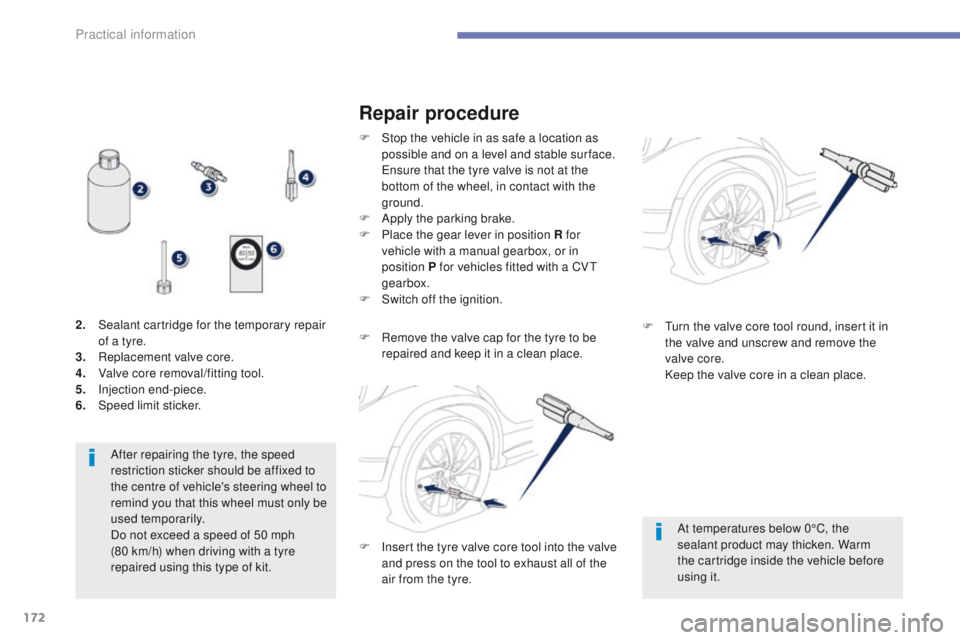
2.
S
ealant cartridge for the temporary repair
of a tyre.
3.
R
eplacement valve core.
4.
V
alve core removal/fitting tool.
5.
I
njection end-piece.
6.
Spe
ed limit sticker. F
R
emove the valve cap for the tyre to be
repaired and keep it in a clean place.
At temperatures below 0°C, the
sealant product may thicken. Warm
the cartridge inside the vehicle before
using it.
F
t
u
rn the valve core tool round, insert it in
the valve and unscrew and remove the
valve core.
K
eep the valve core in a clean place.
F
I
nsert the tyre valve core tool into the valve
and press on the tool to exhaust all of the
air from the tyre.
Practical information
Page 176 of 389
174
4008_en_Chap07_info-pratiques_ed01-2014
F If the specified pressure has not been reached after about 10 minutes, this means
that the tyre is not repairable; contact a
P
e
uge
Ot
dealer or a qualified workshop
for roadside assistance.
F
R
emove the compressor and stow the kit.Do not operate the compressor for more
than 10 minutes continuously.
If the compressor seems extremely
hot, switch it off and disconnect it
immediately. Leave it to cool for at least
30 minutes.
As soon as possible after a repair using
the kit, go to a P
e
uge
Ot
dealer or a
qualified workshop.
te
ll the technician that you have used
the kit. After checking, the technician
will advise you whether the tyre can be
repaired or must be replaced.
If the vehicle is fitted with under-
inflation detection, the under-inflation
warning lamp remains on until the
system has been reinitialised (see the
"
un
der-inflation detection" section). F
A
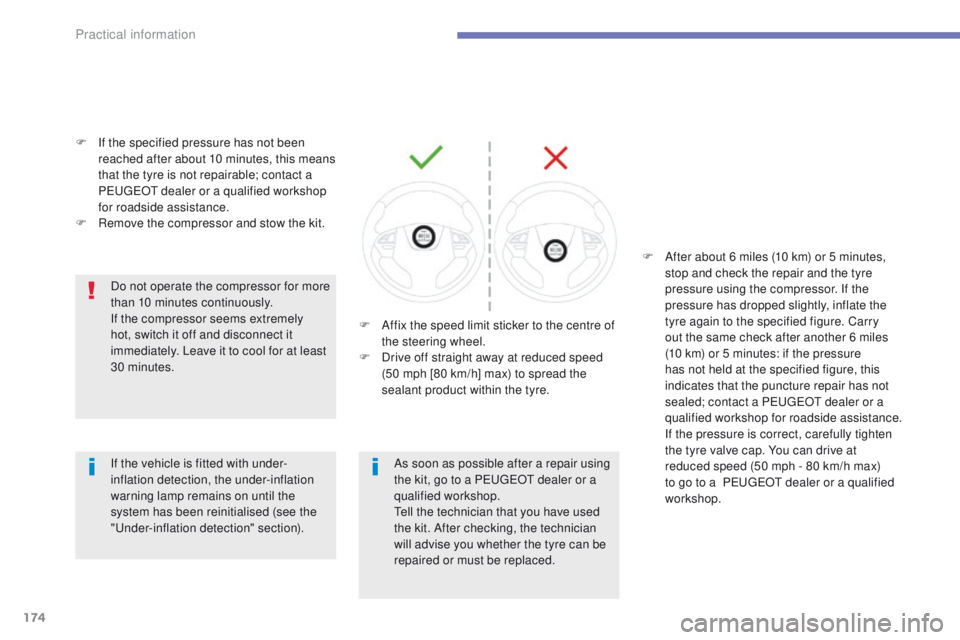
ffix the speed limit sticker to the centre of
the steering wheel.
F
D
rive off straight away at reduced speed
(50 mph [80 km/h] max) to spread the
sealant product within the tyre. F
A
fter about 6 miles (10 km) or 5 minutes,
stop and check the repair and the tyre
pressure using the compressor. If the
pressure has dropped slightly, inflate the
tyre again to the specified figure. Carry
out the same check after another 6 miles
(10 km) or 5 minutes: if the pressure
has not held at the specified figure, this
indicates that the puncture repair has not
sealed; contact a P
e
uge
Ot
dealer or a
qualified workshop for roadside assistance.
I
f the pressure is correct, carefully tighten
the tyre valve cap. You can drive at
reduced speed (50 mph - 80 km/h max)
to go to a
P
e
uge
Ot
dealer or a qualified
workshop.
Practical information
Page 191 of 389
189
4008_en_Chap07_info-pratiques_ed01-2014
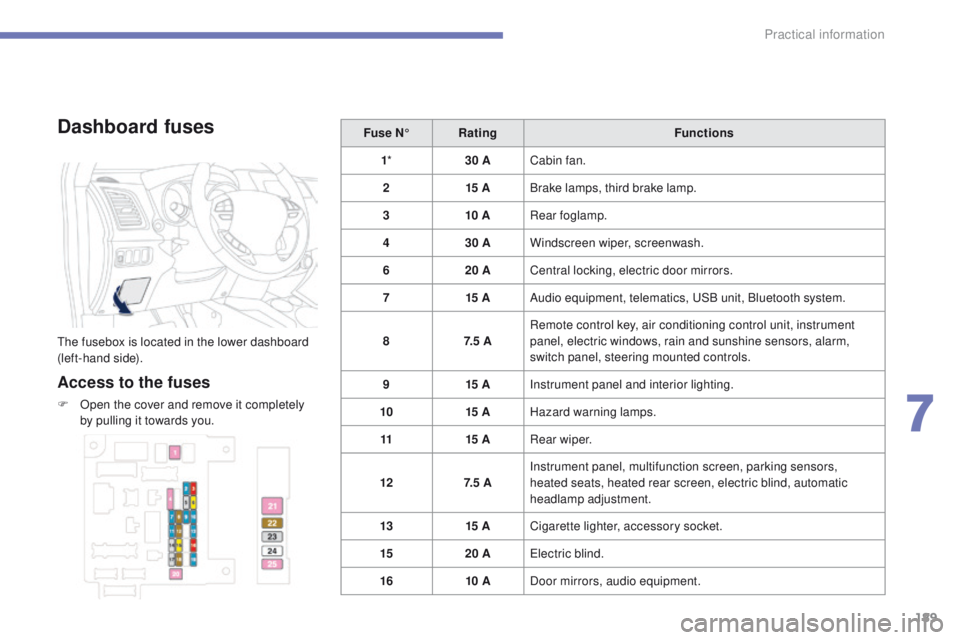
Dashboard fuses
the fusebox is located in the lower dashboard
(left-hand side).
Access to the fuses
F Open the cover and remove it completely by pulling it towards you. Fuse N°
Rating Functions
1 * 30 ACabin fan.
2 15 ABrake lamps, third brake lamp.
3 10 ARear foglamp.
4 30 AWindscreen wiper, screenwash.
6 20 ACentral locking, electric door mirrors.
7 15 AAudio equipment, telematics, u
S
B unit, Bluetooth system.
8 7. 5 ARemote control key, air conditioning control unit, instrument
panel, electric windows, rain and sunshine sensors, alarm,
switch panel, steering mounted controls.
9 15 AInstrument panel and interior lighting.
10 15 AHazard warning lamps.
11 15 ARear wiper.
12 7. 5 AInstrument panel, multifunction screen, parking sensors,
heated seats, heated rear screen, electric blind, automatic
headlamp adjustment.
13 15 ACigarette lighter, accessory socket.
15 20 A
ele
ctric blind.
16 10 ADoor mirrors, audio equipment.
7
Practical information
Page 200 of 389
198
4008_en_Chap07_info-pratiques_ed01-2014
Recovering the vehicle
Recovery of your
vehicle
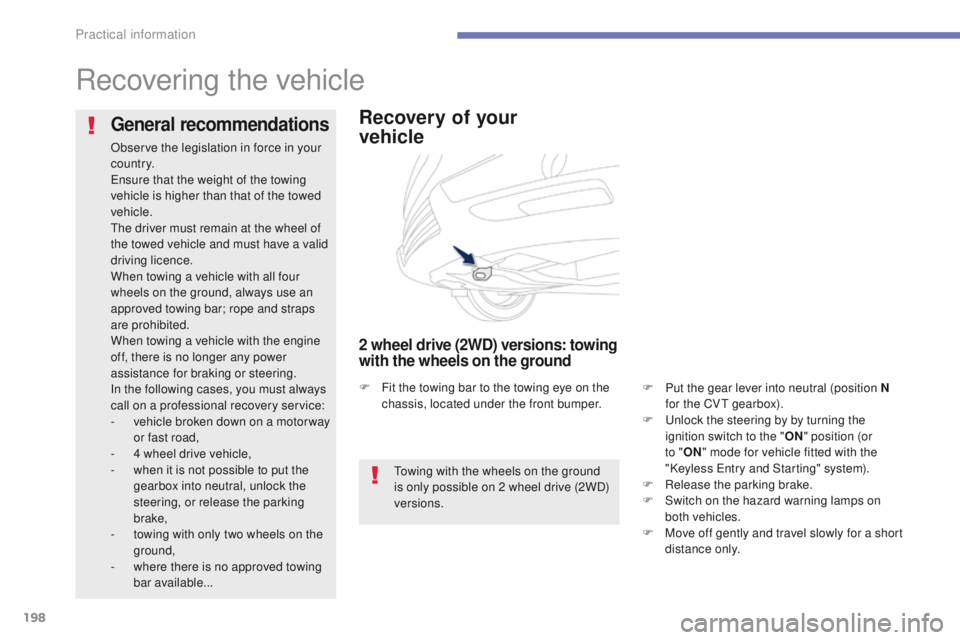
2 wheel drive (2WD) versions: towing
with the wheels on the ground
F Put the gear lever into neutral (position N for the CVt gearbox).
F
u
n
lock the steering by by turning the
ignition switch to the " ON" position (or
to " ON " mode for vehicle fitted with the
"Keyless
e
n
try and Starting" system).
F
R
elease the parking brake.
F
S
witch on the hazard warning lamps on
both vehicles.
F
M
ove off gently and travel slowly for a short
distance only.
General recommendations
Observe the legislation in force in your
c o unt r y.
en
sure that the weight of the towing
vehicle is higher than that of the towed
vehicle.
th
e driver must remain at the wheel of
the towed vehicle and must have a valid
driving licence.
When towing a vehicle with all four
wheels on the ground, always use an
approved towing bar; rope and straps
are prohibited.
When towing a vehicle with the engine
off, there is no longer any power
assistance for braking or steering.
In the following cases, you must always
call on a professional recovery service:
-
v
ehicle broken down on a motor way
or fast road,
-
4 w
heel drive vehicle,
-
w
hen it is not possible to put the
gearbox into neutral, unlock the
steering, or release the parking
brake,
-
t
owing with only two wheels on the
ground,
-
w
here there is no approved towing
bar available...
to
wing with the wheels on the ground
is only possible on 2 wheel drive (2WD)
versions.
F
F
it the towing bar to the towing eye on the
chassis, located under the front bumper.
Practical information
Page 240 of 389
238
BLUETOOTH® TELEPHONE
WITH
VOICE
RECOGNITION
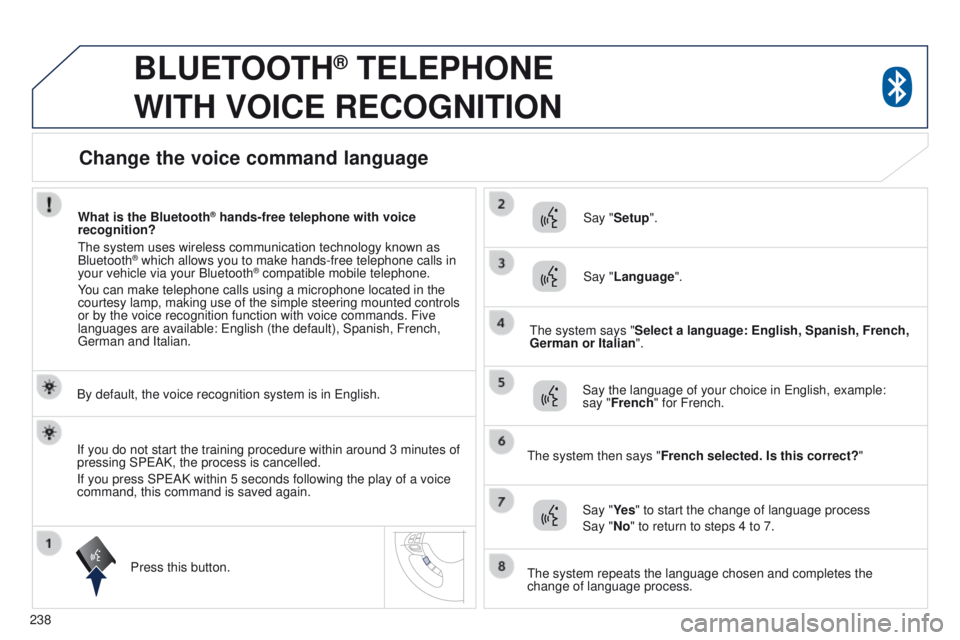
By default, the voice recognition system is in english.
Press this button. Say "
Setup".
Say "Language".
Say the language of your choice in e nglish, example:
say "French" for French.
Say "Ye s " to start the change of language process
Say "No" to return to steps 4 to 7.
t
he system says "Select a language: English, Spanish, French,
German or Italian".
t
he system then says "French selected. Is this correct?"
t
he system repeats the language chosen and completes the
change of language process.
If you do not start the training procedure within around 3
minutes of
pressing SP
e AK, the process is cancelled.
If you press SP
e AK within 5 seconds following the play of a voice
command, this command is saved again. What is the Bluetooth
® hands-free telephone with voice
recognition?
t
he system uses wireless communication technology known as
Bluetooth
® which allows you to make hands-free telephone calls in
your vehicle via your Bluetooth® compatible mobile telephone.
You can make telephone calls using a microphone located in the
courtesy lamp, making use of the simple steering mounted controls
or by the voice recognition function with voice commands. Five
languages are available:
e
nglish (the default), Spanish, French,
g
erman and Italian.
Change the voice command language
Page 251 of 389
249
4008_en_Chap10b_Mitsu6_ed01-2014
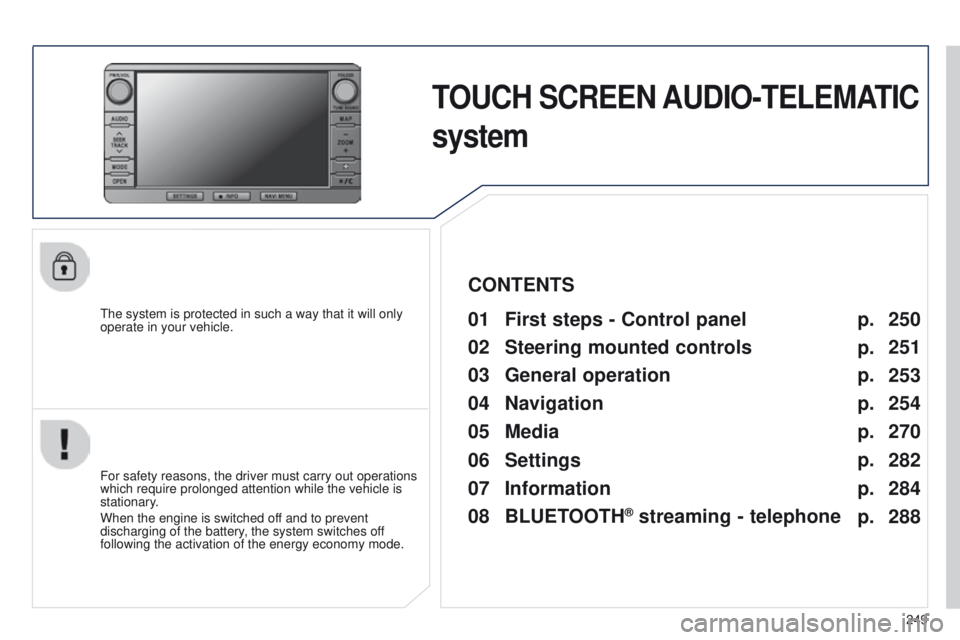
TOUCH SCREEN AUDIO-TELEMATIC
system
the system is protected in such a way that it will only
operate in your vehicle.01 First steps - Control panel
For safety reasons, the driver must carry out operations
which require prolonged attention while the vehicle is
stationary.
When the engine is switched off and to prevent
discharging of the battery, the system switches off
following the activation of the energy economy mode.
CONTENTS
03
General
operation
04
Navigation
05
Media
06
Settings
07
Information p.
p.
p.
p.
p.
p.
p. 250
251
253
254
270
282
284
02
Steering mounted
controls p.
288
08
BLUETOOTH
® streaming - telephone