maintenance PEUGEOT 4008 2017 Owners Manual
[x] Cancel search | Manufacturer: PEUGEOT, Model Year: 2017, Model line: 4008, Model: PEUGEOT 4008 2017Pages: 368, PDF Size: 12.22 MB
Page 2 of 368
On-line handbook
Select one of the following means of access to view your handbook
on-line...Referring to the handbook on-line also gives you access to the latest
information available, easily identified by the bookmark, associated
with this symbol:If the "My
PeugeOt" f unction is not available on the PeugeOt
p ublic website for your country, you can find your handbook at
the following address:
http://public.servicebox.peugeot.com/ddb/
the language,
the vehicle, its body style,
the print edition of your handbook appropriate for the date of
registration of your vehicle.
Select:
Find your handbook on the Peuge
Ot
website, under "MyPeuge
Ot".
S
can this code for direct access to your handbook.
th
is personal space offers advice and other useful information for the
care and maintenance of your vehicle.
Page 11 of 368
9
4008_en_Chap00b_vue-ensemble_ed01-2016
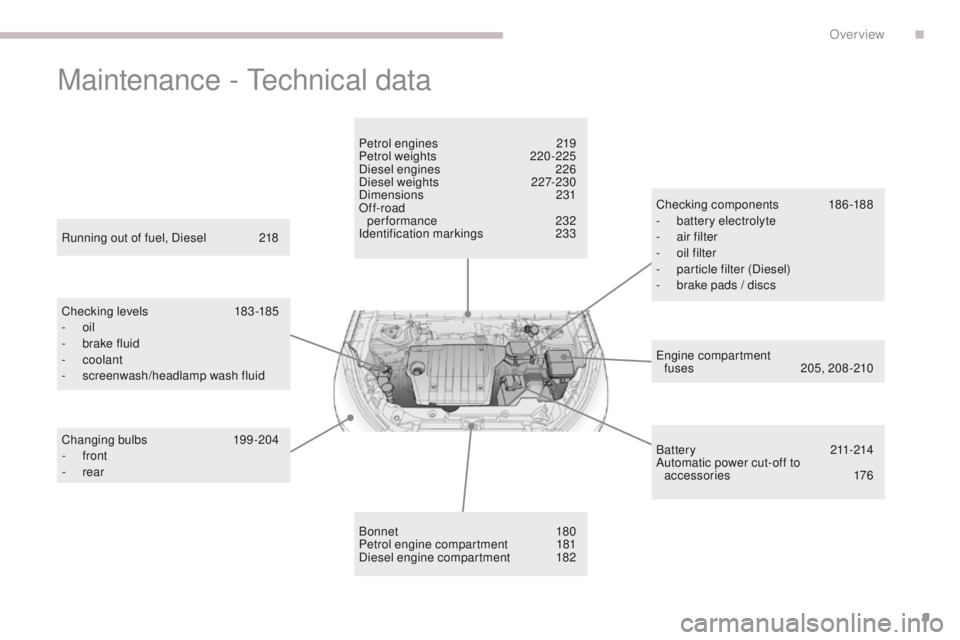
Maintenance - technical data
engine compartment
fuses 2 05, 208 -210
Running out of fuel, Diesel
2
18
Checking levels
18
3 -185
-
oil
-
b
rake fluid
-
coolant
-
s
creenwash/headlamp wash fluid
Changing bulbs
1
99-204
-
front
-
rear Petrol engines
2
19
Petrol weights
2
20 -225
Diesel engines
2
26
Diesel weights
2
27-230
Dimensions
231
Off-road performance
2
32
Identification markings
2
33
Bonnet
180
Petrol engine compartment
1
81
Diesel engine compartment
1
82 Batter y
211-214
Automatic power cut-off to accessories
176
Checking components
1
86-188
-
b
attery electrolyte
-
a
ir filter
-
o
il filter
-
p
article filter (Diesel)
-
b
rake pads / discs
.
Over view
Page 13 of 368
11
4008_en_Chap00c_eco-conduite_ed01-2016
Limit the causes of excess consumption
Spread loads throughout the vehicle; place the heaviest items in the
bottom of the boot, as close as possible to the rear seats.
Limit the loads carried in the vehicle and reduce wind resistance
(roof bars, roof rack, bicycle carrier, trailer, etc.). u
s
e a roof box in
preference.
Remove roof bars and roof racks after use.
At the end of winter, remove snow tyres and refit your summer tyres.
Observe the recommendations on
maintenance
Check the tyre pressures regularly, when cold, referring to the label in
the door aperture, on the driver's side.
Carry out this check in particular:
-
b
efore a long journey,
-
a
t each change of season,
-
a
fter a long period out of use.
Do not forget the spare wheel and the tyres on any trailer or caravan.
Have your vehicle serviced regularly (engine oil, oil filter, air filter,
passenger compartment filter, etc.) and observe the schedule of
operations recommended in the manufacturer's service schedule.
When refuelling, do not continue after the third cut-off of the nozzle to
avoid any over flow.
At the wheel of your new vehicle, it is only after the first 1 800 miles
(3
000 kilometres) that you will see the fuel consumption settle down to
a consistent average.
.
eco-driving
Page 35 of 368
33
4008_en_Chap01_Instruments-de-bord_ed01-2016
Service indicator
System which informs the driver when the
next service is due, in accordance with the
manufacturer's servicing schedule.
th
e point at which the next service is due
is calculated from the last service indicator
zero
reset.
It is determined by two parameters:
-
t
he distance travelled (in miles (km)),
-
t
he time elapsed since the last service
(in months).
th
e distance remaining to be travelled may be
weighted by the time factor, depending on the
use made of the vehicle.
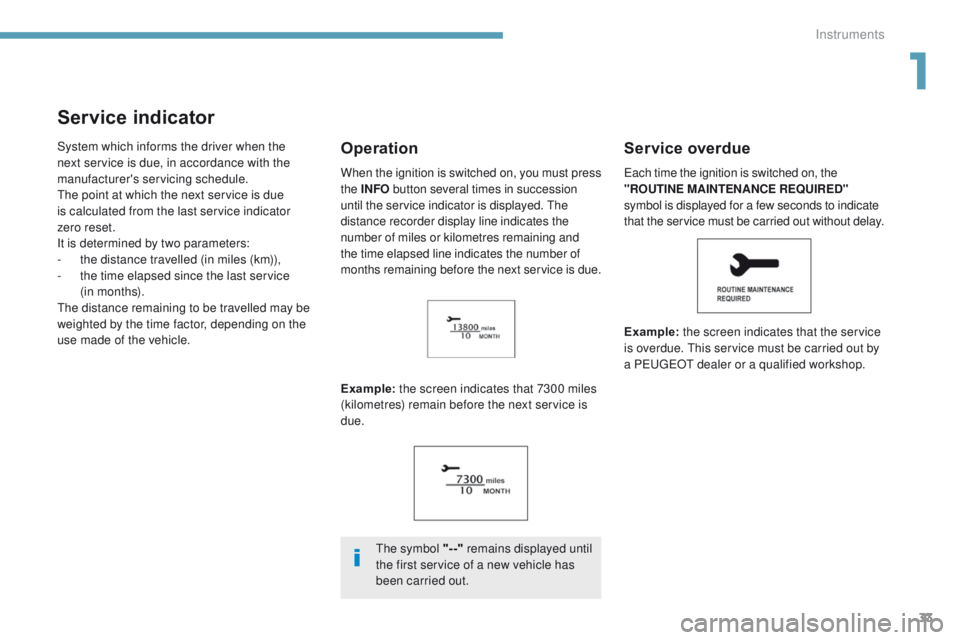
Example: the screen indicates that 7300 miles
(kilometres) remain before the next service is
due.Service overdue
Example: the screen indicates that the service
is overdue. th is service must be carried out by
a P
e
uge
Ot
dealer or a qualified workshop.
Operation
the symbol "--" remains displayed until
the first service of a new vehicle has
been carried out.
ea
ch time the ignition is switched on, the
"ROUTINE MAINTENANCE REQUIRED"
symbol is displayed for a few seconds to indicate
that the service must be carried out without delay.
When the ignition is switched on, you must press
the
INFO button several times in succession
until the service indicator is displayed. t
h
e
distance recorder display line indicates the
number of miles or kilometres remaining and
the time elapsed line indicates the number of
months remaining before the next service is due.
1
Instruments
Page 82 of 368
80
4008_en_Chap03_Ergonomie-et-confort_ed01-2016
In order for these systems to be fully effective, follow the operation and maintenance
guidelines below:
F t
o o
btain an even air distribution, take care not to obstruct the exterior air intake grilles
located at the base of the windscreen, the nozzles, the vents and the air outlets, as well
as the air extractor located in the boot.
F
D
o not cover the sunshine sensor, located on the dashboard; this is used for regulation
of the air conditioning system.
F
O
perate the air conditioning system for at least 5 to 10 minutes, once or twice a month
to keep it in per fect working order.
F
e
n
sure that the passenger compartment filter is in good condition and have the filter
elements replaced regularly.
W
e recommend the use of a combined passenger compartment filter. t
h
anks to its
special active additive, it contributes to the purification of the air breathed by the
occupants and the cleanliness of the passenger compartment (reduction of allergic
symptoms, bad odours and greasy deposits).
F
t
o e
nsure correct operation of the air conditioning system, you are also advised to have
it checked regularly as recommended in the warranty and maintenance record.
F
I
f the system does not produce cold air, switch it off and contact a P
e
uge
Ot
dealer or
a qualified workshop.
Recommendations for ventilation and air conditioning
If after an extended stop in sunshine,
the interior temperature is very high, first
ventilate the passenger compartment for
a few moments.
Put the air flow control at a setting high
enough to quickly change the air in the
passenger compartment.
Humid air cooled quickly by the
vehicle's air conditioning system may
produce condensation at the vent
outlets.
th
is phenomenon disappears after a
few seconds.
When towing the maximum load on a steep gradient in high temperatures, switching off the
air conditioning increases the available engine power and so improves the towing ability.
th
e condensation created by the air
conditioning results in a discharge
of water under the vehicle which is
perfectly normal.
ease of use and comfort
Page 185 of 368
183
4008_en_Chap07_info-pratiques_ed01-2016
Checking levels
take care when working under the bonnet, as certain areas of the engine may be extremely hot (risk of burns) and the cooling fan could start at
any time (even with the ignition off).
Oil level
the check of the level is done with
the dipstick, located under the
bonnet. Refer to the description of
your engine compartment for the
position of the dipstick.Engine oil change
Refer to the warranty and maintenance record
for details of the interval for this operation.
In order to maintain the reliability of the engine
and emission control system, never use
additives in the engine oil.
Oil specification
the oil must be the correct grade for your
engine and conform to the manufacturer's
recommendations.
Check all of these levels regularly, in line with the warranty and maintenance record.
t
o
p them up if necessary, unless other wise indicated.
If a level drops significantly, have the corresponding system checked by a P
e
uge
Ot
dealer or a qualified workshop.
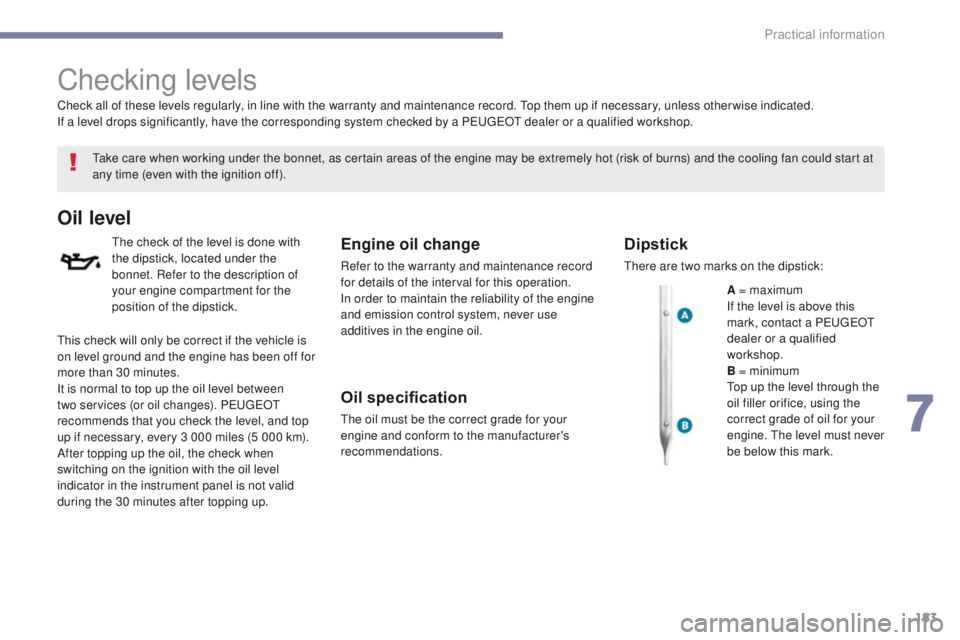
Dipstick
there are two marks on the dipstick:
A = maximum
If the level is above this
mark, contact a P
e
uge
Ot
dealer or a qualified
workshop.
B = minimum
to
p up the level through the
oil filler orifice, using the
correct grade of oil for your
engine.
t
h
e level must never
be below this mark.
th
is check will only be correct if the vehicle is
on level ground and the engine has been off for
more than 30 minutes.
It is normal to top up the oil level between
two services (or oil changes). P
e
uge
Ot
recommends that you check the level, and top
up if necessary, every 3 000 miles (5 000 km).
After topping up the oil, the check when
switching on the ignition with the oil level
indicator in the instrument panel is not valid
during the 30 minutes after topping up.
7
Practical information
Page 186 of 368
184
4008_en_Chap07_info-pratiques_ed01-2016
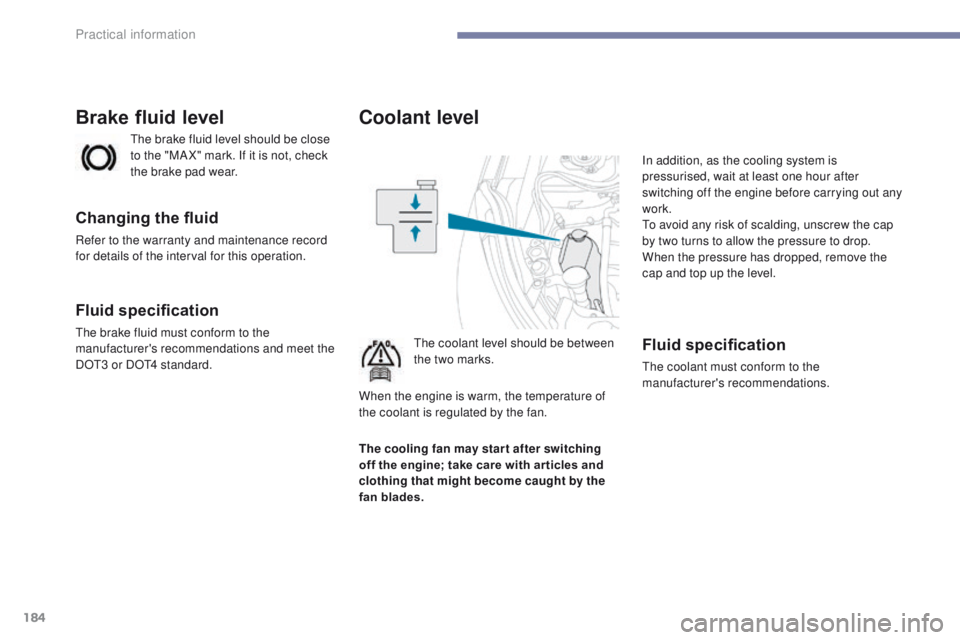
Coolant level
the coolant level should be between
the two marks.In addition, as the cooling system is
pressurised, wait at least one hour after
switching off the engine before carrying out any
work.
to a
void any risk of scalding, unscrew the cap
by two turns to allow the pressure to drop.
When the pressure has dropped, remove the
cap and top up the level.Fluid specification
the coolant must conform to the
manufacturer's recommendations.
th
e brake fluid level should be close
to the "MA X" mark. If it is not, check
the brake pad wear.
Brake fluid level
Changing the fluid
Refer to the warranty and maintenance record
for details of the interval for this operation.
Fluid specification
the brake fluid must conform to the
manufacturer's recommendations and meet the
DO
t3 o
r DO
t4 s
tandard.
The cooling fan may star t after switching
off the engine; take care with ar ticles and
clothing that might become caught by the
fan blades. When the engine is warm, the temperature of
the coolant is regulated by the fan.
Practical information
Page 188 of 368
186
4008_en_Chap07_info-pratiques_ed01-2016
Checking components
12 V battery
Electrolyte level
For access to the 12 V Battery, refer
to the corresponding section. Refer to the warranty and
maintenance record for details of
the replacement intervals for these
components.
Air filter and passenger compartment filter
Replace the oil filter each time the
engine oil is changed.
Refer to the warranty and
maintenance record for details of
the replacement interval for this
component.
Oil filter
If necessary, top up using distilled water,
removing the battery cap from each cell.
Check the electrolyte level at least
once a month.
When carrying out work on the 12 V Battery
,
refer to the corresponding section for
details of the precautions to be taken before
disconnecting the battery and following its
reconnection.
un
less other wise indicated, check these components in accordance with the warranty and maintenance record and according to your engine.
Other wise, have them checked by a P
e
uge
Ot
dealer or a qualified workshop.
th
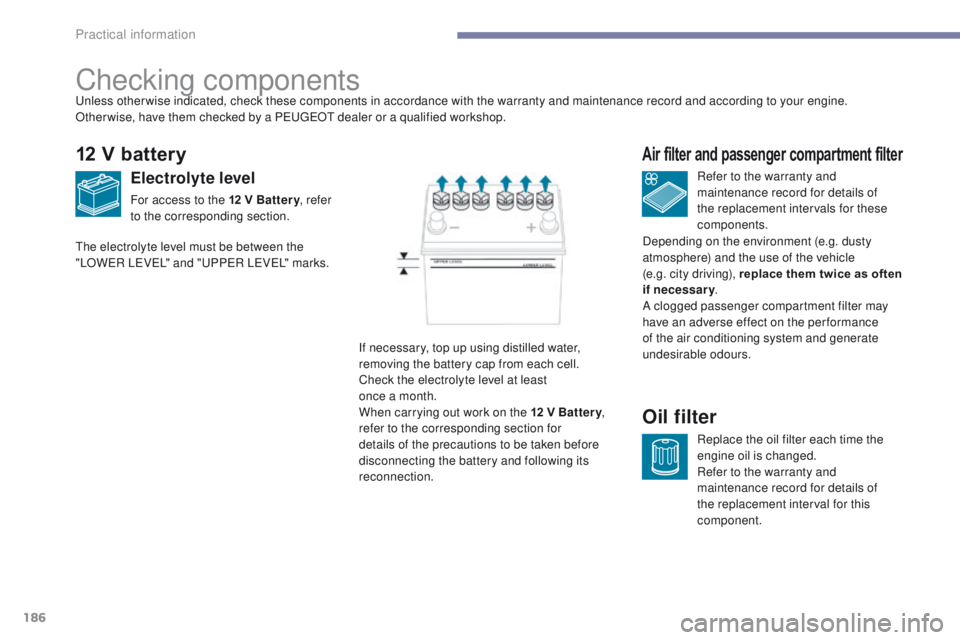
e electrolyte level must be between the
"LOW
eR LeVeL
" and "
uP
P
eR LeVeL
" marks.
Depending on the environment (e.g. dusty
atmosphere) and the use of the vehicle
(e.g. city driving), replace them twice as often
if necessary
.
A clogged passenger compartment filter may
have an adverse effect on the per formance
of the air conditioning system and generate
undesirable odours.
Practical information
Page 189 of 368
187
4008_en_Chap07_info-pratiques_ed01-2016
Manual gearbox
Refer to the warranty and
maintenance record for servicing of
the gearbox.
"CVT" gearbox
For servicing of the "CVt" gearbox,
refer to the manufacturer's service
schedule for details of the interval for
checking this component.
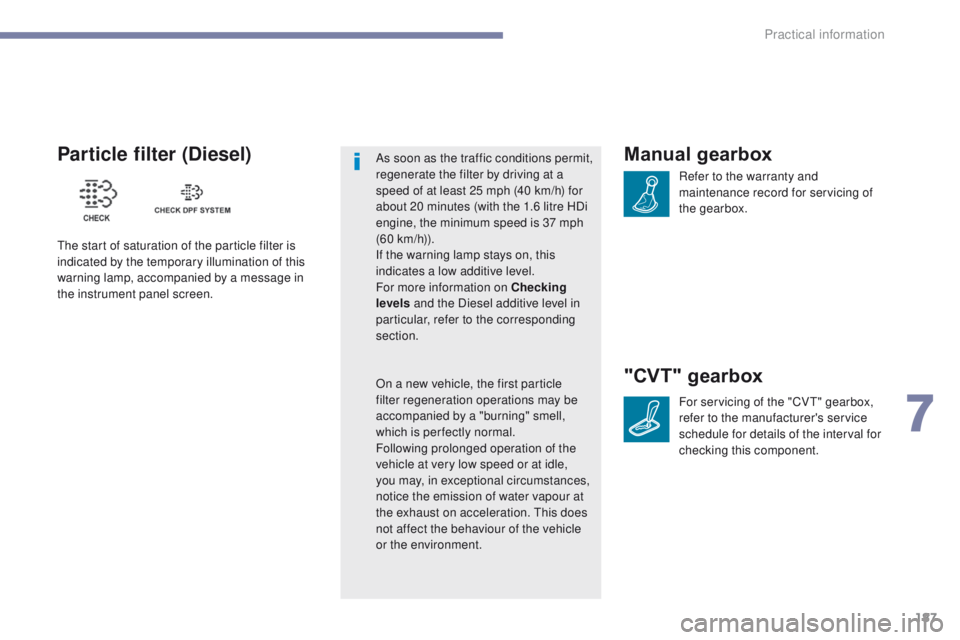
Particle filter (Diesel)
the start of saturation of the particle filter is
indicated by the temporary illumination of this
warning lamp, accompanied by a message in
the instrument panel screen. As soon as the traffic conditions permit,
regenerate the filter by driving at a
speed of at least 25 mph (40 km/h) for
about 20 minutes (with the 1.6 litre HDi
engine, the minimum speed is 37 mph
(60 km/h)).
If the warning lamp stays on, this
indicates a low additive level.
For more information on Checking
levels
and the Diesel additive level in
particular, refer to the corresponding
section.
On a new vehicle, the first particle
filter regeneration operations may be
accompanied by a "burning" smell,
which is per fectly normal.
Following prolonged operation of the
vehicle at very low speed or at idle,
you may, in exceptional circumstances,
notice the emission of water vapour at
the exhaust on acceleration.
t
h
is does
not affect the behaviour of the vehicle
or the environment.
7
Practical information
Page 197 of 368
195
4008_en_Chap08_en-cas-de panne_ed01-2016
Removing a wheel
Parking the vehicle
Immobilise the vehicle where it does
not block traffic; if possible, the ground
must be level, stable and not slippery.
Apply the parking brake, switch off the
ignition and engage first gear to block
the wheels.
Never go underneath a vehicle raised
using a jack; use an axle stand.
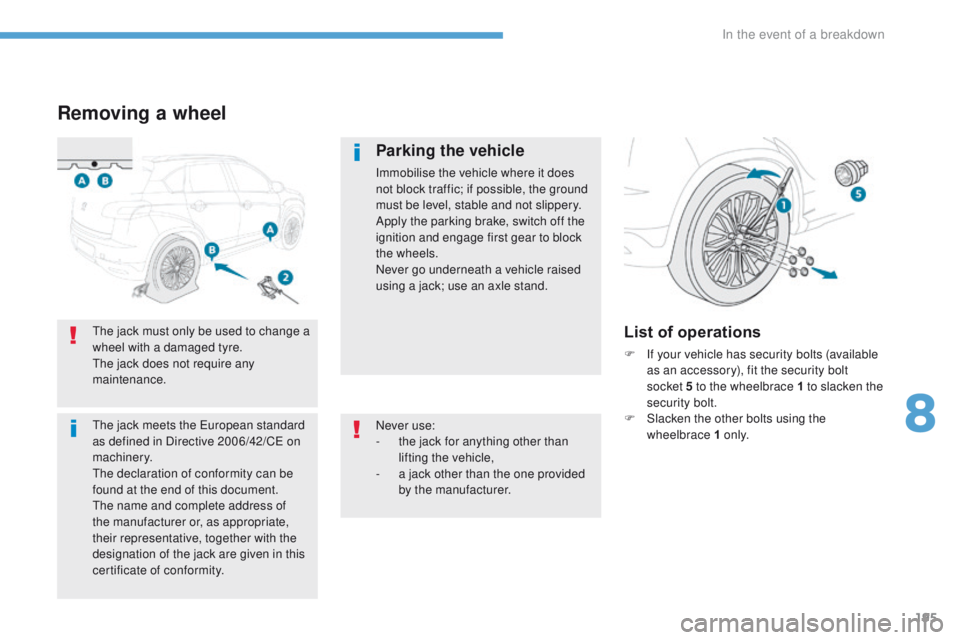
List of operations
F If your vehicle has security bolts (available
as an accessory), fit the security bolt
socket 5 to the wheelbrace 1 to slacken the
security bolt.
F
S
lacken the other bolts using the
wheelbrace 1 o n l y.
Never use:
-
t
he jack for anything other than
lifting the vehicle,
-
a j
ack other than the one provided
by the manufacturer.
th
e jack must only be used to change a
wheel with a damaged tyre.th
e jack does not require any
maintenance.
th
e jack meets the
e
u
ropean standard
as defined in Directive 2006/42/C
e
on
machinery.
th
e declaration of conformity can be
found at the end of this document.
th
e name and complete address of
the manufacturer or, as appropriate,
their representative, together with the
designation of the jack are given in this
certificate of conformity.
8
In the event of a breakdown