tyre pressure PEUGEOT 4008 2017 Owners Manual
[x] Cancel search | Manufacturer: PEUGEOT, Model Year: 2017, Model line: 4008, Model: PEUGEOT 4008 2017Pages: 368, PDF Size: 12.22 MB
Page 13 of 368
11
4008_en_Chap00c_eco-conduite_ed01-2016
Limit the causes of excess consumption
Spread loads throughout the vehicle; place the heaviest items in the
bottom of the boot, as close as possible to the rear seats.
Limit the loads carried in the vehicle and reduce wind resistance
(roof bars, roof rack, bicycle carrier, trailer, etc.). u
s
e a roof box in
preference.
Remove roof bars and roof racks after use.
At the end of winter, remove snow tyres and refit your summer tyres.
Observe the recommendations on
maintenance
Check the tyre pressures regularly, when cold, referring to the label in
the door aperture, on the driver's side.
Carry out this check in particular:
-
b
efore a long journey,
-
a
t each change of season,
-
a
fter a long period out of use.
Do not forget the spare wheel and the tyres on any trailer or caravan.
Have your vehicle serviced regularly (engine oil, oil filter, air filter,
passenger compartment filter, etc.) and observe the schedule of
operations recommended in the manufacturer's service schedule.
When refuelling, do not continue after the third cut-off of the nozzle to
avoid any over flow.
At the wheel of your new vehicle, it is only after the first 1 800 miles
(3
000 kilometres) that you will see the fuel consumption settle down to
a consistent average.
.
eco-driving
Page 17 of 368
15
4008_en_Chap01_Instruments-de-bord_ed01-2016
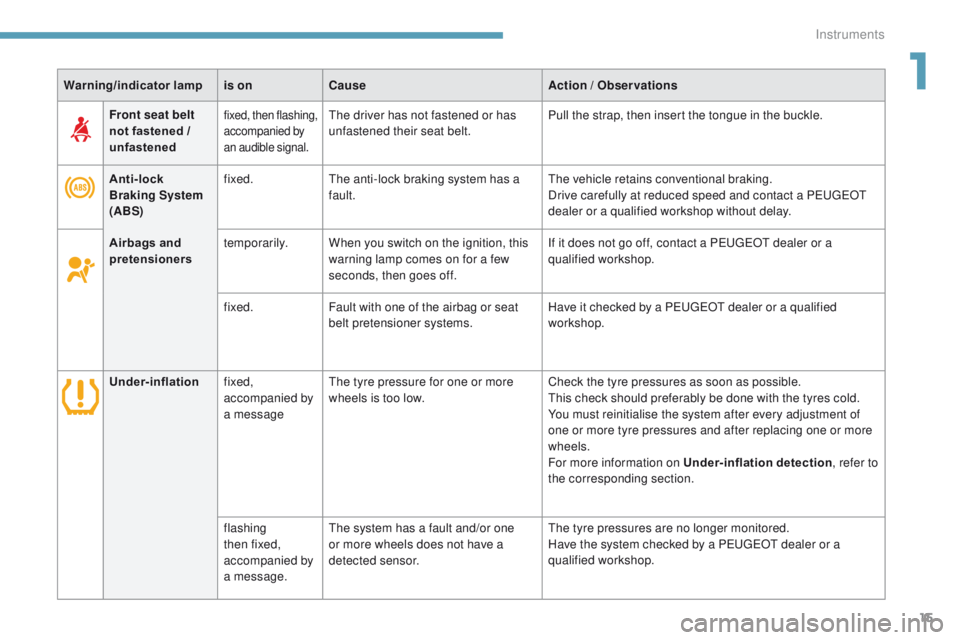
Warning/indicator lampis on Cause Action / Observations
Anti-lock
Braking System
(ABS) fixed.
th
e anti-lock braking system has a
fault.
th
e vehicle retains conventional braking.
Drive carefully at reduced speed and contact a P
e
uge
Ot
dealer or a qualified workshop without delay.
Front seat belt
not fastened /
unfastened
fixed, then flashing,
accompanied by
an audible signal.the driver has not fastened or has
unfastened their seat belt.
Pull the strap, then insert the tongue in the buckle.
Airbags and
pretensioners temporarily.
When you switch on the ignition, this
warning lamp comes on for a few
seconds, then goes off. If it does not go off, contact a P
e
uge
Ot
dealer or a
qualified workshop.
fixed. Fault with one of the airbag or seat
belt pretensioner systems. Have it checked by a P
e
uge
Ot
dealer or a qualified
workshop.
Under-inflation fixed,
accompanied by
a message
th
e tyre pressure for one or more
wheels is too low. Check the tyre pressures as soon as possible.
th
is check should preferably be done with the tyres cold.
You must reinitialise the system after every adjustment of
one or more tyre pressures and after replacing one or more
wheels.
For more information on Under-inflation detection , refer to
the corresponding section.
flashing
then fixed,
accompanied by
a message.
th
e system has a fault and/or one
or more wheels does not have a
detected sensor.
th
e tyre pressures are no longer monitored.
Have the system checked by a Peuge
O
t dealer or a
qualified workshop.
1
Instruments
Page 26 of 368
24
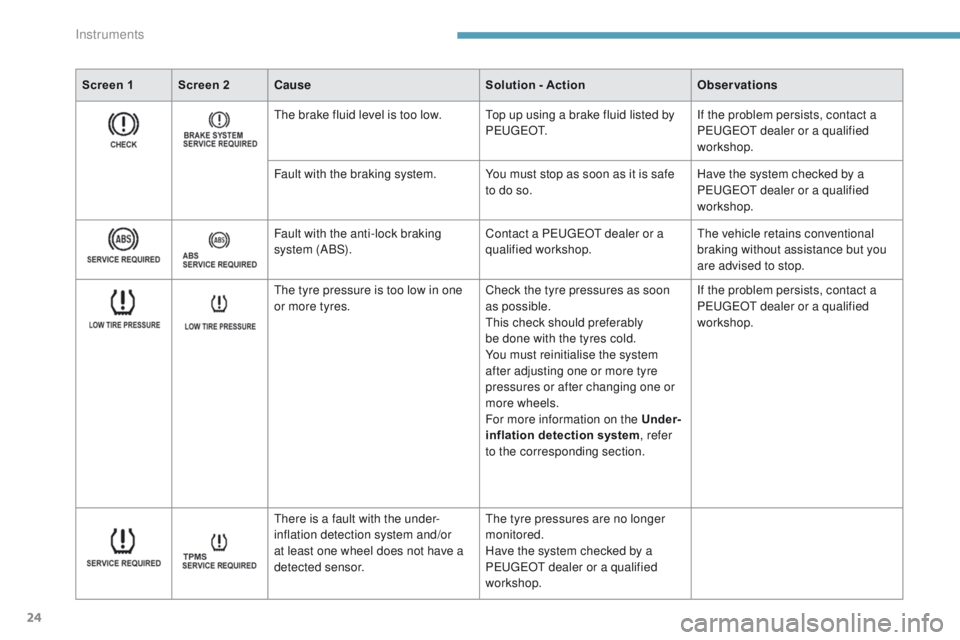
Screen 1 Screen 2Cause Solution - ActionObservations
th
e brake fluid level is too low.
to
p up using a brake fluid listed by
P
e
u g e
Ot
.If the problem persists, contact a
P
e
uge
Ot
dealer or a qualified
workshop.
Fault with the braking system. You must stop as soon as it is safe to do so.Have the system checked by a
P
e
uge
Ot
dealer or a qualified
workshop.
Fault with the anti-lock braking
system (ABS). Contact a P
e
uge
Ot
dealer or a
qualified workshop.
th
e vehicle retains conventional
braking without assistance but you
are advised to stop.
th
e tyre pressure is too low in one
or more tyres. Check the tyre pressures as soon
as possible.
th
is check should preferably
be done with the tyres cold.
You must reinitialise the system
after adjusting one or more tyre
pressures or after changing one or
more wheels.
For more information on the Under-
inflation detection system , refer
to the corresponding section. If the problem persists, contact a
Peuge
O
t dealer or a qualified
workshop.
th
ere is a fault with the under-
inflation detection system and/or
at least one wheel does not have a
detected sensor.
th
e tyre pressures are no longer
monitored.
Have the system checked by a
P
e
uge
Ot
dealer or a qualified
workshop.
Instruments
Page 44 of 368
42
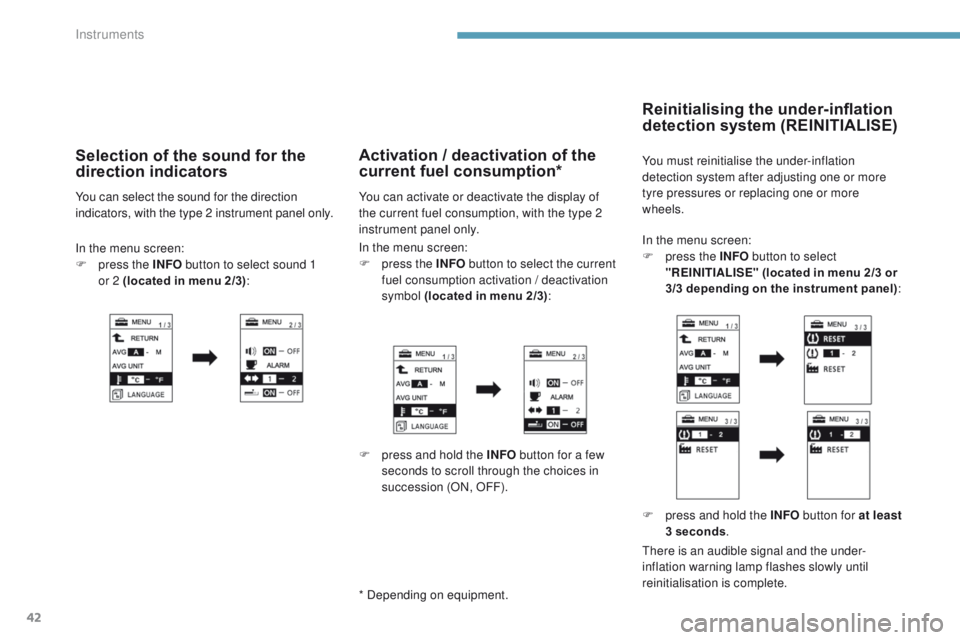
In the menu screen:
F p ress the INFO button to select
"REINITIALISE" (located in menu 2/3 or
3/3 depending on the instrument panel) :
Reinitialising the under-inflation
detection system (REINITIALISE)
You must reinitialise the under-inflation
detection system after adjusting one or more
tyre pressures or replacing one or more
wheels.
F
p
ress and hold the INFO button for at least
3 seconds .
ther
e is an audible signal and the under-
inflation warning lamp flashes slowly until
reinitialisation is complete.
In the menu screen:
F
p
ress the INFO button to select the current
fuel consumption activation / deactivation
symbol (located in menu 2/3) :Activation / deactivation of the
current fuel consumption*
You can activate or deactivate the display of
the current fuel consumption, with the type 2
instrument panel only.
F
p
ress and hold the INFO button for a few
seconds to scroll through the choices in
succession (ON, OFF).
* Depending on equipment.
In the menu screen:
F p ress the INFO button to select sound 1
or
2 (located in menu 2/3) :
Selection of the sound for the
direction indicators
You can select the sound for the direction
indicators, with the type 2 instrument panel only.
Instruments
Page 116 of 368
114
4008_en_Chap04_conduite_ed01-2016
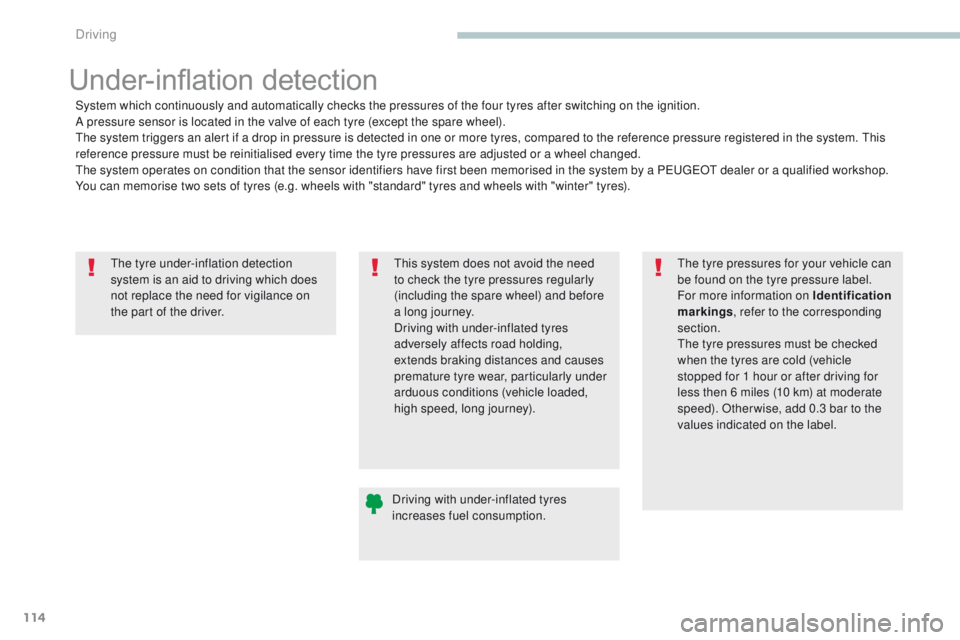
the tyre under-inflation detection
system is an aid to driving which does
not replace the need for vigilance on
the part of the driver.
Under-inflation detection
System which continuously and automatically checks the pressures of the four tyres after switching on the ignition.
A pressure sensor is located in the valve of each tyre (except the spare wheel).
th
e system triggers an alert if a drop in pressure is detected in one or more tyres, compared to the reference pressure registered in the system. t
h
is
reference pressure must be reinitialised every time the tyre pressures are adjusted or a wheel changed.
th
e system operates on condition that the sensor identifiers have first been memorised in the system by a P
e
uge
Ot
dealer or a qualified workshop.
You can memorise two sets of tyres (e.g. wheels with "standard" tyres and wheels with "winter" tyres).
Driving with under-inflated tyres
increases fuel consumption.
th
is system does not avoid the need
to check the tyre pressures regularly
(including the spare wheel) and before
a long journey.
Driving with under-inflated tyres
adversely affects road holding,
extends braking distances and causes
premature tyre wear, particularly under
arduous conditions (vehicle loaded,
high speed, long journey).
th
e tyre pressures for your vehicle can
be found on the tyre pressure label.
For more information on Identification
markings , refer to the corresponding
section.
th
e tyre pressures must be checked
when the tyres are cold (vehicle
stopped for 1 hour or after driving for
less then 6 miles (10 km) at moderate
speed). Other wise, add 0.3 bar to the
values indicated on the label.
Driving
Page 117 of 368
115
4008_en_Chap04_conduite_ed01-2016
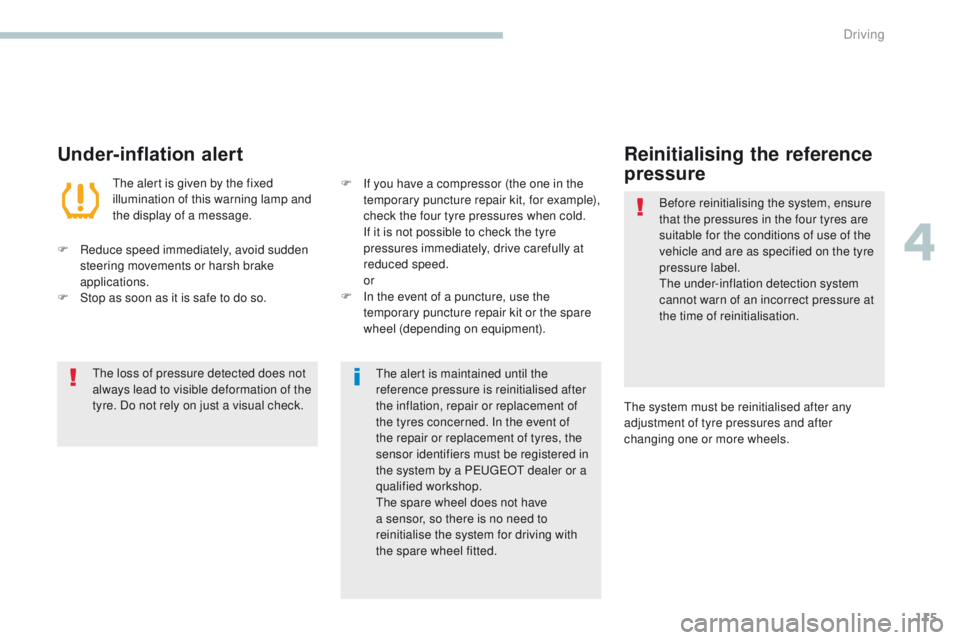
Under-inflation alert
the alert is given by the fixed
illumination of this warning lamp and
the display of a message.
F
R
educe speed immediately, avoid sudden
steering movements or harsh brake
applications.
F
S
top as soon as it is safe to do so.
th
e loss of pressure detected does not
always lead to visible deformation of the
tyre. Do not rely on just a visual check.
th
e alert is maintained until the
reference pressure is reinitialised after
the inflation, repair or replacement of
the tyres concerned. In the event of
the repair or replacement of tyres, the
sensor identifiers must be registered in
the system by a P
e
uge
Ot
dealer or a
qualified workshop.
th
e spare wheel does not have
a sensor, so there is no need to
reinitialise the system for driving with
the spare wheel fitted.
F
I f you have a compressor (the one in the
temporary puncture repair kit, for example),
check the four tyre pressures when cold.
I
f it is not possible to check the tyre
pressures immediately, drive carefully at
reduced speed.
or
F
I
n the event of a puncture, use the
temporary puncture repair kit or the spare
wheel (depending on equipment).
Reinitialising the reference
pressure
Before reinitialising the system, ensure
that the pressures in the four tyres are
suitable for the conditions of use of the
vehicle and are as specified on the tyre
pressure label.
th
e under-inflation detection system
cannot warn of an incorrect pressure at
the time of reinitialisation.
th
e system must be reinitialised after any
adjustment of tyre pressures and after
changing one or more wheels.
4
Driving
Page 118 of 368
116
4008_en_Chap04_conduite_ed01-2016
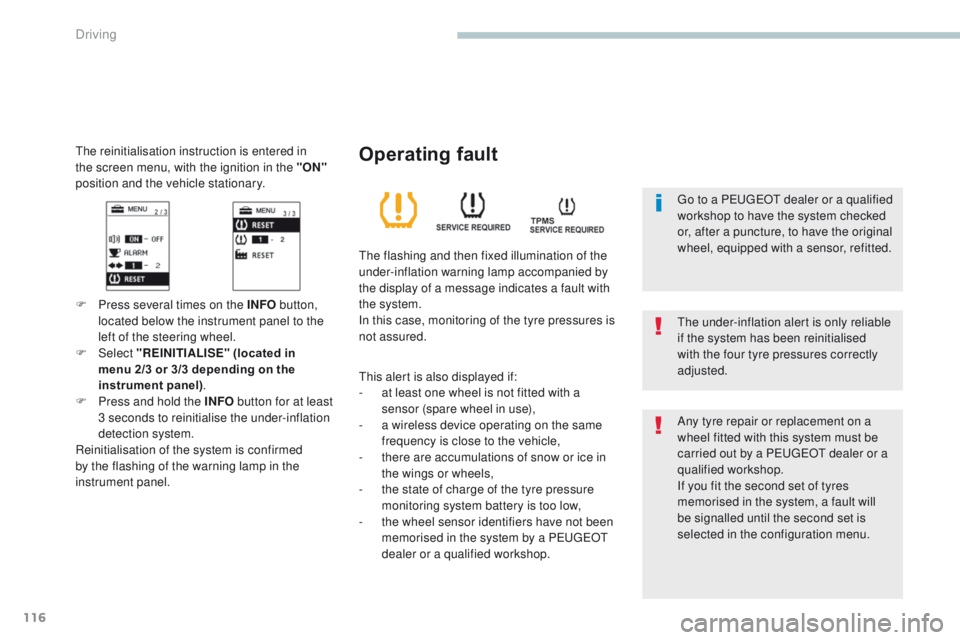
the reinitialisation instruction is entered in
the screen menu, with the ignition in the "ON"
position and the vehicle stationary.
F Press several times on the INFO button,
located below the instrument panel to the
left of the steering wheel.
F
Select "REINITIALISE" (located in
menu
2/3 or 3/3 depending on the
instrument panel) .
F
P
ress and hold the INFO button for at least
3 seconds to reinitialise the under-inflation
detection system.
Reinitialisation of the system is confirmed
by the flashing of the warning lamp in the
instrument panel.
th
e under-inflation alert is only reliable
if the system has been reinitialised
with the four tyre pressures correctly
adjusted.
Operating fault
the flashing and then fixed illumination of the
under-inflation warning lamp accompanied by
the display of a message indicates a fault with
the system.
In this case, monitoring of the tyre pressures is
not assured.
th
is alert is also displayed if:
-
a
t least one wheel is not fitted with a
sensor (spare wheel in use),
-
a w
ireless device operating on the same
frequency is close to the vehicle,
-
t
here are accumulations of snow or ice in
the wings or wheels,
-
t
he state of charge of the tyre pressure
monitoring system battery is too low,
-
t
he wheel sensor identifiers have not been
memorised in the system by a P
e
uge
Ot
dealer or a qualified workshop. Any tyre repair or replacement on a
wheel fitted with this system must be
carried out by a P
e
uge
Ot
dealer or a
qualified workshop.
If you fit the second set of tyres
memorised in the system, a fault will
be signalled until the second set is
selected in the configuration menu.
go t
o a P
e
uge
Ot
dealer or a qualified
workshop to have the system checked
or, after a puncture, to have the original
wheel, equipped with a sensor, refitted.
Driving
Page 119 of 368
117
4008_en_Chap04_conduite_ed01-2016
Managing sets of tyres
If you have had a second set of tyres registered
by a PeugeOt dealer or a qualified workshop,
every time you change the set of tyres (fitting
a set of winter tyres, for example), you must
select the set you have just fitted in the
configuration menu.
After fitting the new set of tyres, you
should check and adjust the tyre
pressures to the values specified on the
tyre pressure label.
For more information on Identification
markings and in particular the
tyre pressure label, refer to the
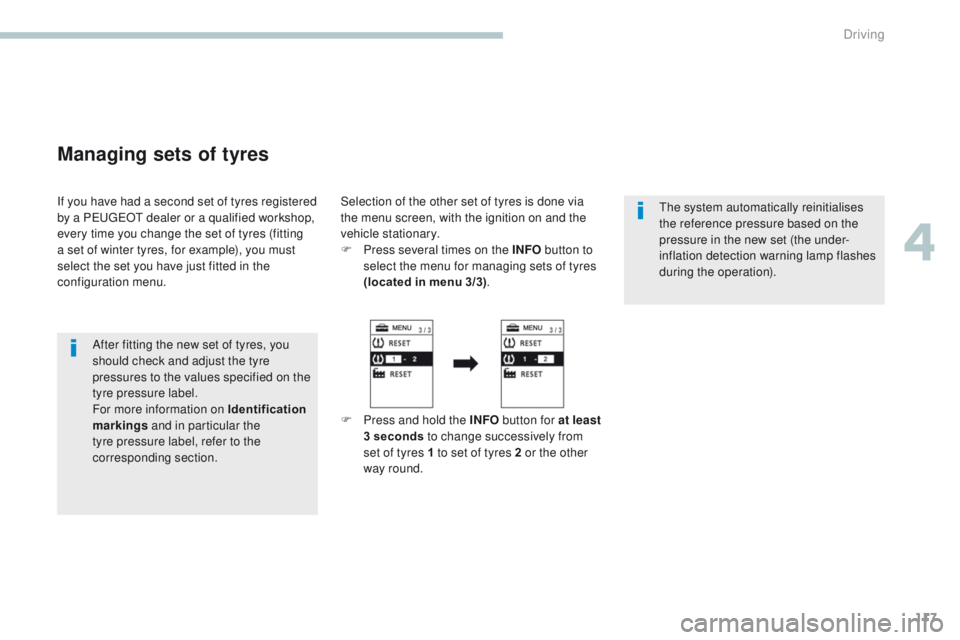
corresponding section. Selection of the other set of tyres is done via
the menu screen, with the ignition on and the
vehicle stationary.
F
P
ress several times on the INFO button to
select the menu for managing sets of tyres
(located in menu 3/3) .
F Press and hold the INFO button for at least
3 seconds to change successively from
set of tyres 1 to set of tyres 2 or the other
way round.
the
system automatically reinitialises
the reference pressure based on the
pressure in the new set (the under-
inflation detection warning lamp flashes
during the operation).
4
Driving
Page 121 of 368
119
4008_en_Chap04_conduite_ed01-2016
As the engine torque is applied to all
four wheels, the condition of the tyres
has a considerable impact on the
performance of the vehicle.
en
sure that all four tyres are in good
condition.
Avoid driving the vehicle in sandy or
muddy areas or in other areas in which
the wheels could spin.
Spinning the wheels places the
transmission components under
pressure and could cause a serious
malfunction.
Do not drive the vehicle through deep
water.
Avoid driving over excessively uneven
terrain (risk of scraping under the body
or of grounding on crossing a bridge).
Operating faults
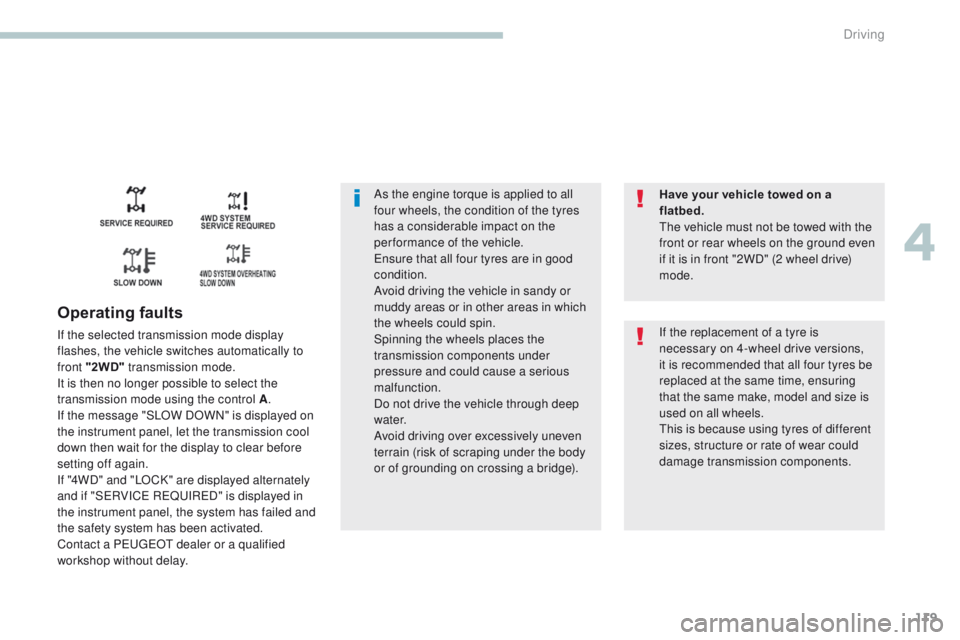
If the selected transmission mode display
flashes, the vehicle switches automatically to
front "2WD" transmission mode.
It is then no longer possible to select the
transmission mode using the control A .
If the message "SLOW DOWN" is displayed on
the instrument panel, let the transmission cool
down then wait for the display to clear before
setting off again.
If "4WD" and "LOCK" are displayed alternately
and if "S
eR
VIC
e
R
eQuI
R
eD
" is displayed in
the instrument panel, the system has failed and
the safety system has been activated.
Contact a P
e
uge
Ot
dealer or a qualified
workshop without delay. Have your vehicle towed on a
flatbed.
th
e vehicle must not be towed with the
front or rear wheels on the ground even
if it is in front "2WD" (2 wheel drive)
mode.If the replacement of a tyre is
necessary on 4-wheel drive versions,
it is recommended that all four tyres be
replaced at the same time, ensuring
that the same make, model and size is
used on all wheels.
th
is is because using tyres of different
sizes, structure or rate of wear could
damage transmission components.
4
Driving
Page 180 of 368
178
4008_en_Chap07_info-pratiques_ed01-2016
Advice on driving when towing
Distribution of loads
F Distribute the load in the trailer so that the heaviest items are as close as possible to
the axle and the nose weight approaches
the maximum permitted without exceeding
it.
Air density decreases with altitude, thus
reducing engine performance. Above
1
000 metres, the maximum towing load must
be reduced by 10
% of the gt
W a
nd so on for
every 1
000 metres of altitude.
For more information on Petrol weights or
Diesel weights and in particular the towed
loads which apply to your vehicle, refer to the
corresponding section.
Side wind
F take into account the increased sensitivity to side wind.
Cooling
towing a trailer on a slope increases the
temperature of the coolant.
As the fan is electrically controlled, its cooling
capacity is not dependent on the engine speed.
F
t
o l
ower the engine speed, reduce your
speed.
th
e maximum towed load on a long slope
depends on the gradient and the exterior
temperature.
In all cases, pay attention to the coolant
temperature.
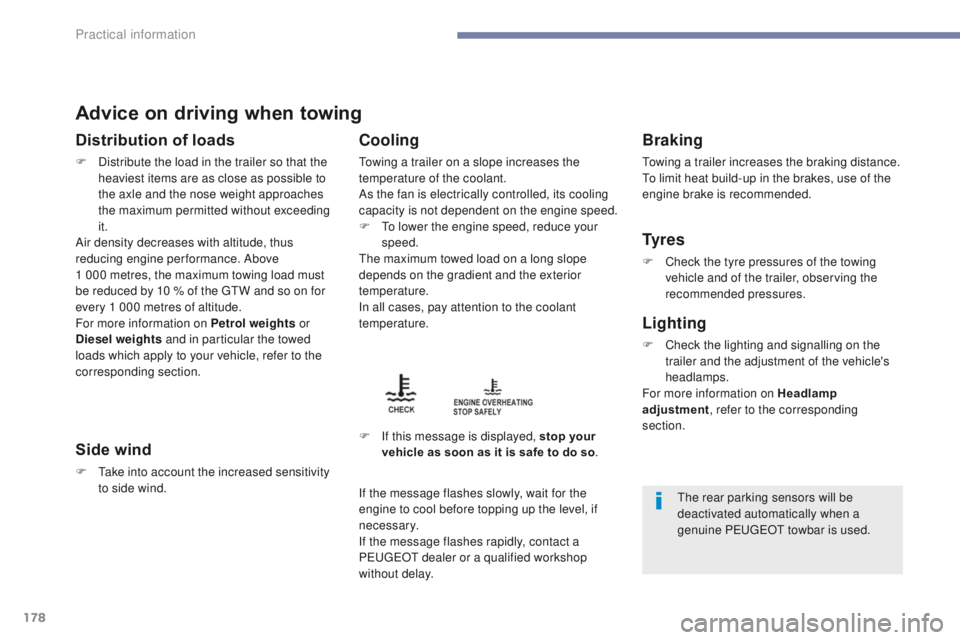
F
I
f this message is displayed, stop your
vehicle as soon as it is safe to do so .
Braking
towing a trailer increases the braking distance.to l
imit heat build-up in the brakes, use of the
engine brake is recommended.
Ty r e s
F Check the tyre pressures of the towing vehicle and of the trailer, observing the
recommended pressures.
Lighting
F Check the lighting and signalling on the trailer and the adjustment of the vehicle's
headlamps.
For more information on Headlamp
adjustment , refer to the corresponding
section.
If the message flashes slowly, wait for the
engine to cool before topping up the level, if
necessary.
If the message flashes rapidly, contact a
P
e
uge
Ot
dealer or a qualified workshop
without delay.
the rear parking sensors will be
deactivated automatically when a
genuine P
e
uge
Ot
towbar is used.
Practical information