engine oil PEUGEOT 4C 2015 User Guide
[x] Cancel search | Manufacturer: PEUGEOT, Model Year: 2015, Model line: , Model:Pages: 348, PDF Size: 3.76 MB
Page 251 of 348
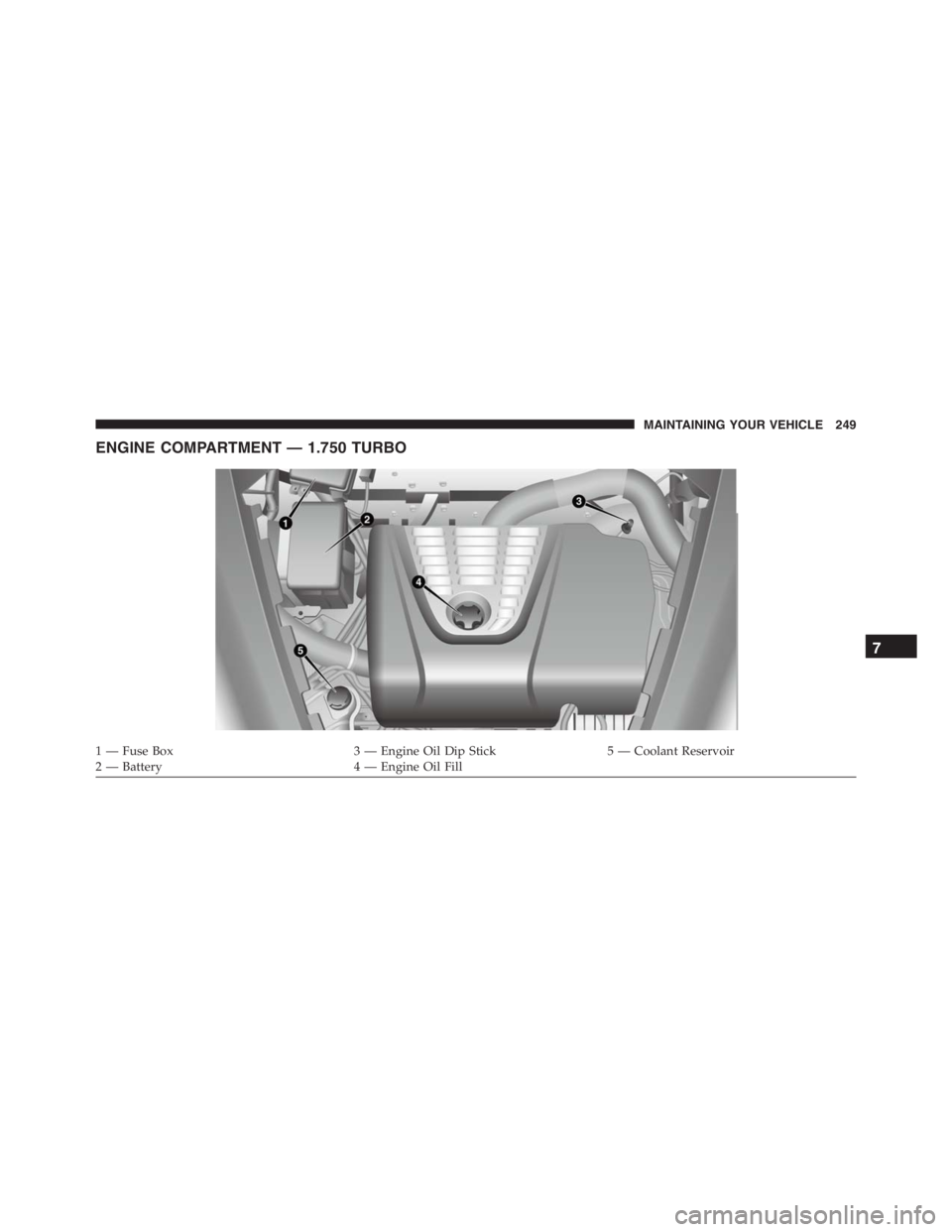
ENGINE COMPARTMENT — 1.750 TURBO
1 — Fuse Box 3 — Engine Oil Dip Stick 5 — Coolant Reservoir
2 — Battery 4 — Engine Oil Fill
7
MAINTAINING YOUR VEHICLE 249
Page 254 of 348
CAUTION!(Continued)
•Your vehicle has been built with improved fluids
that protect the performance and durability of your
vehicle and also allow extended maintenance inter-
vals. Do not use chemical flushes in these compo-
nents as the chemicals can damage your engine,
transmission, or air conditioning. Such damage is
not covered by the New Vehicle Limited Warranty.
If a flush is needed because of component malfunc-
tion, use only the specified fluid for the flushing
procedure.
Engine Oil
Checking Oil Level
To assure proper engine lubrication, the engine oil must
be maintained at the correct level. Check the oil level atregular intervals. The best time to check the engine oil
level is before starting the engine after it has sat over-
night.
Do not check oil level when the engine is warm. Check-
ing engine oil level when the engine is warm will give
you an incorrect reading.
Checking the oil while the vehicle is on level ground, and
has sat overnight, will improve the accuracy of the oil
level readings. Maintain the oil level between the range
markings on the dipstick. The safe range is indicated by
a crosshatch zone. Adding 1 quart of oil when the reading
is at the low end of the indicated range will result in the
oil level at the full end of the indicator range.
252 MAINTAINING YOUR VEHICLE
Page 255 of 348
CAUTION!
Do not overfill the engine with oil. Overfilling the
engine with oil will cause oil aeration, which can
lead to loss of oil pressure and an increase in oil
temperature. This loss of oil pressure and increased
oil temperature could damage your engine.
Change Engine Oil
The oil change indicator system will remind you that it is
time to take your vehicle in for scheduled maintenance.
Refer to the “Maintenance Schedule” for further informa-
tion.
NOTE:The actual interval for changing the oil and
replacing the engine oil filter depends on the vehicle
usage conditions and is signalled by the warning light or
message (if present) on the instrument panel or every 12
months.
Engine Oil Selection
For best performance and maximum protection for tur-
bocharged engines under all types of operating condi-
tions, the manufacturer recommends synthetic engine
oils that are API Certified and meet the requirements of
Chrysler Material Standard MS-12991.
Engine Oil Viscosity — 1.750 Turbo Engine (SAE
Grade)
SAE 5W-40 full synthetic engine oil is recommended for
all operating temperatures. This engine oil improves low
temperature starting and vehicle fuel economy.
Lubricants which do not have both the engine oil certi-
fication mark and the correct SAE viscosity grade num-
ber should not be used.
The engine oil filler cap also shows the recommended
engine oil viscosity for your engine. For information on
7
MAINTAINING YOUR VEHICLE 253
Page 256 of 348
engine oil filler cap location, refer to “Engine Compart-
ment” in “Maintaining Your Vehicle” for further informa-
tion.
Materials Added To Engine Oil
The manufacturer strongly recommends against the ad-
dition of any additives (other than leak detection dyes) to
the engine oil. Engine oil is an engineered product and its
performance may be impaired by supplemental addi-
tives.
Disposing Of Used Engine Oil And Oil Filters
Care should be taken in disposing of used engine oil and
oil filters from your vehicle. Used oil and oil filters,
indiscriminately discarded, can present a problem to the
environment. Contact your authorized dealer, service
station or governmental agency for advice on how and
where used oil and oil filters can be safely discarded in
your area.
Engine Oil Filter
The engine oil filter should be replaced with a new filter
at every engine oil change.
Engine Oil Filter Selection
This manufacturer’s engines have a full-flow type dispos-
able oil filter. Use a filter of this type for replacement. The
quality of replacement filters varies considerably. Only
high quality filters should be used to assure most efficient
service. MOPAR® engine oil filters are high quality oil
filters and are recommended.
Engine Air Cleaner Filter
Refer to the “Maintenance Schedule” for the proper
maintenance intervals.
254 MAINTAINING YOUR VEHICLE
Page 257 of 348
WARNING!
The air induction system (air cleaner, hoses, etc.) can
provide a measure of protection in the case of engine
backfire. Do not remove the air induction system (air
cleaner, hoses, etc.) unless such removal is necessary
for repair or maintenance. Make sure that no one is
near the engine compartment before starting the
vehicle with the air induction system (air cleaner,
hoses, etc.) removed. Failure to do so can result in
serious personal injury.
Engine Air Cleaner Filter Selection
The quality of replacement engine air cleaner filters
varies considerably. Only high quality filters should be
used to assure most efficient service. MOPAR® engine air
cleaner filters are a high quality filter and are recom-
mended.
Engine Cover
To avoid possible damage to the engine cover, please
disconnect each of the four mounting studs by pulling
the engine cover upward, and then lift off the complete
cover. Tilting the engine cover when one or more studs
are still engaged will lead to premature failure of the
couplers.
To reassemble the cover back onto the engine, first make
sure it is properly aligned, the oil cap is centered, and that
all four studs are lined up with their couplers. Then
gently push on the four corners of the engine cover to
snap the stud back into position.
No tools are required to remove or reassemble the engine
cover.
7
MAINTAINING YOUR VEHICLE 255
Page 261 of 348
Wiper Blades
Clean the rubber edges of the wiper blades and the
windshield and rear window periodically with a sponge
or soft cloth and a mild nonabrasive cleaner. This will
remove accumulations of salt, waxes, or road film, and
help reduce streaking and smearing.
Operation of the wipers on dry glass for long periods
may cause deterioration of the wiper blades. Always use
washer fluid when using the wipers to remove salt or dirt
from a dry windshield or rear window.
Avoid using the wiper blades to remove frost or ice from
the windshield or rear window. Make sure that they are
not frozen to the glass before turning them on to avoid
damaging the blade. Keep the blade rubber out of contact
with petroleum products such as engine oil, gasoline, etc.NOTE:Life expectancy of wiper blades varies depending
on geographical area and frequency of use. Poor perfor-
mance of blades may be present with chattering, marks,
water lines or wet spots. If any of these conditions are
present, clean the wiper blades or replace as necessary.
Blade Lifting
If it is necessary to lift the blade from the windshield (In
the event of snow or blade replacement) Proceed as
directed:
1. Rotate the end of the multifunction lever to the OFF
position.
2. Turn the ignition to the MAR-ON position then to
STOP.
7
MAINTAINING YOUR VEHICLE 259
Page 268 of 348
exhaust system inspected each time the vehicle is raised
for lubrication or oil change. Replace as required.
WARNING!
•Exhaust gases can injure or kill. They contain
carbon monoxide (CO), which is colorless and
odorless. Breathing it can make you unconscious
and can eventually poison you. To avoid breathing
CO, refer to “Safety Tips/Exhaust Gas” in “Things
To Know Before Starting Your Vehicle” for further
information.
•A hot exhaust system can start a fire if you park
over materials that can burn. Such materials might
be grass or leaves coming into contact with your
exhaust system. Do not park or operate your ve-
hicle in areas where your exhaust system can con-
tact anything that can burn.
CAUTION!
•The catalytic converter requires the use of un-
leaded fuel only. Leaded gasoline will destroy the
effectiveness of the catalyst as an emissions control
device and may seriously reduce engine perfor-
mance and cause serious damage to the engine.
•Damage to the catalytic converter can result if your
vehicle is not kept in proper operating condition.
In the event of engine malfunction, particularly
involving engine misfire or other apparent loss of
performance, have your vehicle serviced promptly.
Continued operation of your vehicle with a severe
malfunction could cause the converter to overheat,
resulting in possible damage to the converter and
vehicle.
266 MAINTAINING YOUR VEHICLE
Page 277 of 348
WARNING!
•Use only manufacturer’s recommended brake
fluid. Refer to “Fluids, Lubricants, and Genuine
Parts” in “Maintaining Your Vehicle” for further
information. Using the wrong type of brake fluid
can severely damage your brake system and/or
impair its performance. The proper type of brake
fluid for your vehicle is also identified on the
original factory installed hydraulic master cylinder
reservoir.
•To avoid contamination from foreign matter or
moisture, use only new brake fluid or fluid that has
been in a tightly closed container. Keep the master
cylinder reservoir cap secured at all times. Brake
fluid in a open container absorbs moisture from the
air resulting in a lower boiling point. This may
(Continued)
WARNING!(Continued)
cause it to boil unexpectedly during hard or pro-
longed braking, resulting in sudden brake failure.
This could result in a collision.
•Overfilling the brake fluid reservoir can result in
spilling brake fluid on hot engine parts, causing
the brake fluid to catch fire. Brake fluid can also
damage painted and vinyl surfaces, care should be
taken to avoid its contact with these surfaces.
•Do not allow petroleum-based fluid to contaminate
the brake fluid. Brake seal components could be
damaged, causing partial or complete brake failure.
This could result in a collision.
7
MAINTAINING YOUR VEHICLE 275
Page 308 of 348
4. Install luggage compartment roof light by inserting it
in its correct position, first on one side and then
pressing on the other side until it clicks into place.
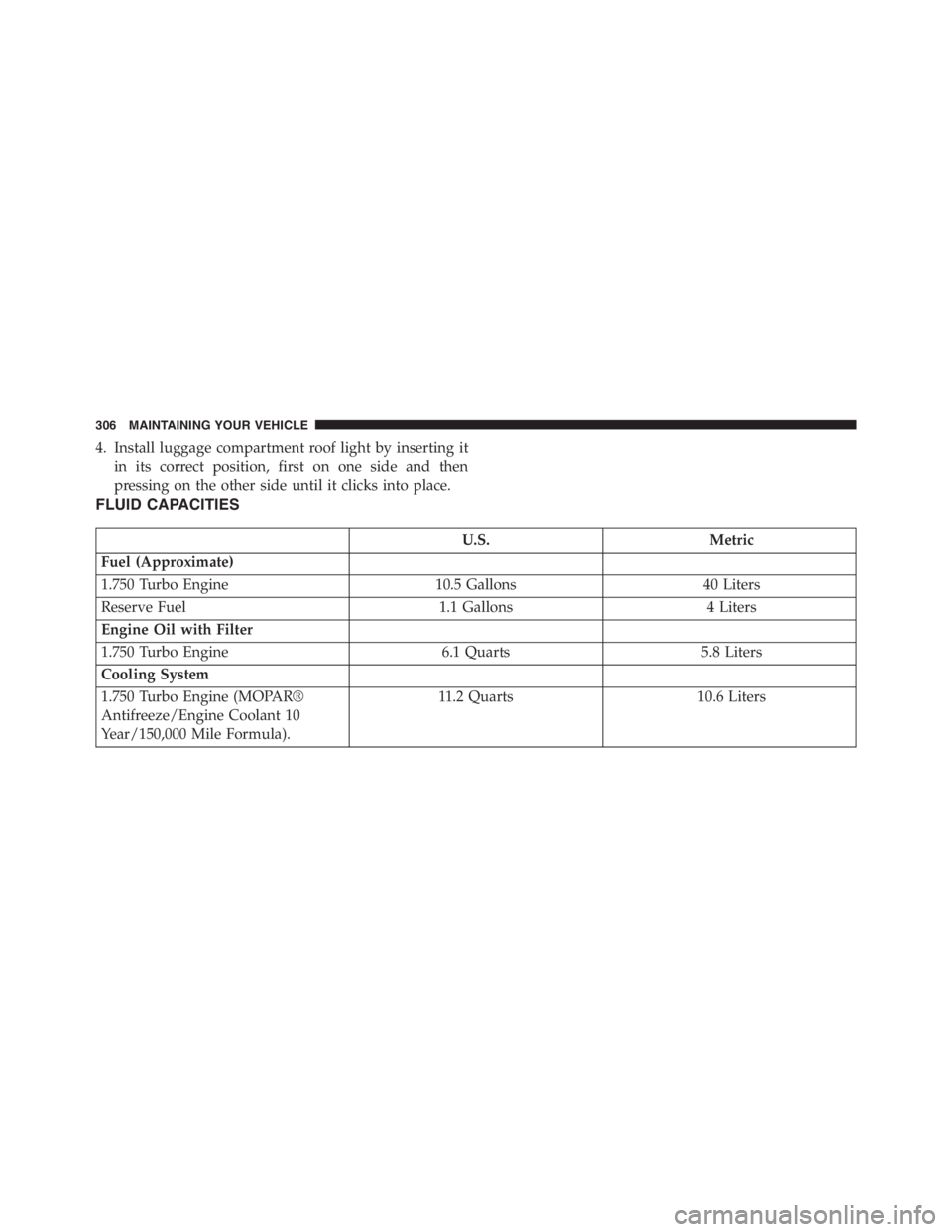
FLUID CAPACITIES
U.S. Metric
Fuel (Approximate)
1.750 Turbo Engine 10.5 Gallons 40 Liters
Reserve Fuel 1.1 Gallons 4 Liters
Engine Oil with Filter
1.750 Turbo Engine 6.1 Quarts 5.8 Liters
Cooling System
1.750 Turbo Engine (MOPAR®
Antifreeze/Engine Coolant 10
Year/150,000 Mile Formula).11.2 Quarts 10.6 Liters
306 MAINTAINING YOUR VEHICLE
Page 309 of 348
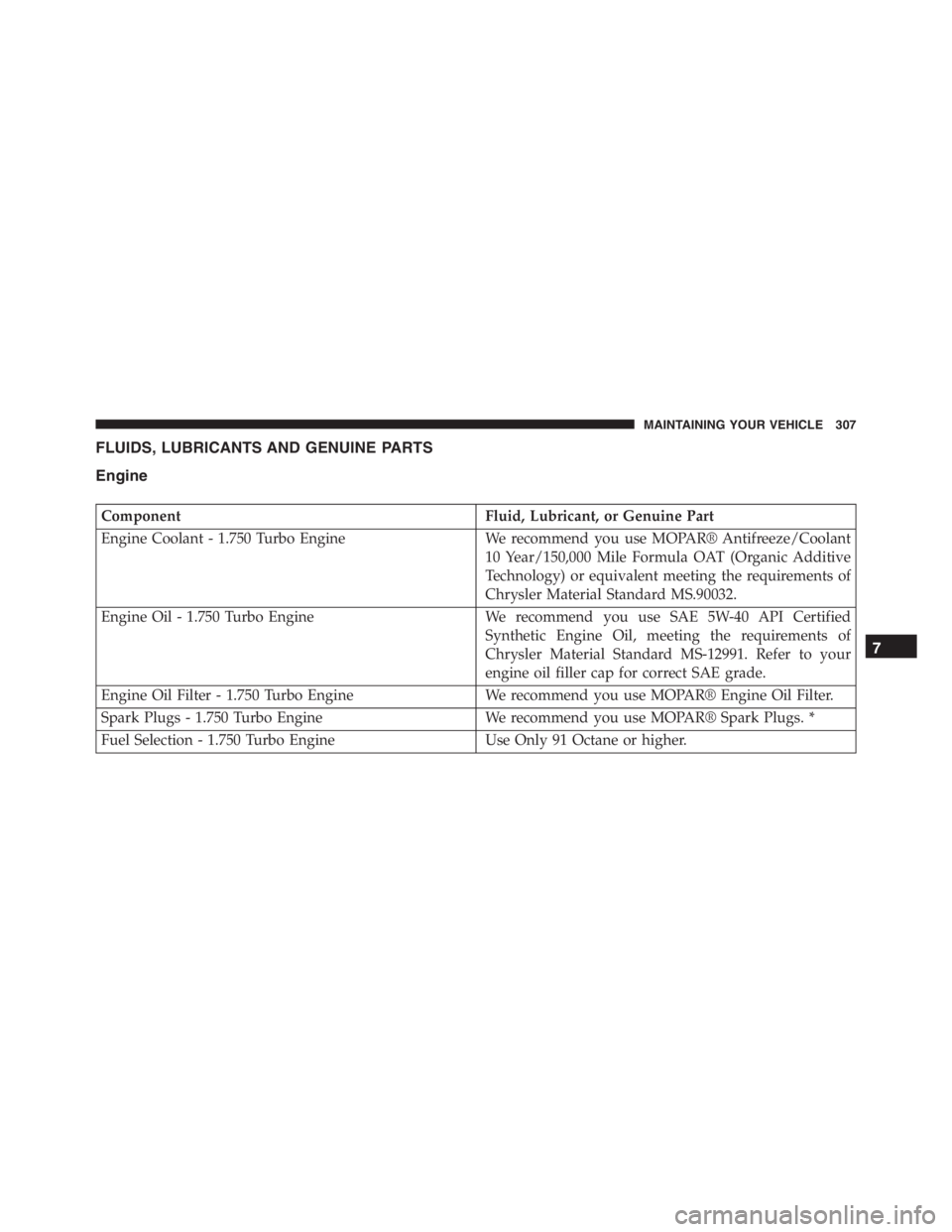
FLUIDS, LUBRICANTS AND GENUINE PARTS
Engine
Component Fluid, Lubricant, or Genuine Part
Engine Coolant - 1.750 Turbo Engine We recommend you use MOPAR® Antifreeze/Coolant
10 Year/150,000 Mile Formula OAT (Organic Additive
Technology) or equivalent meeting the requirements of
Chrysler Material Standard MS.90032.
Engine Oil - 1.750 Turbo Engine We recommend you use SAE 5W-40 API Certified
Synthetic Engine Oil, meeting the requirements of
Chrysler Material Standard MS-12991. Refer to your
engine oil filler cap for correct SAE grade.
Engine Oil Filter - 1.750 Turbo Engine We recommend you use MOPAR® Engine Oil Filter.
Spark Plugs - 1.750 Turbo Engine We recommend you use MOPAR® Spark Plugs. *
Fuel Selection - 1.750 Turbo Engine Use Only 91 Octane or higher.
7
MAINTAINING YOUR VEHICLE 307