flat tire PEUGEOT 4C 2015 Owner's Manual
[x] Cancel search | Manufacturer: PEUGEOT, Model Year: 2015, Model line: , Model:Pages: 348, PDF Size: 3.76 MB
Page 212 of 348
NOTE:For AR 4C models, where available, the vehicle
may be equipped with high performance tires that guar-
antee high grip performance with little increase of wear.
Alfa Romeo, in collaboration with Pirelli, developed a
specific high performance tire for the 4C model. A
dedicated Pirelli PZero, identified with an AR mark,
guarantees this vehicle to obtain the highest performance
capable.
TIRE PRESSURE MONITORING SYSTEM (TPMS)
The Tire Pressure Monitor System (TPMS) will warn the
driver of a low tire pressure based on the vehicle recom-
mended cold tire pressure.
The tire pressure will vary with temperature by about 1
psi (7 kPa) for every 12° F (6.5° C). This means that when
the outside temperature decreases, the tire pressure will
decrease. Tire pressure should always be set based on
cold inflation tire pressure. This is defined as the tire
pressure after the vehicle has not been driven for at leastthree hours, or driven less than 1 mile (1.6 km) after a
three hour period. The cold tire inflation pressure must
not exceed the maximum inflation pressure molded into
the tire sidewall. Refer to “Tires – General Information”
in “Starting and Operating” for information on how to
properly inflate the vehicle’s tires. The tire pressure will
also increase as the vehicle is driven, this is normal and
there should be no adjustment for this increased pres-
sure.
The TPMS will warn the driver of a low tire pressure if
the tire pressure falls below the low pressure warning
limit for any reason, including low temperature effects, or
natural pressure loss through the tire.
The TPMS will continue to warn the driver of low tire
pressure as long as the condition exists, and will not turn
off until the tire pressure is at or above the recommended
cold tire pressure on the placard. Once the low tire
pressure warning (Tire Pressure Monitoring Telltale
210 STARTING AND OPERATING
Page 213 of 348
Light) illuminates, you must increase the tire pressure to
the recommended cold tire pressure in order for the Tire
Pressure Monitoring Telltale Light to turn off. The system
will automatically update and the Tire Pressure Monitor-
ing Telltale Light will turn off once the system receives
the updated tire pressures. The vehicle may need to be
driven for up to 20 minutes above 15 mph (24 km/h) in
order for the TPMS to receive this information.
For example, your vehicle may have a recommended
cold (parked for more than three hours) tire pressure of
30 psi (207 kPa). If the ambient temperature is 68° F (20°
C) and the measured tire pressure is 27 psi (186 kPa), a
temperature drop to 20° F (-7° C) will decrease the tire
pressure to approximately 23 psi (159 kPa). This tire
pressure is sufficiently low enough to turn on the Tire
Pressure Monitoring Telltale Light. Driving the vehicle
may cause the tire pressure to rise to approximately 27
psi (186 kPa), but the Tire Pressure Monitoring Telltale
Light will still be on. In this situation, the Tire PressureMonitoring Telltale Light will turn off only after the tires
are inflated to the vehicle’s recommended cold tire pres-
sure value.
CAUTION!
•The TPMS has been optimized for the original
equipment tires and wheels. TPMS pressures and
warnings have been established for the tire size
equipped on your vehicle. Undesirable system op-
eration or sensor damage may result when using
replacement equipment that is not of the same size,
type, and/or style. Aftermarket wheels can cause
sensor damage. Using aftermarket tire sealants may
cause the Tire Pressure Monitoring System (TPMS)
sensor to become inoperable. After using an after-
market tire sealant it is recommended that you take
your vehicle to your an authorized dealership to
have your sensor function checked.
(Continued)
5
STARTING AND OPERATING 211
Page 214 of 348
CAUTION!(Continued)
•After inspecting or adjusting the tire pressure,
always reinstall the valve stem cap. This will
prevent moisture and dirt from entering the valve
stem, which could damage the Tire Pressure Moni-
toring Sensor.
NOTE:
•The TPMS is not intended to replace normal tire care
and maintenance, or to provide warning of a tire
failure or condition.
•The TPMS should not be used as a tire pressure gauge
while adjusting your tire pressure.
•Driving on a significantly under-inflated tire causes
the tire to overheat and can lead to tire failure.Under-inflation also reduces fuel efficiency and tire
tread life, and may affect the vehicle’s handling and
stopping ability.
•The TPMS is not a substitute for proper tire mainte-
nance, and it is the driver ’s responsibility to maintain
correct tire pressure using an accurate tire gauge, even
if under-inflation has not reached the level to trigger
illumination of the Tire Pressure Monitoring Telltale
Light.
•Seasonal temperature changes will affect tire pressure,
and the TPMS will monitor the actual tire pressure in
the tire.
Base System
This is the TPMS warning indicator located in the
instrument cluster.
212 STARTING AND OPERATING
Page 215 of 348
The TPMS uses wireless technology with wheel rim
mounted electronic sensors to monitor tire pressure lev-
els. Sensors, mounted to each wheel as part of the valve
stem, transmit tire pressure readings to the Receiver
Module.
NOTE:It is particularly important for you to check the
tire pressure in all of the tires on your vehicle regularly
and to maintain the proper pressure.
The TPMS consists of the following components:
•Receiver Module.
•Four Tire Pressure Monitoring Sensors.
•Tire Pressure Monitoring Telltale Light.
Tire Pressure Monitoring Low Pressure Warnings
The Tire Pressure Monitoring Telltale Light will illumi-
nate in the instrument cluster, an audible chime will be
activated, and the “Check left or right front/rear tire”text message will display when one or more of the four
active road tire pressures are low. Should this occur, you
should stop as soon as possible, check the inflation
pressure of each tire on your vehicle, and inflate each tire
to the vehicle’s recommended cold placard pressure
value. The system will automatically update and the Tire
Pressure Monitoring Light will extinguish once the up-
dated tire pressures have been received. The vehicle may
need to be driven for up to 20 minutes above 15 mph
(24 km/h) to receive this information.
Check TPMS Warnings
The Tire Pressure Monitoring Telltale Light will flash on
and off for 75 seconds and remain on solid when a system
fault is detected, the “TIRE PRESSURE MONITORING
UNAVAILABLE” text message will display. If the igni-
tion key is cycled, this sequence will repeat providing the
system fault still exists. The Tire Pressure Monitoring
5
STARTING AND OPERATING 213
Page 233 of 348
WARNING!(Continued)
•Do not use Tire Service Kit or drive the vehicle
under the following circumstances:
– If the puncture in the tire tread is approximately
1/4” (6 mm) or larger.
– If the tire has any sidewall damage.
– If the tire has any damage from driving with
extremely low tire pressure.
– If the tire has any damage from driving on a flat
tire.
– If the wheel has any damage.
– If you are unsure of the condition of the tire or
the wheel.
•Keep Tire Service Kit away from open flames or
heat source.
(Continued)
WARNING!(Continued)
•A loose Tire Service Kit thrown forward in a
collision or hard stop could endanger the occupants
of the vehicle. Always stow the Tire Service Kit in
the place provided. Failure to follow these warn-
ings can result in injuries that are serious or fatal to
you, your passengers, and others around you.
•Take care not to allow the contents of Tire Service
Kit to come in contact with hair, eyes, or clothing.
Tire Service Kit sealant is harmful if inhaled,
swallowed, or absorbed through the skin. It causes
skin, eye, and respiratory irritation. Flush immedi-
ately with plenty of water if there is any contact
with eyes or skin. Change clothing as soon as
possible, if there is any contact with clothing.
(Continued)
6
WHAT TO DO IN EMERGENCIES 231
Page 234 of 348
WARNING!(Continued)
•Tire Service Kit Sealant solution contains latex. In
case of an allergic reaction or rash, consult a phy-
sician immediately. Keep Tire Service Kit out of
reach of children. If swallowed, rinse mouth imme-
diately with plenty of water and drink plenty of
water. Do not induce vomiting! Consult a physician
immediately.
Insert the power plug into the vehicle power outlet
socket. Start the vehicle engine.
Press the Tire Service Kit power button to the “I”
position. The electric compressor will be turned on,
sealant and air will inflate the tire.
Minimum 26 psi (1.8 bar) of pressure should be reached
within 20 minutes. If the pressure has not been reachedturn off and remove the Tire Service Kit, drive the vehicle
30 feet (10 meters) back and forth, to better distribute the
sealant inside the tire.
Attach the clear flexible filling tube of the compressor
directly to the tire valve and repeat the inflation process.
When the correct pressure has been reached, start driving
the vehicle to uniformly distribute the sealant inside the
tire. After 10 minutes, stop and check the tire pressure. If
the pressure is below 19 psi (1.3 bar), do not drive the
vehicle, as the tire is too damaged, contact the nearest
Authorized Dealer.
WARNING!
Tire Service Kit is not a permanent flat tire repair.
Have the tire inspected and repaired or replaced after
using Tire Service Kit. Do not exceed 65 mph
(Continued)
232 WHAT TO DO IN EMERGENCIES
Page 235 of 348
WARNING!(Continued)
(110 km/h) until the tire is repaired or replaced.
Failure to follow this warning can result in injuries
that are serious or fatal to you, your passengers, and
others around you. Have the tire checked as soon as
possible at an Authorized Dealer.
If the pressure is at 19 psi (1.3 bar) or above repeat the
inflation process to reach the correct tire pressure and
continue driving.
Peel off the warning label from the bottle and place it on
the dashboard as a reminder to the driver that the tire has
been treated with Tire Service Kit.
WARNING!
The metal end fitting from Power Plug may get hot
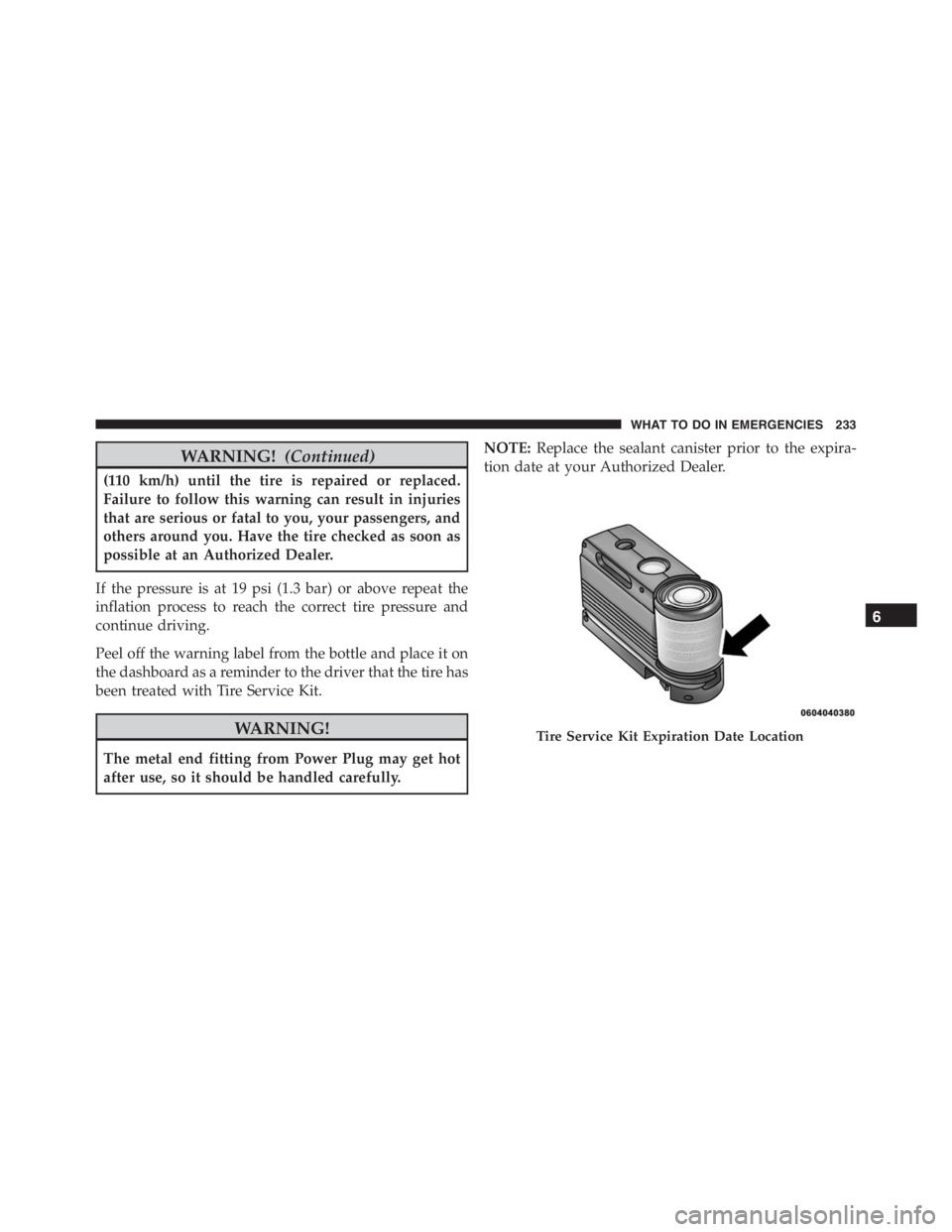
after use, so it should be handled carefully.NOTE:Replace the sealant canister prior to the expira-
tion date at your Authorized Dealer.
Tire Service Kit Expiration Date Location
6
WHAT TO DO IN EMERGENCIES 233
Page 316 of 348
Change Engine Oil at 4000 miles (6,500 km) if the vehicle
is operated in a dusty and off road environment. This
type of vehicle use is considered Severe Duty.
If the vehicle is operated in a dusty or dirty environment
the engine air filter has to be changed every 6500 miles
(10,000 km).
Once A Month Or Before A Long Trip/Periodic Checks
Every 600 miles (1,000 km) or before long trips, check
and, if necessary, top off the following:
•Check engine oil level
•Check brake fluid level
•Check windshield washer fluid level•Check the tire inflation pressures and look for unusual
wear or damage
•Check the fluid levels of the coolant reservoir and
brake master cylinder reservoir, and add as needed
•Check function of all interior and exterior lights
•Check screen wash/wipe system and positioning/
wear of windscreen
Every 2000 miles (3000 km) check and, if necessary, top
up: engine oil level
314 MAINTENANCE SCHEDULES
Page 331 of 348
Temperature Grades
The temperature grades are A (the highest), B, and C,
representing the tire’s resistance to the generation of heat
and its ability to dissipate heat, when tested under
controlled conditions on a specified indoor laboratory
test wheel. Sustained high temperature can cause the
material of the tire to degenerate and reduce tire life, and
excessive temperature can lead to sudden tire failure. The
grade C corresponds to a level of performance, which all
passenger car tires must meet under the Federal Motor
Vehicle Safety Standard No. 109. Grades B and A repre-
sent higher levels of performance on the laboratory test
wheel, than the minimum required by law.WARNING!
The temperature grade for this tire is established for
a tire that is properly inflated and not overloaded.
Excessive speed, under-inflation, or excessive load-
ing, either separately or in combination, can cause
heat buildup and possible tire failure.
9
IF YOU NEED CONSUMER ASSISTANCE 329
Page 344 of 348
Snow Tires..............................201
Spare Tire...............................203
Spark Plugs.............................307
Speed Control (Cruise Control)................93
Starting................................154
Automatic Transmission..................154
Cold Weather..........................155
Engine Fails to Start.....................155
Steering
Column Lock...........................92
Tilt Column............................92
Wheel, Tilt.............................92
Storage................................292
Storage, Vehicle...........................292
Storing Your Vehicle.......................292
Stuck, Freeing............................238
Telescoping Steering Column..................92
Tilt Steering Column........................92Tire and Loading Information Placard...........191
Tire Markings............................184
Tires...................................72
Aging (Life of Tires).....................206
Air Pressure...........................196
Chains...............................208
Compact Spare.........................203
General Information.....................196
High Speed...........................199
Inflation Pressures.......................197
Life of Tires...........................206
Load Capacity.........................191
Pressure Monitor System (TPMS)............210
Pressure Warning Light...................112
Quality Grading........................327
Radial...............................199
Replacement...........................206
Rotation..............................209
Safety...............................184
342 INDEX