lock PEUGEOT 5008 2010 Workshop Manual
[x] Cancel search | Manufacturer: PEUGEOT, Model Year: 2010, Model line: 5008, Model: PEUGEOT 5008 2010Pages: 331, PDF Size: 23.41 MB
Page 152 of 331
125
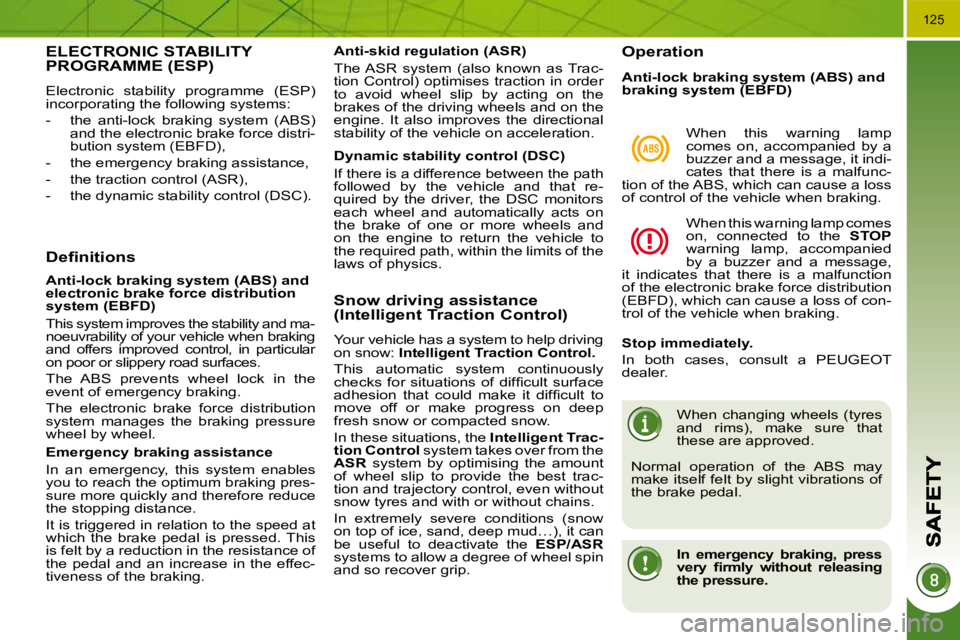
ELECTRONIC STABILITY PROGRAMME (ESP)
Electronic stability programme (ESP)
incorporating the following systems:
- the anti-lock braking system (ABS) and the electronic brake force distri-
bution system (EBFD),
- the emergency braking assistance,
- the traction control (ASR),
- the dynamic stability control (DSC).
Definitions
Anti-skid regulation (ASR)
The ASR system (also known as Trac-
tion Control) optimises traction in order
to avoid wheel slip by acting on the
brakes of the driving wheels and on the
engine. It also improves the directional
stability of the vehicle on acceleration.
Dynamic stability control (DSC)
If there is a difference between the path
followed by the vehicle and that re-
quired by the driver, the DSC monitors
each wheel and automatically acts on
the brake of one or more wheels and
on the engine to return the vehicle to
the required path, within the limits of the
laws of physics.
Emergency braking assistance
In an emergency, this system enables
you to reach the optimum braking pres-
sure more quickly and therefore reduce
the stopping distance.
It is triggered in relation to the speed at
which the brake pedal is pressed. This
is felt by a reduction in the resistance of
the pedal and an increase in the effec-
tiveness of the braking.
Anti-lock braking system (ABS) and
electronic brake force distribution
system (EBFD)
This system improves the stability and ma-
noeuvrability of your vehicle when braking
and offers improved control, in particular
on poor or slippery road surfaces.
The ABS prevents wheel lock in the
event of emergency braking.
The electronic brake force distribution
system manages the braking pressure
wheel by wheel. Operation
When this warning lamp
comes on, accompanied by a
buzzer and a message, it indi-
cates that there is a malfunc-
tion of the ABS, which can cause a loss
of control of the vehicle when braking.
When this warning lamp comes
on, connected to the STOP
warning lamp, accompanied
by a buzzer and a message,
it indicates that there is a malfunction
of the electronic brake force distribution
(EBFD), which can cause a loss of con-
trol of the vehicle when braking.
Stop immediately.
In both cases, consult a PEUGEOT
dealer.
When changing wheels (tyres
and rims), make sure that
these are approved.
Normal operation of the ABS may
make itself felt by slight vibrations of
the brake pedal.
In emergency braking, press
very fi rmly without releasing
the pressure.
Anti-lock braking system (ABS) and
braking system (EBFD)
Snow driving assistance (Intelligent Traction Control)
Your vehicle has a system to help driving
on snow:
Intelligent Traction Control.
This automatic system continuously
checks for situations of diffi cult surface
adhesion that could make it diffi cult to
move off or make progress on deep
fresh snow or compacted snow.
In these situations, the Intelligent Trac-
tion Control system takes over from the
ASR system by optimising the amount
of wheel slip to provide the best trac-
tion and trajectory control, even without
snow tyres and with or without chains.
In extremely severe conditions (snow
on top of ice, sand, deep mud…), it can
be useful to deactivate the ESP/ASR
systems to allow a degree of wheel spin
and so recover grip.
Page 154 of 331
125
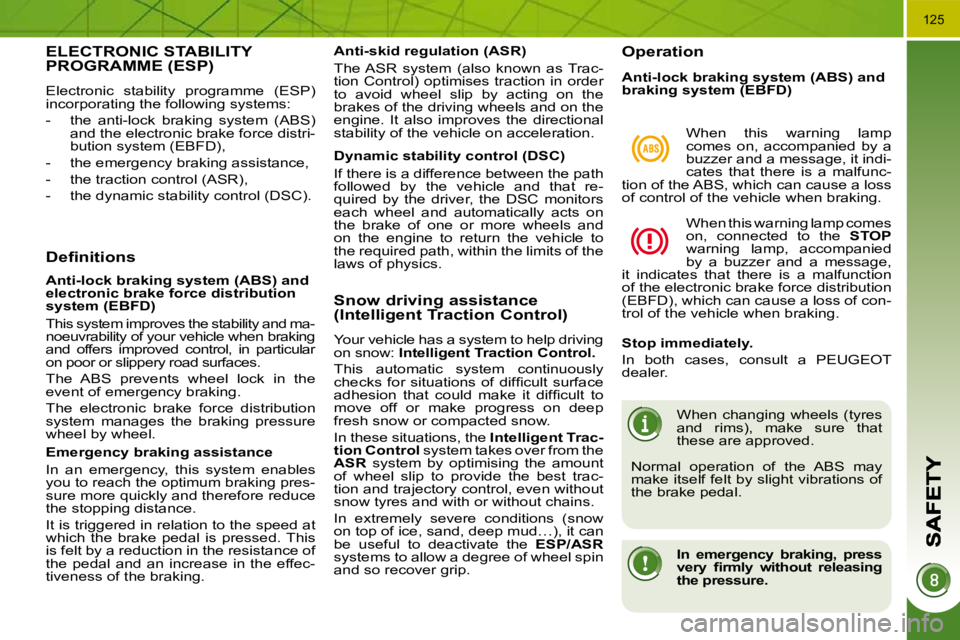
ELECTRONIC STABILITY PROGRAMME (ESP)
Electronic stability programme (ESP)
incorporating the following systems:
- the anti-lock braking system (ABS) and the electronic brake force distri-
bution system (EBFD),
- the emergency braking assistance,
- the traction control (ASR),
- the dynamic stability control (DSC).
Definitions
Anti-skid regulation (ASR)
The ASR system (also known as Trac-
tion Control) optimises traction in order
to avoid wheel slip by acting on the
brakes of the driving wheels and on the
engine. It also improves the directional
stability of the vehicle on acceleration.
Dynamic stability control (DSC)
If there is a difference between the path
followed by the vehicle and that re-
quired by the driver, the DSC monitors
each wheel and automatically acts on
the brake of one or more wheels and
on the engine to return the vehicle to
the required path, within the limits of the
laws of physics.
Emergency braking assistance
In an emergency, this system enables
you to reach the optimum braking pres-
sure more quickly and therefore reduce
the stopping distance.
It is triggered in relation to the speed at
which the brake pedal is pressed. This
is felt by a reduction in the resistance of
the pedal and an increase in the effec-
tiveness of the braking.
Anti-lock braking system (ABS) and
electronic brake force distribution
system (EBFD)
This system improves the stability and ma-
noeuvrability of your vehicle when braking
and offers improved control, in particular
on poor or slippery road surfaces.
The ABS prevents wheel lock in the
event of emergency braking.
The electronic brake force distribution
system manages the braking pressure
wheel by wheel. Operation
When this warning lamp
comes on, accompanied by a
buzzer and a message, it indi-
cates that there is a malfunc-
tion of the ABS, which can cause a loss
of control of the vehicle when braking.
When this warning lamp comes
on, connected to the STOP
warning lamp, accompanied
by a buzzer and a message,
it indicates that there is a malfunction
of the electronic brake force distribution
(EBFD), which can cause a loss of con-
trol of the vehicle when braking.
Stop immediately.
In both cases, consult a PEUGEOT
dealer.
When changing wheels (tyres
and rims), make sure that
these are approved.
Normal operation of the ABS may
make itself felt by slight vibrations of
the brake pedal.
In emergency braking, press
very fi rmly without releasing
the pressure.
Anti-lock braking system (ABS) and
braking system (EBFD)
Snow driving assistance (Intelligent Traction Control)
Your vehicle has a system to help driving
on snow:
Intelligent Traction Control.
This automatic system continuously
checks for situations of diffi cult surface
adhesion that could make it diffi cult to
move off or make progress on deep
fresh snow or compacted snow.
In these situations, the Intelligent Trac-
tion Control system takes over from the
ASR system by optimising the amount
of wheel slip to provide the best trac-
tion and trajectory control, even without
snow tyres and with or without chains.
In extremely severe conditions (snow
on top of ice, sand, deep mud…), it can
be useful to deactivate the ESP/ASR
systems to allow a degree of wheel spin
and so recover grip.
Page 158 of 331
130
The driver must ensure that
passengers use the seat belts
correctly and that they are all
restrained securely before setting off.
Wherever you are seated in the ve-
hicle, always fasten your seat belt,
even for short journeys.
Do not invert the seat belt buckles as
they will not fulfi l their role fully.
The seat belts are fi tted with an in-
ertia reel permitting automatic adjust-
ment of the length of the strap to your
size. The seat belt is stored automat-
ically when not in use.
Before and after use, ensure that the
seat belt is reeled in correctly.
The lower part of the strap must be
positioned as low as possible on the
pelvis.
The upper part must be positioned in
the hollow of the shoulder.
The inertia reels are fi tted with an auto-
matic locking device which comes into
operation in the event of a collision,
emergency braking or if the vehicle
rolls over. You can release the device
by pulling fi rmly on the strap and re-
leasing it so that it re-winds slightly. In order to be effective, a seat belt
must:
- be tightened as close to the body
as possible,
- be pulled in front of you with a smooth movement, checking that
it does not twist,
-
be used to restrain only one person,
- not bear any trace of cuts or fraying,
- not be converted or modifi ed to avoid affecting its performance.
In accordance with current safety
regulations, all repairs and checks
must be carried out by a PEUGEOT
dealer who guarantees that the work
is carried out correctly.
Have your seat belts checked regu-
larly by a PEUGEOT dealer and par-
ticularly if the straps show signs of
damage.
Clean the seat belt straps with soapy
water or a textile cleaning product,
sold by PEUGEOT dealers.
After folding or moving a seat or rear
bench seat, ensure that the seat belt
is positioned and reeled in correctly. Recommendations for children
Use a suitable child seat if the pas-
senger is less than 12 years old or
shorter than one and a half metres.
Never use the same seat belt to secure
more than one person. Never allow a child to travel on your lap.
In the event of an impact
Depending on the nature and se-
riousness of the impacts , the pre-
tensioning device may be triggered
before and independently of the air-
bags. Triggering of the pre-tensioners
is accompanied by a slight discharge
of harmless smoke and a noise, due
to the activation of the pyrotechnic
cartridge incorporated in the system.
In all cases, the airbag warning lamp
comes on.
Following an impact, have the seat
belts system checked, and if neces-
sary replaced, by a PEUGEOT dealer.
Page 168 of 331
139
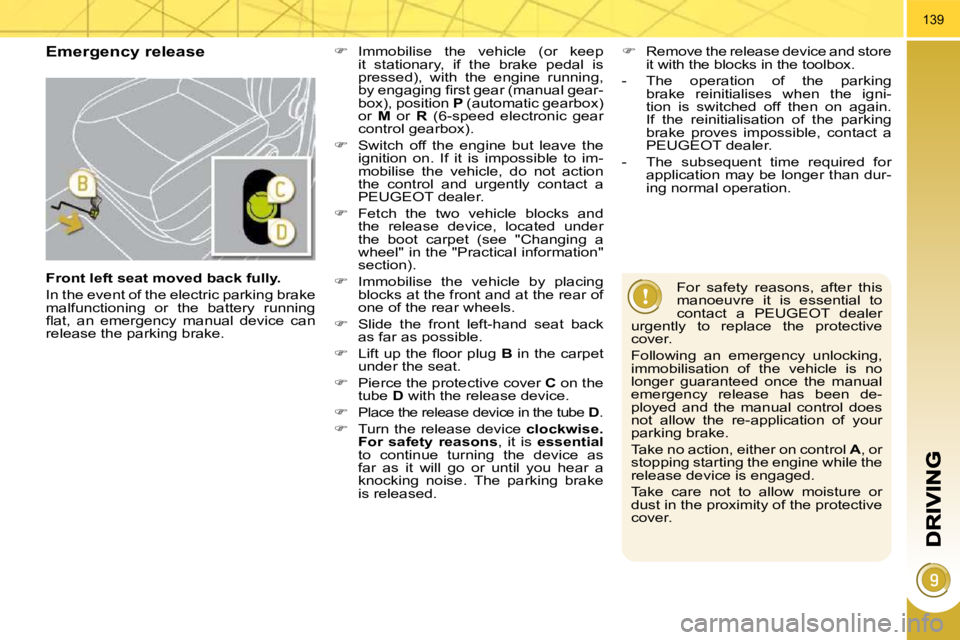
Emergency release
For safety reasons, after this
manoeuvre it is essential to
contact a PEUGEOT dealer
urgently to replace the protective
cover.
Following an emergency unlocking,
immobilisation of the vehicle is no
longer guaranteed once the manual
emergency release has been de-
ployed and the manual control does
not allow the re-application of your
parking brake.
Take no action, either on control A , or
stopping starting the engine while the
release device is engaged.
Take care not to allow moisture or
dust in the proximity of the protective
cover.
Immobilise the vehicle (or keep
it stationary, if the brake pedal is
pressed), with the engine running,
by engaging fi rst gear (manual gear-
box), position P (automatic gearbox)
or M or R (6-speed electronic gear
control gearbox).
Switch off the engine but leave the
ignition on. If it is impossible to im-
mobilise the vehicle, do not action
the control and urgently contact a
PEUGEOT dealer.
Fetch the two vehicle blocks and
the release device, located under
the boot carpet (see "Changing a
wheel" in the "Practical information"
section).
Immobilise the vehicle by placing
blocks at the front and at the rear of
one of the rear wheels.
Slide the front left-hand seat back
as far as possible.
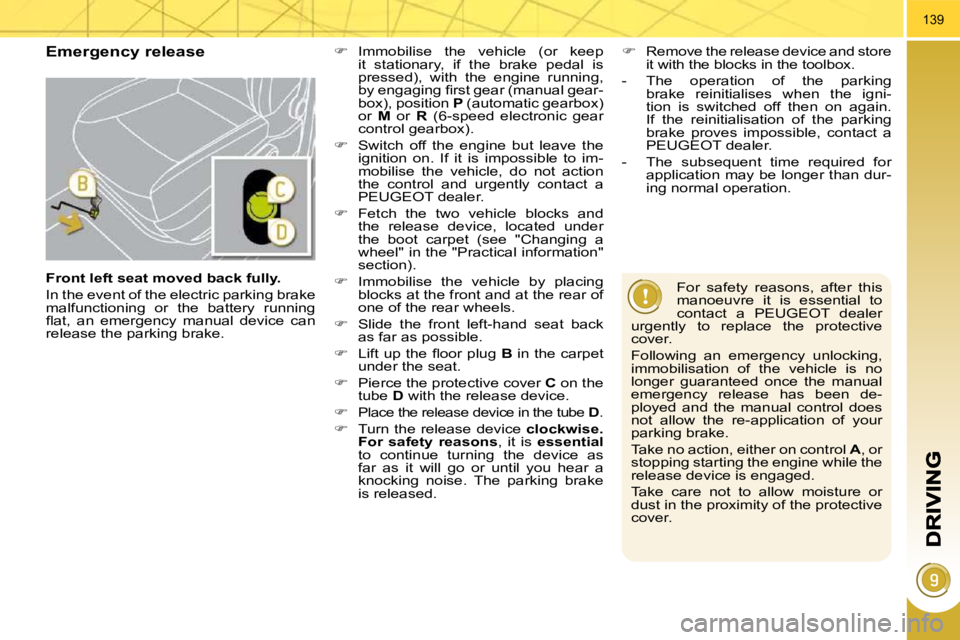
Lift up the fl oor plug B in the carpet
under the seat.
Pierce the protective cover C on the
tube D with the release device.
Place the release device in the tube D .
Turn the release device clockwise.
For safety reasons , it is essential
to continue turning the device as
far as it will go or until you hear a
knocking noise. The parking brake
is released.
Remove the release device and store
it with the blocks in the toolbox.
- The operation of the parking brake reinitialises when the igni-
tion is switched off then on again.
If the reinitialisation of the parking
brake proves impossible, contact a
PEUGEOT dealer.
- The subsequent time required for application may be longer than dur-
ing normal operation.
Front left seat moved back fully.
In the event of the electric parking brake
malfunctioning or the battery running
fl at, an emergency manual device can
release the parking brake.
Page 173 of 331
139
Emergency release
For safety reasons, after this
manoeuvre it is essential to
contact a PEUGEOT dealer
urgently to replace the protective
cover.
Following an emergency unlocking,
immobilisation of the vehicle is no
longer guaranteed once the manual
emergency release has been de-
ployed and the manual control does
not allow the re-application of your
parking brake.
Take no action, either on control A , or
stopping starting the engine while the
release device is engaged.
Take care not to allow moisture or
dust in the proximity of the protective
cover.
Immobilise the vehicle (or keep
it stationary, if the brake pedal is
pressed), with the engine running,
by engaging fi rst gear (manual gear-
box), position P (automatic gearbox)
or M or R (6-speed electronic gear
control gearbox).
Switch off the engine but leave the
ignition on. If it is impossible to im-
mobilise the vehicle, do not action
the control and urgently contact a
PEUGEOT dealer.
Fetch the two vehicle blocks and
the release device, located under
the boot carpet (see "Changing a
wheel" in the "Practical information"
section).
Immobilise the vehicle by placing
blocks at the front and at the rear of
one of the rear wheels.
Slide the front left-hand seat back
as far as possible.
Lift up the fl oor plug B in the carpet
under the seat.
Pierce the protective cover C on the
tube D with the release device.
Place the release device in the tube D .
Turn the release device clockwise.
For safety reasons , it is essential
to continue turning the device as
far as it will go or until you hear a
knocking noise. The parking brake
is released.
Remove the release device and store
it with the blocks in the toolbox.
- The operation of the parking brake reinitialises when the igni-
tion is switched off then on again.
If the reinitialisation of the parking
brake proves impossible, contact a
PEUGEOT dealer.
- The subsequent time required for application may be longer than dur-
ing normal operation.
Front left seat moved back fully.
In the event of the electric parking brake
malfunctioning or the battery running
fl at, an emergency manual device can
release the parking brake.
Page 176 of 331
144
In certain extreme weather
conditions (rain and/or snow,
bright sunshine, ...) the head-
up display may not be legible or may
suffer temporary interference.
Certain glasses (sunglasses, specta-
cles or polarised lenses) may hamper
reading of the information.
To clean the transparent strip, which
is made of organic glass, use a clean,
soft cloth (such as a spectacles cloth
or microfi bre cloth). Do not use a dry
or abrasive cloth or detergent or sol-
vent products as these could scratch
the strip or damage the anti-refl ection
coating. We recommend that adjust-
ments are only made using
these buttons when the vehi-
cle is stationary.
When stationary or while driving, no
objects should be placed around the
transparent strip (or on its cover) to
avoid blocking the strip output and
preventing its correct operation.
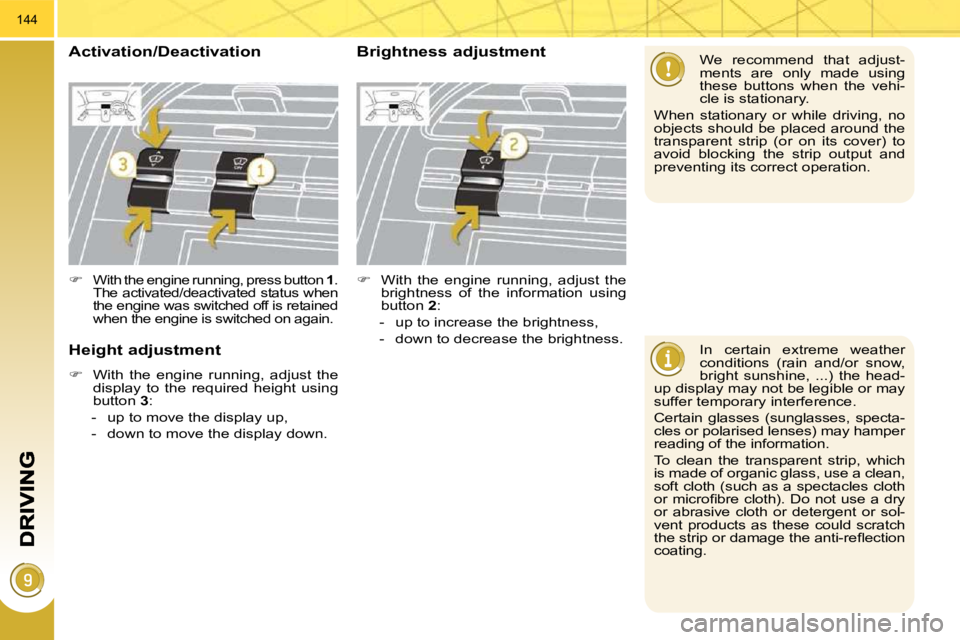
With the engine running, press button 1 .
The activated/deactivated status when
the engine was switched off is retained
when the engine is switched on again.
Height adjustment
With the engine running, adjust the
display to the required height using
button 3 :
- up to move the display up,
- down to move the display down.
Activation/Deactivation Brightness adjustment
With the engine running, adjust the
brightness of the information using
button 2 :
- up to increase the brightness,
- down to decrease the brightness.
Page 190 of 331
158
Stopping the vehicle
Before switching off the engine, you
can engage position P or N to place the
gearbox in neutral.
In both cases, apply the parking brake
to immobilise the vehicle, unless it is
programmed to automatic mode.
Operating fault
When the ignition is on, the
lighting of this warning lamp,
accompanied by an audible
signal and a message on the
multifunction screen, indicates
a gearbox malfunction.
In this case, the gearbox switches to
back-up mode and is locked in 3rd gear.
You may feel a substantial knock when
changing from P to R and from N to R .
This will not cause any damage to the
gearbox.
Do not exceed 60 mph (100 km/h), local
speed restrictions permitting.
Have it checked by a PEUGEOT dealer.
This warning lamp may also come on if
a door is opened.
You risk damaging the gearbox:
- if you press the accelera-tor and brake pedals at the
same time,
- if you force the lever from posi- tion P to another position when
the battery is fl at.
To reduce fuel consumption when
stationary for long periods with the
engine running (traffi c jam...), posi-
tion the gear lever at N and apply
the parking brake, unless it is pro-
grammed in automatic mode.
Manual operation
Select position M for sequential
changing of the six gears.
Push the lever towards the + sign to
change up a gear.
Pull the lever towards the - sign to
change down a gear.
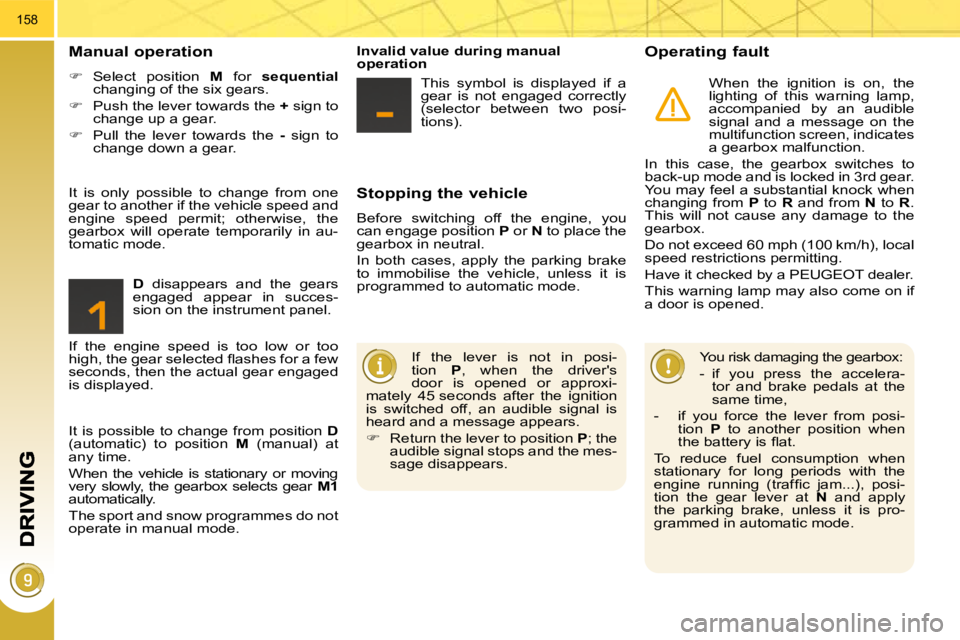
D disappears and the gears
engaged appear in succes-
sion on the instrument panel.
If the lever is not in posi-
tion P , when the driver's
door is opened or approxi-
mately 45 seconds after the ignition
is switched off, an audible signal is
heard and a message appears.
Return the lever to position P ; the
audible signal stops and the mes-
sage disappears.
It is only possible to change from one
gear to another if the vehicle speed and
engine speed permit; otherwise, the
gearbox will operate temporarily in au-
tomatic mode.
Invalid value during manual
operation
This symbol is displayed if a
gear is not engaged correctly
(selector between two posi-
tions).
It is possible to change from position D
(automatic) to position M (manual) at
any time.
When the vehicle is stationary or moving
very slowly, the gearbox selects gear M1
automatically.
The sport and snow programmes do not
operate in manual mode.
If the engine speed is too low or too
high, the gear selected fl ashes for a few
seconds, then the actual gear engaged
is displayed.
Page 191 of 331
159
VISUAL AND AUDIBLE FRONT AND/OR REAR PARKING SENSORS
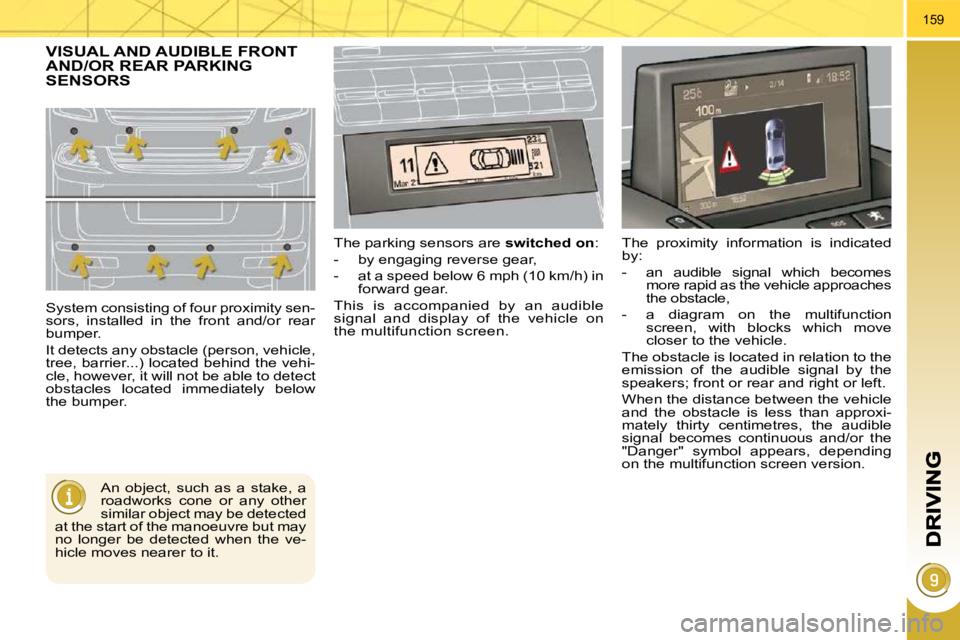
System consisting of four proximity sen-
sors, installed in the front and/or rear
bumper.
It detects any obstacle (person, vehicle,
tree, barrier...) located behind the vehi-
cle, however, it will not be able to detect
obstacles located immediately below
the bumper. The parking sensors are
switched on :
- by engaging reverse gear,
- at a speed below 6 mph (10 km/h) in forward gear.
This is accompanied by an audible
signal and display of the vehicle on
the multifunction screen.
An object, such as a stake, a
roadworks cone or any other
similar object may be detected
at the start of the manoeuvre but may
no longer be detected when the ve-
hicle moves nearer to it. The proximity information is indicated
by:
- an audible signal which becomes
more rapid as the vehicle approaches
the obstacle,
- a diagram on the multifunction screen, with blocks which move
closer to the vehicle.
The obstacle is located in relation to the
emission of the audible signal by the
speakers; front or rear and right or left.
When the distance between the vehicle
and the obstacle is less than approxi-
mately thirty centimetres, the audible
signal becomes continuous and/or the
"Danger" symbol appears, depending
on the multifunction screen version.
Page 220 of 331
PRACTICAL INFORMATION
188
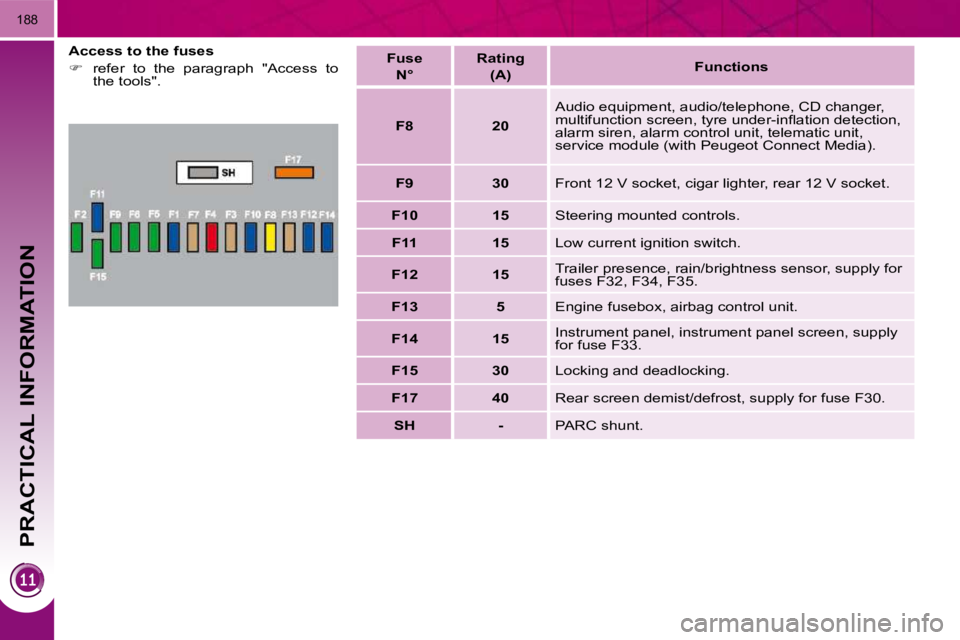
Access to the fuses
refer to the paragraph "Access to
the tools". Fuse
N° Rating
(A) Functions
F8 20 Audio equipment, audio/telephone, CD changer,
multifunction screen, tyre under-infl ation detection,
alarm siren, alarm control unit, telematic unit,
service module (with Peugeot Connect Media).
F9 30 Front 12 V socket, cigar lighter, rear 12 V socket.
F10 15 Steering mounted controls.
F11 15 Low current ignition switch.
F12 15 Trailer presence, rain/brightness sensor, supply for
fuses F32, F34, F35.
F13 5 Engine fusebox, airbag control unit.
F14 15 Instrument panel, instrument panel screen, supply
for fuse F33.
F15 30 Locking and deadlocking.
F17 40 Rear screen demist/defrost, supply for fuse F30.
SH - PARC shunt.
Page 226 of 331
PRACTICAL INFORMATION
194
Do not disconnect the terminals
while the engine is running.
Do not charge the batter-
ies without disconnecting the
terminals fi rst.
Do not push the vehicle to start the
engine if it is fi tted with a 6-speed
electronic gear control gearbox or an
automatic gearbox.
The batteries contain harmful
substances such as sulphuric
acid and lead. They must be dis-
posed of in accordance with regulations
and must not, in any circumstances, be
discarded with household waste.
Take used remote control batteries
and vehicle batteries to a special col-
lection point.
Charging the battery using a
battery charger
Disconnect the battery from the vehicle.
Follow the instructions for use pro-
vided by the manufacturer of the
charger.
Reconnect starting with the negative
terminal (-).
Check that the terminals and con-
nectors are clean. If they are
covered with sulphate (whitish or
greenish deposit), remove them and
clean them.
It is advisable to disconnect
the battery if the vehicle is to
be left unused for more than
one month. Before disconnecting the battery
Wait 2 minutes after switching off the
ignition before disconnecting the battery.
Close the windows and the doors
before disconnecting the battery.
Following reconnection of the
battery
Following reconnection of the battery,
switch on the ignition and wait 1 minute
before starting to permit initialisation of
the electronic systems. However, if prob-
lems remain following this operation,
contact a PEUGEOT dealer.
Referring to the corresponding section,
you must yourself reinitialise:
- the remote control key,
- the panoramic sunroof blind,
- the GPS satellite navigation system.
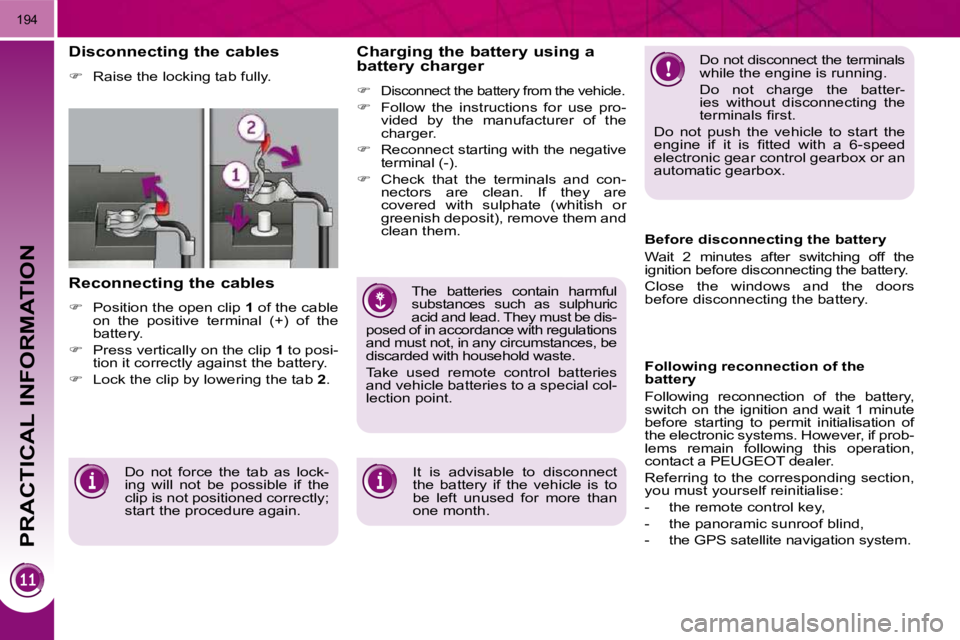
Disconnecting the cables
Raise the locking tab fully.
Reconnecting the cables
Position the open clip 1 of the cable
on the positive terminal (+) of the
battery.
Press vertically on the clip 1 to posi-
tion it correctly against the battery.
Lock the clip by lowering the tab 2 .
Do not force the tab as lock-
ing will not be possible if the
clip is not positioned correctly;
start the procedure again.