engine PEUGEOT 5008 2011.5 Owners Manual
[x] Cancel search | Manufacturer: PEUGEOT, Model Year: 2011.5, Model line: 5008, Model: PEUGEOT 5008 2011.5Pages: 340, PDF Size: 16.4 MB
Page 5 of 340
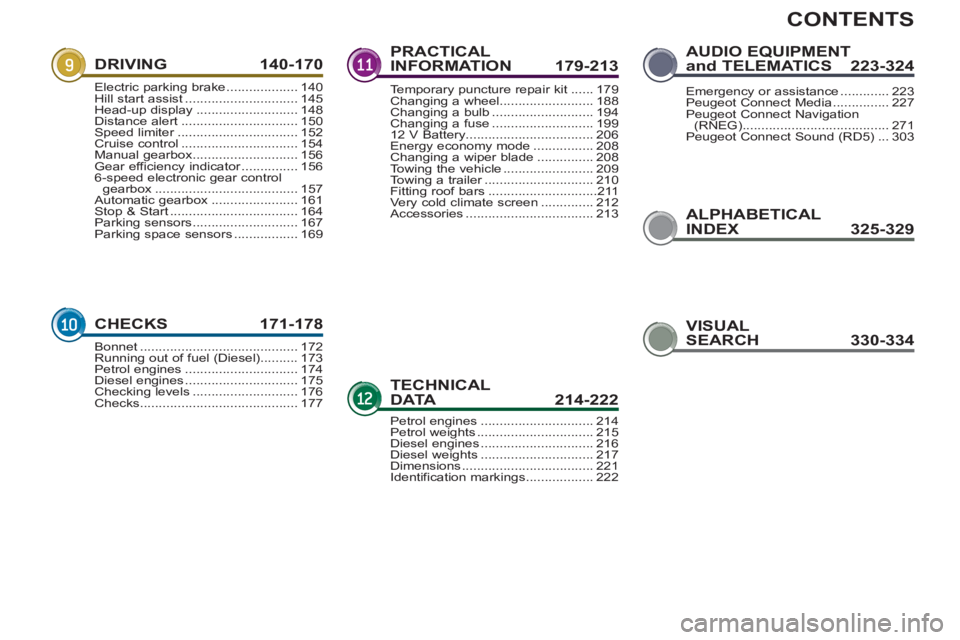
CONTENTS
ALPHABETICAL
INDEX325-329
DRIVING 140-170
CHECKS 171-178
PRACTICAL
INFORMATION 179-213
TECHNICAL DATA 214-222
AUDIO EQUIPMENTand TELEMATICS 223-324
Electric parking brake...................140Hill start assist..............................145Head-up display...........................148Distance alert ...............................150Speed limiter................................r152Cruise control...............................154Manual gearbox ............................156Gear efficiency indicator...............r1566-speed electronic gear control gearbox......................................157Automatic gearbox.......................161Stop & Start ..................................164Parking sensors ............................167Parking space sensors.................169
Bonnet ..........................................172Running out of fuel (Diesel)..........173Petrol engines ..............................174Diesel engines..............................175Checking levels............................176Checks..........................................177
Temporary puncture repair kit......179Changing a wheel.........................188Changing a bulb...........................194Changing a fuse ...........................19912 V Battery..................................206Energy economy mode................208Changing a wiper blade...............208Towing the vehicle ........................209Towing a trailer.............................r210Fitting roof bars.............................211Very cold climate screen..............212Accessories..................................213
Petrol engines..............................214Petrol weights...............................215Diesel engines ..............................216Diesel weights ..............................217Dimensions ...................................221Identification markings..................222
Emergency or assistance.............223Peugeot Connect Media ...............227Peugeot Connect Navigation(RNEG).......................................271Peugeot Connect Sound (RD5)...303
VISUAL
SEARCH330-334
Page 6 of 340
FA
M
4
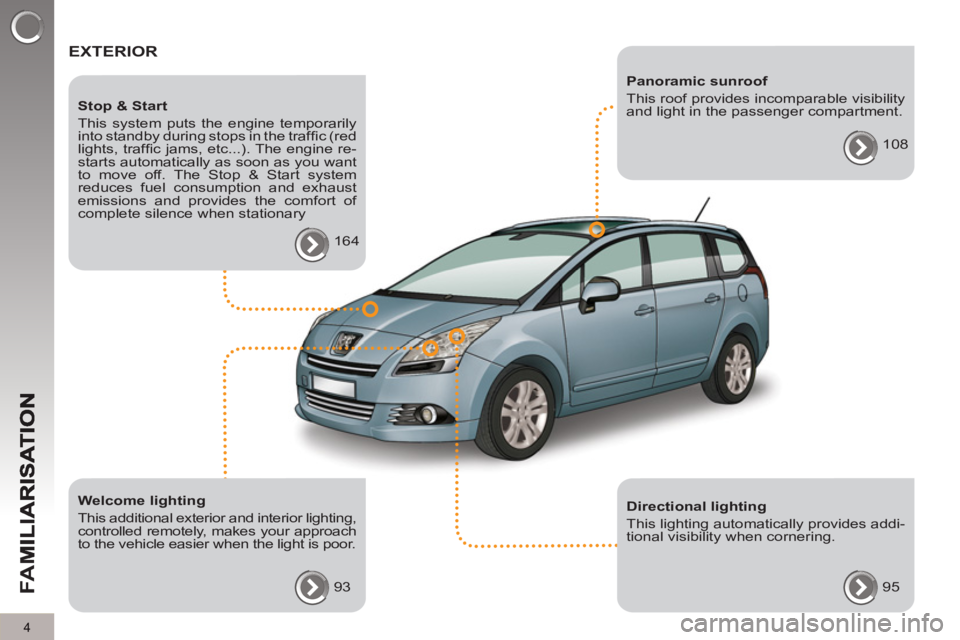
EXTERIOR
Welcome lighting
This additional exterior and interior lighting,
controlled remotely, makes your approach
to the vehicle easier when the light is poor.
93
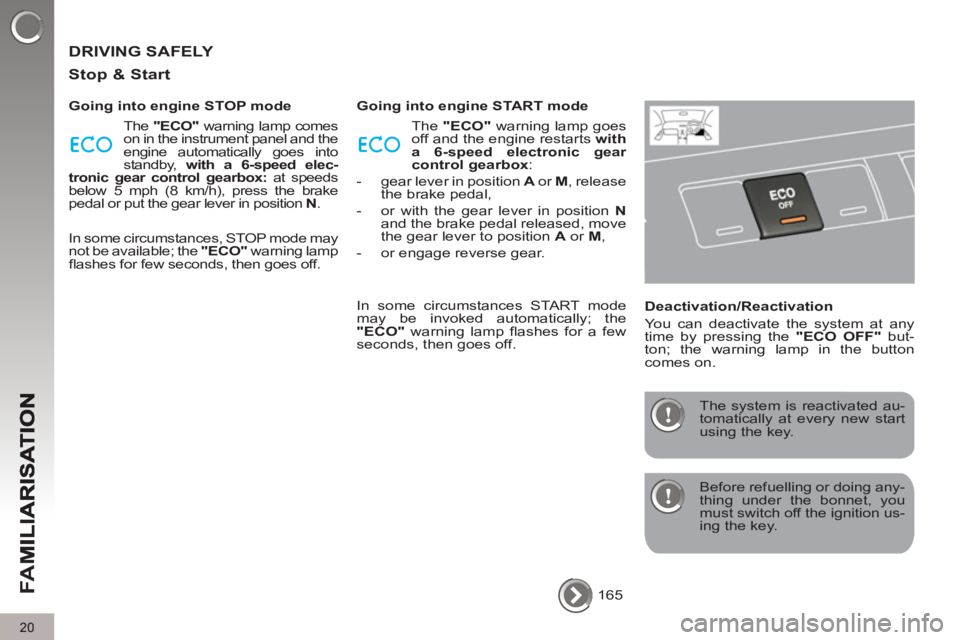
Stop & Start
This system puts the engine temporarily
into standby during stops in the traffi c (red
lights, traffi c jams, etc...). The engine re-
starts automatically as soon as you want
to move off. The Stop & Start system
reduces fuel consumption and exhaust
emissions and provides the comfort of
complete silence when stationary
164
Directional lighting
This lighting automatically provides addi-
tional visibility when cornering.
95
Panoramic sunroof
This roof provides incomparable visibility
and light in the passenger compartment.
108
Page 10 of 340
FA
M
8
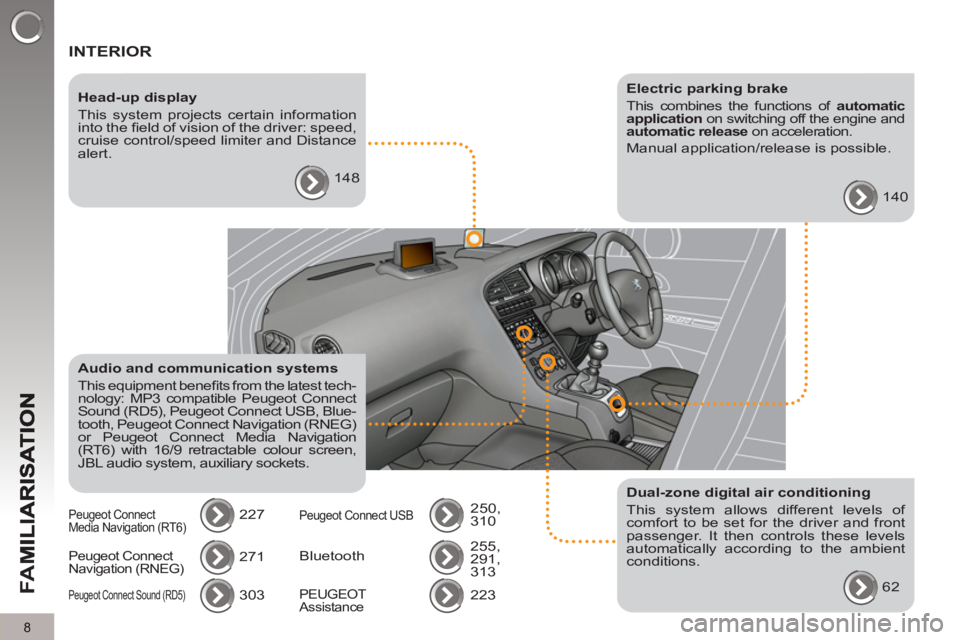
INTERIOR
Electric parking brake
This combines the functions of automatic
application
on switching off the engine and
automatic release
on acceleration.
Manual application/release is possible.
140
Audio and communication systems
This equipment benefi ts from the latest tech-
nology: MP3 compatible Peugeot Connect
Sound (RD5), Peugeot Connect USB, Blue-
tooth, Peugeot Connect Navigation (RNEG)
or Peugeot Connect Media Navigation
(RT6) with 16/9 retractable colour screen,
JBL audio system, auxiliary sockets.
227
Head-up display
This system projects certain information
into the fi eld of vision of the driver: speed,
cruise control/speed limiter and Distance
alert.
148
Dual-zone digital air conditioning
This system allows different levels of
comfort to be set for the driver and front
passenger. It then controls these levels
automatically according to the ambient
conditions.
62
Peugeot Connect
Navigation (RNEG) 271
303
Peugeot Connect Sound (RD5)
Peugeot Connect
Media Navigation (RT6) Peugeot Connect USB
250,
310
Bluetooth 255,
291,
313
PEUGEOT
Assistance 223
Page 18 of 340
FA
M
16
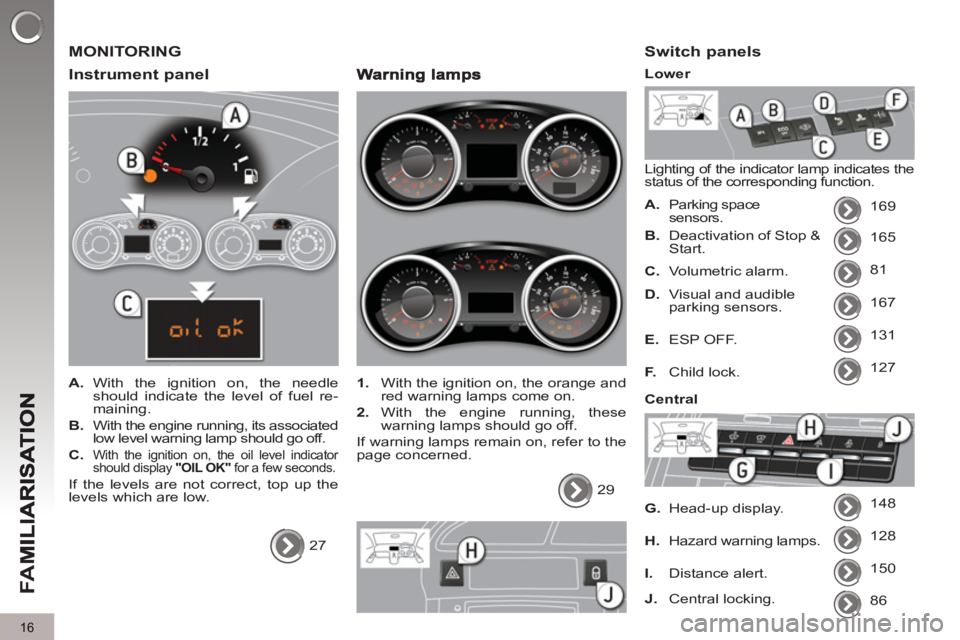
MONITORING
Instrument
panel
A.
With the ignition on, the needle
should indicate the level of fuel re-
maining.
B.
With the engine running, its associated
low level warning lamp should go off.
C.
With the ignition on, the oil level indicator
should display "OIL OK"
for a few seconds.
If the levels are not correct, top up the
levels which are low.
27
1.
With the ignition on, the orange and
red warning lamps come on.
2.
With the engine running, these
warning lamps should go off.
If warning lamps remain on, refer to the
page concerned.
29
Switch panels
Lighting of the indicator lamp indicates the
status of the corresponding function.
A.
Parking space
sensors. 169
165
81
167
131
127
148
128
B.
Deactivation of Stop &
Start.
C.
Volumetric alarm.
D.
Visual and audible
parking sensors.
E.
ESP OFF.
F.
Child lock.
G.
Head-up display.
H.
Hazard warning lamps.
Lower
Central
150
I.
Distance alert.
86
J.
Central locking.
Page 22 of 340
FA
M
20
DRIVING SAFELY
Sto
p & Start
Going into engine STOP mode
The "ECO"
warning lamp comes
on in the instrument panel and the
engine automatically goes into
standby, with a 6-speed elec-
tronic gear control gearbox: at speeds
below 5 mph (8 km/h), press the brake
pedal or put the gear lever in position N
.
In some circumstances, STOP mode may
not be available; the "ECO"
warning lamp
fl ashes for few seconds, then goes off.
Going into engine START mode
The "ECO" warning lamp goes
off and the engine restarts with
a 6-speed electronic gear
control gearbox
:
- gear lever in position A
or M
, release
the brake pedal,
- or with the gear lever in position N
and the brake pedal released, move
the gear lever to position A
or M
,
- or engage reverse gear.
In some circumstances START mode
may be invoked automatically; the
"ECO"
warning lamp fl ashes for a few
seconds, then goes off.
Deactivation/Reactivation
You can deactivate the system at any
time by pressing the "ECO OFF"
but-
ton; the warning lamp in the button
comes on.
Before refuelling or doing any-
thing under the bonnet, you
must switch off the ignition us-
ing the key.
The system is reactivated au-
tomatically at every new start
using the key.
165
Page 23 of 340
FA
M
21
DRIVING SAFELY
Electric parkin
g brake
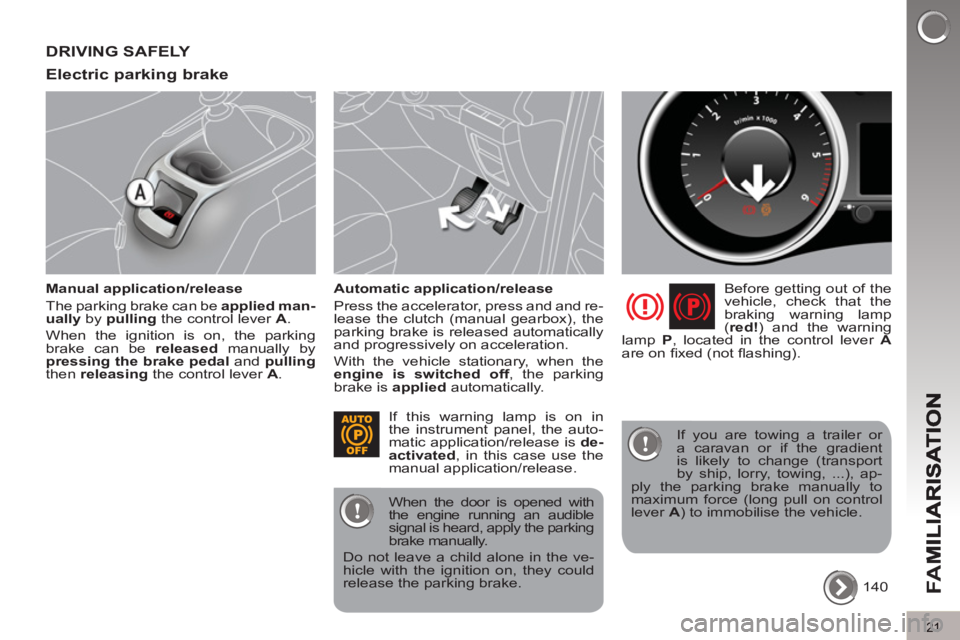
Manual application/release
The parking brake can be applied man-
ually
by pulling
the control lever A
.
When the ignition is on, the parking
brake can be released
manually by
pressing the brake pedal
and pulling
then releasing
the control lever A
.
Automatic application/release
Press the accelerator, press and and re-
lease the clutch (manual gearbox), the
parking brake is released automatically
and progressively on acceleration.
With the vehicle stationary, when the
engine is switched off
, the parking
brake is applied
automatically.
Before getting out of the
vehicle, check that the
braking warning lamp
( red!
) and the warning
lamp P
, located in the control lever A
are on fi xed (not fl ashing).
140 If this warning lamp is on in
the instrument panel, the auto-
matic application/release is de-
activated
, in this case use the
manual application/release.
When the door is opened with
the engine running an audible
signal is heard, apply the parking
brake manually.
Do not leave a child alone in the ve-
hicle with the ignition on, they could
release the parking brake.
If you are towing a trailer or
a caravan or if the gradient
is likely to change (transport
by ship, lorry, towing, ...), ap-
ply the parking brake manually to
maximum force (long pull on control
lever A
) to immobilise the vehicle.
Page 24 of 340
FA
M
22
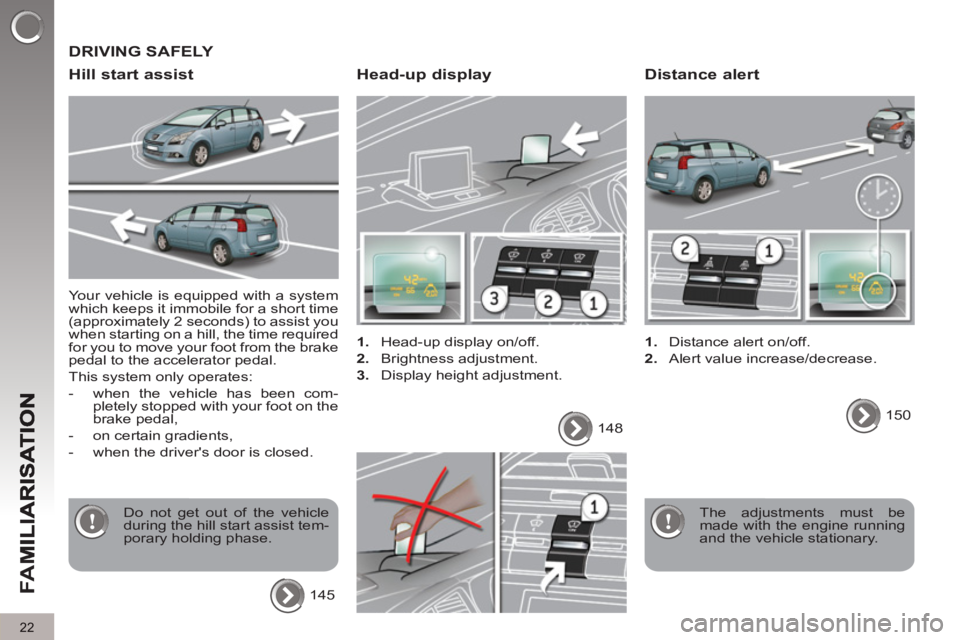
Your vehicle is equipped with a system
which keeps it immobile for a short time
(approximately 2 seconds) to assist you
when starting on a hill, the time required
for you to move your foot from the brake
pedal to the accelerator pedal.
This system only operates:
- when the vehicle has been com-
pletely stopped with your foot on the
brake pedal,
- on certain gradients,
- when the driver's door is closed.
Do not get out of the vehicle
during the hill start assist tem-
porary holding phase.
145
DRIVING SAFELY
Head-up displa
y
1.
Head-up display on/off.
2.
Brightness adjustment.
3.
Display height adjustment.
The adjustments must be
made with the engine running
and the vehicle stationary. 148
Distance alert
1.
Distance alert on/off.
2.
Alert value increase/decrease.
150
Hill start assist
Page 25 of 340
FA
M
23
DRIVING SAFELY
S
peed limiter "LIMIT"
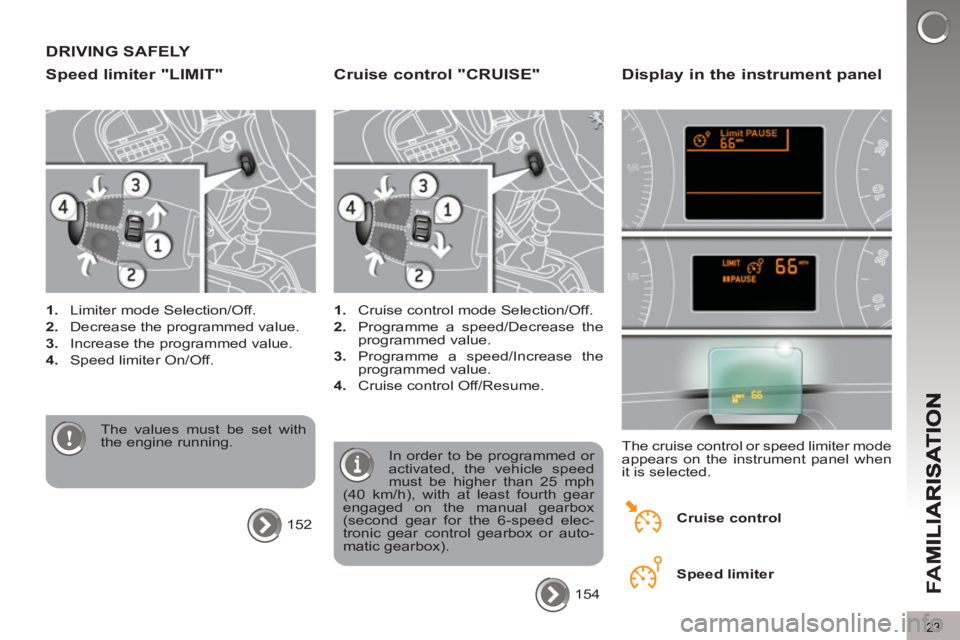
1.
Limiter mode Selection/Off.
2.
Decrease the programmed value.
3.
Increase the programmed value.
4.
Speed limiter On/Off.
The values must be set with
the engine running.
152
Cruise control "CRUISE"
1.
Cruise control mode Selection/Off.
2.
Programme a speed/Decrease the
programmed value.
3.
Programme a speed/Increase the
programmed value.
4.
Cruise control Off/Resume.
In order to be programmed or
activated, the vehicle speed
must be higher than 25 mph
(40 km/h), with at least fourth gear
engaged on the manual gearbox
(second gear for the 6-speed elec-
tronic gear control gearbox or auto-
matic gearbox).
154
Display in the instrument panel
The cruise control or speed limiter mode
appears on the instrument panel when
it is selected.
Cruise control
Speed limiter
Page 26 of 340
FA
M
24
157
DRIVING SAFELY
6-speed electronic
gear control gearbox
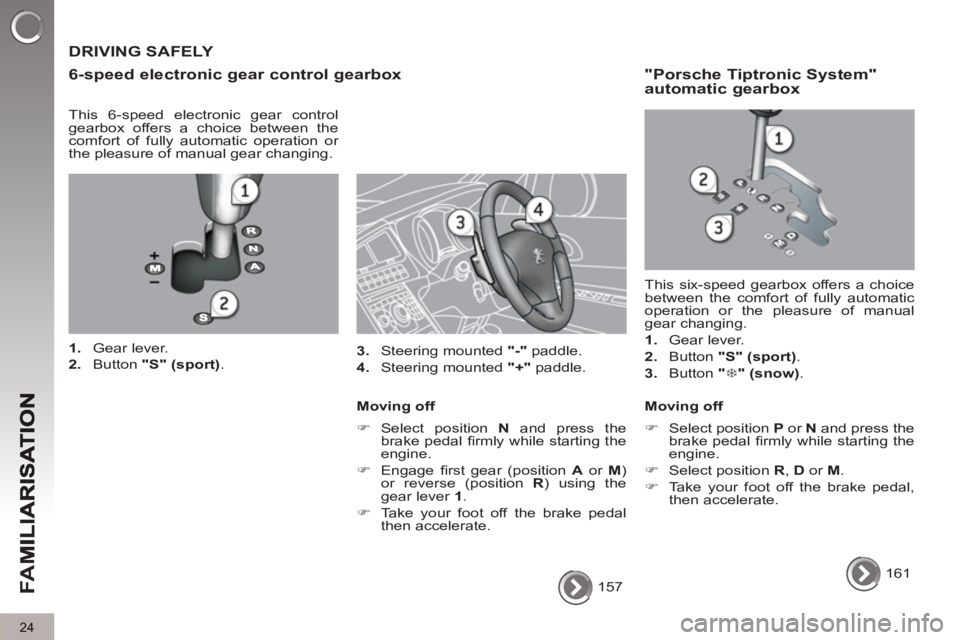
This 6-speed electronic gear control
gearbox offers a choice between the
comfort of fully automatic operation or
the pleasure of manual gear changing.
1.
Gear lever.
2.
Button "S" (sport)
.
"Porsche Tiptronic System" automatic gearbox
This six-speed gearbox offers a choice
between the comfort of fully automatic
operation or the pleasure of manual
gear changing.
1.
Gear lever.
2.
Button "S" (sport)
.
3.
Button " 7
" (snow)
.
Moving off
)
Select position N
and press the
brake pedal fi rmly while starting the
engine.
)
Engage fi rst gear (position A
or M
)
or reverse (position R
) using the
gear lever 1
.
)
Take your foot off the brake pedal
then accelerate.
)
Select position P
or N
and press the
brake pedal fi rmly while starting the
engine.
)
Select position R
, D
or M
.
)
Take your foot off the brake pedal,
then accelerate.
3.
Steering mounted "-"
paddle.
4.
Steering mounted "+"
paddle.
161
Moving off
Page 27 of 340
Optimise the use of your gearbox
With a manual gearbox, move off gently,
change up without waiting and drive by
changing up quite soon. If your vehicle
has the system, the gear effi ciency indi-
cator invites you to change up; it is dis-
played in the instrument panel, follow its
instructions.
With an automatic or electronic gear-
box, stay in Drive "D"
or Auto "A"
, ac-
cording to the type of gearbox, without
pressing the accelerator pedal heavily
or suddenly.
Drive smoothly
Maintain a safe distance between ve-
hicles, use engine braking rather than
the brake pedal, and press the accel-
erator progressively. These practices
contribute towards a reduction in fuel
consumption and CO
2 emissions and
also helps reduce the background traf-
fi c noise.
If your vehicle has cruise control, make
use of the system at speeds above 25 mph
(40 km/h) when the traffi c is fl owing well.
Control the use of your electrical equipment
Before moving off, if the passenger
compartment is too warm, ventilate it by
opening the windows and air vents be-
fore using the air conditioning.
Above 30 mph (50 km/h), close the win-
dows and leave the air vents open.
Remember to make use of equipment
that can help keep the temperature in
the passenger compartment down (sun
roof and window blinds...).
Switch off the air conditioning, unless
it has automatic digital regulation, as
soon as the desired temperature is at-
tained.
Switch off the demisting and defrosting
controls, if not automatic.
Switch off the heated seat as soon as
possible.
Switch off the headlamps and front
foglamps when the level of light does
not require their use.
Avoid running the engine before moving
off, particularly in winter; your vehicle will
warm up much faster while driving.
As a passenger, if you avoid connect-
ing your multimedia devices (fi lm, music,
video game...), you will contribute towards
limiting the consumption of electrical en-
ergy, and so of fuel.
Disconnect your portable devices be-
fore leaving the vehicle.
ECO-DRIVING
2525
Eco-driving is a range of everyday practices that allow the motorist to optimise their fuel consumption and CO2 emissions.