ESP PEUGEOT 5008 2013.5 Owner's Manual
[x] Cancel search | Manufacturer: PEUGEOT, Model Year: 2013.5, Model line: 5008, Model: PEUGEOT 5008 2013.5Pages: 404, PDF Size: 23.45 MB
Page 130 of 404
Fittings
128
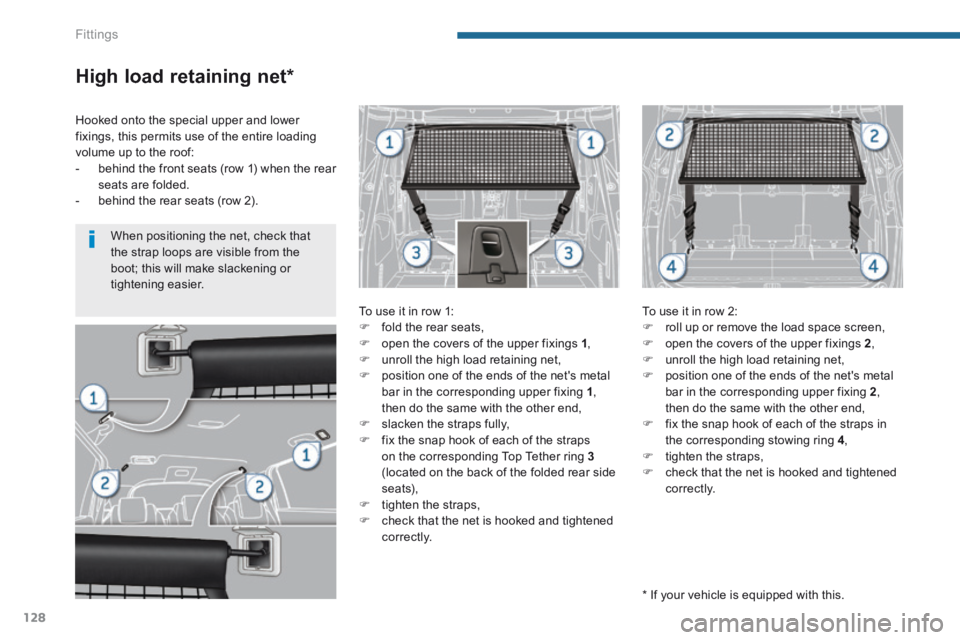
High load retaining net *
To use it in row 1: fold the rear seats, open the covers of the upper fixings 1 , unroll the high load retaining net, position one of the ends of the net's metal bar in the corresponding upper fixing 1 , then do the same with the other end, slacken the straps fully, fix the snap hook of each of the straps on the corresponding Top Tether ring 3(located on the back of the folded rear side seats), tighten the straps, check that the net is hooked and tightened
c o r r e c t l y.
To use it in row 2: roll up or remove the load space screen, open the covers of the upper fixings 2 , unroll the high load retaining net, position one of the ends of the net's metal bar in the corresponding upper fixing 2 , then do the same with the other end, fix the snap hook of each of the straps in the corresponding stowing ring 4 , tighten the straps, check that the net is hooked and tightened c o r r e c t l y.
Hooked onto the special upper and lower fixings, this permits use of the entire loading volume up to the roof: - behind the front seats (row 1) when the rear seats are folded. - behind the rear seats (row 2).
* If your vehicle is equipped with this.
When positioning the net, check that the strap loops are visible from the boot; this will make slackening or tightening easier.
Page 137 of 404
7
AR
BG
НИКОГА НЕ инсталирайте детско столче на седалка с АКТИВИРАНА предна ВЪЗДУШНА ВЪЗГЛАВНИЦ А. Това можеда причини
СМЪРТ или СЕРИОЗНО НАРАНЯВАНЕ на детето.
CSNIKDY neumisťujte dětské zádržné zařízení orientované směrem dozadu na sedadlo chráněné AKTIVOVANÝM čelním AIRBAGEM. Hrozí
nebezpečí SMRTI DÍTĚTE nebo VÁ ŽNÉHO ZR ANĚNÍ.
DABrug aldrig en bagudvendt barnestol på et sæde der er beskyttet af en aktiv airbag. Død eller alvorlig skade på barnet kan forekomme.
DEVer wenden Sie NIEMALS einen Kindersitz oder Babyschale gegen die Fahr trichtung bei AKTIVIERTEM Airbag, TOD oder ERNSTHAFTE
VERLETZUNGEN können die Folge sein.
ELΜη χρησιμοποιείτε ΠΟΤΕ παιδικό κάθισμα με την πλάτη του προς το εμπρός μέρος του αυτοκινήτου, σε μια θέση που προστατεύεται από
ΜΕΤΩΠΙΚΟ αερόσακο που είναι ΕΝΕΡΓΟΣ. Αυτό μπορεί να έχει σαν συνέπεια το ΘΑΝΑΤΟ ή το ΣΟΒΑΡΟ ΤΡΑΥΜΑΤΙΣΜΟ του ΠΑΙΔΙΟΥ
ENNEVER use a rear ward facing child restraint on a seat protected by an ACTIVE AIRBAG in front of it, DEATH or SERIOUS INJURY to the
CHILD can occur
ESNO INSTALAR NUNCA EL SISTEMA DE RETENCIÓN PAR A NIÑOS DE ESPALDAS AL SENTIDO DE LA CIRCULACIÓN SOBRE UN
ASIENTO PROTEGIDO CON UN COJÍN INFLABLE FRONTAL ( AIRBAG ) ACTIVADO. ESTO PUEDE CAUSAR LA MUERTE DEL BEBE
O HERIRLO GRAVEMENTE.
ETÄrge kasutage kunagi lapse tur vatooli seljaga sõidusuunas sõiduki istmel mis on kaitstud AKTIVEERITUD TURVAPADJAGA. See võib
põhjustada lapsele R ASKEID VIGASTUSI või SURMA.
FIÄLÄ KOSK A AN aseta lapsen tur vaistuinta selkä ajosuuntaan istuimelle, jonka edessä suojana on käyttöön aktivoitu TURVAT Y YNY. Sen
laukeaminen voi aiheuttaa LAPSEN KUOLEMAN tai VAK AVAN LOUKK A ANTUMISEN.
FRNE JAMAIS installer de système de retenue pour enfants faisant face vers l’arrière sur un siège protégé par un COUSSIN GONFLABLE
frontal ACTIVÉ.
Cela peut provoquer la MORT de l’ENFANT ou le BLESSER GR AVEMENT
HRNIK ADA ne postavljati dječju sjedalicu leđima u smjeru vožnje na sjedalo zaštićeno UKLJUČENIM prednjim ZR AČNIM JASTUKOM. To bi
moglo uzrokovati SMRT ili TEŠKU OZLJEDU djeteta.
HUSOHA ne használjon menetiránynak háttal beszerelt gyermekülést olyan ülésen, amely AKTIVÁLT ÁLLAPOTÚ (BEK APCSOLT)
FRONTLÉGZSÁKK AL van védve. Ez a gyermek halálát vagy súlyos sérülését okozhatja.
ITNON installare MAI seggiolini per bambini posizionati in senso contrario a quello di marcia su un sedile protetto da un AIRBAG frontale
ATTIVATO. Ciò potrebbe provocare la MORTE o FERITE GR AVI al bambino.
LTNIEK ADA neįrenkite vaiko prilaikymo priemonės su atgal atgręžtu vaiku ant sėdynės, kuri saugoma VEIKIANČIOS priekinės ORO
PAGALVĖS. Išsiskleidus oro pagalvei vaikas gali būti MIRTINAI arba SUNKIAI TR AUMUOTAS.
Child safety
135
Page 154 of 404
Safety
152
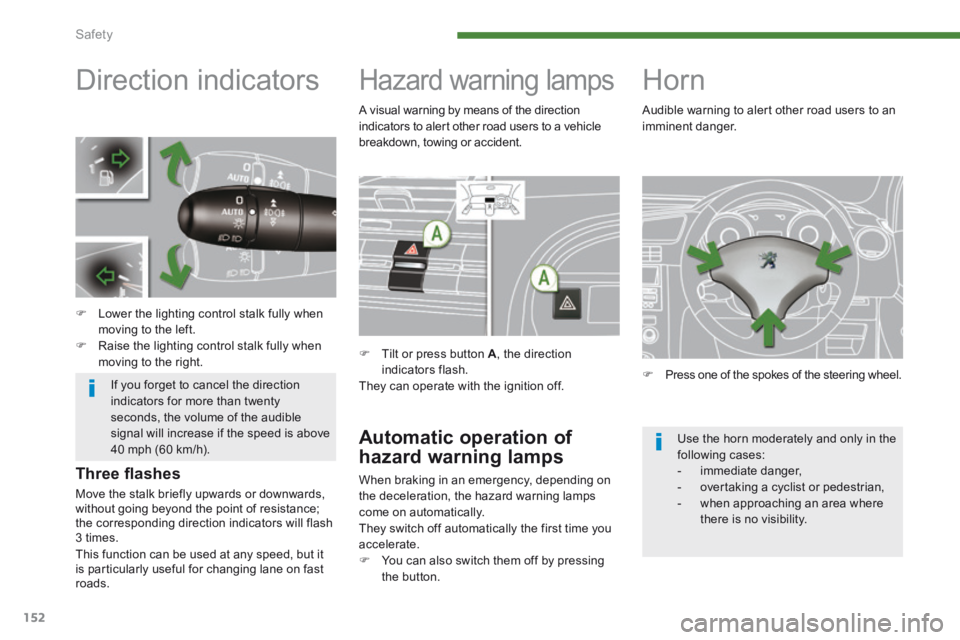
Direction indicators
Lower the lighting control stalk fully when moving to the left. Raise the lighting control stalk fully when moving to the right.
Hazard warning lamps
Tilt or press button A , the direction indicators flash. They can operate with the ignition off.
Automatic operation of
hazard warning lamps
When braking in an emergency, depending on the deceleration, the hazard warning lamps come on automatically. They switch off automatically the first time you accelerate. You can also switch them off by pressing the button.
Horn
Press one of the spokes of the steering wheel.
Audible warning to alert other road users to an imminent danger.
Three fl ashes
Move the stalk briefly upwards or downwards, without going beyond the point of resistance; the corresponding direction indicators will flash 3 times.
Use the horn moderately and only in the following cases: - immediate danger, - overtaking a cyclist or pedestrian, - when approaching an area where there is no visibility.
If you forget to cancel the direction indicators for more than twenty seconds, the volume of the audible signal will increase if the speed is above 40 mph (60 km/h).
A visual warning by means of the direction indicators to alert other road users to a vehicle breakdown, towing or accident.
This function can be used at any speed, but it is particularly useful for changing lane on fast roads.
Page 155 of 404
8
Safety153
Tyre under-infl ation detection
System which automatically checks the pressures of the tyres while driving. The system continuously monitors the pressures of the four tyres, as soon as the vehicle is moving. A pressure sensor is located in the valve of a each tyres (except the spare wheel). The system triggers an alert if a drop in pressure is detected in one or more tyres.
This system does not avoid the need to check the tyre pressures regularly (including the spare wheel) and before a long journey. Driving with under-inflated tyres adversely affects road holding, extends braking distances and causes premature tyre wear, particularly under arduous conditions (vehicle loaded, high speed, long journey).
The tyre pressures for your vehicle can be found on the tyre pressure label (see the "Identification markings" section). The tyre pressures must be checked when the tyres cold (vehicle stopped for 1 hour or after driving for less then 6 miles (10 km) at moderate speed). Other wise, add 0.3 bar to the values indicated on the label.
Driving with under-inflated tyres increases fuel consumption.
The tyre under-inflation detection system is an aid to driving which does
not replace the need for the driver to be vigilant or to drive responsibly.
Page 161 of 404
8
Safety159
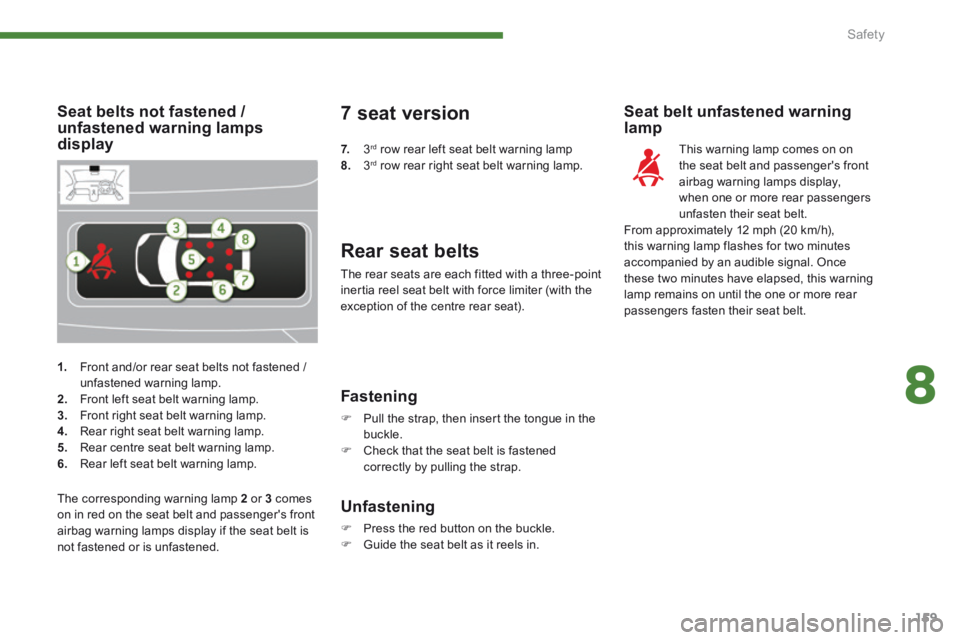
1. Front and/or rear seat belts not fastened / unfastened warning lamp. 2. Front left seat belt warning lamp. 3. Front right seat belt warning lamp. 4. Rear right seat belt warning lamp. 5. Rear centre seat belt warning lamp. 6. Rear left seat belt warning lamp.
Seat belts not fastened / unfastened warning lamps display
Rear seat belts
The rear seats are each fitted with a three-point inertia reel seat belt with force limiter (with the exception of the centre rear seat).
Seat belt unfastened warning lamp
This warning lamp comes on on the seat belt and passenger's front airbag warning lamps display, when one or more rear passengers unfasten their seat belt. From approximately 12 mph (20 km/h), this warning lamp flashes for two minutes accompanied by an audible signal. Once these two minutes have elapsed, this warning lamp remains on until the one or more rear passengers fasten their seat belt.
Fastening
Pull the strap, then insert the tongue in the buckle. Check that the seat belt is fastened correctly by pulling the strap.
Unfastening
Press the red button on the buckle.
Guide the seat belt as it reels in.
The corresponding warning lamp 2 or 3 comes on in red on the seat belt and passenger's front airbag warning lamps display if the seat belt is
not fastened or is unfastened.
7 seat version
7. 3 rd row rear left seat belt warning lamp 8. 3rd row rear right seat belt warning lamp.
Page 162 of 404
Safety
160
Seat belt unfastened warning lamps display
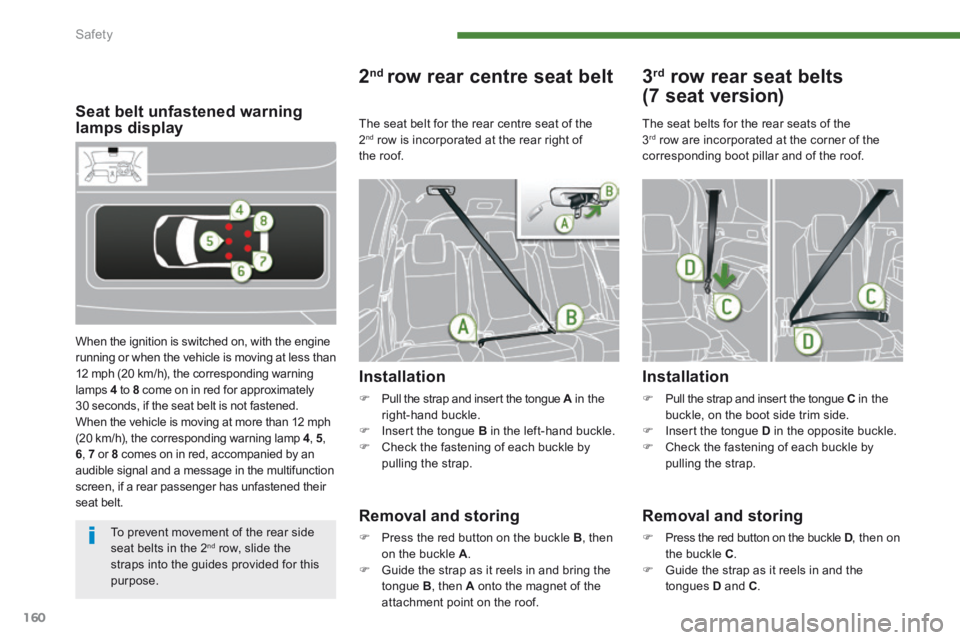
When the ignition is switched on, with the engine running or when the vehicle is moving at less than 12 mph (20 km/h), the corresponding warning lamps 4 to 8 come on in red for approximately 30 seconds, if the seat belt is not fastened. When the vehicle is moving at more than 12 mph (20 km/h), the corresponding warning lamp 4 , 5,6, 7 or 8 comes on in red, accompanied by an audible signal and a message in the multifunction screen, if a rear passenger has unfastened their seat belt.
2 ndrow rear centre seat belt
Installation
Pull the strap and insert the tongue A in the A in the Aright-hand buckle. Insert the tongue B in the left-hand buckle. Check the fastening of each buckle by pulling the strap.
Removal and storing
Press the red button on the buckle B , then on the buckle A . Guide the strap as it reels in and bring the
tongue B , then A onto the magnet of the attachment point on the roof.
3 rd row rear seat belts
(7 seat version)
Installation
Pull the strap and insert the tongue C in the buckle, on the boot side trim side. Insert the tongue D in the opposite buckle. Check the fastening of each buckle by pulling the strap.
The seat belts for the rear seats of the 3 rd row are incorporated at the corner of the corresponding boot pillar and of the roof.
Removal and storing
Press the red button on the buckle D , then on D , then on Dthe buckle C . Guide the strap as it reels in and the
tongues D and C .
The seat belt for the rear centre seat of the 2 nd row is incorporated at the rear right of the roof.
To prevent movement of the rear side seat belts in the 2 nd row, slide the straps into the guides provided for this purpose.
Page 166 of 404
Safety
164
Lateral airbags
System which protects the driver and front passenger in the event of a serious side impact in order to limit the risk of injury to the chest. Each lateral airbag is fitted in the front, in the outer side of the seat back frame.
Deployment
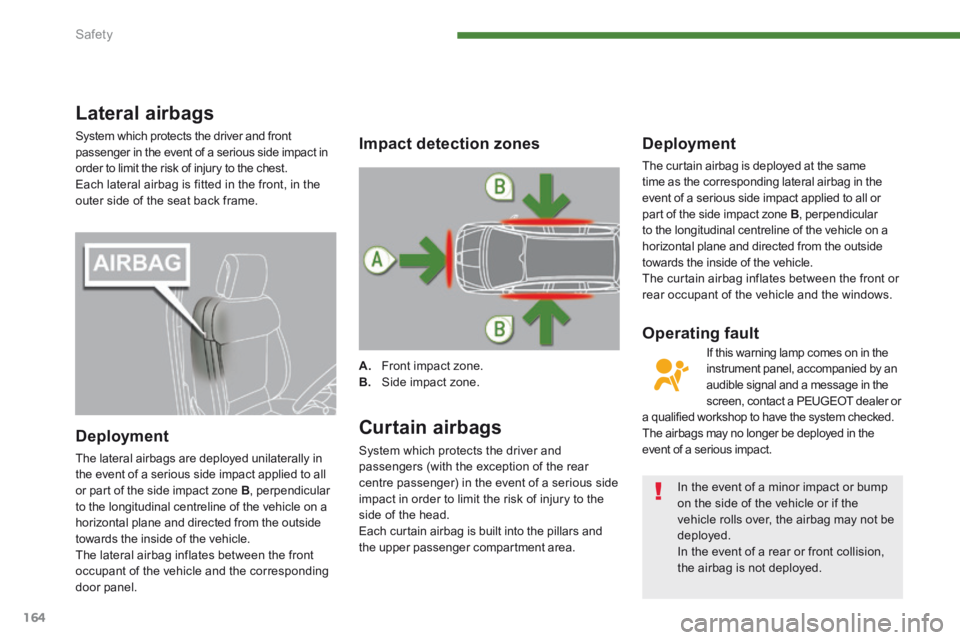
The lateral airbags are deployed unilaterally in the event of a serious side impact applied to all or part of the side impact zone B , perpendicular to the longitudinal centreline of the vehicle on a horizontal plane and directed from the outside
towards the inside of the vehicle. The lateral airbag inflates between the front occupant of the vehicle and the corresponding door panel.
Curtain airbags
System which protects the driver and passengers (with the exception of the rear centre passenger) in the event of a serious side impact in order to limit the risk of injury to the side of the head. Each curtain airbag is built into the pillars and the upper passenger compartment area.
Deployment
The curtain airbag is deployed at the same time as the corresponding lateral airbag in the event of a serious side impact applied to all or part of the side impact zone B , perpendicular to the longitudinal centreline of the vehicle on a horizontal plane and directed from the outside towards the inside of the vehicle. The curtain airbag inflates between the front or rear occupant of the vehicle and the windows.
Impact detection zones
A. Front impact zone. B. Side impact zone.
If this warning lamp comes on in the instrument panel, accompanied by an audible signal and a message in the screen, contact a PEUGEOT dealer or a qualified workshop to have the system checked. The airbags may no longer be deployed in the event of a serious impact.
Operating fault
In the event of a minor impact or bump on the side of the vehicle or if the vehicle rolls over, the airbag may not be deployed. In the event of a rear or front collision, the airbag is not deployed.
Page 177 of 404
9
Driving175
Distance alert *
For the safety time to be observed, refer to the current legislation or highway code recommendations in your country. The system operates when the speed of your vehicle is higher than 45 mph (70 km/h) and below 90 mph (150 km/h). It has a programmable visual alert which remains in the memory when the ignition is
switched off. This system is a driving aid and cannot, in any circumstances, take the place of the vigilance and responsibility of the driver.
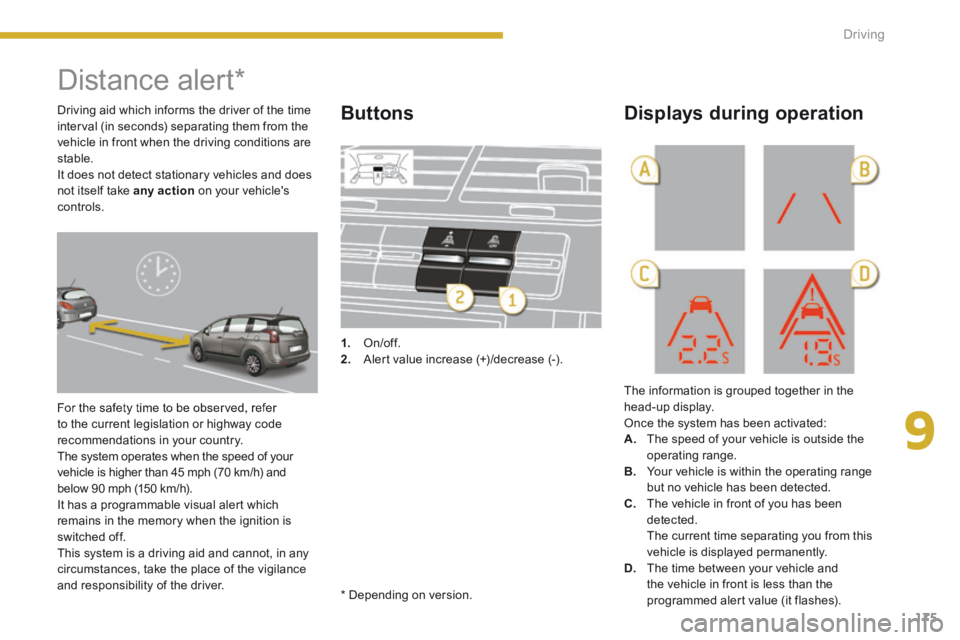
1. On/off. 2. Alert value increase (+)/decrease (-).
The information is grouped together in the head-up display. Once the system has been activated:
A. The speed of your vehicle is outside the operating range. B. Your vehicle is within the operating range but no vehicle has been detected. C. The vehicle in front of you has been detected. The current time separating you from this vehicle is displayed permanently. D. The time between your vehicle and the vehicle in front is less than the programmed alert value (it flashes).
Buttons Displays during operation Driving aid which informs the driver of the time interval (in seconds) separating them from the vehicle in front when the driving conditions are stable. It does not detect stationary vehicles and does not itself take any action on your vehicle's controls.
* Depending on version.
Page 179 of 404
9
Driving177
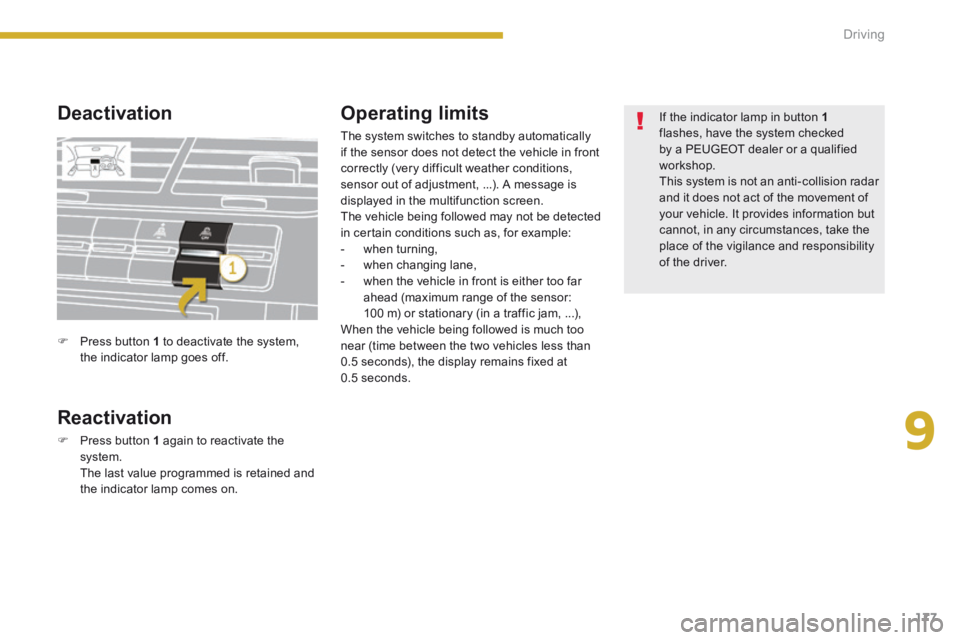
Deactivation
Reactivation
Press button 1 again to reactivate the system. The last value programmed is retained and the indicator lamp comes on.
Operating limits
The system switches to standby automatically if the sensor does not detect the vehicle in front correctly (very difficult weather conditions, sensor out of adjustment, ...). A message is displayed in the multifunction screen. The vehicle being followed may not be detected in certain conditions such as, for example: - when turning, - when changing lane, - when the vehicle in front is either too far ahead (maximum range of the sensor: 100 m) or stationary (in a traffic jam, ...), When the vehicle being followed is much too near (time between the two vehicles less than 0.5 seconds), the display remains fixed at 0.5 seconds.
If the indicator lamp in button 1flashes, have the system checked by a PEUGEOT dealer or a qualified workshop. This system is not an anti-collision radar and it does not act of the movement of your vehicle. It provides information but cannot, in any circumstances, take the place of the vigilance and responsibility of the driver.
Press button 1 to deactivate the system, the indicator lamp goes off.
Page 180 of 404
Driving
178
Speed limiter
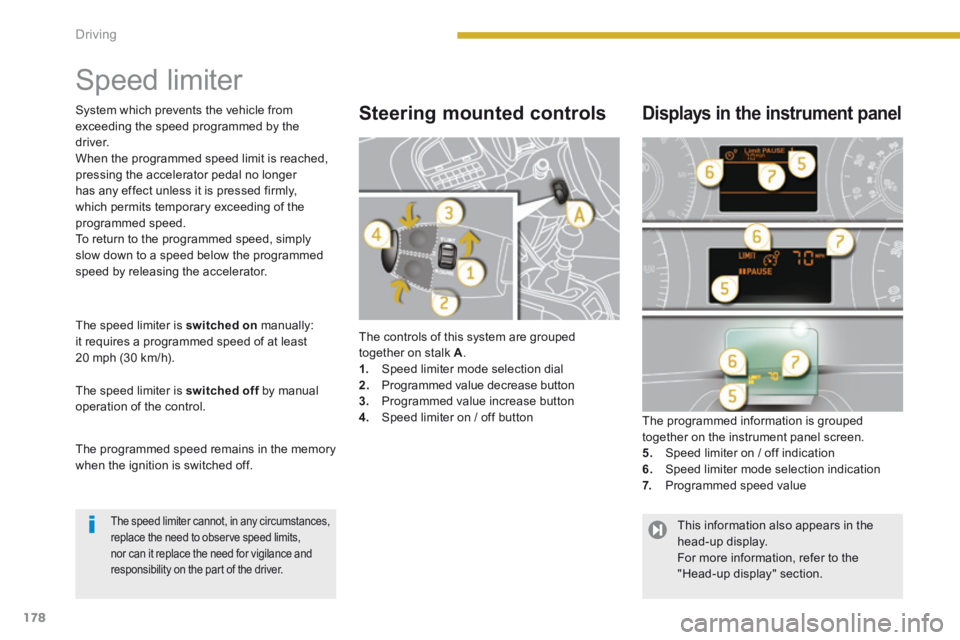
The controls of this system are grouped together on stalk A . 1. Speed limiter mode selection dial 2. Programmed value decrease button 3. Programmed value increase button 4. Speed limiter on / off button The programmed information is grouped together on the instrument panel screen. 5. Speed limiter on / off indication 6. Speed limiter mode selection indication 7. Programmed speed value
Steering mounted controls Displays in the instrument panel
The speed limiter is switched on manually: it requires a programmed speed of at least 20 mph (30 km/h).
The speed limiter is switched off by manual switched off by manual switched offoperation of the control.
The programmed speed remains in the memory when the ignition is switched off.
System which prevents the vehicle from exceeding the speed programmed by the driver. When the programmed speed limit is reached, pressing the accelerator pedal no longer has any effect unless it is pressed firmly, which permits temporary exceeding of the programmed speed. To return to the programmed speed, simply slow down to a speed below the programmed speed by releasing the accelerator.
The speed limiter cannot, in any circumstances, replace the need to observe speed limits, nor can it replace the need for vigilance and responsibility on the part of the driver.
This information also appears in the
head-up display. For more information, refer to the "Head-up display" section.