wheel PEUGEOT 5008 2013.5 Owner's Manual
[x] Cancel search | Manufacturer: PEUGEOT, Model Year: 2013.5, Model line: 5008, Model: PEUGEOT 5008 2013.5Pages: 404, PDF Size: 23.45 MB
Page 189 of 404
9
Driving187
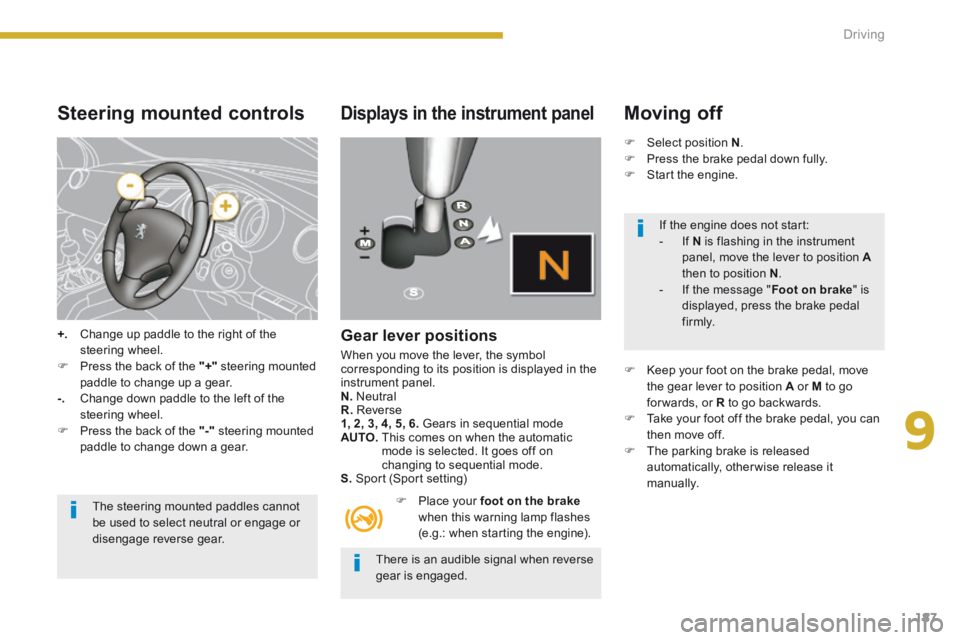
Steering mounted controls
+. Change up paddle to the right of the steering wheel. Press the back of the "+" steering mounted paddle to change up a gear. -. Change down paddle to the left of the steering wheel.
Press the back of the "-" steering mounted paddle to change down a gear.
The steering mounted paddles cannot be used to select neutral or engage or
disengage reverse gear.
Displays in the instrument panel
Gear lever positions
When you move the lever, the symbol corresponding to its position is displayed in the instrument panel. N. Neutral R. Reverse 1, 2, 3, 4, 5, 6. Gears in sequential mode AUTO. This comes on when the automatic mode is selected. It goes off on changing to sequential mode. S. Sport (Sport setting)
Place your foot on the brakewhen this warning lamp flashes (e.g.: when starting the engine).
Moving off
Select position N . Press the brake pedal down fully. Start the engine.
Keep your foot on the brake pedal, move the gear lever to position A or M to go for wards, or R to go backwards. Take your foot off the brake pedal, you can then move off. The parking brake is released automatically, otherwise release it manually.
There is an audible signal when reverse gear is engaged.
If the engine does not start: - If N is flashing in the instrument panel, move the lever to position Athen to position N . - If the message " Foot on brake " is displayed, press the brake pedal f i r m l y.
Page 215 of 404
11
Practical information213
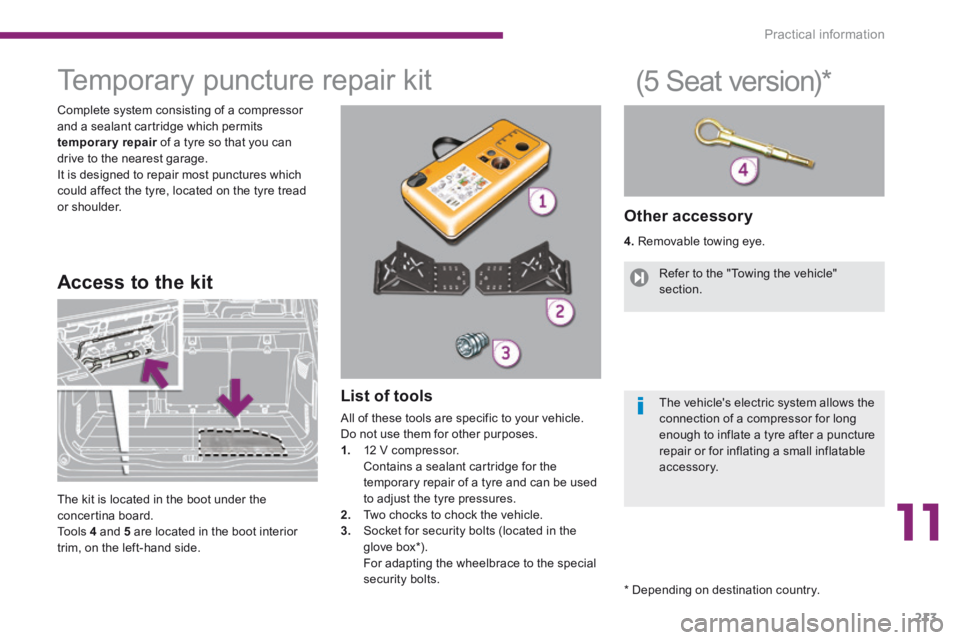
Temporary puncture repair kit
Complete system consisting of a compressor and a sealant cartridge which permits temporary repair of a tyre so that you can temporary repair of a tyre so that you can temporary repairdrive to the nearest garage. It is designed to repair most punctures which could affect the tyre, located on the tyre tread or shoulder.
List of tools
All of these tools are specific to your vehicle.
Do not use them for other purposes. 1. 12 V compressor. Contains a sealant cartridge for the temporary repair of a tyre and can be used to adjust the tyre pressures. 2. Two chocks to chock the vehicle. 3. Socket for security bolts (located in the glove box*) . For adapting the wheelbrace to the special security bolts.
Other accessory
4. Removable towing eye.
Access to the kit
(5 Seat version) *
The kit is located in the boot under the concertina board. To o l s 4 and 5 are located in the boot interior trim, on the left-hand side.
Refer to the "Towing the vehicle" section.
The vehicle's electric system allows the connection of a compressor for long
enough to inflate a tyre after a puncture repair or for inflating a small inflatable accessory.
* Depending on destination country.
Page 216 of 404
Practical information
214
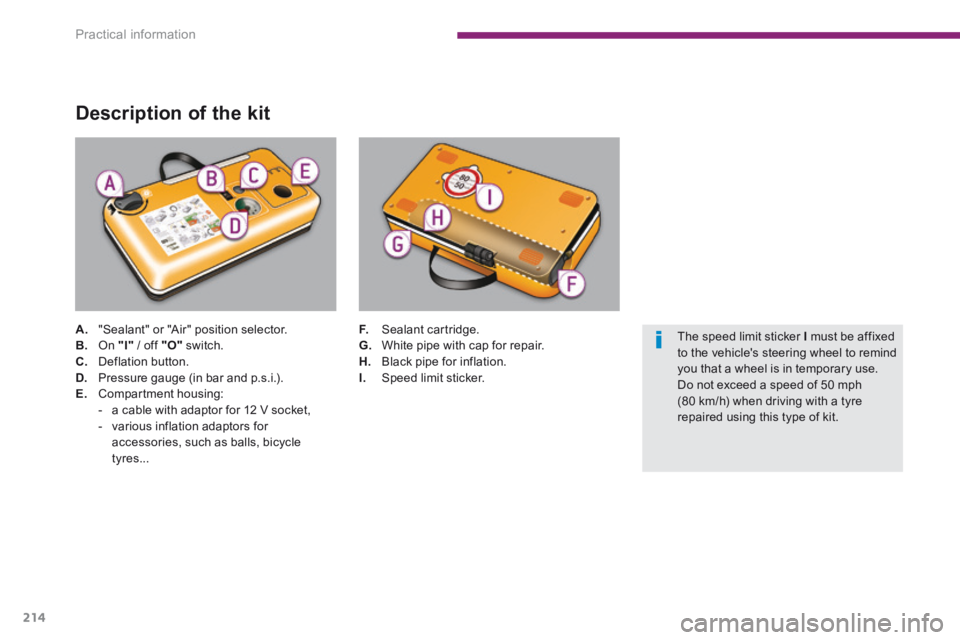
Description of the kit
A. "Sealant" or "Air" position selector. B. On "I" / off "O" switch. C. Deflation button. D. Pressure gauge (in bar and p.s.i.). E. Compartment housing: - a cable with adaptor for 12 V socket, - various inflation adaptors for
accessories, such as balls, bicycle tyres...
F. Sealant cartridge. G. White pipe with cap for repair. H. Black pipe for inflation. I. Speed limit sticker.
The speed limit sticker I must be affixed to the vehicle's steering wheel to remind you that a wheel is in temporary use. Do not exceed a speed of 50 mph (80 km/h) when driving with a tyre repaired using this type of kit.
Page 218 of 404
Practical information
216
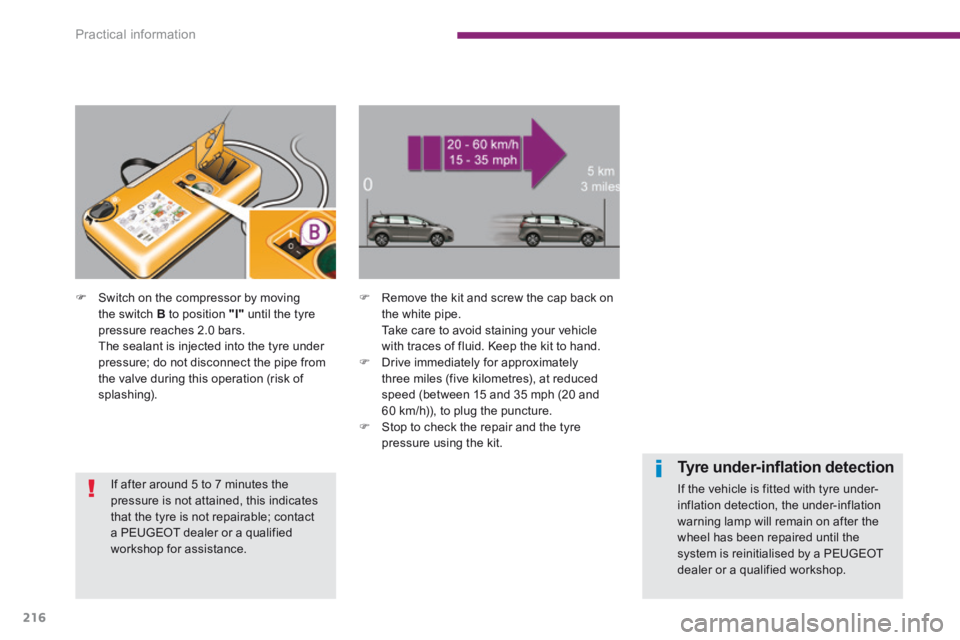
Switch on the compressor by moving the switch B to position "I" until the tyre pressure reaches 2.0 bars. The sealant is injected into the tyre under pressure; do not disconnect the pipe from the valve during this operation (risk of splashing).
Remove the kit and screw the cap back on the white pipe. Take care to avoid staining your vehicle with traces of fluid. Keep the kit to hand. Drive immediately for approximately three miles (five kilometres), at reduced speed (between 15 and 35 mph (20 and 60 km/h)), to plug the puncture. Stop to check the repair and the tyre pressure using the kit.
Tyre under-infl ation detection
If the vehicle is fitted with tyre under-inflation detection, the under-inflation warning lamp will remain on after the
wheel has been repaired until the system is reinitialised by a PEUGEOT dealer or a qualified workshop.
If after around 5 to 7 minutes the pressure is not attained, this indicates that the tyre is not repairable; contact a PEUGEOT dealer or a qualified workshop for assistance.
Page 219 of 404
11
Practical information217
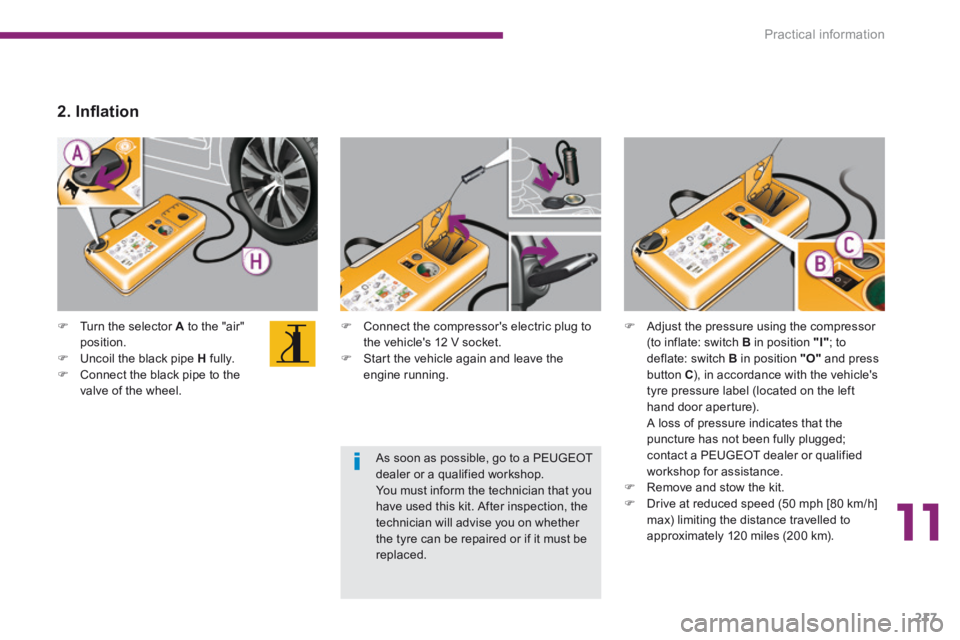
Connect the compressor's electric plug to the vehicle's 12 V socket. Start the vehicle again and leave the engine running.
Turn the selector A to the "air" position. Uncoil the black pipe H fully. Connect the black pipe to the valve of the wheel.
2 . I n fl a t i o n
Adjust the pressure using the compressor (to inflate: switch B in position "I" ; to deflate: switch B in position "O" and press button C ), in accordance with the vehicle's tyre pressure label (located on the left hand door aperture). A loss of pressure indicates that the puncture has not been fully plugged; contact a PEUGEOT dealer or qualified workshop for assistance. Remove and stow the kit. Drive at reduced speed (50 mph [80 km/h] max) limiting the distance travelled to approximately 120 miles (200 km).
As soon as possible, go to a PEUGEOT dealer or a qualified workshop. You must inform the technician that you have used this kit. After inspection, the technician will advise you on whether the tyre can be repaired or if it must be replaced.
Page 220 of 404
Practical information
218
Removing the cartridge
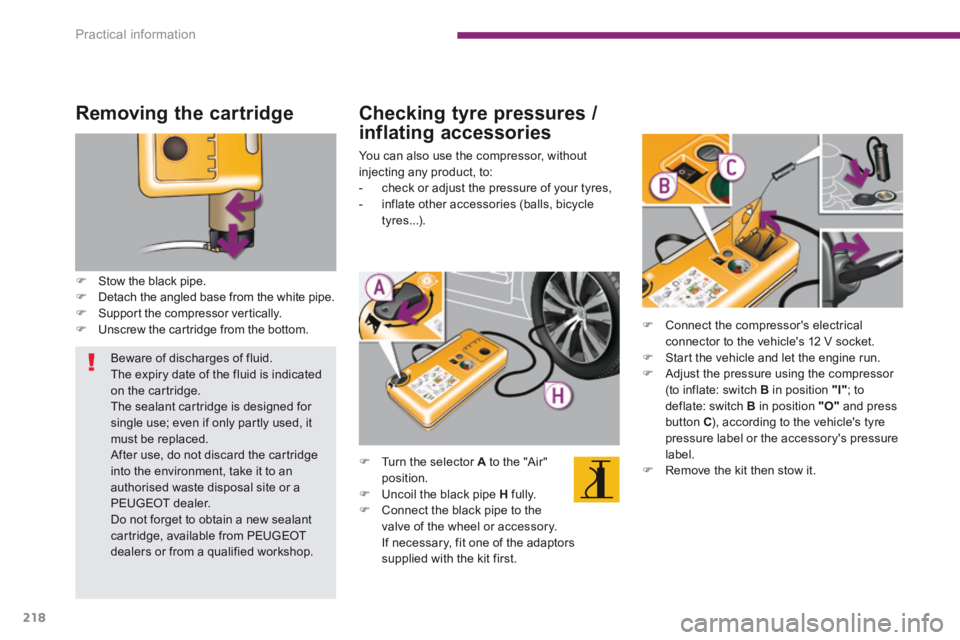
Stow the black pipe. Detach the angled base from the white pipe. Support the compressor vertically. Unscrew the cartridge from the bottom.
Checking tyre pressures /
inflating accessories
You can also use the compressor, without injecting any product, to: - check or adjust the pressure of your tyres, - inflate other accessories (balls, bicycle tyres...).
Turn the selector A to the "Air" position. Uncoil the black pipe H fully. Connect the black pipe to the valve of the wheel or accessory. If necessary, fit one of the adaptors supplied with the kit first.
Connect the compressor's electrical connector to the vehicle's 12 V socket. Start the vehicle and let the engine run. Adjust the pressure using the compressor (to inflate: switch B in position "I" ; to deflate: switch B in position "O" and press button C ), according to the vehicle's tyre pressure label or the accessory's pressure label. Remove the kit then stow it.
Beware of discharges of fluid. The expiry date of the fluid is indicated on the cartridge. The sealant cartridge is designed for single use; even if only partly used, it must be replaced. After use, do not discard the cartridge into the environment, take it to an authorised waste disposal site or a PEUGEOT dealer. Do not forget to obtain a new sealant cartridge, available from PEUGEOT dealers or from a qualified workshop.
Page 221 of 404
11
Practical information219
Temporary puncture repair kit
The kit is located in the boot, under the left hand seat in the 3 rd row.
Using the kit
* According to country of sale.
(7 SEAT VERSION) *
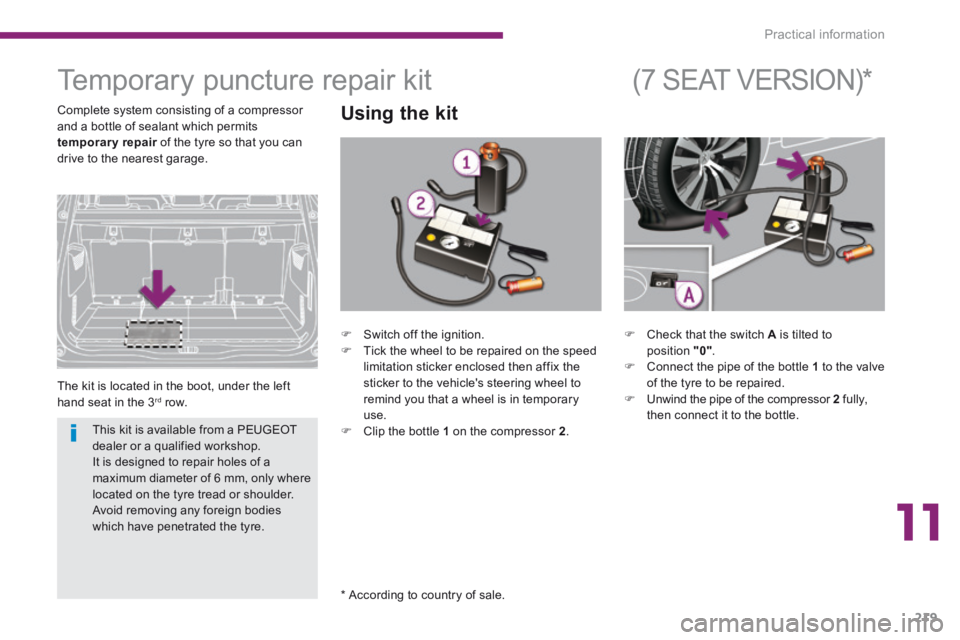
Complete system consisting of a compressor and a bottle of sealant which permits temporary repair of the tyre so that you can temporary repair of the tyre so that you can temporary repairdrive to the nearest garage.
Check that the switch A is tilted to position "0" . Connect the pipe of the bottle 1 to the valve of the tyre to be repaired. Unwind the pipe of the compressor 2 fully, then connect it to the bottle.
Switch off the ignition. Tick the wheel to be repaired on the speed limitation sticker enclosed then affix the sticker to the vehicle's steering wheel to remind you that a wheel is in temporary use. Clip the bottle 1 on the compressor 2 . This kit is available from a PEUGEOT dealer or a qualified workshop. It is designed to repair holes of a maximum diameter of 6 mm, only where located on the tyre tread or shoulder. Avoid removing any foreign bodies which have penetrated the tyre.
Page 223 of 404
11
Practical information221
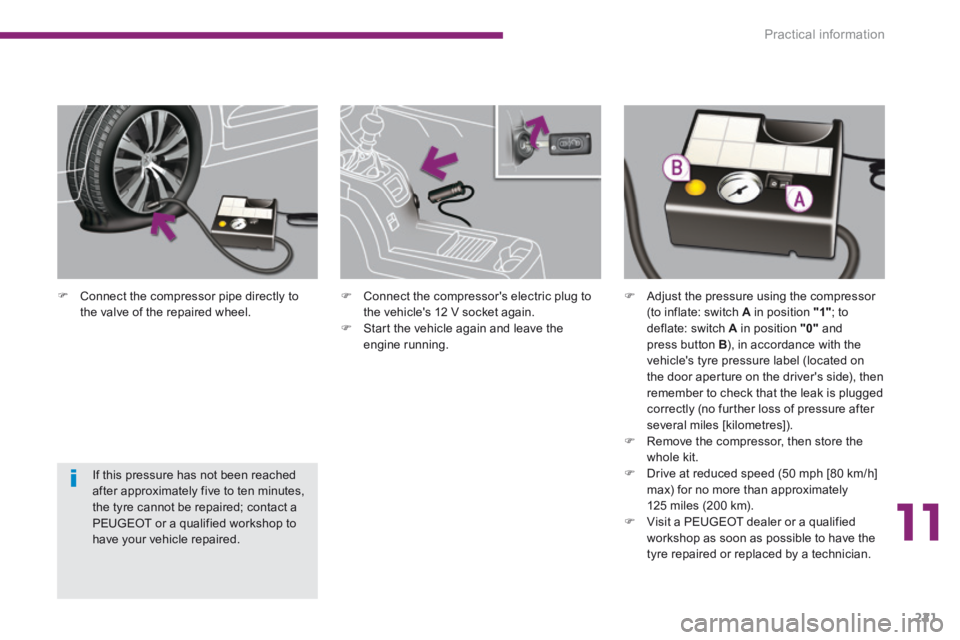
Connect the compressor pipe directly to the valve of the repaired wheel.
If this pressure has not been reached after approximately five to ten minutes, the tyre cannot be repaired; contact a PEUGEOT or a qualified workshop to have your vehicle repaired.
Connect the compressor's electric plug to the vehicle's 12 V socket again. Start the vehicle again and leave the engine running.
Adjust the pressure using the compressor (to inflate: switch A in position "1" ; to deflate: switch A in position "0" and press button B ), in accordance with the vehicle's tyre pressure label (located on the door aperture on the driver's side), then remember to check that the leak is plugged correctly (no further loss of pressure after several miles [kilometres]).
Remove the compressor, then store the whole kit. Drive at reduced speed (50 mph [80 km/h] max) for no more than approximately 125 miles (200 km). Visit a PEUGEOT dealer or a qualified workshop as soon as possible to have the tyre repaired or replaced by a technician.
Page 224 of 404
Practical information
222
Take care, the bottle of fluid contains ethylene-glycol. This product is harmful if swallowed and causes irritation to the eyes. Keep it out of reach of children. The expiry date of the fluid is indicated on the base of the bottle. The bottle is designed for a single use; even if only partly used, it must be replaced. After use, do not discard the bottle into the environment, take it to a PEUGEOT dealer or an authorised waste disposal site. Do not forget to obtain a new bottle of sealant product, available from a PEUGEOT dealer or a qualified workshop.
If the vehicle is fitted with tyre under-inflation detection, the tyre under-inflation warning lamp will remain on after the wheel has been repaired until the system is reinitialised by a PEUGEOT dealer or a qualified workshop.
Page 225 of 404
11
Practical information223
Changing a wheel *
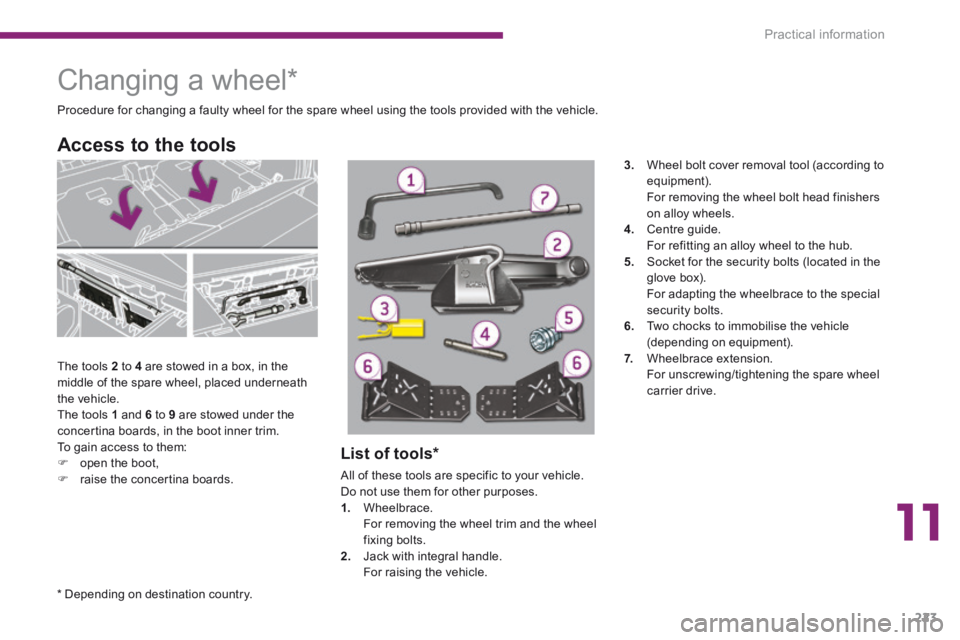
The tools 2 to 4 are stowed in a box, in the middle of the spare wheel, placed underneath the vehicle. The tools 1 and 6 to 9 are stowed under the concertina boards, in the boot inner trim. To gain access to them: open the boot, raise the concertina boards.
Access to the tools
Procedure for changing a faulty wheel for the spare wheel using the tools provided with the vehicle.
List of tools *
All of these tools are specific to your vehicle. Do not use them for other purposes. 1. Wheelbrace. For removing the wheel trim and the wheel fixing bolts. 2. Jack with integral handle. For raising the vehicle.
3. Wheel bolt cover removal tool (according to equipment). For removing the wheel bolt head finishers on alloy wheels. 4. Centre guide. For refitting an alloy wheel to the hub. 5. Socket for the security bolts (located in the glove box). For adapting the wheelbrace to the special security bolts. 6. Two chocks to immobilise the vehicle (depending on equipment). 7. Wheelbrace extension. For unscrewing/tightening the spare wheel carrier drive.
* Depending on destination country.