bonnet PEUGEOT 5008 2013.5 Owners Manual
[x] Cancel search | Manufacturer: PEUGEOT, Model Year: 2013.5, Model line: 5008, Model: PEUGEOT 5008 2013.5Pages: 404, PDF Size: 23.45 MB
Page 5 of 404
.
.
Contents
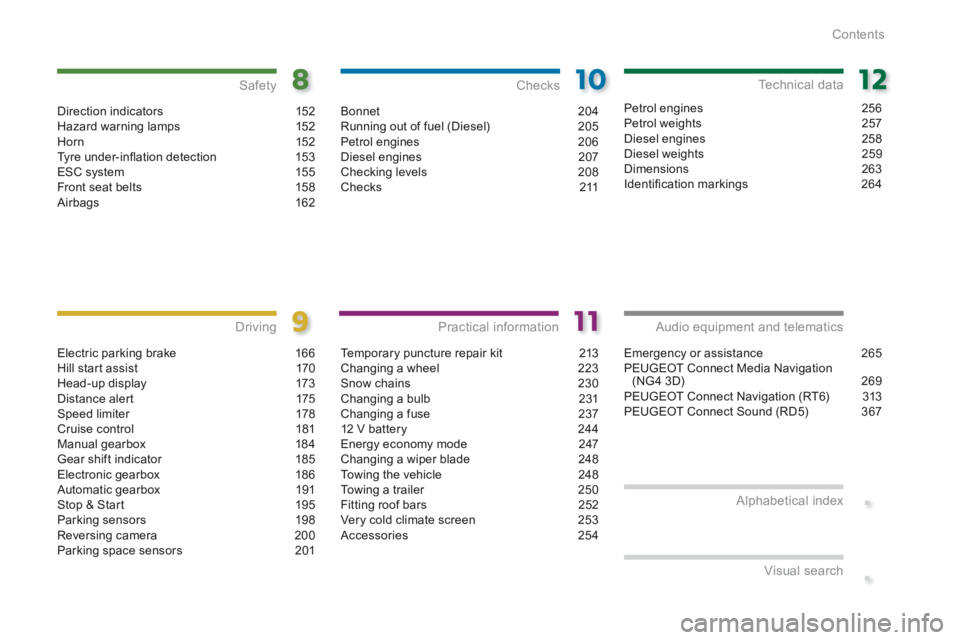
Direction indicators 152Hazard warning lamps 152Hor n 152Tyre under-infl ation detection 153ESC system 155Front seat belts 158Airbags 162
Safety
Electric parking brake 166Hill start assist 170Head-up display 173Distance alert 175Speed limiter 178Cruise control 181Manual gearbox 184Gear shift indicator 185Electronic gearbox 186Automatic gearbox 191Stop & Start 195Parking sensors 198Reversing camera 200Parking space sensors 201
Driving
Emergency or assistance 265PEUGEOT Connect Media Navigation (NG4 3D) 269PEUGEOT Connect Navigation (RT6) 313PEUGEOT Connect Sound (RD5) 367
Audio equipment and telematics
Visual search
Alphabetical index
Bonnet
204Running out of fuel (Diesel) 205Petrol engines 206Diesel engines 207Checking levels 208C h e c k s 2 11
Checks
Temporary puncture repair kit 213Changing a wheel 223Snow chains 230Changing a bulb 231Changing a fuse 23712 V battery 244Energy economy mode 247Changing a wiper blade 248Towing the vehicle 248Towing a trailer 250Fitting roof bars 252Very cold climate screen 253Accessories 254
Practical information
Petrol engines 256Petrol weights 257Diesel engines 258Diesel weights 259Dimensions 263Identifi cation markings 264
Technical data
Page 12 of 404
Familiarisation
10
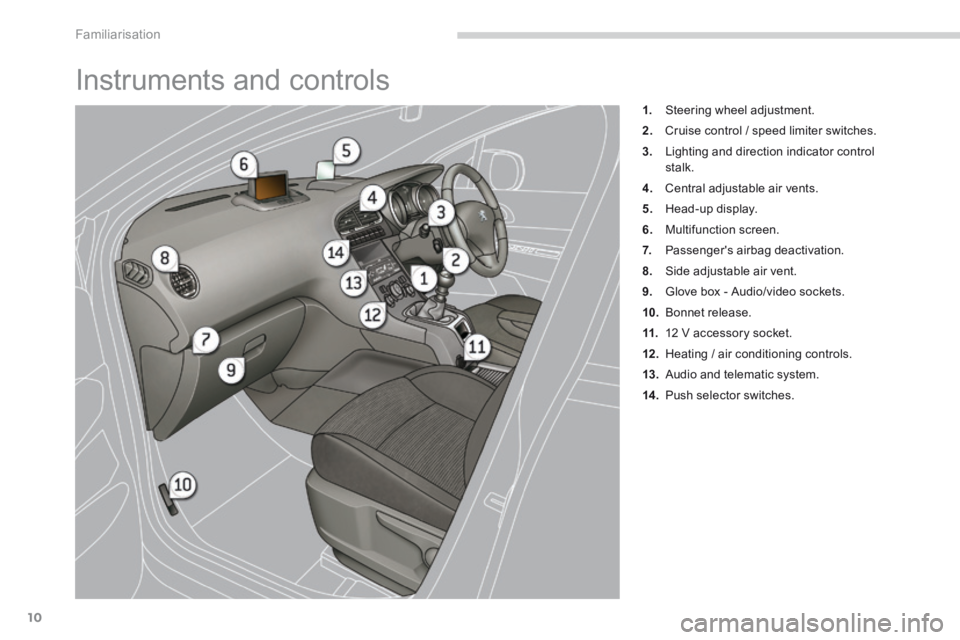
Instruments and controls
1. Steering wheel adjustment.
2. Cruise control / speed limiter switches.
3. Lighting and direction indicator control stalk.
4. Central adjustable air vents.
5. Head-up display.
6. Multifunction screen.
7. Passenger's airbag deactivation.
8. Side adjustable air vent.
9. Glove box - Audio/video sockets.
10. Bonnet release.
11. 12 V accessory socket.
12 . Heating / air conditioning controls.
13. Audio and telematic system.
14 . Push selector switches.
Page 22 of 404
195
Familiarisation
20
Driving safely
Stop & Start
Going into engine STOP mode
The "ECO" warning lamp comes on in the instrument panel and the engine automatically goes into standby, w ith
an electronic gearbox: at speeds below 5 mph (8 km/h), press the brake pedal or put the gear lever in position N .
In some circumstances, STOP mode may not be available; the "ECO" warning lamp flashes for few seconds, then goes off.
Going into engine START mode
The "ECO" warning lamp goes off and the engine restarts with an electronic gearbox :
In some circumstances START mode may be invoked automatically; the "ECO" warning lamp flashes for a few seconds, then goes off.
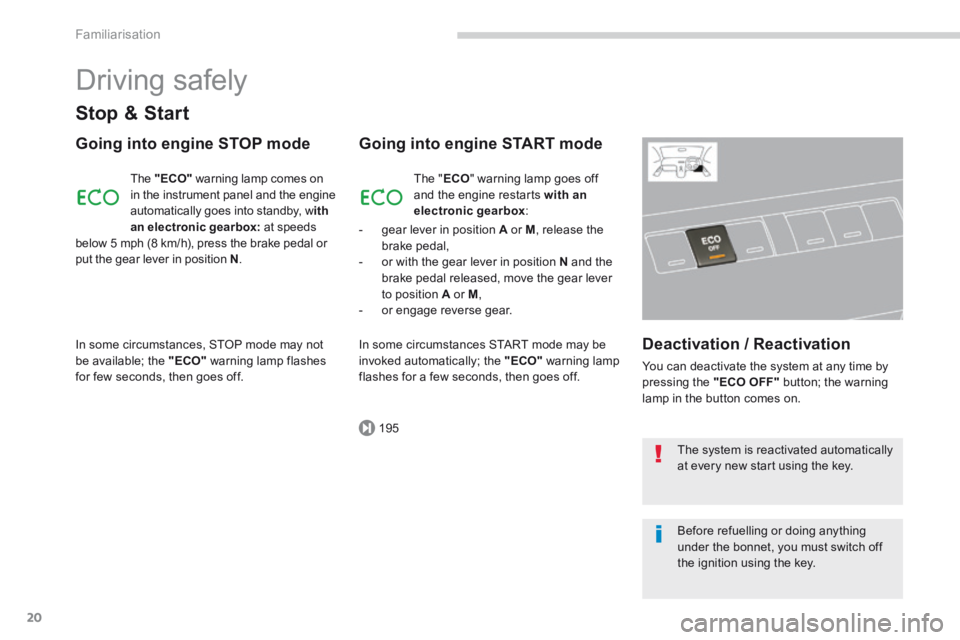
Deactivation / Reactivation
You can deactivate the system at any time by pressing the "ECO OFF" button; the warning lamp in the button comes on.
The system is reactivated automatically at every new start using the key.
Before refuelling or doing anything under the bonnet, you must switch off the ignition using the key.
- gear lever in position A or M , release the brake pedal, - or with the gear lever in position N and the brake pedal released, move the gear lever to position A or M , - or engage reverse gear.
Page 36 of 404
Monitoring
34
Warning lamps
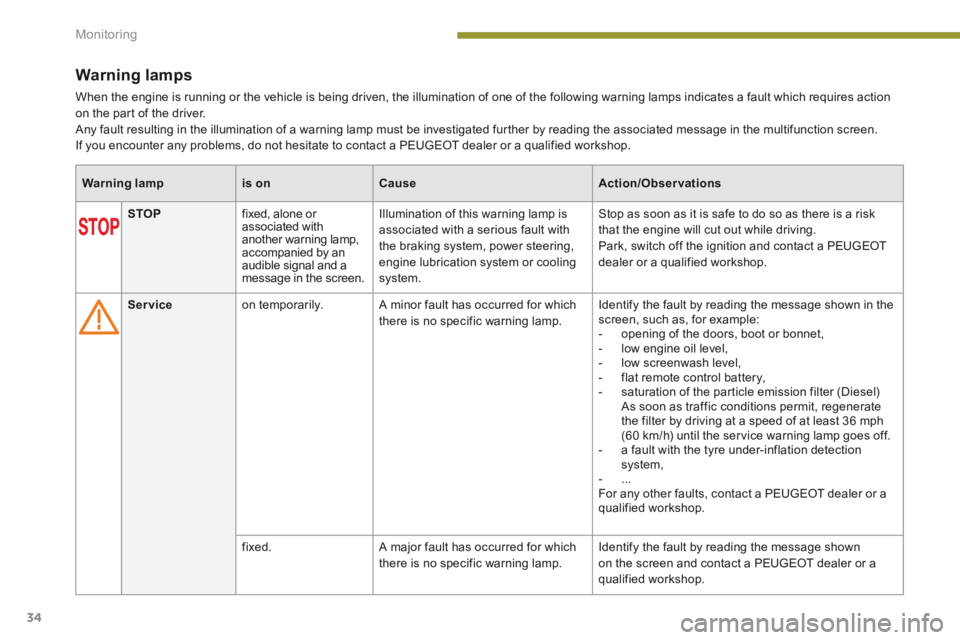
When the engine is running or the vehicle is being driven, the illumination of one of the following warning lamps indicates a fault which requires action on the part of the driver. Any fault resulting in the illumination of a warning lamp must be investigated further by reading the associated message in the multifunction screen. If you encounter any problems, do not hesitate to contact a PEUGEOT dealer or a qualified workshop.
Warning lampis onCauseAction/Observations
STOP fixed, alone or associated with another warning lamp, accompanied by an audible signal and a message in the screen.
Illumination of this warning lamp is associated with a serious fault with the braking system, power steering, engine lubrication system or cooling system.
Stop as soon as it is safe to do so as there is a risk that the engine will cut out while driving. Park, switch off the ignition and contact a PEUGEOT dealer or a qualified workshop.
Service on temporarily. A minor fault has occurred for which there is no specific warning lamp. Identify the fault by reading the message shown in the screen, such as, for example: - opening of the doors, boot or bonnet, - low engine oil level, - low screenwash level, - flat remote control battery, - saturation of the particle emission filter (Diesel) As soon as traffic conditions permit, regenerate the filter by driving at a speed of at least 36 mph (60 km/h) until the service warning lamp goes off. - a fault with the tyre under-inflation detection system, - ... For any other faults, contact a PEUGEOT dealer or a qualified workshop.
fixed. A major fault has occurred for which there is no specific warning lamp. Identify the fault by reading the message shown on the screen and contact a PEUGEOT dealer or a qualified workshop.
Page 39 of 404
1
Monitoring37
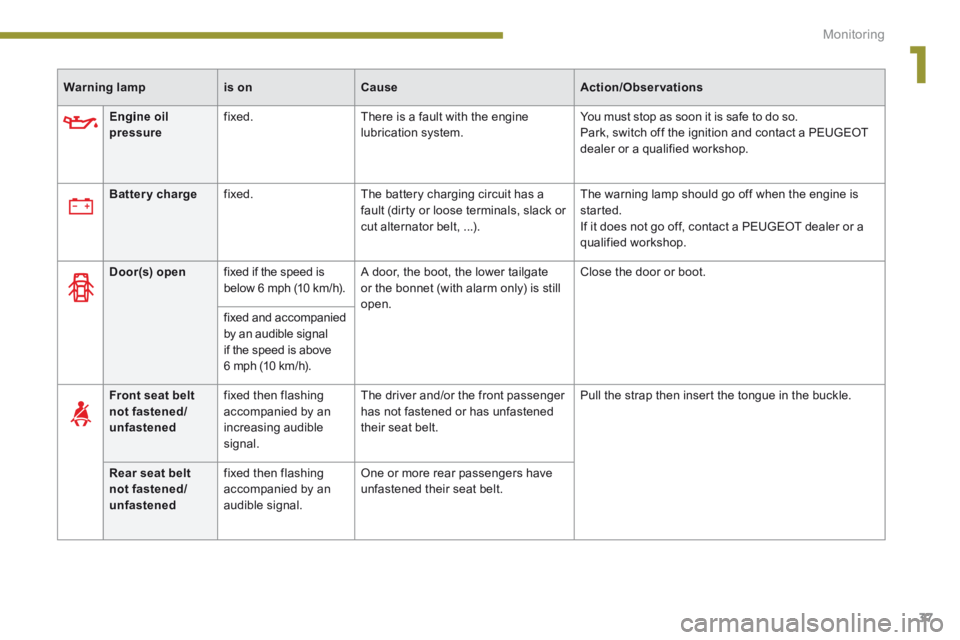
Engine oil pressure fixed. There is a fault with the engine lubrication system. You must stop as soon it is safe to do so. Park, switch off the ignition and contact a PEUGEOT dealer or a qualified workshop.
Battery charge fixed. The battery charging circuit has a fault (dirty or loose terminals, slack or
cut alternator belt, ...).
The warning lamp should go off when the engine is started.
If it does not go off, contact a PEUGEOT dealer or a qualified workshop.
Warning lampis onCauseAction/Observations
Front seat belt not fastened/unfastened
fixed then flashing accompanied by an increasing audible
signal.
The driver and/or the front passenger has not fastened or has unfastened their seat belt.
Pull the strap then insert the tongue in the buckle.
Rear seat belt not fastened/unfastened
fixed then flashing accompanied by an audible signal.
One or more rear passengers have unfastened their seat belt.
Door(s) open fixed if the speed is below 6 mph (10 km/h). A door, the boot, the lower tailgate or the bonnet (with alarm only) is still open.
Close the door or boot.
fixed and accompanied by an audible signal if the speed is above 6 mph (10 km/h).
Page 44 of 404
Monitoring
42
Engine oil level indicator *
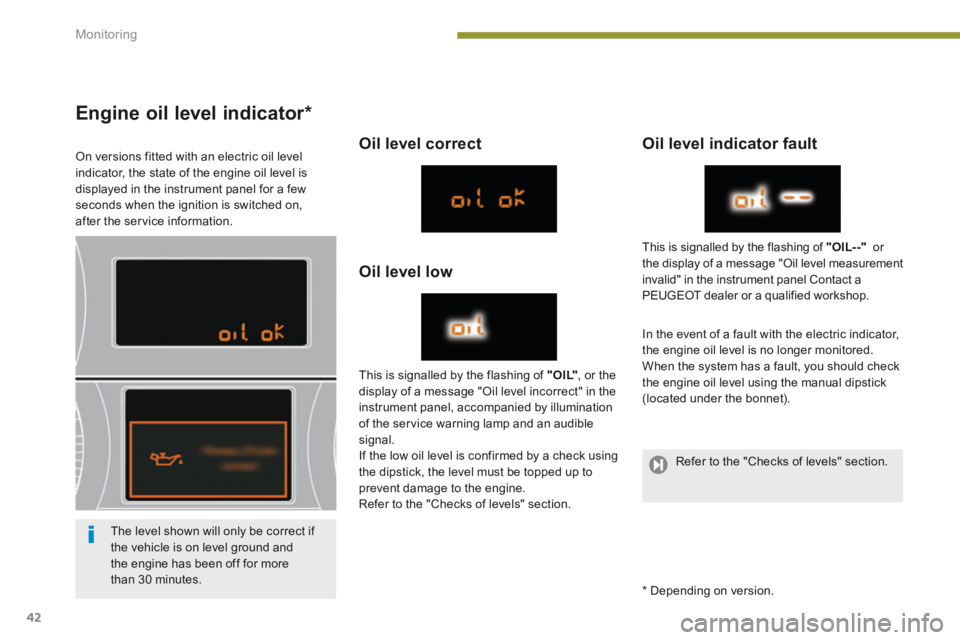
On versions fitted with an electric oil level indicator, the state of the engine oil level is displayed in the instrument panel for a few seconds when the ignition is switched on, after the service information.
Oil level correct
Oil level low
Oil level indicator fault
In the event of a fault with the electric indicator, the engine oil level is no longer monitored. When the system has a fault, you should check the engine oil level using the manual dipstick (located under the bonnet).
This is signalled by the flashing of " O I L" , or the display of a message "Oil level incorrect" in the instrument panel, accompanied by illumination of the service warning lamp and an audible signal. If the low oil level is confirmed by a check using the dipstick, the level must be topped up to prevent damage to the engine. Refer to the "Checks of levels" section.
This is signalled by the flashing of "OIL- -" or the display of a message "Oil level measurement invalid" in the instrument panel Contact a PEUGEOT dealer or a qualified workshop.
The level shown will only be correct if the vehicle is on level ground and the engine has been off for more than 30 minutes. * Depending on version.
Refer to the "Checks of levels" section.
Page 89 of 404
4
Access87
Alarm
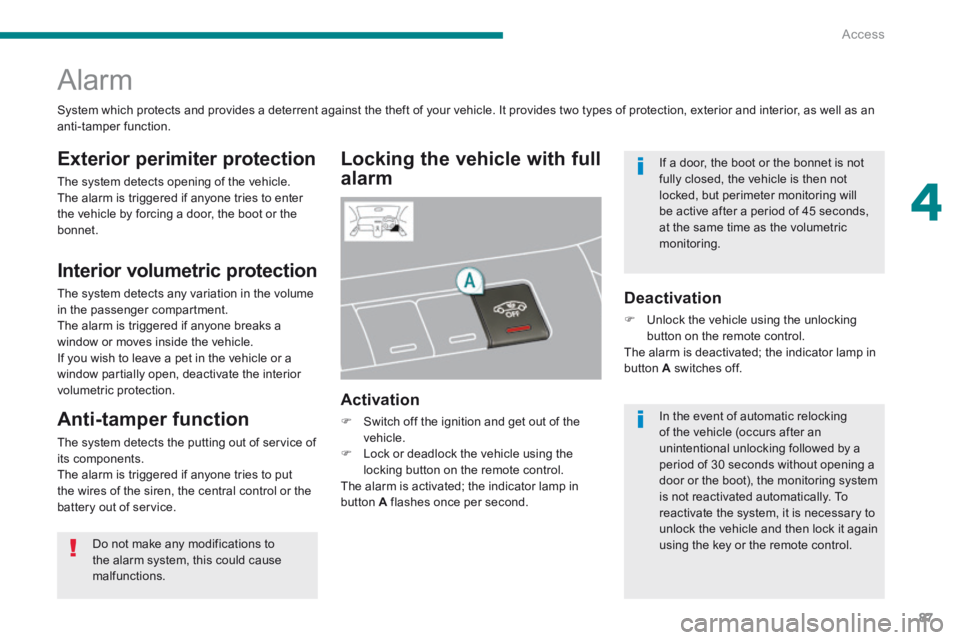
Locking the vehicle with full
alarm
Exterior perimiter protection
The system detects opening of the vehicle. The alarm is triggered if anyone tries to enter the vehicle by forcing a door, the boot or the
bonnet.
Interior volumetric protection
The system detects any variation in the volume in the passenger compartment. The alarm is triggered if anyone breaks a window or moves inside the vehicle. If you wish to leave a pet in the vehicle or a window partially open, deactivate the interior volumetric protection.
Anti-tamper function
The system detects the putting out of service of its components. The alarm is triggered if anyone tries to put the wires of the siren, the central control or the battery out of service.
Activation
Switch off the ignition and get out of the
vehicle. Lock or deadlock the vehicle using the locking button on the remote control. The alarm is activated; the indicator lamp in button A flashes once per second.
System which protects and provides a deterrent against the theft of your vehicle. It provides two types of protection, exterior and interior, as well as an anti-tamper function.
Do not make any modifications to the alarm system, this could cause malfunctions.
If a door, the boot or the bonnet is not fully closed, the vehicle is then not locked, but perimeter monitoring will be active after a period of 45 seconds, at the same time as the volumetric monitoring.
In the event of automatic relocking
of the vehicle (occurs after an unintentional unlocking followed by a period of 30 seconds without opening a door or the boot), the monitoring system is not reactivated automatically. To reactivate the system, it is necessary to unlock the vehicle and then lock it again using the key or the remote control.
Deactivation
Unlock the vehicle using the unlocking button on the remote control. The alarm is deactivated; the indicator lamp in button A switches off.
Page 199 of 404
9
Driving197
Reactivation Operating fault
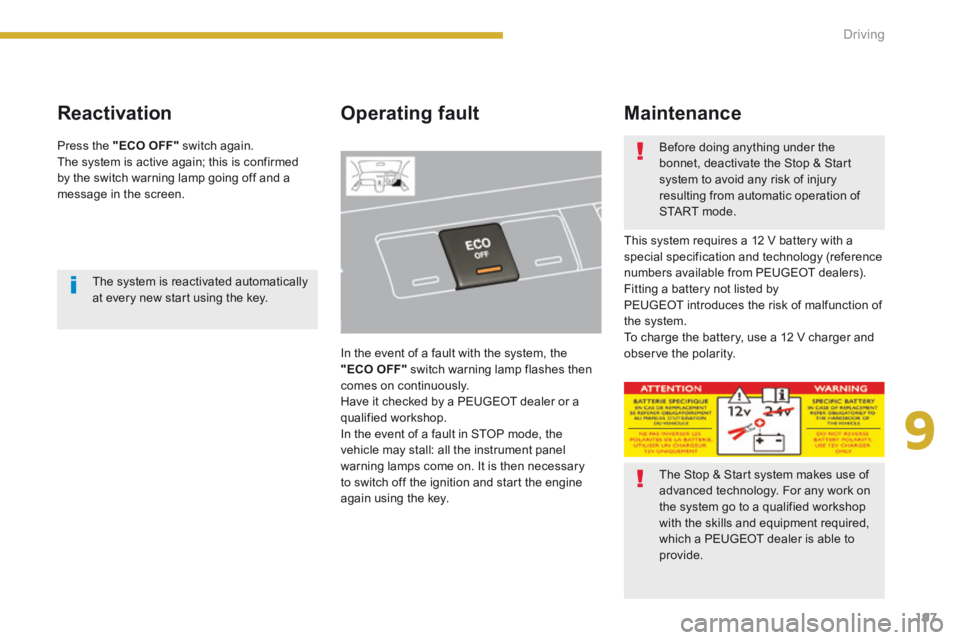
In the event of a fault with the system, the "ECO OFF" switch warning lamp flashes then comes on continuously. Have it checked by a PEUGEOT dealer or a qualified workshop. In the event of a fault in STOP mode, the vehicle may stall: all the instrument panel warning lamps come on. It is then necessary to switch off the ignition and start the engine again using the key.
Maintenance
This system requires a 12 V battery with a special specification and technology (reference numbers available from PEUGEOT dealers). Fitting a battery not listed by PEUGEOT introduces the risk of malfunction of the system. To charge the battery, use a 12 V charger and observe the polarity.
Press the "ECO OFF" switch again. The system is active again; this is confirmed by the switch warning lamp going off and a message in the screen.
The system is reactivated automatically at every new start using the key.
Before doing anything under the bonnet, deactivate the Stop & Start system to avoid any risk of injury resulting from automatic operation of START mode.
The Stop & Start system makes use of advanced technology. For any work on the system go to a qualified workshop with the skills and equipment required, which a PEUGEOT dealer is able to provide.
Page 206 of 404
Checks
204
Bonnet
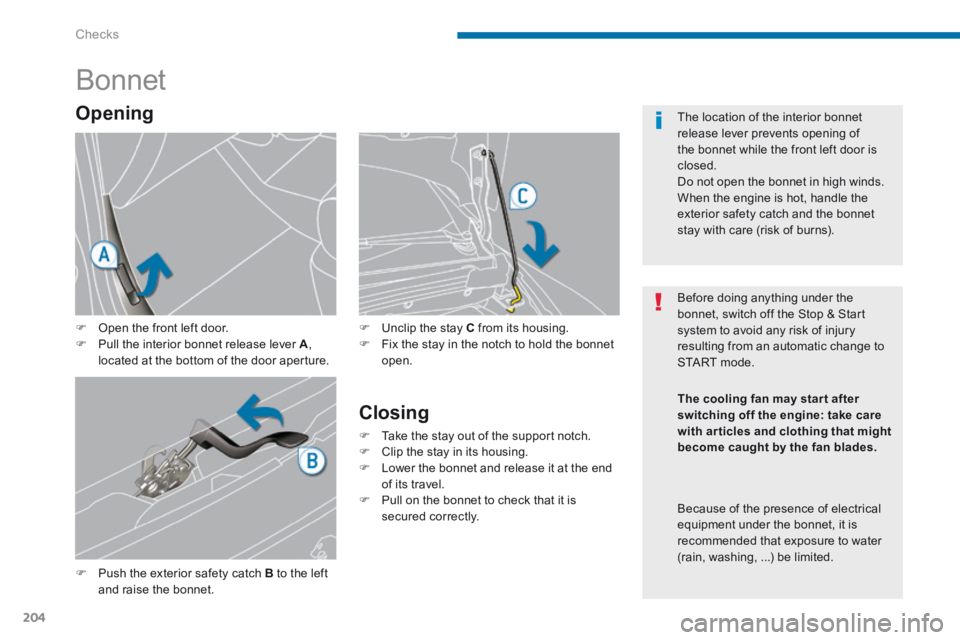
Push the exterior safety catch B to the left and raise the bonnet.
Unclip the stay C from its housing. Fix the stay in the notch to hold the bonnet open.
Closing
Take the stay out of the support notch. Clip the stay in its housing. Lower the bonnet and release it at the end of its travel. Pull on the bonnet to check that it is secured correctly.
Opening
Open the front left door. Pull the interior bonnet release lever A , located at the bottom of the door aperture.
Before doing anything under the bonnet, switch off the Stop & Start system to avoid any risk of injury resulting from an automatic change to START mode.
The location of the interior bonnet release lever prevents opening of the bonnet while the front left door is closed. Do not open the bonnet in high winds. When the engine is hot, handle the exterior safety catch and the bonnet stay with care (risk of burns).
The cooling fan may star t after switching off the engine: take care with articles and clothing that might become caught by the fan blades.
Because of the presence of electrical equipment under the bonnet, it is
recommended that exposure to water (rain, washing, ...) be limited.
Page 207 of 404
10
Checks205
Running out of fuel (Diesel)
1.6 litre HDi engine
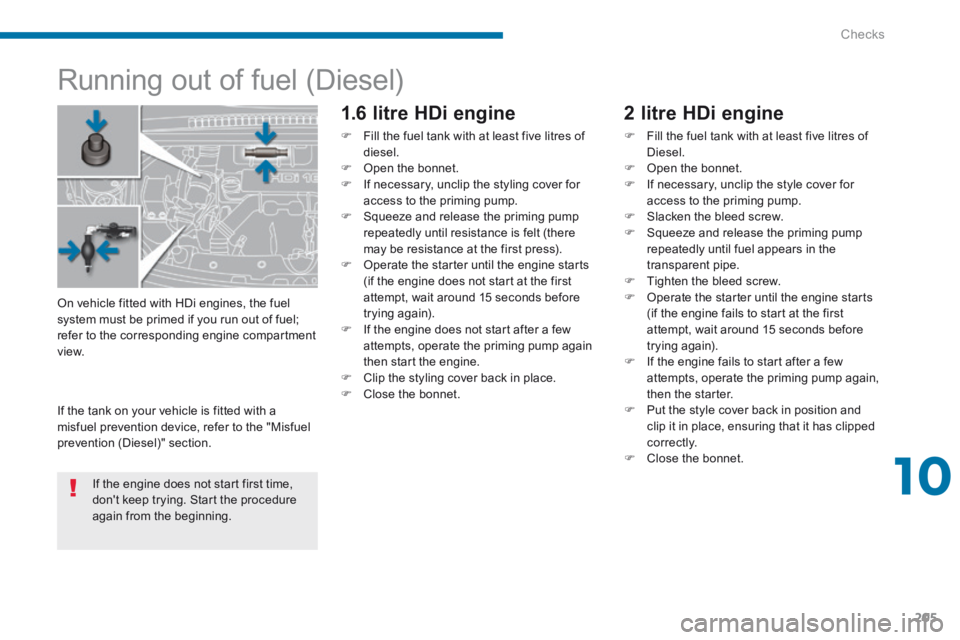
Fill the fuel tank with at least five litres of diesel. Open the bonnet. If necessary, unclip the styling cover for access to the priming pump. Squeeze and release the priming pump repeatedly until resistance is felt (there may be resistance at the first press). Operate the starter until the engine starts (if the engine does not start at the first attempt, wait around 15 seconds before trying again). If the engine does not start after a few attempts, operate the priming pump again then start the engine. Clip the styling cover back in place. Close the bonnet.
2 litre HDi engine
Fill the fuel tank with at least five litres of Diesel. Open the bonnet. If necessary, unclip the style cover for access to the priming pump. Slacken the bleed screw. Squeeze and release the priming pump repeatedly until fuel appears in the transparent pipe. Tighten the bleed screw. Operate the starter until the engine starts (if the engine fails to start at the first attempt, wait around 15 seconds before trying again). If the engine fails to start after a few attempts, operate the priming pump again, then the starter. Put the style cover back in position and clip it in place, ensuring that it has clipped
c o r r e c t l y. Close the bonnet.
On vehicle fitted with HDi engines, the fuel system must be primed if you run out of fuel; refer to the corresponding engine compartment view.
If the tank on your vehicle is fitted with a misfuel prevention device, refer to the "Misfuel prevention (Diesel)" section.
If the engine does not start first time, don't keep trying. Start the procedure again from the beginning.