fuel PEUGEOT 5008 2013 Owner's Manual
[x] Cancel search | Manufacturer: PEUGEOT, Model Year: 2013, Model line: 5008, Model: PEUGEOT 5008 2013Pages: 364, PDF Size: 16.24 MB
Page 89 of 364
AC
87
The key cannot be removed
from the lock until the cap is
put back on the tank.
Opening the cap may trigger an in-
rush of air. This vacuum, which is
completely normal, is caused by the
sealing of the fuel system.
FUEL TANK
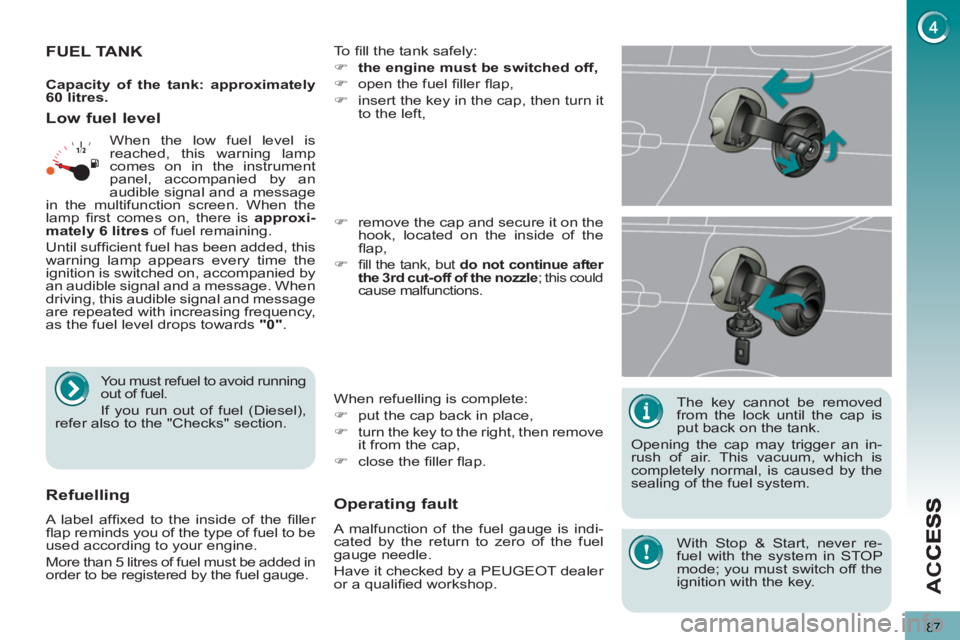
To fi ll the tank safely:
)
the engine must be switched off,
)
open the fuel fi ller fl ap,
)
insert the key in the cap, then turn it
to the left,
When refuelling is complete:
)
put the cap back in place,
)
turn the key to the right, then remove
it from the cap,
)
close the fi ller fl ap.
)
remove the cap and secure it on the
hook, located on the inside of the
fl ap,
)
fi ll the tank, but do not continue after
the 3rd cut-off of the nozzle
; this could
cause malfunctions.
Low fuel level
Operatin
g fault
A malfunction of the fuel gauge is indi-
cated by the return to zero of the fuel
gauge needle.
Have it checked by a PEUGEOT dealer
or a qualifi ed workshop.
Refuelling
A label affi xed to the inside of the fi ller
fl ap reminds you of the type of fuel to be
used according to your engine.
More than 5 litres of fuel must be added in
order to be registered by the fuel gauge. When the low fuel level is
reached, this warning lamp
comes on in the instrument
panel, accompanied by an
audible signal and a message
in the multifunction screen. When the
lamp fi rst comes on, there is approxi-
mately
6 litres
of fuel remaining.
Until suffi cient fuel has been added, this
warning lamp appears every time the
ignition is switched on, accompanied by
an audible signal and a message. When
driving, this audible signal and message
are repeated with increasing frequency,
as the fuel level drops towards "0"
.
You must refuel to avoid running
out of fuel.
If you run out of fuel (Diesel),
refer also to the "Checks" section.
Capacity of the tank: approximately
60 litres.
With Stop & Start, never re-
fuel with the system in STOP
mode; you must switch off the
ignition with the key.
Page 90 of 364
DIESEL
AC
C
88
Quality of the fuel used for petrol engines
The petrol engines are perfectly
compatible with E10 or E24 type petrol
biofuels (containing 10 % or 24 % etha-
nol), conforming to European standards EN 228 and EN 15376.
E85 type fuels (containing up to 85 % ethanol) are reserved exclusively for ve-hicles marketed for the use of this type
of fuel (BioFlex vehicles). The quality of
the ethanol must comply with European
standard EN 15293.
For Brazil only, special vehicles are
marketed to run on fuels containing up
to 100 % ethanol (E100 type).
For Russia only, the use of RON 92
unleaded petrol is possible.
Quality of the fuel used for Diesel engines
The Diesel engines are perfectly com-
patible with biofuels which conform to
current and future European standards
(Diesel fuel which complies with stand-
ard EN 590 mixed with a biofuel which
complies with standard EN 14214)
available at the pumps (containing up
to 7 % Fatty Acid Methyl Ester).
The B30 biofuel can be used in cer-
tain Diesel engines; however, this use
is subject to strict application of the
special servicing conditions. Contact a
PEUGEOT dealer or a qualifi ed work-
shop.
The use of any other type of (bio)fuel
(vegetable or animal oils, pure or dilut-
ed, domestic fuel...) is strictly prohibited
(risk of damage to the engine and fuel
system).
(DIESEL)
*
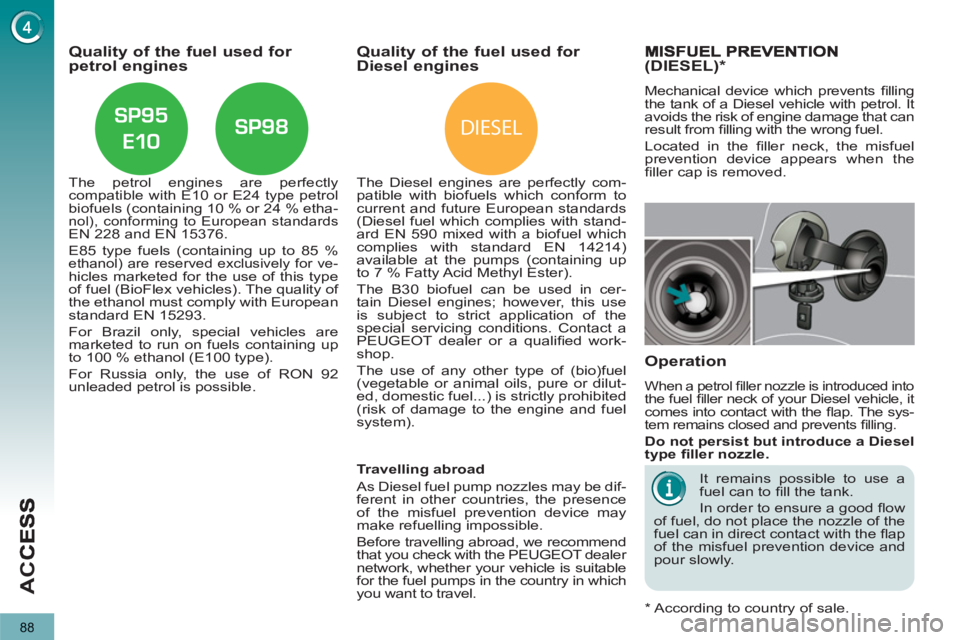
Mechanical device which prevents fi lling
the tank of a Diesel vehicle with petrol. It
avoids the risk of engine damage that can
result from fi lling with the wrong fuel.
Located in the fi ller neck, the misfuel
prevention device appears when the
fi ller cap is removed.
Operation
When a petrol fi ller nozzle is introduced into the fuel fi ller neck of your Diesel vehicle, it
comes into contact with the fl ap. The sys-
tem remains closed and prevents fi lling.
Do not persist but introduce a Diesel
type fi ller nozzle.
It remains possible to use a
fuel can to fi ll the tank.
In order to ensure a good fl ow
of fuel, do not place the nozzle of the
fuel can in direct contact with the fl ap
of the misfuel prevention device and
pour slowly.
Travelling abroad
As Diesel fuel pump nozzles may be dif-
ferent in other countries, the presence
of the misfuel prevention device may
make refuelling impossible.
Before travelling abroad, we recommend
that you check with the PEUGEOT dealer
network, whether your vehicle is suitable
for the fuel pumps in the country in which
you want to travel.
*
According to country of sale.
Page 159 of 364
D
R
157
6-SPEED MANUAL GEARBOX
As a safety precaution and to
facilitate starting of the engine: Only engage reverse gear
when the vehicle is stationary
with the engine at idle.
Engaging 5 thor 6 thgear
)
Move the lever fully to the right to
engage 5 th or 6 th
gear.
GEAR SHIFT INDICATOR *
O
peration
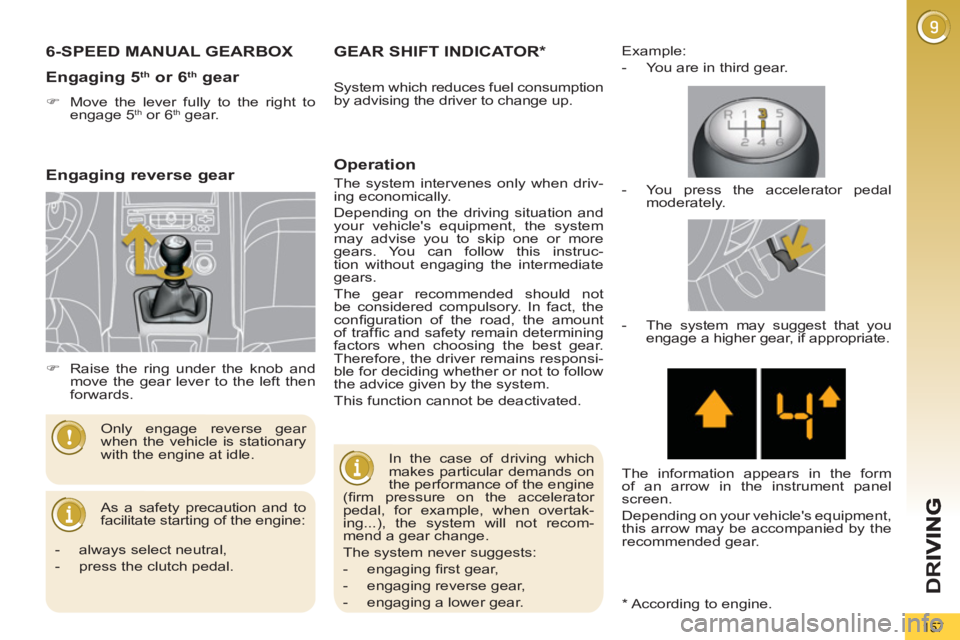
Example:
- You are in third gear.
In the case of driving which
makes particular demands on
the performance of the engine
(fi rm pressure on the accelerator
pedal, for example, when overtak-
ing...), the system will not recom-
mend a gear change.
The system never suggests:
- engaging fi rst gear,
- engaging reverse gear,
- engaging a lower gear.
- You press the accelerator pedal
moderately.
- The system may suggest that you
engage a higher gear, if appropriate.
The information appears in the form
of an arrow in the instrument panel
screen.
Depending on your vehicle's equipment,
this arrow may be accompanied by the
recommended gear.
- always select neutral,
- press the clutch pedal.
)
Raise the ring under the knob and
move the gear lever to the left then
forwards.
Engaging reverse gear
System which reduces fuel consumption
by advising the driver to change up.
The system intervenes only when driv-
ing economically.
Depending on the driving situation and
your vehicle's equipment, the system
may advise you to skip one or more
gears. You can follow this instruc-
tion without engaging the intermediate
gears.
The gear recommended should not
be considered compulsory. In fact, the
confi guration of the road, the amount
of traffi c and safety remain determining
factors when choosing the best gear.
Therefore, the driver remains responsi-
ble for deciding whether or not to follow
the advice given by the system.
This function cannot be deactivated.
*
According to engine.
Page 166 of 364
D
R
I
164
Stopping the vehicle
Before switching off the engine, you
can engage position P
or N
to place the
gearbox in neutral.
In both cases, apply the parking brake
to immobilise the vehicle, unless it is
programmed to automatic mode.
Operating fault
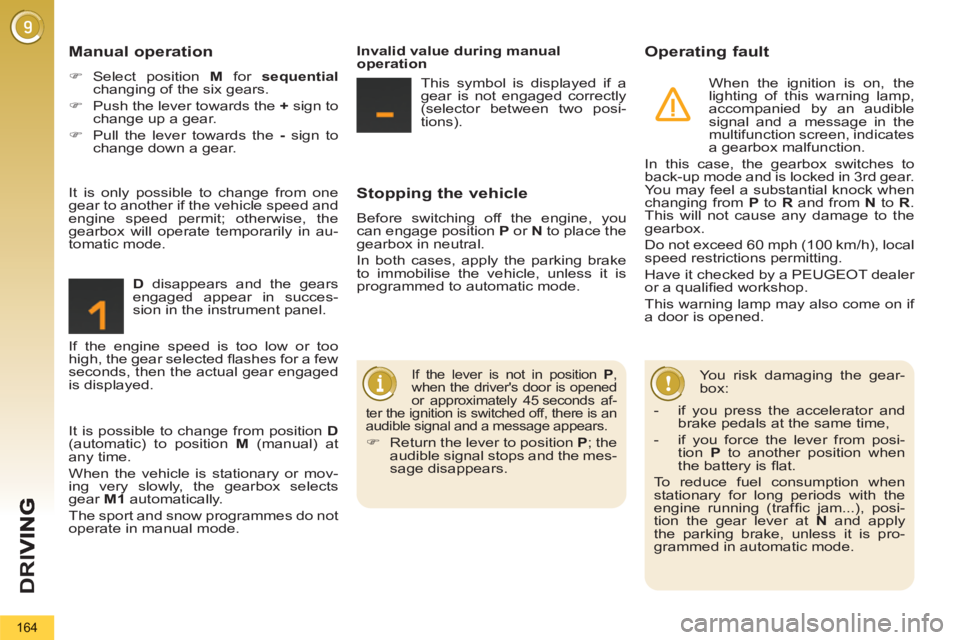
When the ignition is on, the
lighting of this warning lamp,
accompanied by an audible
signal and a message in the
multifunction screen, indicates
a gearbox malfunction.
In this case, the gearbox switches to
back-up mode and is locked in 3rd gear.
You may feel a substantial knock when
changing from P
to R
and from N
to R
.
This will not cause any damage to the
gearbox.
Do not exceed 60 mph (100 km/h), local
speed restrictions permitting.
Have it checked by a PEUGEOT dealer
or a qualifi ed workshop.
This warning lamp may also come on if
a door is opened.
You risk damaging the gear-
box:
Manual operation
)
Select position M
for sequential
changing of the six gears.
)
Push the lever towards the +
sign to
change up a gear.
)
Pull the lever towards the -
sign to
change down a gear.
D
disappears and the gears
engaged appear in succes-
sion in the instrument panel.
If the lever is not in position P
,
when the driver's door is opened
or approximately 45 seconds af-
ter the ignition is switched off, there is an
audible signal and a message appears.
)
Return the lever to position P
; the
audible signal stops and the mes-
sage disappears.
It is only possible to change from one
gear to another if the vehicle speed and
engine speed permit; otherwise, the
gearbox will operate temporarily in au-
tomatic mode.
Invalid value during manual
operation
This symbol is displayed if a
gear is not engaged correctly
(selector between two posi-
tions).
It is possible to change from position D
(automatic) to position M
(manual) at
any time.
When the vehicle is stationary or mov-
ing very slowly, the gearbox selects
gear M1
automatically.
The sport and snow programmes do not
operate in manual mode. If the engine speed is too low or too
high, the gear selected fl ashes for a few
seconds, then the actual gear engaged
is displayed.
- if you press the accelerator and
brake pedals at the same time,
- if you force the lever from posi-
tion P
to another position when
the battery is fl at.
To reduce fuel consumption when
stationary for long periods with the
engine running (traffi c jam...), posi-
tion the gear lever at N
and apply
the parking brake, unless it is pro-
grammed in automatic mode.
Page 167 of 364
D
R
165
STOP & START
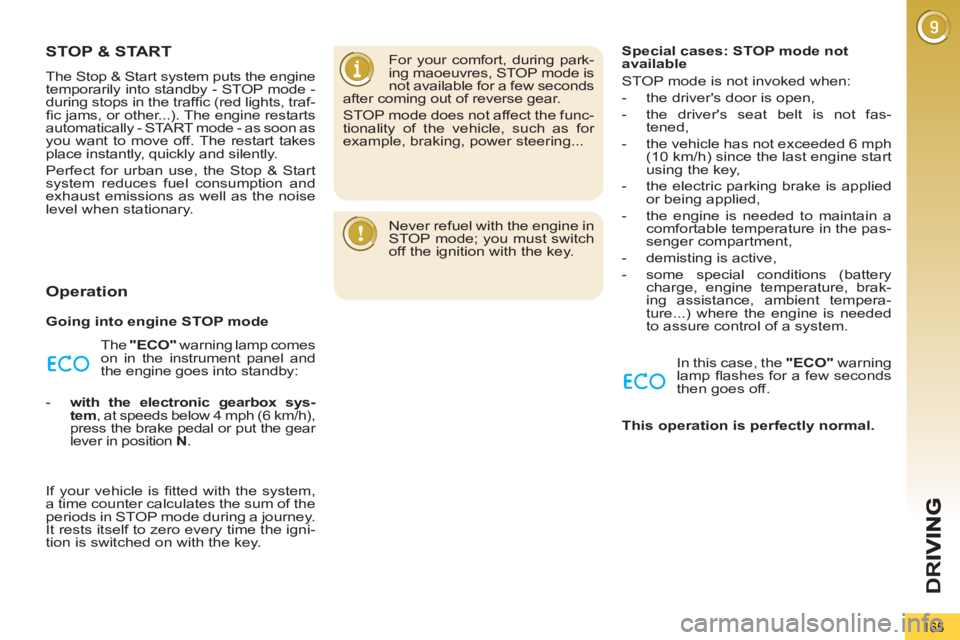
The Stop & Start system puts the engine
temporarily into standby - STOP mode -
during stops in the traffi c (red lights, traf-
fi c jams, or other...). The engine restarts
automatically - START mode - as soon as
you want to move off. The restart takes
place instantly, quickly and silently.
Perfect for urban use, the Stop & Start
system reduces fuel consumption and
exhaust emissions as well as the noise
level when stationary.
Operation
Going into engine STOP mode
The "ECO"
warning lamp comes
on in the instrument panel and
the engine goes into standby:
- with the electronic gearbox sys-
tem
, at speeds below 4 mph (6 km/h),
press the brake pedal or put the gear
lever in position N
.
If your vehicle is fi tted with the system,
a time counter calculates the sum of the
periods in STOP mode during a journey.
It rests itself to zero every time the igni-
tion is switched on with the key.
For your comfort, during park-
ing maoeuvres, STOP mode is
not available for a few seconds
after coming out of reverse gear.
STOP mode does not affect the func-
tionality of the vehicle, such as for
example, braking, power steering...
Never refuel with the engine in
STOP mode; you must switch
off the ignition with the key.
Special cases: STOP mode not
available
STOP mode is not invoked when:
- the driver's door is open,
- the driver's seat belt is not fas-
tened,
- the vehicle has not exceeded 6 mph
(10 km/h) since the last engine start
using the key,
- the electric parking brake is applied
or being applied,
- the engine is needed to maintain a
comfortable temperature in the pas-
senger compartment,
- demisting is active,
- some special conditions (battery
charge, engine temperature, brak-
ing assistance, ambient tempera-
ture...) where the engine is needed
to assure control of a system.
In this case, the "ECO"
warning
lamp fl ashes for a few seconds
then goes off.
This operation is perfectly normal.
Page 176 of 364
CHECKS
174
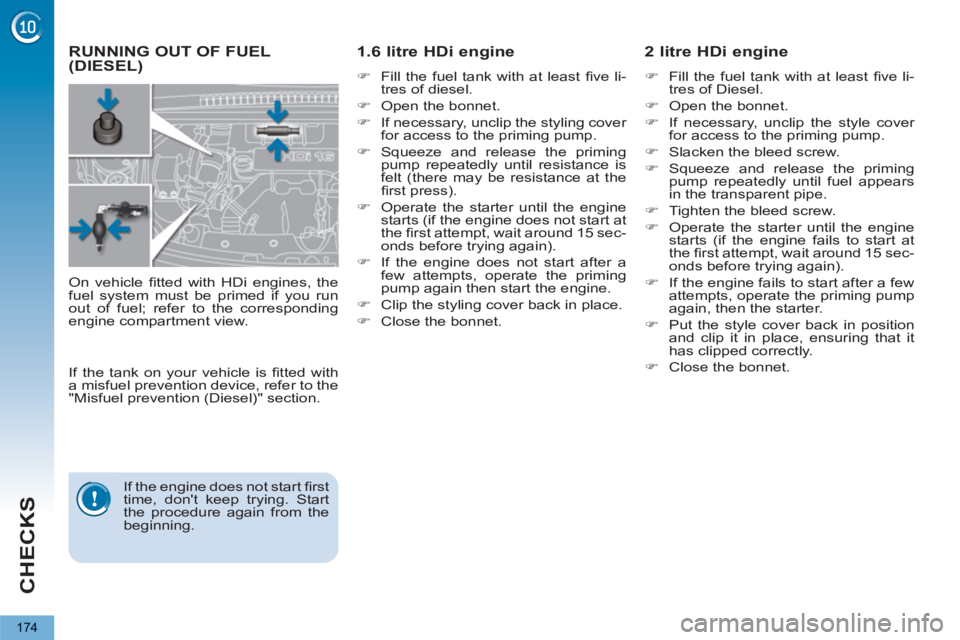
RUNNING OUT OF FUEL(DIESEL)
1.6 litre HDi engine
)
Fill the fuel tank with at least fi ve li-
tres of diesel.
)
Open the bonnet.
)
If necessary, unclip the styling cover
for access to the priming pump.
)
Squeeze and release the priming
pump repeatedly until resistance is
felt (there may be resistance at the
fi rst press).
)
Operate the starter until the engine
starts (if the engine does not start at
the fi rst attempt, wait around 15 sec-
onds before trying again).
)
If the engine does not start after a
few attempts, operate the priming
pump again then start the engine.
)
Clip the styling cover back in place.
)
Close the bonnet.
2 litre HDi engine
)
Fill the fuel tank with at least fi ve li-
tres of Diesel.
)
Open the bonnet.
)
If necessary, unclip the style cover
for access to the priming pump.
)
Slacken the bleed screw.
)
Squeeze and release the priming
pump repeatedly until fuel appears
in the transparent pipe.
)
Tighten the bleed screw.
)
Operate the starter until the engine
starts (if the engine fails to start at
the fi rst attempt, wait around 15 sec-
onds before trying again).
)
If the engine fails to start after a few
attempts, operate the priming pump
again, then the starter.
)
Put the style cover back in position
and clip it in place, ensuring that it
has clipped correctly.
)
Close the bonnet.
On vehicle fi tted with HDi engines, the
fuel system must be primed if you run
out of fuel; refer to the corresponding
engine compartment view.
If the engine does not start fi rst
time, don't keep trying. Start
the procedure again from the
beginning.
If the tank on your vehicle is fi tted with
a misfuel prevention device, refer to the
"Misfuel prevention (Diesel)" section.
Page 178 of 364
CHECKS
176
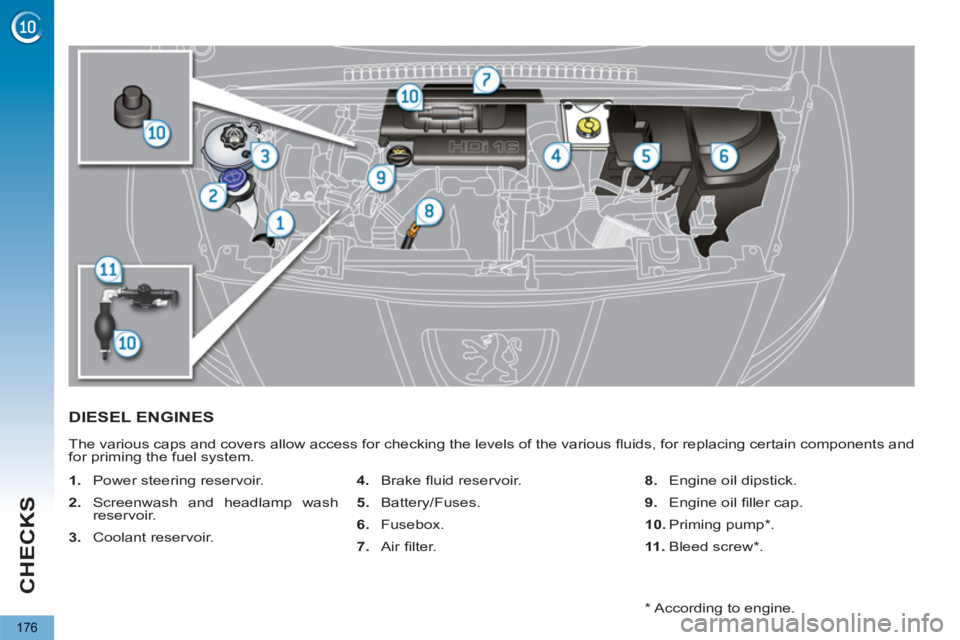
DIESEL ENGINES
The various caps and covers allow access for checking the levels of the various fl uids, for replacing certain components and
for priming the fuel system.
1.
Power steering reservoir.
2.
Screenwash and headlamp wash
reservoir.
3.
Coolant reservoir.
4.
Brake fl uid reservoir.
5.
Battery/Fuses.
6.
Fusebox.
7.
Air fi lter.
8.
Engine oil dipstick.
9.
Engine oil fi ller cap.
10.
Priming pump * .
11 .
Bleed screw * .
*
According to engine.
Page 207 of 364
PRACTICAL INFORMATION
205
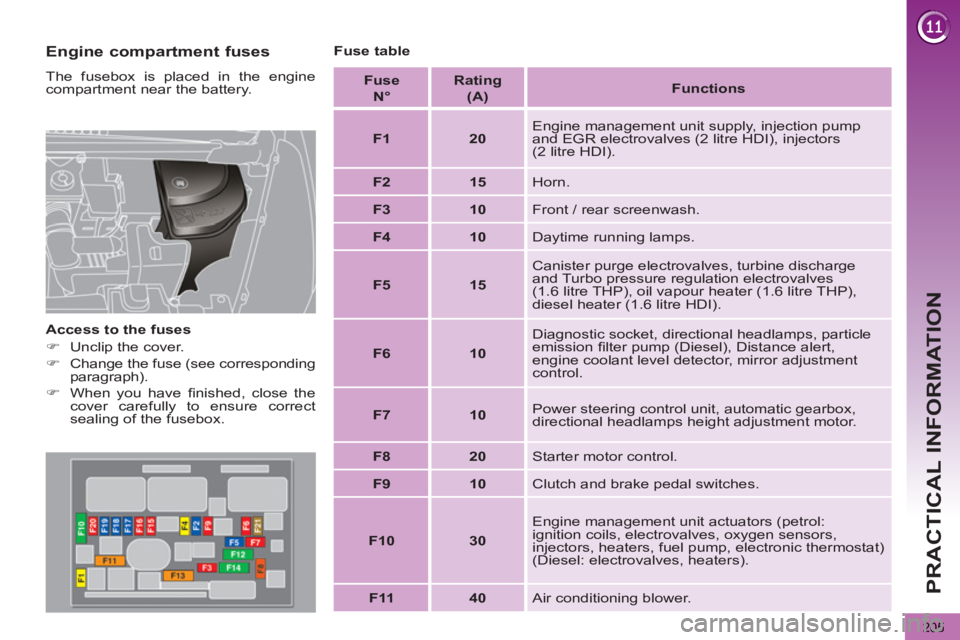
Engine compartment fuses
The fusebox is placed in the engine
compartment near the battery.
Access to the fuses
)
Unclip the cover.
)
Change the fuse (see corresponding
paragraph).
)
When you have fi nished, close the
cover carefully to ensure correct
sealing of the fusebox.
Fuse table
Fuse
N°
Rating
(A)
Functions
F1
20
Engine management unit supply, injection pump
and EGR electrovalves (2 litre HDI), injectors
(2 litre HDI).
F2
15
Horn.
F3
10
Front / rear screenwash.
F4
10
Daytime running lamps.
F5
15
Canister purge electrovalves, turbine discharge
and Turbo pressure regulation electrovalves
(1.6 litre THP), oil vapour heater (1.6 litre THP),
diesel heater (1.6 litre HDI).
F6
10
Diagnostic socket, directional headlamps, particle
emission fi lter pump (Diesel), Distance alert,
engine coolant level detector, mirror adjustment
control.
F7
10
Power steering control unit, automatic gearbox,
directional headlamps height adjustment motor.
F8
20
Starter motor control.
F9
10
Clutch and brake pedal switches.
F10
30
Engine management unit actuators (petrol:
ignition coils, electrovalves, oxygen sensors,
injectors, heaters, fuel pump, electronic thermostat)
(Diesel: electrovalves, heaters).
F11
40
Air conditioning blower.
Page 219 of 364
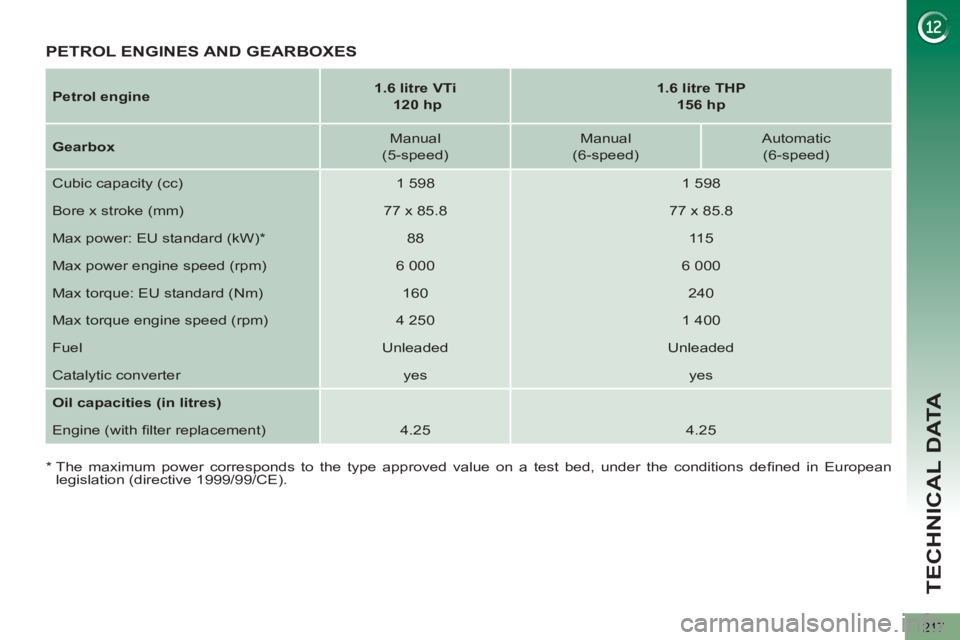
TECHNICAL DATA
217
Petrol engine
1.6 litre VTi
120 hp
1.6 litre THP
156 hp
Gearbox
Manual
(5-speed)
Manual
(6-speed)
Automatic
(6-speed)
Cubic capacity (cc)
1 598
1 598
Bore x stroke (mm)
77 x 85.8
77 x 85.8
Max power: EU standard (kW) *
88
11 5
Max power engine speed (rpm)
6 000
6 000
Max torque: EU standard (Nm)
160
240
Max torque engine speed (rpm)
4 250
1 400
Fuel
Unleaded
Unleaded
Catalytic converter
yes
yes
Oil capacities (in litres)
Engine (with fi lter replacement)
4.25
4.25
PETROL ENGINES AND GEARBOXES
*
The maximum power corresponds to the type approved value on a test bed, under the conditions defi ned in European
legislation (directive 1999/99/CE).
Page 221 of 364
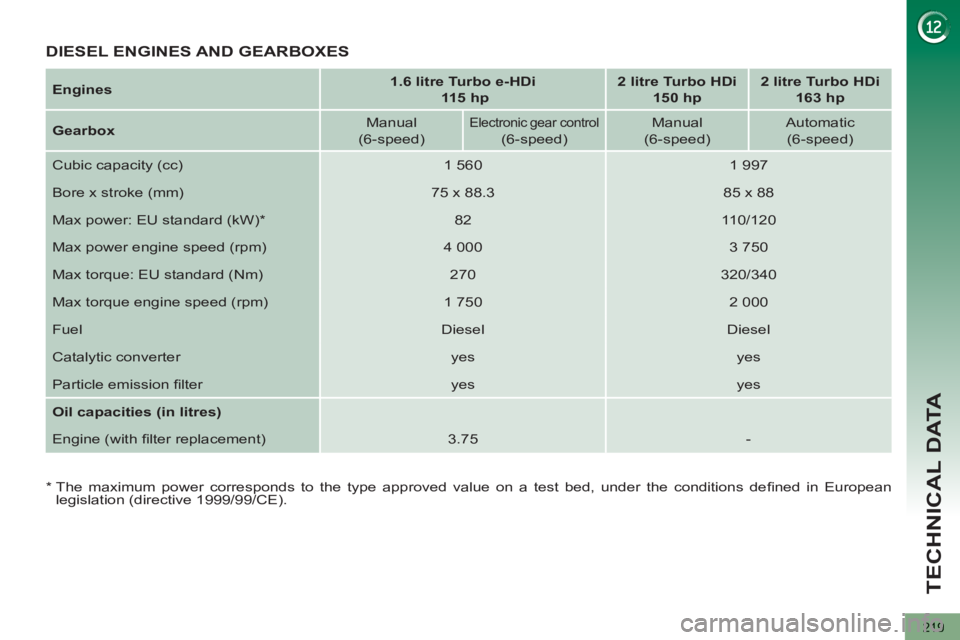
TECHNICAL DATA
219
Engines
1.6 litre Turbo e-HDi
115 hp
2 litre Turbo HDi
150 hp
2 litre Turbo HDi
163 hp
Gearbox
Manual
(6-speed)
Electronic gear control
(6-speed)
Manual
(6-speed)
Automatic
(6-speed)
Cubic capacity (cc)
1 560
1 997
Bore x stroke (mm)
75 x 88.3
85 x 88
Max power: EU standard (kW) *
82
110/120
Max power engine speed (rpm)
4 000
3 750
Max torque: EU standard (Nm)
270
320/340
Max torque engine speed (rpm)
1 750
2 000
Fuel
Diesel
Diesel
Catalytic converter
yes
yes
Particle emission fi lter
yes
yes
Oil capacities (in litres)
Engine (with fi lter replacement)
3.75
-
DIESEL ENGINES AND GEARBOXES
*
The maximum power corresponds to the type approved value on a test bed, under the conditions defi ned in European
legislation (directive 1999/99/CE).