service PEUGEOT 5008 2015.5. User Guide
[x] Cancel search | Manufacturer: PEUGEOT, Model Year: 2015.5., Model line: 5008, Model: PEUGEOT 5008 2015.5.Pages: 364, PDF Size: 12.82 MB
Page 32 of 364
30
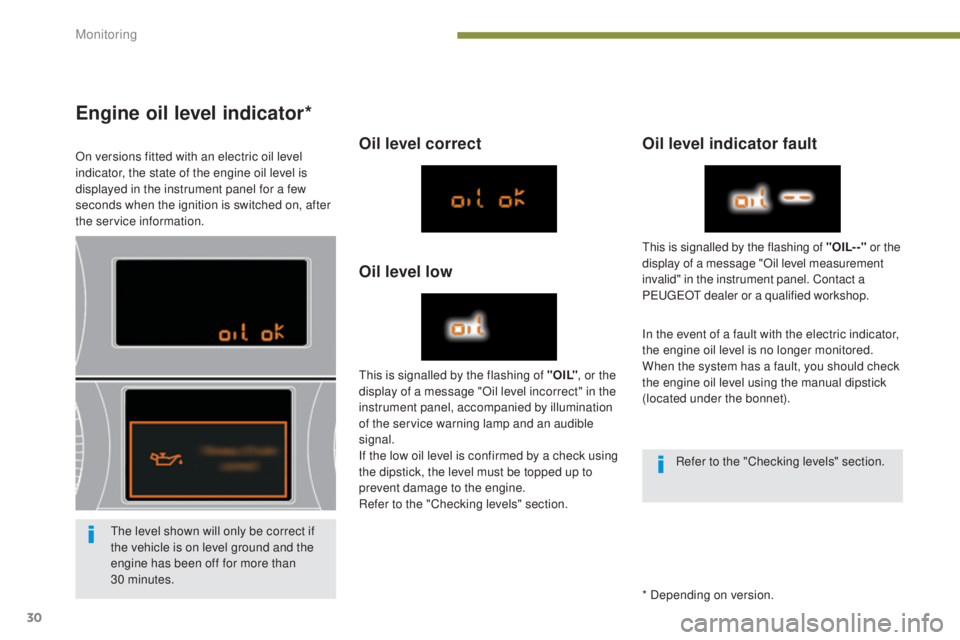
Engine oil level indicator*
On versions fitted with an electric oil level
indicator, the state of the engine oil level is
displayed in the instrument panel for a few
seconds when the ignition is switched on, after
the service information.Oil level correct
Oil level lowOil level indicator fault
In the event of a fault with the electric indicator,
the engine oil level is no longer monitored.
When the system has a fault, you should check
the engine oil level using the manual dipstick
(located under the bonnet).
This is signalled by the flashing of " O I L"
, or the
display of a message "Oil level incorrect" in the
instrument panel, accompanied by illumination
of the service warning lamp and an audible
signal.
If the low oil level is confirmed by a check using
the dipstick, the level must be topped up to
prevent damage to the engine.
Refer to the "Checking levels" section. This is signalled by the flashing of "OIL- -"
or the
display of a message "Oil level measurement
invalid" in the instrument panel. Contact a
PEUGEOT dealer or a qualified workshop.
The level shown will only be correct if
the vehicle is on level ground and the
engine has been off for more than
30 minutes. * Depending on version.Refer to the "Checking levels" section.
Monitoring
Page 40 of 364
38
Display configuration
Once this menu has been selected, you have
access to the following settings:
-
b
rightness-video setting,
-
d
ate and time setting,
-
s
election of the units.
Adjusting the date and time
F
P
ress the " 7" or " 8" button to select the
"Display configuration" menu, then the
"OK" button.
F
P
ress the " 5" or " 6" button, to select the
"Adjust date and time" line, then on the
"OK" button.
F
P
ress the " 7" or " 8" button to select the
setting to modify. Confirm by pressing the
"OK"
button then adjust the setting and
confirm again to save the modification.
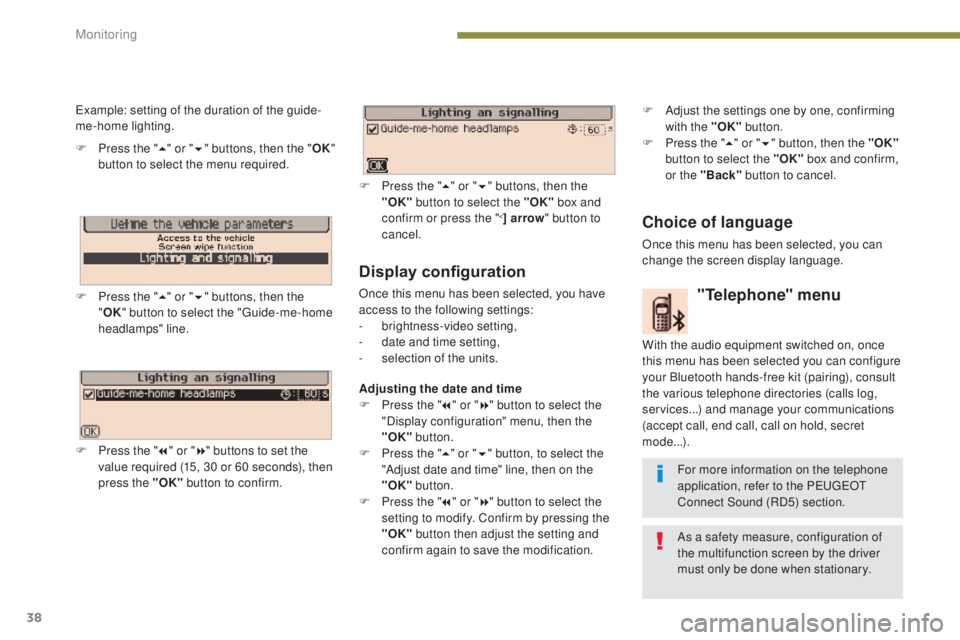
Example: setting of the duration of the guide-
me-home lighting.
F
P
ress the "
5" or " 6" buttons, then the " OK"
button to select the menu required.
F
P
ress the " 5" or " 6" buttons, then the
" OK " button to select the "Guide-me-home
headlamps" line.
F
P
ress the " 7" or " 8" buttons to set the
value required (15, 30 or 60 seconds), then
press the "OK" button to confirm. F
P
ress the "
5" or " 6" buttons, then the
"OK" button to select the "OK" box and
confirm or press the "
<] arrow " button to
cancel.
"Telephone" menu
With the audio equipment switched on, once
this menu has been selected you can configure
your Bluetooth hands-free kit (pairing), consult
the various telephone directories (calls log,
services...) and manage your communications
(accept call, end call, call on hold, secret
mode...).
For more information on the telephone
application, refer to the P
E
UGEOT
C
onnect Sound (RD5) section.
As a safety measure, configuration of
the multifunction screen by the driver
must only be done when stationary.
Choice of language
Once this menu has been selected, you can
change the screen display language. F
A
djust the settings one by one, confirming
with the "OK" button.
F
P
ress the "
5" or " 6" button, then the "OK"
button to select the "OK" box and confirm,
or the "Back" button to cancel.
Monitoring
Page 52 of 364
50
Lost keys
Go to a PEUGEOT dealer with the vehicle's registration document, your personal
identification documents and if possible the key code label.
The PEUGEOT dealer will be able to look up the key code and the transponder code
required to order a new key.Do not throw the remote control
batteries away, they contain metals
which are harmful to the environment.
Take them to an approved collection
point.
Remote control
The high frequency remote control is a sensitive system; do not operate it while it is in your
pocket as there is a possibility that it may unlock the vehicle, without you being aware of it.
Do not repeatedly press the buttons of your remote control out of range and out of sight of
your vehicle. You run the risk of stopping it from working and the remote control would have
to be reinitialised.
No remote control can operate when the key is in the ignition switch, even when the ignition
is switched off, except for reinitialisation.
Locking the vehicle
Driving with the doors locked may make access to the passenger compartment by the
emergency services more difficult in an emergency.
As a safety precaution, never leave children alone in the vehicle, except for a very short
period.
In all cases, it is essential to remove the key from the ignition switch when leaving the vehicle.
Anti-theft protection
Do not make any modifications to the electronic engine immobiliser system; this could
cause malfunctions.
When purchasing a second-hand vehicle
Have the pairing of all of the keys in your possession checked by a PEUGEOT dealer, to
ensure that only your keys can be used to open and start the vehicle.
Access
Page 53 of 364
51
Alarm
Locking the vehicle with full
alarm
Exterior perimiter protection
The system detects opening of the vehicle.
The alarm is triggered if anyone tries to enter
the vehicle by forcing a door, the boot or the
bonnet.
Interior volumetric protection
The system detects any variation in the volume
in the passenger compartment.
The alarm is triggered if anyone breaks a
window or moves inside the vehicle.
If you wish to leave a pet in the vehicle or a
window partially open, deactivate the interior
volumetric protection.
Anti-tamper function
The system detects the putting out of service of
its components.
The alarm is triggered if anyone tries to put
the wires of the siren, the central control or the
battery out of service.
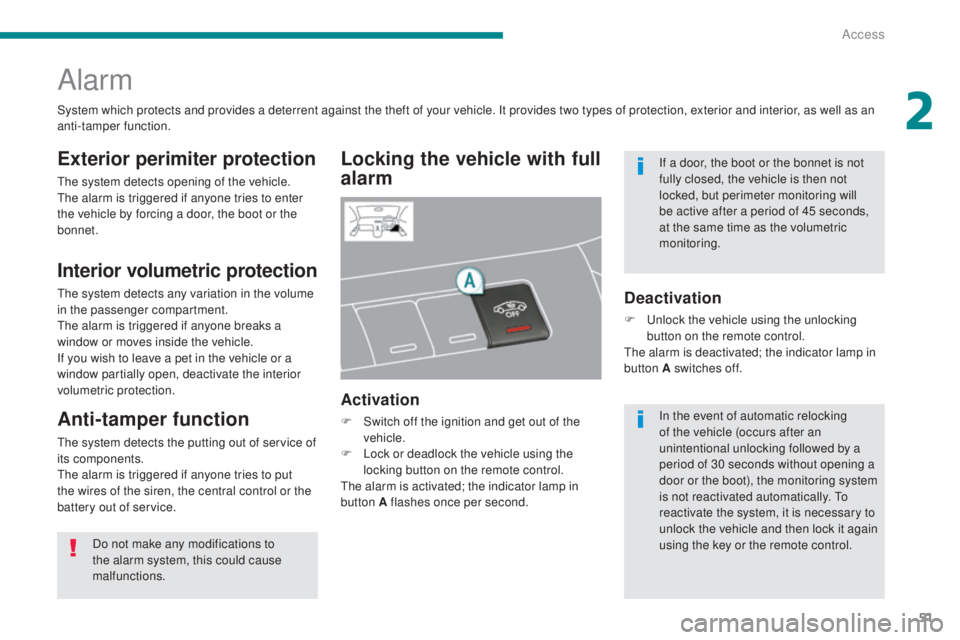
Activation
F Switch off the ignition and get out of the
vehicle.
F
L
ock or deadlock the vehicle using the
locking button on the remote control.
The alarm is activated; the indicator lamp in
button A flashes once per second.
System which protects and provides a deterrent against the theft of your vehicle. It provides two types of protection, exterior and interior, as well as an
anti-tamper function.
Do not make any modifications to
the alarm system, this could cause
malfunctions. If a door, the boot or the bonnet is not
fully closed, the vehicle is then not
locked, but perimeter monitoring will
be active after a period of 45 seconds,
at the same time as the volumetric
monitoring.
In the event of automatic relocking
of the vehicle (occurs after an
unintentional unlocking followed by a
period of 30 seconds without opening a
door or the boot), the monitoring system
is not reactivated automatically. To
reactivate the system, it is necessary to
unlock the vehicle and then lock it again
using the key or the remote control.
Deactivation
F Unlock the vehicle using the unlocking
button on the remote control.
The alarm is deactivated; the indicator lamp in
button A switches off.
2
Access
Page 156 of 364
154
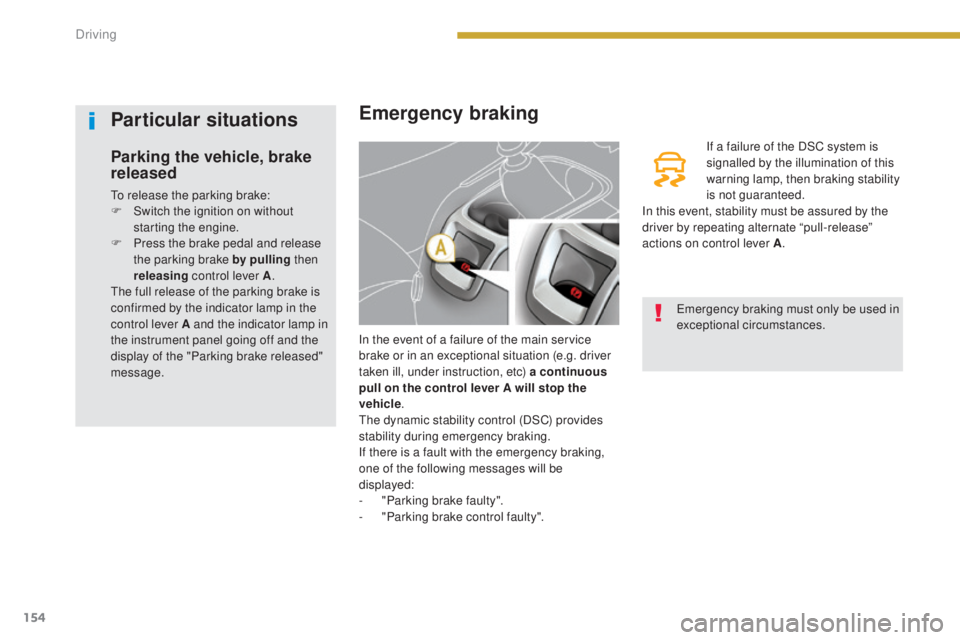
Emergency braking
In the event of a failure of the main service
brake or in an exceptional situation (e.g. driver
taken ill, under instruction, etc) a continuous
pull on the control lever A will stop the
vehicle .
The dynamic stability control (DSC) provides
stability during emergency braking.
If there is a fault with the emergency braking,
one of the following messages will be
displayed:
-
"
Parking brake faulty".
-
"
Parking brake control faulty". If a failure of the DSC system is
signalled by the illumination of this
warning lamp, then braking stability
is not guaranteed.
In this event, stability must be assured by the
driver by repeating alternate “pull-release”
actions on control lever A .
Particular situations
Parking the vehicle, brake
released
To release the parking brake:
F
S witch the ignition on without
starting the engine.
F
P
ress the brake pedal and release
the parking brake by pulling then
releasing control lever A .
The full release of the parking brake is
confirmed by the indicator lamp in the
control lever A and the indicator lamp in
the instrument panel going off and the
display of the "Parking brake released"
message. Emergency braking must only be used in
exceptional circumstances.
Driving
Page 186 of 364
184
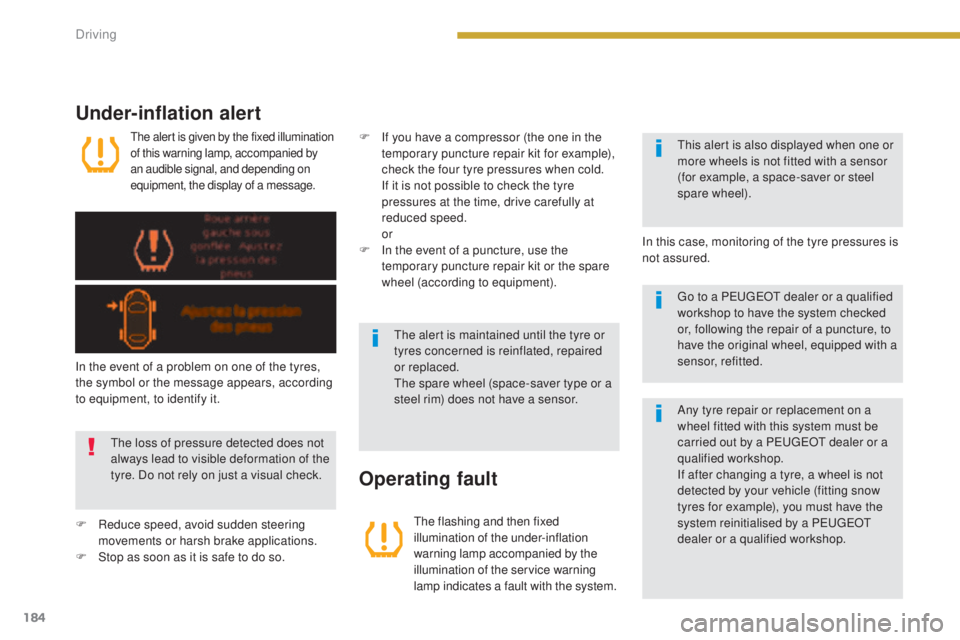
The alert is given by the fixed illumination
of this warning lamp, accompanied by
an audible signal, and depending on
equipment, the display of a message.
Under-inflation alert
The flashing and then fixed
illumination of the under-inflation
warning lamp accompanied by the
illumination of the service warning
lamp indicates a fault with the system.
Operating fault
In the event of a problem on one of the tyres,
the symbol or the message appears, according
to equipment, to identify it.
F
R
educe speed, avoid sudden steering
movements or harsh brake applications.
F
S
top as soon as it is safe to do so.The loss of pressure detected does not
always lead to visible deformation of the
tyre. Do not rely on just a visual check. The alert is maintained until the tyre or
tyres concerned is reinflated, repaired
or replaced.
The spare wheel (space-saver type or a
steel rim) does not have a sensor.This alert is also displayed when one or
more wheels is not fitted with a sensor
(for example, a space-saver or steel
spare wheel).
In this case, monitoring of the tyre pressures is
not assured. Go to a PEUGEOT dealer or a qualified
workshop to have the system checked
or, following the repair of a puncture, to
have the original wheel, equipped with a
sensor, refitted.
F
I
f you have a compressor (the one in the
temporary puncture repair kit for example),
check the four tyre pressures when cold.
I
f it is not possible to check the tyre
pressures at the time, drive carefully at
reduced speed.
or
F
I
n the event of a puncture, use the
temporary puncture repair kit or the spare
wheel (according to equipment).
Any tyre repair or replacement on a
wheel fitted with this system must be
carried out by a PEUGEOT dealer or a
qualified workshop.
If after changing a tyre, a wheel is not
detected by your vehicle (fitting snow
tyres for example), you must have the
system reinitialised by a PEUGEOT
dealer or a qualified workshop.
Driving
Page 201 of 364
199
Checking levels
Engine oil level
The check is carried out either when
the ignition is switched on using the
oil level indicator in the instrument
panel for vehicles so equipped, or
using the dipstick.
Check all of these levels regularly, in line with the manufacturer's service schedule. Top them up if necessary, unless other wise indicated.
If a level drops significantly, have the corresponding system checked by a PEUGEOT dealer or a qualified workshop.
It is normal to top up the oil level between
two services (or oil changes). PEUGEOT
recommends that you check the level, and top
up if necessary, every 3 000 miles (5 000 kms). Take care when working under the bonnet, as certain areas of the engine may be extremely hot (risk of burns) and the cooling fan could start at
any time (even with the ignition off).
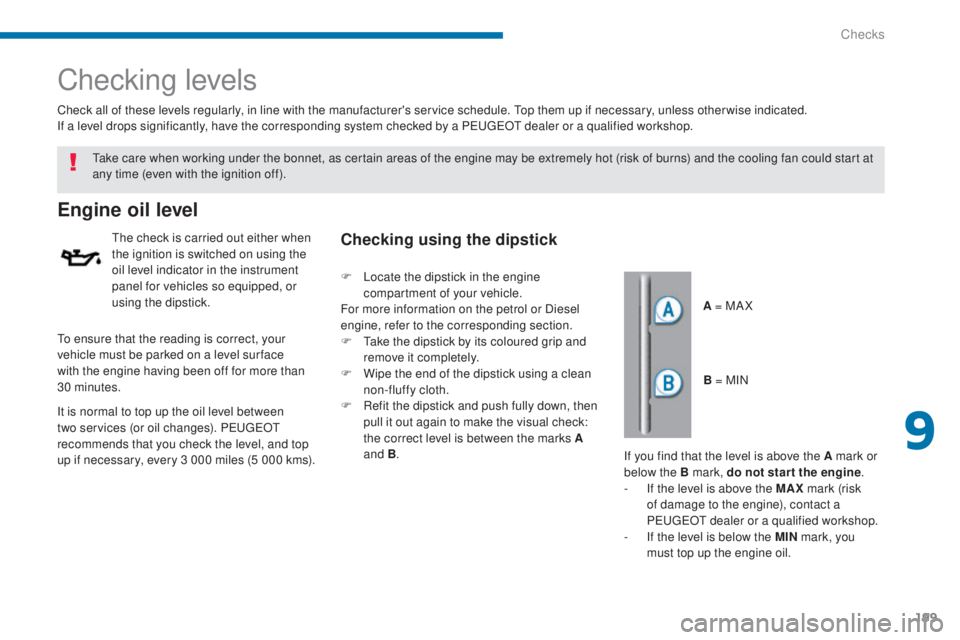
If you find that the level is above the A mark or
below the B mark, do not star t the engine.
-
I
f the level is above the MAX mark (risk
of damage to the engine), contact a
PEUGEOT dealer or a qualified workshop.
-
I
f the level is below the MIN mark, you
must top up the engine oil. A = MA X
To ensure that the reading is correct, your
vehicle must be parked on a level sur face
with the engine having been off for more than
30
minutes.Checking using the dipstick
B = MIN
F
L
ocate the dipstick in the engine
compartment of your vehicle.
For more information on the petrol or Diesel
engine, refer to the corresponding section.
F
T
ake the dipstick by its coloured grip and
remove it completely.
F
W
ipe the end of the dipstick using a clean
non-fluffy cloth.
F
R
efit the dipstick and push fully down, then
pull it out again to make the visual check:
the correct level is between the marks A
and B .
9
Checks
Page 202 of 364
200
Power steering fluid
level
The power steering fluid level should
be close to the "MA X" mark. With
the engine cold, unscrew the cap to
check the level.
Fluid specification
The brake fluid must conform to the
manufacturer's recommendations.
Changing the fluid
Refer to the manufacturer's service schedule
for details of the interval for this operation.
Brake fluid level
The brake fluid level should be close
to the "MA X" mark. If it is not, check
the brake pad wear.
After topping-up the oil, the check when
switching on the ignition with the oil
level indicator in the instrument panel
is not valid during the 30 minutes after
topping up.Oil grade
Before topping-up the oil or changing the oil,
check that the oil is the correct grade for your
engine and conforms to the manufacturer's
recommendations.
Topping-up the engine oil level
F Locate the oil filler cap in the engine
compartment of your vehicle.
For more information on the petrol or Diesel
engine, refer to the corresponding section.
F
U
nscrew the oil filler cap to reveal the filler
aperture.
F
A
dd oil in small quantities, avoiding any
spills on engine components (risk of fire).
F
W
ait a few minutes before checking the
level again using the dipstick.
F
A
dd more oil if necessary.
F
A
fter checking the level, carefully refit the
oil filler cap and the dipstick in its tube.
Engine oil change
Refer to the manufacturer's service schedule
for details of the interval for this operation.
In order to maintain the reliability of the engine
and emission control system, never use
additives in the engine oil.
Checks
Page 204 of 364
202
Particle filter (Diesel)
Checks
Unless otherwise indicated, check these
components in accordance with the
manufacturer's service schedule and according
to your engine.
Other wise, have them checked by a PEUGEOT
dealer or a qualified workshop.
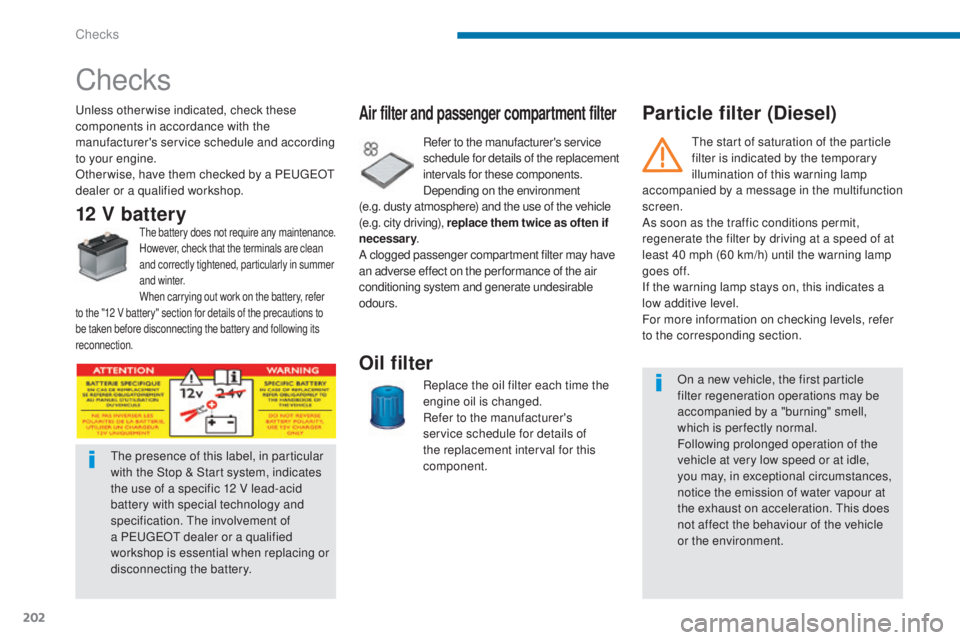
12 V batteryThe battery does not require any maintenance.
However, check that the terminals are clean
and correctly tightened, particularly in summer
and winter.
When carrying out work on the battery, refer
to the "12 V battery" section for details of the precautions to
be taken before disconnecting the battery and following its
reconnection.
Air filter and passenger compartment filter
Refer to the manufacturer's service
schedule for details of the replacement
intervals for these components.
Depending on the environment
(e.g. dusty atmosphere) and the use of the vehicle
(e.g. city driving), replace them twice as often if
necessary .
A clogged passenger compartment filter may have
an adverse effect on the per formance of the air
conditioning system and generate undesirable
odours.
Oil filter
Replace the oil filter each time the
engine oil is changed.
Refer to the manufacturer's
service schedule for details of
the replacement interval for this
component. On a new vehicle, the first particle
filter regeneration operations may be
accompanied by a "burning" smell,
which is per fectly normal.
Following prolonged operation of the
vehicle at very low speed or at idle,
you may, in exceptional circumstances,
notice the emission of water vapour at
the exhaust on acceleration. This does
not affect the behaviour of the vehicle
or the environment.
The presence of this label, in particular
with the Stop & Start system, indicates
the use of a specific 12 V lead-acid
battery with special technology and
specification. The involvement of
a PEUGEOT dealer or a qualified
workshop is essential when replacing or
disconnecting the battery. The start of saturation of the particle
filter is indicated by the temporary
illumination of this warning lamp
accompanied by a message in the multifunction
screen.
As soon as the traffic conditions permit,
regenerate the filter by driving at a speed of at
least 40 mph (60 km/h) until the warning lamp
goes off.
If the warning lamp stays on, this indicates a
low additive level.
For more information on checking levels, refer
to the corresponding section.
Checks
Page 205 of 364
203
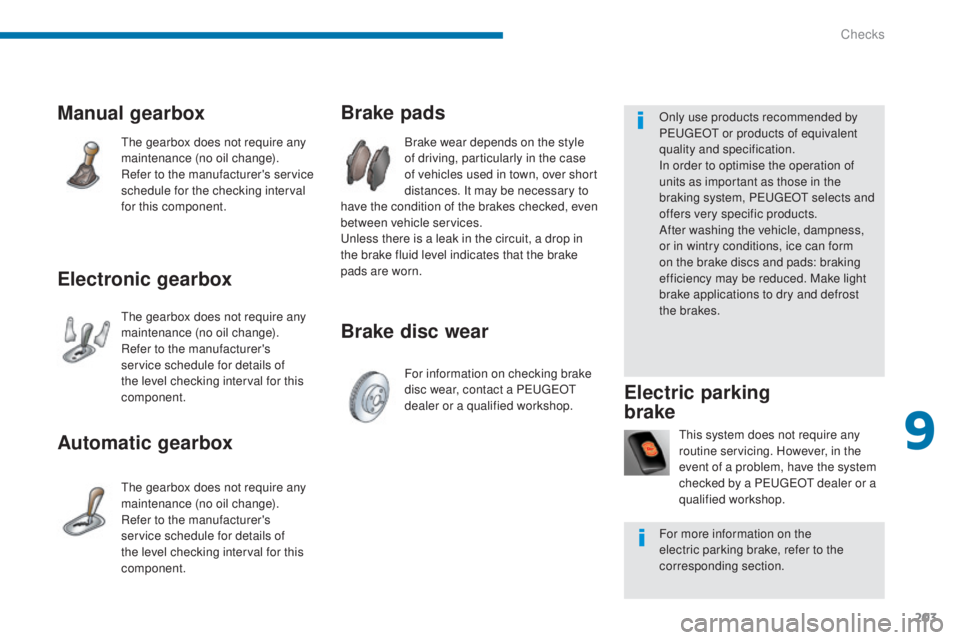
Brake disc wear Brake pads
Brake wear depends on the style
of driving, particularly in the case
of vehicles used in town, over short
distances. It may be necessary to
have the condition of the brakes checked, even
between vehicle services.
Unless there is a leak in the circuit, a drop in
the brake fluid level indicates that the brake
pads are worn.
For information on checking brake
disc wear, contact a PEUGEOT
dealer or a qualified workshop.
Manual gearbox
The gearbox does not require any
maintenance (no oil change).
Refer to the manufacturer's service
schedule for the checking interval
for this component.
Electronic gearbox
The gearbox does not require any
maintenance (no oil change).
Refer to the manufacturer's
service schedule for details of
the level checking interval for this
component.
Automatic gearbox
The gearbox does not require any
maintenance (no oil change).
Refer to the manufacturer's
service schedule for details of
the level checking interval for this
component. This system does not require any
routine servicing. However, in the
event of a problem, have the system
checked by a PEUGEOT dealer or a
qualified workshop.
Electric parking
brake
Only use products recommended by
PEUGEOT or products of equivalent
quality and specification.
In order to optimise the operation of
units as important as those in the
braking system, PEUGEOT selects and
offers very specific products.
After washing the vehicle, dampness,
or in wintry conditions, ice can form
on the brake discs and pads: braking
efficiency may be reduced. Make light
brake applications to dry and defrost
the brakes.
For more information on the
electric parking brake, refer to the
corresponding section.
9
Checks