key PEUGEOT 5008 2015.5. Owner's Manual
[x] Cancel search | Manufacturer: PEUGEOT, Model Year: 2015.5., Model line: 5008, Model: PEUGEOT 5008 2015.5.Pages: 364, PDF Size: 12.82 MB
Page 136 of 364
134
Manual child
lock
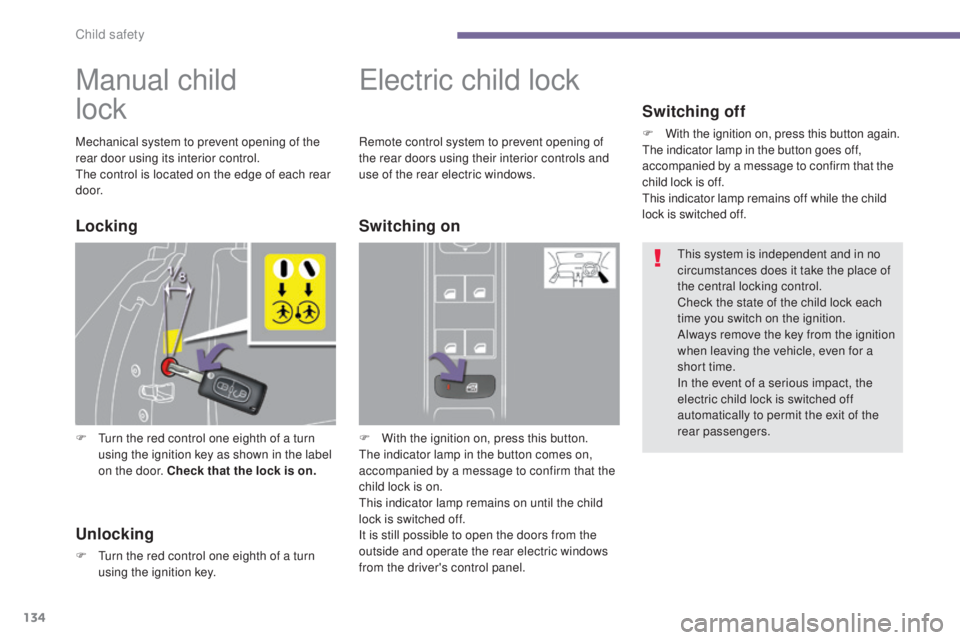
F Turn the red control one eighth of a turn using the ignition key as shown in the label
on the door. Check that the lock is on.
Electric child lock
F With the ignition on, press this button.
The indicator lamp in the button comes on,
accompanied by a message to confirm that the
child lock is on.
This indicator lamp remains on until the child
lock is switched off.
It is still possible to open the doors from the
outside and operate the rear electric windows
from the driver's control panel.
Locking
Unlocking
F Turn the red control one eighth of a turn using the ignition key.
Switching on Switching off
F With the ignition on, press this button again.
The indicator lamp in the button goes off,
accompanied by a message to confirm that the
child lock is off.
This indicator lamp remains off while the child
lock is switched off.
This system is independent and in no
circumstances does it take the place of
the central locking control.
Check the state of the child lock each
time you switch on the ignition.
Always remove the key from the ignition
when leaving the vehicle, even for a
short time.
In the event of a serious impact, the
electric child lock is switched off
automatically to permit the exit of the
rear passengers.
Remote control system to prevent opening of
the rear doors using their interior controls and
use of the rear electric windows.
Mechanical system to prevent opening of the
rear door using its interior control.
The control is located on the edge of each rear
d o o r.
Child safety
Page 146 of 364
144
Operating fault
If this warning lamp comes on,
accompanied by an audible
warning and a message, contact
a PEUGEOT dealer or a qualified
workshop without delay to have the system
checked. The airbags may no longer be
deployed in the event of a serious impact.
Reactivation
When you remove the rear ward facing child
seat, with the ignition off , turn the switch to
the "ON" position to reactivate the airbag and
so assure the safety of your front passenger in
the event of an impact.
When switching the ignition on,
this warning lamp comes on in the
seat belt and passenger's front
airbag warning lamps display for
approximately one minute, to signal that the
passenger's front airbag is activated.
On switching on the ignition, this
warning lamp comes on in the
instrument panel and/or in the seat
belt and passenger's front airbag
warning lamps display. It stays on
until the airbag is reactivated.
Deactivation
Only the passenger's front airbag can be
deactivated.
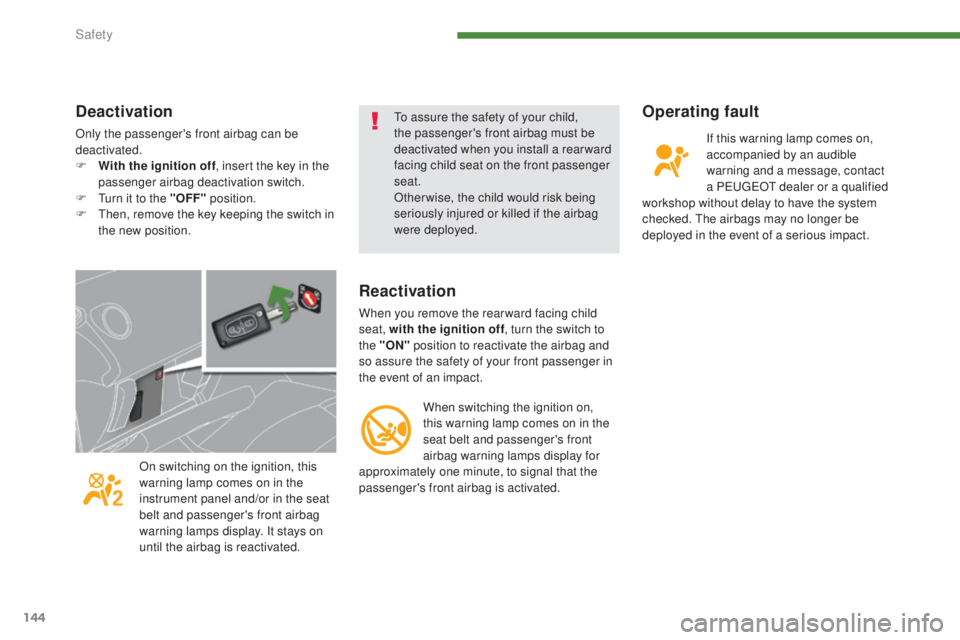
F
W
ith the ignition off , insert the key in the
passenger airbag deactivation switch.
F
T
urn it to the "OFF" position.
F
T
hen, remove the key keeping the switch in
the new position. To assure the safety of your child,
the passenger's front airbag must be
deactivated when you install a rear ward
facing child seat on the front passenger
seat.
Otherwise, the child would risk being
seriously injured or killed if the airbag
were deployed.
Safety
Page 150 of 364
148
Electronic engine immobiliserIgnition switch
Starting-switching off the engine
Anti-theft protection
In the event of a fault, you are informed
by illumination of this warning lamp, an
audible signal and/or the display of a
message, depending on version.
In this case, your vehicle will not start;
contact a PEUGEOT dealer as soon as
possible.
Keep safely, away from your vehicle,
the label attached to the keys given to
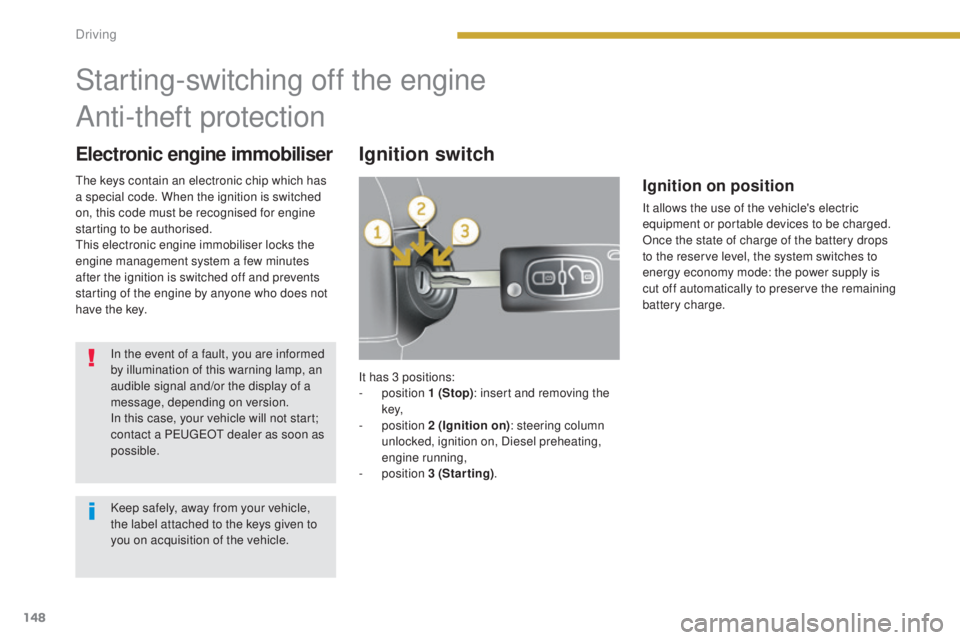
you on acquisition of the vehicle. It has 3 positions:
-
position 1 (Stop): insert and removing the
key,
-
position 2 (Ignition on) : steering column
unlocked, ignition on, Diesel preheating,
engine running,
-
position 3 (Starting) .
Ignition on position
It allows the use of the vehicle's electric
equipment or portable devices to be charged.
Once the state of charge of the battery drops
to the reserve level, the system switches to
energy economy mode: the power supply is
cut off automatically to preserve the remaining
battery charge.
The keys contain an electronic chip which has
a special code. When the ignition is switched
on, this code must be recognised for engine
starting to be authorised.
This electronic engine immobiliser locks the
engine management system a few minutes
after the ignition is switched off and prevents
starting of the engine by anyone who does not
have the key.
Driving
Page 151 of 364
149
Wait until this warning lamp goes off in the
instrument panel then operate the starter
motor by turning the key to position 3
without pressing the accelerator pedal,
until the engine starts. Once the engine is
running, release the key.
Starting the engine
In certain cases, you may have to apply
more force to the steering (wheels on
full lock, for example).
F
W
ith a petrol engine, operate the starter
motor by turning the key to position 3
without pressing the accelerator pedal,
until the engine starts. Once the engine is
running, release the key.
F
W
ith a Diesel engine, turn the key to
position 2 , ignition on, to operate the
engine pre-heating system. Never leave the engine running in
an enclosed area without adequate
ventilation: internal combustion
engines emit toxic exhaust gases,
such as carbon monoxide. Danger of
intoxication and death.
In very severe wintry conditions
(temperatures below -23°C), to ensure
the correct operation and durability of
the mechanical components of your
vehicle, engine and gearbox, it is
necessary to leave the engine running
for 4 minutes before moving off.
In wintry conditions, the warning lamp
can stay on for a longer period. When
the engine is hot, the warning lamp
does not come on.
With the parking brake applied and the gearbox
in neutral or position N or P
:
F
d
epress the clutch pedal fully (manual
gearbox),
or
F
p
ress the brake pedal firmly (electronic or
automatic gearbox),
F
i
nsert the key into the ignition switch; the
system recognises the code,
F
u
nlock the steering column by simultaneously
turning the steering and the key.
If the engine does not start straight
away, switch off the ignition. Wait a
few moments before operating the
starter motor again. If the engine does
not start after several attempts, do not
keep trying: you risk damaging the
starter motor or the engine. Contact
a PEUGEOT dealer or a qualified
workshop.
In temperate conditions, do not leave
the engine at idle to warm up but move
off straight away and drive at moderate
speed.
8
Driving
Page 152 of 364
150
Key left in the "Ignition on"
position
If the key has been left in the ignition
switch at position 2 (Ignition on),
the ignition will be switched off
automatically after one hour.
To switch the ignition back on, turn the
key to position 1 (Stop) , then back to
position 2 (Ignition on) .
Avoid attaching heavy objects to the
key, which would weigh down on its
blade in the ignition switch and could
cause a malfunction. For more information, refer to the
"Practical information" section, under
"Energy economy mode".
Switching off the engine
Energy economy mode
After switching off the engine (position 1- Stop
),
for a maximum of 30 minutes you can still use
functions such as the audio and telematic
system, the wipers, dipped beam headlamps,
courtesy lamps,
...
To facilitate unlocking of the steering
column, it is recommended that the
wheels be returned to the straight ahead
position before switching off the engine.
F
C
heck that the parking brake is correctly
applied, particularly on sloping ground. Never switch off the ignition before the
vehicle is at a complete stop. With the
engine off, the braking and steering
assistance systems are also cut off: risk
of loss of control of the vehicle.
When you leave the vehicle, keep the
key with you and lock the vehicle.
F
S
top the vehicle.
F
W
ith the engine running at idle, turn the key
to position 1 .
F
R
emove the key from the ignition switch.
F
T
o lock the steering column, turn the
steering until it locks.
Driving
Page 182 of 364
180
Stop & Start
Operation
Going into engine STOP mode
The "ECO" indicator lamp comes
on in the instrument panel and the
engine goes into standby:
-
w
ith a manual gearbox, at speeds below
12 mph (20 km/h), or vehicle stationary
with PureTech 130 and BlueHDi 115 and
120 versions, when you put the gear lever
into neutral and release the clutch pedal,
-
w
ith an electronic gearbox , at speeds
below 5 mph (8 km/h), when you press the
brake pedal or you put the gear selector in
position N ,
Special cases: STOP mode not
available
STOP mode is not invoked when:
- t
he driver's door is open,
-
t
he driver's seat belt is not fastened,
-
t
he vehicle has not exceeded 6 mph
(10 km/h) since the last engine start using
t h e key,
-
t
he vehicle is stopped on a steep slope (up
o r d ow n),
-
t
he electric parking brake is applied or
being applied,
-
t
he engine is needed to maintain a
comfortable temperature in the passenger
compartment,
-
d
emisting is active,
-
s
ome special conditions (battery charge,
engine temperature, braking assistance,
ambient temperature...) where the engine is
needed to assure control of a system.
In this case, the "ECO" indicator
lamp flashes for a few seconds then
goes off.
This operation is perfectly normal.
Never refuel with the engine in STOP
mode; you must switch off the ignition
with the key. For your comfort, during parking
maoeuvres, STOP mode is not
available for a few seconds after
coming out of reverse gear.
STOP mode does not affect the
functionality of the vehicle, such as for
example, braking, power steering...
The Stop & Start
system puts the engine
temporarily into standby - STOP mode -
during stops in the traffic (red lights, traffic
jams, or other...). The engine restarts
automatically
-
START mode - as soon as
you want to move off. The restart takes place
instantly, quickly and silently.
Per fect for urban use, the Stop & Start system
reduces fuel consumption and exhaust
emissions as well as the noise level when
stationary. -
w
ith an automatic gearbox, vehicle
stationary, when you press the brake pedal
or you put the gear selector in position N .
If your vehicle is fitted with the system,
a time counter calculates the sum of the
periods in STOP mode during a journey.
It rests itself to zero every time the
ignition is switched on with the key.
Driving
Page 184 of 364
182
ReactivationOperating fault
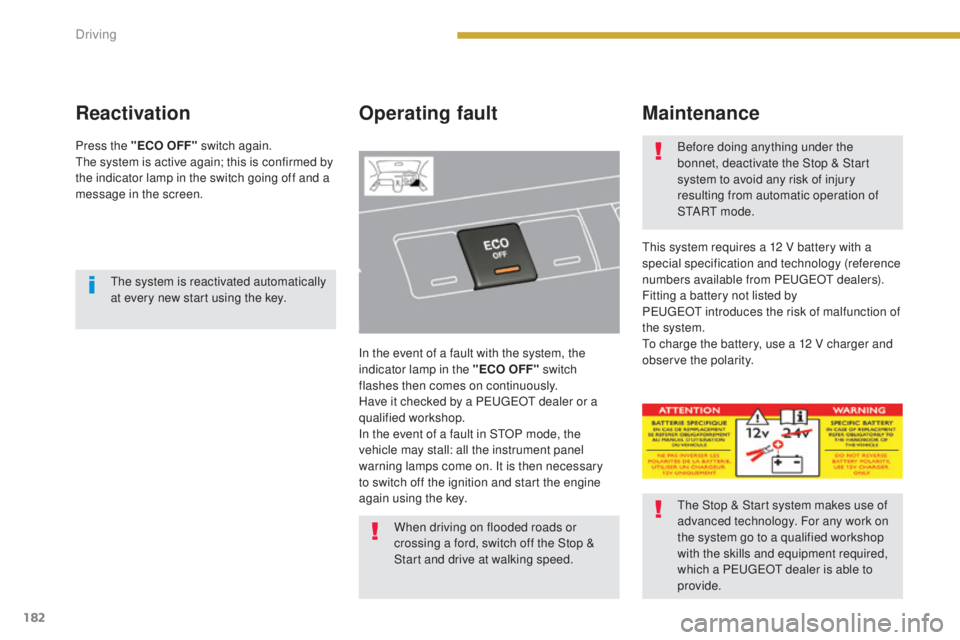
In the event of a fault with the system, the
indicator lamp in the "ECO OFF" switch
flashes then comes on continuously.
Have it checked by a PEUGEOT dealer or a
qualified workshop.
In the event of a fault in STOP mode, the
vehicle may stall: all the instrument panel
warning lamps come on. It is then necessary
to switch off the ignition and start the engine
again using the key.
Maintenance
This system requires a 12 V battery with a
special specification and technology (reference
numbers available from PEUGEOT dealers).
Fitting a battery not listed by
PEUGEOT
introduces the risk of malfunction of
the system.
To charge the battery, use a 12 V charger and
observe the polarity.
Press the "ECO OFF" switch again.
The system is active again; this is confirmed by
the indicator lamp in the switch going off and a
message in the screen.
The system is reactivated automatically
at every new start using the key. Before doing anything under the
bonnet, deactivate the Stop & Start
system to avoid any risk of injury
resulting from automatic operation of
S TA R T m o d e .
The Stop & Start system makes use of
advanced technology. For any work on
the system go to a qualified workshop
with the skills and equipment required,
which a PEUGEOT dealer is able to
provide.
When driving on flooded roads or
crossing a ford, switch off the Stop &
Start and drive at walking speed.
Driving
Page 192 of 364
190
PEUGEOT & TOTAL,
A PARTNERSHIP TO DELIVER
B
ETTER
PERFORMANCE
!
Innovation, the key to success
The TOTAL Research and Development and
PEUGEOT teams work together to develop high
quality lubricants that meet the requirements
of PEUGEOT vehicles. For you, this is the
assurance that the performance of your engine
is optimised while also ensuring its durability.
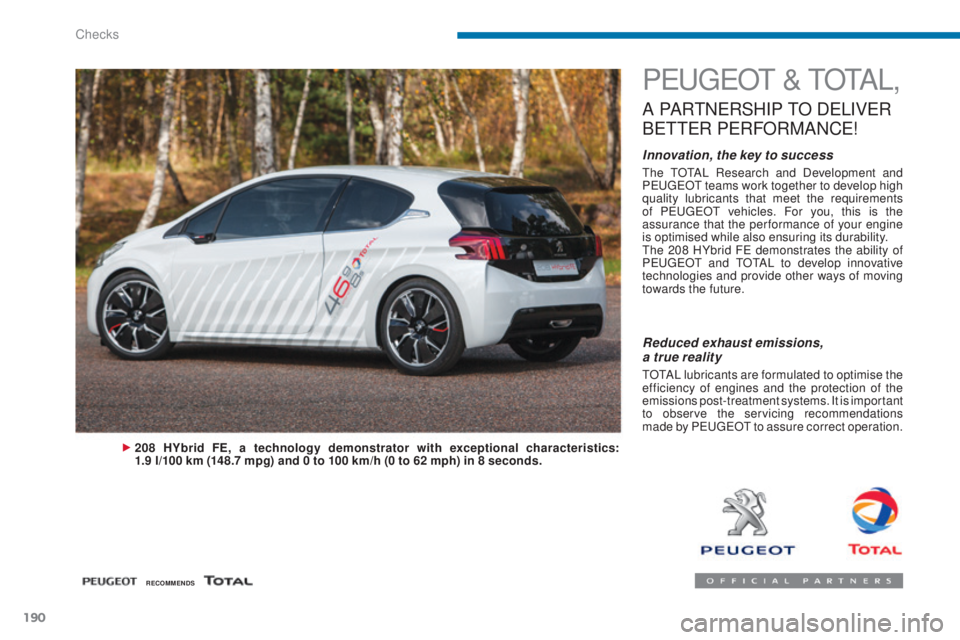
The 208 HYbrid FE demonstrates the ability of
PEUGEOT and TOTAL to develop innovative
technologies and provide other ways of moving
towards the future.
208 HYbrid FE, a technology demonstrator with exceptional characteristics:
1.9 l/100 km (148.7 mpg) and 0 to 100 km/h (0 to 62 mph) in 8 seconds.
Reduced exhaust emissions,
a true reality
TOTAL lubricants are formulated to optimise the
efficiency of engines and the protection of the
emissions post-treatment systems. It is important
to observe the servicing recommendations
made by PEUGEOT to assure correct operation.
RECOMMENDS
Checks
Page 193 of 364
191
Fuel tank
Low fuel levelRefuelling
When the low fuel level is reached,
this warning lamp comes on in the
instrument panel, accompanied by
an audible signal and a message in
the multifunction screen. When the lamp first
comes on, there is approximately 6 litres of
fuel remaining.
Until sufficient fuel has been added, this
warning lamp appears every time the ignition
is switched on, accompanied by an audible
signal and a message. When driving, this
audible signal and message are repeated with
increasing frequency, as the fuel level drops
towards "0" .
Capacity of the tank: approximately 60 litres.
The key cannot be removed from the
lock until the cap is put back on the
tank.
Opening the cap may trigger an inrush
of air. This vacuum, which is completely
normal, is caused by the sealing of the
fuel system.
You must refuel to avoid running out of
fuel.
If you run out of fuel (Diesel), refer also
to the "Checks" section. A label affixed to the inside of the filler flap
reminds you of the type of fuel to be used
according to your engine.
More than 5 litres of fuel must be added in
order to be registered by the fuel gauge.
9
Checks
Page 194 of 364
192
With Stop & Start, never refuel with the
system in STOP mode; you must switch
off the ignition with the key.
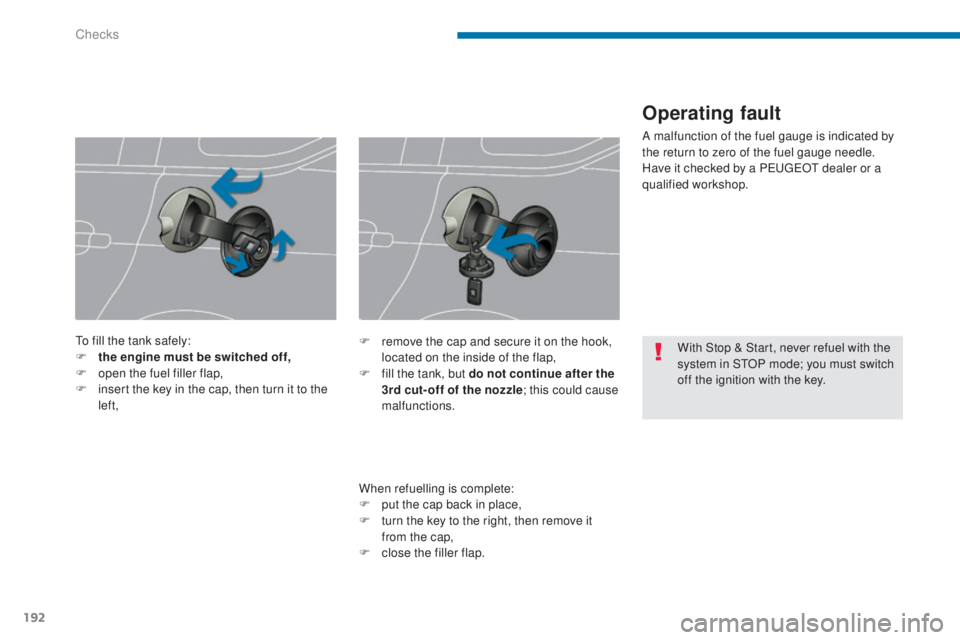
To fill the tank safely:
F
t
he engine must be switched off,
F
o
pen the fuel filler flap,
F
i
nsert the key in the cap, then turn it to the
left,
When refuelling is complete:
F
p
ut the cap back in place,
F
t
urn the key to the right, then remove it
from the cap,
F
c
lose the filler flap.
F
r
emove the cap and secure it on the hook,
located on the inside of the flap,
F
f
ill the tank, but do not continue after the
3rd cut- off of the nozzle ; this could cause
malfunctions.
Operating fault
A malfunction of the fuel gauge is indicated by
the return to zero of the fuel gauge needle.
Have it checked by a PEUGEOT
dealer or a
qualified workshop.
Checks