engine PEUGEOT 5008 2015 Owners Manual
[x] Cancel search | Manufacturer: PEUGEOT, Model Year: 2015, Model line: 5008, Model: PEUGEOT 5008 2015Pages: 364, PDF Size: 12.82 MB
Page 248 of 364
246
Charging the battery using
a battery charger
F Disconnect the battery from the vehicle.
F F ollow the instructions for use provided by
the manufacturer of the charger.
F
C
onnect the battery starting with the
negative terminal (-).
F
C
heck that the terminals and connectors
are clean. If they are covered with sulphate
(whitish or greenish deposit), remove them
and clean them.
The batteries contain harmful substances
such as sulphuric acid and lead. They
must be disposed of in accordance
with regulations and must not, in any
circumstances, be discarded with
household waste.
Take used remote control batteries and
vehicle batteries to a special collection point.
It is advisable to disconnect the battery
if the vehicle is to be left unused for
more than one month.
Before disconnecting the battery
Wait 2 minutes after switching off the ignition
before disconnecting the battery.
Close the windows and the doors before
disconnecting the battery.
Following reconnection of the
battery
Following reconnection of the battery, switch on
the ignition and wait 1 minute before starting to
permit initialisation of the electronic systems.
However, if problems remain following this
operation, contact a PEUGEOT dealer or a
qualified workshop.
Referring to the corresponding section, you
must yourself reinitialise (depending on
version):
-
t
he remote control key,
-
t
he electric blind(s),
-
...
Protect your eyes and face before
handling the battery.
All operations on the battery must be
carried out in a well ventilated area and
away from naked flames and sources
of sparks, so as to avoid the risk of
explosion or fire.
Do not try to charge a frozen battery;
the battery must first be thawed out to
avoid the risk of explosion. If the battery
has been frozen, before charging have
it checked by a PEUGEOT dealer or a
qualified workshop who will check that
the internal components have not been
damaged and the casing is not cracked,
which could cause a leak of toxic and
corrosive acid.
Do not reverse the polarity and use only
a 12 V charger.
Do not disconnect the terminals while
the engine is running.
Do not charge the batteries without
disconnecting the terminals first.
Wash your hands afterwards.
Do not push the vehicle to start the
engine if you have an electronic or
automatic gearbox.
Some functions are not available if the
battery is not sufficiently charged.
Practical information
Page 249 of 364
247
Exiting economy mode
These functions are reactivated automatically
next time the vehicle is driven.
To restore the use of these functions
immediately, start the engine and let it run for at
least 5 minutes.
Load reduction modeEnergy economy mode
Switching to economy mode
Once this time has elapsed, a message
appears in the screen indicating that the
vehicle has switched to economy mode and the
active functions are put on standby.
System which manages the use of certain
functions according to the level of charge
remaining in the battery.
When the vehicle is being driven, the load
reduction function temporarily deactivates
certain functions, such as the air conditioning,
the heated rear screen...
The deactivated functions are reactivated
automatically as soon as conditions permit.
System which manages the duration of use of certain functions to conserve a sufficient level of
charge in the battery.
After the engine has stopped, you can still use functions such as the audio and telematics
system,
windscreen wipers, dipped beam headlamps, courtesy lamps, etc. for a maximum
combined duration of thirty minutes.
This period may be greatly reduced if the battery is not fully charged.
If the telephone is being used at this
time, the call will be maintained for
5 minutes with the hands-free kit of your
P
E
UGEOT
C
onnect Sound (RD5) or
P
E
UGEOT
C
onnect Navigation (RNEG). Let the engine run for the duration
specified to ensure that the battery
charge is sufficient.
Do not repeatedly and continuously
restart the engine in order to charge the
battery.
A flat battery prevents the engine
from starting (refer to the "Battery"
paragraph).
10
Practical information
Page 251 of 364
249
Towing your vehicle
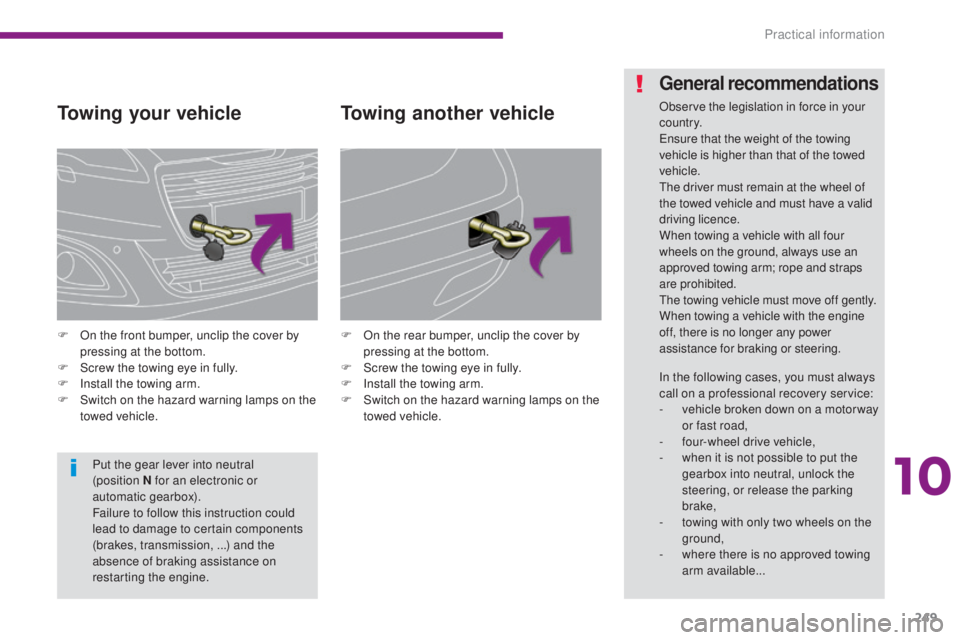
F On the front bumper, unclip the cover by pressing at the bottom.
F
S
crew the towing eye in fully.
F
I
nstall the towing arm.
F
S
witch on the hazard warning lamps on the
towed vehicle. F
O n the rear bumper, unclip the cover by
pressing at the bottom.
F
S
crew the towing eye in fully.
F
I
nstall the towing arm.
F
S
witch on the hazard warning lamps on the
towed vehicle.
Towing another vehicle
Put the gear lever into neutral
(position N for an electronic or
automatic gearbox).
Failure to follow this instruction could
lead to damage to certain components
(brakes, transmission,
...) and the
absence of braking assistance on
restarting the engine.
General recommendations
Observe the legislation in force in your
c o unt r y.
Ensure that the weight of the towing
vehicle is higher than that of the towed
vehicle.
The driver must remain at the wheel of
the towed vehicle and must have a valid
driving licence.
When towing a vehicle with all four
wheels on the ground, always use an
approved towing arm; rope and straps
are prohibited.
The towing vehicle must move off gently.
When towing a vehicle with the engine
off, there is no longer any power
assistance for braking or steering.
In the following cases, you must always
call on a professional recovery service:
-
v
ehicle broken down on a motor way
or fast road,
-
f
our-wheel drive vehicle,
-
w
hen it is not possible to put the
gearbox into neutral, unlock the
steering, or release the parking
brake,
-
t
owing with only two wheels on the
ground,
-
w
here there is no approved towing
arm available...
10
Practical information
Page 254 of 364
252
Towing a trailer
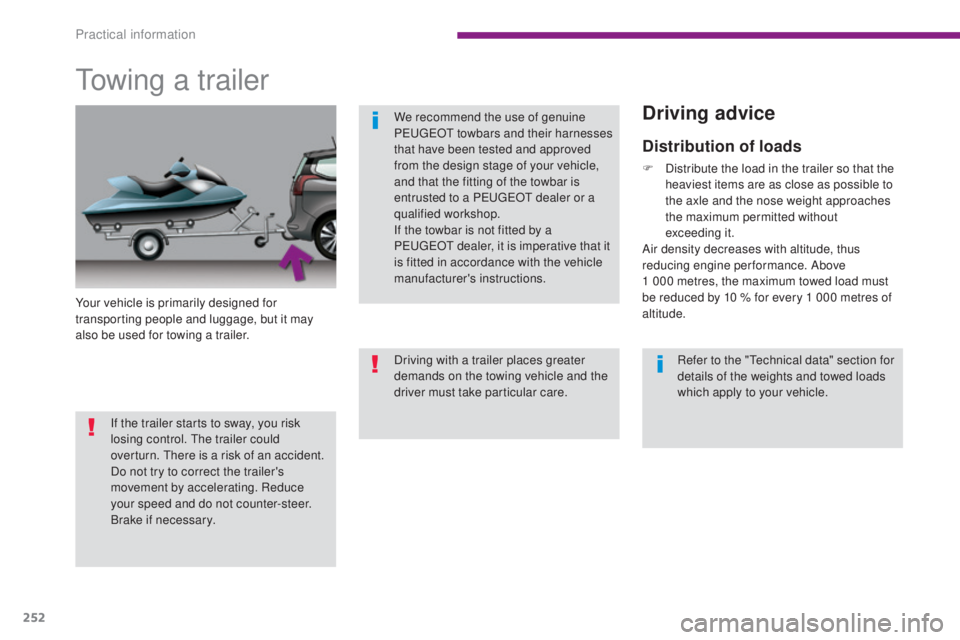
Your vehicle is primarily designed for
transporting people and luggage, but it may
also be used for towing a trailer.Refer to the "Technical data" section for
details of the weights and towed loads
which apply to your vehicle.
We recommend the use of genuine
PEUGEOT towbars and their harnesses
that have been tested and approved
from the design stage of your vehicle,
and that the fitting of the towbar is
entrusted to a PEUGEOT dealer or a
qualified workshop.
If the towbar is not fitted by a
PEUGEOT dealer, it is imperative that it
is fitted in accordance with the vehicle
manufacturer's instructions.
Driving with a trailer places greater
demands on the towing vehicle and the
driver must take particular care.
If the trailer starts to sway, you risk
losing control. The trailer could
overturn. There is a risk of an accident.
Do not try to correct the trailer's
movement by accelerating. Reduce
your speed and do not counter-steer.
Brake if necessary.
Driving advice
Distribution of loads
F Distribute the load in the trailer so that the heaviest items are as close as possible to
the axle and the nose weight approaches
the maximum permitted without
exceeding
it.
Air density decreases with altitude, thus
reducing engine performance. Above
1
000 metres, the maximum towed load must
be reduced by 10
% for every 1 000 metres of
altitude.
Practical information
Page 255 of 364
253
Side wind
F Take into account the increased sensitivity to side wind.
Cooling
Towing a trailer on a slope increases the
temperature of the coolant.
As the fan is electrically controlled, its cooling
capacity is not dependent on the engine speed.
F
T
o lower the engine speed, reduce your
speed.
The maximum towed load on a long incline
depends on the gradient and the ambient
temperature.
In all cases, keep a check on the coolant
temperature.
Braking
Towing a trailer increases the braking distance.
To avoid overheating of the brakes on a long
mountain type of descent, the use of engine
braking is recommended.
Ty r e s
F Check the tyre pressures of the towing vehicle and of the trailer, observing the
recommended pressures.
Lighting
F Check the electrical lighting and signalling on the trailer.
The rear parking sensors will be
deactivated automatically if a genuine
PEUGEOT towbar is used.
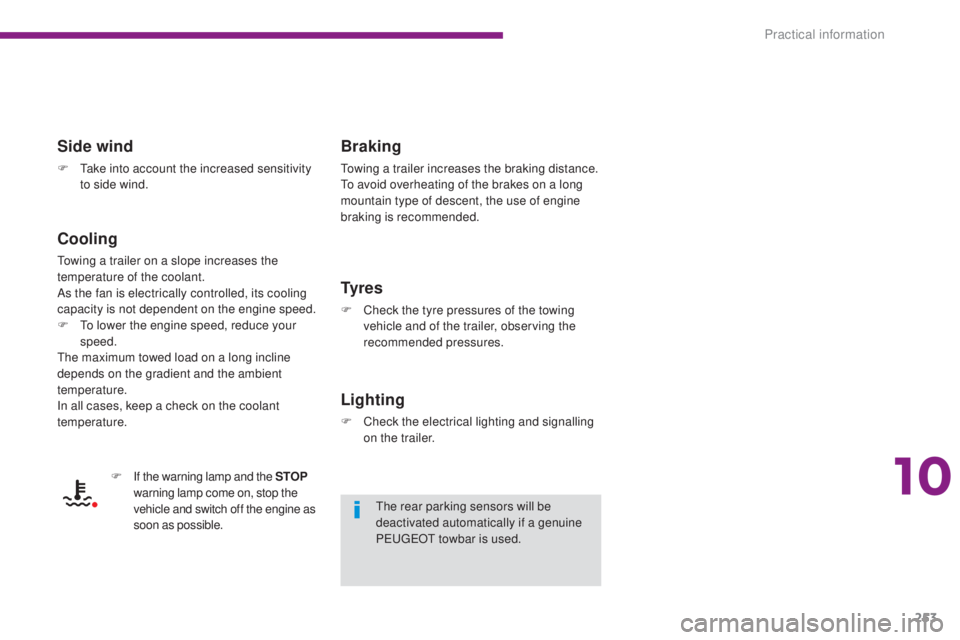
F
I
f the warning lamp and the
STOP
warning lamp come on, stop the
vehicle and switch off the engine as
soon as possible.
10
Practical information
Page 257 of 364
255
Removal
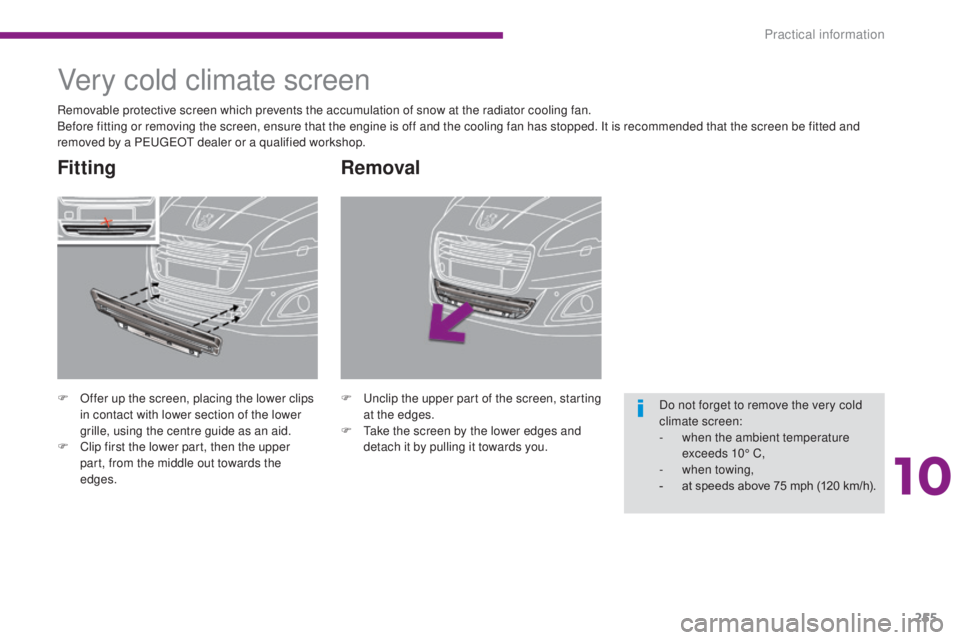
F Unclip the upper part of the screen, starting at the edges.
F
T
ake the screen by the lower edges and
detach it by pulling it towards you.
Very cold climate screen
F Offer up the screen, placing the lower clips in contact with lower section of the lower
grille, using the centre guide as an aid.
F
C
lip first the lower part, then the upper
part, from the middle out towards the
edges.
Fitting
Removable protective screen which prevents the accumulation of snow at the radiator cooling fan.
Before fitting or removing the screen, ensure that the engine is off and the cooling fan has stopped. It is recommended that the screen be fitted and
removed by a PEUGEOT dealer or a qualified workshop.
Do not forget to remove the very cold
climate screen:
-
w
hen the ambient temperature
exceeds 10° C,
-
w
hen towing,
-
a
t speeds above 75 mph (120 km/h).
10
Practical information
Page 260 of 364
258
Engine1.2 litre PureTech 130 S&S 1.6 litre THP 163 1.6 litre THP 165 S&S
Gearbox Manual
(6-speed) Automatic
(6-speed) Automatic
(6-speed)
Model code HNYM/S
HNYM/1S 5FMA /1
5FM A /1D 5G Z T/S
5G Z T/1S
Cubic capacity (cc) 1 1991 598 1 598
Bore x stroke (mm) 70 x 90.577 x 85.8 77 x 85.8
Max power: EU standard (kW)* 96120 121
Max power engine speed (rpm) 5 5006 000 6 000
Max torque: EU standard (Nm) 230240240
Max torque engine speed (rpm) 1 7501 400 1 400
Fuel Unleaded petrolUnleaded petrolUnleaded petrol
Catalytic converter yesyesyes
Engine oil capacity (in litres)
(with filter replacement) 3.5
4.25 4.25
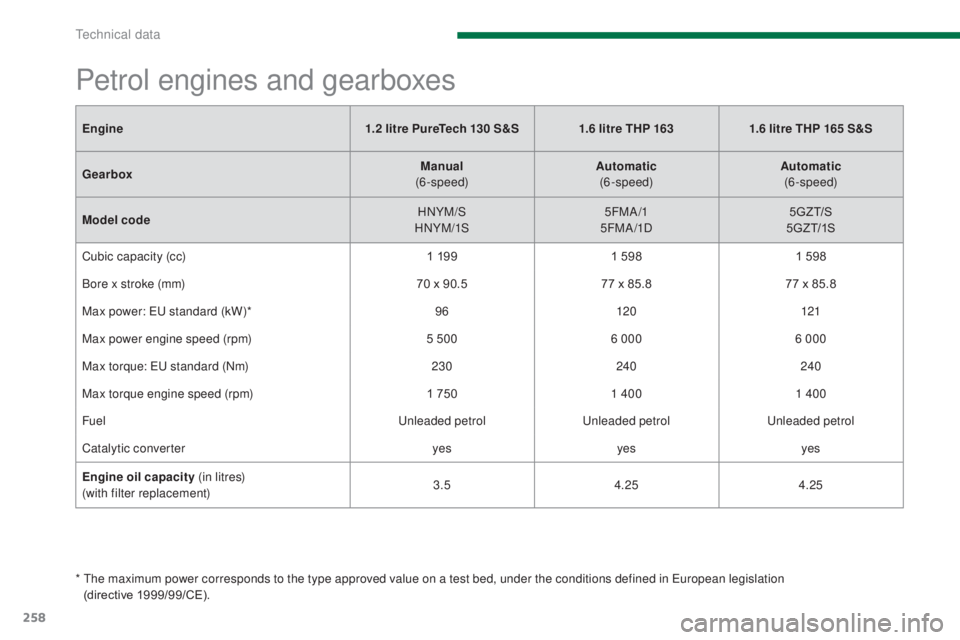
Petrol engines and gearboxes
* The maximum power corresponds to the type approved value on a test bed, under the conditions defined in European legislation
(directive 1999/99/CE).
Technical data
Page 261 of 364
259
* The kerb weight is equal to the unladen weight + driver (75 kg).
** T he weight of the braked trailer can be increased, within the GTW limit, if the GV W of the towing vehicle is reduced by an equal amount; warning,
towing using a lightly loaded towing vehicle may have an adverse effect on its road holding.
Engine
1.2 litre PureTech 130 S&S1.6 litre THP 163
1.6 litre THP 165 S&S
Gearbox Manual
(6-speed) Automatic
(6-speed) E AT 6
automatic (6-speed)
Seats 57575757
Model code
(
5 -seat: 0A, 7-seat: 0E) HNYM/S HNYM/SHNYM/1S
HNYM/2S HNYM/1S
HNYM/2S 5FMA /1 5FMA /1 5G Z T/S
5G Z T/1S 5G Z T/S
5G Z T/1S
-
U
nladen weight 1 430 1 4301 420 1 420 1 5101 540 1 500 1 500
-
K
erb weight* 1 505 1 5051 495 1 4951 5851 6151 575 1 575
-
Payload 610770 620 780565 710560 725
-
G
ross vehicle weight
(GV W) 2 040 2 200 2 040 2 200
2 0752 250 2 060 2 225
-
G
ross train weight (GTW)
o
n a 12% gradient 3 140
3 300 3 1403 300 2 8753 050 3 5103 525
-
B
raked trailer (within GTW limit)
o
n a 10% or 12% gradient 1 10 0 1 10 0 1 10 0 1 10 0
800 8001 450 1 300
-
B
raked trailer** (with load transfer within
the GTW limit) 1 400 1 400 1 400 1 400 -
- 1 650 1 600
-
U
nbraked trailer 750 75074 5 74 5750 750 750 750
-
R
ecommended nose weight 70 70 70 70 70 70 70 70
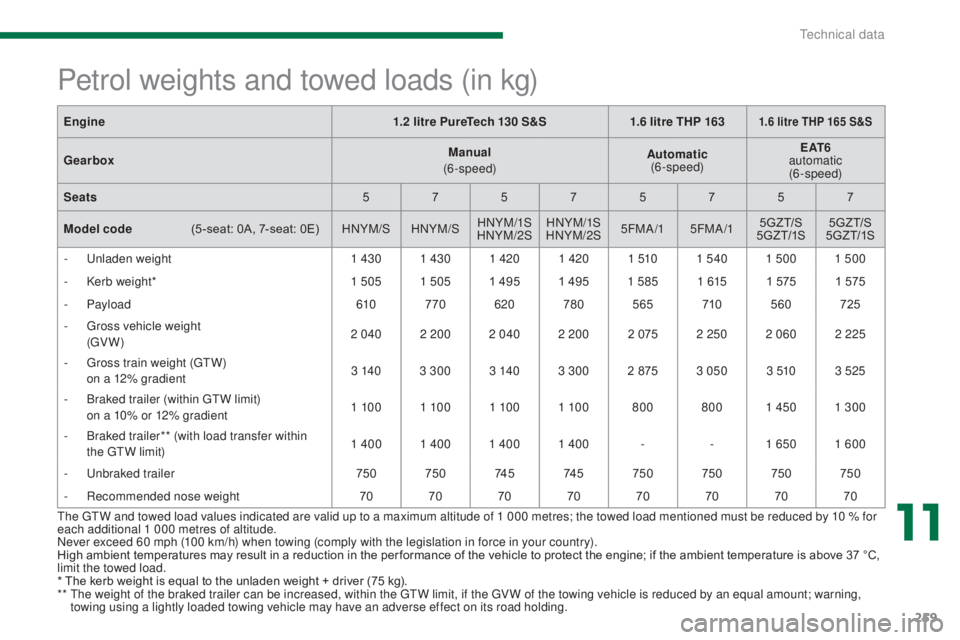
The GTW and towed load values indicated are valid up to a maximum altitude of 1 000 metres; the towed load mentioned must be reduced by 10 % for
each additional 1 000 metres of altitude.
Never exceed 60 mph (100 km/h) when towing (comply with the legislation in force in your country).
High ambient temperatures may result in a reduction in the per formance of the vehicle to protect the engine; if the ambient temperature is above 37 °C,
limit the towed load.
Petrol weights and towed loads (in kg)
11
Technical data
Page 262 of 364
260
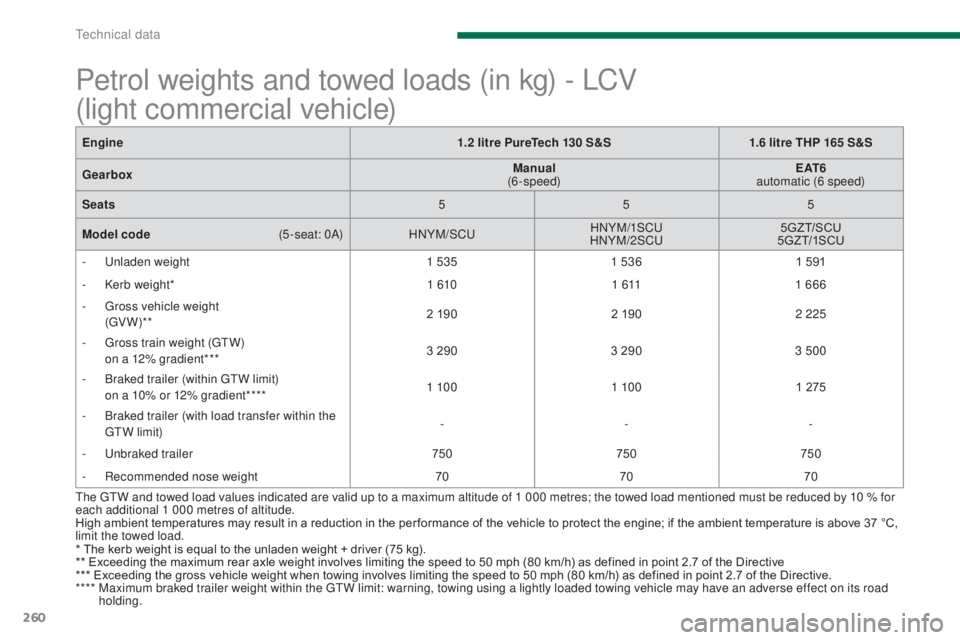
Petrol weights and towed loads (in kg) - LCV
(light commercial vehicle)
* The kerb weight is equal to the unladen weight + driver (75 kg).
** Exceeding the maximum rear axle weight involves limiting the speed to 50 mph (80 km/h) as defined in point 2.7 of the Directive
*** Exceeding the gross vehicle weight when towing involves limiting the speed to 50 mph (80 km/h) as defined in point 2.7 of the Directive.
****
M
aximum braked trailer weight within the GTW limit: warning, towing using a lightly loaded towing vehicle may have an adverse effect on its road
holding.
The GTW and towed load values indicated are valid up to a maximum altitude of 1 000 metres; the towed load mentioned must be reduced by 10 % for
each additional 1 000 metres of altitude.
High ambient temperatures may result in a reduction in the per formance of the vehicle to protect the engine; if the ambient temperature is above 37 °C,
limit the towed load. Engine
1.2 litre PureTech 130 S&S1.6 litre THP 165 S&S
Gearbox Manual
(6-speed) E AT 6
automatic (6 speed)
Seats 555
Model code
(
5-seat: 0A)
HNYM/SCU HNYM/1SCU
HNYM/2SCU 5GZT/SCU
5G Z T/1SCU
-
U
nladen weight
1 5351 536 1 591
-
K
erb weight*
1 6101 6 111 666
-
G
ross vehicle weight
(GV W)* * 2 190
2 1902 225
-
G
ross train weight (GTW)
o
n a 12% gradient***
3 290
3 2903 500
-
B
raked trailer (within GTW limit)
o
n a 10% or 12% gradient****
1 10 0
1 10 0 1 275
-
B
raked trailer (with load transfer within the
GTW limit) -
--
-
U
nbraked trailer
750750750
-
R
ecommended nose weight
707070
Technical data
Page 263 of 364
261
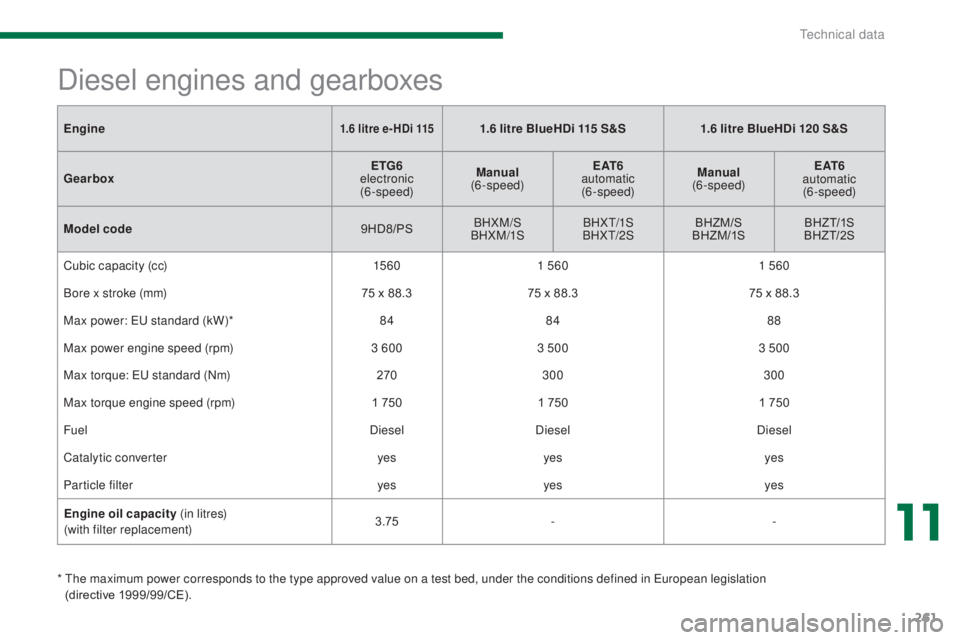
Engine1.6 litre e- HDi 1151.6 litre BlueHDi 115 S & S 1.6 litre BlueHDi 120 S&S
Gearbox ETG6
electronic (6-speed) Manual
(6-speed) E AT 6
automatic (6-speed) Manual
(6-speed) E AT 6
automatic (6-speed)
Model code 9HD8/PSBHXM/S
BHXM/1S BH X T/1S
BH X T/2S BHZM/S
BHZM /1S BHZ T/1S
BHZ T/2S
Cubic capacity (cc) 15 6 01 560 1 560
Bore x stroke (mm) 75 x 88.375 x 88.3 75 x 88.3
Max power: EU standard (kW)* 8484 88
Max power engine speed (rpm) 3 6003 500 3 500
Max torque: EU standard (Nm) 270300 300
Max torque engine speed (rpm) 1 7501 750 1 750
Fuel DieselDiesel Diesel
Catalytic converter yesyes yes
Particle filter yesyes yes
Engine oil capacity (in litres)
(with filter replacement) 3.75
- -
Diesel engines and gearboxes
* The maximum power corresponds to the type approved value on a test bed, under the conditions defined in European legislation
(directive 1999/99/CE).
11
Technical data