ECU PEUGEOT 5008 2015 User Guide
[x] Cancel search | Manufacturer: PEUGEOT, Model Year: 2015, Model line: 5008, Model: PEUGEOT 5008 2015Pages: 364, PDF Size: 12.82 MB
Page 129 of 364
127
"ISOFIX" mountings
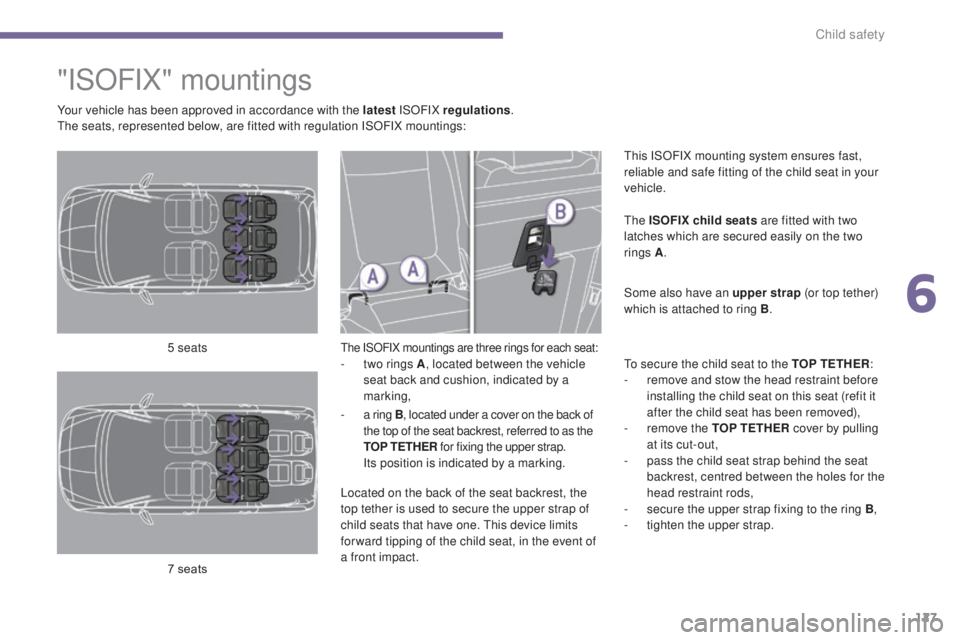
The ISOFIX mountings are three rings for each seat:- two rings A, located between the vehicle
seat back and cushion, indicated by a
marking, This ISOFIX mounting system ensures fast,
reliable and safe fitting of the child seat in your
vehicle.
The ISOFIX child seats are fitted with two
latches which are secured easily on the two
rings A
.
Some also have an upper strap (or top tether)
which is attached to ring B .
To secure the child seat to the TOP TETHER :
- r emove and stow the head restraint before
installing the child seat on this seat (refit it
after the child seat has been removed),
-
r
emove the TOP TETHER cover by pulling
at its cut-out,
-
p
ass the child seat strap behind the seat
backrest, centred between the holes for the
head restraint rods,
-
s
ecure the upper strap fixing to the ring B,
-
t
ighten the upper strap.
5 seats
7 seats
Your vehicle has been approved in accordance with the latest ISOFIX
regulations.
The seats, represented below, are fitted with regulation ISOFIX mountings:
-
a r
ing B, located under a cover on the back of
the top of the seat backrest, referred to as the
TOP TETHER for fixing the upper strap.
I
ts position is indicated by a marking.
Located on the back of the seat backrest, the
top tether is used to secure the upper strap of
child seats that have one. This device limits
for ward tipping of the child seat, in the event of
a front impact.
6
Child safety
Page 132 of 364
130
Remove and stow the head restraint
before installing a child seat on a
passenger seat. Refit the head restraint
once the child seat has been removed.
*
P
recautions are required when fitting a child
seat with a support leg. Refer to the section
on "Installing a child seat with a support leg"
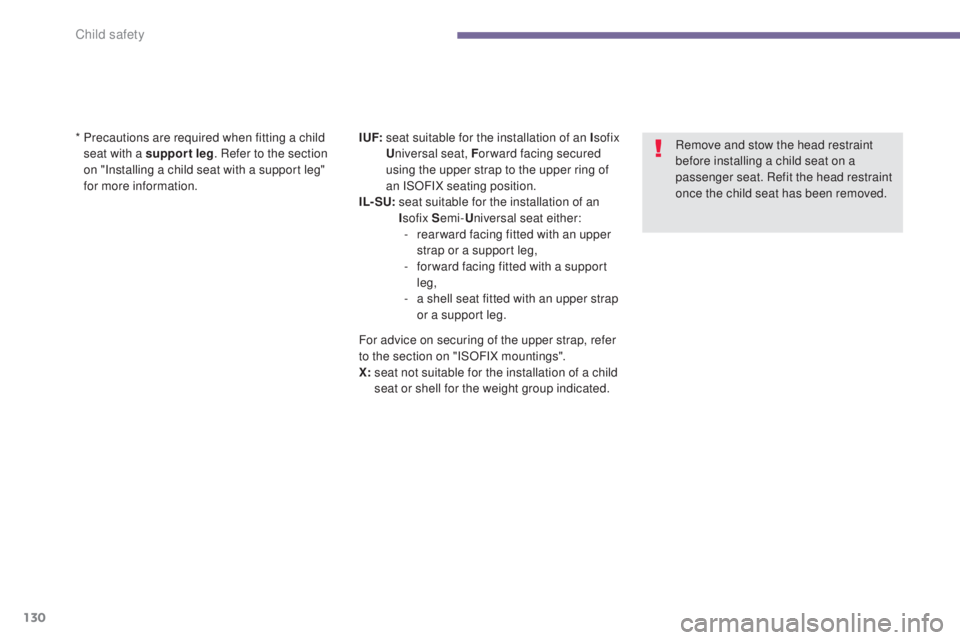
for more information. I UF:
s
eat suitable for the installation of an I
sofix
U niversal seat, F or ward facing secured
using the upper strap to the upper ring of
an ISOFIX seating position.
IL- SU:
s
eat suitable for the installation of an
I sofix S emi-Universal seat either:
-
r
ear ward facing fitted with an upper
strap or a support leg,
-
f
or ward facing fitted with a support
leg,
-
a s
hell seat fitted with an upper strap
or a support leg.
For advice on securing of the upper strap, refer
to the section on "ISOFIX mountings".
X:
s
eat not suitable for the installation of a child
seat or shell for the weight group indicated.
Child safety
Page 134 of 364
132
* Precautions are required when fitting a child seat with a support leg . Refer to the section
on "Installing a child seat with a support leg"
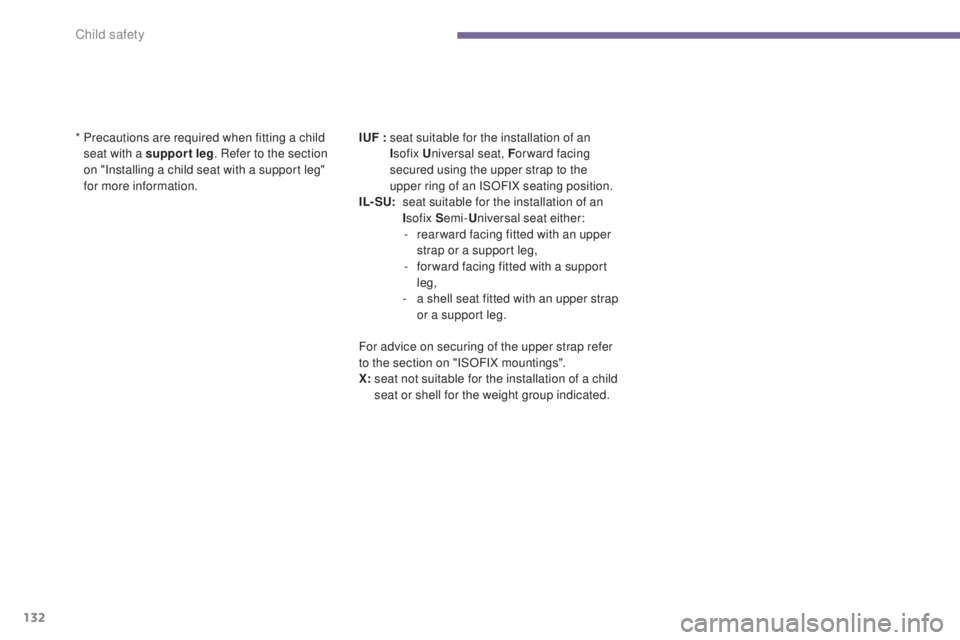
for more information. IUF :
s eat suitable for the installation of an
I sofix U niversal seat, F or ward facing
secured using the upper strap to the
upper ring of an ISOFIX seating position.
IL- SU:
s
eat suitable for the installation of an
I sofix S emi-Universal seat either:
-
r
ear ward facing fitted with an upper
strap or a support leg,
-
f
or ward facing fitted with a support
leg,
-
a s
hell seat fitted with an upper strap
or a support leg.
For advice on securing of the upper strap refer
to the section on "ISOFIX mountings".
X:
s
eat not suitable for the installation of a child
seat or shell for the weight group indicated.
Child safety
Page 135 of 364
133
Recommendations
Child seats
The incorrect installation of a child seat in a
vehicle compromises the child's protection in
the event of an accident.
Check that there is no seat belt or seat belt
buckle under the child seat as this could
destabilise it.
Remember to fasten the seat belts or the
child seat harnesses keeping the slack in
relation to the child's body to a minimum,
even for short journeys.
For the installation of a child seat using a seat
belt, ensure that this is well tensioned on the
child seat and that it is holding the child seat
firmly against the seat of your vehicle. If your
front passenger seat is adjustable, move it
forward if necessary.
At the rear seats, always leave sufficient
space between the front seat and:
-
a r
ear ward facing child seat,
-
t
he feet of a child seated in a for ward
facing child seat.
For this, move the front seat for ward and if
necessary straighten its backrest.
Children at the front
For optimum installation of the "forward facing"
child seat, ensure that the back of the child seat
is as close as possible to the backrest of the
vehicle's seat, or in contact if possible.
The head restraint must be removed before
installing a child seat with a backrest on the
passenger seat.
Ensure that the head restraint is stowed or
attached securely so that it is not thrown around
the vehicle in the event of sharp braking.
Refit the head restraint as soon as the child
seat is removed.
The legislation on carrying a child on the front
passenger seat is specific to each country.
Refer to the legislation in force in the country
in which you are driving.
Deactivate the passenger's front airbag when
a "rear ward facing" child seat is installed on
the front passenger seat. Otherwise, the child
would risk being seriously injured or killed if
the airbag were deployed.
Installing a booster
cushion
The chest part of the seat belt must be
positioned on the child's shoulder without
touching the neck.
Ensure that the lap part of the seat belt
passes correctly over the child's thighs.
PEUGEOT recommends the use of a booster
seat which has a back, fitted with a seat belt
guide at shoulder level.
As a safety precaution, do not leave:
-
o
ne or more children alone and
unsupervised in a vehicle,
-
a c
hild or an animal in a vehicle which
is exposed to the sun, with the windows
closed,
-
t
he keys within reach of children inside
the vehicle.
To prevent accidental opening of the doors,
use the "Child lock".
Take care not to open the rear windows by
more than one third.
To protect young children from the rays of the
sun, fit side blinds on the rear windows.
6
Child safety
Page 144 of 364
142
Advice
In order to be effective, a seat belt must:
- b e tightened as close to the body as
possible,
-
b
e pulled in front of you with a smooth
movement, checking that it does not
twist,
-
b
e used to restrain only one person,
-
n
ot bear any trace of cuts or fraying,
-
n
ot be converted or modified to avoid
affecting its performance.
The driver must ensure that passengers use
the seat belts correctly and that they are all
fastened before setting off.
Wherever you are seated in the vehicle,
always fasten your seat belt, even for short
journeys.
Do not interchange the seat belt buckles as
they will not fulfil their role fully.
The seat belts are fitted with an inertia reel
permitting automatic adjustment of the length
of the strap to your size. The seat belt is
stowed automatically when not in use.
Before and after use, ensure that the seat belt
is reeled in correctly.
The lower part of the strap must be positioned
as low as possible on the pelvis.
The upper part must be positioned in the
hollow of the shoulder.
The inertia reels are fitted with an automatic
locking device which comes into operation in
the event of a collision, emergency braking
or if the vehicle rolls over. You can release
the device by pulling the strap firmly and then
releasing it so that it reels in slightly.
In the event of an impact
Depending on the nature and seriousness
of the impact
, the pretensioning device may
be deployed before and independently of the
airbags. Deployment of the pretensioners
is accompanied by a slight discharge of
harmless smoke and a noise, due to the
activation of the pyrotechnic cartridge
incorporated in the system.
In all cases, the airbag warning lamp comes
on.
Following an impact, have the seat belts
system checked, and if necessary replaced,
by a PEUGEOT dealer or a qualified
workshop.
Recommendations for children
Use a suitable child seat if the passenger is
less than 12 years old or shorter than one and
a half metres.
Never use the same seat belt to secure more
than one person.
Never allow a child to travel on your lap.
For more information on child seats, refer to
the corresponding section.
In accordance with current safety regulations,
for all repairs on your vehicle's seat belts, go
to a qualified workshop with the skills and
equipment needed, which a PEUGEOT dealer
is able to provide.
Have your seat belts checked regularly by a
PEUGEOT dealer or a qualified workshop,
particularly if the straps show signs of
damage.
Clean the seat belt straps with soapy water or
a textile cleaning product, sold by PEUGEOT
dealers.
After folding or moving a seat or rear bench
seat, ensure that the seat belt is positioned
and reeled in correctly.
Safety
Page 148 of 364
146
Guidelines to follow:
Sit in a normal upright position.
Wear a correctly adjusted seat belt.
Do not allow anything to come between
the occupants and the airbags (a child, pet,
object...), do not attach or fix anything near to
the airbags or their trajectories when inflating
as this could cause injuries when the airbags
are deployed.
Never modify the original definition of your
vehicle, particularly in the area directly
around the airbags.
After an accident or if the vehicle has been
stolen or broken into, have the airbag systems
checked.
All work on the airbag system must be carried
out by a PEUGEOT dealer or a qualified
workshop.
Even if all of the precautions mentioned
are observed, a risk of injury or of minor
burns to the head, chest or arms when an
airbag is deployed cannot be ruled out. The
bag inflates almost instantly (within a few
milliseconds) then deflates within the same
time discharging the hot gas via openings
provided for this purpose.
Lateral airbags
Use only approved covers on the seats,
compatible with the deployment the lateral
airbags. For information on the range of seat
covers suitable for your vehicle, you can
contact a PEUGEOT dealer.
Refer to the "Accessories" section.
Do not fix or attach anything to the seat backs
(clothing...). This could cause injury to the
chest or arms if the lateral airbag is deployed.
Do not sit with the upper part of the body any
nearer to the door than necessary.
Front airbags
Do not drive holding the steering wheel by its
spokes or resting your hands on the centre
part of the wheel.
Passengers must not place their feet on the
dashboard.
Do not smoke as deployment of the airbags
can cause burns or the risk of injury from a
cigarette or pipe.
Never remove or pierce the steering wheel or
hit it violently.
Do not fit or attach anything to the steering
wheel or dashboard, this could cause injuries
with deployment of the airbags.
Curtain airbags
Do not fix or attach anything to the roof. This
could cause injury to the head if the curtain
airbag is deployed.
If fitted on your vehicle, do not remove the
grab handles installed on the roof, they play a
part in securing the curtain airbags.
Safety
Page 194 of 364
192
With Stop & Start, never refuel with the
system in STOP mode; you must switch
off the ignition with the key.
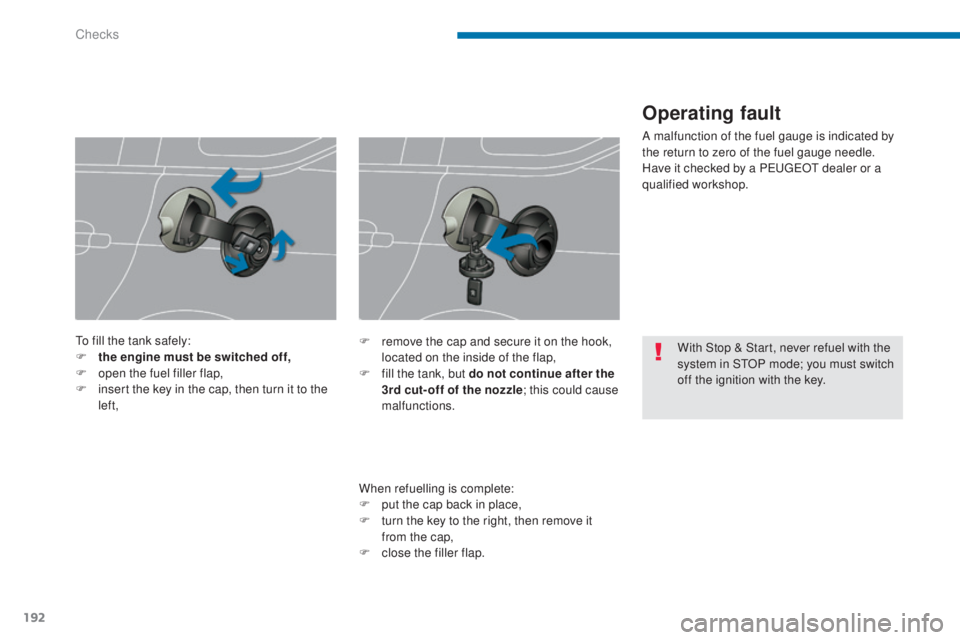
To fill the tank safely:
F
t
he engine must be switched off,
F
o
pen the fuel filler flap,
F
i
nsert the key in the cap, then turn it to the
left,
When refuelling is complete:
F
p
ut the cap back in place,
F
t
urn the key to the right, then remove it
from the cap,
F
c
lose the filler flap.
F
r
emove the cap and secure it on the hook,
located on the inside of the flap,
F
f
ill the tank, but do not continue after the
3rd cut- off of the nozzle ; this could cause
malfunctions.
Operating fault
A malfunction of the fuel gauge is indicated by
the return to zero of the fuel gauge needle.
Have it checked by a PEUGEOT
dealer or a
qualified workshop.
Checks
Page 198 of 364
196
Bonnet
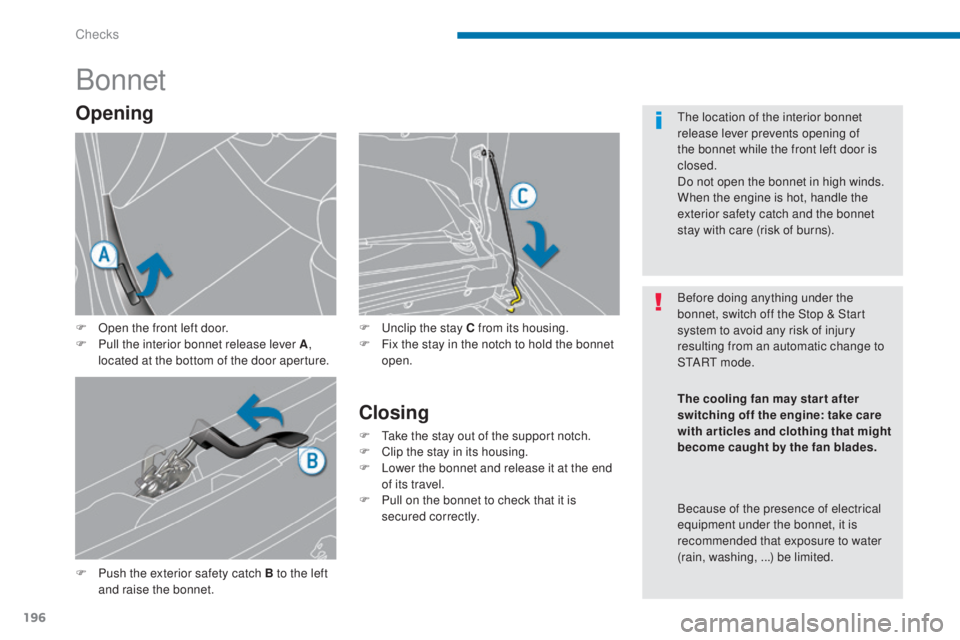
F Push the exterior safety catch B to the left and raise the bonnet. F
U
nclip the stay C from its housing.
F
F
ix the stay in the notch to hold the bonnet
open.
Closing
F Take the stay out of the support notch.
F C lip the stay in its housing.
F
L
ower the bonnet and release it at the end
of its travel.
F
P
ull on the bonnet to check that it is
secured correctly.
Opening
F Open the front left door.
F P ull the interior bonnet release lever A ,
located at the bottom of the door aperture. Before doing anything under the
bonnet, switch off the Stop & Start
system to avoid any risk of injury
resulting from an automatic change to
S TA R T m o d e . The location of the interior bonnet
release lever prevents opening of
the bonnet while the front left door is
closed.
Do not open the bonnet in high winds.
When the engine is hot, handle the
exterior safety catch and the bonnet
stay with care (risk of burns).
The cooling fan may star t after
switching off the engine: take care
with articles and clothing that might
become caught by the fan blades.
Because of the presence of electrical
equipment under the bonnet, it is
recommended that exposure to water
(rain, washing, ...) be limited.
Checks
Page 214 of 364
212
Tool kit
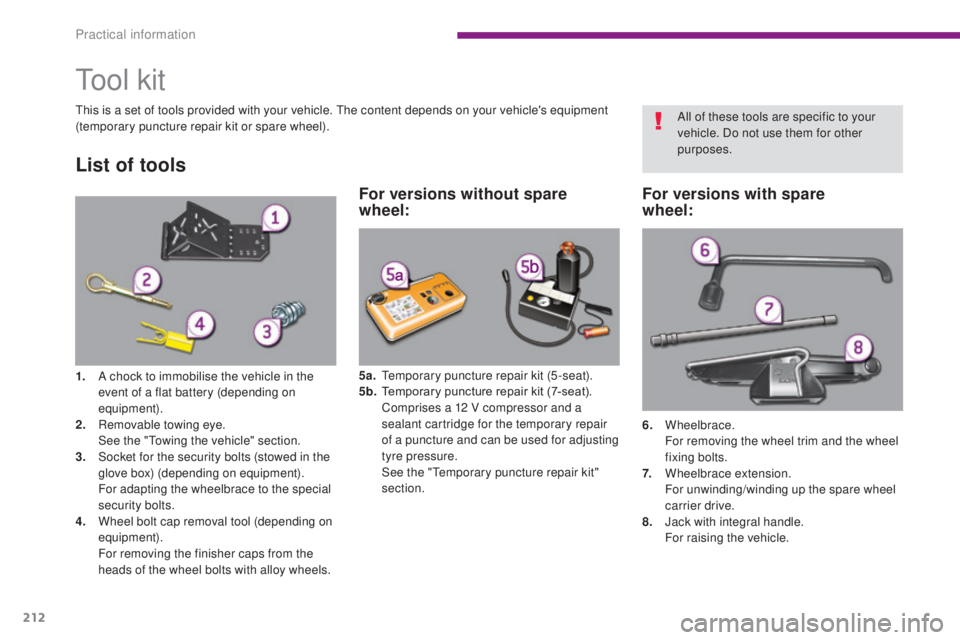
This is a set of tools provided with your vehicle. The content depends on your vehicle's equipment
(temporary puncture repair kit or spare wheel).
List of tools
5a. Temporary puncture repair kit (5-seat).
5b. T emporary puncture repair kit (7-seat).
C
omprises a 12 V compressor and a
sealant cartridge for the temporary repair
of a puncture and can be used for adjusting
tyre pressure.
S
ee the "Temporary puncture repair kit"
section. 6.
Wheelbrace.
F
or removing the wheel trim and the wheel
fixing bolts.
7.
W
heelbrace extension.
F
or unwinding/winding up the spare wheel
carrier drive.
8.
J
ack with integral handle.
F
or raising the vehicle.
1. A c
hock to immobilise the vehicle in the
event of a flat battery (depending on
equipment).
2.
R
emovable towing eye.
S
ee the "Towing the vehicle" section.
3.
S
ocket for the security bolts (stowed in the
glove box) (depending on equipment).
F
or adapting the wheelbrace to the special
security bolts.
4.
W
heel bolt cap removal tool (depending on
equipment).
F
or removing the finisher caps from the
heads of the wheel bolts with alloy wheels. All of these tools are specific to your
vehicle. Do not use them for other
purposes.
For versions without spare
wheel:
For versions with spare
wheel:
Practical information
Page 215 of 364
213
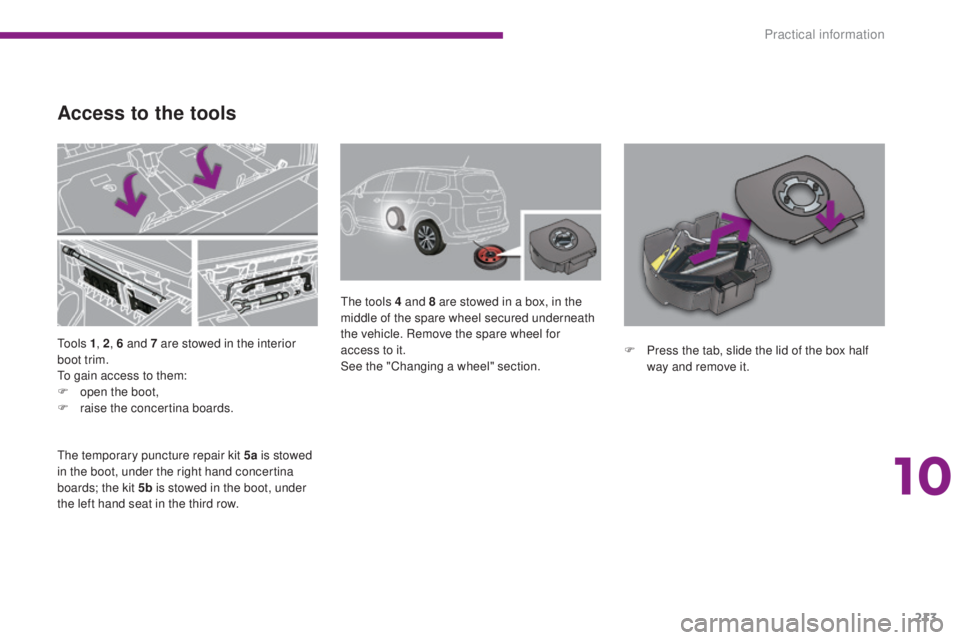
To o l s 1, 2, 6 and 7 are stowed in the interior
boot trim.
To gain access to them:
F
o
pen the boot,
F
r
aise the concertina boards. The tools 4 and 8 are stowed in a box, in the
middle of the spare wheel secured underneath
the vehicle. Remove the spare wheel for
access to it.
See the "Changing a wheel" section.
Access to the tools
The temporary puncture repair kit 5a
is stowed
in the boot, under the right hand concertina
boards; the kit 5b is stowed in the boot, under
the left hand seat in the third row. F
P
ress the tab, slide the lid of the box half
way and remove it.
10
Practical information